New Chairman for Scottish Land & Estates

Scottish Land and Estates (SLE), the grouse moor owners’ lobby group (amongst other things) has announced its new Chairman will be sporting estate owner Mark Tennant.

Mark will begin his new role in April 2020 when the current Chair, Lord David Johnstone, steps down.

We don’t know much about Mark other than what SLE has written in its announcement (here) but let’s be honest, he’s not exactly got big shoes to fill. His predecessor, ‘Dumfriesshire Dave’ has spent the last five years pretending everything’s fine and suggesting there’s really no need to do anything about the illegal killing of raptors on grouse moors because it’s no longer an issue, it’s mostly just the RSPB trying to smear the good name of the industry and/or ‘activists’ trying to ‘set up’ law-abiding estates. (E.g. see here, here, here, here, here). Talk about dial ‘D’ for denial.

It’s hard to think of a single example where Dumfriesshire Dave has inspired any confidence in the industry’s willingness, let alone ability, to clean up its act, so Mark Tennant has a bit of an open goal to get off to a good start, should he choose to take it.

According to the SLE announcement, Mark will be working ‘to help fight climate change’. Excellent. Can we expect all SLE-member grouse moor owners to commit to stopping their routine heather burning regimes, including on deep peat, in the interests of addressing the climate emergency?

What we do know about Mark, from the SLE announcement, is that his ‘family business Innes Estate in Elgin has been a member of SLE for over 40 years‘. That’s really interesting. So SLE didn’t expel the estate when the then head gamekeeper was convicted in 2007 for poisons and firearms offences, then? NOTE: there is no suggestion that those historical offences were part of a wider pattern of continued wildlife crime on the estate – as far as we are aware there are no further reports of alleged offences at this estate – we’re just interested at SLE’s apparent lack of action in response to wildlife crime.

Speaking of which, here’s something Mark could sort out for us. We’re still waiting to hear from SLE whether the Longformacus Estate (the location of a catalogue of horrific and violent wildlife crimes for which a gamekeeper was recently convicted) was, and if so still is, a member of Scottish Land & Estates? We asked SLE this specific question in August, after the Crown Office chose not to pursue a prosecution for alleged vicarious liability and SLE had until then avoided commenting on the estate’s membership status. We had a quick response from the Membership Department who told us, ‘I have forwarded on your email to our Senior Management Team who will respond in due course‘. Needless to say, silence since then.

Over to you, Mark. Was/is Longformacus Estate a member of Scottish Land & Estates?

‘Certificate of appreciation’ for Northern England Raptor Forum (NERF)

The Northern England Raptor Forum (NERF) has received a certificate of appreciation from Police Supt Nick Lyall, Chair of the Raptor Persecution Priority Delivery Group.

In an accompanying letter (read it on the NERF website here), Nick Lyall writes:

Having recently reviewed the 5 year NERF contribution to the RSPB Hen Harrier Life Project I was astounded to see that NERF members had completed nearly 15000 voluntary hours and over 150000 miles on the road to conduct their voluntary work in support of this important project.

The modest estimation would suggest that the value in kind of this contribution would be in excess of £400,000. This is a staggering commitment of both people personal time and money in order to monitor and protect endangered hen harrier.

I would therefore like you to accept this letter and the attached certificate of appreciation as a small thank you for the time effort and commitment for all of your members and volunteers“.

It’s richly deserved recognition for NERF but it only scratches the surface of its members efforts. These volunteers have been undertaking fieldwork on 23 species of raptors, owls and raven (honorary raptor) since 2006 and they’ve amassed a critically important dataset for use in conservation planning and policy.

The statutory agencies have a duty to monitor species’ population trends but they wouldn’t be able to do so without the contribution of voluntary raptor workers’ data. In Scotland, NERF’s counterpart the Scottish Raptor Study Group has estimated that its ~300 volunteers’ annual contribution is worth £1.8M (i.e. this is what it would cost SNH to replicate the SRSG’s monitoring efforts with paid ecologists).

It’s an extraordinary effort, and yet in return these fieldworkers are harassed and abused, both in the field and online. That’s why recognition such as this certificate of appreciation is so welcome.

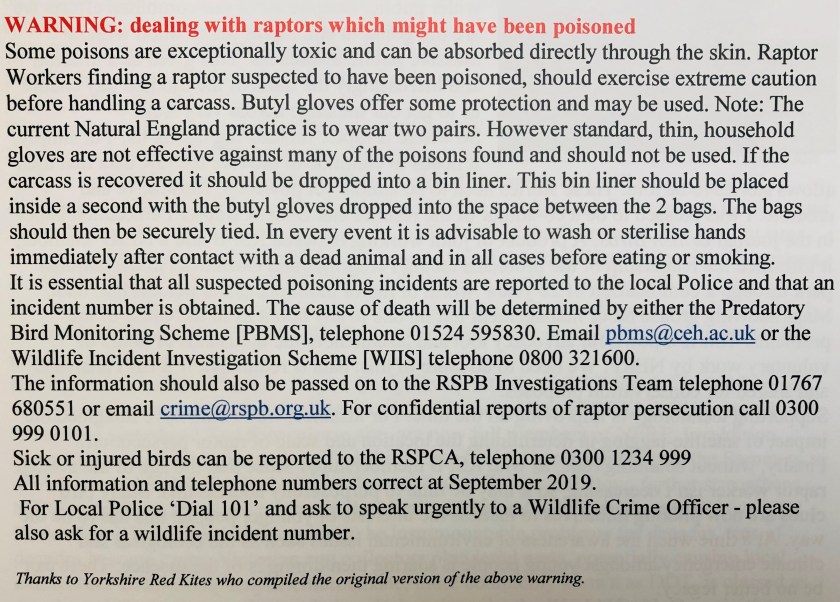
But harassment is probably the least of their worries. If anyone is still unconvinced about how deserving NERF is of this certificate of appreciation, cast your eyes over this:

This is from page 3 of NERF’s latest Annual Review (2018). It’s the first block of text in the report and it’s a warning to NERF members that they risk serious illness (potentially fatal) should they stumble across the corpse of an illegally poisoned bird of prey as part of their monitoring efforts.

It tells you all you need to know about the ongoing persecution of birds of prey in the northern uplands as we head in to the second decade of the 21st Century.

Congratulations to NERF members – you all deserve medals. Without your efforts (and those of your colleagues in Scotland, Wales, Northern Ireland and the Irish Republic) our raptors wouldn’t have so much of a fighting chance.

Gamekeepers caught with banned poisons should receive mandatory jail sentence

Yesterday the Scottish Rural Affairs & Environment Minister, Mairi Gougeon, gave evidence to the cross-party Environment, Climate Change & Land Reform (ECCLR) committee which is currently considering Stage 1 of the Animals and Wildlife (Penalties, Protections and Powers) (Scotland) Bill.

We’ll come back to the wider evidence session in another blog because there were some interesting and important discussions but one point raised deserves an immediate reaction:

Possession of banned poisons.

Here’s the mini transcript:

ECCLR Committee Member Rachael Hamilton MSP: I will go back to the categorisation of wildlife offences and the different tiers of the penalty system. We heard evidence that perhaps possession of illegal pesticides should be categorised as a tier 1 offence, because they are currently illegal anyway. Do you have any comments on that point and do you have any plans to have an amnesty on illegal pesticides prior to the bill being passed? People should not possess illegal pesticides anyway, so using them in connection with animal crimes should attract the highest and severest category of penalty.

Environment Minister Mairi Gougeon: That has been the feeling behind that issue. As you said, possession of such pesticides is already illegal and there are offences in place to deal with that individual issue separately. Using such pesticides as part of another offence would attract the higher penalty. As they are already illegal and there are offences attached to them, using them in relation to any other offences could well attract severe penalties.

In relation to your amnesty point, I would be happy to consider looking at the matter.

Scottish Government Wildlife Management Team leader Leia Fitzgerald: Just to clarify, there was a previous amnesty, which was quite successful and resulted in a lot of pesticides being handed in. We could speak to stakeholders about whether that is something that could be done again. We would hope that we got all of what we needed after the last amnesty, but we can look at the matter.

Environment Minister Mairi Gougeon: I will happily get back to the committee and let you know how we get on with that.

ENDS

Is the Scottish Government seriously considering yet another amnesty for banned poisons, which would be the third amnesty in the 15 years since it became an offence to even possess these deadly toxins, let alone use them? (The Possession of Pesticides (Scotland) Order 2005).

The first amnesty took place in 2011 (see here), six years after the ban was first introduced. The second amnesty came four years later in 2015 (see here).

Since then poisoning crimes have certainly dropped in Scotland, probably thanks to the increase in satellite-tagged raptors, whose tags lead researchers to the poisoned corpses that would otherwise remain undetected, and also due to the introduction of vicarious liability legislation in 2012 which made it possible for landowners to be prosecuted for raptor persecution crimes committed by their gamekeeper employees. However, these poisoning crimes haven’t been totally eradicated and we’re still reading reports about illegally-poisoned birds (and some dogs) that have died after ingesting banned poisons in Scotland including some that were killed this year, and some even inside the Cairngorms National Park (e.g. see here, here, here, here, here, here, here, here, here, here, here, here).

[An illegally-poisoned buzzard found on the boundary of a sporting estate in Perthshire. Contributed photo]

How many more chances is the Scottish Government planning on giving to these criminals? How many more get-out-of-jail-free cards will be dished out?

Why can’t the Scottish Government, 15 years on, implement a zero tolerance policy on this vile and primitive crime that not only risks the lives of wildlife and domestic animals but puts humans at risk as well? In the most recent criminal case, a Scottish gamekeeper was found with two cartons containing the banned poison Carbofuran. He was carrying one of these containers in his bum bag – presumably he wasn’t just taking the container out for company every day – and yet 180 schoolchildren were put at risk when they attended the grouse shooting estate on an officially-sanctioned school trip. Can you believe that? The gamekeeper was convicted for possession (along with a litany of other wildlife offences) and received a community payback order. No fine, no jail sentence, no deterrent whatsoever. Compare and contrast to how illegal poisoners are dealt with in Spain (see here, here and here).

The criminals who persist with such reckless activity in Scotland deserve a mandatory custodial sentence – there can be no more excuses, no more discussion and certainly no more amnesties.

Enough.

Special Constables pilot scheme in Cairngorms National Park a waste of time & money

Two and a half years ago, Environment Cabinet Secretary Roseanna Cunningham announced a pilot scheme whereby Police Special Constables would be deployed in the Cairngorms National Park to tackle wildlife crime.

This initiative was one of a number of measures announced in May 2017 in response to the findings of the golden eagle satellite tag review which showed clear evidence of deliberate and sustained illegal raptor persecution, particularly on some driven grouse moors in and around the Cairngorms National Park (CNP).

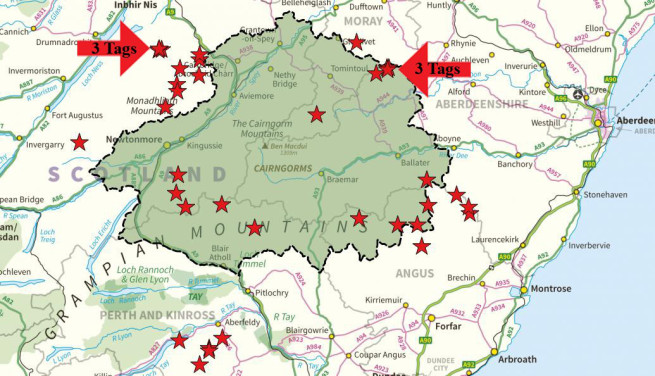
This RPUK map shows the last known location of satellite-tagged golden eagles that were either found illegally killed or had disappeared in suspicious circumstances in and around the CNP (data from the golden eagle satellite tag review):

Golden eagles are not the only victims of wildlife crime in and around the CNP. This RPUK map below, based mostly on RSPB data, shows raptor persecution incidents between 2005-2016. Only one of these (just outside the CNP boundary on Kildrummy Estate) has resulted in a successful prosecution. With such clear evidence of wildlife crime it’s easy to see why the CNP was chosen as the first location for this pilot scheme.

This pilot scheme was the Government’s alternative to extending the powers of the SSPCA to allow it to investigate a wider suite of wildlife crime (including raptor persecution) – a decision made after six years of Governmental deliberation under five different Environment Ministers.

It also emerged in 2018 that this pilot scheme was an alternative to the Government’s 2016 manifesto pledge to establish a Wildlife Crime Investigation Unit as part of Police Scotland – a pledge on which it has now reneged (see here).

The idea was that the police special constable scheme could be rolled out across Scotland “if judged to be successful” in the CNP, but we weren’t told the criteria that would be used to judge this ‘success’.

The scheme was formally launched in March 2018 (see here) and nothing more was heard of it.

Just over a year later in April 2019 we asked the Cairngorms National Park Authority the following questions about the scheme:

Here’s the response:

So basically after a year of operation, one of the main project partners couldn’t tell us anything about the scheme.

Fast forward six months to November 2019 and Scottish Greens MSP Mark Ruskell thought it was time more questions were asked. Here are his two Parliamentary questions and Roseanna Cunningham’s answers:

S5W-26349 Mark Ruskell (Mid Scotland and Fife) (Scottish Green Party): To ask the Scottish Government how much funding (a) it and (b) the Cairngorms National Park Authority allocated each year to the Wildlife Special Constables pilot project.

Roseanna Cunningham: The Scottish Government agreed to contribute £18,000 and the Cairngorms National Park Authority agreed to provide £10,000 for the Wildlife Special Constables pilot project.

S5W-26346 Mark Ruskell (Mid Scotland and Fife) (Scottish Green Party): To ask the Scottish Government what the outcome was of the Wildlife Special Constables pilot project; how many constables participated each month in this, and how many suspected crimes they reported, also broken down by how many led to subsequent (a) arrests, (b) charges, (c) prosecutions and (d) convictions.

Roseanna Cunningham: a)The Scottish Government is currently undertaking an evaluation of the Special Constable Pilot Project in conjunction with Police Scotland and the Cairngorms National Park Authority. We will announce a decision on the future direction of the project in due course.

b) There were five special constables in the project, employed on a part-time basis.

c) and d) From the information gathered in the review conducted by Police Scotland, there were no recorded crimes reported by the Special Constables during their patrols in the 12 month trial period. However, Special Constables were involved in meeting stakeholders and partners operating within the Cairngorms National Park to build relationships and understand the needs and demands of National Park users which will aid future intelligence gathering.

Gosh, it’s easy to see why the Scottish Government’s evaluation of the pilot scheme is taking so long, what with having to count ZERO reported wildlife crimes.

Meanwhile satellite tagged raptors continue to disappear in suspicious circumstances in the Cairngorms National Park (white-tailed eagle here; hen harrier here; hen harrier here and hen harrier here); birds are still being illegally poisoned in the Cairngorms National Park (here) and birds of prey are still being caught by illegally-set traps in the Cairngorms National Park (golden eagle here).

But it’s ok, nothing to worry about because £28K has just been spent on ‘building relationships and understanding the needs and demands of National Park users’.

FFS.

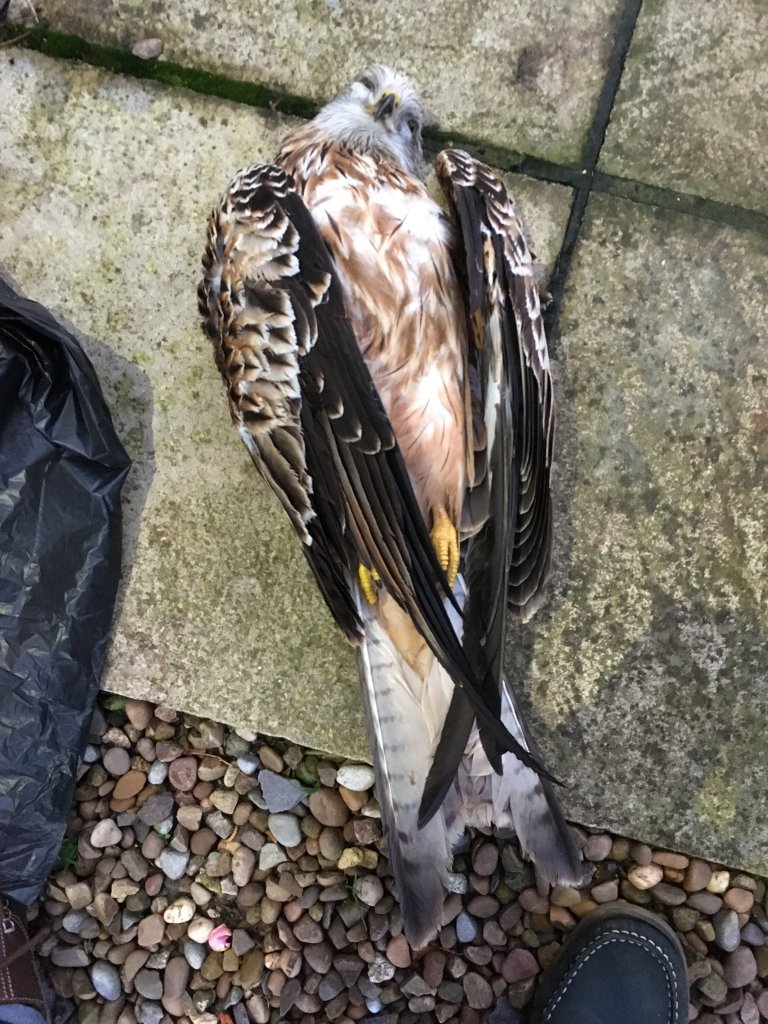
Poisoned red kite in Nidderdale: two local businesses put up a reward

Following the news last week that yet another red kite had been found poisoned in Nidderdale (see here), the Northern England Raptor Forum (NERF) has published a statement.

It’s well worth a read, here.

[A poisoned red kite]

A selected quote from the NERF statement:

‘The population of Pateley Bridge and surrounding area is less than 3,000 people. Whoever put the poisoned bait out in the open countryside and killed the Red Kite is most likely to live locally, shop locally, use the local pub and may have children or grand-children in the local school. In short if you live in the Pateley Bridge area the person indiscriminately putting poisoned baits out in your countryside, putting your life, the life of your pets and local wildlife at risk is your neighbour.

In addition to the physical threats posed by the use of dangerous poison there is also the reputational damage caused to this Area of Outstanding Natural Beauty and local businesses. This potential reputational damage was recognised by Pateley Bridge businessman Keith Tordoff in 2017 when he and a fellow businessman, jointly offered a reward for information following the unlawful killing of another Red Kite. On that occasion the bird was shot near Greenhow‘.

[Photo by Ruth Tingay]

A few days ago RPUK was contacted by a local businessman from Pateley Bridge who has once again put up a £1,000 reward for information leading to the arrest of the suspected poisoner(s). The businessman prefers to stay anonymous at this point for fear of retribution but he told us that another local businessman has also agreed to put up a £1,000 reward if the information received leads to a conviction. There may well be other members of the local community stepping forward. The businessmen have been in contact with the RSPB and North Yorkshire Police to facilitate the reward process.

Ongoing concern about the level of wildlife crime in Nidderdale has been raised by residents and visitors alike for a number of years, particularly on the extent of illegal raptor persecution and such is the strength of feeling that the Nidderdale AONB Partnership has now included a specific objective on raptor conservation in its AONB Management Plan. As part of this work, an evidence report was published in September 2019 which placed grouse moor management firmly in the frame.

Incidentally, those of you who read last week’s report on this latest poisoned red kite will know that there was an inexplicable eight-month delay between the discovery of the poisoned red kite and a police appeal for information. It was the latest in a number of cases (as yet unpublished) in North Yorkshire that have caused raised eyebrows, not least because of the previous exemplary efforts (e.g. here) of the North Yorkshire Police Rural Task Force, a team which includes some of the UK’s most dedicated and knowledgeable police officers tackling raptor persecution crimes through Operation Owl.

Last weekend at the annual Wildlife Crime Enforcers Conference we were able to have some full and frank discussions about recent events, including the delayed appeal for information about this poisoned red kite, with some senior members of North Yorkshire Police. The response was impressive, the explanations plausible (it would be inappropriate to provide detail here), the admission of mistakes made admirable, and the determination and commitment to target the offenders was unquestionable.

We look forward to being able to report some more success stories from the UK’s worst raptor persecution hotspot.

Police warn public about potential buzzard poisoning in Tebworth

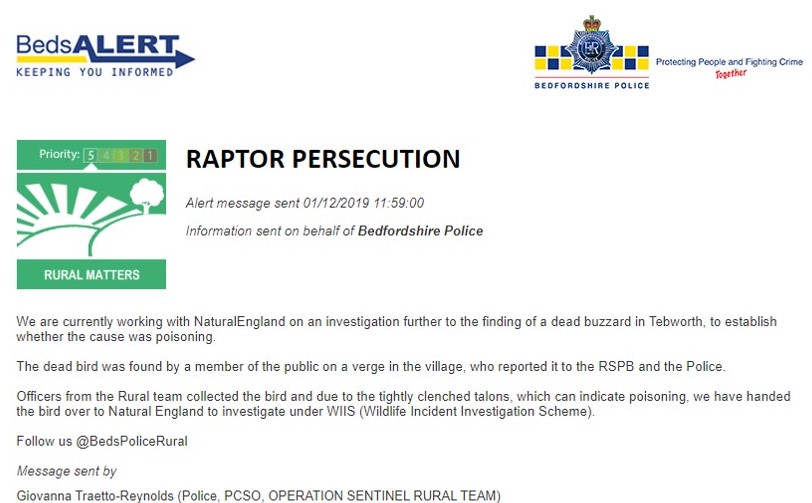
Bedfordshire Police issued the following statement yesterday:

This is good communication from the police. Although the alert doesn’t say when the buzzard was found it sounds as though it was a recent discovery and IF it does turn out to have been poisoned, the toxicology results may not be available for several weeks so this early police alert provides local dog walkers etc with due warning.

Good work, Bedfordshire Police.

Raptor persecution in Northern Ireland: ten year review and new strategies to tackle these crimes

Press release from the Partnership for Action Against Wildlife Crime Northern Ireland (PAW NI):

Birds of prey to be safeguarded by new technology

Satellite tracking devices are to be fitted onto birds of prey and nesting site surveillance installed, in the latest fight against wildlife crime.

‘Hawk-Eyes’, an advanced technology project, is being launched by the Partnership for Action Against Wildlife Crime Northern Ireland (PAW NI), alongside their ‘10 Years of Persecution’ Report.

The report reveals that from 2009-18, there were a total of 72 incidents of confirmed raptor persecution in Northern Ireland, resulting in the death or injury of 66 birds of prey and the destruction of two nesting sites.

Department of Agriculture, Environment and Rural Affairs (DAERA) Wildlife Officer Dr Jon Lees said buzzards and red kites are amongst the most common victims of persecution: “Sadly, a small proportion of our population still seem to think it’s ok to destroy these magnificent birds at the expense of the environment and the rest of the community.

“Raptors such as buzzards, red kites, peregrine falcons and Sparrowhawks, have been illegally targeted right across Northern Ireland to such an extent some areas are at risk of losing their natural top predators,” explained Dr Lees.

The methods these criminals use, such as poisoned bait, are often highly dangerous, putting livestock, pets and people at risk. These offenders care little for people’s safety. We rely heavily on the vigilance of the public to report these crimes and any evidence to the police or Crimestoppers,” Dr Lees added.

The “Hawk-Eyes” project, is funded and supported by the Department of Justice, – Assets Recovery Community Scheme (ARCS) and run through PAW NI, which brings together government Departments, PSNI and other enforcement agencies, environmental organisations, animal welfare groups and country sports associations with the common goal of combating wildlife crime through publicity, education and campaigning.

Some of the birds’ tracking information will be publicly available on the project website at http://wildlifecrimeni-hawkeyes.com, which will allow people to help protect these special birds by reporting such crimes.

PAW NI encourages people across Northern Ireland to be vigilant. If anyone sees or knows of any wildlife crime, report it to the PSNI by calling 101 or, in an emergency, 999. Crime can be reported anonymously to Crimestoppers on 0800 555 111.

ENDS

The ten year review report (2009-2018) can be downloaded here: PAW NI Raptor Persecution Report 2009 – 2018

The use of technology (nest cameras and satellite tags) in the Hawk Eyes project is very interesting, especially as it’s being funded by the Department of Justice’s Assets Recovery Community Scheme, where proceeds of crimes are distributed to help community projects. It would be great to see this approach repeated in England, Scotland and Wales.

Of most interest to us is that these tags are being deployed primarily to aid the detection of wildlife crime. Typically, up until now the main reason for deploying satellite tags has been as part of an ecological research project – the subsequent detection of wildlife crime hotspots (through the discovery of poisoned/shot/trapped sat tagged birds or the suspicious disappearance of tagged birds) has been a by-product of that research and not its primary aim. This is a very clear change of approach from the PAW NI and its also very pleasing to see that the police are key partners in it. Good stuff.

Will the use of satellite tag technology help to identify the criminals as well as the hotspots? Quite possibly. It doesn’t work in England, Scotland or Wales where there are large game shooting estates and where evidence can be quickly destroyed with relative ease (no witnesses around and thousands of acres in which to hide corpses/tags) and where multiple gamekeepers can hide in the crowd (a prosecution isn’t possible unless an individual suspect is identified) but the situation in Northern Ireland is quite different.

Raptor killing in Northern Ireland isn’t such an ‘organised crime’ as it is in the rest of the UK because there are very few large game shooting estates. It seems to be more localised and opportunistic in Northern Ireland, so the perpetrators aren’t so clued up on how to avoid detection. The deterrent effect of simply knowing that these birds might be tagged may also be significant in Northern Ireland because the raptor killers there won’t have wealthy employers prepared to fork out thousands of pounds for legal defence as they do on the game shooting estates in England and Scotland. The risk of getting caught and being afraid of the consequences might just do the trick in Northern Ireland.

Well done and good luck to the PAW NI team – a lot of people will be watching this project with interest.

Red kite illegally poisoned in North Yorkshire

Toxicology testing (by WIIS – Wildlife Incident Investigation Scheme) has confirmed that a dead red kite that was found ‘recently’ near Thixendale, North Yorkshire was illegally poisoned with the banned pesticide Carbofuran, according to local raptor rehabilitator Jean Thorpe.

We haven’t been able to find any further information about this crime.

[The poisoned red kite. Photo from Jean Thorpe]


Pre-Werritty propaganda from grouse shooting industry

As we all continue to wait for the publication of Professor Werritty’s report on driven grouse shooting, the usual suspects have been busy putting together a damage limitation programme to save their sorry necks.

An ‘informal alliance’ has been created under the banner of RELM (Rural Environment Land Management) ‘to help co-ordinate and streamline responses and communications ahead of the publication of the final report‘ and its first offering is this briefing document for MSPs which was distributed by Scottish Land & Estates a couple of weeks ago:
Here’s the intro blurb:

Grouse moor management has been the subject of much attention during the summer period across a range of issues such as the environment and species conservation, satellite tagging and wildlife crime, mountain hares and the start of the season on August 12.

With the Scottish Government’s review into grouse moor management due to be published shortly, rural organisations wished to provide the following update to parliamentarians. We would be pleased to provide additional detail where required.

Ah, how thoughtful. Amusingly, several MSPs have sent us a copy of this briefing document with comments along the lines of ‘You might want to say a few things about this’.

We’re grateful to those MSPs because yes, we do want to say a few things about the document’s contents and we wouldn’t otherwise have had an opportunity had they not shared the briefing with us.

We’re not posting the full briefing document here, yet. Instead we intend to blog about different aspects of it in turn.

Today we’re looking at the page entitled ‘Wildlife Crime’ and its five paragraphs of propaganda:

Propaganda paragraph 1:
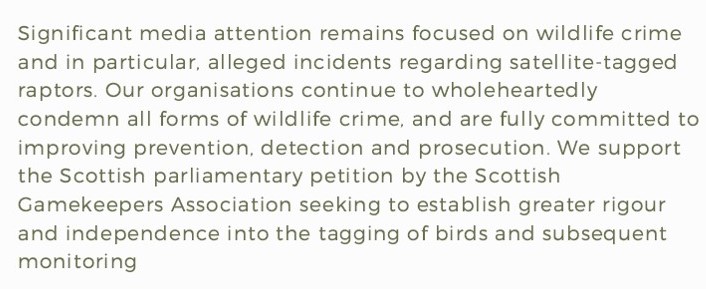
Yes, significant media attention does remain focused on wildlife crime, and particularly illegal raptor persecution because everyone else finds it abhorrent and can’t understand why it still goes on and why the grouse shooting industry continues to shield the criminals involved. It’d be interesting to know what, exactly, these five organisations have done to crack down on raptor persecution as part of their claimed ‘full commitment to improving prevention, detection and prosecution’.

Propaganda paragraph 2:
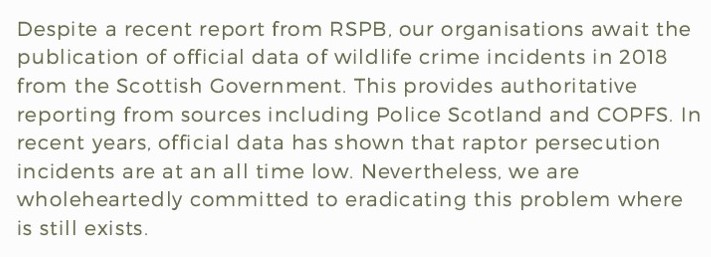
No surprises here. This is a blatant attempt, yet again, to discredit the RSPB’s annual Birdcrime Report which was published a couple of weeks ago and showed that confirmed raptor persecution crimes in Scotland in 2018 had doubled from those recorded in 2017. These cases included a peregrine poisoned in the Pentland Hills, near Edinburgh; a buzzard found to have been shot twice, in South Lanarkshire; a buzzard caught in an illegal trap, in Inverness-shire; and a hen harrier caught in a spring trap in Perthshire. All of these incidents occurred on, or close to, land being managed intensively for driven grouse shooting.

With this level of relentless criminality, it’s no wonder the grouse shooting industry apologists want to infer that the RSPB’s data are ‘unofficial’. Fine. We’ll come back to this later this autumn when the Government publishes its annual wildlife crime report, which we know will include all of the confirmed incidents already reported by the RSPB.

Propaganda paragraph 3:
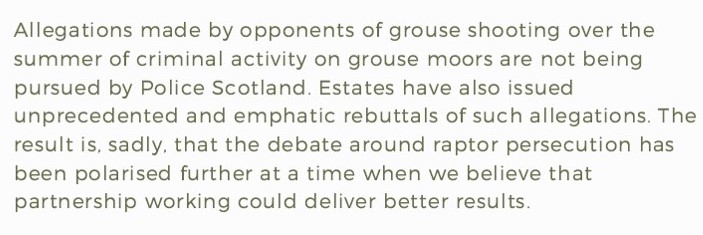
This is perhaps the most cynical of attempts to downplay the disgusting reality of the criminality still being committed on some driven grouse moors. And the first sentence of paragraph 3 is actually a lie. Not being pursued by Police Scotland? Er, ALL the cases of alleged raptor persecution that have been reported from grouse moors over the last few months are still considered to be live criminal investigations by the Police, according to the investigations officer we spoke to yesterday.

So, the satellite-tagged hen harrier that was found dead on a grouse moor in Strathbraan with an illegal spring trap clamped to its leg – it’s still the subject of a criminal investigation by the police.

The two satellite-tagged golden eagles (Adam and Charlie) that ‘disappeared’ in suspicious circumstances on another grouse moor in Strathbraan, on the same morning as each other – they’re still the subject of a criminal investigation by the police (as are several other alleged offences uncovered during the police search).

The hen harrier that was found caught by its leg in a spring trap that had been set illegally next to its nest on a grouse moor in South Lanarkshire – it’s still the subject of a criminal investigation by the police.

The buzzard that was caught inside a legal cage trap on the same South Lanarkshire grouse moor but was then allegedly beaten to death by someone arriving on a quad bike after dark and using a key to open the padlocked door of the cage – it’s still the subject of a criminal investigation by the police.

The young golden eagle that was photographed flying around in the Cairngorms National Park with an illegal trap clamped to its leg – it’s still the subject of a criminal investigation by the police.

And as for the claim that estates have issued ‘unprecedented and emphatic rebuttals’ – er, there’s nothing unprecedented about that! Estates have always denied any involvement in any of the wildlife crimes that have been uncovered on their land – it’s what they do!

Propaganda paragraph 4:
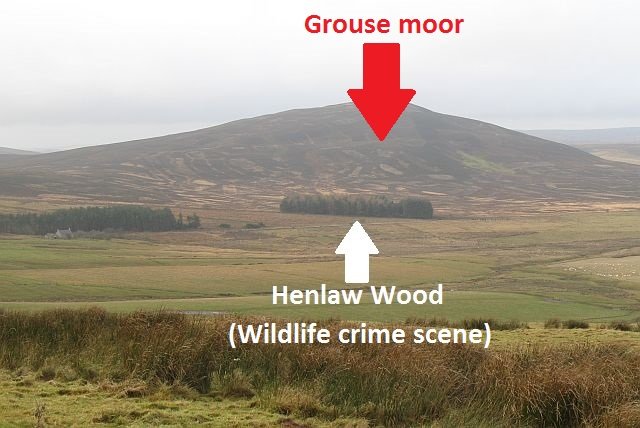
Ah yes, convicted gamekeeper Alan Wilson, dubbed by the press as ‘Scotland’s worst wildlife killer‘. Yet again, the link between Wilson’s filthy criminal activity uncovered at Henlaw Wood and driven grouse shooting is kept well hidden. Yes, the Longformacus Estate was managed for low ground pheasant shooting but it was also managed for driven grouse shooting – a fact that Scottish Land & Estates doesn’t like to mention!
And speaking of Scottish Land & Estates and it’s so-called ‘full commitment’ to tackling wildlife crime, it still hasn’t said whether the Longformacus Estate was a member at the time these crimes were committed and if so, whether that membership has now been terminated? We asked SLE this question on 22 August 2019. Still waiting for an answer….

Propaganda paragraph 5:
Of course they continue to call for tougher penalties – how can they not? But they know as well as we do that the severity of the penalty is utterly irrelevant if the perpetrators of these crimes can’t even be identified, let alone prosecuted.

And as long as evidence continues to be destroyed and employers continue to shield their criminal employees by instructing them to give ‘no comment’ interviews to the police, nothing will change.

Fortunately, there are more and more savvy MSPs in the Scottish Parliament who have seen through the greenwash and know exactly what’s going on. If you think your MSP isn’t one of those, it’d be worth dropping them an email with a link to this blog.

Damning report highlights illegal killing of birds of prey on Nidderdale AONB grouse moors

The Nidderdale Area of Outstanding Natural Beauty (AONB) is an absolute hell hole for many birds of prey.

[Photo: Ruth Tingay]

This is no secret. The illegal killing of raptors on the grouse moors of this AONB has been documented and reported on for years, by the RSPB and by this blog. The area is notorious amongst raptor conservationists for the number of hen harriers that ‘disappear’ in suspicious circumstances (that’s a euphemism for ‘they have been killed’) and the number of red kite corpses that have been found either shot or poisoned, or sometimes both.

It’s a gaping black hole on the breeding distribution maps of many raptor species and despite this being a so-called protected area, in the words of Mark Avery it’s actually a massive wildlife crime scene.

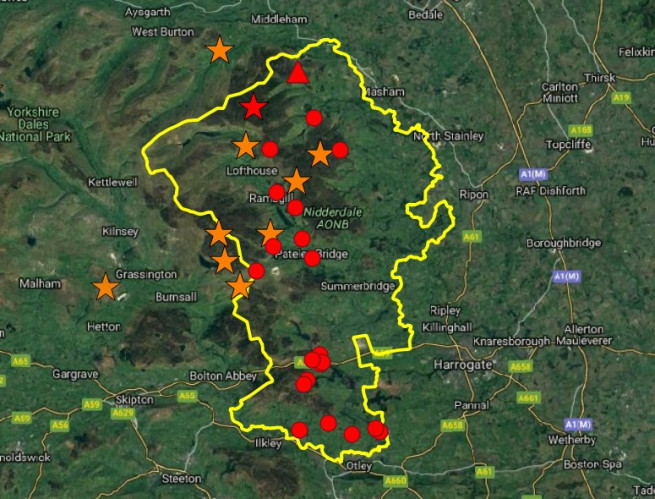
Here’s a map we produced a while ago showing the boundary of the Nidderdale AONB (yellow line), illegally killed red kites (red dots), missing satellite-tagged hen harriers (orange stars), shot hen harrier Bowland Betty (red star), shot hen harrier River (red triangle, which we now know should be closer to the red star on the Swinton Estate).

Nidderdale AONB lies directly east of the Yorkshire Dales National Park, another raptor persecution hell hole. Last year, the Park Authority responded to public concerns about the killing of raptors on grouse moors by producing an evidence report on the scale of the problem. As we wrote at the time, ‘This report, which is very well written and referenced, is a significant move. There’s no attempt to deny or hide or obfuscate the facts, as we’ve seen so often before. It is a clear description of what’s been happening in this National Park and places grouse moor management at the centre of it all. It’s well worth a read‘.

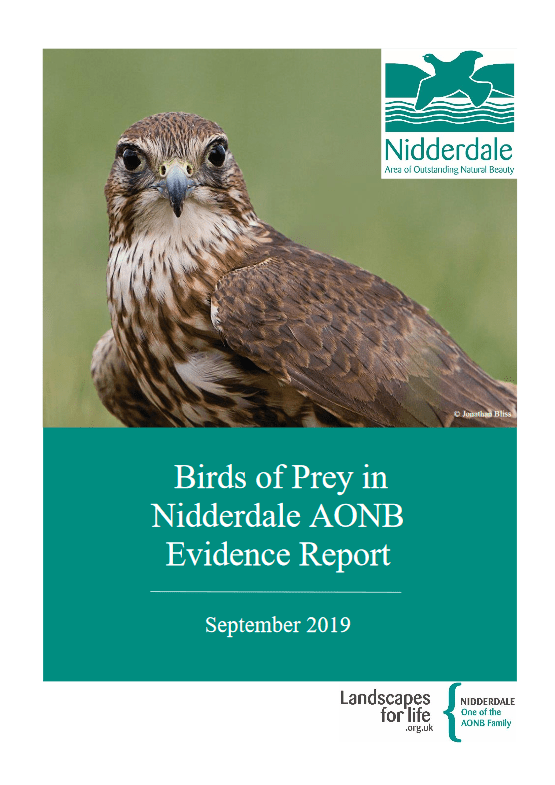
Fast forward a year and now the Nidderdale AONB has done exactly the same:

You can download the report here: BoP-in-NiddAONB-Evidence-Report-FINAL-Sept-2019

It’s another well-written, fully-referenced report and there’s no hint of denial or obfuscation. It is particularly pleasing to see the use of RSPB persecution data, not just the inaccurate, out of date, watered-down RPPDG data that some pro-shooting organisations rely upon to minimise the perceived scale of the problem. Once again, the report’s conclusion is that grouse moor management is in the frame.

Well done to the author(s) of this report and well done to the Nidderdale AONB for having the balls to publish it.