Two job opportunities with award-winning charity Birds of Poole Harbour

The award-winning charity Birds of Poole Harbour (BOPH) is advertising two rare job opportunities.

The first one is for the role of maternity cover for the BOPH Manager, starting in spring 2025.

Salary: £36,500

Hours: 40 hours per week with occasional weekend work required. Primarily Poole and Wareham-based with occasional optional home-working.

Location: Primarily Poole and Wareham-based with occasional optional home-working.

Key Responsibilities:

  • Providing overall management of the charity, working closely with our Chair of Trustees to make sure that the charity’s operations are guided by the our core values, aims and strategy, while operating sustainably.
  • Overseeing the management of our team, providing support where required, including line management of 4-5 staff members and recruitment of new team members.
  • Ensuring the organisation fulfils its legal, statutory and regulatory responsibilities, with support from our trustee board.
  • Working with our Operations Manager to prepare and review the charity annual budget and annual report.
  • Maintaining effective communication with our Chair of Trustees, and regularly supply the board with charity updates and reports with support from the Operations Manager.
  • Providing management support for our conservation and engagement projects.
  • Identifying funding opportunities to diversify the charity’s income streams.
  • Maintaining and growing relationships with charity partners.
  • Working with our engagement team to develop our annual events calendar and providing support with the delivery of our events when required.
  • Ensuring a high standard of delivery for our outreach projects and events, overseeing feedback from the public to continue our growth.

Closing Date: 9am on Wednesday 26 February 2025.

For a job specification and details of how to apply, click here.

The second job opportunity is for a Part-time Osprey Engagement Officer from April to August 2025.

Salary: £12.60 per hour (Real Living Wage)

Hours: 15 hours per week, w/b 14th April – 31st August. Due to the nature of our events, this position will require working regular Saturdays and outside of regular working hours.

Location: Wareham and Poole based.

What you’ll be working on: You’ll be helping our team to deliver an ambitious events schedule through the spring and summer, including our Carey Osprey Tours led in partnership with Careys Secret Garden, as well as our Osprey Cruises during August.

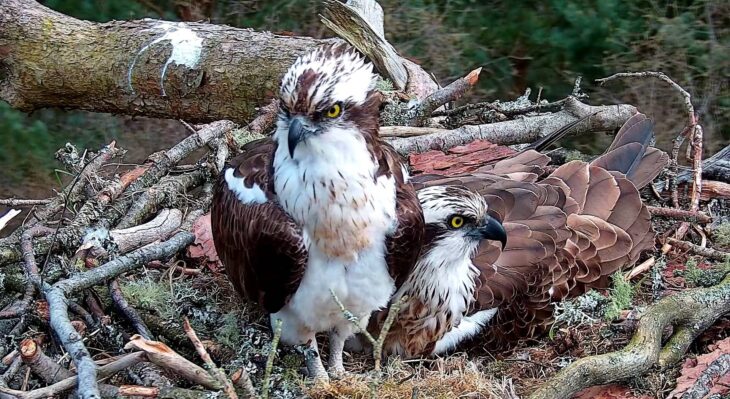
During the spring and early summer you will primarily be responsible for delivering three 2-hour sessions per day to view and interpret the nesting Ospreys at Careys Secret Garden with groups of up to 12 people, informing them about the exciting Poole Harbour Osprey Translocation Project, the nesting pair, and engaging them with the other birdlife that can be found onsite. Later in the summer, you will provide support with spotting and commentary on our award-winning Osprey Cruises around Poole Harbour. This role will be well-suited to an aspiring and enthusiastic ornithologist with excellent communication skills and a good knowledge of British birds.

Closing Date: 9am on Monday 3 March 2025.

For a job specification and details of how to apply, click here.

Osprey cruises run by Birds of Poole Harbour charity win gold in Dorset Tourism Awards

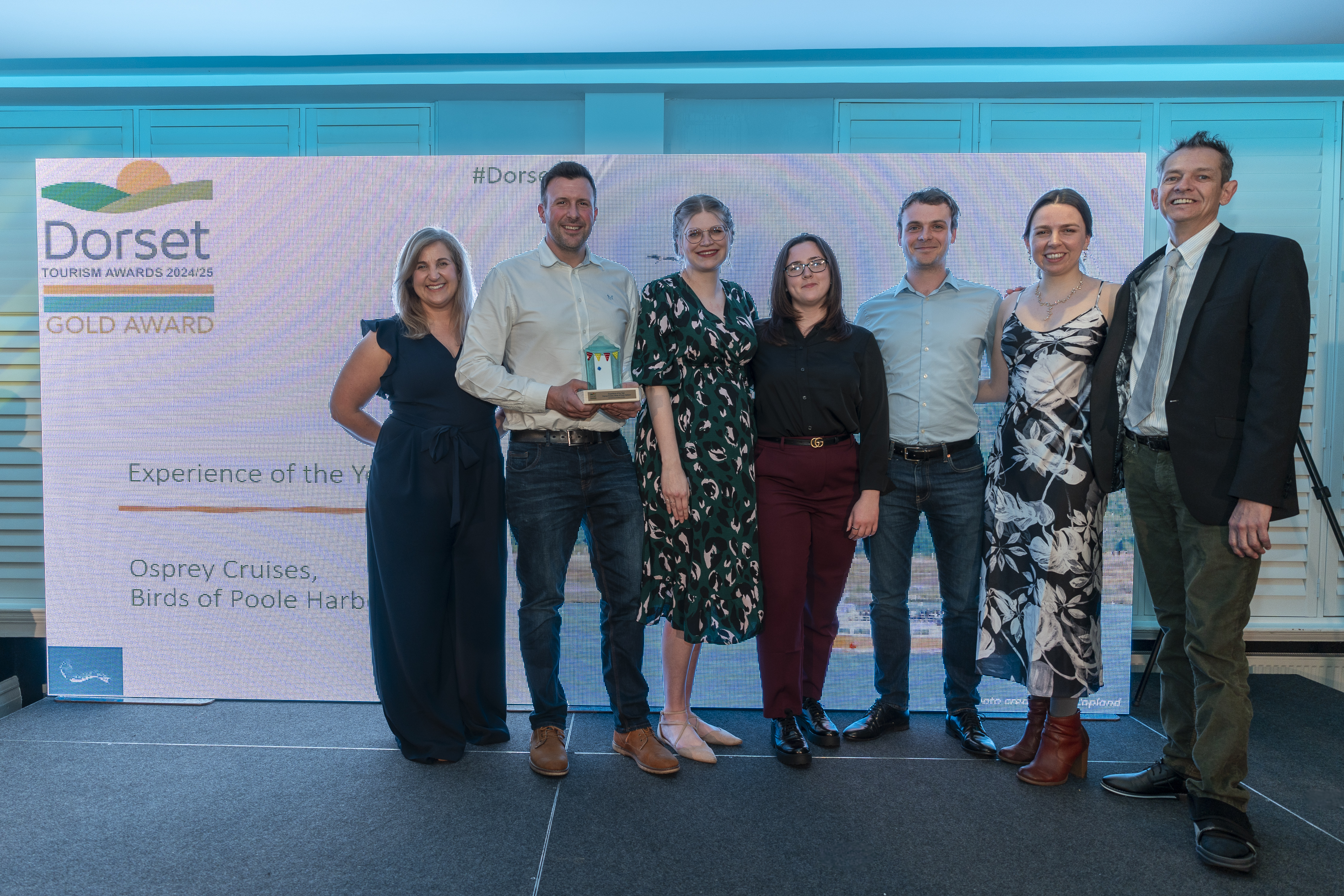
HUGE congratulations to the fantastic team behind the charity Birds of Poole Harbour whose Osprey Cruises have won GOLD in the 2024/25 Dorset Tourism Awards (Experience of the Year category)!

The Birds of Poole Harbour team collecting their gold award earlier this week. Photo by Ian Plested, IPVisuals, Dorset Tourism Awards 2024/25

If ever there was a well-deserved award, this is it, because the work of this small, passionate and knowledgeable team expands far, far beyond the popular Osprey Cruise boat trips that they run every summer.

In the world of UK raptor conservation, the charity is probably best known for successfully bringing back Ospreys to the south coast of England, working in close partnership with the Roy Dennis Wildlife Foundation. Ospreys were translocated from Scotland over a number of years, starting in 2017, and are now regularly breeding in Poole Harbour, with the first chicks hatching in southern England in almost 200 years.

The Osprey project is just one of several high impact conservation projects this team is involved with and they are currently working towards a Chough reintroduction on the Purbeck Coast. They are also heavily involved in various annual bird surveys and bird ringing projects around this important wetland site.

Public engagement and education has always been one of the core objectives of the Birds of Poole Harbour charity, and boy, do they deliver on that front!

They run a School Bird Boat Project during the winter and spring, offering local primary schools free two-hour harbour boat trips, including free coach travel to and from Poole Quay. There are free binoculars for the pupils to use and they’re encouraged to participate in identifying and recording different species whilst on board, as well as learning about natural history, conservation and their local environment. Imagine the impact those boat trips have on those kids.

In addition to the school boats, the charity delivers an extraordinary events calendar throughout the year which members of the public can pay to attend. They do guided walks and ID courses, talks and free pop-up events, but probably the most popular events are the various boat cruises which attract thousands of visitors a year, many of them selling out quickly and attracting visitors from far beyond Dorset.

I’m one of those visitors and I’ve been making the trip down to join these boat trips since 2017. Initially it was to see the Ospreys, but more recently the big draw for me is the resident pair of White-tailed Eagles that have set up home in Poole Harbour. There are plenty of other raptor species too, notably Marsh Harriers and Peregrines, and because of the diversity of habitats around the harbour there are many, many more bird species to see.

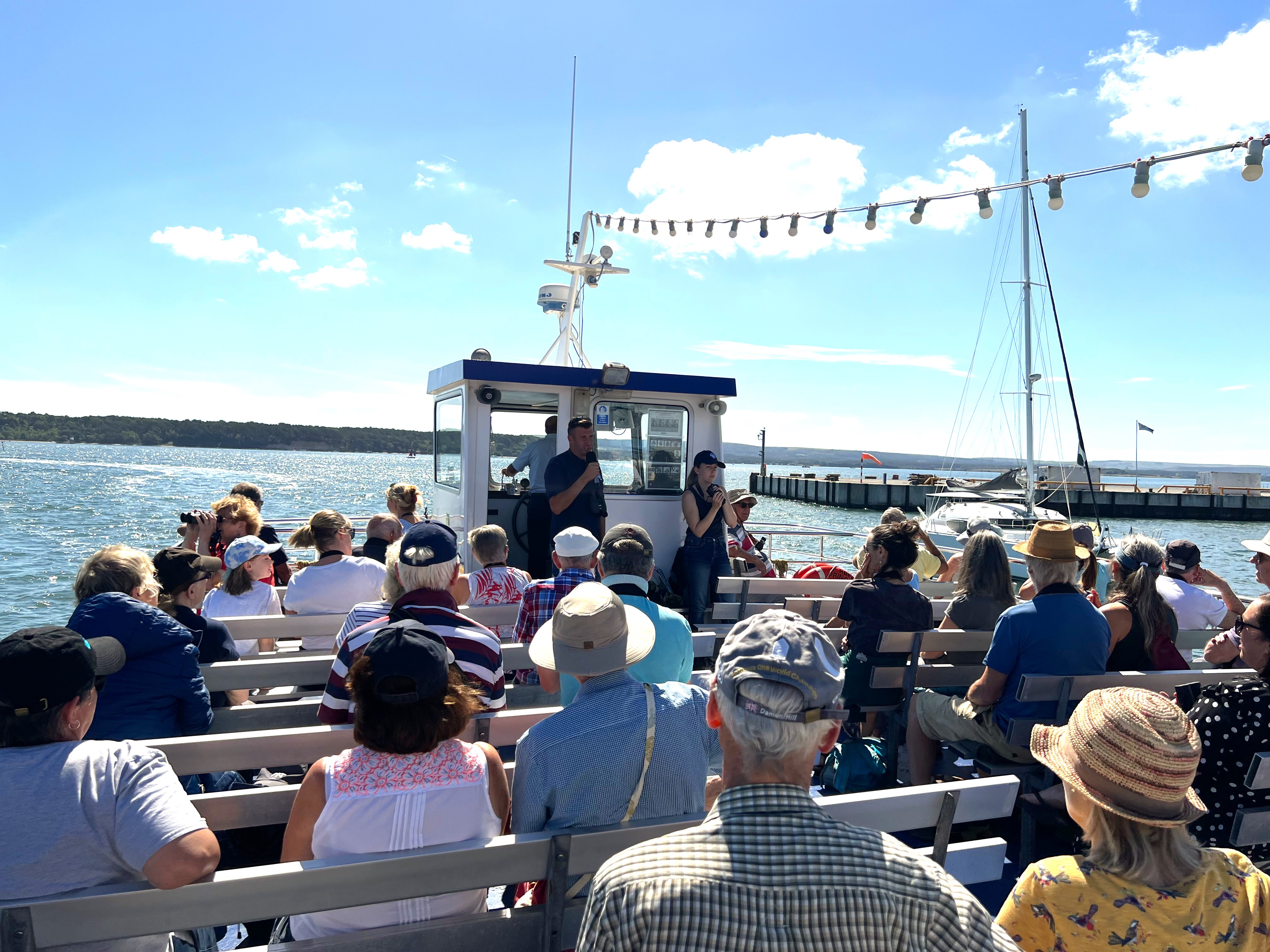
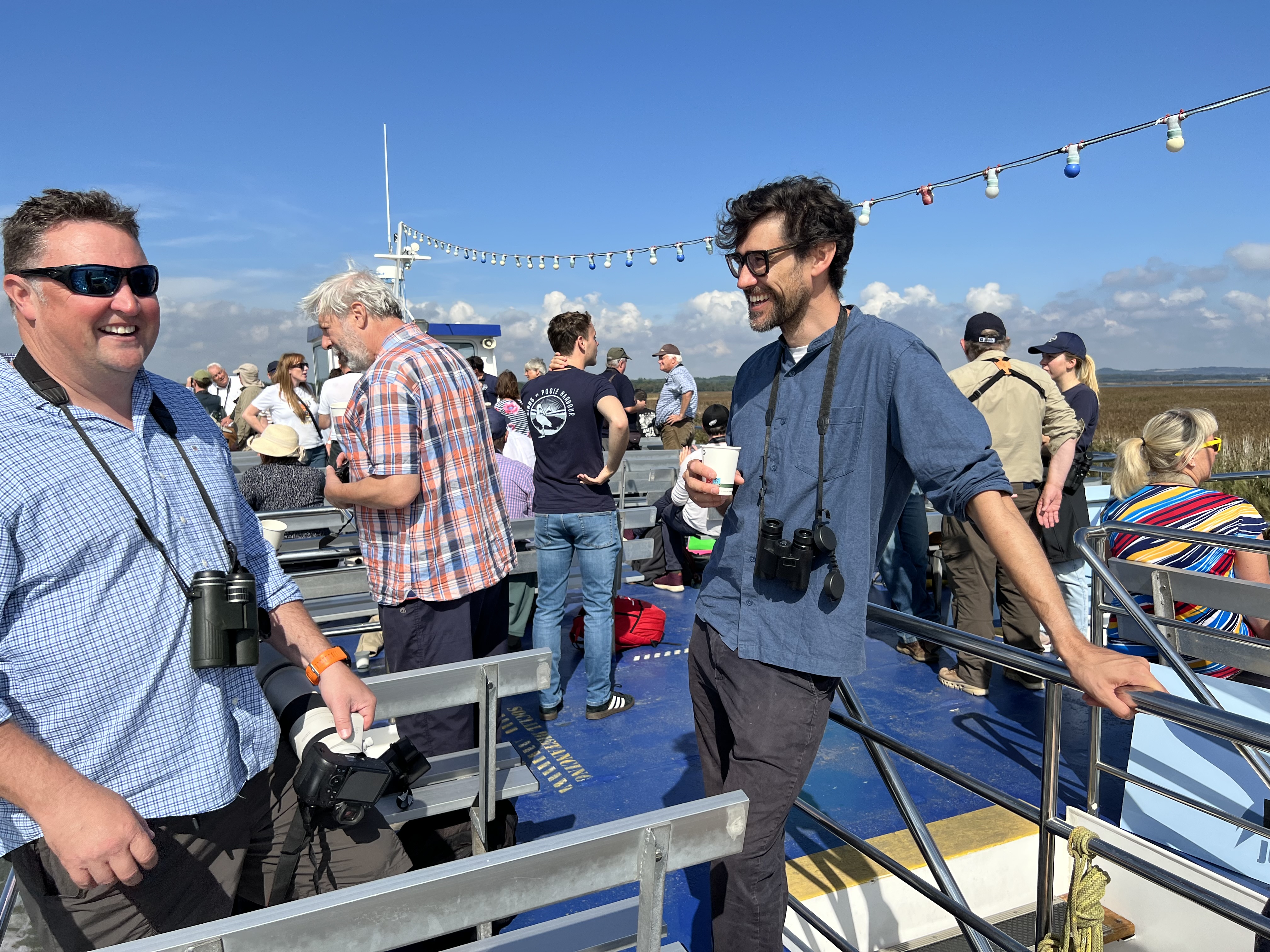
These boat trips usually last for three hours and members of the BOPH team are always on board to provide a running commentary (and they also know where the eagles like to hang out). The trips are hugely enjoyable and massively informative. You don’t need to be an expert birder to attend – the passengers are often an eclectic mix of backgrounds and experience, ranging from the expert to the novice and everything inbetween. If you want a brilliant, fun and engaging day out, look out for this year’s boat trip dates on the BOPH website (being announced shortly). You can also organise a private, bespoke boat trip, e.g. as a corporate event or as an event for supporters as Wild Justice did in 2023.

BOPH boat trips – photos by Ruth Tingay

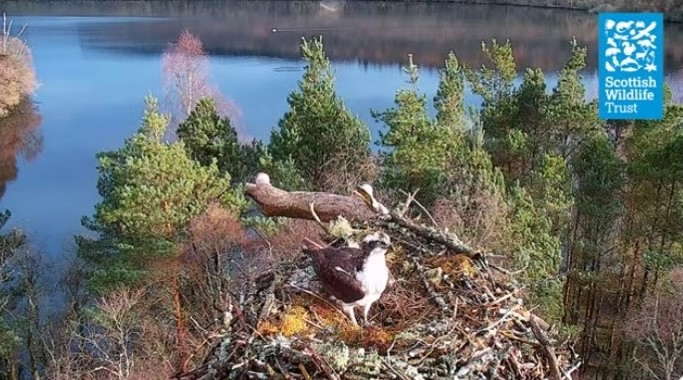
For those who can’t visit the harbour in person, Birds of Poole Harbour provide a daily blog of bird sightings, a regularly-updated website with news from their various projects, and they provide live-streaming webcams so people from around the world can follow the fortunes of the Ospreys’ breeding seasons.

Another winner at the 2024/25 Dorset Tourism Awards was Careys Secret Garden, based on the western side of the harbour, who won GOLD in the Ethical, Responsible & Sustainable Tourism category, SILVER in the Small Visitor Attraction of the Year category, and took home the WINNER OF WINNERS award, too! Careys Secret Garden works in partnership with Birds of Poole Harbour and offers a wide range of events, courses and activities from March to October, including the Careys Osprey Tours where small groups can book to visit a viewing platform to watch the famous nest belonging to Ospreys CJ7 & 022. If you’re in the area for a BOPH boat trip, I’d highly recommend a visit to this special, secluded location.

Congratulations again to both organisations on winning the richly-deserved recognition these awards will bring.

I wonder if former Conservative MP Chris Loder was at the awards ceremony?

NatureScot fails to make any compliance checks on use of new grouse moor licences

As many of you will be aware, the 2024 grouse shooting season in Scotland (12 Aug – 10 Dec 2024) saw the use of grouse moor licences for the first time ever, introduced by the Wildlife Management & Muirburn (Scotland) Act 2024 passed by the Scottish Parliament in March 2024.

For new readers, this Act was introduced as the Scottish Government’s response to the continued widespread illegal killing of birds of prey on grouse moors. It works on the basis that all red grouse shooting must now be licensed in Scotland under a section 16AA licence and if, on the civil burden of proof (i.e. on the balance of probability) sufficient evidence is found that the licence has been breached (including evidence of illegal raptor persecution), the licence can be withdrawn as a sanction, preventing the shooting of red grouse on a particular estate for a period of up to five years.

The licences have already been weakened significantly by NatureScot after a legal threat from the game-shooting industry (see here) and I’ll be writing more about that, probably later this week.

Red grouse photo by Pete Walkden

As part of the new grouse moor licensing scheme, NatureScot published a Code of Practice for Grouse Moor Management (also known as the Grouse Code) which sets out the legal requirements associated with managing land for killing and/or taking red grouse.

The Wildlife Management & Muirburn (Scotland) Act 2024 requires that a licence holder comply with the Grouse Code. Non-adherence to the Grouse Code could result in a licensing sanction and/or suspension or revocation. Here is the Grouse Code:

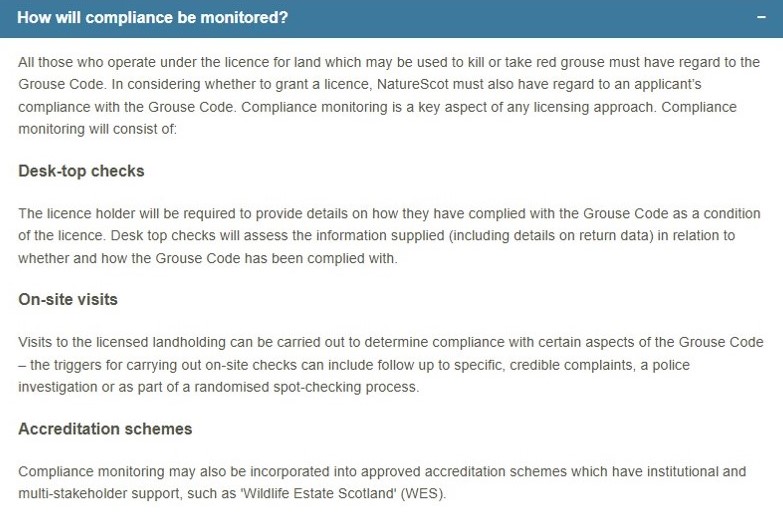
You’ll note on pages 2-3 of the Grouse Code that it includes a section on compliance monitoring.

Stating the obvious, NatureScot says, ‘Compliance monitoring is a key aspect of any licensing approach‘ and then outlines the types of compliance monitoring checks it says it will conduct:

Sounds reassuringly comprehensive, doesn’t it?

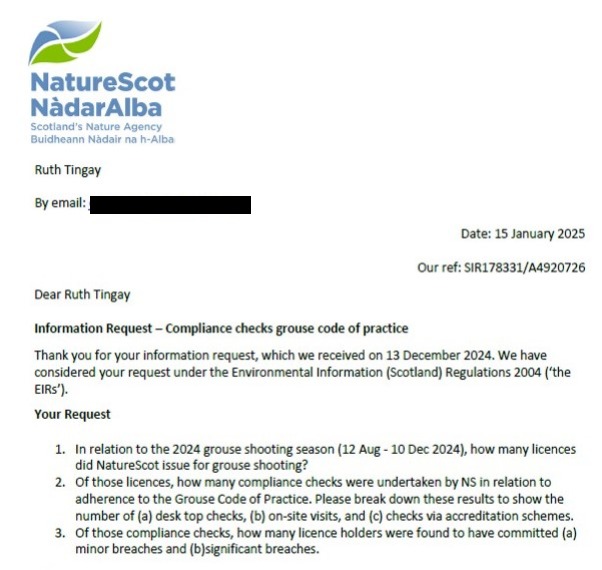
However, in recent months I’ve learned that NatureScot can’t be trusted (more on that soon!) so rather than rely on what NatureScot says it will do with regard to Grouse Code compliance checks, I decided to find it what it actually did by submitting an FoI request as follows:

  1. In relation to the 2024 grouse shooting season (12 Aug – 10 Dec 2024), how many licences did NatureScot issue for grouse shooting?
  2. Of those licences, how many compliance checks were undertaken by NatureScot in relation to adherence to the Grouse Code of Practice? Please break down these results to show the number of (a) desk top checks, (b) on-site visits, and (c) checks via accreditation schemes.
  3. Of those compliance checks, how many licence holders were found to have committed (a) minor breaches and (b) significant breaches?

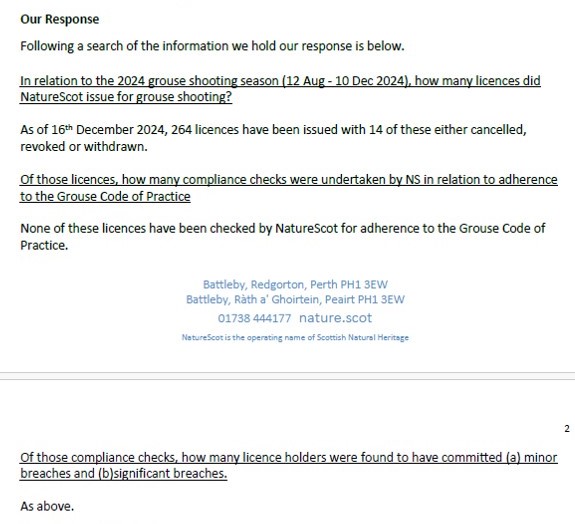
Here is NatureScot’s response:

So, NatureScot issued 264 grouse shooting licences for the 2024 season and says that 14 ‘were either cancelled, revoked or withdrawn‘. I’m guessing that none of them were ‘cancelled’ or ‘revoked’, but rather all 14 were ‘withdrawn’ by the licence applicant, probably as a result of the threatened legal challenge against NatureScot by the grouse-shooting industry that resulted in a narrowing of the licensable area, so perhaps some licence holders withdrew their original licence applications and submitted revised applications showing the more limited boundary.

Whatever the reason, I’m quite confident that no licences have been ‘cancelled’ or ‘revoked’ by NatureScot because if they had, NatureScot would have publicised it on its website in the same way it does for General Licence restrictions. I suspect in this case, NatureScot has deliberately included the words ‘cancelled’ and ‘revoked’ in its FoI response in an attempt to infer enforcement action when actually it hasn’t done any enforcement whatsoever.

That leaves 250 grouse shooting licences that NatureScot issued for the 2024 grouse shooting season. Of those, NatureScot didn’t undertake one single compliance check.

That’s astonishing, given that the Scottish Parliament introduced grouse shoot licensing on the basis that many grouse moor owners and managers couldn’t be trusted to abide by the law, despite years of warnings that if they didn’t stop illegally killing birds of prey they’d face imposed regulations. Given this long history of criminality, you’d think that compliance monitoring would be fundamental.

Regulation, in this case licensing, is only as strong as the associated compliance monitoring efforts and subsequent enforcement action. We’ve already seen the illegal shooting of an osprey (here) and a peregrine (here) since the licensing scheme began, and no sign of any subsequent enforcement action, which suggests that the licensing scheme simply isn’t an effective mechanism for stopping The Untouchables. NatureScot’s failure to undertake a single licence compliance check is playing right into their hands.

‘Why are birds of prey still being killed in Scotland despite new legislation?’ – special report in The National

The National newspaper published a special report on Monday 16 December 2024 entitled, ‘Why are birds of prey still being killed in Scotland despite new legislation?’, with a particular focus on the Cairngorms National Park.

It’s reproduced below.

SCOTLAND passed the Wildlife Management and Muirburn (Scotland) Bill earlier this year, introducing a licensing scheme for the grouse shooting industry in a bid to end the illegal killing of birds of prey.

The first licenses were issued this past summer, and while considered a blueprint for tougher legislation across the UK – people are still killing birds of prey on grouse moors, which is not an easy thing to do.

Guilty parties must have access to a vehicle, equipment such as a firearm, opportunity and motive.

This isn’t people traveling from towns and cities going up onto our hills and randomly killing birds of prey. These are targeted offences,” Ian Thomson, investigations manager for the RSPB, told The National.

But why? And who would do this?

Why are grouse moor shootings still taking place?

A Hen Harrier disappeared in February. A buzzard was shot in Perthshire in mid-May. An osprey was shot in the Glen Doll area in August. A dead golden eagle was found in a plastic bag near Loch Rusky in November.

In the last 15 years, more than 1500 birds of prey have been killed, with 57 convictions. However, the majority of these sentences are suspended, and only one person has been jailed.

Most of the evidence gathered by investigators is from satellite tags, fitted to allow conservationists to monitor the movements around the country.

The technology is estimated to be about 97% reliable, and “very rarely suffers some sort of technical function”, according to Thomson.

Often we believe that there is strong evidence that supports the fact that these birds are being shot often at night, the tags destroyed, and the carcass is disposed of,” Thomson said.

The RSPB investigations team assists Police Scotland by speaking to local land managers and liaising with the community if a tag stops working. When asked why anyone would target the birds, even with the new legislation in place, Thomson said: “The killings are being undertaken by people who are working on the land.

That’s the reality, and the vast majority of raptor persecution offenses occurring in Scotland are linked to management for kind of game bird shooting and particularly grouse shooting.

There are many layers of evidence that support that.

First of all, the location of the incidents that are found. Whether its birds shot, birds poisoned, or nests destroyed, these are all subject to police investigations.

A significant proportion of people convicted for raptor persecution offenses have been gamekeepers,” Thomson shared.

RSPB data shows that at least 54% of all confirmed incidents in the last 10 years (2014-2023) have been linked to land managed for pheasant, partridge and grouse shooting.

The association of these crimes with the gamebird industry is also evidenced by criminal court records. Of all individuals convicted of bird of prey persecution related offences from 2009 to 2023, 75% were connected to the gamebird shooting industry and 68% were gamekeepers.

The Angus Glens crime hotspot

Angus Glens in the Cairngorms is a hotspot for the number of raptor persecution in Scotland, with the Highlands having 69 since 2009.

There have been multiple confirmed incidents occurring on several estates in the area. This includes many poisoning incidents using chemicals whose possession was long banned, repeated illegal misusing abuse of crow traps and pole traps, shootings and destruction of nests.

Earlier this year, NatureScot placed restrictions on an estate on the edge of the Cairngorms National Park for three years following evidence of bird poisoning on the property.

Thomson said there had been 10 suspicious disappearances of satellite tags on birds of prey in the Angus Glen in the last 15 years.

There has been a peregrine, and an osprey shot since the start of the shooting season in Angus Glens this year, which Thomson described as “worrying”.

The law as it has stood since 2012 has been serious liability, which means landowners are responsible for the actions of their employees and the land.

So are landowners aware of the circumstances surrounding raptor persecutions on their land?

A wall of silence

The first licenses under the new bill were approved this past July, but Thomson noted there would have been no need for it had the industry “taken possession of this problem decades ago”.

He added: “I think had the industry rooted out criminals, then we wouldn’t have needed this sort of legislation moved on.

We are in a situation where some Victorian management practices towards birds of prey persist. It really is time that the shooting industry got into the 21st century.

Thomson said it was rare for estates to report raptor persecutions.

When asked whether estates may be protecting or turning a blind eye to those who target birds of prey, Thomson said he could not confirm but he and his team frequently hear of peer pressure within estates to keep reporting low, adding that crimes are rarely reported by the industry.

The problem is the game keeping industry is used to operating a bit like a closed shop,” Thomson said.

It’s very difficult. There is no whistleblowing culture, and it would be fantastic if organizations representing gamekeepers set up a scheme where people could report incidents taking place and those are passed on to the police.

But that just never seems to happen. Exceedingly rare truths are told.”

Thomson revealed that gamekeepers come to the team sharing their worries and are “terrified” to come forward.

They say to us this information can’t come from me because I may lose my job and I may lose my friends and I may lose my hobby. People are under considerable pressure to keep their mouths shut,” he said.

Either people won’t see anything or there is just a culture of denial.”

Thomson described “efforts to deny or downplay” incidents, and said that when satellite tags start to disappear, people blame “imaginary wind farms” or factors, dismissing science and evidence of crimes.

It’s a mix of cultural misinformation, a wall of silence and complete denial”, Thomson added.

ENDS

For those who are sick to the back teeth of birds of prey being illegally killed on grouse moors, you might want to sign this new petition from Wild Justice calling for a ban on driven grouse shooting – HERE.

Satellite-tagged golden eagle ‘disappears’ in suspicious circumstances on grouse moor in the notorious Angus Glens

Press release from RSPB:

EAGLE VANISHES IN BIRD OF PREY CRIME HOTSPOT

  • The young Golden Eagle, fitted with a satellite-tag, was being monitored by researchers in Scotland until it suddenly disappeared in the Angus Glens – an area dominated by grouse moors and with a history of raptor persecution.
  • Scotland’s national bird, Golden Eagles are still heavily – and criminally – persecuted.

The sudden disappearance of a satellite-tagged Golden Eagle has sparked concerns of criminal activity in the Angus Glens. 

The young bird, which hatched in Tayside in 2022, was fitted with a satellite tag while in its nest. This work was supported by Forestry and Land Scotland for research purposes.

The tag was transmitting as expected until May 2024 when it suddenly went offline. Its last known location was an area of moorland in the Angus Glens – an area with a long history of illegal bird of prey persecution

The data from the bird’s tag was swiftly provided to the police for independent scrutiny. Police Scotland, the National Wildlife Crime Unit and RSPB Scotland then conducted a search of the area but found no trace of the bird or its tag. 

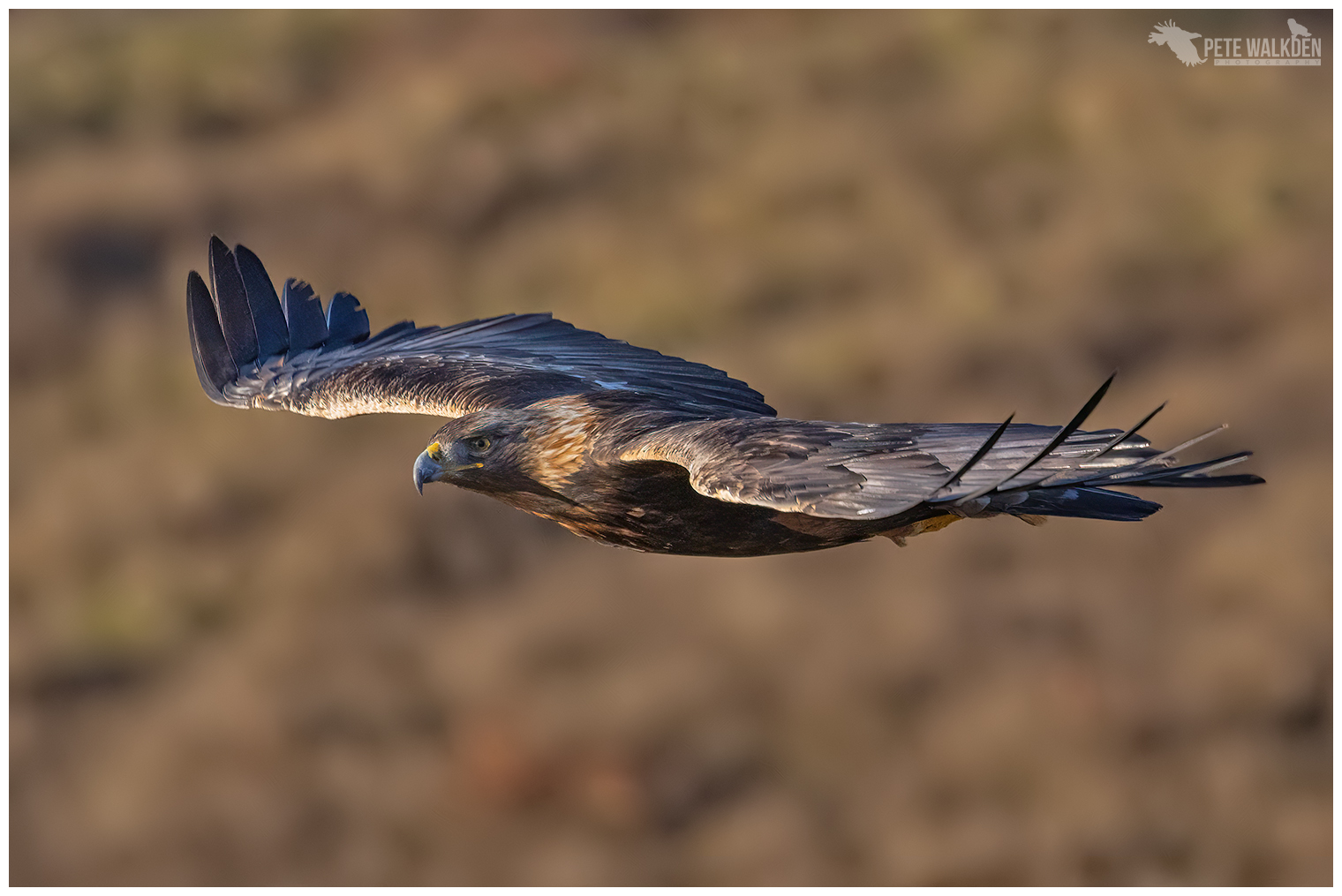
Golden eagle photo by Pete Walkden

It is a crime to kill a bird of prey, and anyone caught doing so faces a fine or even jail. Furthermore, legislation introduced in March 2024 means that, if illegal activity takes place on a grouse moor, that grouse moor could lose its license to operate. 

Will Hayward, RSPB Scotland Senior Investigations Officer, said: “The sudden cessation of transmissions from this tag strongly suggests human interference, and reflects a pattern of tagged birds ‘disappearing’ almost exclusively on or near grouse moors that has become all too evident in recent years. Had this bird died of natural causes or if the tag had become detached, we would be able to locate and retrieve it. Given the well-proven reliability of this technology, when no body or tag is found, this is highly suspicious. We believe this bird has been killed and the tag destroyed.”

Unfortunately, this young bird is the latest of many to disappear without explanation on or near a grouse moor. 

Angus was one of the raptor crime hotspots identified in a Government-commissioned report on the fates of satellite tracked golden eagles in Scotland, published in 2017. Sadly there has been no let-up in confirmed incidents and suspicious disappearances since then. Most recently, an Osprey was found shot in the Glen Doll area on 12 August – the opening day of the grouse shooting season. [Ed: And a Peregrine was found shot in the Angus Glens on 3 September 2024, here]. And earlier this year sat-tagged Hen Harrier ‘Shalimar’ disappeared in circumstances similar to this Golden Eagle. 

If you notice a dead or injured bird of prey in suspicious circumstances, call Police Scotland on 101 and fill in the RSPB’s online reporting form here.

If you have information about anyone killing birds of prey which you wish to report anonymously, call the RSPB’s confidential Raptor Crime Hotline on 0300 999 0101.

ENDS

Osprey found shot in Angus Glens on opening day of grouse shooting season

Police Scotland appeal for information (26 August 2024):

APPEAL FOR INFORMATION FOLLOWING DEATH OF OSPREY IN PERTHSHIRE

We are appealing for information following the death of an osprey in Perthshire. 

On Monday, 12 August, 2024 the injured osprey was found in distress by a gamekeeper in the Glen Doll area. The SSPCA was called and the bird taken to the wildlife resource centre in Fishcross for treatment, however it had to be euthanised due to the severity of the injuries. 

Following further investigations, x-rays revealed the osprey had been shot and Police Scotland was contacted. 

Officers are appealing for anyone with information on what happened to contact them. 

Detective Constable Daniel Crilley, Wildlife Crime Investigation, said: “It’s illegal to kill any protected species and we’re working with partner agencies to fully investigate the circumstances. 

“Information from the local community is vital and I’d ask anyone who was in the area around 12 August and thinks they may have information which could assist our enquiries to come forward. We’re keen to speak to anyone who may have seen anything suspicious or has information about shooting activity in the area.”

Anyone with information is urged to contact Police Scotland on 101 quoting reference 1671 of 26 August. Alternatively, you can call Crimestoppers anonymously on 0800 555 111.

ENDS

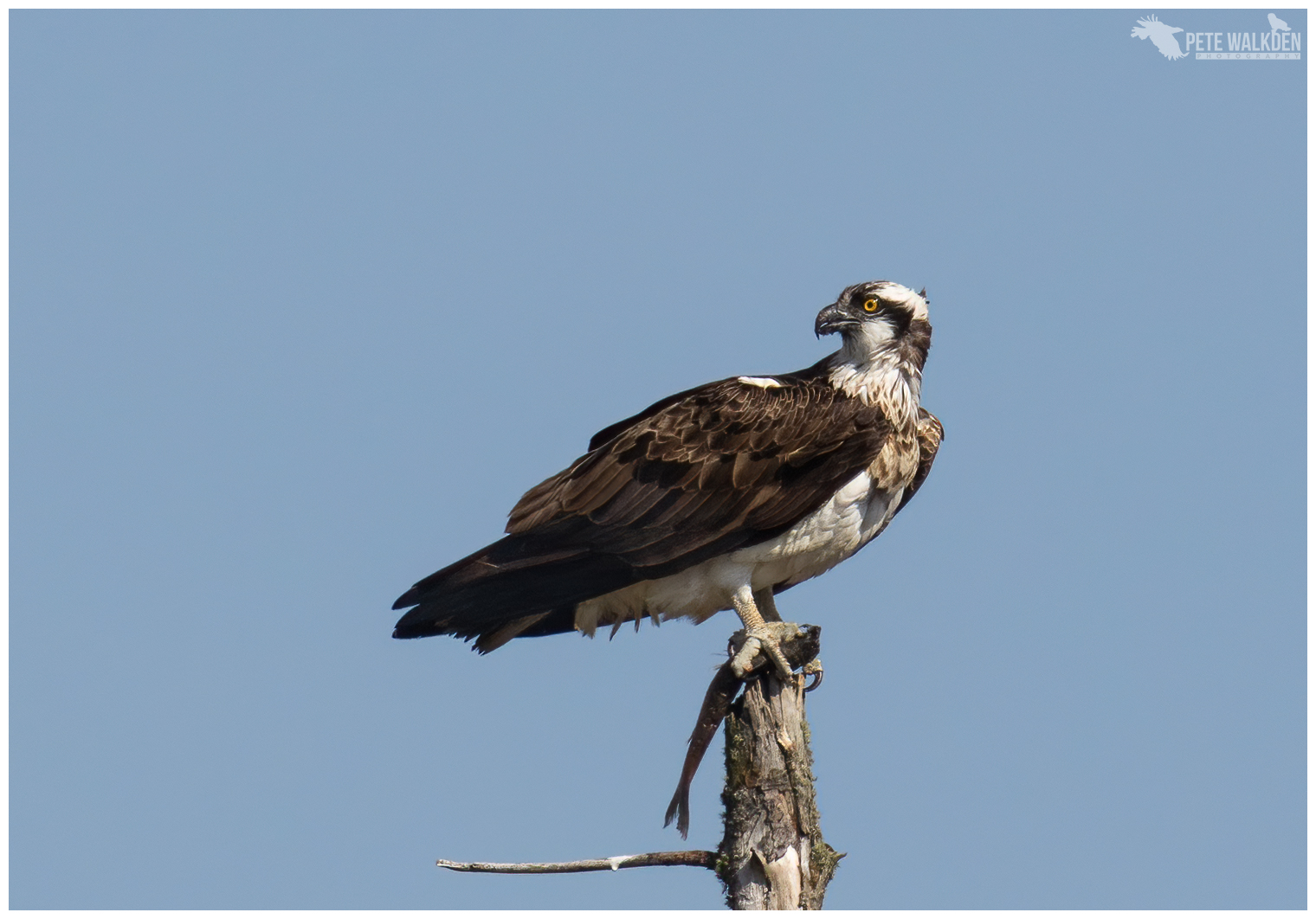
Osprey photo by Pete Walkden

It’s unusual for an Osprey to be shot in the UK, given that they’re a fish-eating specialist and therefore no threat to gamebirds such as red grouse, pheasants or partridges.

Police Scotland’s appeal for information doesn’t say what type of gun was used (shotgun or air rifle) which would have been evident from the x-ray, nor the extent of the osprey’s injuries (i.e. was it able to still fly? If not, it was obviously shot close to where it was found), so it’s quite difficult to comment in detail.

However, given it was found on the opening day of the annual grouse shooting season, in the Angus Glens, an area dominated by driven grouse moors and with a long, long history of illegal raptor persecution, then it’s difficult not to perceive this osprey has been shot by somebody out on a day’s grouse shooting.

Perhaps a case of mistaken identity? One too many sloe gins? Something similar has happened before, that time it was a buzzard shot during a pheasant shoot (see here).

Oh, and the osprey shooting happened inside the Cairngorms National Park.

What better advertisement for the gamebird shooting industry, eh?

This will be an interesting investigation to follow. If it was shot on a moor when a grouse shoot was taking place, how will that impact on the estate’s new licence?

One to watch.

Post mortem confirms osprey ‘Laddie’ died of natural causes

In May 2024, Police Scotland issued an appeal for information after the discovery of a dead osprey called ‘Laddie’, the famous breeding male from the Scottish Wildlife Trust’s Loch of the Lowes Reserve in Perthshire (see here).

Criminality had been suspected initially but a few weeks later the police announced that criminality still hadn’t been established but they were awaiting the results of a post mortem to confirm (see here).

Osprey ‘Laddie’ with his mate. Photo from Scottish Wildlife Trust webcam.

Yesterday Police Scotland (Tayside) issued the following statement on Facebook:

Following extensive enquiries on the remains of an osprey found near Dunkeld, Perth and Kinross, on Friday, 3 May, 2024, no criminality has been established.

It is believed the protected species, which is thought to have been nesting at Loch of the Lowes, close to where it was found, died from natural causes“.

Further detail has been published by the Scottish Wildlife Trust:

The post mortem has revealed that the male osprey died of bleeding from stomach ulcers. There was no indication of lead or any other poisoning; evidently, old age played its part. We think he was at least 15 years old” (see here for more info).

Update on death of Osprey ‘Laddie’ from Loch of the Lowes Reserve in Perthshire

Earlier this month Police Scotland issued an appeal for information after the discovery of a dead Osprey, believed to be ‘Laddie’, the resident breeding male from the Scottish Wildlife Trust’s Loch of the Lowes Reserve in Perthshire (see here).

Webcam footage from the Scottish Wildlife Trust’s Loch of the Lowes Reserve in Perthshire where Laddie returned this spring after over-wintering in Africa

The details in the police press release were scant and although the police were clear that criminality had yet to be established, it was widely assumed that a police appeal for information suggested that there was at least a suspicion of criminality. That was a reasonable assumption, I think, given that birds of prey die of natural causes all the time and we don’t see police appeals for information every time a raptor corpse is discovered.

There wasn’t any further information about this case until five days ago when a couple of media outlets (e.g. STV News, here) ran a story stating that the police were no longer treating the death of ‘Laddie’ as a criminal matter, and a police spokesperson was quoted as follows:

Following initial tests on the bird, no crime has been established at this time. Further tests and a post mortem will take place in due course to gather more information on this death and our enquiries continue“.

It appears from this information that Police Scotland’s appeal for information was premature, to say the least. However, having made some enquiries I’ve now learned that ‘Laddie’ was found with an injury that could have been consistent with him being shot but unfortunately the police issued the appeal for information before ‘Laddie’ had been x-rayed.

I’m loathe to criticise Police Scotland for being too quick to publicise a suspected persecution incident – more often than not, I’m critical of police forces who typically delay appeals for information until weeks/months after a raptor crime has been discovered, when the chance of finding witnesses is seriously diminished.

In this case, I can see why the police issued an early appeal the day after ‘Laddie’s’ body had been found, because there were grounds to suspect he had been shot (i.e. the nature of his injury), but it would have been good practice for them to have waited for the results of the x-ray, which didn’t show any indication that this osprey had been shot.

It’s a fine line for police officers – in this case they got it wrong but they did so with the best of intentions (i.e. to secure potential witnesses) and not to ‘demonise’ the shooting industry, which I’ve seen being claimed by ridiculous conspiracy theorists on certain websites. For example, the police didn’t mention the shooting industry, nor even that they suspected ‘Laddie’ had been shot, and they were very clear that they hadn’t yet established whether he’d been illegally killed. They simply appealed for information. Many members of the public did make the assumption he’d been shot, and again, who can blame them given the track record of the shooting industry over many decades.

The cause of death is still not yet known – ‘Laddie’ has been sent for a post mortem.

UPDATE 21 August 2024: Post mortem confirms osprey ‘Laddie’ died of natural causes (here)

Police appeal for info after osprey remains found nr Loch of the Lowes reserve, Perthshire

Police Scotland have issued the following appeal for information this evening:

We are appealing for information after the remains of an osprey were found near Dunkeld, Perth and Kinross, on Friday, 3 May, 2024.

The protected species is believed to have been nesting at Loch of the Lowes, close to where it was found.

Enquiries are at an early stage to establish the full circumstances.

Inspector James Longden said: “It is illegal to kill any protected species and we are working closely alongside partner agencies to confirm what has happened here and whether there is any criminality involved.

“Information from the local community could prove vital and it is important we speak to anyone who saw anything suspicious in the area, or who may know something which could assist our investigation.

Any information can be passed to Police Scotland on 101 quoting incident number 3266 of Friday, 3 May, 2024. You can also contact Crimestoppers anonymously on 0800 555 111.

The remains are believed to be Osprey LM12, the famous resident male also known as Laddie.

Webcam footage from the Scottish Wildlife Trust’s Loch of the Lowes Reserve in Perthshire where Laddie returned this spring after over-wintering in Africa

The police haven’t yet revealed the cause of death but the fact they’ve issued an appeal for information suggests that there is at least a suspicion of criminality.

If a post mortem subsequently confirms the osprey was killed illegally, it will cause upset for thousands of people around the world who have followed this charismatic osprey’s story for years via the SWT webcam, and will once again bring international shame on Scotland for its continued failure to protect birds of prey.

UPDATE 20 May 2024: Update on death of Osprey ‘Laddie’ from Loch of the Lowes Reserve in Perthshire (here).

UPDATE 21 August 2024: Post mortem confirms osprey ‘Laddie’ died of natural causes (here)

Job opportunity: Events Assistant, Birds of Poole Harbour (Dorset)

The charity Birds of Poole Harbour (the fabulous team behind the Osprey Reintroduction Project, amongst many other things) is advertising for an Events Assistant to help them deliver a number of exciting public engagement projects this year.

This includes helping out on their brilliantly popular ‘bird cruise boats’ around the harbour, providing the public with an opportunity to see ospreys, white-tailed eagles, marsh harriers, peregrines and much, much more!

Looking for raptors (& other species!) on the Birds of Poole Harbour Bird Boat. Photo: Ruth Tingay

Here are the details of this fantastic job opportunity:

BIRDS OF POOLE HARBOUR EVENTS ASSISTANT

Birds of Poole Harbour is a Dorset-based charity with a local community focus, committed to conserving and interpreting the important birdlife in the Poole Harbour area. We deliver a range of exciting events and projects, and are looking for an enthusiastic Events Assistant to support our team in delivering our public engagement offer through the Spring and Summer of 2024.

Position: Events Assistant

Hours: 32 hours per week, 15th April – 15th September 2024. Due to the nature of our events, regular weekend and occasional early morning/evening working hours are required.

Salary: £8053.76 (FTE: £23,795.20 per annum)

Location: Poole and Wareham-based, with travel to events around Poole Harbour

Annual Leave: 9.5 days, inclusive of bank holidays

Essential Criteria:

  • Friendly and warm interpersonal style
  • Excellent verbal and written communication skills
  • Ability to work effectively as part of a busy team
  • Proactive and self-motivated attitude
  • Excellent bird identification skills

Desirable Skills and Experience:

  • Experience of working with volunteers
  • Experience of delivering events
  • Knowledge of local birding sites and conservation projects, including the Poole Harbour Osprey Reintroduction Project
  • Full driving licence and access to a vehicle

What you’ll be working on:

You’ll be helping our team to deliver an ambitious events schedule through the spring and summer, including our Carey Osprey Tours led in partnership with Careys Secret Garden, as well as our guided walks and cruises. This role will be well-suited to an aspiring and enthusiastic ornithologist with excellent communication skills and a good knowledge of British birds.

Full training will be provided and more detail on our project work and events can be found here: www.birdsofpooleharbour.co.ukPlease note that this position will be offered subject to the successful return of the nesting pair of Osprey to Careys Secret Garden, and that we will be unable to fulfil the role if they do not return.

If you would like to apply, please email our Operations Manager Laura at laura@birdsofpooleharbour.co.uk with a CV (2 pages maximum) and a PDF with answers to the following questions:

  • What attracted you to apply for this position? (200 words max)
  • Why do you believe you are well-suited for the role of Events Assistant at Birds of Poole Harbour? (500 words max)

Interviews commencing W/B 4th March with the option for online interviews available. Please note that the interview will involve a UK bird species identification test.

Closing date: 9am on 26th February 2024

If you have any questions or queries about the role or application process, please contact our Charity Manager Liv via liv@birdsofpooleharbour.co.uk. Birds of Poole Harbour are an equal opportunities employer and are happy to provide additional information or accommodations within our hiring practices to support applicants.

ENDS