
Over the last couple of years we’ve blogged a lot about the obscene massacre of mountain hares on Scottish grouse moors (see here for previous posts).
It’s quite the hot topic these days, resulting in Parliamentary questions, public petitions, and even a call from SNH/GWCT/SLE for grouse moor managers to practice “voluntary restraint” – a pointless exercise in our opinion (see here).
It seems that SNH doesn’t have much faith that voluntary restraint will be employed – a few weeks after they issued their plea to landowners, they asked hill-walkers to report any evidence of large-scale culls (see here).
Today, the grouse-shooting industry issued their own press release about mountain hares on grouse moors. We thought it was an early April Fools’ Day stunt but apparently it isn’t. It reads as follows:
MOUNTAIN HARES ON THE MARCH AFTER GROUSE BONANZA
(Issued on behalf of a Scottish Moorland Group)
The Highlands are celebrating a special conservation bonus following two very good grouse seasons.
Scottish moorland managers are reporting large numbers of the much loved and easily recognised mountain hare, linked to last year’s ‘best in a generation’ grouse season. The Scottish population of hares is thought to be around 350,000 and in some areas they are now at historically high levels – the hares have the red grouse to thank!
Concern has been expressed recently that hare numbers may be going down; however grouse moors in the Angus Glens, Speyside and Highlands report that their numbers have increased along with grouse levels. Heather moorland managed for red grouse is an extremely good habitat for hares to thrive on.
The mountain hare is the only native species of hare or rabbit in Britain, easily distinguished by its white plumage during the winter months and brown during the summer. It is known that its population fluctuates in 7-10 year cycles, however actively managed moorlands give this iconic Scottish species a sustainable future.
Danny Lawson, head gamekeeper on Glenogil Estate in the Angus Glens, said: “I have seen more mountain hares this year than at any time since I came here. Our mountain hare population has been increasing along with grouse over the last three years because our heather management gives them good grazing and because of predator control over the estate and other neighbouring estates.
“Good weather in the breeding season helps mountain hare numbers and the last two seasons, 2013 and 2014, have been very good for both grouse and mountain hares. Like grouse, mountain hare populations have to be carefully managed. Culling is legal and is necessary in some circumstances and such management should be done sustainably and be supported by a sound management plan.”
Tim Baynes, Director of the Scottish Moorland Group, says: “There are surprising gaps in our collective knowledge about this secretive animal. This can lead to assumptions about population changes which are not correct and we support the research project commissioned by Scottish Natural Heritage to get a better handle on how to accurately count hares on the open hill. What does seem certain from the long term observations of moorland managers on the ground is that there is a strong link to land use; hare numbers are likely to go down where moorland is unmanaged or afforested but will increase where managed for red grouse.”
-ENDS-
Anyone convinced that grouse moor managers view mountain hares as “much loved”? Anyone convinced that hare culls by grouse moor managers are “carefully managed”?
Have a look at the photographs at the foot of this blog and make up your own minds.
What’s also interesting about this press release is the decision to include a quote from the head gamekeeper of Glenogil Estate. We’ve blogged a lot about Glenogil Estate over the years (see here). Glenogil Estate is one of several grouse-shooting estates in the Angus Glens. Here’s some information about raptor persecution in the Angus Glens, mainly gleaned from the RSPB’s annual BirdCrime reports and SASA’s annual reports:
2004 May, near Edzell: long-eared owl and two short-eared owls starved to death in crow cage trap. No prosecution.
2004 May, Invermark Estate: peregrine nest destroyed. No prosecution.
2006 March, Glenogil Estate: poisoned rabbit bait (Carbofuran). No prosecution.
2006 April, Easter Ogil: poisoned buzzard (Alphachloralose). No prosecution.
2006 April, Easter Ogil: poisoned tawny owl (Alphachloralose). No prosecution.
2006 May, Glenogil Estate: poisoned rabbit bait (Carbofuran). No prosecution.
2006 June, Glenogil Estate: poisoned woodpigeon bait (Carbofuran). No prosecution.
2006 June, Glenogil Estate: Traces of Carbofuran found in estate vehicles & on equipment during police search. No prosecution. Estate owner had £107k withdrawn from his farm subsidy payments. This was being appealed, but it is not known how this was resolved.
2006 July, Millden Estate; poisoned sheepdog (Lindane). No prosecution.
2007 November, Glenogil Estate: Disappearance of radio-tagged white-tailed eagle ‘Bird N’ coincides with tip off to police that bird been shot. No further transmissions or sightings of the bird.
2008 May, ‘Nr Noranside’: poisoned white-tailed eagle ‘White G’ (Carbofuran, Isophenfos, Bendiocarb). No prosecution.
2008 May, ‘Nr Noranside’: poisoned buzzard (Bendiocarb). No prosecution.
2008 May, ‘Nr Noranside’: poisoned mountain hare bait (Carbofuran, Isophenfos, Bendiocarb). No prosecution.
2008 May, Glenogil Estate: 32 x poisoned meat baits on fenceposts (Carbofuran, Isophenfos, Bendiocarb). No prosecution.
2008 October, ‘Glenogil Estate: poisoned meat bait on fencepost (Carbofuran). No prosecution.
2009 March, Glenogil Estate: poisoned buzzard (Carbofuran). No prosecution.
2009 March, Glenogil Estate: poisoned buzzard (Carbofuran). No prosecution.
2009 April, Millden Estate: poisoned buzzard (Alphachloralose). No prosecution.
2009 July, Millden Estate: poisoned golden eagle ‘Alma’ (Carbofuran). No prosecution.
2009 August, Glenogil Estate: poisoned white-tailed eagle “89” (Carbofuran). No prosecution.
2010 May, ‘Nr Noranside’: poisoned red kite (Carbofuran). No prosecution.
2010 September, Glenogil Estate: poisoned buzzard (Chloralose). No prosecution.
2010 October, Glenogil Estate: poisoned buzzard (Carbofuran). No prosecution.
2010 October, Glenogil Estate: poisoned pigeon bait (Carbofuran). No prosecution.
2010 October, Glenogil Estate: poisoned pigeon bait (Carbofuran). No prosecution.
2011 February, Airlie Estate: buzzard caught in illegal crow trap. (see below)
2011 March, Airlie Estate: 3 x buzzard caught in illegal crow trap. Prosecution (!) but dropped after statement from suspect given to SSPCA deemed inadmissible.
2011 April, Millden Estate: shot buzzard. No prosecution.
2012 April, ‘Nr Noranside’: Remains of buzzard found beside pheasant pen. Suspicious death.
2011 June, Rottal & Tarabuckle Estate: dead kestrel inside crow cage trap. No prosecution.
2012 February, ‘Nr Edzell’: spring-trapped buzzard. No prosecution.
2012 February, ‘Nr Bridgend’: remains of buzzard found under a rock. Suspicious death.
2012 May, Millden Estate: satellite-tagged golden eagle seemingly caught in spring trap, then apparently uplifted overnight and dumped on Deeside with two broken legs & left to die. No prosecution.
2012 May, Glen Esk: disappearance of sat-tagged red kite. No further transmissions or sightings of bird.
2013 January, Invermark Estate: white-tailed eagle nest tree felled. No prosecution.
2013 November, Glen Lethnot: poisoned golden eagle ‘Fearnan’. No prosecution.
2014 October, Nathro: shot buzzard. Prosecution? Unknown.
Can we take it then, that as this press release was issued by the Scottish Moorland Group – a sub-group of Scottish Land & Estates – that Glenogil Estate is a member of SLE? If so, surely the partner organisations of the PAW Scotland Raptor Group will be asking questions at their next ‘partner’ meeting.
A few newspapers have picked up on this press release today, including an article in the P&J entitled, ‘Mountain hare thriving thanks to grouse management‘.
Here are some pictures of ‘much-loved’ mountain hares ‘thriving’ on Scottish grouse moors, including one photograph that was taken on, er, Glenogil Estate.
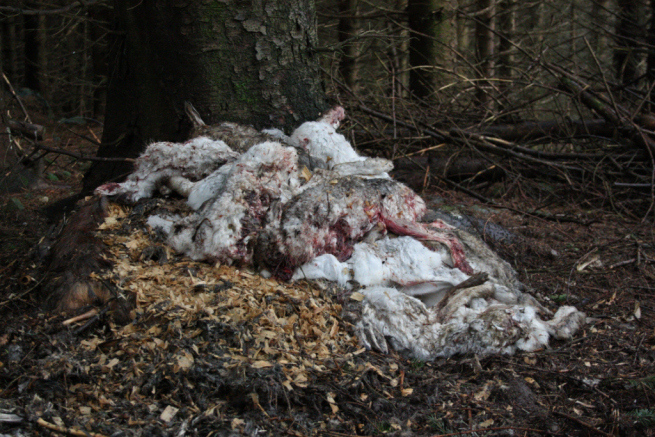

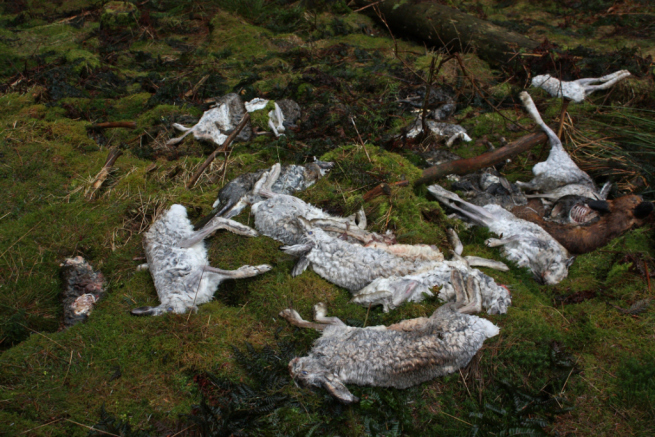
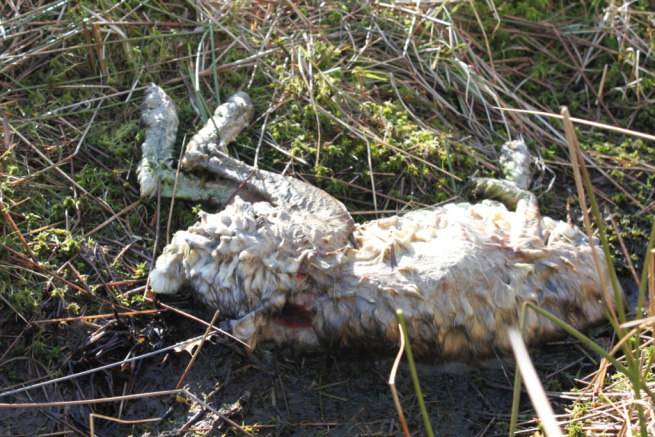
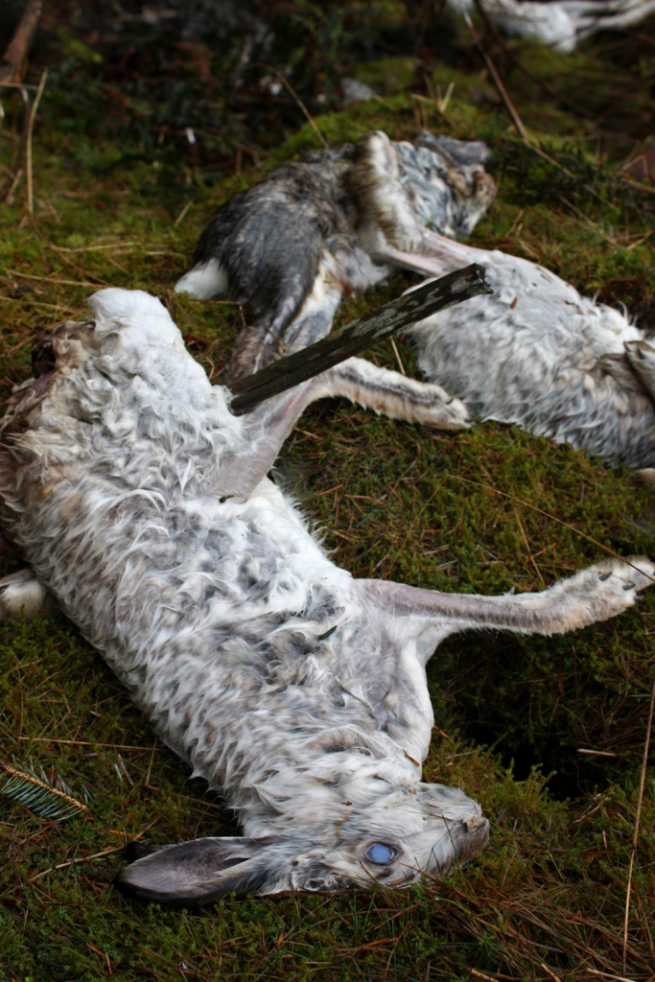
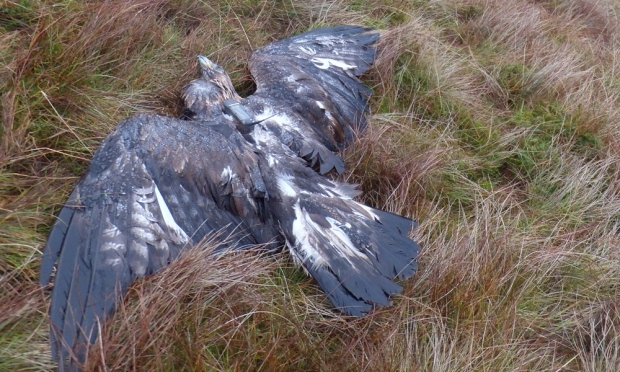
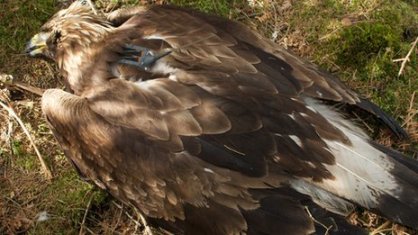 Un-fucking-believable. Yes, it’s a swear word but that’s the least of our concerns. Read what follows and you’ll be swearing in anger too…
 MAY 2006: A dead adult golden eagle was found on the Dinnet & Kinord Estate, near Ballater, Aberdeenshire. Tests revealed it had been poisoned by the illegal pesticide, Carbofuran. Grampian Police launched an investigation. Five years and 11 months later, nobody has been prosecuted.
 JUNE 2006: A dead golden eagle was found on Glen Feshie Estate in the Cairngorms. Tests revealed it had been poisoned by the illegal pesticide, Carbofuran. Northern Constabulary launched an investigation. Five years and ten months later, nobody has been prosecuted.
 AUGUST 2007: A dead adult female golden eagle was found on an estate near Peebles in the Borders. She was half of the last known breeding pair of golden eagles in the region. Tests revealed she had been poisoned by the illegal pesticide, Carbofuran. Lothian & Borders Police launched an investigation. Four years and eight months later, nobody has been prosecuted.
 AUTUMN 2007: Tayside Police received a detailed tip-off that a young male white-tailed eagle (known as ‘Bird N’) had allegedly been shot on an estate in Angus. The timing and location included in the tip-off coincided with the timing and location of the last-known radio signal of this bird. Four and a half years later, the bird has not been seen again. With no body, an investigation isn’t possible.
 MAY 2008: A one year old male white-tailed eagle hatched on Mull in 2007 and known as ‘White G’ was found dead on the Glenquoich Estate, Angus. Tests revealed he had been poisoned by an unusual concoction of pesticides that included Carbofuran, Bendiocarb and Isofenphos. A police search in the area also revealed a poisoned buzzard, a baited mountain hare and 32 pieces of poisoned venison baits placed on top of fenceposts on the neighbouring Glenogil Estate. Laboratory tests revealed the baited mountain hare and the 32 poisoned venison baits contained the same unusual concoction of highly toxic chemicals that had killed the white-tailed eagle, ‘White G’. Three years and 11 months later, nobody has been prosecuted.
 JUNE 2009: An adult golden eagle was found dead at Glen Orchy, Argyll, close to the West Highland Way. Tests revealed it had been poisoned by the illegal pesticide, Carbofuran. Strathclyde Police launched a multi-agency investigation. Two years and ten months later (April 2012), Tom McKellar pled guilty to possession of Carbofuran stored in premises at Auch Estate, Bridge of Orchy. Nobody has been prosecuted for poisoning the golden eagle.
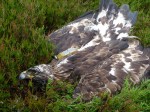 JULY 2009: A two year old female golden eagle known as ‘Alma’ was found dead on the Millden Estate, Angus. Tests revealed she had been poisoned by the illegal pesticide, Carbofuran. Alma was a well-known eagle – born on the Glen Feshie Estate in 2007, she was being satellite-tracked and her movements followed by the general public on the internet. Tayside Police launched an investigation. Two years and nine months later, nobody has been prosecuted.
 AUGUST 2009: A young white-tailed eagle was found dead on Glenogil Estate, Angus. Tests revealed it had been poisoned by the illegal pesticide, Carbofuran. Tayside Police were criticized in the national press for not releasing a press statement about this incident until January 2010. Two years and 8 months later, nobody has been prosecuted.
 MAY 2010: Three dead golden eagles were found on or close to Skibo Estate, Sutherland. Tests revealed they had been poisoned; two with Carbofuran and one with Aldicarb. Northern Constabulary launched a multi-agency investigation. One year later (May 2011), Sporting Manager Dean Barr pled guilty to possession of 10.5 kg of Carbofuran stored in premises at Skibo Estate. One year and 11 months later, nobody has been prosecuted for poisoning the three golden eagles.
 JUNE 2010: Leg rings with unique identification numbers that had previously been fitted to the legs of four young golden eagles in nests across Scotland were found in the possession of gamekeeper James Rolfe, during a multi-agency investigation into alleged raptor persecution at Moy Estate, near Inverness. It is not clear how he came to be in possession of the rings. The bodies of the eagles from which the rings had been removed were not found. No further action was taken in relation to the discovery.
 JUNE 2010: A golden eagle and a white-tailed eagle were found dead on an estate near Farr, Inverness-shire. Tests revealed they had been poisoned by the illegal pesticide, Carbofuran. Northern Constabulary apparently did not search the property until July 2011. One year and ten months later, nobody has been prosecuted.
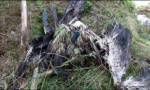 DECEMBER 2010: A decomposing carcass of a white-tailed eagle was found and photographed on Logie (Lochindorb) Estate, Morayshire. It was reported to Northern Constabulary. By the time the police arrived to collect it, the carcass had disappeared. The police said they couldn’t investigate further without the body.
 MARCH 2011: The body of a young golden eagle was discovered on North Glenbuchat Estate, Aberdeenshire. Tests revealed it had been poisoned by the illegal pesticide, Carbofuran. Grampian Police launched an investigation and raided the property in May 2011. One year and one month later, we are not aware of any pending prosecutions.
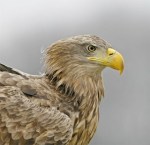 APRIL 2011: The body of a white-tailed eagle was found at the base of cliffs on Skye. The person who discovered it (a professional medic) considered it to have been freshly shot with a rifle, decapitated with a sharp implement and thrown from the cliff top. He took photographs and alerted Northern Constabulary and RSPB. There was a delay of two weeks before the now probably decomposed carcass was collected. A post-mortem was inconclusive. This incident was not made public until one year later after a tip off to this blog. We are not aware of any pending prosecutions.
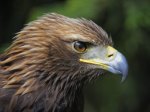 NOVEMBER 2011: The signal from a satellite-tracked young golden eagle (hatched in 2010) stopped functioning when she was at a location in the Monadhliaths, a well-known raptor persecution black spot in the Highlands. Her last known location was checked by researchers but there was no sign of the bird. Another ‘disappearance’ in suspicious circumstances or a technical malfunction of the satellite transmitter?
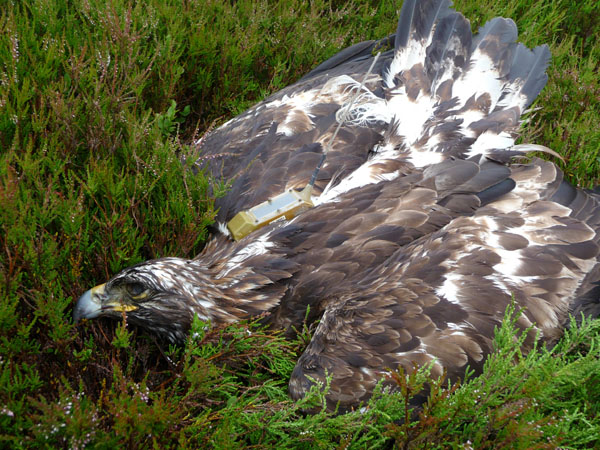 An article in today’s Telegraph reports that Millden Estate, where golden eagle ‘Alma’ was found poisoned in 2009, is no longer up for sale. The estate, owned by investment banker Richard Hanson, was reportedly put on the market earlier this year (see
  Glen Esk is, of course, where golden eagle ‘Alma’ was found poisoned two years ago (see
  Millden Estate near Brechin, Angus has been put up for sale with a whopping £17.5 million price tag. If the estate is sold as a whole (as opposed to up to 13 Lots), it will become the most expensive Scottish country estate ever sold on the open market, according to Scotland on Sunday.
 Two years ago in July 2009, Alma, a two-year golden eagle who had been satellite-tracked across Scotland from her birth place on the Glenfeshie Estate,
  Raptor Persecution UK