
Golden eagle found poisoned on Angus grouse moor

A two-year old golden eagle named ‘Fearnan’ has been found dead on a Scottish grouse moor. He had been poisoned with a banned pesticide. The poison hasn’t been named but we’ll take an educated guess at Carbofuran, the gamekeepers’ poison of choice.

Interestingly, there are three separate press releases about this latest disgraceful crime:

One from the government via PAW (here)

One from the police (here)

One from RSPB Scotland (here)

Usually, we’re lucky to see anything for at least 4-5 months after the crime so it’s somewhat surprising to see the scuffle for media attention on this one. Could this be a sign that Environment Minister Wheelhouse has put his foot down and demanded that timely press statements are released? We can’t think of any other reason why the police should suddenly change their tactics from seemingly apathetic to seemingly responsive.

Of course, regular blog readers will already know that Fearnan is not the only poisoned eagle to have been found dead in the Angus Glens. In fact, there’s been a fair bit of raptor persecution over the last nine years. Here’s a list of incidents we’ve compiled from various published reports:

2004 May, near Edzell: long-eared owl and two short-eared owls starved to death in crow cage trap.  No prosecution.

2004 May, Invermark Estate: peregrine nest destroyed. No prosecution.

2006 March, Glenogil Estate: poisoned rabbit bait (Carbofuran). No prosecution.

2006 April, Easter Ogil: poisoned buzzard (Alphachloralose). No prosecution.

2006 April, Easter Ogil: poisoned tawny owl (Alphachloralose). No prosecution.

2006 May, Glenogil Estate: poisoned rabbit bait (Carbofuran). No prosecution.

2006 June, Glenogil Estate: poisoned woodpigeon bait (Carbofuran). No prosecution.

2006 June, Glenogil Estate: Traces of Carbofuran found in estate vehicles & on equipment during police search. No prosecution. Estate owner had £107k withdrawn from his farm subsidy payments. This was being appealed, but it is not known how this was resolved.

2006 July, Millden Estate; poisoned sheepdog (Lindane). No prosecution.

2007 November, Glenogil Estate: Disappearance of radio-tagged white-tailed eagle ‘Bird N’ coincides with tip off to police that bird been shot. No further transmissions or sightings of the bird.

2008 May, ‘Nr Noranside’: poisoned white-tailed eagle ‘White G’ (Carbofuran, Isophenfos, Bendiocarb). No prosecution.

2008 May, ‘Nr Noranside’: poisoned buzzard (Bendiocarb). No prosecution.

2008 May, ‘Nr Noranside’: poisoned mountain hare bait (Carbofuran, Isophenfos, Bendiocarb). No prosecution.

2008 May, Glenogil Estate: 32 x poisoned meat baits on fenceposts (Carbofuran, Isophenfos, Bendiocarb). No prosecution.

2008 October, ‘Glenogil Estate: poisoned meat bait on fencepost (Carbofuran). No prosecution.

2009 March, Glenogil Estate: poisoned buzzard (Carbofuran). No prosecution.

2009 March, Glenogil Estate: poisoned buzzard (Carbofuran). No prosecution.

2009 April, Millden Estate: poisoned buzzard (Alphachloralose). No prosecution.

2009 July, Millden Estate: poisoned golden eagle ‘Alma’ (Carbofuran). No prosecution.

2009 August, Glenogil Estate: poisoned white-tailed eagle “89” (Carbofuran). No prosecution.

2010 May, ‘Nr Noranside’: poisoned red kite (Carbofuran). No prosecution.

2010 September, Glenogil Estate: poisoned buzzard (Chloralose). No prosecution.

2010 October, Glenogil Estate: poisoned buzzard (Carbofuran). No prosecution.

2010 October, Glenogil Estate: poisoned pigeon bait (Carbofuran). No prosecution.

2010 October, Glenogil Estate: poisoned pigeon bait (Carbofuran). No prosecution.

2011 February, Airlie Estate: buzzard caught in illegal crow trap. (see below)

2011 March, Airlie Estate: 3 x buzzard caught in illegal crow trap. Prosecution (!) but dropped after statement from suspect given to SSPCA deemed inadmissible.

2011 April, Millden Estate: shot buzzard. No prosecution.

2012 April, ‘Nr Noranside’: Remains of buzzard found beside pheasant pen. Suspicious death.

2011 June, Rottal & Tarabuckle Estate: dead kestrel inside crow cage trap. No prosecution.

2012 February, ‘Nr Edzell’: spring-trapped buzzard. No prosecution.

2012 February, ‘Nr Bridgend’: remains of buzzard found under a rock. Suspicious death.

2012 May, Millden Estate: satellite-tagged golden eagle caught in spring trap, then apparently uplifted overnight and dumped on Deeside. No prosecution.

2012 May, Glen Esk: disappearance of sat-tagged red kite. No further transmissions or sightings of bird.

2013 January, Invermark Estate: white-tailed eagle nest tree felled. No prosecution.

2013 November, Glen Lethnot: poisoned golden eagle. Prosecution? Highly unlikely!

We think you’ll agree, this is overwhelming evidence that some people in the Angus Glens are systematically persecuting birds of prey, they have been for many years, and those same people are avoiding criminal justice for their disgusting and illegal activities. We call them The Untouchables.

Why have they been able to avoid prosecution for so long?

Now would be a good time to ask the Environment Minister for an explanation. While you’re at it, please also mention your revulsion about the continued practice of illegal raptor persecution on driven grouse moors. The time for estate licensing is here; the game-shooting industry, quite clearly, cannot or will not self-regulate.  Emails to: ministerforenvironment@scotland.gsi.gov.uk

RIP Fearnan.
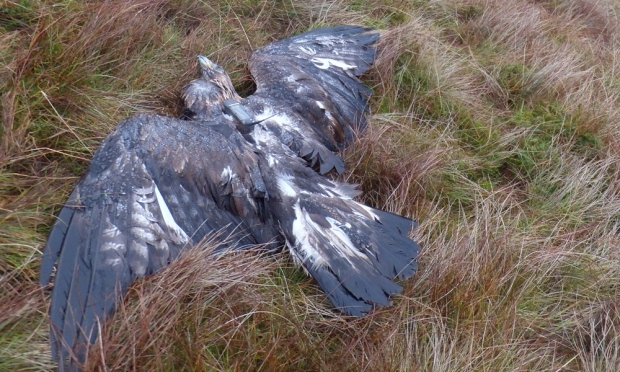
posioned GE Lethnot 2013

Pathetic fine & curfew order for kestrel chick thief

Here’s a very good example of how just how useless the court system is at addressing wildlife crime.

Last week at Wolverhampton Magistrates Court, 38-year-old Cogoo Sherman Bowen was fined £210 and given a six-week curfew after his conviction for being in possession of four x 2-week-old kestrel chicks.

He was caught with the chicks in the dead of night on 19th June in the grounds of St Mary’s Church in Bushbury. The police had been alerted to suspicious activity on the church roof and had turned up expecting to find metal thieves; instead they found the defendant in his car with the bag of kestrels.

Quick-thinking RSPCA officials and the police wildlife crime officer, PC Chris Watson, found the nest ledge on the side of the church and were able to return the chicks, which fledged safely several weeks later.

Great work by the investigating authorities but a pathetic result in terms of the magistrate providing any sort of deterrent to other would-be chick thieves or indeed a meaningful punishment to the convicted criminal in this case.

Full story in the Express and Star here

Sparrowhawk shot dead in Wrexham

SparhawkWrexhamThe BBC is reporting the fatal shooting of a kestrel in Wrexham, although judging by the photograph it appears the victim was a sparrowhawk, not a kestrel.

The critically injured bird was discovered by a member of the public on Thursday 29th August in Brynhyfryd, Johnstown and it died shortly afterwards.

The RSPCA Cymru are appealing for information. Tel: 0300 1234 999.

BBC News article here

Ireland publishes its first persecution report, with interesting results

94f6f996ec3a866ce6d587d28bd5b809_LThe Irish National Parks and Wildlife Service (NPWS) has published its first national raptor persecution report, relating to reported incidents in 2011.

The NPWS issued the following press release:

“33 poisoning or persecution incidents affecting birds of prey were recorded in Ireland in 2011, according to a report published today by the Department of Arts, Heritage and the Gaeltacht. 

15 birds of prey were confirmed poisoned, and four more suspected cases were recorded. 8 birds of prey were shot.

Some of the deaths were accidental, but many were deliberate. The most frequent casualty was the red kite, a native species that was recently re-introduced to Ireland. It is believed that seven of the ten kites found dead were poisoned by eating rats that had themselves been poisoned. As well as red kite, other raptor species that were deliberately targeted included peregrine falcon, buzzard, sparrowhawk, and kestrel.

The report is the result of cooperation between the National Parks and Wildlife Service, the Department of Agriculture, Food & the Marine’s Regional Veterinary Laboratories and the State Laboratory, and also involves An Garda Síochána, the Golden Eagle Trust and BirdWatch Ireland. 

The report notes that the use of tracking devices on birds has enabled dead birds to be found, but this also means that the true levels of mortality are likely to be significantly higher.

The use of poison has been greatly restricted under EU law in recent years. It is illegal to poison any animal or birds other than rats, mice or rabbits in Ireland and only then using certain registered products. The Campaign for Responsible Rodenticide Use has recently been set up with funding from industry. This campaign aims to promote best practice so that rat poison in particular should not get into the wildlife food chain where it harms owls, kites and other birds of prey.

The poisoning of golden and white-tailed sea eagles has been a particular problem in recent years, but fortunately in 2011, no poisonings were recorded. Records of poisoning and persecution in 2012 are currently being analysed and the second annual report is due for release shortly.

The Minister for Arts, Heritage and the Gaeltacht, Mr Jimmy Deenihan, T.D., welcomed the report. ”This gives us at least a partial view of the scale of the problem in Ireland”, he said. ”It is simply not acceptable for majestic birds of prey and other wildlife to be persecuted or poisoned. First it is illegal, but just as important it harms our reputation as a clean, green country. I would urge anyone to report such incidents to the National Parks and Wildlife Service in my Department. There are alternatives to poison which can be successfully used when control is essential ” he said.”

Here is a copy of the report: Persecution Report Ireland 2011

The publication of this report, and the anticipated future annual reports, demonstrates a basic but very important step forward, allowing the authorities and NGOs to monitor and record raptor persecution incidents in a coordinated effort, to help tackle the issue as well as to improve public awareness and education.

The report includes the usual list of victims and the substances that were used to kill them (Alphachloralose, Carbofuran etc) although we did notice one particular substance that was less familiar – Nitroxynil (also called Nitroxinil). As far as we understand, Nitroxynil is an active ingredient in the veterinary treatment of cattle and sheep, for example in sheep dips. According to this report, Nitroxynil  was detected in the carcases of three poisoned white-tailed eagles and one golden eagle, as well as in several recovered baits, including an egg and two lagomorphs (rabbit or hare).

It would appear, given that it was detected in different baits, that Nitroxynil has been used deliberately in Ireland to target any animal that might scavenge from a bait. It’s also possible that some of the deaths were from accidental poisoning, although fallen stock should not be left out on the hill.

We’re not certain, but we don’t recall seeing Nitroxynil listed in any recent toxicology reports published in Scotland by SASA. We don’t know if SASA tests for this substance when they’re presented with a potentially poisoned animal – it would be fair to say that SASA can’t test for every known poison due to resource constraints, and it’s reasonable for them just to test for the more commonly-used poisons. However, we have noticed in recent SASA reports that there are quite a number of birds for which SASA have been unable to establish the cause of death (i.e. the poisons they regularly screen for have not been detected) even though the circumstances of the bird’s death may have been suspicious. If SASA are not already testing for Nitroxynil, we hope that they pay attention to the frequency of detection in Irish cases and consider including it in the list of poisons for which they routinely screen.

Well done to the Irish NPWS and their project partners for getting this report published.

In Scotland we’re still waiting for the promised 2012 wildlife crime report from the Scottish Government. Environment Minister Paul Wheelhouse told the Police Wildlife Crime Conference in March 2013 that his staff were working on the report. Earlier this month, we asked him if he could tell us when we might expect to see it published (see here). According to our calendar (he has to respond within 20 working days), Mr Wheelhouse is due to provide a response to that question, and the other questions we posed, by this coming Wednesday…..

UPDATE 29th July: SASA are on the ball – they’ve recently started to test for Nitroxynil – see here.

Kestrel shot in North Yorkshire

North Yorkshire Police are appealing for information after a kestrel was found shot on Monday. The bird was found near the High Batts Nature Reserve at North Stainley, near Ripon, its wing shattered by shotgun pellets. It had to be euthanised by a vet.

North Yorkshire is one of the worst areas for raptor persecution crimes in the UK.

We’re impressed that North Yorkshire Police Wildlife Crime Officer PC Gareth Jones got the appeal for information out, in the media and on the North Yorks Police website, within 4 days of the bird being found. Really well done to him.

Anyone with information about this crime is urged to contact PC Gareth Jones – his details available in the following links:

Press release on North Yorks Police website here

Article in the Northern Echo here

Photo of kestrel hovering by davidchapman.org.uk

Landowners & gamekeepers claim ‘misrepresentation’ on BBC’s The One Show

One-Show-smallScottish Land and Estates and the Scottish Gamekeepers’ Association have written a letter of complaint to the BBC, claiming ‘misrepresentation’ on The One Show programme.
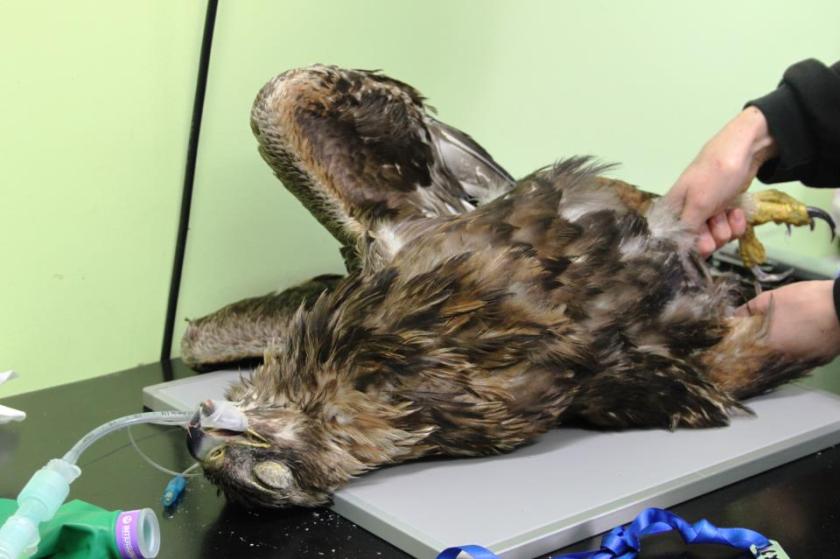
The programme (see here and here) included a feature on golden eagle persecution and during a studio interview, the RSPB’s Stuart Benn laid the blame firmly at the door of gamekeepers on Scottish grouse moors.

Doug McAdam, Chief Exec of Scottish Land & Estates, took great exception to that statement and wrote a hilarious letter of complaint, on behalf of SLE and SGA, to The One Show’s executive editor, Sandy Smith.

Here is his letter: SLE SGA complaint about BBC One Show

According to dear old Doug, there have only been four dead golden eagles found since 2010 and no charges [for these deaths] have been brought against anyone involved in grouse moor management. Conveniently, he failed to include the other known incidents of dead raptors turning up on grouse moors since 2010 (including white-tailed eagles, red kites, hen harriers, buzzards, short-eared owls, sparrowhawks, peregrines, kestrels), or the critically-injured golden eagle found shot and left to die on a grouse moor, or indeed the satellite-tagged raptors (particularly golden eagles and hen harriers) who have all gone ‘missing’ after their last known signal was received from, er, a grouse moor. There may well be more of these ‘missing’ birds but of course we’re no longer allowed to hear about them after the introduction of the new PAW Scotland ‘protocol’ that aims to keep these incidents away from the public’s gaze (see here).

Apart from trying to play down the extent of persecution incidents on grouse moors, and inferring that a lack of criminal convictions is a good indicator that gamekeepers are not involved with the illegal killing of golden eagles on grouse moors, Doug goes on to emphasise the SLE’s involvement with PAW Scotland, as though membership of that ‘partnership’ should be a measure of good behaviour. We’ve all seen how effective these ‘partnerships’ can be, following the near-extinction of breeding hen harriers on English grouse moors during the six-year Hen Harrier Dialogue ‘partnership’ designed to resolve the conflict. Indeed, three raptor conservation organisations have now resigned from that particular ‘partnership’ because they recognised it could be used as a convenient political cover by certain organisations with grouse-shooting interests.

Doug makes an astonishing claim about the PAW Scotland partnership: “Our combined efforts with the police, rural communities, the RSPB and over 120 other relevant stakeholders have been universally acknowledged as a key factor in reducing the number of raptor persecution incidents“.

Talk about misleading! For a start, there are not 120 ‘relevant stakeholders’ in relation to addressing raptor persecution. Many of the stakeholders have absolutely no involvement in directly addressing raptor persecution – they are there to specifically address other types of wildlife crime such as poaching, theft of freshwater pearl mussels, bat persecution and badger persecution.

Secondly, where does this notion come from that work by PAW Scotland has been ‘universally acknowledged as a key factor in reducing the number of raptor persecution incidents’? Has it been ‘universally acknowledged’? We don’t think PAW Scotland has had any demonstrable impact whatsoever on the number of raptor persecution incidents – where’s the evidence? Perhaps by ‘universal’ he means those with a vested interest in having people think that illegal raptor persecution is being dealt with effectively (e.g. the police, SNH, Scottish Government, SLE, SGA etc etc).

Doug finishes by saying, “Owners of moorland estates all over Scotland look after golden eagles” (ahem) and he invites Sandy Smith to visit a grouse moor “to find out for yourself the valuable conservation measures being implemented“. Let’s hope Sandy takes him up on his offer. Ooh, which grouse moor to choose? We could give Sandy quite a few suggestions….

Sandy Smith responded with a letter of his own: One Show’s reply to SLE

He says he’s sent an email to all One Show staff and suppliers “asking them to ensure they don’t make assumptions about gamekeepers based on out of date or inaccurate assumptions“.

Interestingly, Sandy Smith was the former executive editor of Panorama – a programme recognised for its investigative journalism and an ability to differentiate between fact and PR. Let’s hope he’s taken those qualities with him to The One Show.

We’ve sent a letter to Sandy, giving him the URL of this blog, to ensure his staff are kept up to date and are not basing their work on inaccurate assumptions (spin). You may wish to do the same – send your email, marked for the attention of Sandy Smith, to: TheOneShowEmails@bbc.co.uk

If you think grouse moor owners and their gamekeepers need to be held to account for their activities, please sign this e-petition and share it with your friends and colleagues: SIGN HERE.

Here’s a photo showing how well golden eagles are looked after on some Scottish grouse moors. This one was found critically injured on Buccleuch Estate last aututmn – he had been shot and left to die, although it is not known on whose land he was shot. He is currently recuperating with the SSPCA after undergoing life-saving surgery. Needless to say, nobody has been charged for this crime.

The shot golden eagle undergoing emergency surgery

Hen harrier found shot dead on Yorkshire grouse moor

A young hen harrier has been found shot dead on a Yorkshire grouse moor. Regular blog readers will not be surprised to learn that it has taken over 5 months for an appeal for information to be made by North Yorks police.

The harrier was raised in a nest in Bowland, Lancashire in 2011. She was nick-named ‘Bowland Betty’ and was fitted with a satellite tag as part of Natural England’s so-called ‘Hen Harrier Recovery Project’. During her first year of life she was tracked through the uplands of Northern England and as far north as Caithness in northern Scotland. In June 2012 she was back in the Yorkshire Dales. Predictably, by late June her sat tag data suggested she was stationary and her dead body was found on 5 July on Thorny Grain Moor in Colsterdale in the Yorkshire Dales. Post-mortem results confirmed she had been shot.

This area is dominated by moorland managed for grouse shooting. We understand her body was found on Swinton Estate, although it is not known where she was actually shot as she could have flown for several miles before succumbing to her injuries.

RSPB and government data show the Yorkshire Dales as a hot spot for illegal raptor persecution, with at least 20 birds of prey illegally poisoned, trapped or shot between 2007-2011. This figure includes 10 poisoned red kites, 4 poisoned buzzards, 2 shot red kites, 2 shot buzzards, 1 shot kestrel and 1 trapped sparrowhawk. In addition there were at least 4 incidents of poisoned baits and a number of dogs were also poisoned.

Hen harriers have been tracked from Bowland since 1999. Wing tags were used to monitor hen harrier dispersal and survival between 1999-2002 (data from at least 42 birds). From 2002-2010, 118 hen harriers have been tracked either via radio transmitter or satellite tag. Astonishingly, Natural England have released very little detail about the results of this project, ten years on. They did produce a report in 2008 (see here) although this related to hen harriers over a broad geographic area and didn’t include specific detail about individual birds. What happened to all those birds? Where are their data? Why, when a satellite tag suggests that a harrier’s movements are suspicious (i.e. it’s been stationary on a grouse moor for several hours), do NE researchers have to seek the estate owner’s permission before they can go and search for the (presumably dead) bird? We’ve used an analogy before but it’s worth repeating – would you expect a police officer to call ahead to a suspected drug dealer to ask permission to go and search his house?

We all know only too well what will happen now. The death of this harrier will be added to the never-ending list of illegally-persecuted raptors found dead on UK grouse moors. Nobody will be prosecuted for shooting it. The public will express outrage for a few days but it’ll soon be forgotten, just like all the others that have been illegally killed before and all the others that undoubtedly will be killed in the future. The people who hold the positions of power that could bring this disgraceful practice to an end will continue to show wilful blindness and downplay the extent of the problem. The police will continue to form ‘partnerships’ with organisations who harbour the criminals responsible for this systematic killing. Nothing will change. Tune in next month to read about the latest victim. (Actually, tune in later this month….)

What can we do? The only thing we can do is to keep publicising these incidents. We can all play a part; don’t leave it to someone else. Tweet it, Facebook it, blog it, talk about it, email your MP about it. Do it.

RSPB Scotland: 2011 persecution report published

RSPB Scotland has just published its latest report, The Illegal Killing of Birds of Prey in Scotland in 2011. You probably won’t be surprised or shocked by the content, especially if you’ve read the previous 17 annual reviews. In fact, when you read this 18th review, you might get a strong sense of déjà vu.

It opens with a Foreword by Stuart Housden, Director of RSPB Scotland. Apart from the new photo, this foreword looks like a cut and paste job from the 2010 report, with a few words or sentences added or adjusted. To be fair, not much has changed since the 2010 report was published so perhaps he felt justified in repeating what he’d written the previous year.

Then there are RSPB Scotland’s strategic recommendations for addressing raptor persecution. Again, these show a remarkable similarity to the recommendations made in the 2010 report, and also in the 2009 report. The recommendations were / are still good and to see them repeated again is a useful indicator of how little progress has been made by those with the power to push them forward.

Next come the tables showing the confirmed and probable persecution incidents recorded by the RSPB during 2011. It’s these tables that the game-shooting lobby usually object too – they’re especially reluctant to accept the ‘probable’ incidents although to date, they’ve failed to provide a convincing argument to account for any of them.

The data in the 2011 tables demonstrate once again that illegal raptor persecution is widespread, with incidents reported in Perthshire, Angus, South Lanarkshire, Aberdeenshire, Dumfries-shire, East Ayrshire, Borders and Inverness-shire. We counted 15 very familiar-sounding locations within these regions, although there are a few notable absentees this time. Have they stopped their criminal activities or have they just got better at covering up? Time will tell.

Just focusing on the confirmed incidents, in total 17 incidents of deliberate poison abuse were confirmed during 2011, involving 20 victims: 7 buzzards, 4 red kites, 1 golden eagle, 2 peregrines, 2 ravens and 4 other bird species. Sixteen other illegal incidents relating to shooting, nest destruction, and the use of uncovered spring traps or cage traps were confirmed. The victims included 8 buzzards, 2 peregrines, 1 goshawk, 1 sparrowhawk, 2 kestrels and 1 short-eared owl. As in previous years, not all of these incidents were publicised at the time they occurred. It’s a continual disappointment that several years have to pass before the public learns of these appalling crimes.

Once again the occupations and interests of those convicted for illegal raptor persecution crime have been analysed (data from 2003-2011 inclusive). 87% of them were gamekeepers (7% pigeon racers, 3% pest controllers, 3% farmers).
The report includes an interesting case study of poisoned raptors that have been found in recent years on the Glen Kyllachy and Farr Estate near Inverness. Very little of this information has been previously published and certainly this is the first time these photographs have been published. It’s a shame it’s taken several years for the info and images to reach the public domain but nevertheless it’s very encouraging to see RSPB Scotland highlight these cases, especially as Northern Constabulary hasn’t bothered.

All in all the report makes for grim reading, but nobody should be surprised by that. We all owe a large debt of gratitude to the RSPB’s Investigations Team for meticulously collecting these data and especially for making them publically available.

TO DOWNLOAD A COPY OF THE REPORT CLICK HERE

Here’s some media coverage:

RSPB Scotland press release here

BBC news article here

STV news article here

Herald Scotland article here

Scottish Gamekeepers Association: statement here

Scottish Land and Estates: nothing yet

@SNHMedia: “SNH report finds vast majority of gamekeepers highly qualified”. Link to this.

PAW Scotland: nothing yet

Raptor Persecution: still a national disgrace

The following article has been published in the autumn edition of Wild Land News, the magazine of the Scottish Wild Lands Group (visit their website here). The magazine should be posted online in the near future and we’ll provide a link when it’s available. Congratulations to the SWLG’s magazine editor, Calum Brown, for providing a platform for this subject. UPDATE: Magazine now published online. Link here.

Raptor Persecution: Still A National Disgrace. By Bob McMillan.

Bob McMillan has had a lifelong interest in birds of prey. He retired as Assistant Chief Constable in Tayside Police in 1998 at which time he was the ‘lead officer’ on wildlife crime in Scotland on behalf of ACPOS. He represented Scottish Raptor Study Groups on PAW Scotland and the Raptor Priority Persecution Group until 2011. He now lives on Skye and runs the website www.skye-birds.com

My childhood in the 1950s had been spent in a rural village near Dunblane in south Perthshire surrounded by sporting estates. To see a Buzzard or a Kestrel was a rarity, let alone a Hen Harrier. An early interest in birds was cultivated by older friends, one of whom had found breeding Harriers on a moor on the nearby Cromlix estate. He subsequently studied and photographed the birds, much to the consternation of the local estate which eventually took out a civil action and interdicted him from the ground. Twice prosecuted for breach of interdict, the case remains unique amongst individuals who have put themselves on the line to protect birds of prey from the illegal actions of gamekeepers and sporting estates.

Eddie Blake from Dunblane died recently. Somewhat eccentric, he received little support for his actions from the ornithological establishment who shunned him. In 1952 Blake had recorded the first breeding record of Montagu’s Harrier in Scotland on Braco Moor. Though the pair returned the following year, the female was shot. There have only been five recorded breeding attempts in Scotland and the last of these was in 1955. Montagu’s Harriers might still be breeding in Scotland today were it not for persecution, but rarely merit a mention alongside formerly extinct species such as Osprey, Red Kite and White-tailed Eagle.

When I joined the police service in 1963 my final interview was by the Chief Constable at Callander Police Station. Bedecked in tweeds and with two spaniels at his heels, George Glendinning was every inch the country squire. Any discussion about Blake’s interdict was strictly off limits but I later learned that Glendinning was a regular shooting guest on Cromlix estate. The influence of landowners on local policing was profound in the 1960/70s and vestiges of it remain today. Rural police officers had access to free fishing and shooting, which invariably meant an immediate response to suspected poachers, or for that matter, to ‘suspicious trespassers’ who were simply enjoying their Scottish right to roam. Many gamekeepers were Special Constables. Rural shoots in Perthshire would have been unsustainable had it not been for the many police officers who acted as ‘beaters’ at pheasant shoots on their days off. Though trained and aware of wildlife crime, such cultural influences would make them strongly anti-poaching, and more likely than not to turn a blind eye if an occasional Sparrowhawk was accidentally ‘taken out’ during a Pheasant drive. The police response to reports of illegal trapping or poisoning of birds of prey, up until the end of the 1980s, was likely to be ambivalent. Some raptor enthusiasts would argue it remains fairly unpredictable to this day.

Despite most raptors having legal protection since 1954, persecution by gamekeepers and those with sporting interests in grouse moors and lowland estates remains a major problem. In 1998 Scottish Raptor Study Groups carried out an assessment of the extent of the illegal killing of raptors in Scotland. Published by the Scottish Office, it was launched at the Scottish Wildlife and Countryside Fair at Kinross, where the late Donald Dewar, then Secretary of State for Scotland, expounded the view that persecution of birds of prey was a national disgrace. As a retiring Assistant Chief Constable in Tayside Police, who took the lead on wildlife crime in Scotland, my last public duty was to meet Donald Dewar at the event. In the context of the persecution of raptors, this was a major political statement, and the expression “a national disgrace” was used by many others subsequently. The reality was that the expression had been conjured up by a senior civil servant and Donald Dewar posed the question as to whether he could actually say it. The fact that he decided to say it represented a major politicisation of the issue, though not necessarily a turning point.

Having found my first poisoned Golden Eagle at an eyrie in Perthshire 40 years ago these problems were not new to me, as was the case for other raptor enthusiasts. What was new, however, was that senior politicians and officials of agencies such as Scottish Natural Heritage were, for the first time, prepared to speak out against the problem. Raptor persecution was by no means rare, and the killing of adult birds and destruction of nests continued or even increased during the 1990s. Donald Dewar also said that the Government, and the soon to be Scottish Parliament, “will take all possible steps to eliminate persecution.” Fifteen years on from this statement, perhaps finally, some progress is being made.

The Partnership for Action on Wildlife Crime (PAW) brings together the Police, HM Revenue and Customs, and representatives of Government Departments and voluntary bodies with an interest in wildlife law enforcement. It provides a strategic overview of enforcement activity, considers and develops responses to strategic problems, and looks at issues of strategic concern. Its main objective is to support the networks of Police Wildlife Crime Officers (PWCO). As part of the overall UK-wide structure, PAW Scotland has existed for at least 20 years. Although it has been responsible for many preventive initiatives post-devolution, and despite Donald Dewar’s commitment, it lacked strategic support from a number of the key agencies.

Since the SNP administration came to power that has significantly changed, initially under the leadership of the then Minister for Environment Michael Russell and, since then, through subsequent ministers. A major turning point was the Borders Golden Eagle poisoning incident in 2007 which led to two parliamentary debates on Wildlife Crime and the police thematic inspection ‘Natural Justice’. This led to the publication in September 2008 of the Scottish Wildlife Crime Reduction Strategy which is being implemented through a PAW Scotland plenary and executive group, and a number of sub-groups.
The persecution of raptors had been a major factor in influencing this new strategic commitment, and although a Raptor Persecution Priority Group was established, it has been slow to make progress and is still to report. The pro-shooting lobby has been extremely influential within PAW Scotland and within this group. In terms of the protection of raptors, much of this has muddied the waters and not been particularly constructive. Whilst it is important to have a partnership approach to deal with these problems, some question whether it is appropriate that the perpetrators, in the main gamekeepers and the sporting estates which condone these crimes, should be part of it. (More details of the work of PAW Scotland can be found at http://www.scotland.gov.uk/Topics/Environment/Wildlife-Habitats/paw-scotland/).

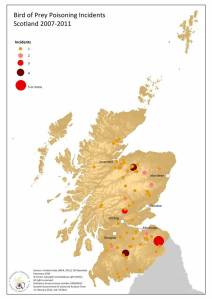
The accurate recording of wildlife crime incidents involving raptors is a major challenge and most will be aware that the RSPB in Scotland produce an annual report. Annual maps of incidents (‘maps of shame’) can also be found on the website above. A major challenge is to make sure that all wildlife crime incidents are reported to the police, preferably to Wildlife Crime Officers who are known locally. It is equally important to make sure that RSPB Investigations staff are also aware of any incidents reported to the police. Wildlife crimes such as suspected shooting or poisoning of birds, destruction of nests or eggs, or reckless disturbance should be reported at the time and without delay. The remains of dead birds of prey, irrespective of age or condition, may be important evidence and require forensic examination. Advice on what to do if you find a suspected incident is available on the PAW Scotland website.

Recently-published research showed that illegal persecution remained particularly prevalent on grouse moors, and for raptor workers and those who visit wild land this is perhaps nothing new. The recent recovery of a poisoned Golden Eagle in Morar and a shot White-tailed Eagle on Skye confirms that birds are at risk throughout the Highlands, not just on sporting estates. Some local populations face the prospect of significant decline unless action is taken. In areas of Scotland such as the Black Isle the re-establishment of the Red Kite continues to be jeopardised by illegal persecution, and each year brings further reports of the destruction of Hen Harriers and Peregrines.

Satellite telemetry is now being used extensively on several species of birds of prey, primarily intended to trace the movements of young birds to gather information which assists their long-term conservation. An unintended outcome from this new science is that when signals indicate a bird has stopped moving, follow-ups have established that birds have been trapped, shot and poisoned. Without satellite telemetry these crimes would never be known about. The Golden Eagle ‘Alma’, poisoned in 2009, is one such example. Unfortunately a significant number of recent persecution casualties involving our large raptors have been found in this way, supporting the argument that reported incidents represent the tip of the iceberg.

The ‘Natural Justice’ thematic inspection recommended dedicated Wildlife Crime Officers in every force. The reality is there are now fewer WCOs than existed when the inspection was carried out. Strathclyde, the largest force in Scotland, have had no full-time post for some years. With a single national police force just months away there is little evidence that there is any genuine commitment on the part of the police service to meet many of the earlier recommendations. Whilst we can work in partnership, increase awareness, improve legislation and ensure landowners and employers accept vicarious responsibility, we can achieve nothing without a properly trained and professional police service which can rise to the challenge. Regrettably, the number of successful prosecutions remains extremely low, and there is a need to ensure that, in terms of enforcement and investigation, the limited resources dedicated to this field of work are properly supported so that much of the political and public relations rhetoric can be converted into tangible results.

I was part of a delegation from Scottish Raptor Study Groups which met Roseanna Cunningham when she was Minister for Environment in November 2010, and we recommended that a dedicated investigative unit be established, comprising trained WCOs and specialists from the RSPB, SSPCA and SNH, with a remit to cover the whole of Scotland, untrammelled by force boundaries. Many will argue, politicians amongst them, that only a few rogue estates and gamekeepers are involved, but any review of the so-called ‘maps of shame’ and the RSPB maps which preceded them, would find that hundreds of estates have been involved in incidents during the last ten years. Uniquely, there are also several estates with histories of persecution going back 30 years. As long as the police have responsibility to investigate such crimes, there is a need for them to develop a cutting edge and target the perpetrators. There would never be a better time to establish a specialist unit than now.

Some fifty years on from my childhood days in south Perthshire I will certainly be able to see Buzzards, Kestrels, Sparrowhawks and even Red Kites when I visit. Unfortunately Hen Harriers remain absent from the moors of Cromlix and Braco. Golden Eagles show little sign of expanding their range, and there is a real risk that fifteen years on from the branding of the problem ‘a national disgrace’, the fate of some of the iconic species which occupy our wild land remains in the balance.

Dear Diary…

Here’s a rare opportunity to look into the world of  the ‘modern’ gamekeeper. These are extracts taken from a Scottish gamekeeper’s diary. We were shown these diaries by someone from within the keepering world who wishes to remain anonymous, for obvious reasons. Worryingly, the diary-writer is still currently employed as a full-time gamekeeper. We’ve split the entries into different years – the following is from 2008. See how many wildlife crime offences you can spot:

Thurs 3rd January: set baits in Glen S & right hill

Sat 5th January: John P came for rabbits & Alpha

Weds 16th January: Gassed fox at Black Brae Lower

Fri 25th January: Eggs out on Top Moor + rabbit for crows by Big Wood

Fri 1st February: Lifted eggs Top M & set out at edge of Middle.

Tues 5th February: Shot dog Glen S.

Mon 11th February: Lifted eggs Top M. Shot kestrel.

Tues 19th February: Baits out at Harry’s, rabbits & hares

Thurs 21st February: Pick up gins from Glen side. Got female peregrine.

Fri 29th February: Done traps at S Corner and more eggs out. Saw pair peregrines at Millers.

Sat 1st March: baits out with Jim at Middle. Missed a cock harrier. Staked pigeon at Millers.

Sun 2nd March: Got peregrines at Millers. Eggs out on Broadfield.

Tues 4th March: Got 2 buzzards, 2 rooks + 9 crows. Rabbit out for others.

Fri 7th March: Got a vixen at T Moor. Put out birds by low fence.

Sun 9th March: Eggs at Glen side again.

Weds 12th March: Eggs up, tracks seen. Done baits at Gordon’s. Sheep shot for midden 3.

Thurs 13th March: Got buzzard at Becks. More rabbits out. Alpha.

Sat 15th March: Picked ups crows & eggs Langsmere. Saw 2 harriers.

Tues 18th March: Set eggs JB & baits southside.

Weds 19th March: Got a cat on Red moor.

Thurs 20th March: Got SE owl & set 59 eggs Lower bank.

Sat 22nd March: 1 harrier at Langsmere. Merlins at Merv’s.

Mon 24th March: Snares at Glen side. 26 foxes so far.

Tues 25th March: Missed harrier at Langsmere. Baited Broadfield again.

Thurs 27th March: Got a badger with John S. He heard gos behind Big Wood.

Fri 28th March: Lifted eggs Lower bank. More set at Harry’s.

Mon 31st March: Crow cages out Big Wood.

Wed 2nd April: Harrier trap empty.

Thurs 3rd April: Pair eagles seen southside.

Fri 4th April: Put eggs T Moor. Shot rabbits for baits.

Sun 6th April: Crow cages done. Eggs checked.

Weds 9th April: Baits out Glen side. Tom collected pigeons.

Fri 11th April: Got buzzards at JB.

Tues 15th April: Gos in crow cage. Gave it to PL.

Fri 18th April: Baited traps & re-did snares.

Tues 22nd April: Eggs & hares out in the Sloughs.

Sun 27th April: Eggs lifted Sloughs.

Fri 2nd May: Put out more baits.

Sat 3rd May: Pigeons staked upper side. Got tiercel.

Weds 7th May: Set eggs.

Thurs 15th May: Put baits out at Bothy.

Sat 17th May: 3 buzzards in crow cage. Re-set.

Thurs 22nd May: Two Peres at Glen side. Got one.

Weds 28th May: Eggs lifted more baits out. Rabbit gone at Bothy.

Mon 2nd June: Set pheasant eggs at Big Wood. Did crow traps.

Sun 8th June: Litter of foxes gassed behind GateBridge.

Fri 13th June: Partridges into pen.

Mon 23rd June: Put eggs out Broadfield.

Weds 2nd July: Gassed another litter with Paul at Stebb’s.

Fri 1st August: Got a short eared owl. Lifted eggs Broadfield.

Tues 5th August: Moved crow cages to RT.

Sun 10th August: Spar caught. Trap re-set.

Fri 12th Sept: 42 brace at Sam’s but harrier seen.

Fri 26th Sept: New snares out.

Thurs 2nd Oct: Two eagles seen Glen S. 1 buzzard in crow trap at T Moor.

Tues 7th Oct: Hare baits out Langsmere.

Thurs 16th Oct: Shot sheep for midden 3.

Mon 20th Oct: Pigeons 5pm

Weds 22nd Oct: Shot a kestrel at Sam’s.

Fri 31st Oct: Merlin pair done North Bothy.

Sat 8th Nov: 6 pigeons put out Big Wood.

Tues 25th Nov: Baits out with Paul.

Fri 19th Dec: Put grouse on T Moor.