Minutes of meeting between Cairngorms National Park Authority & Scottish Gamekeepers’ Association

ALMDLast month we blogged about a comment that had been made during an official meeting between the Cairngorms National Park Authority (CNPA) and the SGA. The comment came from a CNPA Board member (Eleanor Mackintosh) who was advising the gamekeepers to ‘cover up’ dead mountain hares so that photographs of the corpses couldn’t be published on social media (see here).

That meeting between the CNPA and the SGA was triggered by the SGA’s anger over a blog that had been written by Will Boyd Wallis (CNPA’s Head of Land Management & Conservation) in August, where Mr Boyd Wallis had raised legitimate concerns about some aspects of intensive grouse moor management (see here).

The SGA was furious about that CNPA blog, for a number of reasons (see below). The SGA asked for a meeting with the CNPA to discuss these concerns and the meeting was arranged, apparently after the ‘intervention‘ of Fergus Ewing MSP, who is Cabinet Secretary for the Rural Economy & Connectivity, but whose remit does not cover the National Parks (Cabinet Secretary Roseanna Cunningham has responsibility for the National Parks).

Chairman of the SGA, Alex Hogg, wrote to the CNPA requesting a meeting. We got a copy of his letter via an FoI request and here it is: sga-letter-requesting-mtg-with-cnpa-sept-2016

It’s an entertaining read. In it, Alex claims there’s no need for concern about the potential environmental harm of dumping tonnes of medicated grit on to the grouse moors because there’s no scientific evidence to show any damage. He also suggests that if the CNPA was concerned about potential environmental damage then the CNPA would be looking at the issue of dogs and livestock (which have also been wormed) defecating all over the Park. Hmm. If dogs and livestock had been wormed every day with a drug that was 10-20 x the strength permitted for use in the UK, and those piles of faeces were placed at every 100 metres across the grouse moor, for up to eight months of the year, as are piles of medicated grit put out for red grouse, then he might have had a valid point. Unfortunately for Alex, there is growing scientific evidence that the drug used in medicated grit (Flubendazole) is actually highly toxic to some aquatic organisms (e.g. see here) and, given the extent of its use on intensively managed grouse moors, this is exactly why Leeds University is offering a PhD scholarship to examine this issue in more detail (see here).

Anyway, on to the actual meeting itself. This took place on 29 September 2016 at Glenlochy in the National Park (an interesting choice of venue given the raptor persecution crimes that have been recorded in the area). In attendance were several representatives of the CNPA, several from the SGA, including Bert Burnett, some gamekeepers, and local SNP councillor Geva Blackett, who used to work as the SGA’s Parliamentary Officer many moons ago and who is married to Simon Blackett, the (now retired) Estate Factor at Invercauld Estate.

The minutes can be downloaded here: minutes-cnpa-sga-mtg-29-sept-2016

These minutes are well worth a read, not just because they expose the buffoonery of the SGA, but also because they provide an insight to the astonishing display of deference from the CNPA officials towards the SGA.

The meeting covered many topics and we won’t go in to all of them here because you can read them for yourselves and have a good giggle (whatever you do, don’t diss red grouse by calling them willow grouse!). The main thing we want to focus on is the discussion about gamekeepers getting licences to monitor and ring raptors and waders within the National Park.

Geva Blackett is pushing the CNPA to support this idea, and according to Bert Burnett, “no training is needed”. He really doesn’t have a clue, does he?!  The CNPA seems equally as ignorant, claiming that they’d like to support this initiative because they’d like to know about raptor numbers within the Park. Er, have they not heard of the award-winning Scottish Raptor Monitoring Scheme? A multi-partner scheme that holds all the raptor monitoring data collected across Scotland? Apparently not.

What’s even funnier about the SGA’s demands to get licences is that just this week, Bert Burnett and a couple of his cronies (including a convicted falcon thief) have launched a social media campaign designed to portray raptor fieldworkers in a negative light. They’ve trawled the internet and come up with some old photographs of raptor tagging activities (one photo is at least 13 years old!) and have made wholly unsubstantiated allegations about the behaviour of those featured in the photographs (unbeknownst to Bert, one of the photographs is actually from a project in North America, not from Scotland!). Apparently, these nest visits cause birds to desert. Hmm. And the evidence for that is where, exactly?

Bert has also claimed that raptor monitoring, ringing and tagging is “completely unregulated and those doing it are totally non accountable for their actions”. This exposes Bert’s lack of knowledge about the training and qualifications needed for this work, and also his ignorance about the high level of reporting required by the licensing authorities.

Strange, isn’t it, that if Bert thinks all this monitoring and ringing is ‘bad’, that at this meeting with the CNPA he is pushing for gamekeepers to be issued with licences to do the same work!

And if Bert/the SGA and co are so upset about satellite-tagging, why are they not kicking off about the GWCT’s woodcock satellite-tagging project?

And if Bert/the SGA and co are so upset about the ‘welfare’ of satellite-tagged golden eagles, why do we never see them kicking off about eagles that have been found poisoned, shot or trapped on driven grouse moors?

What is obviously going on here is a desperate little smear campaign designed to coincide with the forthcoming review of raptor satellite tag data, as requested by Cabinet Secretary Roseanna Cunningham (see here). This review, due out in the spring, is expected to be damning. We already know that many satellite-tagged raptors ‘disappear’ on grouse moors, and we also know that many satellite-tagged raptors have turned up either poisoned, shot or trapped on grouse moors. This review will pull all of those data together and it is predicted to be a shocking read.

The SGA knows this, hence these latest tactics to try and discredit the raptor workers.

Now, what was it that Tim (Kim) Baynes of the Scottish Moorland Group told that parliamentary committee last week? Ah yes, it was this:

We would very much like to see greater cooperation between ourselves, the Raptor Study Groups and the RSPB“.

It’s pretty clear the SGA has not received this message, or if it has, it’s chosen to ignore it.

But you carry on, Bert, because what you’re doing is political suicide. By asking your cronies to send (no doubt illiterate, baseless rants) to Roseanna Cunningham, complaining about Scottish Raptor Study Group members, she will see that the SGA is trying to undermine her review of the satellite tag data, and she’ll also recognise that the SGA’s claims of ‘partnership working’ with other members of the PAW Raptor Group are nothing more than lip service. PAW partners? Piss-poor partners, more like.

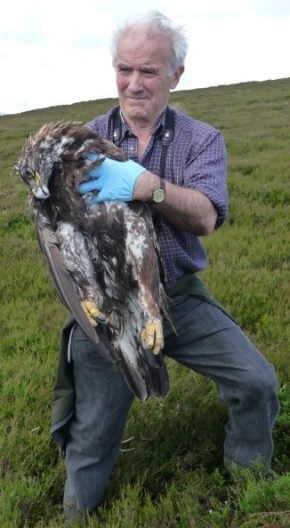
Photograph: dead golden eagle ‘Alma’, found poisoned on a grouse moor on Millden Estate in the Angus Glens. Her corpse was only found because she was wearing a satellite tag, fitted by Scottish Raptor Study Group member and internationally-recognised expert Roy Dennis. It’s no surprise then, that the SGA wants to put a stop to satellite-tagging.

Illegally-set traps on Invercauld Estate: not another cover up?

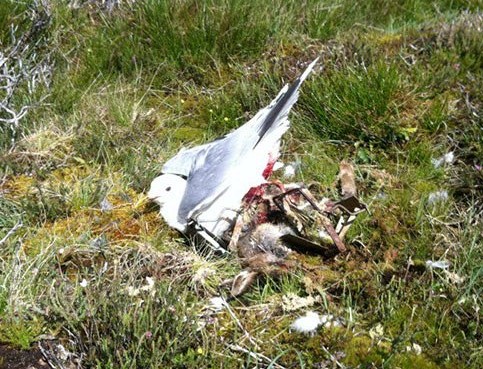
Cairngorms Invercauld - CopyIn July we blogged about the discovery in June of a critically-injured Common gull that had been found caught in two illegally-set spring traps on Invercauld Estate in the Cairngorms National Park (see here).
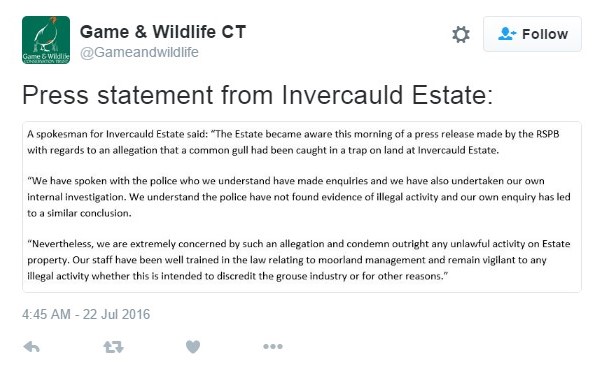
We also blogged about a bizarre press statement from Invercauld Estate (issued via the GWCT’s twitter feed) in which they denied any illegal activity had taken place or if it had, it was perhaps a set-up ‘intended to discredit the grouse industry‘ (see here).

We also blogged about the Scottish Gamekeepers’ Association’s response, which was an announcement that they would conduct their own enquiry before commenting further (see here).

We also blogged about Police Scotland’s view that a Common gull had been found caught in an illegally-set trap but ‘despite a thorough investigation‘, Police enquiries had failed to find further evidence to proceed with a potential prosecution and ‘there are at present no further investigative opportunities available‘ (see here).

In September, through a series of FoIs, we uncovered a very interesting letter, dated 27 July 2016 and written by Angus McNicol, who identified himself as the Estate Manager for Invercauld Estate. The letter was addressed to the Cabinet Secretary for the Environment, Roseanna Cunningham. A copy of the letter was also sent to the Cairngorms National Park Authority (CNPA). It was written, in our view, to reassure the Cabinet Secretary and the CNPA that Invercauld Estate takes wildlife crime very seriously and that they’d ‘taken action’ in this case. The specific action taken was unknown (to us) because that part of the letter had been redacted. We’ll come back to this.

Since then, it all went quiet, apart from a persistent rumour (we’ve been told this by five separate, well-informed sources) that a gamekeeper had been sacked as a result of this incident. This claim has also been made on the ParksWatchScotland blog (here), which says: ‘Unusually, the gamekeeper in this case has been dismissed, although he apparently has not been charged‘.

Hmm. Naturally, we wanted to find out if this rumour had any basis.

We knew that Grant Moir (CNPA Chief Executive) had asked for a meeting with Invercauld Estate and the sporting partner ‘to discuss the issue’ of the illegally-set traps – he had said so in a press statement in July (here). Perhaps the minutes from that meeting would reveal whether a gamekeeper had been sacked, so we asked, via FoI, for a copy of those minutes.

We received a response from the CNPA in mid-November which confirmed that two meetings had indeed taken place:

Meeting 1 (22 August 2016) with the following people present: Peter Argyle (CNPA Convener), Grant Moir (CNPA Chief Executive), Hamish Trench (CNPA Director of Conservation & Visitor Experience) and Invercauld Estate’s sporting partner from the Micras beat (his name was not given).

Meeting 2 (25 August 2016) with the following people present: Peter Argyle (CNPA Convener), Grant Moir (CNPA Chief Executive), Hamish Trench (CNPA Director of Conservation & Visitor Experience), the Chair of Trustees for Invercauld Estate (name not given) and the Manager for Invercauld Estate (name not given but presumably this was Angus McNicol, the author of the letter from Invercauld Estate to the Environment Cabinet Secretary).

According to the CNPA’s response to our FoI, ‘The purpose of both meetings was to discuss the recent incident and understand the actions taken by the estate and sporting partner. As a result of the meetings we will now be meeting with the other sporting partners on Invercauld Estate‘.

Interestingly, according to the CNPA, there isn’t a record of the minutes from either of these meetings.

So, we’re still none the wiser about whether a gamekeeper was sacked by Invercauld Estate, which brings us back to that redacted letter from Invercauld Estate to the Cabinet Secretary. Was the readacted part of that letter a statement from Invercauld Estate, saying that they’d sacked a gamekeeper as a result of this incident?

If so, that’s incredible. A wildlife crime took place on Invercauld Estate in June 2016 (that’s undeniable). Has Invercauld Estate identified a suspect and sacked him/her? And if so, does the Scottish Government know about it, does the Cairngorms National Park Authority know about it, and does the Scottish Gamekeepers’ Association know about it (given they were conducting their ‘own enquiry’ in to this incident back in July)?

The question then becomes, does Police Scotland know about it, and if so, will they be prosecuting? If not, why not?

Some transparency about this case wouldn’t go amiss.

An interesting letter from Invercauld Estate

In July we blogged about the discovery in June of a critically-injured Common gull that had been found caught in two illegally-set spring traps on Invercauld Estate in the Cairngorms National Park (see here).
Cairngorms Invercauld - Copy

We also blogged about a bizarre press statement from Invercauld Estate (issued via the GWCT’s twitter feed) in which they denied any illegal activity had taken place or if it had, it was perhaps a set-up ‘intended to discredit the grouse industry‘ (see here).

We also blogged about the Scottish Gamekeepers’ Association’s press statement, which said the SGA was conducting its own enquiry (see here).

We also blogged about Police Scotland’s view that a Common gull had been found caught in an illegally-set trap but ‘despite a thorough investigation‘, Police enquiries had failed to find further evidence to proceed with a potential prosecution and ‘there are at present no further investigative opportunities available‘ (see here).

So that looked like the end of it. Until, through a series of FoIs to the Scottish Government and the Cairngorms National Park Authority, a very interesting letter has emerged.

The letter, dated 27 July 2016 (so a week after the original story had broken) was written by Angus McNicol, who identifies himself as the Estate Manager for Invercauld Estate, and was addressed to the Cabinet Secretary for the Environment, Roseanna Cunningham. A copy of the letter was also sent to the Cairngorms National Park Authority. It’s a fascinating read.

Here is a copy of the letter: Invercauld Estate letter

Having read it, our first question was, ‘Why was this letter written?’ That’s a hard question to answer because we can’t get inside Mr McNicol’s head to read his thought processes. We can, though, speculate about the intentions. In our opinion, this letter was written to reassure the Cabinet Secretary that Invercauld Estate takes wildlife crime seriously and they’ve done something about it.

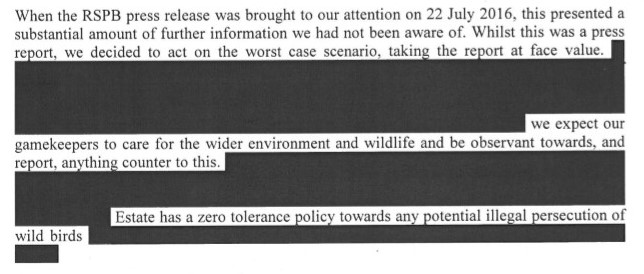
You’ll see that one paragraph in this letter has been partially redacted (by the Scottish Government – and, incidentally, the copy of the letter received from the Cairngorms National Park Authority was redacted in exactly the same place). It’s this partial paragraph that interests us the most. Here it is:

Invercauld redacted

Let’s focus on the sentence immediately before the redaction begins. “Whilst this was a press report, we decided to act on the worst case scenario, taking the report at face value“. Assuming that the ‘worst case scenario‘ might have been that an Estate employee was responsible for illegally setting the traps, the Estate ‘decided to act‘. What action they took is unknown, because that bit has been redacted. But interestingly, the word ‘gamekeepers’ appears later in the same paragraph.

Later in the letter, Mr McNicol reiterates that ‘action‘ had been taken:

Invercauldredacted2

So, was the ‘action’ to which Mr McNicol refers, disciplinary action against one or more Invercauld Estate gamekeepers in relation to this crime? Has somebody been sacked?

If that’s actually what happened, and if Mr McNicol has admitted this in writing, wouldn’t that trigger an investigation in to a potential vicarious liability prosecution?

Is that why, later in the letter, Mr McNicol goes to great lengths to explain the measures that Invercauld Estate has put in place to ensure its staff do not commit wildlife crimes? These measures, explained in such detail, might form the defence of ‘due diligence’ – remember, if an estate is accused of being vicariously liable for certain wildlife crimes, a defence of due diligence is permitted (see here).

Whether an estate’s attempts at due diligence are a sufficient defence to an accusation of vicarious liability is for a court to decide. We presume, if our interpretation of what happened is accurate, that both the Scottish Government and the Cairngorms National Park Authority have notified Police Scotland about the content of Mr McNicol’s letter and Police Scotland will now be following this up with an investigation? Time will tell.

The content of Mr McNicol’s letter raises some other interesting points.

Why, if Invercauld Estate has taken action against an employee, did the Estate deny in their original press statement that the offence had even taken place or claim that if it had, it had been a set-up ‘intended to discredit the grouse industry‘?

Who is the person/organisation that conducted “independent searches of hill ground and of buildings on the Estate to check for illegal traps, snares and illegal pesticides“? Presumably it wasn’t the GWCT – they can hardly be classed as being ‘independent’ if they’re publishing press statements on their twitter feed on behalf of Invercauld Estate. And presumably it wasn’t anybody from Scottish Land & Estates – they can hardly be classed as ‘independent’ as Mr McNicol states Invercauld Estate is a member of SLE. And presumably it wasn’t anybody from the SGA – they can hardly be classed as ‘independent’ as Mr McNicol states that ‘all the relevant staff are members of the SGA‘. So who was it?

When did these ‘independent searches of hill ground and of buildings on the Estate to check for illegal traps, snares and illegal pesticides” take place, and how often have they been conducted?

Why did Police Scotland, as part of what they described as a ‘thorough investigation‘, only speak to a representative of Invercauld Estate (Mr McNicol)? Why didn’t officers question, under caution, the gamekeepers who work on the part of the Estate where the illegally-set traps were found?

It’s all very interesting.

Perhaps we’ll get some answers once the SGA has finished its enquiry in to what happened. Presumably they’ll be publishing their findings in due course….

Coordinated hunt & shooting of a hen harrier in 2013 – location revealed

A couple of years ago (20 June 2014) we blogged about the alleged coordinated hunt and shooting of a male hen harrier on a grouse moor in Scotland (see here).

This alleged crime had actually taken place in May 2013 – it was reported to Police Scotland by the two members of the public who had witnessed the event, Police Scotland investigated but no further evidence was available to take the case forward.

For some reason, Police Scotland failed to publicise this incident or appeal for information, despite hen harrier persecution being a UK National Wildlife Crime Priority. Instead, it was left to the RSPB to issue a press release over a year later (see here) as part of a wider call for more sporting estates to take action to protect hen harriers.

At the time, the location of this incident was pretty sketchy. The RSPB press release said it took place ‘on a moor in the eastern Cairngorms, within the boundary of the Cairngorms National Park’.

But then roll on to late 2015 and the publication of RSPB Scotland’s 20-year review of raptor persecution crimes. If you have a look at Table 3 in this report, which details confirmed incidents of persecution or attempted persecution (excluding poisoning) of birds of prey in Scotland 2013, the following information appears:

HH shot Glen Gairn

According to this table, a hen harrier was shot at ‘Glen Gairn’ in Aberdeenshire in May 2013. We presume, given the date and location, this is the same incident as referred to in that 2014 RSPB press release.

So, Glen Gairn. Where’s that then?

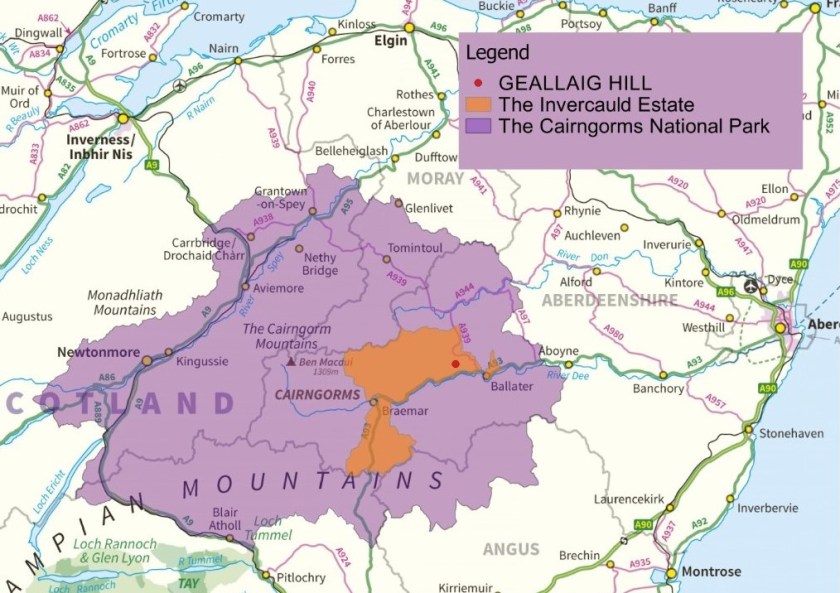
Well, would you believe, part of Glen Gairn appears to lie at the eastern boundary of Invercauld Estate, not a million miles from where those illegally-set spring traps were recently discovered at Gellaig Hill. (Map detail created from information provided on Andy Wightman’s Who Owns Scotland website).

Glen Gairn final - Copy

Now, we should urge caution here before anyone jumps to conclusions. This map is slightly misleading because it suggests that Glen Gairn lies entirely within the boundary of Invercauld Estate. It doesn’t. Glen Gairn extends east across the river, beyond the Invercauld Estate boundary, and on to the grouse moors of neighbouring Dinnet Estate.

We don’t know exactly where in Glen Gairn those two members of the public watched the alleged coordinated hunt and then shooting of that male hen harrier in 2013. It could have been on the Dinnet side of the Glen, or it could have been on the Invercauld side of the Glen, or it could have extended across both sides of the Glen. We don’t know, but presumably Police Scotland will know if those two members of the public were able to give accurate grid references.

As so often happens, there was insufficient evidence to proceed with a prosecution so we have no idea who was responsible. It must have been the handiwork of those pesky moorland fairies. They do seem to be quite active in this part of the Cairngorms National Park, don’t they?

Police statement on illegal traps found on Invercauld Estate

A few weeks ago we blogged about the discovery of two illegally-set spring traps and a critically injured Common gull found on a grouse moor on Invercauld Estate (Cairngorms National Park) in June 2016 (see here). We later blogged about the Estate’s subsequent denial that illegal activity had taken place and the Estate’s ‘understanding that the Police had not found evidence of illegal activity’ (see here).

Cairngorms Invercauld - Copy

We asked Police Scotland to clarify whether evidence of illegal activity had been found on Invercauld Estate (we didn’t ask who had found such evidence, just whether any evidence had been found). Here is the response from Police Scotland:

Thank you for your email to ACC Graham and concern about wildlife crime in Scotland.

The RSPB media release refers to an incident that it reported to both Police Scotland and the SSPCA following the discovery by two members of the public of a Common Gull caught in an open spring (Fenn) trap on the Invercauld Estate. As a result of the injuries sustained in the trap the bird was euthanized by an SSPCA officer who attended and the full circumstances along with clarification of an illegally set trap were subsequently passed to Police Scotland. Once aware of the specifics and having confirmed the availability of resources from partner agencies, Police Scotland  accompanied by specialist RSPB and SSPCA staff undertook a search of the area using powers available under S19 Wildlife and Countryside Act, 1981. That search was only able to identify signs of what appeared to have been trap-setting activity on the hillside i.e. holes in the ground but no actual traps. However, in light of the initial observations by the members of the public police officers spoke with representatives from Invercauld Estate. Unfortunately, the Estate was unable to shed any further light on this suspected illegal activity.

Other than the witness statements, there is no further evidence available from the initial discovery of the trapped bird and as previously highlighted the joint partner agency search failed to uncover any traps in place on the hillside. As a consequence, and despite a thorough investigation, there are at present no further investigative opportunities available to Police Scotland.

Police Scotland is committed to tackling wildlife crime and works closely with fellow members of the Partnership for Action Against Wildlife Crime (Scotland) to address wildlife crime issues across Scotland. We would encourage anybody with information about those that commit wildlife crime to contact Police Scotland by telephoning 101 or by contacting Crimestoppers anonymously on 0800 555 111.

Regards,

 Andrew Mavin

 Sergeant Andrew Mavin

Scottish Wildlife Crime Coordinator

Specialist Crime Division

Police Scotland

END

It’s a carefully worded statement but even so, is still quite opaque. The statement appears to confirm the discovery of an illegally-set trap (“….along with clarification of an illegally set trap….”) [actually, the gull’s legs were caught in two illegally-set traps, not just one] but then later it mentions ‘suspected illegal activity‘, although this appears to be a direct reference to other potential trap-setting activity on the hill, and not a direct reference to the two illegally-set traps that were reported by two hill walkers and then by the attending SSPCA Inspector.

Whether illegally-set traps were found on Invercauld Estate is not in question. The evidence, collected by the SSPCA Inspector, shows that two illegally-set traps had been found and that they’d caused appalling injuries to the trapped Common gull. The unanswered question, as ever, is who set those traps?

Invercauld gull

We will wait with interest to see whether SNH imposes a General Licence restriction order on this part of Invercauld Estate. Remember, even if there is insufficient evidence for a criminal prosecution, SNH may still impose this penalty if they consider the evidence is sufficient to warrant a GL restriction penalty. We may have to wait a while to find out, because SNH appears to have stopped issuing GL restrictions while it waits for a court decision on whether the process it uses to impose a GL restriction is fair. As you may remember, the Raeshaw Estate in the Scottish Borders has called for a judicial review of SNH’s decision to impose a GL restriction (see here) and we understand that the court has recently granted permission for the judicial review to take place.

While we wait for that judicial review, we will have more to write about the Invercauld Estate case…..watch this space.

In the meantime, you might want to consider signing THIS PETITION calling for the licensing of all gamebird hunting in Scotland (online petition currently at 3,089 signatures)

When you’ve done that, please consider signing THIS PETITION calling for a ban on driven grouse shooting (online petition currently at 79,404 signatures).

SGA statement re: illegal traps found on Invercauld Estate

Following the news that illegally-set spring traps were found on a grouse moor on Invercauld Estate in the Cairngorms National Park (see here), the Scottish Gamekeepers’ Association has issued a statement.

Are you ready for this?

A Spokesman for The Scottish Gamekeepers Association said: “This is the first we, as an organisation, have heard about this so we will take time to make the appropriate inquiries. The SGA is an organisation which advocates best practice and condemns wildlife crime.”
END
Not exactly an unequivocal condemnation of this wildlife crime, is it? This case is a little bit awkward for the SGA, given their close ties to Invercauld Estate (SGA Vice Chair Peter Fraser worked on Invercauld Estate for 43 years).
Perhaps, like Invercauld Estate, the SGA is going to deny this crime ever happened, a bit like they did when they ‘investigated’ another disgusting wildlife crime (here is the crime, here is the SGA’s response) and another disgusting wildlife crime (here is the crime, here is the SGA’s response).
Or perhaps this time they will admit the crime happened but will suggest that the ‘evidence was planted’, a bit like SGA Vice Chairman Peter Fraser did in this interview when asked about the discovery of three poisoned buzzards and a poisoned raven that were found on Invercauld Estate in 2005 (no prosecutions, natch).
And talking of the SGA condemning wildlife crime, we’re still waiting for a statement from them about the conviction of Scottish gamekeeper William (Billy) Dick, successfully prosecuted for killing a buzzard on the Newlands Estate by throwing rocks at it and then repeatedly stamping on it (see here). At the time of Dick’s conviction, the SGA refused to comment until Dick’s appeal had been heard. As you know, Dick’s appeal was rejected a week ago and his conviction still stands (see here), so where’s the SGA’s condemnation of this gamekeeper’s crimes and where’s the information about Dick’s SGA membership status? Was he an SGA member? Is he still an SGA member?
The SGA’s commitment to condemning and tackling wildlife crime doesn’t look at all convincing, does it? And if it doesn’t look convincing to us, how does it look to the SGA’s membership? Will they think their great leaders are standing strong against illegal raptor persecution and doing all they can to apply peer pressure to eliminate it? On the above evidence, that’s unlikely.
More on the Invercauld Estate case to come….

Statement from Invercauld Estate re: illegal traps

In relation to this morning’s news (here) that illegally-set traps have been discovered on a grouse moor on Invercauld Estate in the Cairngorms National Park, the following statement from Invercauld Estate has just appeared on GWCT’s twitter feed:

Invercauld statement

This is staggering! In one paragraph the estate is denying that this crime ever happened, but then in the next paragraph suggests that if it did happen the evidence was probably planted by someone trying to discredit the grouse shooting industry. Really? Really? Seven hours to think about it and that’s the response? Really?

The RSPB, the SSPCA, and two witnesses (the hill walkers) say it happened (full statement here).

Cabinet Secretary for the Environment Roseanna Cunningham believes it happened and has said, “It is difficult to see their use [the illegally-set spring traps] as anything other than a blatant and criminal attempt to target protected birds of prey” (full statement here).

Grant Moir, CEO of the Cairngorms National Park Authority also believes it happened and has asked for a meeting with the Head Trustee of Invercauld Estate, the Sporting Partner on Invercauld Estate, and Police Scotland to improve enforcement measures (full statement here).

So, Police Scotland, over to you. Was evidence of illegal activity found on Invercauld Estate? Emails please to Assistant Chief Constable Malcolm Graham who leads on wildlife crime for Police Scotland: ACC.CrimeMCPP@scotland.pnn.police.uk

When you’ve sent your email, please consider signing THIS PETITION calling for the licensing of all gamebird hunting in Scotland.

When you’ve done that, please consider signing THIS PETITION calling for a ban on driven grouse shooting.

Invercauld gull

Illegal traps on Invercauld Estate: part 2

Further to today’s news that illegally-set traps have been found on a grouse moor on Invercauld Estate in the Cairngorms National Park (see here), we are interested in the SSPCA’s role in this investigation.

As you’ll recall, RSPB Scotland notified the SSPCA about the severely injured gull caught by both legs in two spring traps. An SSPCA Inspector attended the scene (utilising powers under the Animal Health & Welfare (Scotland) Act) and was able to put the poor suffering bird out of its misery. However, the SSPCA Inspector did not conduct a wider search of the area for evidence because their current powers do not permit that.

Invercauld gull

Instead, the wider search was delayed until Police Scotland could attend (Police Scotland does have the authority to undertake searches of land to look for evidence of offences committed contrary to the Wildlife & Countryside Act). Now, this delay is NOT a criticism of Police Scotland’s actions in this case (they were on site relatively swiftly and invited both the SSPCA and RSPB Scotland Investigations to assist with the search. That’s a big improvement on some previous cases).

But, the problem of the SSPCA’s limited powers are clear in this case.

When the multi-agency search did take place ‘a few days later’, ‘clear evidence was found that eight similar traps had been deployed, attached to stakes and baited with dead rabbits, in a line stretching two hundred metres across the moor. It was also evident that these traps had been removed very recently’.

Whichever criminal had set these two traps that caught the gull was given the time to remove those further eight traps before the Police turned up.

How ridiculous is it that the SSPCA Inspector wasn’t allowed to walk two hundred metres across the grouse moor to retrieve those eight additional traps (and any other evidence that the criminal may have left lying around)? It’s plainly bonkers! Instead, there was an inevitable delay while the Police sorted themselves out (again, not a criticism in this case), allowing the criminal to distance him/herself from the crimes.

As many of you will know, on 1 Sept 2016 it will be two years since the closure of the Scottish Government’s public consultation on increased investigatory powers for the SSPCA. Three Environment Ministers later and we’re still waiting for a decision (see here). It’s pathetic.

More on this Invercauld case shortly…..

Illegally-set traps found on Invercauld Estate grouse moor, Cairngorms National Park

RSPB Scotland has today issued a press statement about the discovery of illegally-set traps found on a Royal Deeside grouse moor in the Cairngorms National Park (see here).

On 27 June 2016, two members of the public found a Common Gull that had been caught by the legs in two spring traps that had been positioned next to a dead rabbit that had been used as bait. The gull was distressed and bleeding profusely. The hill walkers called RSPB Scotland, who immediately alerted Police Scotland and the SSPCA. An SSPCA Inspector quickly attended the scene and the gull was found to have two broken legs. The bird’s injuries were so extensive it had to be euthanised.

Several days later, a multi-agency (Police Scotland, SSPCA, RSPB Scotland) search was undertaken on the grouse moor, ‘where clear evidence was found that eight similar traps had been deployed, attached to stakes and baited with dead rabbits, in a line stretching two hundred metres across the moor. It was also evident that these traps had been removed very recently’.

The press statement continues, ‘Police Scotland officers later spoke to a number of people involved with the management of the land on which the traps were found, but the identity of who had set the traps could not be established‘.

According to the press statement, the two hill walkers had found the distressed gull on “the northern slopes of Geallaig Hill, a few miles north west of Ballater“.

According to Andy Wightman’s fantastic website Who Owns Scotland, Geallaig Hill lies within the boundary of the Invercauld Estate. Using Andy’s data, we’ve created this map to show the position of Invercauld Estate within the Cairngorms National Park and the location of Geallaig Hill within the boundary of Invercauld Estate.

Cairngorms Invercauld - Copy

This is not the first time illegally-set spring traps have been found on Invercauld Estate. In 1997, a gamekeeper was fined £120 after admitting to illegally setting a spring trap to catch a rook (see here).

Spring traps can (currently) be used legally to catch stoats, weasels, rats etc BUT ONLY if they are placed inside a natural or artificial tunnel with a restricted entrance to minimise the risk of catching a non-target species. There are frequent reports of their illegal use on some shooting estates to trap birds of prey (e.g. set in the open next to a bait, or attached to the top of a post to turn them in to pole traps) – some recent examples can be found here, herehere, here, here, here, here, and of course the recent and now infamous Mossdale Estate traps here.

There’s a lot to discuss about this latest crime, and we’ll be doing just that in a series of blogs later this afternoon.

In the meantime, well done to the two hill walkers who reported this crime, well done to the SSPCA Inspector for a quick response, well done to the Police Scotland wildlife crime officers for a quick, multi-agency follow up and search, and well done to RSPB Scotland for a timely press release.

More shortly…..

UPDATE 2.30pm: Illegal traps on Invercauld Estate part 2 here

UPDATE 4.45pm: An astonishing statement from Invercauld Estate here

UPDATE 23 July 2016: SGA statement re: illegal traps found on Invercauld Estate here

‘Bumper’ grouse season proves raptors aren’t having a ‘significant impact’

The 2011 grouse season closed on Saturday. According to an article in the Shooting Times, it’s been a “bumper season“, and, “many moor owners, keepers and shooters around the UK will be reflecting on one of their best years in decades” (see here for article).

In another review, this time just of the Scottish grouse season, Robert Rattray, head of CKD Galbraith’s Sporting Letting Department, comments on the performance of some well-known grouse moors (including Glenogil, Millden and Invercauld) and he writes: “The 2011 grouse season will be looked upon as one of the best in recent living memory, and in many instances a distinct improvement on the 2010 season, in itself regarded as one of the best seasons for a decade or more” (see here for his report).

All very interesting. So much for the supposed ‘significant impact’ of raptors on gamebirds, repeatedly trotted out by the gamekeeper and landowner associations in their quest to legalise persecution. If, as they claim, they are not already killing everything with a hooky beak that dares to even look at their grouse moor, then it seems to me that they’re managing to [legally] kill a record number of red grouse without having to go after the raptors. So what’s the problem?

Of course, there are some who’ll read this blog and will have a different perspective – that is, the 2011 grouse season was a ‘bumper’ one precisely because anything with a hooky beak in the vicinity of the grouse moors had already been killed off.