Legal challenge against Hen harrier brood meddling – crowdfunder launched

Do you want to see justice for Hen harriers?

Do you oppose DEFRA’s outrageous Hen harrier brood meddling scheme?

Do you want to support a legal challenge against the brood meddling licence that Natural England has recently issued?

Here’s how you can help.

#justice4henharriers

Failed Peak District Bird of Prey Initiative featured on BBC regional news

The Moorland Association’s plan to block publicity about the failed Peak District Bird of Prey Initiative has spectacularly backfired.

Journalists have picked up on the news that the RSPB has terminated its involvement with the project and yesterday evening the failed Initiative, and more importantly, the reasons behind its failure, featured prominently on several BBC regional news programmes including East Midlands Today and Look North.

The videos for both programmes are available on BBC iPlayer but only until 7pm this evening.

BBC East Midlands Today (here) – starts at 4.35

BBC Look North (here) – starts 10.00

Both programmes are worth watching if you get the chance as there are similarities but also differences. For example, David Hunt from the RSPB features in both programmes (and delivers a very strong message, calling out the Moorland Association by name. Well done!) whereas Steve Bloomfield from BASC only appears in the East Midlands programme and Amanda Anderson from the Moorland Association only appears in the Look North version.

For those who missed the archived footage, here are the relevant quotes:

David Hunt (RSPB):Instead of seeing numbers rise of peregrine and goshawk we’ve actually seen the numbers drop over the lifespan of the Initiative, and against all of that there’s been a refusal from one of the partners in the Initiative, the Moorland Association, to acknowledge that one of the leading contributing factors in this drop in numbers is illegal killing of birds of prey“.

Steve Bloomfield (BASC):We share their [the RSPB’s] frustrations and I think this needs to be a wake up call for the shooting community that these issues are going on and causing problems. There are huge amounts of benefits to the shooting interests on these estates to other wildlife. We musn’t lose that“.

Amanda Anderson (Moorland Association):We’re all really disappointed that they’ve [the RSPB] left this really important collaborative Initiative. We all want the same thing, and that’s a sustainable, healthy assemblage of birds of prey across the Peak District National Park. We just differ in our view of how to achieve that“.

In the Look North programme, the BBC reporter Mark Ansell closed with this:

“The Peak District National Park Authority declined to be interviewed but they have said in a recent report that the Bird of Prey Initiative has failed to meet its targets. They go on to say that there is confirmed evidence of raptor persecution, and in a statement they say they’ll be looking for an increase in birds in the breeding season before committing to working with the other organisations in the Initiative beyond 2018”.

Northern England Raptor Forum slams ‘outrageous’ hen harrier brood meddling plan

Following the announcement earlier this week that Natural England has licensed the highly controversial brood meddling trial for hen harriers (see here), the Northern England Raptor Forum (NERF) has issued a damning statement in response.

Quoting from the statement (which we encourage you to read in full on the NERF website, here), NERF’s main reasons for objecting to this trial are as follows:

  • The Hen Harrier is near extinct as a breeding species in England (an average of just 3 successful nests per year over the last 9 years, ranging 0-6 nests annually) and is threatened thoughout the year as the pattern of disappearance of satellite tagged juvenile birds confirms.
  • Bowland and the North Pennine Special Protection Areas {SPAs} are both designated for their supposed breeding populations of Hen Harrier at 13 and 11 pairs respectively. In 2016 and 2017 there were none in either.  The UK government has a legal responsibility to correct these serious infractions and restore the species to a favourable status.
  • Given the species’ fragile status we would expect Natural England to be focused on protection and addressing the known principal reason for the species’ demise which by their own admission (‘A Future for the Hen Harrier?’ NE 2008) is that of illegal persecution.
  • Recent nesting pairs have only occurred on land which is not used for driven grouse shooting. As such breeding birds cannot possibly impact on the overall economics of driven grouse shooting estates. To contemplate interference via brood management with potentially the very first nesting pair to repopulate any one or more estates is outrageous and an affront to sound species’ conservation.
  • Research has shown the natural carrying capacity of Hen Harrier habitat in northern England to be 300+ pairs! Therefore as a minimum we would expect to see the upland SPAs, protected under EU Directives, demonstrably supporting their designated populations of Hen Harrier. Across the whole region we’d also expect to have at least 70 breeding pairs, below which published reports show there would be no economic impact on Red Grouse numbers. Only when these thresholds are reached should the case for brood management be considered anew.
  • Adequate protection against illegal persecution must be evidenced first and a growth in breeding numbers seen. There is no point in expending an estimated £0.9-1.2 million, to release young birds after hand rearing, into a dangerous environment where continuing illegal persecution severely diminishes their chances of surviving their first winter.

NERF is clearly angry (justifiably) about Natural England’s decision to licence this brood meddling trial at a time when the hen harrier’s breeding population is so desperately small, due to illegal persecution. So angry, in fact, that the last paragraph of the NERF statement is unusually forthright:

NERF is left dismayed that Defra and Natural England, as protectors of our natural environment should promote this untimely and unnecessary intervention which seems wholly contrary to the best principles of conservation.  As such NERF members are now intent on re-evaluating areas of cooperation with Natural England‘.

Five year Hen harrier brood meddling trial gets green light to start this year

Natural England has finally given the green light to the highly controversial hen harrier brood meddling scheme and has issued a licence for the five-year trial to begin this year.

As many of you already know, brood meddling is one of six action points in DEFRA’s ludicrous Hen Harrier Action Plan, designed to rescue the English hen harrier breeding population from virtual extinction.

For the benefit of new blog readers, here’s a quick overview of what brood meddling is about:

Hen harriers have been wiped out as a breeding species on driven grouse moors in England. Even though this is a protected species of the highest conservation priority, it has been, and still is, illegally persecuted, with impunity, by grouse moor owners and their gamekeepers. There is enough room for over 300 breeding pairs in England: last year there were only three successful pairs, and none of those was on a grouse moor (prime habitat). So, here’s DEFRA’s ‘rescue’ plan.

Instead of throwing absolutely everything in to catching and prosecuting these criminals (because that’s what they are), the Government is instead going to allow the temporary removal of hen harriers from grouse moors during the breeding season. Eggs/chicks will be collected from nests (‘brood meddled’) and hatched/reared in captivity for a few weeks. The idea is that by removing the hen harrier eggs/chicks, the adult hen harriers won’t prey on as many red grouse chicks (which are already at a ridiculously artificial high density thanks to intensive management), which means there’ll be even more red grouse available later in the season for paying clients to shoot in the face, for a bit of fun. The grouse moor owners and their gamekeepers will be happy and there’ll be no need to kill any more hen harriers. Sounds good, right?

But wait. What about those young hen harriers that have been reared in captivity? What happens to them? Well, they’ll be released, at fledging age, back to the moorland areas from where they were first removed. They’ll no longer be a threat to the grouse moor owners’ profits because all the red grouse chicks will have grown in to adults so they won’t be as vulnerable to hen harrier predation.

Perfect. Everybody lives happily ever after (except the red grouse).

There’s just one tiny problem with this plan.

Those young hen harriers will be released back on to the moors around the same time that the grouse shooting season opens on 12 August. Those young hen harriers are going to be flying around the moors looking for food and the red grouse will react by either trying to hide or by scattering in all directions. This will disrupt the grouse ‘drives’ which is when the red grouse are flushed in lines towards the grouse butts and the waiting guns. Guests who have paid thousands of pounds for the chance to stand in a grouse butt and shoot those grouse are not going to be happy if there aren’t many birds available for them to blast to smithereens.

So what do you think’s going to happen? You don’t need to be a genius to work it out. And indeed satellite tag data has shown time and time again that young dispersing hen harriers are routinely killed on grouse moors, especially during the first few months of the grouse shooting season in August, September and October, because grouse moor owners and their gamekeepers will not tolerate anything that threatens to disrupt their lucrative grouse shoots.

Nobody will get caught/prosecuted, the grouse-shooting industry will deny all knowledge (they’ll deny it’s even happening because they’ll be careful to hide the evidence), there’ll be further delay in the Government considering any other kind of action (such as licensing or banning driven grouse shooting) because it’ll say the five-year trial needs to run its course, and so we’ll end up back where we started with virtually no hen harriers and the untouchable, filthy grouse shooting industry still getting away with their crimes.

Despite knowing all this, yesterday Natural England finally issued a licence that will permit brood meddling to begin this year. We’ve been asking for the details of this project for a long, long time and Natural England has put every possible obstacle in our way while the licence application was being considered. Reading the details that have just been released, it not hard to see why they would want to keep it under wraps for so long.

The most important documents for you to read are these:

Hen Harrier brood meddling trial project plan

Brood meddling licence 2018_2020

Letter to licensing applicant

Additional conditions for brood meddling licence 2018_2020

Technical assessment of brood meddling licence application

These documents (above) will provide you with a good overview of what’s going on. There are other documents that go in to more detail for those who wish to know more, and these are provided at the end of this blog.

Here are the main points about the brood meddling plan:

  • The licence covers moorland throughout northern England
  • No eggs or chicks may be taken into captivity unless the threshold of two nests within 10km is met
  • Nests can only be brood meddled where the harrier pair has the potential to reduce the shootable surplus of red grouse
  • No hen harrier pair can be brood meddled in consecutive nesting attempts (this assumes individuals can be identified)
  • Hen harriers cannot be brood meddled without the landowner’s consent
  • Hen harriers cannot be brood meddled until a release site has been determined and the ‘local team’ has been approved by Natural England
  • All brood meddled hen harriers will be satellite-tagged prior to release
  • Hen harriers cannot be brood meddled until satellite-tags have been procured
  • The Moorland Association is procuring the satellite tags (yes, really!)
  • A ‘new’ type of satellite tag will be used
  • The Moorland Association and GWCT, as members of the Project Board, will have access to the hen harrier satellite tag data (yes, really!)
  • Natural England is responsible for analysing the satellite tag data (yes, really!)
  • Hen harriers removed from a Special Protection Area designated for hen harriers (Bowland Fells SPA, Nothern Pennines SPA) must be returned within the boundary of that SPA
  • Hen harriers removed from sites outwith an SPA will be returned to ‘suitable habitat within the trial area and where practical close to the area from where they were taken’
  • There is a recommendation that hen harriers ‘should not be released within sight of burnt heather strips’ (!!)
  • Brood meddling will be undertaken by the International Centre for Birds of Prey (Newent, Glos) – the brood meddling licence holder is Mrs Jemima Parry Jones of the ICBP. Natural England tried to redact this information without realising it had already been released in response to one of our earlier FoIs, and they also made a hash of the actual redaction: ‘Dear Jemima’ is a bit of a giveaway!
  • The Moorland Association will pay the ICBP to undertake the brood meddling trial and has entered into a five-year legal contract with the ICBP to ensure funding throughout the trial
  • Brood meddled eggs/chicks will be held in captivity at the ICBP in Newent
  • At approx 3 weeks old, captive hen harriers will be removed to a temporary aviary at a suitable release site where a ‘local team’ will look after them
  • There must be 24hr site security at the release aviary
  • Details of release sites have not been given
  • The trial can be stopped at any stage if a number of things happen. One of these is if ‘there is higher than expected mortality of birds post release’. This is suspicously vague and may well become a contentious issue, a bit like the Hawk & Owl Trust’s so-called ‘immoveable provisos’ on illegal persecution that turned out to be quite moveable after all.

That’s quite a lot to digest so we’ll return to some of these details in due course.

The big question now is, how many grouse moor owners will ‘allow’ a pair of nesting hen harriers on their land? The grouse shooting industry is kind of backed in to a corner, and it’s all of its own making. Grouse moor owners probably all thought brood meddling was a great idea when it was first mooted, as they thought those ‘brood meddled’ harriers would be removed from their moors and dumped hundreds of miles away in southern England as part of the proposed reintroduction scheme down there. Now they’ve been told that’s not going to happen – brood meddled hen harriers have to be returned to the upland moors.

What will the grouse moor owners do? Do they play ball and allow hen harriers to breed on the moors (because DEFRA et al are going to be pretty upset if it looks like the grouse shooting industry is not cooperating)? But if they do that, they run the risk that ‘their’ nest may not get brood meddled, especially if neighbouring moors refuse to ‘let hen harriers in‘, and so then they’ll be stuck with an unwanted hen harrier pair plus offspring.

It’s all going to get quite interesting in the next few months.

Here are the additional documents released by Natural England for those who want more detail of this disgraceful decision:

SSSI notice proforma supplied with brood meddling licence

Summary of brood meddling licensing decision

Habitats Regulations Assessment of brood meddling licence application

Brood meddling licence application

Information from the applicant on project submitted in the form of a draft Habitats Regulations Assessment

Applicants email response to further information request

Information from applicant in response to further information request

UPDATE 17 April 2018: Legal challenge against hen harrier brood meddling continues, x2 (see here)

Stop illegal persecution then no need for reintroduction of hen harrier to southern England, says DEFRA Minister

In response to a Parliamentary question about the reintroduction of hen harriers to lowland England, a DEFRA Minister responded as follows:

Sounds good, doesn’t it? Unfortunately, this response didn’t come from Dr Therese Coffey MP or Michael Gove MP. It came from Ben Bradshaw MP back in 2004, who at the time was the Under Secretary of State at DEFRA, under the leadership of Margaret Beckett.

The question came as part of a series of Parliamentary questions posed by James Gray MP (Conservative, North Wiltshire) in response to the launch of Operation Artemis, a police-led initiative aimed at tackling the illegal persecution of the hen harrier. Mr Gray wasn’t a fan (no surprise when you look at his background) as you can see from this Early Day Motion from Labour MP Tony Banks:

We haven’t been able to find the exact quote from Mr Gray on Hansard, but it’s clear he wasn’t in support of Operation Artemis, and judging by this (scroll down to the bottom), a number of his fellow Conservative MPs agreed.

Operation Artemis was launched in the spring of 2004 and part of the initiative was for police officers to visit every single estate where there was the potential for hen harriers to breed. The idea was that police officers would provide landowners and gamekeepers with a code of best practice to help any hen harrier breeding attempt, and invite those land owners and gamekeepers to sign up to support the initiative.

Here is Paul Henery (Police WCO for Northumberland) and Chief Constable Richard Brunstrom at the launch (photo by Guy Shorrock)

There was apparently strong support in Wales, but in England, landowners and gamekeepers reacted with fury. Here is a cutting from the RSPB’s Legal Eagle newsletter in July 2004:

And here is the astonishing response from the National Gamekeepers’ Organisation (take note of the suggestion that the limited police budget for this scheme could be decimated by police officers having to respond to a barage of complaints, which could then be withdrawn at the last minute):

Fourteen years on, the hen harrier’s breeding population in England remains critical, the illegal persecution of this species continues unabated, it is virtually impossible to secure a conviction even when high definition video evidence of the crime is available, the Conservative Government has approved the removal of hen harriers from grouse moors to allow a few hundred rich folk (including a number of Conservative MPS) to shoot 0.75 million red grouse in the face for a bit of fun, and thinks that importing hen harriers from France in to southern England under the guise of being a conservation initiative is a great idea, even though illegal persecution continues (which means the scheme does not meet the required IUCN guidelines for reintroductions).

Diverting attention from the illegal killing of peregrines on grouse moors

One of the many criticisms about the proposed reintroduction of hen harriers to southern England is that if a population does manage to become established, the grouse-shooting industry will use it to divert attention from the on-going eradication of this species on intensively managed driven grouse moors. ‘Look, hen harriers are doing just fine in the lowlands, the species’ conservation status has improved, everything’s fine, there’s nothing to worry about anymore’.

If you don’t think that that’s what will happen, just take a look at this letter from the Countryside Alliance, published in The Times yesterday:

PEREGRINE’S SUCCESS

Sir, your report that the peregrine falcon is “now seeking sanctuary in cities as it comes under threat” fails to provide vital context (“Prized peregrine falcons falling prey to greed“, News, Jan 9). The peregrine falcon population reached a low of about 150 pairs in the 1960s as a result of the impact of toxic agricultural chemicals such as DDT in the food chain as well as illegal persecution. However, improved legislation and protection has helped the peregrine falcon to expand its range and numbers. The latest estimates place the number of peregrines at a historic high of 1,500 pairs, and has led to the peregrine having its conservation status declared “secure”. The species, like other raptors such as the buzzard and red kite, is an undoubted conservation success.

ENDS

No mention then, of how illegal persecution on the north of England grouse moors is suppressing local peregrine populations (see here).

No mention then, of how the preliminary results of the 2014 national peregrine survey show a sharp decrease in peregrine occupation in the UK’s uplands, especially in areas intensively managed for driven grouse shooting (see here).

No mention then, of how illegal persecution has led to the continuing decline of peregrines in the grouse moor areas of north east Scotland, particularly on the eastern side of the Cairngorms National Park (see here).

No mention then, of how illegal persecution has led to the continuing decline of the peregrine’s breeding population on the grouse moors of Bowland.

No mention then, of how illegal persecution has led to the continuing decline of the peregrine’s breeding population on the grouse moors of the Dark Peak in the Peak District National Park (see here).

Funny, that.

Photo of a dead peregrine that was found shot next to a grouse moor in the Peak District National Park in 2016 (RSPB photo)

GWCT’s North of England Grouse Seminar 2018

The GWCT is hosting another North of England Grouse Seminar on March 8th at The Morritt Hotel & Garage Spa, Greta Bridge, nr Barnard Castle in County Durham.

Here’s the planned programme:

What an exciting line-up! First some news about how intensive grouse moor management has caused the rapid spread of disease across moors in England & Scotland.

Then some science that shows if you kill off predators, waders will have improved breeding success (duh!). Oh, and so will your red grouse, meaning there’ll be more birds for you to kill later in the year. Not that that’s your primary motive – no, you’re all about wader conservation and any side benefits that help increase your already-way-too-high red grouse population are simply unintended.

Then a bit about how great it is to repeatedly burn the heather on your grouse moor (as long as you ignore the widespread environmental damage this causes). It’s no big deal, it’s just like getting your hair cut. The fact that moorland burning has been detected in 55% of Special Areas of Conservation and in 63% of Special Protection Areas, (sites that are designated under EU legislation for their conservation value) and yet many are in ‘unfavourable condition’ with burning identified as the primary cause, is nothing to worry about.

Then after a spot of lunch, there’s an as yet to be revealed guest speaker from Natural England, talking about er, something.

Perhaps it’ll be someone coming along to reassure the room full of grouse moor owners that they needn’t worry, Natural England is doing its level best to ensure the last known fixes of all those missing satellite-tagged hen harriers remain a secret. [Incidentally, we have an update on this – blog coming soon].

Or perhaps it’ll be someone coming along to advise grouse moor owners how to get a licence to kill marsh harriers.

Then there’s some stuff about black grouse, and then a chance to hear the ‘final results’ from the Langholm 2 Project. Perhaps this time Dr Sonja Ludwig will be allowed to answer any questions about the science by herself, instead of being bulldozed off stage by someone who clearly doesn’t understand etiquette, nor science, and doesn’t like buzzards.

You don’t have to be a grouse moor owner to attend this seminar. If you’ve got a spare £40, you can book your ticket here.

Can we please just have some honesty about the Heads up for Harriers project?

The controversial Heads Up for Harriers project got another airing at the weekend, this time on BBC Radio Scotland’s Out of Doors programme.

For those who missed it, you can listen to it on the BBC iPlayer HERE for the next 27 days (starts at 01.58, ends 07.39).

For the sake of posterity, here’s the transcript, and our comments are below:

Mark Stephen (presenter): Last year we covered the launch of an ambitious project to put cameras in hen harrier nests on grouse moors to see why the bird’s population numbers are so low. Now, we’d best not underestimate the challenge of this project in getting access to some moorland where privacy is treasured. The results are in and one of the main drivers behind Heads up for Harriers is Professor Des Thompson of Scottish Natural Heritage. Des has been talking to Euan.

Des Thompson: The hen harrier is one of our most special birds of prey, it’s a fantastically beautiful, graceful bird. It’s one of our most endangered birds. In the UK we’ve got hardly any birds nesting….[interrupted].

Euan McIlwraith: Is that just because they have a habit of taking grouse and they’re not welcome on the moors? Is that the main reason?

Des Thomson: Well historically that’s certainly been the case Euan, they’ve not been welcome at all on the intensively managed grouse moors. But they’re doing very well in the Outer Isles, we’ve got roughly just under 500 pairs at the moment but not doing anything like as well on the grouse moors.

Euan McIlwraith: So we should have them throughout Scotland or is it just mainly on the moorland?

Des Thompson: No, we should have them throughout Scotland, I mean historically they’ve nested in lowland areas but their best habitat and the best foods for these birds [is] on heather dominated areas.

Euan McIlwraith: The project last year, Heads up for Harriers, what was the idea of the project?

Des Thomspon: Well there’s two things we’re trying to do with Heads up for Harriers, one is just encouraging people to report their sightings of these birds, I mean they’re just so beautiful to see, and we’ve had a fantastic response from people throughout the country, just giving us information on where they’re seeing these birds and we can follow up to see how these birds are faring. But we’ve also recognised that on grouse moor areas they’re either absent or not doing well, so we’ve wanted to work with estates and conservationists to encourage these birds to settle. Where they’ve settled, with the agreement of the estates we’ve put out nest cameras to see what’s happening to the nests. If nests are failing, why? Is it because of foxes, crows, or disturbance or some other factor?

Euan McIlwraith: That was last year, what kind of results have you got?

Des Thompson: Well we’ve been very lucky because we’ve now got more than 20 estates participating.

Euan McIlwraith: Was that a hard thing, to persuade people?

Des Thompson: Yeah, it was actually, if I’m frank with you Euan. We’ve had to develop a very strong partnership involving Scottish Land & Estates, RSPB, Scottish Raptor Study Groups, SNH and other people, bringing them together, having candid conversations, which is sort of code for quite difficult discussions, but in the end we’ve had estates coming forward saying, ‘Ok, bring it on, we want to have hen harriers settle in our areas, we want to show that we can look after them’. Now, we’re not being naive, there are quite a number of estates I’d like to see joining the scheme, they’ve not come forward yet, and I would like to reach into these estates to see if we can get them to come on board.

Euan McIlwraith: So what did you do? Did you put cameras beside the nest and just monitor how many survive?

Des Thompson: Yes, we’ve had some fantastic people working with us, one person in particular, Brian Etheridge, who this year won the Nature of Scotland Species Champion Award, has been brilliant at working with estates, going out working with estate staff, locating nesting hen harriers, finding the nest, cannily putting out the camera and then re-visiting it to see how the birds are faring.

Euan McIlwraith: So what kind of results have you had?

Des Thompson: Well a sort of mixed bag, pretty much what you’d expect across the country. We’ve had some nests being predated by foxes, we’ve had some nests failing for natural reasons, but overall across all of our nest sites we’ve had 37 fledged harriers from the nests which is a great result.

Euan McIlwraith: So that would imply that if it went on, you should be able to re-populate Scotland?

Des Thompson: I don’t know about re-populating Scotland because we’ve still got a lot of estates that we need to reach in to and you’ll know that the Scottish Government has recently set up an expert group to look at the management of driven grouse moors, and there’s still a number of moors that we need to reach in to, to try and influence management.

Euan McIlwraith: What about the success rate of the chicks because they’re normally, I presume, 3 eggs laid and survival would be one?

Des Thompson: Yes, I mean in some cases four, five or even six eggs if we’re lucky, most of the chicks will fledge and that’s where it gets very difficult. Some are predated, some unfortunately are being persecuted, they’re either being poisoned or killed, the females tend to stay on the moor, the males migrate very long distances because they’re feeding on much smaller prey.

Euan McIlwraith: But the results, I’m led to believe, compared to England were much more impressive?

Des Thompson: Well, they are, but you would expect me to say that. Well in England, we’ve got virtually no hen harriers nesting. We don’t have the sort of partnership working we have in Scotland so I think we’re extremely fortunate. But I think its fair to say that raptor conservationists, a number of raptor conservationists are impatient for change, they want to see the fortunes of hen harriers much better, and I think they’re absolutely right, so that’s why I want to really throw down the gauntlet to those remaining estates where there’s intensive driven grouse shooting and to say we really would like to work with you, to see if we can extend the scheme.

Euan McIlwraith: Because it’s in their interests, isn’t it, if you can actually say, ‘I’ve put a camera on the harrier nest, they’re surviving, it’s not us’?

Des Thompson: Well I think it is, Euan, but I think also reputationally, for the wider brand of Scotland, why would we not want to see hen harriers in the wild uplands of Scotland, it’s such a fantastic spectacle, especially in spring when you’re getting males flighting, I mean it’s a wonderful thing to see so it’s in their interests to do so.

ENDS

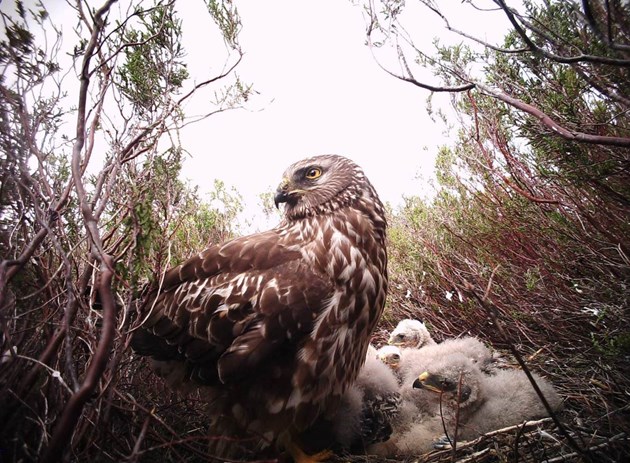
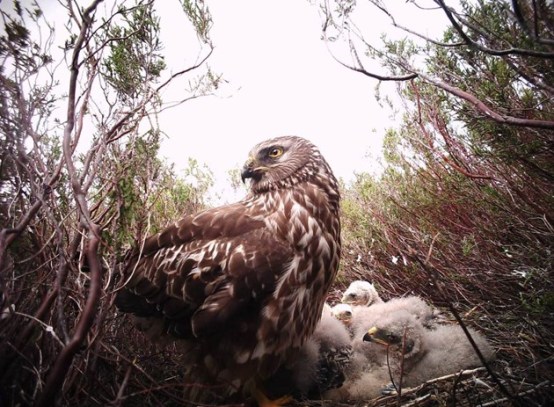
Photograph from a 2017 Heads up for Harriers nest camera:

For God’s sake, when are we going to get some honesty about the Heads up for Harriers project?

Let’s just be clear – the purpose of installing nest cameras is not ‘to find out what’s happening to these birds’ – we already know what’s happening, and Des even alluded to this in his interview. On intensively managed grouse moors, breeding hen harriers are not tolerated. They are illegally killed and this has been going on for decades, in England and in Scotland.

We know that at some nests the breeding attempt can and will fail, from a number of natural causes, but that’s perfectly normal. These types of failures are NOT the cause of the declining hen harrier population, nor the reason behind the persistent absence of breeding hen harriers on driven grouse moors – that is down to illegal persecution. It’s a fact, accepted by Governments, by statutory agencies, by police forces, by conservationists, in fact by everybody except those involved with the driven grouse shooting industry.

So let’s stop pretending that we need the Heads up for Harriers project to determine ‘what is happening to hen harriers’. No, the real reason for wanting these estates to sign up for the Heads up for Harriers project is to prevent them from killing nesting birds. If they know there’s a camera pointing at the nest, the gamekeepers will not touch those birds.

In this interview, when discussing the results from the 2017 breeding season, once again it was glossed over that none of the seven estates with nest cameras were intensively managed driven grouse moors (we’ve blogged about this quite recently, here, and we’ll be saying more in the near future). Those estates with cameras are not known as raptor persecution hotspots and they do not have a reputation for killing hen harriers. These are relatively progressive estates that do tolerate hen harriers and have done for some time, with or without this project. To claim this as a project ‘success’ is wholly misleading.

And while it’s true that of the 21 estates that have signed up for this project, some ARE intensively managed grouse moors (including a number in the Angus Glens), not one of those driven grouse moors has produced a hen harrier breeding attempt. Its all very well signing up for the scheme and using this for a bit of PR value, but until they support a hen harrier breeding attempt, their ‘participation’ is meaningless.

And even if some of those intensively managed grouse estates did manage to support a hen harrier breeding attempt, that wouldn’t stop the illegal killing of the fledglings. As we’ve seen over and over and over again, as well as breeding adults, dispersing young harriers are also illegally killed on driven grouse moors, and this would take place beyond the view of a nest camera.

And please, Des, stop also pretending that there’s ‘a very strong partnership’ between SLE, RSPB, SRSG, SNH and others involved with this project.

There is not!

Sure, there is partnership working with ‘decent’ estates (i.e. those that don’t kill raptors), as there always has been, but the relationship between raptor conservationists and the driven grouse shooting industry has never been worse!

We’ve seen grouse moor estate owners telling raptor workers they’re no longer welcome (here), we’ve seen a Director of the Scottish Gamekeepers Association repeatedly making outrageous and false accusations about raptor workers (here), we’ve seen the Director of the Scottish Moorland Group falsely accuse raptor workers of producing “deeply flawed” peer-reviewed science (here), we’ve seen the Chairman of the Scottish Gamekeepers Association falsely accuse the Scottish Raptor Study Group of ‘driving [gamekeepers’] wives, children and grandchildren from their homes‘ (here), we’ve got the Scottish Gamekeepers Association refusing to attend PAW Scotland Raptor Group meetings through a perceived lack of trust (here), and we’ve got SLE refusing to tell the RSPB (a Heads up for Harriers project partner) the names of the participating estates in this project (here).

Does that sound like ‘a very strong partnership’ to you?

Come on, stop with the spin, stop with the secrecy, stop with the pretence. We’ve had enough. And no, we’re not “impatient for change” – raptor conservationists’ patience has been tested to the limit over several decades – it’s no surprise it has now run out.

Previous blogs about the Heads up for Hen Harriers project: see hereherehereherehere, here, here, here, here

‘Closer cooperation to protect hen harriers’ – what does that mean, exactly?

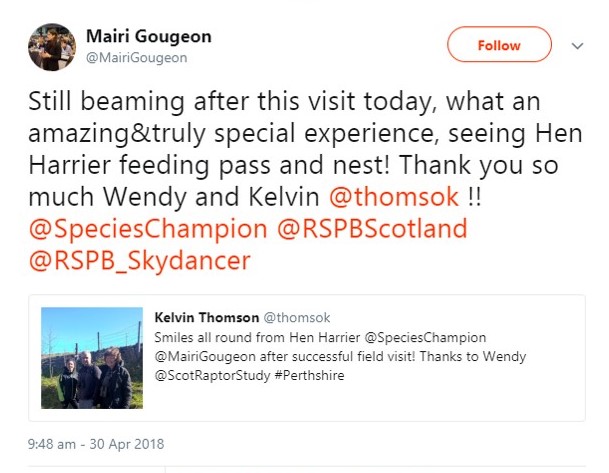
Further to a recent article published in The National where Hen Harrier Species Champion Mairi Gougeon MSP calls for ‘closer cooperation’ between conservationists and the game shooting industry ‘to protect hen harriers’ (see here), this deserves more comment.

We’ve given this some thought over the Xmas break and frankly, it’s a bloody affront to imply that conservationists are somehow partly responsible for the continuing decline of the hen harrier population.

Here’s what the driven grouse shooting industry does for hen harriers:

Illegally shoots them; illegally traps and bludgeons them to death; illegally poisons them; illegally burns out nest sites; illegally stamps on eggs & chicks; illegally uses dogs to kill chicks & then blames it on fox predation; sets illegal spring traps; sets illegal pole traps; waits at known roost sites & uses thermal imaging to detect & then shoot roosting birds; deploys gas guns at the onset of the breeding season to disturb; ignites banger ropes at the onset of the breeding season to disturb; deploys inflatable scarecrows with sirens at the onset of the breeding season to disturb; consistently denies the extent of illegal persecution; accuses conservationists of exaggerating the persecution data; blames disappearances on imaginary windfarms, faulty sat tags & disturbance by fieldworkers; uses fake partnerships to portray an image of conservation action; pays a PR company to put false and malicious propaganda in right-wing newspapers; claims not to know who the criminals are; gives ‘no comment’ interviews & creates a wall of silence in police investigations; accuses conservationists of planting evidence.

Here’s what conservationists do for hen harriers:

Nest monitoring; roost monitoring; nest protection schemes; ringing; satellite-tagging; surveying; data collection; data analysis; report writing; scientific paper writing; public engagement e.g. RSPB Skydancer, Hen Harrier Day; report suspected wildlife crimes; campaign for stronger law enforcement; campaign for industry regulation; raise public awareness of illegal persecution.

Conservationists are NOT the problem here. Conservationists are not the ones systematically and illegally killing this species whenever it turns up or attempts to breed on intensively managed driven grouse moors and nor are conservationists the ones engaged in a perpetual cover-up of what is essentially serious organised crime.

What did Mairi Gougeon mean then, by calling for ‘closer cooperation’? The only part of her quote that gave any indication of what she meant was this:

“At the same time we cannot tar all estates with the same brush. We must acknowledge the positive steps some estates and gamekeepers are taking to promote the species“.

That’s easily resolved. We don’t tar all estates with the same brush and we do acknowledge the positive steps some estates and gamekeepers are taking to encourage and safeguard nesting hen harriers, but as far as we’re aware, not one of those estates is actively managed for intensive driven grouse shooting. You show us one that is and we’ll sing its praises from the rooftops. So far, we only have the word of the driven grouse shooting industry that these estates exist, but we don’t and won’t believe them until we’re shown the evidence.

So what other avenues does that leave open for ‘closer cooperation’? None. Are we going to stop campaigning? No. Are we going to stop pushing Govt for some sort of state-regulatory control of driven grouse moors? No. Are we going to stop highlighting hen harrier persecution crimes? No. Are we going to stop satellite tagging? No. Are we going to stop pushing for better law enforcement? No. Are we going to stop asking for public accountability when prosecutors drop clear-cut criminal proceedings without explanation? No. Are we going to stop calling out the grouse shooting industry’s ludicrous propagandist claims? No. Are we going to stop reporting suspected wildlife crimes to the police? No. Are we going to stop lobbying MPs and MSPs to take more action on raptor persecution? No. Are we going to stop talking about illegal hen harrier persecution? No. Are we going to stand by and watch the hen harrier population plunge further in to decline? No.

Are we going to ‘cooperate’ with hen harrier-killing criminals?

Not a chance.

MSP urges closer cooperation to protect hen harriers – a futile request while illegal raptor killing continues

Following the recent news that yet another hen harrier has been found dead in suspicious circumstances (here), Hen Harrier Species Champion Mairi Gougeon MSP has taken the opportunity to call for conservationists to work in closer cooperation with the game shooting industry.

Here’s an article in yesterday’s edition of The National:

MSP MAIRI GOUGEON URGES CLOSER COOPERATION TO PROTECT HEN HARRIERS

SCOTLAND’S big landowners have backed an SNP MSP’s call for all sides to work together to end persecution of hen harriers.

Species champion Mairi Gougeon spoke out after Police Scotland launched a probe this week into the death of a hen harrier found with “unexplained injuries” near Dunoon in Argyll.

The Angus North and Mearns MSP urged all sides of the debate on raptor persecution to come together to find a long-term way to help the hen harrier flourish.

The death of the satellite-tagged bird, named Kathy, is one of a number of high-profile cases involving hen harrier.

Earlier this year a bird was reportedly shot in Leadhills, while satellite-tagged Calluna went missing near Braemar, Aberdeenshire, and a four-year court case over the alleged shooting of a harrier on Cabrach Estate in Moray was dismissed.

A recent survey showed a 27 per cent fall in Scotland’s hen harrier population – down to 460 pairs – since 2004. Illegal persecution of the bird is thought to be a major factor in its decline. It has been suggested some estate staff kill the birds to protect game-bird species such as grouse.

Heads Up for Harriers is an initiative from the Scottish Government’s Partnership for Action against Wildlife Crime to get land managers to protect harriers.

More than 20 of Scotland’s estates have signed up for the project. It reported its highest number of fledged young hen harriers, 37, in 2017, and Gougeon is keen to do more to bridge the gap between estates and conservationists.

Gougeon said: “I’m under no illusions about how contentious this issue is. I know it won’t be resolved overnight but I take my role as a species champion very seriously.

One of the main reasons why the hen harrier population hasn’t flourished is the fact there has been illegal persecution of this species over a long period.

Almost half of Scotland is capable of supporting a hen harrier population. There are a number of ongoing projects – including Heads Up for Harriers – geared towards trying to sustain and grow the population in the future.

Heads Up for Harriers is not without its critics and may not be an immediate panacea but it is a promising step in the right direction.

More estates need to sign up to the project before we can assess whether or not it is successful.

We also need to look at other potential solutions such as diversionary feeding.

We need to take every available measure to crack down on the serious crime committed against raptors and to tackle the illegal persecution that takes place.

At the same time we cannot tar all estates with the same brush. We must acknowledge the positive steps some estates and gamekeepers are taking to promote the species.

We need conservation groups and shooting interests to set aside their natural distrust and to try to work together“.

‘Species Champion’ MSPs agree to provide political support for Scotland’s wildlife, under a scheme organised by environment groups.

Tim Baynes of landowners’ group Scottish Land and Estates said: “We are committed to playing our part in helping to restore this iconic species.

We support Mairi Gougeon’s call for greater co-operation and collaboration and look forward to working with other organisations with the same objective at heart.

We are concerned about the fate of the hen harrier found near Dunoon.

This bird has been found in area which is heavily afforested and a long way from any grouse moor. We echo the police appeal for information.”

ENDS

Photo of satellite-tagged hen harrier ‘Annie‘, found shot dead on a Scottish grouse moor in 2015, shortly after the Heads Up for Hen Harriers Project began [photo by RSPB Scotland].

Full credit to Mairi for being quick off the mark and using her position to reiterate in the national press that, “One of the main reasons why the hen harrier population hasn’t flourished is the fact there has been illegal persecution of this species over a long period”. That’s exactly what the Hen Harrier Species Champion needs to be saying and we applaud her for doing so.

But this idea that ‘conservationists need to be working closer with the gameshooting industry to tackle illegal raptor persecution and then everything will get better’ is indicative that Mairi is new to this game – and she is. That’s not her fault and she’s taking the position that every other reasonable person takes when they first join this ‘debate’ – that of thinking that if only both ‘sides’ would sit and talk/cooperate then this whole sorry mess could be resolved. Mark Avery wrote a detailed blog about this earlier in the year (see here), and although it’s slanted towards ineffective long-term talking in England, the same applies to Scotland.

The bottom line is that as long as one ‘partner’ (or in this case, many partners) continues to deny the extent of illegal persecution (e.g. see here) even when the evidence continues to mount that the illegal killing continues, then that ‘partnership’ is doomed to fail.

In the case of hen harriers in Scotland, the so-called Heads up for Harriers ‘partnership’ has been a scam right from the start – we’ve blogged about it a lot (e.g. see hereherehereherehere, here) and only recently this view was aired in Parliament by MSP Andy Wightman (see here). We are currently pursuing an FoI with SNH to expose what we believe is a very serious political cover up about this project (see here) – more on this in the new year.

And all the time this ‘partnership’ has been running, hen harriers have continued to be killed.

Conservationists are tired of the rhetoric, tired of the propaganda, tired of the lies, tired of the ineffective judicial system and tired beyond belief of the never-ending illegal killing.

For hen harriers to start recovering in Scotland (and in England), no amount of ‘closer cooperation’ between conservationists and the game shooting industry will ever work. Only one thing will work – and that is for the raptor killers to stop their criminal activities. And as they can’t (or won’t) do it after 60+ years of self-regulation, then they only have themselves to blame as the strength of public disgust brings about enforced political change.

Have a read of the first comment under the article in The National – nobody’s fooled by this scam anymore and no amount of Xmas goodwill is going to change that:

Bruce Anderson: Scotland’s big landowners have signed up for this because it is just the latest in a long line of window dressing ‘partnerships’ which provide cover and a veneer of respectability for the routine criminal destruction of protected wildlife across nearly all Scottish grouse moors. Mari Gougeon has done some very good work championing hen harriers but she is naive if she thinks that ‘working together’ with Tim Baynes and the grouse industry will have any effect on the organised crime and big money that have left huge ares of Scotland devoid of hen harriers and other protected raptors.

UPDATE 27 December 2017: ‘Closer cooperation to protect hen harriers’ – what does that mean, exactly? (here)