
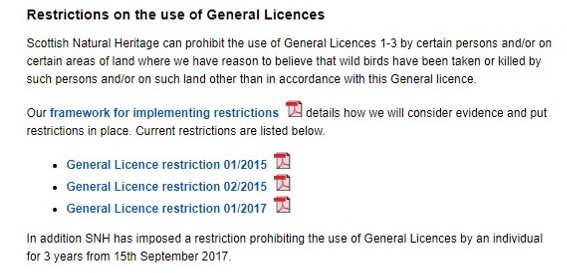
In September 2017 we learned that SNH had imposed a General Licence restriction on an individual for alleged criminal activity in relation to raptor persecution (see here).
This was a highly unusual restriction because it applied to an individual rather than to an estate.
At the time the restriction was announced, SNH provided virtually no information other than to say a General Licence restriction had been imposed and that it would apply for three years.
However, RSPB Scotland released a press statement in relation to this restriction order which included the following quote from RSPB Scotland’s Head of Investigations, Ian Thomson:
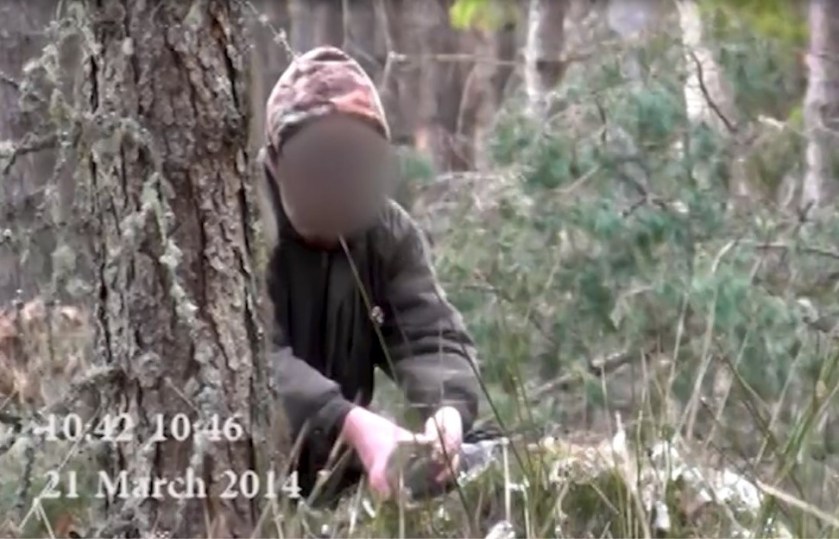
The restriction was imposed after RSPB investigations staff passed video footage to police of a gamekeeper allegedly setting illegal traps, baited with a dead woodpigeon, very close to a goshawk nest in NE Scotland”.
Here’s a clip from that video evidence:
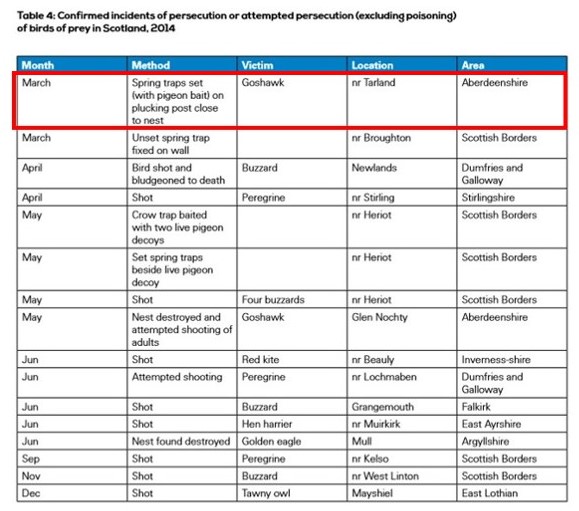
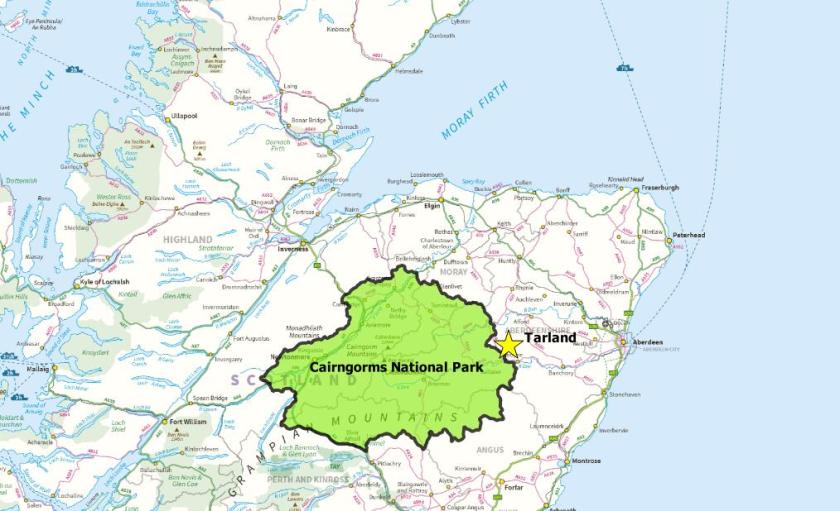
From this, we were able to deduce that this alleged wildlife crime took place in March 2014 ‘nr Tarland, Aberdeenshire’, although the specific location was not given.
This alleged offence was reported by Police Scotland to the Crown Office in April 2014 (see here). It is clear, now, that the Crown Office did not prosecute the gamekeeper, probably on the grounds that the video evidence was deemed ‘inadmissible’. That’s the sixth alleged wildlife crime case, that we know about, that the Crown Office has dropped in recent months.
So at this stage we know that an alleged wildlife crime had taken place, we know that a criminal prosecution is not going to happen (because the case is now time-barred), and we know that SNH has imposed an individual General Licence restriction on a gamekeeper as a supposed sanction. The identity of the alleged offender remains a secret, as does the name of the estate where the alleged offence was committed. This lack of transparency is, frankly, appalling, especially when former Environment Minister Paul Wheelhouse had stated when he first introduced General Licence restrictions in 2014 that he expected them to function as “a reputational driver”. Not much chance of that happening when the details of a case are kept secret.
In early October 2017 we submitted an FoI to SNH to try and find out more details about this case. We asked for:
- The name of the person who had been given a General Licence restriction (we didn’t expect to be told but thought we’d ask anyway – you never know)
- The occupation of that person (we already knew from the RSPB press statement that he was a gamekeeper but we wanted SNH to confirm this)
- The name of the county in which this individual resides (we already knew from the RSPB press statement that the alleged offence had taken place in Aberdeenshire but we wanted SNH to confirm this)
- The name of the estate from where the Police evidence of alleged raptor persecution had been collected
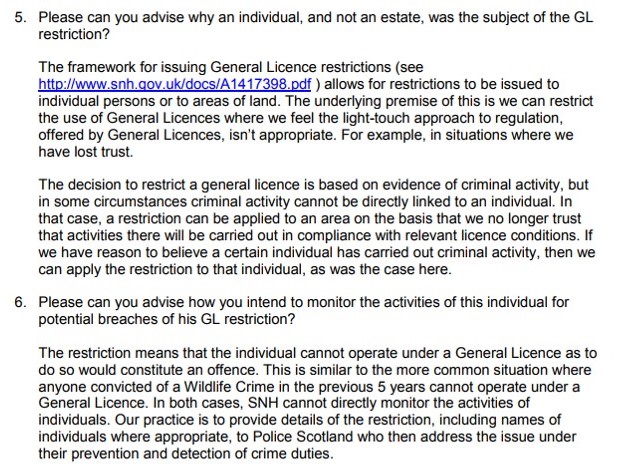
- An explanation about why an individual and not an estate was the recipient of the General Licence restriction
- An explanation about how SNH intends to monitor the activities of the individual for potential breaches of his General Licence restriction.
SNH has now responded and it’s astonishing:
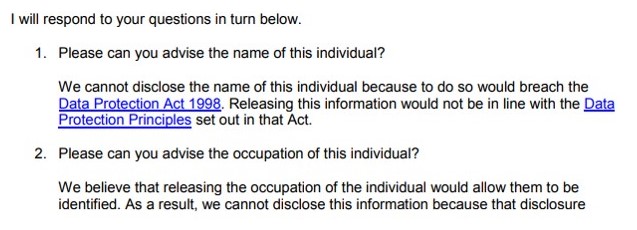
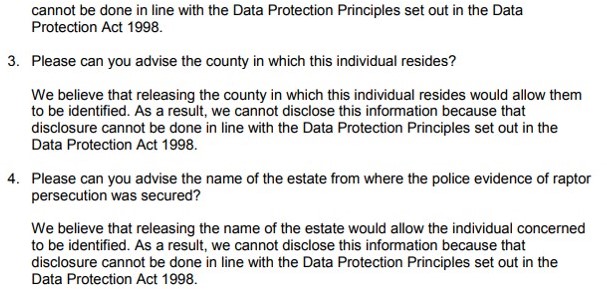
It looks like SNH has been taking lessons from Natural England in the withholding of information that should be in the public domain. It’s understandable that SNH can’t disclose the alleged offender’s identity, but withholding details of his occupation and the county in which he resides because “this would allow them to be identified” is obviously nonsense, and we already know this information from the RSPB press release!
We would argue that it is in the public interest to know the name of the estate on which this alleged offence took place (and we do know from various local sources it was on a game-shooting estate and that this gamekeeper was employed by that estate). Why should that information be kept secret? Who is SNH shielding, and why?
And does anyone actually believe that Police Scotland, no matter how well-intentioned, has the resources to track this gamekeeper’s activities for the next three years to ensure he’s not breaching the terms of his General Licence restriction?!
Whilst this response doesn’t get us any further forward in knowing the specifics of this case, what it does demonstrate, quite clearly, is that the General Licence restriction, introduced as a way of publicly embarassing estates where there is evidence of wildlife crime but, due to perceieved evidential difficulties, the cases don’t ever reach the courts, is simply not working.
Tomorrow’s blog, on another General Licence restriction case, will emphasise this point again but on a whole bigger scale.



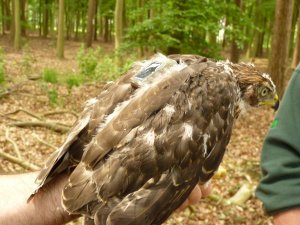 Not for the first time, the Queen’s Sandringham Estate in Norfolk has been at the centre of a police investigation in relation to a raptor incident.
 Police Scotland has issued an appeal for information following the discovery of disturbed and abandoned buzzard and goshawk nests in the Moy Forest near Tomatin in the Scottish Highlands.
 What this press release doesn’t say is that this goshawk site is a historical one (i.e. goshawks have attempted to breed here in the past) although strangely the site has never been successful, with breeding attempts always failing by the incubation stage. Perhaps not so strange when you realise that the site is adjacent to a driven grouse moor.
 Grant Moir, Chief Executive of the Cairngorms National Park Authority, has today issued a
 Raptor Persecution UK