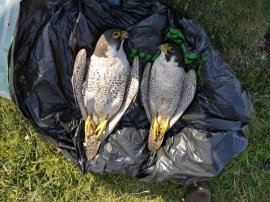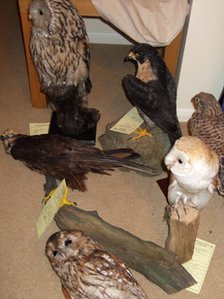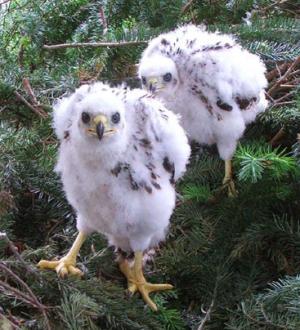
More on the Borders goshawk chicks reported shot

Yesterday we commented on an article being run on the BBC News website that was reporting on the shooting of goshawk chicks in the Borders (here). We raised some questions about the details in the article.
Thanks to the contributors who have written in to clarify things:

The BBC News article said: “The find was made in woods near Innerleithen by wildlife police officers earlier this month“.  Not true. The dead chicks were found by raptor workers in June and were reported to the police at that time.

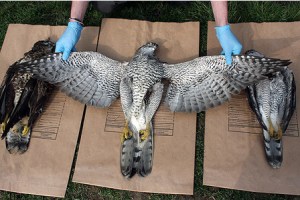
The BBC News article said: “It appears that whoever attacked the nest climbed up and then blasted it with a shotgun making it impossible to identify how many chicks were inside“. Not true. The chicks were shot by someone standing beneath the nest tree. Two dead chicks were retrieved from the nest by raptor workers and delivered to the local police station to be sent for x-ray to confirm the cause of death.

The BBC News article said: “Anyone with information has been urged to contact Lothian & Borders Police immediately“. Information was given to the Lothian & Borders Police Wildlife Crime Coordinator in June.

The BBC News article said: “Police said they were treating the case very seriously“. Really?

Borders goshawk chicks reported shot – but something not right about this story

The BBC News website is running a story today that doesn’t quite sound right. The article says that earlier this month wildlife officers from Lothian & Borders Police discovered a nestful of dead goshawk chicks in the Tweed Valley that had been killed with a shotgun.

Goshawk chicks fledge in June/July, not September, so unless there has been a second clutch laid – which would be a rare event indeed, then these chicks were presumably shot in May/June and have remained unnoticed until September. That’s possible but seems fairly unlikely – the Borders goshawk population has been closely monitored for the last few decades. Hmmmm…

Anyone with information is urged to contact Lothian & Borders Police.

Article on BBC News here

Four goshawks and a buzzard found poisoned

The RSPB has put up a reward of £1,000 for information about the deaths of four goshawks and one buzzard which have been found poisoned in Devon. They were discovered in Forestry Commission woods near to Exeter and had been poisoned with the bannned pesticide Carbofuran.
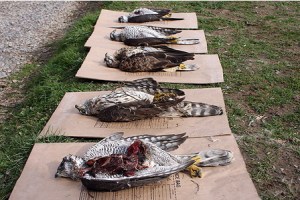
A recent survey suggests that there are no more than 20 breeding pairs of goshawk in Devon.

Ian Parsons, a Forestry Commision ranger, said: “The people that do this to our wildlife not only deprive people of the chance to see these rare birds but they also put the public at risk. The poison involved is lethal to dogs and humans and the land where this happened is open to the public. These people obviously don’t care about the dangers of doing this“.

Anyone with information about these crimes is urged to call Crimestoppers, in confidence, on: 0800-555-111, or email Devon & Cornwall Police Wildlife Crime Officer P.C. Josh Marshall directly: Joshua.MARSHALL2@devonandcornwall.pnn.police.uk
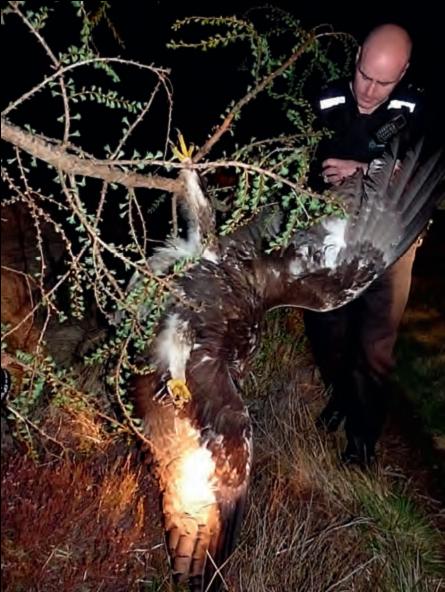
PC Marshall said: “We rely on the public to be our eyes and ears in wildlife crimes such as this. If anyone knows anything about this, please get in touch“.

BBC News story here

Western Morning News article here

RSPB publishes 2010 raptor persecution report

The RSPB has just published its annual report on raptor persecution in Scotland. The report, ‘The Illegal Killing of Birds of Prey in Scotland 2010‘ is the only known published record of all known persecution incidents including poisoning, shooting and trapping, in contrast to the PAW Scotland annual report which only details poisoning incidents. As well as the confirmed incidents of persecution, the report also provides information about ‘probable’ incidents (those where the available evidence points to illegality as by far the most likely explanation but where the proof of an offence is not categorical) and ‘possible’ incidents (where an illegal act is a possible explanation but where another explanation would also fit the known facts).

The report provides details of several confirmed and probable persecution incidents that didn’t make it into the public domain at the time they occurred, including two shot sparrowhawks (Dingwall, Inverness-shire & nr Dolphinton, South Lanarkshire), a goshawk killed in a pole trap (nr Dalwhinnie, Inverness-shire), a shot short-eared owl (Leadhills, South Lanarkshire), 5 separate incidents involving peregrines (Stirlingshire, South Lanarkshire and Dumfries-shire), ‘disappearing’ hen harrier chicks (nr Knockando, Moray), a member of the public witnessing the shooting of a buzzard (nr Leadhills, South Lanarkshire), the discovery of a heavily decomposed buzzard carcass found in a stink pit (nr Dornie, Inverness-shire) and the discovery of a suspected pole-trapping site (nr Dornie, Inverness-shire).

Interestingly, although the report doesn’t go as far as naming estates in most incidents (apart from the reports of successful prosecutions), it does go further than the vague information provided in the annual PAW statistics. For example, in the PAW Scotland ‘Bird of Prey Poisoning Incidents 2006-2010 – Incident Details’ report (that we discussed here in March 2011), there are several cases of buzzard poisoning that were just listed as ‘Tayside’. The RSPB report clarifies this a little bit, and lists the locations as ‘Glenogil’ and ‘nr Kinross’.

This annual report makes for grisly reading, but as the report says, these incidents no longer shock or surprise us. The evidence yet again points to the involvement of people within the game-shooting industry; the latest statistics show that of all those convicted for illegal raptor persecution in Scotland between 2003-2010, 88% were involved with gamekeeping (the rest involved pest controllers, farmers and pigeon racers at 4% each).

The RSPB makes several recommendations in the report that would considerably reduce the difficulty of bringing these criminals to justice. They include recommended action for the police, the crown office & procurator fiscal service, the Scottish government, and representatives from the game-shooting industry. Some of these recommendations have been made before but have apparently remained unheeded.

Well done to the RSPB for publishing this report and for keeping the issue high on the political and public agenda.

The report can be downloaded here

Update on last week’s police raid

Further to the blog post on 19 July 2011, the name of the Highland sporting estate that was raided last week has been reported as Farr and Kyllachy Estate, near Inverness. The police raid was in connection with alleged wildlife crime incidents that include a poisoned sea eagle and a poisoned golden eagle, believed to have been discovered in June 2010, and four dead red kites.

Allegations of wildlife crime in this area date back several decades, including the previously reported discovery of poison bait, hen harrier nest destruction, poisoned eagles, poisoned red kites and attempted trapping of goshawks and peregrines. All of these allegations can be found by anybody interested in doing an internet search, although no allegation has ever been proven in the Scottish courts.

No charges have been reported in relation to last week’s police raid. On this basis, blog commentators are reminded that anyone connected with Farr and Kyllachy Estate must be presumed innocent.

According to a 2005 report in The Times, Farr Estate is expected to receive profit of up to £11 million from revenue generated by recently erected wind turbines (see here).

Last year, The Press & Journal ran an article (here) about tick management on the estate, including an interview with the Laird, Philip Mackenzie. The article claimed that tick control had led to a 20-fold increase in the number of brace shot (red grouse) in the previous six years. It also stated the Estate was expecting 2010 to produce the best grouse bags since 1938, leading to 15 days of let driven grouse shooting, at a tidy charge of £10,000 + per day.

Last year Farr Estate donated driven and walked-up grouse shooting days to the Game and Wildlife Conservation Trust’s (GWCT) 2010 Grand Scottish Draw (see here).

“Professional gamekeepers do not poison raptors” says Alex Hogg

Episode 11 of the BBC 2 Scotland ‘Landward’ programme went out on Friday 27 May and included a segment on the new vicarious liability regulation in the Wildlife and Natural Environment (Scotland) Act 2011. The programme is available here for a limited period.

The segment opened with Duncan Orr-Ewing, Head of Species at RSPB Scotland, who told the interviewer, “Bird of prey poisoning is particularly associated with driven grouse moors in the upland of Scotland, in the central and eastern highlands, parts of Perthshire and also down in the southern uplands”.

The interviewer, Dougie Vipond, asked: “So who is doing this? Who is killing the birds?”

Orr-Ewing: “Well, it is estate employees, gamekeepers who are usually involved, but they are only employees, they are acting under the direct instructions so ultimately it is the landowners that are responsible for this”.

A short section followed with a brief interview with Liz Plath, listed as a rural law specialist and a partner at Thorntons Law LLP. Basically she explained in simple terms how vicarious liability brings the landowner or the employer into the frame in cases of raptor poisoning.

Next up was Alex Hogg, chairman of the SGA, whose opening line was: “Professional gamekeepers do not poison raptors”. Funny that, because if you bother to look back at the statistics on raptor poisoning for the ten-year period that Hogg has been in post, you’ll see that raptor poisoning incidents have been recorded on many estates, and yes, ‘professional’ gamekeepers have been convicted.

He then contradicted himself (and not for the first time) by saying: “It’s only a small minority that are still at it. A rogue few if you like”.  Lest we forget, here is the official government map showing confirmed raptor poisoning incidents between 2006-2010. Widespread, I’m sure you’ll agree, and the trend is pointing upwards.

He continued: “And we’ve tried our hardest over the past, I’ve now been in this job for ten years, to impress on everybody that it’s absolutely illegal to poison raptors”. Peer pressure from Hogg and co., while welcome, has been ineffective. It can’t help the situation when he and others from his industry continue to claim that raptors are having a significantly negative effect on game birds, songbirds, waders and lambs. Is there any scientific evidence for this? No, not a shred.

Next up came David Hendry, listed as the proprietor of Cardney Estate, near Dunkeld in Perthshire. Now this was an interesting interview. The piece opened with an introduction to Hendry, and video footage of a diving osprey on his estate. We were told that this estate ‘is home to many endangered birds of prey’. Unfortunately, Hendry was not asked how many and what species of raptors made their home there. The osprey was implied, but of course the osprey only eats fish, not exotic red-legged partridge (also known as French partridge) or pheasant, which are reared and released in large numbers for sport shooting on this estate, according to this shooting directory.

Vipond talked about the belief that the only way to stop poisoning is to introduce a licensing system which would allow landowners to control [kill] raptors. Hendry agreed, and suggested “it should become the gamekeeper’s job for instance to look after the rare raptors like harriers, your merlins, bring on your red kites, but they should also be allowed to reduce buzzards and sparrowhawks to numbers that are sustainable, because what we have today is not sustainable”.

Ok, so this is the first time we’ve officially heard that sparrowhawks are also the landowners’ intended target for licensed killing. Until now, the list has ‘just’ included buzzards and ravens. So what happens if they get the go ahead to kill these species? Will we see goshawks added to the next list? They’re just an over-sized sparrowhawk after all, so why not? And golden eagles? They’re just over-sized buzzards, so why not? Where will it stop?

It’s also very interesting that he thinks the current number of buzzards and sparrowhawks is ‘unsustainable’. According to this shooting website, Cardney Estate offers shooting days where between 200-400 exotic birds (partridge/pheasant) can be shot. That’s 200-400 birds per shooting day, depending on the time in the season. In September 2010, a record 677 birds were shot on one day according to one participant! Sounds to me like this sporting estate is doing very nicely thank you, without the need to kill off any indigenous protected raptors, whatever species they may be.

We then went back to Orr-Ewing, who was asked for his opinion about the need to ‘manage’ [kill] protected raptors. “These birds of prey are rightly protected because they’re vulnerable. We have a history of killing birds of prey in Scotland, many species are just recovering from that situation, there’s no other country in Europe that [legally] kills birds of prey”.

His first three points are accurate, but his last statement is not. In 2008 the provincial government of Lower Austria issued a decree allowing hunters to shoot 1,000 buzzards and 250 goshawks over the following five years. It previously allowed the killing of Montagu’s harriers until the EC stepped in to halt it. The decree allowing the legal persecution of buzzards and goshawks resulted in an international public outcry – the same can be expected if the licensed killing of raptors for the benefit of the game bird-shooting industry is permitted in Scotland.

And of course, it’s not just poison that is used to illegally kill raptors. Unfortunately our government does not produce annual statistics on the other incidences of raptor persecution that take place every single year. Thankfully, the RSPB does. Their annual reports (one covering bird persecution in the UK as a whole, and the other covering incidents in Scotland) are a welcome insight into the extent of the problem. Their 2010 annual reports are due for publication in the very near future. Their efforts to compile and publish these reports are worthy of the public’s gratitude because without them, we would only have Alex Hogg and co’s word about the extent of illegal raptor killing on Scotland’s sporting estates.

SGA announces new vice-chairman

The Scottish Gamekeepers’ Association has announced the appointment of a new Vice-Chairman – Peter Fraser. According to the SGA website, Peter has been employed as a stalker on the Invercauld Estate, Aberdeenshire, for 41 years and “is highly regarded throughout the industry for his knowledge and experience of the hill environment and the countryside“. He’s probably also well aware of the continuing problem of illegal raptor persecution, especially as Invercauld Estate has been reported to be at the centre of several allegations over the years. Although as only one of these allegations ever resulted in a conviction, it could be argued that the others were all scurrilously and falsely levelled at Invercauld Estate employees. We all know that Invercauld Estate is against the illegal poisoning of raptors, because they signed the SRPBA letter to say so.

Peter has made a good start to his new role as Vice-Chair, as he apparently has argued ‘that in order to move forward the industry has to abide by the rules set by government’. Great insight. All that thinking time while stalking animals across the Scottish hills for 41 years has obviously been well used.

Peter is no stranger to voicing his opinions in the media either. In a televised interview with STV, he speaks fondly of golden eagles, saying: “A beautiful bird, part of our natural heritage and must always remain so“. Unfortunately, it appears he doesn’t feel the same way about goshawks, as he calls them “ruthless killers” and says they “kill for fun“. Perhaps Peter doesn’t view goshawks as part of our natural heritage, or understand that as a predator, they kill to survive, because, er, that’s what predators do?

Never mind. Peter and his colleague, SGA Chairman Alex Hogg, will make an entertaining formidable debating team in the Scottish political arena and we look forward to hearing about their efforts to stop the continued illegal killing of raptors by people within the shooting industry.

Here is the SGA announcement of Peter’s appointment: http://www.scottishgamekeepers.co.uk/content/new-sga-vice-chairman-elected

Here is Peter’s interview on STV: http://video.stv.tv/bc/scotland-outdoors-20080530-gamekeeping-in-the-highlands/

RSPB Birdcrime 2009 Report Shows Continuing Raptor Persecution

The RSPB’s annual Birdcrime 2009 report was published today and shows that 2009 was the second worst year for raptor persecution in the last decade.

This depressing report shows that there were 384 reported persecution incidents against birds of prey in the UK  during 2009, 123 in Scotland, 224 in England, 17 in Wales and 11 in Northern Ireland, 9 incidents could not be allocated to a single country and were recorded at a UK level. Incidents include trapping, shooting, poisoning and nest destruction.

Again the trend showed that most incidents involved game shooting interests with a bias towards the upland grouse moors in Scotland and Northern England where the main victims of persecution are: golden eagle, white-tailed eagle, hen harrier, goshawk, peregrine and red kite.

In the report, the RSPB has made 11 recommendations for government action, so that these appalling crimes can be eradicated. These include the introduction of a “vicarious liability” offence which would make land managers and owners responsible for the actions of their employees.

Despite several successful prosecutions the conviction rate and subsequent sentencing appears pitifully poor and ineffective.

Full RSPB Report – http://www.rspb.org.uk/Images/birdcrime_tcm9-260567.pdf


Roseanna Cunningham Quizzed over proposed licences to kill buzzards

Environment Minister Roseanna Cunningham was asked some pretty incisive questions by Rhona Brankin MSP during parliamentary questions and answers on Wednesday 16th June 2010.

Questions were asked in relation to the mass rearing and release of pheasants and red legged partridges, the value of these birds, the value of Scotland’s biodiversity and natural heritage, the persecution of buzzards, applications for licences to kill buzzards, and the status of the goshawk and sparrowhawk in Scotland etc.

Full details of the parliamentary question and answer session can be found here: http://www.scottish.parliament.uk/business/pqa/wa-10/wa0616.htm#2

Questions and answers regarding raptors and game birds are listed below. Apologies for the long post but it’s well worth a read.

Rhona Brankin (Midlothian) (Lab): To ask the Scottish Executive , further to the answer to question S3W-33201 by Richard Lochhead on 30 April 2010, what particular species of pheasant it considers to be naturally occurring in Scotland and what the taxonomic basis is for this view.

(S3W-34201)

Ms Roseanna Cunningham MSP :

The common pheasant (phasianus colchicus) has been breeding in the wild in Scotland for hundreds of years.

Rhona Brankin ( Midlothian ) (Lab): To ask the Scottish Executive  whether it considers (a) biodiversity and (b) the natural heritage to have intrinsic value.

(S3W-34231)

Ms Roseanna Cunningham MSP :

The Scottish Government considers that there are two important ways in which the Scottish people derive benefit from biodiversity and the natural heritage. In the first place, significant value is derived from user benefits, ranging from ecosystem services such as water purification and nutrient recycling, to the pleasure provided by visiting natural areas and seeing plants and animals. In addition, although it less readily susceptible to quantification or analysis, we recognise that for a variety of moral or precautionary reasons, many people also place significant value on the simple existence of natural heritage and biodiversity.

Rhona Brankin ( Midlothian ) (Lab): To ask the Scottish Executive  whether it considers that buzzards are subject to deliberate ill-treatment in areas where pheasants are released for shooting.

(S3W-34188)

Ms Roseanna Cunningham MSP :

Buzzards are widespread and frequently the victims of wildlife crime. It is likely that at least some of this wildlife crime will be associated with pheasant rearing.

Rhona Brankin (Midlothian) (Lab): To ask the Scottish Executive , should large numbers of licence applications to kill protected predatory birds meet guidance requirements for approval, what contingency plans exist to prevent a reduction in the population of the protected species being killed.

(S3W-34189)

Ms Roseanna Cunningham MSP :

We would not expect a large number of applications to be approved. No application would be approved that threatens the conservation status of the species concerned. The detail of any further guidelines is yet to be finalised.

Rhona Brankin (Midlothian) (Lab): To ask the Scottish Executive , should large numbers of licence applications to kill protected predatory birds meet guidance requirements for approval, what contingency plans exist to prevent a reduction in the capacity of the population to continue its expansion to previous natural levels.

(S3W-34190)

Ms Roseanna Cunningham MSP :

I refer the member to the answer to question S3W-34189 on 16 June 2010. All answers to written parliamentary questions are available on the Parliament’s website, the search facility for which can be found at http://www.scottish.parliament.uk/Apps2/Business/PQA/Default.aspx.

Rhona Brankin ( Midlothian ) (Lab): To ask the Scottish Executive  what contingency plans exist should evidence of illegal killing arise in or near sites subject to applications for licences to kill predatory birds in order to protect game birds released to be shot.

(S3W-34191)

Ms Roseanna Cunningham MSP :

The detail of any further guidelines is yet to be finalised but it should be a condition of any licence that it could be withdrawn if there was evidence of illegal activity.

Rhona Brankin ( Midlothian ) (Lab): To ask the Scottish Executive  what proportion of released pheasant poults survive to such an age that they are shot as part of a commercial operation.

(S3W-34192)

Ms Roseanna Cunningham MSP :

The Scottish Government does not hold this information.

Rhona Brankin ( Midlothian ) (Lab): To ask the Scottish Executive  what estimates it is aware of regarding the total number of pheasant poults released each year.

(S3W-34193)

Ms Roseanna Cunningham MSP :

The Scottish Government does not hold this information. UK figures quoted by the GWCT state that 35 million pheasants are released each year (http://www.gwct.org.uk/research__surveys/species_research/birds/pheasant/default.asp).

Rhona Brankin ( Midlothian ) (Lab): To ask the Scottish Executive  what the average value is of a pheasant poult at release age.

(S3W-34194)

Ms Roseanna Cunningham MSP :

The British Association for Shooting and Conservation estimate that the average price in 2010 for a pheasant poult, assuming that release age means the point at which the birds are put into a release pen at around 6-8 weeks of age, is
£3.25 – £3.75.

Rhona Brankin ( Midlothian ) (Lab): To ask the Scottish Executive  what average income shooting businesses receive per pheasant shot by their clients.

(S3W-34195)

Ms Roseanna Cunningham MSP :

The British Association for Shooting and Conservation estimate that shooting businesses that charge for pheasant shooting would expect anything from £25-£40 per bird, plus VAT if applicable, assuming that this would be driven pheasant shooting. A number of these businesses could also offer clients walked-up shooting and it could be that the average cost per pheasant for walked-up shooting would be around £15-£20.

The majority of pheasants shot in Scotland each year are shot on driven shoots.

Rhona Brankin ( Midlothian ) (Lab): To ask the Scottish Executive  whether research evidence supports the claims that raptors cause damage to game birds.

(S3W-34179)

Ms Roseanna Cunningham MSP :

Yes, available research does confirm that raptors cause damage to game birds.

Rhona Brankin ( Midlothian ) (Lab): To ask the Scottish Executive  what key tests are applied before an agricultural licence is granted to kill buzzards.

(S3W-34180)

Ms Roseanna Cunningham MSP :

No licence to kill buzzards for this purpose has been granted. However any application to carry out licensed control of avian predators to prevent serious damage to livestock would have to meet two tests as set out in the Wildlife and Countryside Act 1981 ;

  • that the proposed licensed control will prevent serious damage;
  • that there is no satisfactory alternative to licensed control of the predator;

The Scottish Government would also not grant any licence that threatened the conservation status of the species concerned. Further detailed guidance has been discussed with stakeholders. This process has not been completed.

Rhona Brankin ( Midlothian ) (Lab): To ask the Scottish Executive  whether it is considering changing the key tests applied to the granting of agricultural licences to kill buzzards.

(S3W-34181)

Ms Roseanna Cunningham MSP :

There is no change planned in relation to any of the tests used in considering applications to control predatory birds to prevent serious damage to livestock.

Rhona Brankin ( Midlothian ) (Lab): To ask the Scottish Executive  what alternatives to killing buzzards it is considering in relation to changes to agricultural licences.

(S3W-34182)

Ms Roseanna Cunningham MSP :

Any guidance should contain a list outlining alternatives solutions that must be shown to be unsatisfactory before any licence can be considered. This would include: increasing cover in release pens, changes to pen construction or placement, disrupting predator flight lines, the use of deterrents and diversionary feeding. The detail of any further guidelines is yet to be finalised.

Rhona Brankin (Midlothian) (Lab): To ask the Scottish Executive  whether it considers that stakeholders were given adequate time to respond to its drafts of guidance on how to apply for licences to kill protected birds for the protection of game birds released in order to be shot and how the relevant timescale complied with its guidance on the management of consultations.

(S3W-34184)

Ms Roseanna Cunningham MSP :

The guidance is being drafted in accordance with discussions at stakeholder meetings and supporting correspondence. Stakeholders have been given adequate time to contribute to this process. Discussions have been ongoing since October 2009.

Rhona Brankin (Midlothian) (Lab): To ask the Scottish Executive  what changes were made, following consultation, to its drafts of guidance on how to apply for licences to kill protected birds for the protection of game birds released in order to be shot; how these changes related to consultees’ comments; what analysis it did in relation to the comments and changes, and how this approach complied with its guidance on the management of consultations.

(S3W-34185)

Ms Roseanna Cunningham MSP :

The guidance seeks to clarify how the Scottish Government will operate a particular aspect of existing legislation. A wide range of comments from stakeholders have been considered, but ultimately, the content of the guidance will be the responsibility of the Scottish Government.

Rhona Brankin (Midlothian) (Lab): To ask the Scottish Executive  what the conservation status of the goshawk is in Scotland .

(S3W-34186)

Ms Roseanna Cunningham MSP :

Overall the species status is unfavourable due to population growth and distribution of birds being limited despite suitable habitat being available.

Best current estimates date from 2007 and place the breeding population at a minimum of 130 pairs (Birds in Scotland ), and 136 territories (Scottish Raptor Monitoring Scheme Report).

Rhona Brankin (Midlothian) (Lab): To ask the Scottish Executive  what the conservation status of the sparrowhawk is in Scotland .

(S3W-34187)

Ms Roseanna Cunningham MSP :

The overall conservation status of the Sparrowhawk is favourable.

The sparrowhawk is one of the most widespread and common raptors in Scotland, although there has been some suggestion of a decline since the 1980s within conifer forest nesting pairs due to changes in age structure of the forest estate.

Rhona Brankin ( Midlothian ) (Lab): To ask the Scottish Executive  what research evidence it has considered in relation to licensing landowners to kill buzzards.

(S3W-34175)

Ms Roseanna Cunningham MSP :

The research evidence taken into account includes:

Allen, D.S., Packer, J.J., Blanchard, C. and Feare, C.J., 2000. Raptors and the rearing of Pheasants: problems and management needs. ADAS Consulting Ltd. Unpublished report to the British Association for Shooting and Conservation.

Allen, D.S., 2001. Raptors and the rearing of Pheasants, Part II: A preliminary evaluation of techniques to reduce losses of young pheasants to raptors at release pens. ADAS Consulting Ltd. Unpublished report to the British Association for Shooting and Conservation.

British Association for Shooting & Conservation leaflet.  Birds of prey at pheasant release pens.

Clements, R., 2000. Range expansion of the Common Buzzard in Britain . British Birds, 93: 242-248.

Clements, R., 2002. The Common Buzzard in Britain : a new population estimate. British Birds, 95: 377-383.

Cramp, S., 1977. Handbook of the Birds of Europe, the Middle East and North Africa . Volume II, OUP.

Forester, R.W., Andrews, I.J., McInerny, C.J., Murray, R.D., McGowan, R.Y., Zonfrillo, B., Betts, M.W., Jardine, D.C. and Grundy, D.S. (Eds), 2007, vol II. The Birds of Scotland . The Scottish Ornithologists’ Club, Aberlady.

Game & Wildlife Conservation Trust (formerly GCT), Review of 2003. Fate of released pheasants, page 74-75.

Harradine, J., Reynolds, N. and Laws, T., 1997. Raptors and gamebirds. A survey of game managers affected by raptors. Wrexham: British Association for Shooting and Conservation.

Kenward, R.E., 1999. Raptor predation problems and solutions. Journal of Raptor Research, 33(1): 73-75.

Kenward, R.E., Hall, D.G., Walls, S.S., Hodder, K.H., Pahkala, M., Freeman, S.N. and Simpson, V.R., 2000. The prevalence of non-breeders in raptor populations: evidence from rings, radio-tags and transect surveys. Oikos, 91(2): 271-279.

Kenward, R.E., Hall, D.G., Walls, S.S., and Hodder, K.H., 2001. Factors affecting predation by buzzards (Buteo buteo) on released pheasants (Phasianus colchicus). Journal of Applied Ecology, 38: 813-822.

Kenward, R.E., 2002. Management tools for reconciling bird hunting and biodiversity. European Concerted Action within the 5th Framework Program: Reconciling Gamebird Hunting and Biodiversity (REGHAB).

Lloyd, D.E.B., 1976. Avian predation of reared pheasants. Report to the British Field Sports Society, The Game Conservancy, The RSPB and the Wildfowlers Association of G.B. and Ireland .

JNCC, 2000. The report of the UK Raptor Working Group.

Manosa, S., 2002. The conflict between gamebird hunting and raptors in Europe . European Concerted Action within the 5th Framework Program: Reconciling Gamebird Hunting and Biodiversity (REGHAB).

Park, K.J., Calladine, J.R., Graham, K.E., Stephenson, C.M. and Wernham, C.V., 2005. The Impacts of Predatory Birds on Waders, Songbirds, Gamebirds and Fisheries Interests. A report to Scotland ’s Moorland Forum.

Redpath, S. and Thirgood, S., 1997. Birds of prey and red grouse. London : Stationery Office.

Reif, V., Jungell, S., Korpimaki, E., Tornberg, R. and Mykra, S., 2004. Numerical response of common buzzards and predation rate of main and alternative prey under fluctuating food conditions. Ann. Zool. Fennici, 41: 599-607.

Robertson, P.A., 1988. Survival of released pheasants, Phasianus colchicus, in Ireland . Journal of Zoology, 214: 683-695.

Thompson, D.B.A, Redpath, S.M., Fielding, A.H., Marquiss, M. and Galbraith , C.A. , 2003. Birds of prey in a changing environment. Edinburgh : The Stationery Office.

Walls, S.S. and Kenward, R.E., 1998. Movements of Common Buzzards, Buteo buteo, in early life. Ibis, 140: 561-568.

Rhona Brankin ( Midlothian ) (Lab): To ask the Scottish Executive  whether it considers that any legislative changes that would allow landowners to kill buzzards would comply with EU tests and regulations.

(S3W-34176)

Ms Roseanna Cunningham MSP :

No legislative change is required to allow the control of predatory birds under licence.

Rhona Brankin ( Midlothian ) (Lab): To ask the Scottish Executive  whether it will list ongoing research projects looking at alleged damage by raptors to other birds.

(S3W-34177)

Ms Roseanna Cunningham MSP :

The Langholm Demonstration Project is the main ongoing research project.

This topic has been looked at several times and was reviewed by Park et al in 2005 The Impacts of Predatory Birds on Waders, Songbirds, Gamebirds and Fisheries Interests (report to Moorland Forum) and 2008 Impacts of birds of prey on game birds in the UK: a review (Ibis 150 (Suppl. 1), 9–26).

Wider research that is available includes, spatial and temporal associations between recovering populations of common raven Corvus corax and British upland wader populations. Arjun Amar et al 2010 Journal of Applied Ecology is relevant, as is the BTO/Songbird Survival research – Population change of avian predators and grey squirrels in England : is there evidence for an impact on avian prey populations? Newson S et al. 2010 Journal of Applied Ecology.

Rhona Brankin ( Midlothian ) (Lab): To ask the Scottish Executive  what the cost to the taxpayer has been of undertaking research into alleged damage to other birds by raptors.

(S3W-34178)

Ms Roseanna Cunningham MSP :

Public sector funding contributions to recent research into impact of raptors on other birds is as follows:

  • Racing Pigeons: Impact of Raptor Predation CSL report to SNH & SHU 2004 £122,000.
    ·       Sparrowhawks & Racing Pigeons – SG/SHU/SNH Research Trial 2009 c£25,000.
    ·       The Impacts of Predatory Birds on Waders, Songbirds, Gamebirds and Fisheries Interests. Moorland Forum Report  (2005) £24,000.

Langholm Moor Demonstration Project (2007-date) – £357,000 (including £52,500 from Natural England).

Farr Estate gamekeeper’s conviction quashed

A gamekeeper on the Farr Estate, Tomatin, Inverness-shire was fined £1,500 for attempting to trap rare birds of prey. The keeper was found guilty of laying traps to catch peregrine falcons and goshawks. The 37-year-old was convicted at Inverness Sheriff Court in January 2005 at the end of a trial which lasted two years.

Sheriff Donald Booker-Milburn found the keeper, of  Strathdearn, Tomatin, guilty of two charges under the Wildlife and Countryside Act 1981.

The first charge stated that he set a crow cage funnel trap in Kyllachy with the intention of trapping peregrine falcons and goshawks. He used the trap with the funnel open, the door wired shut and two live feral pigeons set within the trap as bait.

The second accused him of possessing nine illegal gin traps, which can be used to trap wild birds and mammals such as foxes and wild cats, for criminal purposes.

RSPB Species Protection Officer Keith Morton said at the time: “We are very encouraged that the sheriff imposed a substantial penalty, as this will highlight the seriousness of this offence”. He added: “It will be interesting to see the reaction of the estate, we suspect there is a great deal of support about this activity among some employers.”

http://news.bbc.co.uk/1/hi/scotland/4217109.stm

The keeper’s conviction was quashed by the Court of Appeal later in 2005.