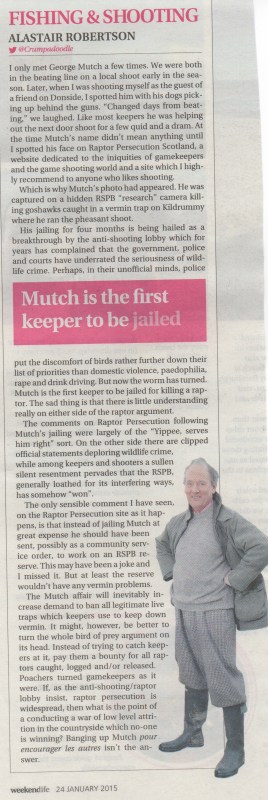
Balaclava sales set to rise

Daily Mail Bloody battle of the glens (2)The angst generated by the successful use of video evidence to convict gamekeeper George Mutch continues, as does the game-shooting lobby’s pathetic attempts to discredit the RSPB….

The following excerpts are from a recent article in the Mail, written by Jonathan Brocklebank:

The camera was hidden in a pile of twigs deep inside a sporting estate whose owner had no idea that it had been infiltrated by Europe’s wildlife charity.

But then, RSPB Scotland needs no invitation or permission to launch covert surveillance ops on private land. These days, it gives its own go-aheads.

So it was that gamekeeper George Mutch, 48, came to be filmed with a juvenile goshawk he beat to death with a stick on the Kildrummy Estate, Aberdeenshire. He began a four month jail sentence this week after damning footage showed him using two traps to catch birds of prey.

His apparent motive was to protect pheasants from the raptors, thus ensuring a plentiful supply of game birds for the shooting parties whose business helps keep such estates alive. Mutch, thought to be the first person ever to be jailed in Scotland for killing a bird of prey, will win no sympathy from animal lovers.

But the court case did not simply highlight the inhumane behaviour of a lone gamekeeper who brought disgrace upon his profession. It also served as a demonstration of the now immense power of the charity whose evidence convicted him.

That power, say ever-growing numbers of critics, leaves few areas of outdoor and rural life untouched.

[There follows some predictably tedious claims made by Botham’s You Forgot The Birds campaign, whose failed complaints about the RSPB to the Charity Commission Mr Brocklebank failed to mention (see here), and how some landowners are erecting signs saying RSPB Not Welcome (see here). It then continues….]

During Mutch’s trial, Aberdeen Sheriff Court was told the RSPB routinely enters estates without asking the landowners and, once inside, staff are free to use hidden cameras to gather ‘data’.

When questioned in court, Ian Thomson, the charity’s head of investigations, explained why they needed no permission. “Because we are entering an area for scientific study, we feel we are using our access rights under the Land Reform Act”.

Is it, then, acceptable for RSPB officials to march onto a private estate and set up equipment to secretly video employees?

It seems so. A spokesman for the charity told the Mail: “In Scotland, the Land Reform Act (2003) enshrined a legal “right to roam” and this includes access for survey and research purposes, provided this is carried out responsibly”.

He said the shocking images captured on the video spoke for themselves.

Notwithstanding Mutch’s appalling actions, there is a distinct air of discomfort in the Scottish Gamekeepers’ Association (SGA) over the means by which the RSPB’s evidence was obtained.

A spokesman for the organisation said it seemed wrong for individuals “from one particular profession” to be under surveillance in their workplace without their knowledge.

He added: “Is it the case now that charities can do this rather than the police – and is this the correct thing?

They have said they used their rights of access to go on to the land to do this. Really, they should have asked the landowner out of courtesy, if anything. Although it is not sacrosanct in law to do so, I think it would rile people a lot less if there were a little bit more cooperation from organisations such as the RSPB.

These are the things that lead to the breakdown of trust. If they did things a little bit more with due respect, they would find themselves in a lot less problems”.

His words hint at both a clash of cultures and at competing interests in the schism between senior figures in the charity and the ‘tweedies’ who own and manage vast swathes of the Scottish countryside.

While Scottish Natural Heritage (SNH) routinely issues licences to farmers to control wildlife which threatens their livestock, it has never issued a licence to a gamekeeper or landowner to control any species threatening birds kept for game, which also count as livestock under the Wildlife & Countryside Act 1981. The reasons for this, gamekeepers believe, is obvious: politics.

[The rest of the article covers complaints from a gamekeeper on the Lochnell Estate in Argyll about people turning up unannounced to monitor raptor nests; how many members the RSPB has; how much income the RSPB generates; the RSPB’s involvement in the renewal energy debate; how the RSPB is seen as the ‘go to’ organisation for advice on developments; how arrogant the RSPB is; and ends with the question: Is there a time, perhaps, when a charity just becomes too big?]

ENDS

So, the SGA thinks that wildlife crime investigators should let landowners know, in advance, of their arrival on a privately-owned estate. They seem to be missing the point. The landowner can now be held criminally vicariously liable for some crimes against raptors that are carried out by their gamekeepers; what do you think is the first thing the landowner would do, if he/she was notified that wildlife crime investigators were on their way? Advanced warning would hardly be in the interest of an investigation, (or justice), would it? Besides, as was pointed out in the article, nobody has to give advanced warning to a landowner of an impending visit and as long as they act responsibly once on the land, they’re well within their rights – that’s kind of the point of the Land Reform Act.

And what’s all this guff about gamekeepers have never been issued an SNH licence to ‘control’ (kill) “any species” that is perceived as a threat to their game birds? What utter nonsense! Gamekeepers routinely use the SNH General Licences to ‘control’ (kill) corvids. Ironically, this is what Mutch was supposed to be doing when he was filmed killing a trapped goshawk and shoving two other raptors in sacks and walking off with them. Sounds to us like the SGA are trying to play the victim card, again, albeit unsuccessfully.

McAdam 1The SGA aren’t the only ones up in arms about the admissibility of the RSPB’s video footage which was used to devastatingly good effect in the Mutch trial.

Here’s what the CEO of Scottish Land & Estates (SLE), Doug McAdam, wrote in last week’s SLE e-newsletter:

There can be no doubt that the custodial sentence handed down this week to a gamekeeper convicted of wildlife crime will send a very strong message out to those who continue to break the law. The illegal killing of any bird of prey is unacceptable and anyone who engages in such activity can, rightly, expect to feel the full weight of the law.

However, this case has raised some fundamental issues regarding access rights and the law as it becomes clear that a central party to this investigation [he means the RSPB] has chosen to totally disregard Scottish Government approved guidance contained in the Scottish Outdoor Access Code regarding undertaking survey work on someone else’s land. This is a serious matter in its own right, but it also reaches well beyond matters of wildlife crime, crossing in to areas such as new development and planning work where it could have some serious implications”.

Why is this “a serious matter”? It’s no such thing (unless you happen to be CEO of an organisation that just wants to have another go at discrediting the RSPB or is concerned about what future video footage may reveal). The Scottish Outdoor Access Code is just that – it’s a code, not a statutory instrument. It has as much legal influence as the Green Cross Code. It is trumped, magnificently, by the 2003 Land Reform Act. The totally independent Sheriff in the Mutch trial (who, don’t forget, was brought in because the defence thought that the original Sheriff, as an RSPB member, might be biased – see here) deemed that, in this instance, the RSPB video footage was admissible.

That’s not to say that other video footage will be deemed admissible in other trials – it will depend entirely on the circumstances of the case. In the Mutch trial, the RSPB argued successfully that their cameras were not in place to ‘catch someone at it’ – they had been placed as part of a long-term study in to crow cage trap use. That their footage captured Mutch engaging in his disgusting crimes was just a very happy coincidence.

You have to wonder, with all this consternation from the game-shooting crowd, just what it is they’re so frightened that covert cameras might record….

Now might be a good time to buy some shares in balaclava-making companies.

RSPB Investigations Team: 1; Countryside Alliance: 0

Last October, the Countryside Alliance launched a scathing attack on the RSPB’s latest annual Birdcrime Report (Birdcrime 2013). The link to their article has mysteriously ‘disappeared’ from their website, so here’s a copy we took:

Thursday, 30 October 2014, Countryside Alliance website:

Countryside Alliance Director for Shooting Adrian Blackmore writes: The RSPB’s Birdcrime Report for 2013, which was published on Thursday 30th October 2014, provides a summary of the offences against wildlife legislation that were reported to the RSPB in 2013. It should be noted that in 2009, the RSPB took the decision to focus on bird crime that affected species of high conservation concern, and crime that it regarded as serious and organized. The figures supplied do not therefore give a total figure for wild bird crime in the UK in 2013, and they are not comparable with figures provided for years prior to 2009.

As is becoming increasingly the case, the report makes sweeping allegations against the shooting community, and grouse shooting in particular – allegations that are not consistent with the evidence provided. It claims that activity on grouse moors is having a serious impact on some of our most charismatic upland birds, and that current measures have failed to find a solution. The report claims that “over the years, a steady stream of grouse moor gamekeepers have been prosecuted for raptor persecution crimes”, and lists each of the offences for which those gamekeepers have been found guilty between 2001 and 2013. Over that 13 year period, 20 gamekeepers employed on grouse moors (an average of 1.5 per year) are shown as having been prosecuted, but according to the RSPB’s birdcrime reports for each of those years, the total number of individual prosecutions involving wild birds totalled 526 individuals. Given that grouse moor keepers therefore represent a mere 4% of those prosecuted in the courts, one can only wonder why the RSPB should choose not to focus on the occupations of the other 96%.

The RSPB also states in the report that “it believes it is the shooting industry as a whole, not individual gamekeepers, that is primarily responsible for raptor persecution in the UK”. It has therefore repeated its call for: political parties to introduce licensing of driven grouse shooting after the election; the introduction of an offence of vicarious liability in England; increasing the penalties available to courts for wildlife offences; and for game shooting to be regulated with an option to withdraw the ‘right’ of an individual to shoot game or businesses to supply shooting services for a fixed period following conviction for a wildlife or environmental offence.

For the third year running, the RSPB has included a piece of research in its Birdcrime Report that is intentionally misleading. Both the 2011 and 2012 reports covered in detail a research paper which claimed that peregrines on or close to intensive grouse moor areas bred much less successfully than those in other habitats, and that persecution was the reason for this. That same research paper is covered again in the 2013 Birdcrime report. The research in question used data from 1990 – 2006 and at the time it was published a representation was made to the National Wildlife Crime Unit which resulted in a caveat being circulated to all Police Wildlife Crime Officers in the UK explaining that the data used in the paper was out of date, and that in using such information there was danger that the research paper suggested a current situation. For the RSPB is well aware of that caveat, and to include this once again makes a complete mockery of its previously stated belief that reliable data are essential to monitoring the extent of wildlife crime.

Summary of statistics

341 reported incidents of illegal persecution in 2013 – a reduction of 24% since 2012 when there were 446 reported incidents, and well below the previous 4 year average of 573.

164 reported incidents of the shooting and destruction of Birds of Prey which included the confirmed shooting of 49 individual birds of which only 7 took place in counties associated with grouse shooting in the North of England.

74 reports of poisoning incidents involving the confirmed poisoning of 58 Birds of Prey of which only 2 occurred in counties in the North of England where grouse shooting occurs.

In total, there were 125 confirmed incidents of illegal persecution against Birds of Prey in 2013. Just 18 of those occurred in counties in the North of England where grouse shooting takes place, and none of those have been linked to grouse shooting.

Of the 32 individual prosecutions involving wild birds in 2013, only 6 individuals were game keepers, and one of those was found not guilty. Therefore, of those prosecuted, only 16% were gamekeepers and only 6% of the 32 cases involved birds (buzzards) that had been killed. Only one of the cases concerned an upland keeper employed by an estate with grouse shooting interests, and that case did not involve the destruction of a bird of prey.

Of the 14 incidents of nest robberies reported in 2013, only 3 were confirmed, one of which involved the robbery of at least 50 little tern nests.

There is no evidence to support the RSPB’s allegation of persecution of birds of prey by those involved in grouse shooting. The RSPB’s Birdcrime Reports show that between 2001 and 2013 there were 526 individual prosecutions involving wild birds, and according to its 2013 report only 20 of those individuals (4%) were actually gamekeepers employed on grouse moors.

Land managed for grouse shooting accounts for just 1/5th of the uplands of England and Wales.

The populations of almost all our birds of prey are at their highest levels since record began, and only the hen harrier and the white-tailed eagle are red listed as species of conservation concern.

REPORTED INCIDENTS IN 2013

In 2013, the RSPB received 341 reported incidents of wild bird crime in the UK, the lowest figure since 2009. This represents a reduction of 24% since 2012 when there were 446 reported incidents, and well below the previous 4 year average of 573.

SHOOTING INCIDENTS

As in previous years, the, the most commonly reported offence in 2013 was the shooting and destruction of birds of prey, with 164 reported incidents in 2013. Of these, the shooting of 49 birds of prey are shown in the report as being confirmed, of which 7 were in counties of the North of England where grouse shooting takes place. The remaining 23 incidents that were confirmed in England occurred elsewhere.

POISON ABUSE INCIDENTS

During 2013 there were 74 reports of poisoning incidents involving the confirmed poisoning of 58 Birds of Prey of which only 2 occurred in counties in the North of England where grouse shooting takes place:

ILLEGAL TRAPPING AND NEST DESTRUCTION

There were 18 confirmed incidents of illegal trapping of birds of prey in 2013, and no confirmed cases of nest destructions, compared to 2012 when there had been 10 incidents of nests being destroyed. Although this figure of 18 is an improvement on that for 2012, it is still above the previous 4 year average of 14 incidents.

WILD BIRD RELATED PROSECUTIONS

In 2013 there were 32 individual prosecutions involving wild birds. Only 6 of those individuals were game keepers, and one of those was found not guilty. Therefore, of those prosecuted, only 16% were gamekeepers and only 6% of the 32 cases involved birds (buzzards) that had been killed. Only one of the cases concerned an upland keeper employed by an estate with grouse shooting interests, and that case did not involve the destruction of a bird of prey:

CONCLUSION

It is clear from its 2013 Birdcrime Report that the RSPB is continuing in its efforts to promote an anti-shooting agenda, especially against driven grouse shooting. It has less to do with aconcern about birds and more about ideology and a political agenda. Like reports of recent years, the 2013 Birdcrime Report is deliberately misleading, and many readers will invariably take at face value the claims and accusations that have been made. Many of these are serious, and made without the necessary evidence with which to substantiate them.

ENDS
The reason, perhaps, this article has mysteriously ‘disappeared’ from the CA’s website can probably be explained by the following…..

The Countryside Alliance used this article to lodge a complaint against the RSPB with the Charity Commission. The CA’s claim was based on this:

The report [Birdcrime 2013] makes sweeping allegations against the shooting community, and grouse shooting in particular – allegations that are not consistent with the evidence provided [in Birdcrime 2013]”.

The Charity Commission was obliged to investigate the CA’s complaint that the RSPB had ‘mis-used’ data and had made ‘un-founded allegations’ and they have now issued their verdict – they have rejected every single complaint made by the Countryside Alliance against the RSPB.

Strangely, although the Charity Commission’s response letter was sent to the CA on 7th January 2015, the findings have not appeared on the CA’s website. Can’t think why. Anyway, here’s a copy for those who want to read it – it’s really rather good:

Charity Commission response to Countryside Alliance complaint re RSPB Jan 2015

Not to be deterred by making yet another ‘embarrassing blunder‘, this week the Countryside Alliance wrote a response to the sentencing of goshawk-bludgeoning gamekeeper George Mutch, sent to jail for four months for his raptor-killing crimes. The CA’s response starts off well, condemning Mutch’s actions, but then it all goes badly wrong. According to the CA, it’s the RSPB’s ‘wider policy’ that is driving the continued illegal persecution of raptors!

You couldn’t make this stuff up. Why is it so hard for the game-shooting industry to take responsibility for their actions instead of continually trying (and failing) to discredit the RSPB? Is it because they have no intention whatsoever of addressing the widespread criminality within their ranks and so they churn out all this anti-RSPB rhetoric as a distraction technique? Nothing to do with the RSPB being so effective at exposing and documenting the game-shooting industry’s crimes, of course.

Expect more ludicrous attacks on the RSPB over the coming weeks and months….a predictable response from an industry unable, or unwilling, to self-regulate and undoubtedly feeling the pressure of scrutiny and demand for change from an increasingly well-informed public.

The link to the CA’s latest absurd accusation can be found here, but just in case it also mysteriously ‘disappears’, here’s the full text. Enjoy!

Countryside Alliance website

16th January 2015

‘Shooting, livelihoods and raptors’

The illegal killing of birds of prey is about the most selfish crime it is possible to commit because even if there are short term benefits for the preservation of game (and those benefits are as likely to be perceived as real) they will always be outweighed by the long term damage to the shooting industry as a whole.

That is why the Alliance has no hesitation in condemning an Aberdeenshire gamekeeper who was sentenced to four months in prison earlier this week for four offences including the killing of a goshawk.

Raptors as a whole may be the biggest success story in British birds with numbers having increased hugely as a result of legal protection and reintroduction, but some species remain rare and killing them for the sake of providing more birds to shoot is never going to be anything but a political and PR disaster.

The RSPB collected the evidence which convicted that gamekeeper and was understandably pleased with the outcome of the case. Whilst its actions in relation to individual cases like this are entirely justified the Society must, however, consider whether its wider policy is actually helping to perpetuate, rather than reduce, illegal persecution.

This might sound a strange statement, but it is worth considering the RSPB’s own history and how other wildlife conflicts have been resolved. The RSPB was founded by a group of women appalled by the trade in exotic feathers for ladies’ hats. Its first campaign was not aimed at prosecuting the people killing birds, but at removing the causes of persecution, which in that case was the high value of feathers. By reducing demand for rare birds it removed the economic imperative for persecution.

One argument might be to simply ban shooting and with it one of the main reasons someone might have for killing a raptor. However, that policy would create far greater conflict and remove the many positive environmental, economic and social benefits of shooting which far outweigh the negatives of any associated raptor killing.

Another, we would argue far more logical, approach would be to consider the causes of any illegal raptor killing and how the drivers for that activity could be removed. In two areas in particular the RSPB seems unwilling to consider proposals which tackle the causes of persecution, as well as persecution itself.

Firstly by refusing to endorse proposals for hen harrier ‘brood management’ which would give assurances to upland keepers that colonies of hen harriers could not make their moors unviable and their jobs redundant. And secondly by opposing absolutely any management, even non-lethal, of the burgeoning buzzard population even if they are having a significant economic impact on game shooting.

We are not suggesting that these management practices must take place, but surely an agreement that they could be used where absolutely necessary to protect livelihoods would make it less likely that people would make the wrong decision about illegal killing?

END

Who owns Kildrummy Estate?

Following yesterday’s news that Kildrummy Estate gamekeeper George Mutch has been jailed for four months for his raptor-killing criminal activities, a common question we’ve heard is, ‘Will there now be a vicarious liability prosecution?’

We think that there is the potential for a prosecution, although obviously we’re not privy to any evidence that the Crown might have available when they make a decision whether to proceed or not. We’ll just have to be patient and see what happens.

Let’s assume the Crown does decide that there is sufficient evidence to proceed, and that it would be in the public interest to prosecute, then the question becomes, ‘Who would be charged?’

That will depend on who was in the chain of command above Mutch and what managerial responsibilities they had at the time he committed his crimes (see here for our interpretation of how vicarious liability works). For example, if there was a Head Gamekeeper then perhaps he/she might be the one charged. If there was an Estate Factor then perhaps he/she might be the one charged. Perhaps there wasn’t anyone in a hierarchical managerial role between Mutch and the landowner, in which case, the landowner may be the one charged. But in this case, that might be a bit difficult.

Why? Have a read of Andy Wightman’s brilliant blog here and you’ll understand!

George Mutch sentenced to four months in prison

Scottish gamekeeper George Mutch, convicted in December for trapping a goshawk and then battering it to death (and a few other things – see here) on the Kildrummy Estate in Aberdeenshire, has been sentenced to four months in prison for his crimes.

He was led away from the court in handcuffs and is currently en-route to a prison cell.

What an unbelievably brilliant outcome – we never thought we’d see the day. Mutch is the first gamekeeper ever to be jailed in the UK for killing raptors.

Huge congratulations to the RSPB Investigations Team, SSPCA, Police Scotland and the Crown Office, and kudos (and thanks) to Sheriff Noel McPartlin for handing out this sentence. An acknowledgement also to former Environment Minister Paul Wheelhouse, who pushed hard for the admissibility of video evidence. Had he not done so, this case would probably not have made it to court.

For anyone who missed it when he was convicted in December, here is the video nasty showing gamekeeper Mutch carrying out his crimes on the Kildrummy Estate in Aberdeenshire.

We understand there’s the potential for a vicarious liability prosecution in this case. We’ll have to wait and see whether COPFS deems there’s enough evidence to proceed. Although that may prove difficult – have a read of Andy Wightman’s blog about who owns Kildrummy Estate, here.

Media coverage:

A bizarre statement from the SGA here. Isn’t it great to see the representative organisation strongly condemning his crimes, er…

BBC news here, including statements from the Sheriff, RSPB Scotland, COPFS, SGA and SLE.

RSPB Scotland statement here

Press & Journal here

Herald here. This is an interesting one, with quotes from defence agent David McKie about Mutch’s employment status and the status of his firearms certificates.

Telegraph here, with claims that Mutch had been sent a ‘threatening letter’ following his conviction in December. The police are investigating.

Daily Mail here, with a classic quote from Superintendent George MacDonald (Police Scotland) suggesting it’s just a “small minority” of gamekeepers who are at it. What he meant, of course, is that it’s just a small minority that are actually caught.

Courier here, which is pretty much a carbon copy of the Mail’s piece.

COPFS statement here

Sentencing today for gamekeeper George Mutch, convicted raptor killer

Convicted gamekeeper George Mutch will be sentenced today at Aberdeen Sheriff Court.

Mutch, a 48-year old (now former) member of the Scottish Gamekeepers’ Association who worked on Kildrummy Estate, Aberdeenshire, was found guilty of four wildlife crimes in December, including the illegal killing of a goshawk which he trapped and then clubbed to death, and the trapping and taking of a further goshawk and a buzzard (see here).

All eyes on Sheriff McPartlin, who said in December that a custodial sentence was being considered….

Scottish gamekeeper George Mutch: guilty on all 4 counts

This is an historic day in the battle against the raptor killers.

Scottish gamekeeper George Mutch, 48, of Kildrummy Estate, Aberdeenshire, has been found guilty on all four charges, including the illegal killing of a trapped goshawk, which he clubbed to death, and the taking of two other birds, a goshawk and a buzzard.

No-one will be surprised to learn that yet another gamekeeper has been convicted of illegally killing raptors; Mutch is the 28th gamekeeper to be convicted of wildlife crime in the last three years alone (see here). The big surprise in this case has been the Sheriff’s ruling that the covert video footage, filmed by RSPB Scotland, was admissible evidence. This alone was a significant ‘win’ for those of us who have been exasperated, for years, that this type of evidence has been consistently rejected by the Crown Office, thus allowing The Untouchables to be, well, untouchable. Especially when covert video surveillance has been consistently used in England to secure convictions in similar cases.

So what prompted the change of heart? Undoubtedly, the efforts of former Environment Minister Paul Wheelhouse, who said in July 2013 that he would be urging the Crown Office to consider the use of video footage in cases against those committing wildlife crime.

According to our journalist contacts, COPFS prosecutor Tom Dysart’s performance in court was dynamite, pressing for the admissibility of the video footage and then later shredding the evidence of defence witness Hugo Straker from the GWCT. He also then shredded the evidence of Mutch, resulting in the Sheriff saying that Mutch’s evidence was ‘not credible’ and that his explanation for killing the goshawk (because it was injured) was “a convenient lie”. We never thought we’d say this but Tom Dysart apparently played a blinder. Long may it continue.

The video nasty in this case, showing Mutch trapping and then clubbing the goshawk to death, can be viewed here. WARNING – CONTAINS DISTURBING IMAGES.

Sheriff McPartlin will pass sentence in January and has already said he is considering a custodial sentence. We’ll see.

Meanwhile, the SGA has put out a fascinating press statement. It turns out that Mutch was an SGA member and apparently “his membership of the SGA has been in suspension for some time, until the outcome of the case was known. Now that it is, he will no longer be a member of the SGA“.

That’s interesting. Mutch committed his crimes in 2012, but according to the SGA’s 2013 silent auction booklet, the SGA accepted a fundraising donation from Kildrummy Estate, with George Mutch listed as the contact:

SGA Silent Auction Booklet 2013 (see Lot #17)

So not only was the SGA still accepting donations from this estate the year after the crimes were committed, but it’s also apparent that Mutch was still employed by Kildrummy Estate after he’d committed those crimes. Fascinating.

The SGA’s statement continues:

On the separate, theoretical, issue of the use of covert video evidence, it is clear to us that it should not be acceptable for individuals from one particular profession to be under surveillance in their place of work, without their knowledge, and to have their right to liberty and privacy from such encroachment, removed.

If this is to be the direction of travel, it is not right for Scottish Government to deny people whose livelihoods come under pressure due to the activity of certain species or animals, recourse to a legal solution to solve that conflict.

Currently, there are no legal or scientific means by which people can protect their investments or jobs in situations exacerbated by conflicts with species. Scottish Government has never granted anyone from the game industry a licence to protect investments, which they have the power to do, although it does grant licences routinely to other industries. This, in our view, is a barrier to justice and does nothing to prevent wildlife crime.

In a society supposedly enlightened when it comes to tackling this issue, we believe this is untenable and we will be seeking talks with Scottish Government so that this anomaly is finally closed, removing once and for all the rationale for people to commit wildlife crime.”

So, the SGA doesn’t agree with the use of covert video footage to convict those within the gamekeeping industry of wildlife crime. Why ever not? Surely, they’d be thrilled to root out those individuals who are causing so much damage to the industry’s reputation? By their reaction, you’d be forgiven for thinking that that’s not the case at all. And as Mutch was an SGA member when he committed his crimes, what does that tell us about the SGA’s ability to provide adequate training for its members? They even admit that Mutch is the 5th SGA member in three years to have been convicted!

And then they go into the usual whine about how wildlife crime would stop if only the Government would issue licences to allow the killing of protected species, (although they don’t actually mention the word ‘killing’ – instead they say “licence to protect investments”). The bottom line is, if the leisure industry of killing millions of gamebirds is reliant on the killing of protected species then that industry has had its day.

This case has taken over two years to conclude. We had thought that because the crimes were committed in 2012, before the vicarious legislation was enacted (1st Jan 2013), that there wouldn’t be a vicarious liability prosecution because we didn’t think it could be applied retrospectively. However, one of our legal friends has since advised us that there still may be a vicarious liability prosecution as long as it’s lodged within the three-year time frame from the date the offence was committed (August 2012). So potentially then, if the Crown deems it appropriate and they get it in before August 2015, we could have another vicarious liability prosecution on the cards.

For now though, let’s just enjoy the successful conviction of another raptor-killing gamekeeper, and acknowledge the work of the people who got it to this stage. Huge congratulations to the RSPB Scotland Investigations Team, the SSPCA, Police Scotland, COPFS, Sheriff McPartlin and former Environment Minister Paul Wheelhouse. Real partnership working at its best.

Media coverage:

RSPB press release and video here

BBC news here

STV news here (this one is amusing!)

Reporting Scotland here [6.25 – 8.40] (this film only available for 24 hrs)

Herald here

George Mutch trial: sheriff rules video evidence admissible

Sheriff Noel McPartlin, presiding over the trial of gamekeeper George Mutch (Kildrummy Estate, Aberdeenshire) yesterday ruled that the RSPB’s video footage is admissible.

His ruling was based on his view that the footage in question was a by-product of a legitimate survey (in to the use of crow cage traps) rather than the camera being placed with the sole intention of filming someone committing a criminal act.

This ruling doesn’t mean that covert video footage will be acceptable evidence in all criminal proceedings; each case will have to be considered based on its specific circumstances. But in this trial at least, the video evidence has been ruled lawful.

That is a big result. More often than not, this sort of evidence has not been accepted in Scotland, although it is routinely accepted in England. Credit is due to the Fiscal, Tom Dysart, and especially to former Environment Minister Paul Wheelhouse for all the political pressure he piled on to the Crown regarding the use of video evidence in wildlife crime prosecutions.

After two days of legal wrangling and following Sheriff McPartlin’s decision, Mutch’s trial got underway ‘properly’ yesterday, i.e. the evidence (video) was shown in court.

One recording filmed on August 14th 2012 showed a goshawk being caught inside a Larsen trap, which had been set inside a pheasant pen. A live Jay was being used as the decoy bird [illegally – the General Licences do not allow a Jay to be used as a decoy species in a Larsen trap]. Mutch was filmed approaching the trap the next morning at around 6am.

Prosecution expert witness David Anderson, a Conservation Manager for the Forestry Commission, was asked to tell the court what he could see in the footage, which was filmed in misty conditions. He said the man appeared to pick up an object to pin down the bird. “Then I saw the man got the bird, pulled it out and dispatched it with a stick or whatever they had in their hand”.

Another recording showed Mutch walking in to a crow cage trap (also set inside a pheasant pen) and catching a goshawk that had been caught in the trap. The bird was placed (alive) inside a white sack and removed from the cage.

Mutch has denied all the charges against him.

The trial continues at Aberdeen Sheriff Court and hopefully it’ll conclude today.

George Mutch trial: Sheriff to rule on admissibility of video evidence

The sheriff presiding over the trial of Scottish gamekeeper George Mutch is due to rule today on the admissibility of covert video footage.

Mutch is accused of several offences relating to the alleged killing or injuring of two goshawks and a buzzard that had been caught inside traps in August 2012. He has denied the charges. The evidence against him is based on covert footage collected by RSPB Scotland.

Mutch’s trial began on Monday, after months of adjournments, but so far the trial has focused on whether the evidence is admissible. The defence advocate, Mark Moir QC, has argued that the footage is inadmissible because the RSPB has an agenda against the use of crow cage traps and didn’t have the landowner’s permission to film. The prosecution (Tom Dysart from COPFS!) has argued that the evidence should be deemed admissible because the RSPB were filming as part of a research study.

Sheriff Noel McPartlin is due to rule on the question of admissibility today. Whatever his decision, it will have significant ramifications for not only this trial but also for future potential prosecutions.

News articles on this trial here and here.

Case against gamekeeper George Mutch: part 13

The criminal trial of Scottish gamekeeper George Mutch is set to re-start today.

Mutch, of Kildrummy Estate, Aberdeenshire, is accused of a series of offences relating to the capture and subsequent killing or injuring of a number of raptors, alleged to have taken place in August 2012. He has denied the charges.

This case has dragged on for over two years. Eventually a trial date was set for October 2014 but it was quickly adjourned after the defence QC argued that the presiding Sheriff shouldn’t hear the case as she was a member of the RSPB (see here).

Presumably there’ll be a different sheriff in court today; one with absolutely no connection whatsoever with game-shooting, eh?

Killing with impunity: Birdcrime 2013 published

Birdcrime 2013The RSPB has published its latest annual report on crimes against birds in the UK in 2013.

Their press release here.

The killing goes on, with impunity.

76 individual birds & other animals were confirmed illegally poisoned in 2013. This is more than double the figure from 2012 (29 confirmed victims).

Poisoning victims in 2013 included 30 buzzards, 20 red kites, 1 golden eagle and 1 white-tailed eagle.

68 confirmed incidents involved the shooting or destruction of birds of prey. Victims included two hen harriers, two marsh harriers and 5 peregrines.

These are just the confirmed incidents. A total of 338 incidents were reported to the RSPB in 2013, with North Yorkshire once again being the worst location. There’s also a worrying number of incidents from Powys in South Wales, seemingly relating to poisoned baits.

Birdcrime 2013 is a thoroughly depressing read. The RSPB calls on the shooting industry, again, to clean up its act. Judging by the contents of this report, that’s a seemingly futile request.

Well done and thanks to the RSPB for not only compiling these thorough statistics but importantly, for sharing them in the public domain.

Download Birdcrime 2013: Birdcrime 2013

Hen harrier Bowland Betty, found shot dead on a grouse moor in North Yorkshire. (Photo by Natural England).

Bowland Betty