Community action after golden eagle ‘Alma’ found poisoned on Millden Estate, Perthshire

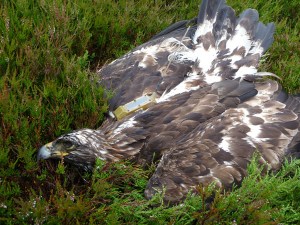
Local residents are outraged at the poisoning of golden eagle ‘Alma’, who was found dead on the Millden Estate in Glen Esk in July 2009.

Members of Inveresk Community Council are now writing to the three Estates in Glenesk (Millden Estate, Gannochy Estate and Invermark Estate), as well as the Scottish Environment Minister, Roseanna Cunningham and the Chair of Scottish Natural Heritage, Andrew Thin, to express their concern about the alleged use of lethal illegal poisonous baits in the area.

Brechin Community Council vice-convenor, David Adam, who was at the meeting and raised the issue, said: “I think we are all quite shocked about this. I think it is fairly conclusive that the bird was poisoned and that the bird was poisoned in Glen Esk. These birds are an extremely important part of our heritage”.

Inveresk Community Council chairperson, Charlie Simpson, commented: “To poison such creatures goes totally against the nature of Scotland”.

http://www.brechinadvertiser.co.uk/top/Community-action-follows-death-of.5558572.jp

At the time of the discovery of the dead eagle, police conducted searches, under warrant, of gamekeepers’ cottages and vehicles on the Millden Estate. No arrests have been made. Tayside Police claim this is an on-going investigation, which probably means this crime will remain unsolved and the criminal(s) unpunished, like so many other reported poisoning incidents in this region and elsewhere in Scotland.

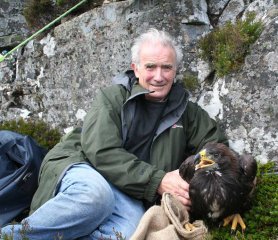
This is Alma as a chick, at her nest on the Glenfeshie Estate in 2007, being tagged by Roy Dennis
   
Two years later, Alma is dead after visiting grouse moors in Glen Esk

“Eagles have no place on my grouse moor”, allegedly said former Laird of Fordie Estate, Perthshire

It is often said that gamekeepers only persecute raptors because they are acting upon the orders of their employer, and fear losing their job and often a tied cottage if they refuse. Here is an example of an estate manager who refused.

Ian Thomas (42) had worked on the Fordie Estate near Comrie, Perthshire for 15 years, when the estate was bought by former banker Lord Anthony Tryon (former husband of Lady ‘Kanga’ Tryon). During an inspection of his newly-acquired grouse moor, Lord Tryon allegedly became irritated at finding piles of grouse feathers indicating kills by birds of prey. According to Ian Thomas, Lord Tryon allegedly said, “Eagles have no place on my grouse moor” and “I have bought an estate and I will do what I like”.

Thomas claims that he was instructed by Lord Tryon to shoot a golden eagle and use illegal poisons to rid the estate of other raptors. Thomas refused and reported him to the authorities, saying he felt “morally obliged” to blow the whistle. Thomas claimed he was constructively dismissed after being branded a trouble-maker by Tryon and took his claim to an employment tribunal.

To avoid giving evidence in court, Tryon made an undisclosed settlement to his former estate manager in 2004.

Full story: http://news.scotsman.com/birdsofprey/Shooting-row-laird-agrees-to.2526404.jp

The Fordie Estate was bought from Lord Tryon in 2009 and is now owned by designer luggage tycoon, Luis Vuitton. The Fordie Estate is one of eight estates in Perthshire who have joined the Countrywatch Partnership, working to protect three key raptor species in the area (golden eagle, hen harrier and peregrine).

Thomas has gone on to establish his own forestry consultancy business. Here is a man with whom it’s worth doing business.

Poisoner on Isle of Lewis given pathetic £50 fine

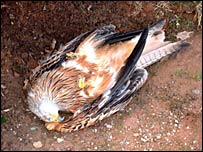
The poisoned golden eagle found on Lewis in July 2005, killed by Carbofuran

An Isle of Lewis crofter was convicted of possessing Carbofuran at his home on 25 November 2005. At Stornoway Sheriff Court on 26 July 2006, John Mackenzie pleaded guilty to possession of a proscribed pesticide under Section 15(A) of the Wildlife & Countryside Act 1981. He was fined just £50.

A staggeringly pathetic fine, hot on the heels of the discovery of a dead golden eagle found on Lewis in July 2005 that had been poisoned with Carbofuran.

“Map of Shame” doesn’t say anything new

Map of Shame 2004-2008

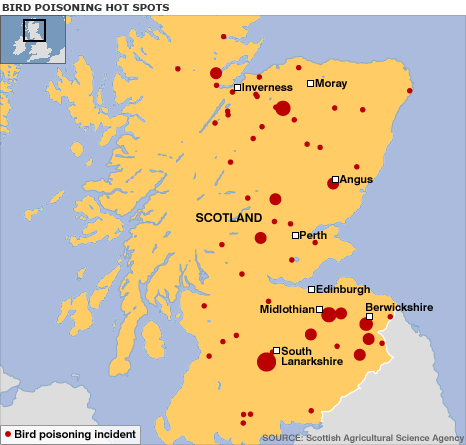
In January 2009, the Scottish government released its ‘Map of Shame’ showing confirmed poisoning incidents between 2004-2008. The map, using data from the Scottish Agricultural Science Agency (SASA), was hailed as a “significant step” in the fight against wildlife crime as it showed the scale of raptor persecution.

In reality, the map doesn’t tell us anything new at all. The RSPB has been producing these maps for years; the difference with this one is that for the first time, the Scottish Rural Property & Business Association (SRPBA) which represents landowners, agreed to its contents.

The map locates 88 incidents in which raptors were poisoned over the previous 5 years, including iconic species such as the golden eagle, white-tailed sea eagle, red kite, buzzard, tawny owl and peregrine.

http://news.scotsman.com/birdsofprey/Bird-of-prey-poisoning-map.4864489.jp

What the map fails to tell us is the name of the shooting estates involved. What is the point of providing such a vague map? There is no point, other than to confirm what was already known – raptor persecution incidents are widespread across Scotland. If the SRPBA is as committed to stamping out wildlife crime as it claims it is, why wouldn’t it take every opportunity to name and shame those known to be involved?

It is not just wildlife-interest groups that are asking for the estates to be named. In September 2009, MSP Sarah Boyack (Scottish Labour) called for the government to name and shame the offending estates and said taking steps to reduce the number of incidents of wild raptors being shot and poisoned was a “matter of urgency”. http://news.stv.tv/scotland/121040-msp-name-and-shame-bird-killers/

The government is due to release the official 2009 raptor poisoning figures shortly….

osprey, golden eagle & buzzards illegally killed in 1993

According to the Hansard Report April 2004 (Hansard is the edited verbatim report of proceedings in UK parliament), the following illegal raptor persecution incidents were recorded in 1993:

Lothian Estate (nr Jedburgh, Scottish Borders) – 1 x osprey shot.

Aberarder Estate (Strathnairn, Inverness-shire) – 1 x golden eagle killed by Carbofuran.

Gledfield Estate (nr Ardgay, Sutherland) – 1 x buzzard killed by Chloralose.

South Balkeith Farm (Tain, Ross-shire) – multiple buzzards killed by Carbofuran.

Glenberg Estate (Speyside) – 1 x buzzard killed by Chloralose.

Ralia Estate (by Newtonmore, Inverness-shire) – 1 x buzzard killed by Chloralose.

Woodall Estate (Airdrie, North Lanarkshire) – 1 x buzzard killed by Chloralose.

Carruth Estate (Strathclyde) – 1 x buzzard killed by Chloralose.

Farleyer Estate (Aberfeldy, Perthshire) – 1 x buzzard killed by Carbofuran.

Loansfold & Blindswell Farms (Perthshire) – 1 x buzzard killed by Chloralose.

This report was published in the days when the government publicised the names of the Estates where illegal raptor persecution incidents had been recorded. Shame they don’t do that anymore – you have to wonder why? The Hansard report documenting these and other persecution incidents, can be read here: http://hansard.millbanksystems.com/written_answers/1994/apr/28/bird-killing

Golden eagle & buzzards illegally killed in 1991

According to the Hansard Report April 2004 (Hansard is the edited verbatim report of proceedings in UK parliament), the following illegal raptor persecution incidents were recorded in 1991:

Seafield Estate (Speyside) – 1 x buzzard killed by Chloralose.

Rosehaugh Estate (Black Isle, Ross-shire) – multiple buzzards killed by Mevinphos.

Dougarie Estate (Isle of Arran) – 1 x golden eagle killed by Chloralose.

This report was published in the days when the government publicised the names of the Estates where illegal raptor persecution incidents had been recorded. Shame they don’t do that anymore – you have to wonder why? The Hansard report documenting these and other persecution incidents, can be read here: http://hansard.millbanksystems.com/written_answers/1994/apr/28/bird-killing

Hen harriers, golden eagles & buzzards illegally killed in 1990

According to the Hansard Report April 2004 (Hansard is the edited verbatim report of proceedings in UK parliament), the following illegal raptor persecution incidents were recorded in 1990:

Cromlix Estate (nr Dunblane, Perthshire) – 1 x buzzard + 1 x hen harrier killed by Chloralose.

Rosehaugh Estate (Black Isle, Ross-shire) – 1 x buzzard killed by Chloralose.

Ledmore Estate (Lairg, Sutherland) – 1 x golden eagle + 1 x buzzard killed by Chloralose.

Hopetoun Estate (Abington, South Lanarkshire) – 1 x buzzard killed by Chloralose.

Glenfernate Estate (Blairgowrie, Perthshire) – 1 x buzzard killed by Chloralose.

Grimerston Estate (Isle of Lewis) – 1 x golden eagle killed by Chloralose.

This report was published in the days when the government publicised the names of the Estates where illegal raptor persecution incidents had been recorded. Shame they don’t do that anymore – you have to wonder why? The Hansard report documenting these and other persecution incidents, can be read here: http://hansard.millbanksystems.com/written_answers/1994/apr/28/bird-killing

golden eagles, peregrines & buzzards illegally killed in 1989

According to the Hansard Report April 2004 (Hansard is the edited verbatim report of proceedings in UK parliament), the following illegal raptor persecution incidents were recorded in 1989:

Roxburghe Estate (nr Kelso, Scottish Borders) – 1 x buzzard killed by Mevinphos.

Carbeth Estate (Stirlingshire) – 1 x buzzard killed by Chloralose.

Langholm Estate (Dumfries & Galloway) – 1 x peregrine killed by Mevinphos.

Drumochter Estate (Dalwhinnie, Inverness-shire) – 1 x golden eagle killed by Chloralose.

Islay Estate (Strathclyde) – 1 x buzzard killed by Mevinphos.

Islay Estate (Strathclyde) – 1 x peregrine shot.

Monzie Estate (Crieff, Perthshire) – 1 x buzzard killed by Chloralose.

This report was published in the days when the government publicised the names of the Estates where illegal raptor persecution incidents had been recorded. Shame they don’t do that anymore – you have to wonder why? The Hansard report documenting these and other persecution incidents, can be read here: http://hansard.millbanksystems.com/written_answers/1994/apr/28/registers-of-scotland

Scottish police accused of failing to tackle wildlife crime

POLICE forces in Scotland have been accused of failing to tackle wildlife crime after it was revealed that just 24 cases of illegal killing of birds of prey have been taken to court in five years.

Out of 157 cases involving killing the birds – including golden eagles, red kites and hen harriers – just 15 per cent have resulted in court action.

And the average penalty for a crime linked to persecution of birds of prey was just £240, despite the maximum available penalty being £10,000 or a year in jail.

Read more at: http://scotlandonsunday.scotsman.com/news/System-39failing39-on-wildlife-crime.6130378.jp

golden eagle found poisoned on glenfeshie estate, Cairngorms

RSPB investigator with the poisoned golden eagle on Glenfeshie Estate.

A golden eagle was found dead on the Glenfeshie Estate, Cairngorms, in June 2006. It was the second golden eagle found this year, after the eagle found poisoned a few months earlier on the Dinnet & Kinnord Estate in nearby Ballater. Both birds had ingested the illegal pesticide Carbofuran.

The RSPB put up a reward for information leading to the conviction of the people responsible for both eagle deaths. No arrests have been made.

http://www.wildlifeextra.com/go/news/news-eaglereward.html#cr

At the time, local raptor workers thought that this eagle had been ‘dumped’ on the Glenfeshie Estate in retaliation for the Estate’s plans to reduce red deer numbers. In recent years, the Glenfeshie Estate has been closely involved with golden eagle conservation projects, in association with Roy Dennis and his eagle satellite-tagging efforts – which makes the theory about the Estate being ‘set up’ in 2006 quite plausible. It is clear that Glen Feshie actively supports golden eagle conservation.