Poisoning by numbers

Last week the RSPB published its annual UK-wide report on raptor persecution (Birdcrime 2010, see here). We said we’d comment on the report once we’d had a chance to read it. Others chose to comment on the day of its release, or to be more accurate, their commentary was probably written prior to the release and was probably based on the content of the RSPB’s press release, rather than on the actual report’s content (see here).

Birdcrime 2010 held few surprises for many of us. The report carried details of raptor persecution incidents (confirmed, probable and possible) that had been reported throughout 2010, so by not publishing the report until November 2011, many of the items could be considered ‘old news’ (or at least those incidents that had been previously reported in the media – as usual, there were several incidents recorded in this report that were not made public at the time they occurred). That’s not to say the report has no value – it is an immensely important document because it is still the only publication to collate these national statistics in one place. It would just be more useful if it could be published at the beginning of the following year to which the report relates, rather than at the end of the following year, but limited RSPB staff resources may prevent this.

One advantage of publishing the report so late is that information can be provided on the outcome of criminal proceedings for those persecution incidents that actually made it to court. For example, the report provides some previously unpublished information about the trial of gamekeeper Glenn Brown, who was found guilty in June 2011 of operating an illegal trap to take birds of prey (amongst other crimes) on Howden Moor in the Peak District in April and May 2010 (see here, here and here). According to Birdcrime 2010, Judge Caroline Goulbourn “ruled that she viewed the attack on the integrity of the RSPB investigations staff by Bertie Woodcock QC on behalf of Knights Solicitors as an aggravating factor in the case. In addition, she criticised Brown’s employer, Geoff Eyre, who leases Howden Moor from the National Trust, for being evasive and reluctant to answer questions” [Birdcrime 2010, p.17].

Incidentally, there is further detail about this case that has been written in the RSPB’s newsletter, Legal Eagle 65. On page 2 the following has been written: “During the ten day trial, the prosecution relied on expert evidence including Prof Ian Newton, Dr Mick Marquiss, Stewart Scull, Dr Alisdair Wood and Guda van der Burght. The defence case, led by Bertie Woodcock QC, centred on the fact that Brown was not using the trap and the entire investigation was a set up with RSPB officers acting in bad faith throughout”. It’s good to see that Judge Goulbourn ruled against this, although what will happen at Brown’s impending appeal remains to be seen. Legal Eagle 65 reports that this appeal “is expected to take place in 2012”.

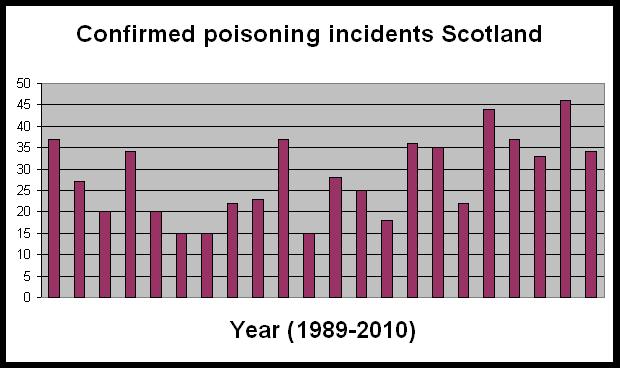
In addition to the case studies of earlier persecution incidents, Birdcrime 2010 reports that annual poisoning figures were down from 2009 (128 reported poisoning incidents in 2010, compared to 153 in 2009). It also reports that the 2010 figure is below the average for the last five years (2005-2009 average of 150 incidents). Unsurprisingly, it is this aspect that has been picked up on by the game-shooting lobby (e.g. see here). There has also been much made in the media this year about the ‘low’ poisoning figures for 2011 (e.g. see here) – although the published figures only relate to the first half of 2011; figures from June 2011 onwards are not yet available. So is this a sign of progress, as many of the game-shooting lobby would have us believe, or is it indicative of something else? For example, the lower figures could well be an indication that the gamekeepers have finally seen the light and have decreased their poisoning efforts. On the other hand, it could be an indication that gamekeepers are either (a) getting better at hiding their crimes, (b) switching to other persecution methods such as shooting, which is less likely to be detected, or (c) reporting efforts by the authorities have fallen. At this point I don’t think that either ‘side’ can claim a ‘victory’ in the on-going war of words. It is far too early to tell. For example, if you look at the graph that was published in the RSPB’s earlier report, The Illegal Killing of Birds of Prey in Scotland in 2010 (see here), then this reported decline in poisoning incidents can be seen in much clearer context. The graph I’m referring to appears on page 11 of that report and shows the number of confirmed poisoning incidents in Scotland from 1989-2010. The graph has been recreated for this post – see below (thanks to the contributor who sent it!).

If you look closely at the graph, you will see a great deal of variation between years in the number of confirmed poisoning incidents. Of particular interest are the years 1994 and 1995 – in these two years, confirmed poisoning incidents dropped to a low of 15 from a previous high of 35+. However, if you then look at the following three years, the number of confirmed incidents steadily rose until they reached 35+ again. In 1999, the figure dropped again to 15, and from then until 2010, that figure has steadily risen and fallen, although never reaching the low of 15 again. So what does that tell us? I’m fairly sure that in the years 1994 and 1995, the game shooting lobby would have declared a ‘victory’ as the figures had dropped so much, and would have shouted from the hilltops that they’d changed their ways.  I’m also fairly sure that in the following three years when the figures rose again, the conservationists would have declared a ‘victory’ and pronounced that their claims of widespread persecution had been vindicated. Either way, it is clear that neither ‘side’ can draw conclusions just based on an annual figure; for a trend to be detected, we need to see long-term figures.
But do these figures actually provide the full picture? If you read the recent paper on historical persecution at Atholl Estate (see here), then it’s pretty obvious that the ‘official’ persecution figures are meaningless, in the sense that they don’t tell the whole story. And from a conservation perspective, the figures, whether accurate or not, are not really that important. To steal a line from the recent paper on peregrine persecution on grouse moors (see here), “….it is the population level impact that is important, rather than the number of confirmed persecution cases”. We now have peer-reviewed scientific studies that have shown how persecution on grouse moors is having a population level impact on several vulnerable species (golden eagle, hen harrier, red kite and now peregrine). We have yet to see any peer-reviewed scientific studies that can counter these findings and show that these species are NOT impacted by persecution on grouse moors at a population scale. Why do you think that is, and more to the point, what are our politicians going to do about the published findings, apart from telling us that the Scottish government’s support for grouse shooting “goes beyond words“? (see here). Let’s hope that support doesn’t go beyond action as well.

Red kite and buzzard poisoned in Ireland

Meanwhile, back in the real world, an article in the Wicklow People yesterday says that a red kite and a buzzard have been found poisoned in County Wicklow, Ireland.
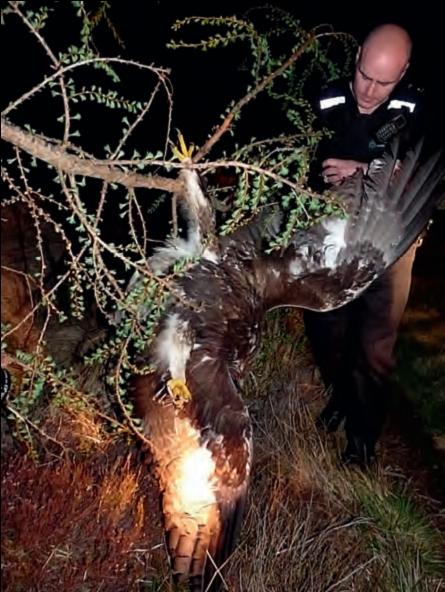
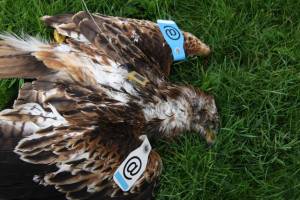
The red kite was found by a member of the public and handed in to the National Parks and Wildlife Service headquarters at  Wicklow Mountains National Park. It was sent to the State Veterinary Laboratories at Cellbridge where it was confirmed it had been poisoned. The article does not say when this happened, nor does it name the poison used. [Update: we have since been informed by the Golden Eagle Trust that alphachloralose was used in both incidents].

A buzzard was reportedly found in the same area and the article states it was poisoned with Alphachloralose.

Red kites have been recently reintroduced as part of a pioneering project to bring back native raptors to Ireland. The Golden Eagle Trust has been reintroducing red kites, as well as golden eagles and white-tailed eagles. Part of their project has included a high-level campaign to raise awareness about the use of poisoned baits.

Article in the Wicklow People here

Golden Eagle Trust website here

RSPB’s Birdcrime 2010 report published

The RSPB has published its annual report on raptor persecution in the UK (Birdcrime 2010). Poisoning reports are down (128 reported in 2010; 153 reported in 2009). Birds confirmed poisoned in 2010 include:
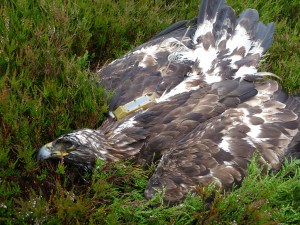
20 red kites, 30 buzzards, 8 peregrines, 5 golden eagles, 2 goshawks, 1 sparrowhawk and 1 white-tailed eagle.

Meanwhile, the RSPB are using the publication as an opportunity to call for a crackdown on poisons, according to the BBC website. It says the current law, which makes it illegal to possess certain pesticides, is rendered ‘impotent’ because the list of controlled substances hasn’t been published in England, Wales and Northern Ireland.

We’ll write more about the Birdcrime 2010 report over the coming few days. BBC news article here. Birdcrime 2010 report here


Tip of the iceberg

Anyone who has been reading the ‘official’ annual raptor persecution reports over the last few decades will be familiar with the phrase, “These figures represent the tip of the iceberg”. Conservationists have long held the view that many illegal raptor persecution incidents go unreported, given the remote locations involved and the cultural and social pressures that inhibit certain sectors of the rural community from speaking up about these crimes. Most reports of poisoned, shot, or trapped raptors come from people who have found them by chance, for example hill walkers and dog walkers. The game shooting lobby, in response to the ‘tip of the iceberg’ statement, usually asks, “Where’s the evidence?” The numerous (and ever-increasing) glut of peer-reviewed scientific publications, that show a clear correlation between persecution and upland grouse moors, are usually dismissed as ‘pseudo-science’ by the landowners and gamekeepers, and the conservationists are often accused of conducting some sort of smear campaign against the game shooting industry.

No doubt we will hear all of this, and more, in the coming few days once the RSPB Birdcrime 2010 report has been published later this week. For certain, the report will contain the statement, “These figures represent the tip of the iceberg”, or words to that effect.

So, if the gamekeepers want evidence, here’s some that was unwittingly provided by….er, gamekeepers. It comes in the form of a recently (Sept 2011) published paper in the journal Scottish Birds, which is published by the Scottish Ornithologists’ Club. The paper was written by R.L. McMillan and is entitled, ‘Raptor persecution on a large Perthshire estate: a historical study’. Unfortunately we’re not allowed to publish the whole paper here (you have to be a member of the SOC to get access, or google the author and ask him for a PDF for your personal use) but here is the abstract:

The Atholl Game and Vermin Lists provide an almost continuous record from 1867 until 1988 and in many respects are unique for a large estate in Scotland. Large numbers of raptors and owls were destroyed by gamekeepers during the latter part of the 19th century and into the late 20th century. The implementation of legislation to protect predatory birds appears to have made little difference to persecution levels. Gamekeepers on individual beats seemed able to decide whether they killed predators or not. A few gamekeepers chose not to kill any birds of prey. Some persecution continued well into the late 20th century and a comparison between estate records and incidents recorded by the authorities strongly suggests that a substantial amount of illegal persecution was not recorded.

The paper provides a detailed insight into the extent of raptor persecution on Atholl Estate,  covering the historical period when it was legal to kill raptors (pre-1954), and the current period when it is illegal to kill raptors (1954 onwards). Gamekeepers on the nine beats at Atholl Estate were required to submit annual report cards that recorded the number of game and ‘vermin’ [including raptors!] that was killed on each beat. According to the paper, McMillan writes of Atholl Estate:

To maintain the estate record of game and vermin killed, the individual shooting beats were required to complete a card by the end of February each year and this contained details from the preceding year. The same printed card had been in use for many years and this included hawks, owls and ravens. Although the estate factor regularly checked the returns on these cards, it was only when a member of staff expressed concern that protected birds were included in the returns, that a new form was introduced for the 1988/89 season which excluded protected species”.

The historical records covering part of the period (1867-1911) when it was legal to kill raptors don’t provide any surprises, showing that 11,428 ‘hawks’ were killed on Atholl Estate, in addition to 3,731 owls. Sadly the records do not distinguish between different species of ‘hawks’ or owls and McMillan has interpreted the term to include every raptor and owl species that would typically occur in the area.

The more recent records, however, are of far more interest. They show the period covering the introduction of the 1954 Protection of Birds Act (making it illegal to kill all raptors except sparrowhawks, which weren’t protected until 1961) and McMillan’s graphs of persecution incidents show that the legislation was ignored on the two beats whose records he analysed. In fact on one beat, McMillan shows that persecution actually increased at the time the Act was implemented.

But the most interesting part of this paper comes in Table 3. It is a comparison of gamekeeper records from just one Atholl Estate beat, with the ‘official’ RSPB data for the whole of Scotland, from the period 1980 – 1988. The RSPB data only include details of raptors that have been killed (so not details of ‘suspected’ incidents). Here’s an overview of McMillan’s findings:

1980/81: Atholl Estate beat = 19 raptors killed; RSPB official data for all of Scotland= 9 raptors killed.

1981/82: AE beat = 21; RSPB all Scotland= 23.

1982/83: AE beat = 36; RSPB all Scotland= 16.

1983/84: AE beat = 36; RSPB all Scotland  = 13.

1984/85: AE beat = 25; RSPB all Scotland= 12.

1985/86: AE beat = 22; RSPB all Scotland= 8.

1986/87: AE beat = 14; RSPB all Scotland= 13.

1987/88: AE beat = 30; RSPB all Scotland  = 15.

So, in each of the years listed, with the exception of 1981/82, the ‘official’ RSPB figures for the WHOLE of Scotland were lower than the number of illegally persecuted raptors on just one shooting beat. Does anyone need any clearer evidence that the ‘official’ statistics of illegal raptor persecution are just the tip of the iceberg?!! Of course, there are plenty of arguments that could be made about the reliability of the gamekeepers’ records – i.e. keepers could have inflated the number to earn a bonus, or alternatively keepers could have reduced the number for fear of providing potentially incriminating evidence. McMillan deals with these and other issues in the paper. And for those who think the persecution stopped when Atholl Estate stopped recording it in the 1988/89 season, McMillan reports that “between 1989 and 1999, a number of incidents were logged by the RSPB on several shooting beats on the Atholl Estates, not all of which were confirmed, but which included shootings of raptors, trapping of birds including golden eagle and the deliberate destruction of broods of hen harrier and peregrines“.

It’s worth bearing in mind that these figures in Table 3 are from just ONE beat on just ONE sporting estate. You don’t need much imagination to guess what these figures would look like if records from every sporting estate in Scotland were included in the analysis. This should provide some perspective when we read the ‘official’ figures in the RSPB Birdcrime 2010 report later this week.

It should be noted that under the current management, Atholl Estate regularly provides a home for breeding golden eagles, peregrines, hen harriers and other raptors.

Full paper citation: McMillan, R.L. (2011). Raptor persecution on a large Perthshire estate: a historical study. Scottish Birds 31(3): 195-205.

Atholl Estate website here

Thank you to the contributor who alerted us to this publication.

GWCT grouse keeper’s course in glen where poisoned eagle found dead

The Game and Wildlife Conservation Trust (GWCT) are advertising a grouse keeper’s training course, to be held in November. Their advert for the training course includes the following statement:

This highly acclaimed, practical training will take place on working estates in Glen Esk, Angus, where well respected grouse keepers, along with GWCT advisory and research staff, will impart their knowledge based on a wealth of experience“.

Glen Esk is, of course, where golden eagle ‘Alma’ was found poisoned two years ago (see here). She had been poisoned by Carbofuran. Police raided one of the three sporting estates in Glen Esk where Alma’s body was found (Millden Estate), but no arrests were made. A report in the Brechin Advertiser one month later (see here) included the following statement: “It had previously been confirmed by Tayside Police that the bird “certainly” picked up the poison in the local area“. It is not clear what this ‘certainty’ was based upon. Local residents apparently shared this view though, and Brechin Community Council vice-convenor, David Adam, was reported in the Advertiser article as saying: “I think it is fairly conclusive that the bird was poisoned and that the bird was poisoned in Glenesk“.

It is not known whether the police extended their investigations to the other two sporting estates in Glen Esk – Gannochy Estate and Invermark Estate. As far as anyone can tell, the police investigation is still on-going.

Interesting then, that the GWCT would select Glen Esk as the venue for their ‘highly acclaimed’ grouse keeper’s training course, don’t you think? And also interesting that Scottish Land and Estates and the Scottish Gamekeepers Association should choose to advertise this training course on their websites.

Training course advert on GWCT website here

Training course advert on Scottish Land and Estates website here

Training course advert on SGA website here

Bye, then

In a feature article in the latest edition of Shooting Times, the Chairman of the National Gamekeepers Organisation, Lindsay Waddell, laments the sale of Millden Estate in Angus (see our earlier story about the sale here).

He questions the reasons behind the sale, “just as the moor is coming good“. It’s a strange description for an estate where two-year-old golden eagle Alma was found poisoned in 2009 (see here). His theory about why Millden has come on the market goes like this:

It would appear the answer lies in the recent legislation passed by the Scottish Parliament which holds landowners liable for the actions of their staff [vicarious liability], and that is something, it appears, some will not entertain at any cost. So it’s sell up, and get out. It may well turn out to be a sad day for the inhabitants of many glens if more and more of the modern-day owners decide to take the same course of action“.

Interesting.

Waddell goes on to acknowledge that there are still landowners (he says “a few”, we say ‘too many’) who won’t manage their land without the use of [illegal] poison and says these individuals have to shoulder a lot of the blame for the introduction of vicarious liability. No disagreement there, Lindsay – the criminals within your industry are finally having to face the music after 60 long years of relentless and systematic illegal raptor persecution.

He also comments that the new legislation (vicarious liability) is ‘open to abuse’. He writes: “It is all very easy for items to be ‘found’ on a piece of land“. By ‘items’, does he mean poisoned birds and poisoned baits, and enormous caches of illegal poison? Much like what was found on Skibo Estate in 2010? The ‘items’ that Dean Barr, sporting manager at Skibo Estate, claimed in the press had been planted by the RSPB (see here)? Obviously his press statement was made before he was found guilty of possessing 10.5 kg of Carbofuran – the UK’s biggest haul of this banned pesticide to date (see here).

Waddell continues by suggesting that Millden may be the first of many Scottish sporting estates to be sold. Let’s hope so. I can think of more than just ‘a few’ whose closure is long overdue.

Shooting Times article here

Latest SASA figures show illegal raptor poisoning continues in Scotland

Well finally, on behalf of the Scottish Government, SASA (Science and Advice for Scottish Agriculture) has published the poisoning figures from the second quarter of 2011 (covering the period from April to June), and guess what? More raptors were illegally poisoned during this period. Seems a bit of a coincidence that these figures have been published four months late and on the very day that people were encouraged to make a Freedom of Information request to SASA to obtain the 2011 poisoning data. Nevertheless, the publication of these data is still welcome and provides us with cold hard facts about the continuing illegal poisoning of our native species.

The latest report shows that there were three confirmed ‘abuse’ incidents during this period, including:

April 2011: 1 x buzzard poisoned by Aldicarb & Carbofuran (Highland region)

May 2011: 1 x raven poisoned by Carbofuran (Dumfries & Galloway)

May 2011: 1 x red kite poisoned by Bendiocarb & Carbofuran (Highland)

All three incidents are reported to be the subject of on-going police investigations. How many of these were reported in the media at the time of the incidents? These latest figures can now be added to the figures from the first quarter (Jan – Mar 2011 – see here) to show that in the first half of this year the following  have been confirmed poisoned by illegal pesticides:

4 x buzzards; 1 x golden eagle; 2 x red kites; 2 x peregrines; 1 x raven.

And of course these are only the ones that have been discovered. And the figures do not include all the other incidents of non-poisoning persecution reported this year (e.g. shot goshawks here, shot peregrine here), nor the suspected poisoning incidents that were not included in the earlier SASA report (see here), nor the birds reported to have been poisoned since June (e.g. see here). It is clear that the widespread problem of illegal raptor persecution still exists, despite the (now apparently premature) comments from the game-shooting industry that this criminal behaviour has been eradicated. It clearly hasn’t been eradicated, but have the numbers dropped? Given the chronic delays in reporting these incidents in the media, we’ll have to wait for the next two SASA reports before that assessment can be made.

I wonder how long will we have to wait until the figures from the 3rd quarter (July – Sept) are released? If their publication is as late as this current one, we can expect to see them in four months time (February 2012). Perhaps that FoI request is still worth pursuing after all..

Latest SASA figures available for download here.

Estate probed in eagle poisoning investigation now up for sale

Millden Estate near Brechin, Angus has been put up for sale with a whopping £17.5 million price tag. If the estate is sold as a whole (as opposed to up to 13 Lots), it will become the most expensive Scottish country estate ever sold on the open market, according to Scotland on Sunday.

Millden Estate is well known for its grouse moors – according to the sales documents there are over 70 different lines of butts and 8 different beats to shoot on just under 20,000 acres. Tim Baynes, described as a consultant to Scottish Land and Estates and the Scottish Countryside Alliance, said Millden was a “wonderful” property, and urged the new owners to continue the “incredible” work done by its current proprietor.

Here’s what Baynes is reported to have said in the Scotland on Sunday article: “Good grouse moors don’t grow on trees, only a handful come on the market each year in the UK, and this is one of the top ones, and one of the best estates. The new owner will have to keep up their investment as moors require a lot of effort to make them productive. Well-run moors do an awful lot of good for wildlife and the community“.

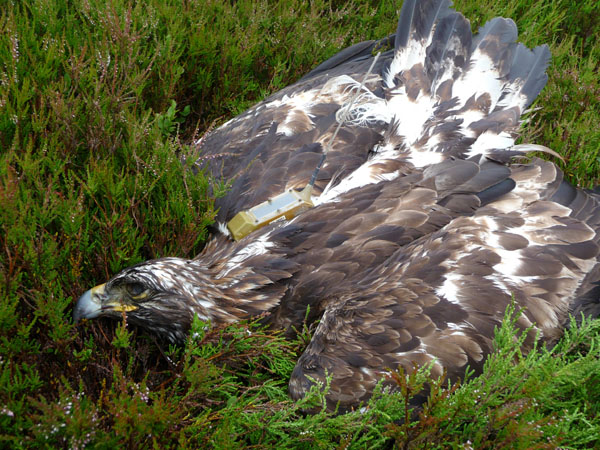
Millden Estate was the place where a young golden eagle was found poisoned in July 2009. The eagle, two year old ‘Alma’ who was being satellite-tracked from her birthplace on Glenfeshie Estate, had been killed by the banned poison Carbofuran. A police search of Millden Estate failed to find any evidence and to date, nobody has been charged with any related offences (see here). The local community was outraged at the death of Alma and wrote to local estate owners, the Environment Minister and the Chairman of SNH to express their concern about the alleged use of poisoned baits in the area (see here).

Scotland on Sunday article here

Millden Estate sales brochure: Millden sales brochure 2011

RSPB publishes 2010 raptor persecution report

The RSPB has just published its annual report on raptor persecution in Scotland. The report, ‘The Illegal Killing of Birds of Prey in Scotland 2010‘ is the only known published record of all known persecution incidents including poisoning, shooting and trapping, in contrast to the PAW Scotland annual report which only details poisoning incidents. As well as the confirmed incidents of persecution, the report also provides information about ‘probable’ incidents (those where the available evidence points to illegality as by far the most likely explanation but where the proof of an offence is not categorical) and ‘possible’ incidents (where an illegal act is a possible explanation but where another explanation would also fit the known facts).

The report provides details of several confirmed and probable persecution incidents that didn’t make it into the public domain at the time they occurred, including two shot sparrowhawks (Dingwall, Inverness-shire & nr Dolphinton, South Lanarkshire), a goshawk killed in a pole trap (nr Dalwhinnie, Inverness-shire), a shot short-eared owl (Leadhills, South Lanarkshire), 5 separate incidents involving peregrines (Stirlingshire, South Lanarkshire and Dumfries-shire), ‘disappearing’ hen harrier chicks (nr Knockando, Moray), a member of the public witnessing the shooting of a buzzard (nr Leadhills, South Lanarkshire), the discovery of a heavily decomposed buzzard carcass found in a stink pit (nr Dornie, Inverness-shire) and the discovery of a suspected pole-trapping site (nr Dornie, Inverness-shire).

Interestingly, although the report doesn’t go as far as naming estates in most incidents (apart from the reports of successful prosecutions), it does go further than the vague information provided in the annual PAW statistics. For example, in the PAW Scotland ‘Bird of Prey Poisoning Incidents 2006-2010 – Incident Details’ report (that we discussed here in March 2011), there are several cases of buzzard poisoning that were just listed as ‘Tayside’. The RSPB report clarifies this a little bit, and lists the locations as ‘Glenogil’ and ‘nr Kinross’.

This annual report makes for grisly reading, but as the report says, these incidents no longer shock or surprise us. The evidence yet again points to the involvement of people within the game-shooting industry; the latest statistics show that of all those convicted for illegal raptor persecution in Scotland between 2003-2010, 88% were involved with gamekeeping (the rest involved pest controllers, farmers and pigeon racers at 4% each).

The RSPB makes several recommendations in the report that would considerably reduce the difficulty of bringing these criminals to justice. They include recommended action for the police, the crown office & procurator fiscal service, the Scottish government, and representatives from the game-shooting industry. Some of these recommendations have been made before but have apparently remained unheeded.

Well done to the RSPB for publishing this report and for keeping the issue high on the political and public agenda.

The report can be downloaded here

Remony Estate provides safe haven for golden eagles

Remony Estate in Perthshire has joined a very small group of Scottish sporting estates known to actively support breeding populations of raptors on their grounds. Following in the footsteps of estates such as Coignafearn and Glen Tanar, Remony, near Aberfeldy, has provided a safe haven for a species not often tolerated on a working grouse moor – the golden eagle.

This year a pair of golden eagles was allowed to breed successfully and without disturbance at Remony, resulting in the production of two healthy offspring. One of the youngsters has been collected under licence to join the on-going effort to re-introduce the golden eagle to Ireland.

For the full story, click here.

Congratulations to Remony Estate owner, James Duncan Miller, and his team of gamekeepers, for showing the rest of their industry that raptor conservation and grouse moor management need not be mutually exclusive activities. They deserve to be recognised and acknowledged for their efforts.

Remony Estate website here