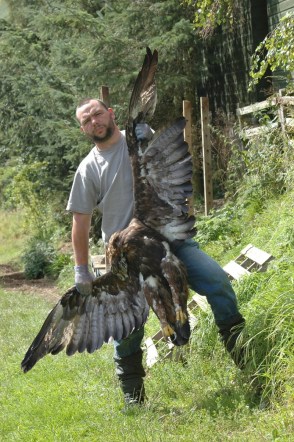
Golden eagle protection discussed in parliament

Great to see more MSPs raising questions about golden eagles in the Scottish Parliament….

Joan McAlpine (South Scotland) (SNP): To ask the Scottish Government what steps it is taking to protect golden eagles. (S4O-02010).

The Minister for Environment and Climate Change (Paul Wheelhouse): All wild birds are protected in Scotland under the Wildlife and Countryside Act 1981. Golden eagles are listed in schedule 1 to the 1981 act, which provides further protection measures to prevent disturbance to nesting birds. Last month, we added golden eagles to schedules A1 and 1A to the 1981 act, to provide year-round protection for nest sites and protect birds from harassment.

Since 2008, we have broadened and developed the partnership for action against wildlife crime in Scotland—PAW Scotland; strengthened the legal framework by introducing vicarious liability; provided funding for the national wildlife crime unit; and supported initiatives to tag and satellite track golden eagles. Recent police reform has increased the number of specialist wildlife crime officers.

We have been active in the fight against raptor persecution, and poisoning has reduced significantly. However, we are in no way complacent and we are actively considering whether other methods of persecution are being deployed. Some of the new wildlife crime measures that we have put in place are yet to be tested, but we know that there is still a problem in some parts of Scotland, and I reiterate to people outside the Parliament that we stand ready to introduce further measures, should that be necessary.

May2012 GE tayside grampianJoan McAlpine: As the minister acknowledged, there have been a number of shocking incidents across Scotland during the past year. Earlier this month, a golden eagle was shot on the southern upland way. In light of that, will the minister reassure the Parliament that investigations into the illegal killing of eagles are carried out quickly and effectively? Is he willing to update the Parliament on the investigation into the killing of the golden eagle that was found on Deeside in May 2012?

Paul Wheelhouse: As I said, police reform has resulted in a revised structure for wildlife crime, which will improve co-ordination and support for wildlife crime officers. I have every confidence in Assistant Chief Constable Graham, who has been appointed to lead the work. We also have a specialist unit in the Crown Office, which ensures that there is greater understanding of the complexities of this area of the law, in and out of the courtroom. That is a major development, which should not be underestimated and which will increase the focus on wildlife crime.

I assure the member and the Parliament that such measures, along with robust working in the partnership for action against wildlife crime in Scotland, will ensure that investigations are carried out as quickly and effectively as possible. PAW Scotland is looking at making the evidential trail on issues such as raptor persecution more robust, if it is possible to do so, which involves working closely with the Scottish raptor persecution priority delivery group.

I am not in a position to update the Parliament on the 2012 Deeside eagle case. There is an on-going police investigation and it would be entirely inappropriate for me to comment at this point.

[Ed: this issue about when is a case still ‘live’ is of great interest to us. How do you define when a case is still live/on-going? We would expect the definition to mean that active leads are still being followed up and/or a court case is pending. However, we are suspicious that the regularly-heard phrase ‘it’s an on-going police investigation and therefore can’t be discussed’ is a convenient excuse for the police/government to avoid answering serious questions about the effectiveness of these investigations. Take the Deeside eagle case as an example. That golden eagle was found dead almost one year ago. Are we expected to believe that the police are still following up active leads? Come on, let’s be realistic here. How about some of the other 26 cases of either dead or ‘missing’ eagles in the past seven years (see here), for which no-one has been prosecuted? Are they still ‘on-going’ investigations as well? Are the police still investigating the death of Alma, the golden eagle found poisoned on Millden Estate in 2009? How about the poisoning of the last remaining breeding golden eagle in the Borders in 2007? We would like to see much more transparency about these cases – obviously not while they’re genuinely on-going – but when a case is clearly going nowhere shouldn’t there be a point when questions can be asked, and answered, no? We would be very interested to hear from anyone who can tell us the official definition of how an ‘active case’ is defined and at what point, if any, can the police/government be questioned about an incident?]

Graeme Pearson (South Scotland) (Lab): I am sure that members welcome the drop in reported poisonings of birds of prey, but I am concerned that there has been no decline in other forms of raptor persecution. The Wildlife and Natural Environment (Scotland) Act 2011 introduced vicarious liability, to combat raptor persecution. Will the minister indicate what the next steps will be? Now that Police Scotland has been established, what new approaches will be introduced?

Paul Wheelhouse: Graeme Pearson is right to say that vicarious liability is a significant development in the law on wildlife crime. The provisions came into force on 1 January 2012 and the legislation has not yet been tested in court, as he is aware. I believe, however, that the legislation has had the welcome effect of encouraging responsible land managers to examine the training of and procedures for their staff. I have no doubt that, if a land manager or owner is prosecuted under the provisions, it will have a salutary effect on others who have been content to turn a blind eye to unlawful practices that are carried out on their land.

More generally, the Government is doing everything that it can to encourage good practice. Recently, Scottish Land & Estates launched the wildlife estates Scotland initiative, which I hope will gather arms and legs and cover an ever-greater share of landowners. In theory, that will enable the promotion of the most proactive and progressive conservation measures by land managers. However, I reassure the member that, if the measures under vicarious liability prove to be ineffective, I will take further action.

Jamie McGrigor (Highlands and Islands) (Con): The RSPB states that one of the key problems for the survival of golden eagles is the lack of live prey that is available to the species. Does the minister agree that a healthy supply of food species in golden eagle areas, such as rabbits and mountain hares, is a factor in the maintenance of healthy numbers of golden eagles? Is he, through the appropriate agencies, doing something about the decline of those species in some areas?

Paul Wheelhouse: The member raises an important point about the need for golden eagles to have adequate food supplies. It is not as simple as saying that it is all about raptor persecution; we know that there are multiple influences on the sad decline in the populations of a number of our key, iconic species of birds. Clearly, mountain hares are a species that we want to protect. If there was any persecution of those animals by land managers, we would be concerned about it. If the member has constructive proposals that he would like me to consider, I would be happy to meet him to discuss the issues.

Zanussi engineers called in to help SGA stuck on spin cycle

spin2There’s an article in the Scotsman today about Scottish gamekeepers offering to help the fire service put out fires, started by, er,…well it depends on whose opinion you accept.

According to the Scottish Gamekeepers’ Association, the fires weren’t caused by gamekeepers involved in muirburning activities. Oh no, apparently they were caused by ‘camp fires getting out of control’ and ‘garden fires’.

However, last week the Scottish Fire and Rescue Service clearly thought that landowners were at least partly responsible as they issued a threat to prosecute those involved with muirburning activities in unsuitable conditions (see here). Why issue such a warning if they believed the fires were caused by careless campers and gung-ho gardeners?

Is the point of the SGA’s press release an attempt to portray a ‘caring sharing’ attitude, impressing us all by riding to the rescue as the fourth emergency service to put right the misdeeds of others? Dream on.

Later in the article the SGA accuses the RSPB of ‘scaremongering’ after they predicted the wildfires could potentially have a huge impact on golden eagle breeding success this year. This is quite an amusing accusation considering the content of the SGA’s Hogg Blog this week (see here), which includes this statement:

Many interesting subjects have been spoken about [with his chums at various meetings], not least the huge numbers of badgers, ravens and buzzards which are having a detrimental effect on our wildlife and livestock“.

Er, and the evidence for this ‘detrimental effect’ is what, exactly? And they call the RSPB the scaremongerers!

SGA chairman Hogg is further quoted in the Scotsman article talking about the golden eagle population and he implies that there’s no need for concern about its conservation status. He trots out the usual line about the population’s ‘stability’ at around 420-440 pairs but fails to acknowledge that this ‘stability’ is wholly misleading, given the accepted scientific evidence shows that the species only has favourable conservation status in 3 of 16 regions, the population is being kept suppressed by illegal persecution, and there should be a minimum of 716 pairs overall (we blogged about this the other day (here) and we’ll keep blogging about it for as long as the spin cycle lasts).

Scotsman article here

Golden eagle population in south Scotland close to collapse

Poisoned golden eagle Borders 2007An article in the Scotsman today suggests that the recent death of the shot golden eagle (see here) signals ‘disaster’ for the species in this region.

We would agree with that, although we disagree with the figures used to support the statement.

RSPB Scotland has warned that the latest death puts the future of the species in the area at risk, with the number of breeding pairs in the south at “less than half of what it should be”, down from around ten to just three or fewer.

Actually, based on the extent of suitable habitat, the target number of breeding territories (for the species to achieve a favourable conservation status in the region) has been estimated at 17 (see the Golden Eagle Conservation Framework below).

We know of only four currently occupied territories in southern Scotland. Of these, two are occupied by single adults and two by breeding pairs. Of the two breeding pairs, only one pair has been productive in recent years.

We understand the shot golden eagle was an adult male. Was he part of the one remaining  productive breeding pair in the whole of southern Scotland? We’re hearing unconfirmed reports that only one adult has been seen this spring in the one occupied (productive) breeding territory. We’ll have to wait a while longer for this to be verified.

The article also suggests that the national golden eagle population has remained stable in recent decades, around 420-440 known breeding pairs. This is actually quite misleading. Yes, the figures suggest a stable population but what they don’t reveal is that this is a suppressed population, being held at a level well below what it should be, largely prevented from growth by illegal persecution. A conservative estimate of known or potential golden eagle territories throughout Scotland has been estimated at 716 (see the Golden Eagle Conservation Framework below).

The article includes a facile quote from Scottish Land and Estates, who seem to ignore the unfolding disaster in southern Scotland and instead talk about the work their members are doing in the north. Sure, there are some enlightened landowners helping golden eagles in the north, but the evidence suggests they are heavily outnumbered by those who are not.

It’s been five years since the Golden Eagle Conservation Framework was published. That government-funded study demonstrated that golden eagles were in favourable conservation status in only 3 of 16 regions nationwide. The report concluded that the highest national priority for the conservation and management of golden eagles in Scotland was to tackle persecution in the areas where it still persists.

Last Friday, when we reported on the death of the shot golden eagle, we encouraged readers to contact the Environment Minister to urge him to take the action he promised last year if persecution incidents continued. According to our site stats, we know that over 70 of you have now used the direct email link to send him a message. We also know that many more have contacted him without using the direct email link. If you haven’t already done so, please consider contacting him: ministerforenvironment@scotland.gsi.gov.uk. This surge of messages should let him know our strength of feeling on this issue. We’ve had enough and we expect our elected representatives to respond.

Article in the Scotsman here

Golden Eagle Conservation Framework here

Shot golden eagle finally succumbs to its injuries

The golden eagle that was found shot and critically injured on a grouse moor last autumn has finally succumbed to its injuries. The bird apparently died last week, although as far as we can tell there’s been no publicity, which seems a bit surprising given the public interest in this incident. We understand the Environment Minister Paul Wheelhouse was informed.

This eagle was discovered ‘barely alive’ last October, on a grouse moor belonging to Buccleuch Estate, close to the boundary with Leadhills Estate (see here). Its death now completes a grisly trilogy of golden eagle killings in Scotland in 2012: one poisoned, one trapped and one shot. And these are just the ones that were discovered.

It’s highly unlikely anyone will be prosecuted for killing these eagles if past incidents are anything to go by. We’ve been keeping a list of known dead or ‘missing’ eagles and any subsequent prosecutions. At last count it was 26 eagles, 6 years, 0 prosecutions (see here).

It’s now 27 eagles, 7 years, 0 prosecutions.

If you want to express your disgust to the Environment Minister and ask him when he’s going to make good on the promise he made last year to consider further measures to bring the raptor killers to justice, please email him at: ministerforenvironment@scotland.gsi.gov.uk

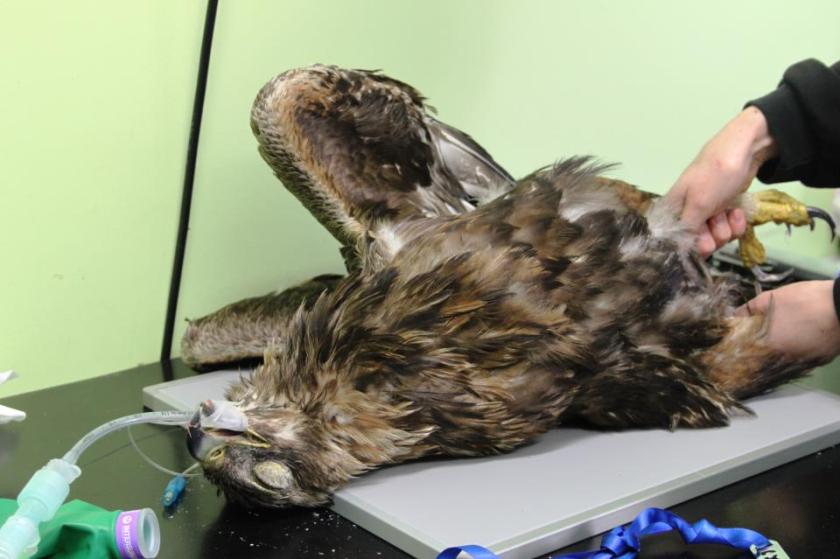
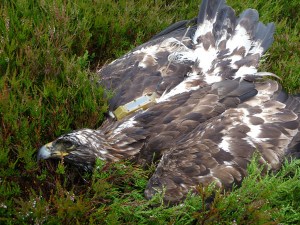
The shot golden eagle ungergoing surgery

Landowners ‘blamed unfairly’ for wildfires, say, er, landowners

Scottish Land and Estates, the representative organisation of 2,500 landowners across Scotland, says landowners are being ‘blamed unfairly’ for the outbreak of wildfires that have occured across huge swathes of the Highlands this week.

According to Luke Borwick, chairman of SLE, “Some of these fires have been as a result of careless activity by recreational access takers. However, a significant number of fires have clearly been the result of irresponsible actions of other land users burning and not following the Muirburn Code“.

Amazing. The SLE statement in full here.

Meanwhile, the RSPB is deeply concerned about the effect of the fires on moorland-nesting birds, and particularly on golden eagles.

James Reynolds of the RSPB said: “It is absolutely certain that we will have lost a number of golden eagle nests. How many we don’t know but for a population that small, even the loss of one nest is serious“. Full details on BBC news here.

Marvellous. Welcome to the Year of Natural Scotland.

2013 wildlife crime conference: Duncan Orr-Ewing, RSPB

This is the third blog in our series about the 2013 Scottish Police Wildlife Crime conference. (NB: these are not being produced in the order the presentations were made at the conference). Here’s what Duncan Orr-Ewing of RSPB Scotland had to say on the topic of raptor persecution:

“Good morning everybody, I think most of you know me here, but my name is Duncan Orr-Ewing, I’m Head of Species and Land Management at RSPB Scotland, based in Edinburgh. My talk today, what I plan to do is give a bit of an outline of the issue if you like, then cover some of the sort of on-going work that is underway to try and address the problems, and then take a bit of a forward view if you like, on what the next steps might be. I should probably also confess at this point that I’m also a Director of the Langholm Demonstration Project, which Simon’s just talked about. I’m not planning to talk a lot about that but obviously as a science-based organisation the RSPB is heavily involved with that and a range of other scientific projects to try and identify solutions to some of the issues on-going in this area. I should also say, just briefly at the outset, as a science-based organisation our focus is on the conservation of raptors, we’re informed by the science, our focus is on raptor populations. We are not opposed to hunting as an organisation provided it’s carried out sustainably and legally.

Taking us back to the beginning, I think the advent of the Scottish Parliament has seen political unity break out on this issue, and I’m minded to remind you all of Donald Dewar’s statement that the persecution of birds of prey in Scotland is a national disgrace, and subsequent Environment Ministers of all political persuasions that we’ve had in power in Scotland have also pretty well taken this sort of line. This is not a political issue, this is a significant conservation issue. The RSPB is involved with this because it is a conservation issue and we’re rightly standing up for the interests of raptors. And I would also remind you at this stage that there are no enlightened countries, shall we say, in the world, that I think I can point to, where people are allowed to illegally, or, in most cases I would also say, legally kill raptors. They’re rightly protected as I’ll come on to say.

So just talking about some of the issues, this is the Skibo Estate in Sutherland taking you back a few years, in the foreground you’ll see one of three golden eagles that were found poisoned on that estate. Why should we be concerned about this? This incident, in itself, has probably resulted in a set-back for that local golden eagle population for many many years to come, that one incident. So the question we ask ourselves here is, why has this been allowed to happen? The individuals that have been involved with this, why are they involved with the hunting industry? Why haven’t they been removed by the hunting industry? Why haven’t they been marginalised? Instead, we see some of these people held up as exemplars of best practice, in particularly in the grouse moor industry, and that is very disappointing and I think that has to be addressed.

I’ll also remind you that raptors are not just important as the Minister said, on their own volition, in their own right, they’re also important because they’re important to local economies. Need I say the story of the sea eagle, a reintroduced species, its value to the local Mull economy – £5 million per annum. People come to Scotland to see our environment, they’re attracted to seeing some of these iconic species that we have here, the sea eagle is one of those.

Another example, and there are examples across the whole of Scotland, the length and breadth of Scotland, the Galloway Kite Trail, also bringing in hundreds of thousands of pounds a year to a local Dumfries & Galloway economy. And some of these benefits that come from raptor conservation, supported it has to be said by local estates and enlightened land owners, they are now very important to the economies of some of our most rural areas in Scotland.

So why are raptors protected? And this is a very fundamental point which informs very much how we think about this issue. Firstly, they’re long-lived birds with slow reproductive rates, so illegal killing can be highly detrimental to their populations. Scotland also has a particularly poor history in conserving our raptor species. We have had national extinctions, I mean even birds like the buzzards, because of what we did two centuries ago, were driven to the edge of what should be their former range and only now are some of these species recovering their populations, and indeed, some have had to be reintroduced by humans with the support of local land owners because they were driven to extinction, and the red kite and the sea eagle being those. And we still, I’m afraid, based on some of this history, still have a prejudice in the UK and Scotland towards predators, and this isn’t just raptors, this is all sorts of predators, you know, big cats, wild cats, pine martens, otters, badgers, there is prejudice against these species as well, which persists in some places.

So I want to touch now just on what the impact of illegal killing has on three raptor species and I’m taking the golden eagle, hen harrier and red kite as examples, and we now have a very good body of science to support these assertions.
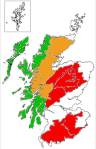
Conservation status of the golden eagle in ScotlandSo I’m referring here to the SNH Golden Eagle Framework, and here the red areas that are on the map show the areas in Scotland where the golden eagle population is considered to be in unfavourable conservation status. And overlaid on that map are the incidents of illegal persecution, poisoning incidents, between 2006 and 2012. And you’ll see there’s a strong coincidence with illegal persecution of golden eagle poisoning in this case and where the bird is in unfavourable conservation status. And in 2012 alone, I’ll just highlight three cases of crime against golden eagles that were detected: one in the far north west of Scotland, one in the Angus area and the other in Dumfries & Galloway/Strathclyde border. And every time one of these cases happens, I would say, you know, the trust that should be there between land managers and conservationists takes a step back.

With hen harrier I take you back to 2000 and a case in Strathspey in Morayshire, and here was a case of a gamekeeper shooting a hen harrier at the nest, successfully convicted for this, and I’m afraid that this was the first successful conviction of a gamekeeper for killing a hen harrier, although this is considered to be widespread practice, and I’ve put this in really just to show how difficult it is to secure convictions in this kind of case because these cases occur in remote areas, in this case on a grouse moor, you know, far away from public roads, it is difficult to get access and bring these people to justice but in this case we were successful in doing that and subsequently there have also been a couple of other successful convictions. But we think this is still widespread practice, and following on from the Joint Raptor Study than Simon mentioned earlier, we do know that that resulted in an escalation of crime against hen harriers because people saw that hen harriers were blamed for suppressing grouse populations and as a result people saw justification for taking the law into their own hands. And in 2010, as a result of this, we’ve just carried out a national population survey with the Raptor Study Groups and others, into hen harriers, we have a national population decline of 20% in hen harriers. And if I tell you that on grouse moors, driven grouse moors in the UK, we only have five breeding pairs of hen harriers, and as many of you will know the hen harrier is on the verge of extinction in England as a result of human persecution. Other work that has been done by people in this room actually and GWCT and others has shown that there is room for 500 breeding pairs of hen harriers on driven grouse moors in the UK, so their population is being suppressed  and they are at very low levels. And I’ve just put this in to show that this is a species that isn’t affected really by illegal poisoning – most of the impacts on hen harriers are either by direct nest destruction, or in this case, illegal trapping. You can see a male hen harrier there, caught in a leg-hold trap.
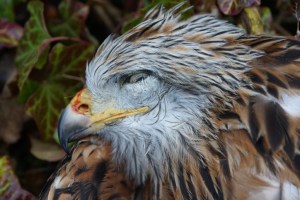
red kite 12And red kite, a species which I have a fair bit of involvement with myself, again we’re in a unique situation here where we have an almost totally marked population of birds, because the bird was reintroduced, all the birds that were released were wing-tagged and we know the fate of these birds because we’ve been radio-tracking them and recording all the wing tag data. And we’re also in a position where we’re able to compare between two reintroduction areas so in the south of England, in the Chilterns, there was a similar reintroduction and we released the same number of birds, about 90 birds were released, also 90 birds in north Scotland and the population in 2006 of red kites in the Chilterns area, with similar productivity, same number of young produced compared roughly to north Scotland is over 300 pairs whereas in north Scotland the population has bubbled along and has stayed pretty well static at about 50 breeding pairs. Indeed the Chilterns population this year is nearly 1,000 breeding pairs whereas the north Scotland population is still stuck below 60 breeding pairs. And the main difference between these rates of growth is explained by the prevailing levels of illegal poisoning in the two countries, i.e. we have far higher levels of illegal poisoning. And last time I was here speaking to you was about red kites and I reported that since reintroduction we’d found 50 kites that had been confirmed as being illegally poisoned since reintroduction began in 1989 and that figure is now 75 in Scotland. And where is this happening? There is a strong coincidence, illegal activity in the east of Scotland in the areas shaded, which are grouse moors, hence the work we’re doing at Langholm and elsewhere to try and find some solutions to this problem. And increasingly it is looking like the driven grouse moor areas are the problem areas to focus on.

The big concern if you like with the driven grouse shooting set-up these days is that this sport seems to be moving into a new, more intensive phase. So over the past 10-15 years we’ve seen land management systems that have been employed for England for quite a number of years, coming up to Scotland, means more intensive management, more keepers, more predator control, killing as you’re aware of hares and deer tick hosts, increased burning, and we’ve mapped this and we know that there is a strong coincidence where this intensive management is coming in there is a prevalence also of illegal raptor persecution. And I would see this very much as the problem area to focus on in the forthcoming years. There have been some very notorious cases of course, that have occurred in these places where this intensification of management has taken place, in this case ‘Alma’, a golden eagle being radio-tracked and being found dead in the Angus glens a few years ago, illegally poisoned.

So is the situation improving? I think the answer is yes in some places, and this is a map of BTO data on the breeding bird survey buzzard trend, and you will see that the buzzard population, as many of you will know, has increased quite rapidly in recent years but now it’s plateau-ed off as you’d expect and we have a largely stable buzzard population but this species is still absent from some areas of its former range but I think the next breeding bird atlas, coordinated by BTO, will show that the buzzard has recovered large areas of its former range, which is good progress.

Earlier today we were talking about the illegal poisoning incidents in Scotland. This is a bar chart showing the number of reported poisoning incidents over the years since 1989, and as the Minister mentioned, over the past couple of years we have seen a significant decline in illegal poisoning and that is again very good progress. We would say this is informed by a few things perhaps as background which have helped us get to where we are today and this is work in progress, there’s no room for complacency here and we will work with Scottish Land and Estates and others to make sure that we continue to bear down on this problem.
AlmaBut the high point [on the graph] in 2009 was when Alma, the eagle that I mentioned earlier, was found poisoned. We also had a case, the Skibo case also mentioned earlier, a seizure of 10kg of Carbofuran, one of the poisons most implicated in illegal poisoning. And then again, 2011, another satellite-tagged eagle found poisoned. And of course the introduction of vicarious liability making land owners more responsible for the actions of their employees. These welcome steps, apart from the poisonings of course, are helping to move the situation onwards but as I say, we’re not complacent and we will continue to work with partners in the Partnership Against Wildlife Crime to bear down on this problem. What we’ve learned through poisoning hopefully will transfer to other types of raptor crime in due course.

Ok, this is just to remind you also that there are quite a large number of birds that have been killed since 1989 through illegal poisoning – 930 birds and animals have been discovered poisoned and hopefully in the future we can make a dent in that situation. Ultimately, consign illegal poisoning to history, that’s what we want to do.

But also worth mentioning that birds of prey are killed in other ways, they’re shot, trapped or have their nests destroyed and we need to start progressing that as well, as was stated earlier.

So what are the solutions? As we’ve heard earlier, we’re developing legal alternatives to killing birds of prey, and diversionary feeding is one such method, which in the case of the hen harrier has been shown to be pretty effective and we hope over the next few years the grouse moor sector will start adopting this technique and rolling it out across driven grouse moors across Scotland and perhaps even in the north of England. These are legal techniques to solve problems.

I think we also need a model of how grouse moors can be managed more sustainably. It’s not acceptable that this continued intensification occurs and the people that are involved with it are held up as exemplars of best practice if that involves illegal activity. We need a model that fits more with 21st century public expectations and is not predicated on ever-increasing grouse bags. Some of the moors which we see now have the highest grouse bags they’ve had for many years. You would think there would be room for raptors there. They also don’t have the grouse cycle that they used to have because we have medicated grit and other methods developed by GWCT to prevent that from happening. So why can’t these places tolerate raptors? Many of the grouse moors that we’re talking about here don’t have any breeding raptors, let alone hen harriers and eagles, they are black holes for raptors. But we also need more land owners and their employees to work with the police and marginalise those who undermine other good practice and that is happening to a large extent now, through PAW and the work of Scottish Land and Estates and others and we very much welcome that.

And of course there has to be a deterrent out there and that includes effectively robust policing, enforcement, to deal with those serious incidents when they occur.

And I throw this open, but do we need more regulation of the sporting industry? It was discussed last time, the Wildlife and Natural Environment (WANE) Act went through the Scottish Parliament. We have one of the most unregulated shooting industry anywhere in the world. Does this contribute to this problem? In Germany, North America, Scandinavia, other countries, they have quite an established system of regulation for hunting.

But what it’s all about for us, and we will measure success of all of these actions, is through improved populations of the key species, in this case goshawks, ospreys, hen harriers. That is how we will measure progress. But this will be delivered through a range of partnership arrangements as well. It’s easy to knock these partnership arrangements but they are important. They build trust, they build dialogue and in Scotland as a small country of only 5 million people we have good communication between most of the key players here, and that can only help us move this along.

I’m delighted that Scottish Land and Estates are developing their Wildlife Estates initiative; some RSPB staff are involved with helping develop this and we will help Scottish Land and Estates encourage those good land owners who want to do the right thing as we move forward with that programme.

The Langholm Demonstration Project, I won’t dwell on that in detail because Simon’s covered a lot of it – a very important project. This is the model for sustainable grouse moor management going forward. Many of you  may not see that, and Simon said, it’s not without problems, the project, but we’re working our way through those problems as partners, and this less intensive approach to grouse moor management, within the law, with protected raptor species, has to be the way forward, and a combination of hunting and conservation occurs.

And of course I should mention the Partnership Against Wildlife Crime, which over the past few years has really developed into a solid partnership and we’re all working together in the same direction. Thank you very much”.

Year of Natural Scotland: SNH cock up launch of ‘Big 5’

IMG_2300a2013 is the Year of Natural Scotland – a Scottish Government initiative aimed at getting people out and about to enjoy Scotland’s natural wonders (see here). 

As part of this, SNH has chosen five iconic species to act as the focus of attention. These so-called ‘Big Five’ were revealed today: otter, red deer, golden eagle, harbour seal and red squirrel.

SNH has helpfully produced various media so we can learn about each of these species, including a special app and a downloadable flyer giving detailed information about the Big Five (see here).

Unfortunately, somebody in SNH can’t tell the difference between a golden eagle and a white-tailed eagle. Have a look at the information sheet they’ve produced for the golden eagle (see photo above left). Looks lovely, eh? Oh, but what’s that on the second page? Is that a photo of a sea eagle labelled as a golden eagle?! Oops! That’s going to be expensive to fix.

IMG_2301a

It seems that someone in SNH has noticed this tiny error, as the downloadable leaflet for the golden eagle is no longer available. Here’s a copy in case you missed it this morning: Golden eagle high flyer

It’s worth a read – it tells us that one of the ‘likely areas’ to see breeding golden eagles is, er, on the grouse moors of the central and eastern Highlands!!!

You couldn’t make this up. SNH at its best.

Pets killed by the bird poisoners

poisonThere’s an article in the Express today talking about pets that have been poisoned by gamekeepers (see here). According to the article, ‘new figures show 60 dogs and 28 cats have been poisoned in the last decade’. Unfortunately, the article doesn’t tell us who published these ‘new figures’ or on what evidence they’re based.

We do know that pets are poisoned, snared, shot etc by gamekeepers because we’ve read the stories in the newspapers and seen the toxicology reports –  we just aren’t sure about the accuracy of these ‘new figures’.

The article goes on to say, ‘over the past decade more than 250 protected birds such as golden and white-tailed eagles, peregrine falcons, red kites and buzzards have died and there are fears a child could fall victim if they touch the bait’. This figure, we know, is definitely an underestimate of the number of raptors poisoned over the last decade.

The main thrust of the article is based around last week’s news that the UK government has decided to ignore the Environmental Audit Committee’s recommendations for addressing wildlife crime (see here) and how the Opposition are now slagging them off for it.

If you think gamekeepers should be held accountable for what they get up, please sign this e-petition: HERE.

2013 wildlife crime conference: Paul Wheelhouse, Environment minister

The 2013 Scottish Police Wildlife Crime conference took place last Thursday (14th March). Many of this year’s presentations were once again directly relevant to raptor persecution and we’ll be commenting on these in due course.

To start off this year’s blog series, here are excerpts from the Environment Minister’s speech. He started by thanking the organisers etc before moving onto the meaty stuff:

“We’re now more than a year on since the passing of the Wildlife & Natural Environment (Scotland) Act 2011 and my predecessor, Stewart Stevenson, stood here last year and, amongst other things, talked about the new vicarious liability provisions. Now, we’ve not seen any prosecutions under the vicarious liability yet; I think it remains very likely that circumstances will arise in the future when these provisions can be brought into play and we will all be very interested to see how they work out in court.

In the meantime though, I am certain that whilst persecution of wild birds does exist in parts of our countryside, this change in the law has already had a deterrent effect as responsible land managers take a close look at management practices and training for employees and contractors. As Stewart said last year, we’ve never been out to get prosecutions; we just want to see an end to these criminal acts. However, if a conviction is what it takes to make those breaking the law stop, take notice and address their behaviour, then so be it. I shall be keeping an eye on this particular area with interest. A true test of course may be when we see raptors in all areas that should be their natural habitat and a disappearance of these ‘not spots’.

So what’s coming up in 2013? Legislative changes my team of policy officials have been working on which are of relevance to the conference include provisions relating to snaring, and invasive non-native species, and you will be hearing more from Catherine Murdoch about non-native species later today, and Kenny Wilmott from BASC will be talking about the importance of keeping up to date in relation to the use of snares and traps.

2013 will also see the publication of the first government report into wildlife crime. Policy officials are currently working on this and I’m sure it will make for an interesting read and it will no doubt provide a focal point to drive forward the debate on what is a very important topic. What we are looking to achieve with this report is an idea of what wildlife crime in Scotland looks like overall, the big picture if you will. This will not be easy because it’s the first report, there’ll be nothing to compare it with. However, like poisoning maps, once we have a few reports published we will hopefully start to see trends and pictures emerge. It will also be a challenge to compare data from all of the different agencies such as the police, National Wildlife Crime Unit, the Crown Office and the Scottish Government Justice Department. However challenging that may be, it is an extremely worthwhile cause. And unfortunately crimes and any resulting prosecutions don’t fall neatly into calendar years. They also are not always recorded in a manner which allows for obvious interpretation of the charges. So for example, where there is more than one charge, which so often occurs in the lesser charges of wildlife crimes, then the main charge is usually what appears in the records. We’ll therefore be looking to present the data as simply as possible, but with a view to ensuring any comparisons are meaningful, if indeed that is possible. And I’m looking forward to the publication of this report to act as a standard we can use going forward. I will leave the experts to talk to you about the legislative changes across the rest of today, however should you fancy a chat with a policy official over a sausage roll at lunch, please feel free to collar any one of them.

I’d like now to turn to the annual raptor poisoning maps which were published this morning. These maps generate significant media interest and many of you will already have seen the figures. There has been a major drop in confirmed incident numbers recorded for 2012 and this must be welcomed in the warmest possible terms. Whilst any poisoning is unacceptable, the fact that just three birds were confirmed poisoned in 2012 – a golden eagle and two buzzards – must represent progress. This is the second significant drop in two years and we hope it is evidence of the beginning of the end of poisoning of birds of prey in Scotland. We are now, however, facing a critical moment with the maps. The purpose of the maps is to highlight problem areas with an agreed and confirmed set of data, and to build the partnership working within PAW. So, so far we’ve made good progress on those objectives but we cannot now afford to see things slipping back. So let me make it abundantly clear: poisoning cannot be replaced with other types of persecution, and whilst it’s not appropriate for me to elaborate, I was heartened to hear that the police investigation into the 2012 poisoning case for a buzzard has made progress. And it does sicken me that unfortunately, once again, a bird has died as a result of Carbofuran poisoning, but I very much hope to see a positive outcome in that particular case. If we do continue to see a downward trend with the poisoning maps, but there is evidence perhaps of other types of persecution taking its place, as I’ve already said on the record, I will have no hesitation nor indeed very little option but to consider what other measures might be necessary.

optableLast year we lost two golden eagles – one was poisoned, another was found dead in suspicious circumstances, whilst a third which was shot is thankfully in recovery with the SSPCA, and I must thank Chief Superintendant Mike Flynn and his colleagues for their excellent efforts in caring for the eagle so far and I look forward to one day seeing that particular victim of a crime return to good health. These golden eagle incidents generated a huge amount of media and public interest and rightly so, as our golden eagles are part of what makes up our national identity. As a partnership we share a duty of care to work hard to stop wildlife crime and as I stated earlier, we will know if we’ve achieved success when we see the raptors return to areas where they are currently absent. And we must also recognise that this will not happen overnight.

Keeping on the raptor theme, the Raptor Persecution Priority Delivery Group, which is a key PAW Scotland group, has been continuing to look at a number of initiatives, latest being a hen harrier action plan. The members of this group have come up with a strategy to look at the status of this species across Scotland and see what can be done to help it recover. Whilst the plan is still being finalised I wanted to draw your attention to it and highlight what work is being done in the background. This is an exciting piece of work and I hope it will build on the partnership working approach by involving all those on the ground in monitoring and reporting on nesting birds. If I’m standing here this time next year, I hope that I’ll be able to give you an update as to what’s been accomplished and that genuine progress is being observed”.

The Minister then went on to discuss other areas of wildlife crime, police reform in Scotland and the Year of Natural Scotland. He ended by thanking everyone for their work and particularly on behalf of “the innocent victims of wildlife crime who clearly cannot speak for themselves”.

Comment:

It’s tempting to make comparisons between Scotland’s Environment Minister and his UK equivalent. In light of the UK government’s appalling recent attitude towards dealing with wildlife crime, Wheelhouse looks like an environmental god. He isn’t that, but he is certainly a good way further ahead than his contemporaries south of the border. But although comparisons are useful, it’s also important to assess his presentation just within the context of Scottish wildlife crime, and particularly within the field of raptor persecution.

In our opinion, this presentation drew the battle line. Wheelhouse is exceptionally well-informed on the persecution issue (especially for someone who has only been in post for six months), he understands the important details of how these crimes are reported (or not reported) and he seems genuinely determined that raptor persecution will not be allowed to continue on his watch.

Wheelhouse is clearly not fooled by the superficial short-term results of the poisoning maps. He understands that other persecution methods are being used to achieve the same effect. He understands that despite vicarious liability and other measures, persecution will undoubtedly continue. He understands that the only true measure of success will be the return of raptors into areas where currently they are conspicuously absent. He understands the shambolic state of raptor crime reporting and the limitations of the data in their current format. He understands the fury and frustration we all experience when we hear of yet another persecuted bird of prey and he seems to understand that our patience has run out – we simply will not tolerate this disgraceful practice any longer.

Of course, it’s easy to give a rousing speech and to say the things the audience wants to hear. It’s fair to say that most of us have become jaded by the empty rhetoric that’s been heaped on us decade after decade while the raptor killing continues right under our noses. However, to be fair to Wheelhouse, he personally is not responsible for all those previous platitudes and promises. Is he going to be different and stick by his commitment to stamp out persecution? More than with any other Environment Minister of recent years, there is a sense that something is going to happen this time. As always though, it will be the actions that follow the words that we’ll be taking the most interest in. The battle line has most definitely been drawn and now it’s a question of watching and waiting. The next persecution incident is just around the corner…

Analysis of the SGA’s Deeside eagle report

Last month the SGA released a report into their ‘investigation’ into the death of the Deeside golden eagle (see here to read their report).

At the time we said we would comment on their report once we’d received responses to some pending Freedom of Information requests. We’re now in a position to comment.

So, the motivation for the SGA’s ‘investigation’ into the circumstances of this eagle’s death was because of what they perceived as “irregularities” in the media reports put out by the RSPB. Let’s have a look at those ‘irregularities’ in turn.

May2012 GE tayside grampianThe SGA don’t believe that the eagle was caught in an illegally-set trap because during their discussions with the estate’s staff, it was claimed they only ever use Mark 4 Fenn traps as opposed to Mark 6 Fenn traps (and of course statements made by those involved with grouse moor management should always be believed). The SGA say the Mark 4 Fenn trap is too weak to smash the legs of a golden eagle and it would be impossible for an eagle to get both feet caught inside the trap at the same time. However, if you read the RSPB’s original media statement about this incident (released 24th September 2012 – here) nowhere do they mention a Fenn trap. All they mention is a “spring type trap”, which covers a wide array of different traps, both legal and illegal, that could have caused the injuries sustained by that eagle. Indeed, independent veterinary pathology experts at the Scottish Agricultural College laboratory concluded that the two broken legs sustained by this eagle “could be consistent with an injury caused by a spring type trap”. It’s up to the reader to decide whether the statements made by the estate’s staff and the SGA are more authoritative than those of the independent veterinary pathologist experts at the SAC lab.

The SGA say they visited the precise location of the ‘alleged’ trapping on the estate. They say, “Close by, on one side, was a large multi-catch crow cage. On the other was a 7-8 foot deer fence”. This is an interesting interpretation of what “close by” means. We understand that the deer fence is actually at least 80m away from the location where the bird was static for 15 hours.

The SGA say that the eagle could have broken both its legs by crashing into the fence at a speed that could have been in excess of 50mph (according to their falconer friend). However, the post mortem report clearly states that the eagle’s injuries could be consistent with being caught in a spring type trap, not crashing into a static object at high speed. In the event of crashing into the fence with an estimated speed in excess of 50mph, you might expect injuries to the feet and to the pelvis, as a bare minimum. The post mortem report documented two broken legs as the bird’s only injuries. It’s up to the reader to decide whether the statement of an un-named falconer with an unknown level of ‘expertise’ holds more authority than the statements of the independent veterinary pathologist experts at the SAC lab.

The SGA say that after hitting the fence the eagle “would then have undoubtedly tried to regain flight. This is consistent with the GPS signals which we were shown by the RSPB, which appeared to show variations in the readings. The readings do not show that the bird was “static” for 15 hours”. It seems that the SGA have a limited understanding of how to interpret GPS sat tag signals. The variations in the readings are entirely within the +/- 18m variation quoted by the manufacturer (Microwave Telemetry). In other words, all of the signals received during the 15 hour period in question were within an 18m circle radius. To all intents and purposes the bird was “static”. It’s up to the reader to decide whether the SGA’s interpretation of the satellite data is more authoritative than those of the sat tag manufacturer or the experienced biologists tracking this eagle.

The SGA say, “The RSPB state that the eagle could no longer become airborne. We disagree, having witnessed on several occasions various bird species gaining flight with leg injuries”. But it wasn’t the RSPB who said that the eagle could no longer become airborne, it was the independent veterinary pathologists at the SAC, who said the injuries were so severe “they would prevent the bird from being able to take off”. If anyone has ever watched a golden eagle take off they will know that the bird bends its legs to push off from the ground/perch. Clearly, two broken legs would prevent this from happening. The SGA suggest that the bird could have used the “advantageous slope of the ground” to “get air below its wings”. Actually the area where this bird was static for 15 hours is relatively flat – not on the edge of a high cliff where an injured bird might be able to roll off and find a thermal uplift. So, imagine an eagle with two broken legs on the flat ground – it will be lying on its side, back or front – do you think it could get airborne? It’s up to the reader to decide whether the SGA’s explanation is more plausible than that of the independent veterinary pathologist experts at the SAC lab.

The SGA say that the eagle could have flown 15km in the dark, tried to land but crashed into the tree and fell to its final resting place underneath a tree branch. This crash would, according to them, explain the eagle feathers found between the road lay-by and the dead eagle. Unfortunately the post mortem report doesn’t show any evidence of the eagle having crashed into a dense conifer tree. It’s up to the reader to decide whether the opinion of the SGA is more authoritative than that of the independent veterinary pathologist experts at the SAC lab.

To conclude then, the SGA’s version of what happened to this eagle was that it died as a result of a terrible accident. However, they haven’t been able to provide any convincing evidence and what they propose happened is not supported by the evidence provided by the independent veterinary pathology experts.

The RSPB’s reaction to the SGA’s report included this statement:

This is a rather desperate statement from the SGA, which seemingly does more to reveal their nature as apologists for the worst types of wildlife crime, as they try to defend the indefensible. Indeed, it calls into question their very commitment to the aims and objectives of the partnership for Action Against Wildlife crime Scotland (PAWS)”.

It’s interesting (and obviously totally unrelated) to learn that in a recent meeting with the Environment Minister Paul Wheelhouse, the SGA were told very clearly that they would not be issued with licences to kill raptors for the foreseeable future due to the ongoing incidents of criminal raptor persecution. According to the police, the case of this particular eagle obviously falls within that category.  

Unfortunately we’ll probably never find out who was responsible for this eagle’s death. Had a full police search, under warrant, taken place then further supporting evidence might have been retrieved. As it stands, it appears that this supposedly ‘on-going investigation’ is as dead as the eagle.

This bird will simply join the long list of other dead or ‘missing’ eagles whose killers have never been brought to justice: 26 eagles in six years at our last count, including ‘Alma’ who was found poisoned in 2009 on, er, this estate.