Update on Holkham Estate head keeper’s pending court case

Further to blog posts on 25 January and 11 February….

Nicholas Parker, head gamekeeper on the Holkham Estate in Norfolk was due in court this morning to face a number of charges relating to alleged wildlife and firearms offences carried out on the Holkham Estate. His case was originally due to have been heard on 9 February 2011, which was then postponed until 2 March 2011.

Parker has pleaded not guilty to some of the charges, and, given the seriousness of these charges, his case has now been adjourned until 1 April 2011 as it has been moved to Norwich Magistrate’s Court where his case will be heard by a more senior District Judge.

Apprentice gamekeeper jailed for barbaric animal welfare offences in Northumberland

Two men from Northumberland have been jailed after forcing animals to fight to the death and posting video footage of their barbaric activities on the internet. The crimes are reported to include two dogs attacking a badger, cock fighting, a snared fox having a stick rammed into its mouth and one of the men standing on the fox’s neck as it was attacked by a dog, and a fox trapped inside a cage with a dog, with someone holding the fox’s ears as the dog attacked it.

One of the men, 23-year-old Connor Patterson, of Whitfield, near Hexham Northumberland, is reported to be a farm worker and an apprentice gamekeeper. During police interviews, he said he had a national diploma in countryside and game management, and while studying for this he had learned how to use snares and traps.

Congratulations to Northumbria Police and the RSPCA for bringing a successful prosecution. Let’s hope that when Patterson is released from his prison term he does not gain employment in the gamekeeping world.

Full details of this horrific story: http://www.journallive.co.uk/north-east-news/todays-news/2011/02/18/pair-forced-animals-to-fight-to-the-death-61634-28191448/2/

Game & Wildlife Conservation Trust (GWCT) Chief Questioned over Dead Sea Eagle.

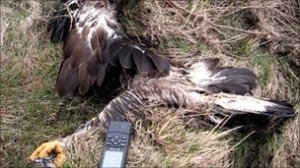
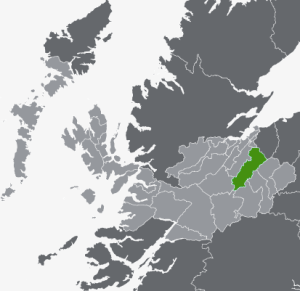
Mr Alasdair Laing, the Game and Wildlife Conservation Trust’s Scottish committee chairman, has been questioned by police, according to The Scotsman, following the discovery of a dead sea eagle on his Logie Estate, Morayshire, which was joint winner of the Purdey Award for Shooting and Conservation in 2008.

The dead eagle (released in East Scotland in 2008 as one of the reintroduced birds from Norway) was apparently found by an employee of RSPB Scotland whilst walking  in the snow on 15th December 2010.  The dead bird was reported to Northern Constabulary the same day but when officers returned to investigate the incident the following morning the carcass had mysteriously disappeared.

Police have launched an investigation into the incident but say they are unable to determine how the bird died without a body. Gamekeepers at the Morayshire estate, as well as Mr Laing, are understood to have been spoken to by investigators. The head keeper has been previously described as ‘a prominent  member of the SGA committee’ and has been praised for his conservation work (see here). Alasdair Laing was a signatory to the May 2010 SRPBA letter to the Environment Minister, one of over 200 landowners who condemned illegal raptor poisoning.

A spokesman for Northern Constabulary said “An investigation was launched by the area wildlife crime officer, but to date no remains have been recovered. There is also no evidence as to how the bird died, given the fact there was no body”

It seems strange that this incident happened on 15th Dec 2010 and this is the first media report about it. It seems to fly in the face of other investigation techniques where evidence is gathered as soon as possible whilst events are clear and fresh in potential witnesses minds.

Full story here – http://www.scotsman.com/environment/Conservation-chief-questioned-by-police.6720123.jp?articlepage=1

Alasdair Laing’s letter of response published in The Scotsman: http://news.scotsman.com/letters/Letter-Estate-work.6720703.jp

An interesting insight into how the Lochindorb Shoot (on Logie Estate) is managed, including the culling of mountain hares: http://www.shootingtimes.co.uk/features/387120/The_Lochindorb_Shoot.html

Update on pending court cases

Nicholas Parker, head gamekeeper on the Holkham Estate, Norfolk, was due to appear before King’s Lynn Magistrates on Wednesday 9 February 2011 to answer the following charges:

  • Killing a Schedule One bird
  • Taking game out of season
  • Possessing ammunition for a firearm without a certificate
  • Possessing a shotgun or rifle for committing an ‘either way’ offence
  • Possessing a shotgun without a certificate
  • Contravening the Wildlife & Countryside Act.

Parker’s case has been postponed and is now due to be heard on 2 March 2011. (See blog post 25 January 2011 for original story).

A convicted gamekeeper in Scotland (name removed for legal reasons) was due back in court on 2nd December 2010 to face charges of using poison to kill multiple buzzards on a sporting estate. This case was postponed due to bad weather and was re-scheduled for 23 December 2010. The second trial was postponed after the defendant lodged an appeal on a legal technicality. This appeal is still pending. We will post an update in due course. (See blog posts Dec 1 & 21 for original story).

HOT OFF THE PRESS – there will be a forthcoming trial in March/April concerning alleged raptor persecution incidents in Derbyshire. Watch this space!

Head gamekeeper charged with wildlife crime & firearms offences at Holkham Estate, Norfolk

The head gamekeeper at Holkham Estate, Norfolk, has been charged with  a series of wildlife crime and firearms offences following a police investigation, according to The Fakenham Times.

41 year-old Nicholas Parker of Main Road, Holkham, has been charged with the following: killing a Schedule One wild bird, taking game out of season, possessing ammunition for a firearm without a certificate, possessing a shotgun or rifle for committing an either way wildlife offence, possessing a shotgun without a certificate, and contravening the Wildlife and Countryside Act.

He has apparently been suspended from his job since the allegations came to light last year. The report says he has been released on police bail and will appear before King’s Lynn magistrates on Wednesday 9 February 2011.

News story here: http://www.fakenhamtimes.co.uk/news/country_estate_head_gamekeeper_charged_1_782567

Nicholas Parker joined the Holkham Estate staff in April 2008, after working for six years for the Van Cutsem shoot on Mossdale Estate in North Yorkshire. Here’s his self-introduction in the Holkham Estate newsletter (page 13): Holkham Estate newsletter 2008

It’s not the first time that Holkham Estate has been at the centre of a wildlife crime investigation. In March 2000, a Holkham Estate gamekeeper was fined £850 for the killing of three kestrels on the estate. He admitted to shooting two birds and poisoning a third with a Carbofuran – baited pheasant carcass because he blamed them for attacking young partridges. Following the keeper’s conviction, a 37 year-old land agent and a 62 year-old head keeper were both convicted of three charges of allowing the gamekeeper on the 25,000-acre estate to illegally store poison. Although they denied the charges, they were fined £1,200 and £750 respectively. They both appealed and their cases were heard at Norwich Crown Court on 9 October 2000. Judge Lawrence stated that, although the standard of supervision of the use of poisons on the estate “left something to be desired”, he had reached the conclusion that the gamekeeper was acting independently. Both appeals were upheld.

Twelve charges were also brought against Viscount Coke, heir to the family’s estate in north Norfolk, for allowing the gamekeeper to illegally use poison on the estate. However, Fakenham magistrates said the Viscount had no case to answer. It is claimed that Viscount Coke threatened to sue the police and the crown prosecution service after he was cleared of all involvement. News story here: http://www.independent.co.uk/environment/peers-gamekeeper-fined-for-killing-three-kestrels-721792.html and here: http://nwhsa.redblackandgreen.net/convicted_gamekeepers.htm

It’s very interesting to note that the name of the convicted gamekeeper appears in the latest edition of the Holkham Estate newsletter (Winter 2010) – still employed there then, even with a criminal conviction? So much for estates wanting to rid the industry of those who persecute raptors!

The now 45 year-old Viscount Coke appears to be quite a character. Educated at Eton, he was apparently a former page of honour to the Queen. He took over the estate when his father retired in 2007 and lives with his family in Holkham Hall on the estate. It has been reported that he is a principal trustee and spokesperson for the charity Songbird Survival – notorious for its views against raptors: http://www.againstcorvidtraps.co.uk/songbird_survival/bloodsports

According to the current Holkham Estate website, nine gamekeepers are employed and “a predator control programme is exercised within the law”: http://www.holkham.co.uk/html/farming.html

A former head keeper at Holkham is Simon Lester, now head keeper at the Langholm Moor Demonstration Project in Scotland. Simon & the Viscount’s father, the Earl of Leceister, express their views about raptors in a revealing article here: Holkham Estate partridges & raptors 2006

Hen Harrier Conservation Framework – leaked!

Follow this link to journalist Rob Edward’s website, where a leaked copy of the Hen Harrier Conservation Framework report is available to download – http://www.robedwards.com/2011/01/revealed-scotlands-bird-killing-fields.html#more

buzzard poisoners in Derbyshire get away with it

On 30 April 2010, an article was posted on this blog about an investigation by Derbyshire police into the apparent poisoning of six buzzards. Here’s a quick re-cap:

On 22 February 2010, two dead buzzards were found in Jebbs Lane, Idridgehay, nr Ashbourne in Derbyshire. The birds were believed to have been poisoned. On 7 April 2010, a further four buzzards were found dead nr Kirk Ireton, just a few miles away from the dead buzzards that had been found in February. These four buzzards were also believed to have been poisoned, and were found next to a dead pheasant, believed to have been used as a poisoned bait.

In a recent report, the following details have emerged on the outcome of this investigation:

Feb 22 2010: 2 dead buzzards found on the ground and chicken bait found in a tree. Analysis has confirmed a residue of Carbofuran in the gizzard of both birds, which is likely to be the cause of death. As the police have failed to identify a suspect, this case is now closed“.

April 7 2010, link to Feb 22 case: 4 buzzards found dead, 2 baits (pheasant & hare). Six buzzards have now been found on this estate. The estate is trying to make the shooting part of the estate viable and new gamekeepers have been employed. Analysis has confirmed a residue of Carbofuran in the crop content of the birds. The amounts are significant and are likely to be the cause of death. An advisory letter to dispose of Strychnine found has been sent and complied with. This case is now closed“.

So, six buzzards are confirmed to have been poisoned by Carbofuran (a banned pesticide) and two poisoned baits were found on the same sporting estate within a small period of time. The name of the estate has not been published (surprise!). Presumably, a search of the un-named estate failed to uncover any stocks of Carbofuran, but did uncover a stock of Strychnine. Strychnine is also a banned pesticide, outlawed in the UK since September 2006 by the EU’s Biocide Directive, which states that it can no longer be sold or stored in the UK. Instead of being prosecuted for this illegal stash, the criminals get sent an ‘advisory letter’. No action is taken against them for the six illegally poisoned buzzards.

And if you think this is an unacceptable outcome, the news we will release shortly (about another case) will blow your mind….

illegal poisoning hampers red kite population growth in Scotland

On the face of it, Scotland’s red kite population appears to be doing well. Red kites used to be a common and widespread feature of our countryside, but became extinct in almost the entire United Kingdom in the early 1900s, after gamekeepers persecuted them to oblivion. A national reintroduction project began in 1989, bringing kites from mainland Europe and releasing them at strategic locations throughout the country.

Figures just released from the 2010 breeding season show that in Scotland, the numbers of breeding pairs are thought to be at their highest level since the project began in 1989. 166 breeding pairs were located, and 291 young fledged – an increase on 2009 figures.

However, recent scientific research has shown that the Scottish red kite population is not growing as rapidly as a similar reintroduced population in southern England, mainly due to the continued use of illegal posion being laid out in the Scottish countryside. As kites are a scavenging species, they are particularly susceptible to feeding from poisoned baits. At least 6 red kites were poisoned in Scotland in 2010 – and these were just the ones that were found. The illegal poisons Carbofuran and Aldicarb were responsible for their deaths. We also know about several more red kites that had been found dead in suspicious circumstances but that the police chose not to investigate. In addition to the illegal poisoned baits, 11 young kites died after eating prey that contained high concentrations of legal rodenticide. Although legal, there are still precautions needed when using rodenticides and efforts are being made to ensure that those people using this method of poison are fully aware of the user guidelines, especially about placement of the bait.

In addition to illegal and legal poisoning, in recent years Scottish red kites have also been killed illegally by being shot, and by being caught by the legs on a spring trap and being clubbed to death.

BBC News story: http://www.bbc.co.uk/news/uk-scotland-highlands-islands-12088673

Convicted gamekeeper back in court to answer poisoning charges

A gamekeeper will appear in front of a Sheriff tomorrow, to face charges of illegal raptor persecution incidents that are alleged to have taken place on the shooting estate where he works. Dead buzzards and posioned baits – you get the picture by now.

Nothing especially unusual in that statement, except perhaps the rare occurrence of a wildlife crime prosecution actually reaching court. Although this will be the second case in as many weeks in Scotland – someone is doing their job really well.

However, there is a twist to this one. The accused in tomorrow’s case will be very familiar with the inside of the Sheriff’s court, seeing as he was convicted there not so long ago, for a wildlife crime incident that took place in the same area where the current dead birds and poisoned baits were discovered. 

If he is found guilty tomorrow, it will be very interesting indeed to see what penalty the Sheriff deems appropriate this time, as we’ll be able to safely conclude that the pathetic fine he received as punishment for his previous offence had no deterrent value whatsoever. He may, of course, have been falsely accused and will walk from the court an exonerated man, leaving us all to ponder the mystery of who laid the poisoned baits that killed the buzzards on this estate.

Details that could identify this man have been deliberately excluded from this post in the interests of him receiving a fair trial. Full details will be published once the criminal proceedings have finished.


gamekeeper convicted for poisoning offences on Leadhills Estate

A 20 yr old gamekeeper formerly employed on the Leadhills Estate in Lanarkshire was today convicted for laying poisoned baits, contrary to the Wildlife & Countryside Act. In April 2009, underkeeper Lewis H. Whitham was observed by a research officer from the charity OneKind (formerly called Advocates for Animals) staking out a dead rabbit, whose stomach had been split open and sprinkled with the deadly pesticide Carbofuran.

Whitham pleaded guilty at Lanark Sheriff Court and he was fined £800. This had been reduced from £1000 because of his guilty plea. The maximum penalty that can be imposed for this wildlife offence is a fine of up to £5000 and/or six months imprisonment. It is understood that Whitham is no longer employed at Leadhills and has since moved to North Yorkshire.

The Leadhills Estate has a shocking record of alleged wildlife crime incidents in recent years. See blog posts on 4 March, 6 March, 11 March and 14 March for a taster. In addition, OneKind claims that over a period of several months, numerous apparently illegal snares have been discovered on Leadhills, 3 badgers were caught in snares and 2 of these had to be put down due to their injuries, and also dead buzzards have been found in shallow graves.

If this most recent conviction isn’t justification for Roseanna Cunningham’s proposed vicarious liability ammendment to the WANE bill to be accepted, then I don’t know what is. Persistent wildlife crime exposed, yet again, on a so-called sporting estate. It’s disgusting.

Congratulations to OneKind for their dedicated research, and to the SSPCA who took the lead in securing this conviction.

For more details on the Leadhills conviction, see OneKind link here: http://www.onekind.org/onekind/blog_article/leadhills_conviction_strengthens_case_for_liability

Case details from PAW Scotland: http://www.scotland.gov.uk/Topics/Environment/Wildlife-Habitats/paw-scotland/Resources/Newsletters/Issue2/Inthecourts/LewisWhitham2010

SSPCA press release here: http://www.scottishspca.org/news/511_man-convicted-for-poisonings

Crown Office and National Wildlife Crime Unit press releases here: http://www.scotland.gov.uk/Topics/Environment/Wildlife-Habitats/paw-scotland/news/Gamekeeperfined171110

We wait with bated breath (not baited rabbit) for the SGA and SRPBA press releases.