Thanks to the contributor who sent in the August edition of ‘Modern Gamekeeping’, a monthly rag that claims to be ‘Britain’s only independent gamekeeping industry publication’, although it boasts ‘to be in partnership with The British Association for Shooting and Conservation (BASC), so the notion of being an independent publication is somewhat perplexing.
The first article in this month’s rag is entitled: “Rise of the Mesopredator”. The sub-heading reads: “Editor Peter Carr welcomes the expected badger cull which, if it proves successful, may be a useful model to adopt for future predator licensing applications”.
It’s a longish article and because I’ve got to type it out I’m going to ignore the first half which basically is a scare-mongering exercise on the badger ‘problem’, and I’ll just regurgitate the second half:
“Perhaps government will learn from this experience [a “too large” badger population] and look at other burgeoning predator populations in our countryside that are an increasing threat to our game birds, fisheries and other wildlife interests. If the proposed area-specific badger culling programme is successful, this model could be used in relation to the control of other mesopredators threatening countryside interests.
The problem predator situation in our Isles has been made much worse by misguided conservationists who have released and translocated certain mesopredators once thought to be threatened. Translocated pine martins [sic], for instance, have since spread across much of the country, destroying many of Scotland’s remaining capercaillie populations. One report conducted at Abernethy recorded that predators had destroyed 65 per cent of known capercaillie nests on the estate, and that a whopping great 57 per cent of these were known to be predated by pine martens.
Is it right to promote a predatory species that has found its natural balance to the detriment of an already struggling species such as the caper? I think not. Surely in areas of serious concern common sense has to be realised, and limited licensing of control put in place to prevent further loss of this iconic species.
The rapidly increasing otter population presents a similar story. In many areas, otters have turned to raiding commercial fisheries after decimating wild fish stocks.
Celebrity angler John Wilson MBE recently caused a major stir in the press when he once more called for immediate action against marauding otters and cormorants that have caused a catastrophic loss of fish in many parts of the country. Specimen carp fisheries that generate a significant amount of money and other wild coarse fisheries have crashed in recent years due to predation by both otters and cormorants. Serious concerns from salmon fisheries have also been expressed, especially in vulnerable spawning redds.
John Wilson has compiled a dossier over many months recording how his local waters and associated businesses have been affected by both otters and cormorants. He has called for other anglers around the country to help him compile further evidence and said: “why is it within the law for a farmer to shoot someone’s dog that is worrying his sheep, yet fish farmers, fishery owners and angling clubs etc are not freely allowed to cull predators such as cormorants and otters decimating their stocks of fish, it all beggars belief”.
The ‘Go Fishing’ star also recently appeared on prime time BBC news slamming predating otters that have been reintroduced all over the country by conservationists. “The otter is a wanton killer; it grabs a carp, eats a pound or two of flesh around the throat region and then leaves it. One in 20 people in Britain go fishing, paying 35 million pounds to the Government to look after our fisheries. I don’t think it is special pleading at all”, said the Norfolk-based TV angling legend. He certainly does have a point that should be seriously considered.
Let us hope that Government continues to see sense, and puts the regulation of wildlife concerns that affect our countryside’s economy and biodiversity into the hands of those that are in the know. Whether it’s badgers, otters, pine martens or buzzards, none of us want to eradicate these species, but it really is a question of balance that should be shared by all stake holders, and interested parties. Control practices should be implemented by professionals, and a high percentage of these, if ever licenses are put in place, will be by gamekeepers, river keepers and water ghillies. Let’s hope it is not too far in the future”.
No surprises there then – the usual anti-predator rhetoric that just happens to have thrown buzzards into the mix in what looks like a ‘jumping on the band wagon’ after-thought. Unfortunately this great rag is not available to read on-line, although you can subscribe (see here). It’s published by Blaze Publishing Ltd, with James Marchington listed as ‘Editorial Director’. The author of this particular article, Peter Carr, may be the same Peter Carr listed as ‘ex-gamekeeper, professional stalker, big game hunter and editor of Sporting Rifle magazine’ on the National Gamekeepers’ Organisation’s website.

 Earlier this year, a subsidised pesticide and biocide disposal scheme was set up for a three month period (Jan-Mar), so that gamekeepers, farmers, pest controllers etc could safely and cheaply get rid of certain redundant and/or illegal substances. The scheme was organised by the bafflingly-named Project SOE (Security in the Operational Environment) and was supported by government funding, which allowed collection and disposal for the bargain rate of £20 per application.
 The case against gamekeeper Andrew Malcolm Slaughter, which opened at Inverness Sheriff Court in March 2011, has been delayed once again.
 Cast your minds back to February and you may recall the story about the white-tailed eagle that was reportedly found dead in the snow by a member of the public on Logie Estate, Moray in December 2010. The Scotsman newspaper said at the time that when the police arrived ‘the next morning’ to collect the body, it had ‘disappeared’. The paper reported that the estate owner, Mr Alasdair Laing (Game & Wildlife Conservation Trust’s Scottish Committee Chairman) and his gamekeepers were questioned by the police. The police said they couldn’t do anything without the body. Mr Laing wrote to the Scotsman and said it was mis-leading for them to report that he and his keepers had been ‘questioned’ and for them to say that the sea eagle had ‘disappeared’: “Use of words such as ‘questioned’ and ‘disappeared’ imply a level of suspicion of guilt which is unwarranted by the circumstances“, he wrote (See
 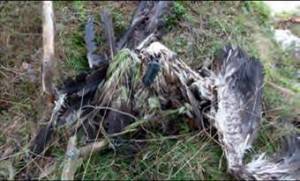 “On 11 December 2010, a member of the public found and photographed the carcass of a white-tailed eagle, lying under a tree on a remote moorland near Lochindorb in Nairnshire. The police were notified, but when they attended the scene a few days later to recover the carcass for a post-mortem, it had disappeared. There were no tracks of scavengers in the surrounding snow, and there was not a feather remaining from the well-decomposed carcass. In fact, the only new tracks that were in the area were those of a quad bike, leading to near the finding location, and the footprints of the person who had walked over to the body, removed it, returned to the quad bike, and left the area“.
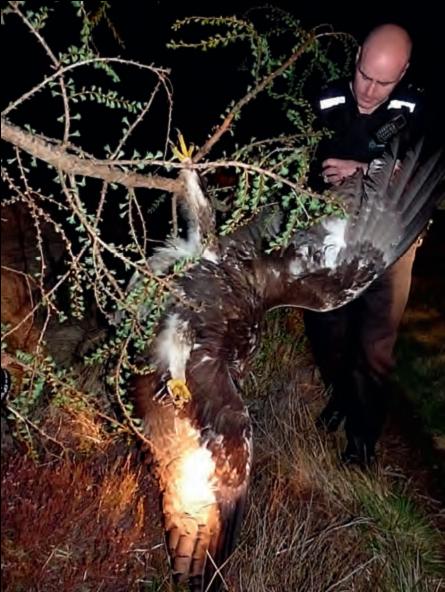 The RSPB has just published its annual report on raptor persecution in Scotland. The report, ‘The Illegal Killing of Birds of Prey in Scotland 2010‘ is the only known published record of all known persecution incidents including poisoning, shooting and trapping, in contrast to the PAW Scotland annual report which only details poisoning incidents. As well as the confirmed incidents of persecution, the report also provides information about ‘probable’ incidents (those where the available evidence points to illegality as by far the most likely explanation but where the proof of an offence is not categorical) and ‘possible’ incidents (where an illegal act is a possible explanation but where another explanation would also fit the known facts).
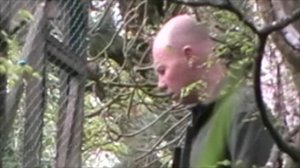 An appeal is pending for convicted gamekeeper Glenn Brown, who was found guilty in June 2011 of offences relating to the illegal use of a cage trap to catch raptors on the National Trust’s Howden Moor in Derbyshire (see
  Raptor Persecution UK