Court case updates

The ridiculously lengthy legal proceedings against Keith Liddell continue. First reported on this blog in July 2011 (here) and subsequently in February 2012 (here), May 2012 (here) and June 2012 (here), Liddell’s case will have another intermediary diet at Inverness Sheriff Court tomorrow (9th October). Liddell is accused of various offences including the alleged trading of raptor eggs.

Another lengthy case has also been continued at Inverness Sheriff Court. The so-called ‘hare-snare’ case, which began back in 2009 (!!) was heard at Inverness last Thursday and Friday. It is now set to continue on 16th November. Two gamekeepers from the Lochindorb Estate originally faced trial but now the charges are only being heard against one of them, David Taylor. Previous posts on this case here, here, here, here, here, here.

Dear Diary…

Here’s a rare opportunity to look into the world of  the ‘modern’ gamekeeper. These are extracts taken from a Scottish gamekeeper’s diary. We were shown these diaries by someone from within the keepering world who wishes to remain anonymous, for obvious reasons. Worryingly, the diary-writer is still currently employed as a full-time gamekeeper. We’ve split the entries into different years – the following is from 2008. See how many wildlife crime offences you can spot:

Thurs 3rd January: set baits in Glen S & right hill

Sat 5th January: John P came for rabbits & Alpha

Weds 16th January: Gassed fox at Black Brae Lower

Fri 25th January: Eggs out on Top Moor + rabbit for crows by Big Wood

Fri 1st February: Lifted eggs Top M & set out at edge of Middle.

Tues 5th February: Shot dog Glen S.

Mon 11th February: Lifted eggs Top M. Shot kestrel.

Tues 19th February: Baits out at Harry’s, rabbits & hares

Thurs 21st February: Pick up gins from Glen side. Got female peregrine.

Fri 29th February: Done traps at S Corner and more eggs out. Saw pair peregrines at Millers.

Sat 1st March: baits out with Jim at Middle. Missed a cock harrier. Staked pigeon at Millers.

Sun 2nd March: Got peregrines at Millers. Eggs out on Broadfield.

Tues 4th March: Got 2 buzzards, 2 rooks + 9 crows. Rabbit out for others.

Fri 7th March: Got a vixen at T Moor. Put out birds by low fence.

Sun 9th March: Eggs at Glen side again.

Weds 12th March: Eggs up, tracks seen. Done baits at Gordon’s. Sheep shot for midden 3.

Thurs 13th March: Got buzzard at Becks. More rabbits out. Alpha.

Sat 15th March: Picked ups crows & eggs Langsmere. Saw 2 harriers.

Tues 18th March: Set eggs JB & baits southside.

Weds 19th March: Got a cat on Red moor.

Thurs 20th March: Got SE owl & set 59 eggs Lower bank.

Sat 22nd March: 1 harrier at Langsmere. Merlins at Merv’s.

Mon 24th March: Snares at Glen side. 26 foxes so far.

Tues 25th March: Missed harrier at Langsmere. Baited Broadfield again.

Thurs 27th March: Got a badger with John S. He heard gos behind Big Wood.

Fri 28th March: Lifted eggs Lower bank. More set at Harry’s.

Mon 31st March: Crow cages out Big Wood.

Wed 2nd April: Harrier trap empty.

Thurs 3rd April: Pair eagles seen southside.

Fri 4th April: Put eggs T Moor. Shot rabbits for baits.

Sun 6th April: Crow cages done. Eggs checked.

Weds 9th April: Baits out Glen side. Tom collected pigeons.

Fri 11th April: Got buzzards at JB.

Tues 15th April: Gos in crow cage. Gave it to PL.

Fri 18th April: Baited traps & re-did snares.

Tues 22nd April: Eggs & hares out in the Sloughs.

Sun 27th April: Eggs lifted Sloughs.

Fri 2nd May: Put out more baits.

Sat 3rd May: Pigeons staked upper side. Got tiercel.

Weds 7th May: Set eggs.

Thurs 15th May: Put baits out at Bothy.

Sat 17th May: 3 buzzards in crow cage. Re-set.

Thurs 22nd May: Two Peres at Glen side. Got one.

Weds 28th May: Eggs lifted more baits out. Rabbit gone at Bothy.

Mon 2nd June: Set pheasant eggs at Big Wood. Did crow traps.

Sun 8th June: Litter of foxes gassed behind GateBridge.

Fri 13th June: Partridges into pen.

Mon 23rd June: Put eggs out Broadfield.

Weds 2nd July: Gassed another litter with Paul at Stebb’s.

Fri 1st August: Got a short eared owl. Lifted eggs Broadfield.

Tues 5th August: Moved crow cages to RT.

Sun 10th August: Spar caught. Trap re-set.

Fri 12th Sept: 42 brace at Sam’s but harrier seen.

Fri 26th Sept: New snares out.

Thurs 2nd Oct: Two eagles seen Glen S. 1 buzzard in crow trap at T Moor.

Tues 7th Oct: Hare baits out Langsmere.

Thurs 16th Oct: Shot sheep for midden 3.

Mon 20th Oct: Pigeons 5pm

Weds 22nd Oct: Shot a kestrel at Sam’s.

Fri 31st Oct: Merlin pair done North Bothy.

Sat 8th Nov: 6 pigeons put out Big Wood.

Tues 25th Nov: Baits out with Paul.

Fri 19th Dec: Put grouse on T Moor.

Glen Orchy: a hollow victory

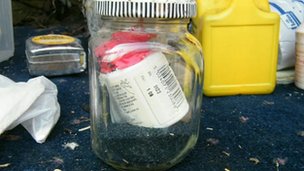
Last Friday, Tom McKellar, an employee of Auch Estate, an Argyll sporting estate in Bridge of Orchy, was convicted of possessing the illegal poison Carbofuran and was fined £1,200 (see here). This conviction should be a cause for celebration, and in some respects it is, but there is also an overwhelming sense of disappointment and frustration. We had all thought this was a pretty clear-cut case, with lots of investigative resources thrown at it, a strong evidential trail and a known suspect. We were further encouraged by a statement given by the then Scottish Environment Minister, Roseanna Cunningham, who said:

I am truly appalled that yet another golden eagle has been illegally killed in Scotland – the second this summer. Illegal poisoning is simply inexcusable and while the perpetrators are certainly beneath contempt they are in no way above the law“.

Given the nature of the alleged offences (wildlife & firearms), we were certain that a custodial sentence was inevitable. How stupid were we?

It all started to unravel in December 2010, 18 months after the poisoned eagle was found dead in Glen Orchy. We learned that Tom McKellar had been convicted of possessing two illegal handguns, but instead of receiving the mandatory five-year prison sentence, he was given just 300 hours community service and a commendation from the judge who reportedly told him: “There is no doubt you are an outstanding individual” (see here). There was little mention in the media about the poisoned golden eagle or the stash of illegal poison that had been found at McKellar’s house during the original police search. We were suspicious that the wildlife crimes were being ignored and that COPFS had decided to just take on the firearms offences because, in the eyes of the law, these are greater crimes than the poisoning offences and would normally result in a custodial sentence.

Based on these suspicions, we blogged about the case in January 2011, and suggested that no charges were being brought against anyone for poisoning that eagle. We also encouraged readers to contact the Scottish Government to complain. Many did, and all hell let loose. The Scottish Government responded by saying that the firearms offences were being dealt with separately, at a court with a higher authority than a Sheriff Court, and that the wildlife offences were still ‘being dealt with’. A well-known prosecutor threatened us, indirectly, with legal action. For what? Expressing an opinion? As it turns out, we were right all along, nobody has been prosecuted for poisoning that golden eagle, although we’ve had to wait for over three years to have this confirmed.

It then all went quiet for a while, at least publicly. It’s not known whether COPFS bowed to pressure to take forward the wildlife crime prosecution or whether they had actually been pursuing the charge all along, but that it took over three years for the case to conclude is probably quite telling.  Not that it really matters now anyway; what matters is the outcome.

So, a conviction was eventually secured, although this was just for ‘possession’ of a banned substance; in our opinion this is the least significant charge of any that could have been brought. McKellar admitted during interviews that he had laid out poisoned baits ‘in the past’, and yet he wasn’t charged for that. Were the words ‘in the past’ significant in the decision not to press charges for that offence? What does ‘in the past’ mean, anyway? Two years ago? Two weeks ago? Two days ago? Two hours ago? In addition to the poisoned golden eagle, a Carbofuran-poisoned fox was found and also a dead sheep laced with Carbofuran. Someone was clearly still putting out poisoned baits, but COPFS accepted McKellar’s claim that he wasn’t responsible. It’s unfortunate that these types of offences are only dealt with as summary cases in a Sheriff Court. It would have been interesting to hear what a jury might have thought had the charges been heard in a higher court. Again, we’ll never know and we have to accept that McKellar is guilty of nothing more than possessing the banned poison Carbofuran (oh, and possessing two illegal handguns).

It’s hard not to think that McKellar has come out of all this relatively lightly. It’s also hard to believe that his punishments will act as any sort of deterrent to other would-be criminals. He avoided a mandatory five-year prison term for the firearms offences, and he was fined just a fraction of the amount that he could have been fined for possessing the illegal poison Carbofuran. It appears that he has also kept his job. Auch Estate is currently up for sale (for a mere £8.4 million) and a look at the sales particulars (Auch Estate sales brochure 2012), dated August 2012, indicates that the new owner has to take on the current Estate employees under the TUPE regulations, including Farm Manager Tom McKellar. These sales particulars also show that almost £700,000 was paid in grants and subsidies during 2011; it would be interesting to know whether there will be any forfeiture of these payments following McKellar’s conviction, although based on previous experience, this information is exceptionally difficult to access, even though it’s public money! It would also be interesting to hear whether McKellar’s employer is being investigated, after McKellar reportedly claimed it was his employer who had provided him with the Carbofuran (see here). Wouldn’t it also be interesting to find out whether Auch Estate is a member of Scottish Land & Estates? And whether McKellar, as an employee of a sporting estate, is a member of the Scottish Gamekeepers’ Association? Needless to say, neither of these organisations has made any public statements about McKellar’s conviction last Friday.

Other question marks include a strange bit of (non)-reporting by SASA. The poisoned golden eagle found at Glen Orchy was listed in SASA’s 2009 annual report. However, the dead fox found nearby that was reported to have been poisoned by Carbofuran did not appear in the SASA report. Neither did the dead sheep also found nearby that was reportedly laced with Carbofuran and used as poisoned bait. Why weren’t these two animals included in SASA’s list of confirmed poison cases for 2009? Perhaps SASA didn’t do the toxicology tests. If they didn’t, then who did? If SASA did do the tests, but failed to include the animals in their report, what confidence does this give us when SASA release their annual poisoning statistics? Are other cases missing? We only knew about the fox and the sheep because the RSPB had listed them in their annual report.

A further question mark hangs over a related issue. The media has reported that the poisoned golden eagle found dead in Glen Orchy had been killed with the banned pesticide Carbofuran. However, if you look at the 2009 SASA report, the following chemicals are listed as being detected in this bird’s body: Carbofuran, Methiocarb, Sodium Cyanide and Strychnine. Now, we have it on good authority, although this has not been formally verified, that a second individual was searched during the police raid back in June 2009. This individual, XXXXX XXXXX is believed to be a gamekeeper in Perthshire but is not an employee of Auch Estate; he was just there on the day the police arrived to conduct their search. We understand that the police found Mr XXXXX to be in possession of a bottle of Strychnine and a container of decanted Cyanide. Now look again at the chemicals detected in the body of the dead golden eagle. As far as we are aware, no charges have been brought against Mr XXXXX, not even for possession. If this turns out to be an accurate report, then something has gone seriously wrong with this investigation. A lack of resources can’t be blamed on this one, given the array of organisations involved with the investigation, including multiple police forces with specialist wildlife crime officers as well as the National Wildlife Crime Unit. So what happened? Did Mr XXXXX slip through the net and if so, how? Do you think we’ll hear anything about this or do you think it’ll be quietly pushed under the carpet?

In summary then, yes, a conviction was secured (McKellar) and we should be pleased about that. McKellar’s illegal stash of Carbofuran and his illegal cache of handguns have been taken out of circulation and so we should also be pleased about that, too. But this is not what could be called a successful outcome; far from it. It’s deeply unsatisfactory and shares striking similarities with other recent, high-profile cases which also concluded unsatisfactorily, such as Moy Estate and Skibo Estate. In all three cases, and in countless other lower-profile cases, sporting estate employees have only been charged with the lesser offence of possession. Charges have not been brought against anyone for the illegally-killed raptors found in each location, nor for laying the illegal poisoned baits or for putting out the illegal traps. On a superficial level then, the convictions for possession look good and the authorities can claim they are successfully addressing the issue of wildlife crime. Scratch below the publicity gloss though and you find that very little progress has been made; charges, if they’re brought at all, are not reflecting the full extent of the crimes uncovered, and on conviction the sentences are not reflecting the seriousness of these crimes.

Glen Orchy case concludes: call this justice?

So, three years and three months later, the infamous Glen Orchy case has concluded. Tom McKellar, previously described as a gamekeeper but curiously now described as a farmer, has been fined £1,200 for possessing the banned pesticide, Carbofuran.

The Crown Office press release (here) doesn’t mention anything of the poisoned golden eagle that was found in Glen Orchy and prompted the search of McKellar’s house, which led to the discovery of the Carbofuran. Although it does mention how he was previously given a 300-hour community service order for the possession of illegal handguns (instead of the mandatory five-year prison sentence), also found during the search of his house.

Of course, McKellar wasn’t charged with laying poisoned baits (even though he reportedly admitted to doing so during an interview), and nor was he charged with poisoning that golden eagle, because even though he had this rare, banned poison in his house, and lived just down the road from where the dead eagle had been found, and he’d previously admitted to laying out poisoned baits, there apparently wasn’t enough evidence to link him to the poisoned eagle.

But this story doesn’t end there. There are other things that went on (or more to the point, didn’t go on) in this investigation and we’ll be discussing those in due course, including the failure to charge a second person….

Meanwhile, we’ll add this poisoned golden eagle to the growing list of illegally-killed eagles for which nobody has ever been (nor will be) prosecuted. Justice?

RSPB press statement here

UPDATE 11 Sept 2012: Glen Orchy, a hollow victory (here)

Previous blogs on this case here, here, here, here, here,here here, here

Crown drops case against Edradynate estate gamekeeper

The case against Edradynate Estate Head Keeper David Campbell came to a close last Friday, after the Crown deserted the case at Perth Sheriff Court.

Campbell had been facing charges related to alleged firearms and explosives offences (see here, here and here), which he had denied.

We don’t know why the Crown deserted this case. It’s not the first time that charges against an Edradynate gamekeeper have been dropped (see the RSPB’s newsletter, Legal Eagle #43, page 3 here).

Linklater: “I stand by everything I wrote”

A couple of weeks ago we blogged about an article penned by the well-known advocate of ‘raptor control’, Magnus Linklater (see here).

He’s back again, this time as a guest blogger on Mark Avery’s ‘Standing up for Nature’ blog (see here). For a masterclass in arrogance and ignorance, you’d struggle to find a better example than his latest offering. You might think that “one of the country’s most respected journalists” (according to his editor) would have gone away to consider the factual inaccuracies that were pointed out by many knowledgeable readers of his original article, and then come back to discuss each point in turn. He didn’t manage to do that. Instead, he dug in his heels and stated, “I stand by everything I wrote“.

As is becoming more and more obvious, Linklater’s views seem to be representative of the majority of those involved in grouse-shooting, especially landowners and gamekeepers, judging by current and previous comments made by these groups. It’s easy to try and deflect attention from the real issue (continuing illegal raptor persecution) by attacking the UK’s largest conservation charity (RSPB), who just happen to be involved in exposing these illegal practices. What isn’t as easy is to convince an increasingly well-informed public that [driven] grouse-shooting shouldn’t now be banned.

For our anagram-loving readers, here’s another one: Kill Tuns Manager

Lochindorb hare snare trial to continue in October

The long-running Lochindorb Estate hare-snaring trial is set to drag on until October (see here, here and here for background to this case).

An important point of law was established during deliberations at Inverness Sheriff Court yesterday – whether a snare could be considered to be a trap. Although this question might sound ridiculous to us (of course a snare is a type of trap – they’re used for the sole purpose of trapping animals, aren’t they?), it was important to establish the legal definition of a snare in this particular case because if a snare wasn’t considered to be a trap, then there would be no case for gamekeeper David Taylor to answer. Anyway, the Sheriff apparently decided that a snare is a trap, and that there was sufficient evidence for the case to be continued in October (the defence had argued that there was insufficient evidence against Taylor).

Northern Times article reporting on yesterday’s court hearing here

Predictable shite as grouse season approaches

Yes, it’s that time of year again. The opening of the grouse-shooting season is upon us (although this year it’ll start on August 13th as the traditional opening day of the 12th falls on a Sunday) and the usual suspects are out in force to tell us all how great grouse moors are and how we should all be grateful for the conservation and economic benefits they provide. Not forgetting the predictable swipe at the RSPB along the way.

Shooting Times has an article suggesting that it’s time to sever ties with the RSPB due to their ‘bullying’ ways (see here). The best line has to be this: “For too long we have acted as gentlemen, only for our big-heartedness to be thrown back in our faces“. That’s priceless! Have a look here at an earlier blog we wrote about how the RSPB has been treated by these ‘gentlemen’!

An STV news article (here) has SGA Chairman Alex Hogg telling us how grouse shooting can save the world…or at least the rural economy, calling it a “modern industry” (ahem) and laughably explaining how “People admire Scotland’s diversity of landscape, its well-managed moorlands teeming with wildlife being a huge part of that attraction“!!!

An alternative view of grouse moor management can be found in The Guardian blog (here), where a national campaign against moorland bog-burning is due to be launched with a protest walk over the now infamous Walshaw Grouse Moor this Sunday.

Latest poisoning figures are just a smokescreen

So, SGA Chairman Alex Hogg is “hugely encouraged” by the forthcoming 2012 poisoning statistics, due to be released by the government agency SASA in the next few days (see here for STV news story and here for SGA press release). The figures are expected to show just two confirmed raptor poisonings in the first half of 2012, a considerable drop from the figures of previous years.

Unfortunately, these figues are just a small part of the story, as many regular readers will already be aware. We’ve blogged about this before, back in March when the poisoning figures for 2011 were published (see here for our previous post). As we said then, these figures look promising on a superficial level but do they really reflect the true extent of illegal persecution?

The lower poisoning figures may well be a true indicator that fewer people are still poisoning raptors. That’s what the SGA and friends clearly think and would like the rest of us to think. However, another equally plausible explanation is that the poisoners are just getting better at hiding the evidence. We’ve always known that the published poisoning figures just show a tiny fraction of actual poisoning incidents; these poisonings usually take place in vastly remote areas where few people are around to find the evidence. The poisoned birds that have been discovered have usually been discovered by chance. More recently, they’ve been discovered because more raptors are now fitted with satellite tags so it’s easier to follow their movements and to find the locations where they die.

There is another plausible explanation, too. As we’ve also said before, poisoning is not the only method of illegally killing raptors. Perhaps the lower poisoning figures reflect a substantial shift in the methods used to persecute raptors. Are more raptors being shot at the nest? Are more raptors being shot at roost sites? Are more nests and eggs being destroyed? Are more raptors being caught in traps and being bludgeoned to death? The persecutors know very well that the government doesn’t record these types of incidents; only reported poisoning incidents are published. What better way to make it look like you’ve cleaned up your act than by reducing the poisoning but increasing the other techniques that you know will never be officially reported? (Except by the RSPB who always publish these other persecution incidents in their annual reports, but which are then dismissed as being ‘unofficial’ and ‘exaggerated’ by the game-shooting lobby).

Is it plausible that other persecution methods have now taken precedence over poisoning? Let’s look at the hen harrier situation. The UK’s hen harriers continue to spiral towards oblivion and the main cause has been identified as illegal persecution. Everyone knows it and even the government has acknowledged it. But how many hen harriers do you see listed in the annual poisoning figures? Very few indeed. Mainly because poison is rarely used to kill harriers – they’re not typically a scavenging species that depends on carrion so they’re harder to poison. But just because they don’t feature on the annual list of poisoned raptors doesn’t mean they’re not persecuted! Of course they are; the national hen harrier survey results say it all.

If anyone is still in any doubt about whether the latest poisoning figures are an accurate reflection of the extent of illegal raptor persecution, then consider this. Will the figures for Jan-June 2012 include this ‘missing’ satellite-tagged golden eagle (here), or this ‘missing’ satellite-tagged golden eagle (here), or this dead golden eagle found with substantial injuries (here), or this dead golden eagle found in what was described as ‘suspicious circumstances’ here? Or just the one confirmed poisoned golden eagle found dead in Lochaber (here)?

Pheasant poults killed by ruthless cyborgs

Jedi Knights, the protectors of the countryside, are warning of ruthless cyborgs disguised as red kites coming from the Death Star to kill pheasant poults. The Knights have called upon their Chosen One, Albert Hogburn, to help them neutralise the Dark Force.

Albert said: “Teach me this at Yoda College they did. Uphold peace and justice will we. Evil red kites prevail shall not and lightsabre force feel will they. Stopped they must be; on this all depends. Carrion-eaters not they are and rural economy collapse it will if defeated they are not. Only a fully-trained Jedi Knight, with the Force as his ally, will conquer and save the pheasants”.

Donald Spewing-Moore of the Royal Bird Protection Society said: “I’m sorry, I can’t talk right now, a kestrel just stole my car. These damn raptors are getting way out of hand. I wonder if Albert and his Jedi Knights will deploy their Imperial Star Destroyer to patrol my house?”

A totally unconnected story in the Dumfries & Galloway Standard here.