Significant haul of poisoned baits found on Leadhills Estate

leadhills estateA significant haul of pre-prepared poisoned meat baits has been found on Leadhills Estate, South Lanarkshire. And when we say significant, that’s what we mean. We’re not talking about one or two baits here; we’re talking a considerable number that, if used, would have been part of a comprehensive poisoning campaign.

The poisoned baits were discovered on 8th March 2013. Yes, that’s right, over three months ago. We’ve waited patiently for Police Scotland or NWCU or PAW Scotland to issue a press release about this, but, true to form, they’ve remained silent. During this period they even launched the 2012 poisoning maps, making much of what they called a ‘sharp fall’ in the number of poisoning incidents, even though they were well aware of what had just been uncovered at Leadhills Estate.

Because this is an on-going police investigation there is only limited detail that we’re prepared to publish at this stage. However, in due course, the full story will emerge. It’s worth keeping an eye on a forthcoming website (http://projectraptor.org.uk/) where photographs and film footage will probably appear.

This incident raises many of the usual concerns. Firstly, why has it been kept covered up? Why didn’t Police Scotland (“Keeping People Safe,” according to their website) issue a public safety warning about the discovery of these highly toxic poisoned meat baits that have the potential to kill anyone coming into contact with them? Many people, not just local residents but tourists too, visit the moors around Leadhills for recreational pursuits. Why were they not informed about the risks? That’s not ‘Keeping People Safe’ by any stretch of imagination.

Secondly, why are Police Scotland still making the same fundamental errors that they were making ten years ago in investigations of this type? They sent two marked police vehicles to collect the evidence – thus alerting the would-be poisoners that their stash had been discovered and allowing them an opportunity to hide any other incriminating evidence. This is basic stuff! Did they conduct a search of the surrounding moorland to see if any baits had already been placed? You probably can guess the answer to that.

Why didn’t they attend the scene covertly and install hidden cameras at the site where the poisoned baits were discovered? We all know that without evidence linking a specific person to the baits, a conviction would be virtually impossible to secure. So why not use cameras to film the person(s) coming to the poison storage site and either picking up the baits or replenishing the stash with new baits?

Nobody will be surprised to learn that Leadhills Estate is once again at the centre of another wildlife crime investigation; the latest in a long list dating back at least a decade. The following incidents are known, confirmed persecution incidents (data from RSPB Scotland & Scottish Government) from 2003-2011 (2012 & 2013 data not yet published). This list does not include ‘probable’ or ‘possible’ incidents such as the discovery of buried decomposing carcasses too decayed for analysis:

2003 April: hen harrier shot

2003 April: hen harrier eggs destroyed

2004 May: buzzard shot

2004 May: short-eared owl shot

2004 June: buzzard poisoned (Carbofuran)

2004 June: 4 x poisoned rabbit baits (Carbofuran)

2004 June: crow poisoned (Carbofuran)

2004 July: poisoned rabbit bait (Carbofuran)

2004 July: poisoned rabbit bait (Carbofuran)

2005 February: poisoned rabbit bait (Carbofuran)

2005 April: poisoned buzzard (Carbofuran)

2005 June: poisoned rabbit bait (Carbofuran)

2005 June: poisoned rabbit bait (Carbofuran)

2006 February: poisoned buzzard (Carbofuran)

2006 March: poisoned buzzard (Carbofuran)

2006 March: poisoned pigeon bait (Carbofuran)

2006 April: dead buzzard (persecution method unknown)

2006 May: poisoned rabbit bait (Carbofuran)

2006 May: poisoned rabbit bait (Carbofuran)

2006 May: poisoned egg baits (Carbofuran)

2006 June: poisoned buzzard (Carbofuran)

2006 June: poisoned raven (Carbofuran)

2006 June: 6 x poisoned rabbit baits (Carbofuran)

2006 June: poisoned egg bait (Carbofuran)

2006 September: 5 x poisoned buzzards (Carbofuran)

2006 September: poisoned rabbit bait (Carbofuran)

2006 September: poisoned rabbit bait (Carbofuran)

2007 March: poisoned buzzard (Carbofuran)

2007 April: poisoned red kite (Carbofuran)

2007 May: poisoned buzzard (Carbofuran)

2008 October: poisoned buzzard (Carbofuran) [listed as ‘Nr Leadhills’]

2008 October: poisoned rabbit bait (Carbofuran) [listed as ‘Nr Leadhills’]

2008 November: 3 x poisoned ravens (Carbofuran) [listed as ‘Nr Leadhills’]

2009 March: poisoned rabbit bait (Carbofuran)

2009 March: poisoned raven (Carbofuran)

2009 April: poisoned rabbit bait (Carbofuran)

2009 April: poisoned magpie (Carbofuran)

2009 April: poisoned raven (Carbofuran)

2010 October: short-eared owl shot

2011 March: illegally-set clam trap

2011 December: buzzard shot

2012 October: golden eagle shot (just over boundary with Buccleuch Estate)

The evidence is clear. Poisoning is taking place with virtually total impunity (some would say immunity) on this estate. As far as we can tell, there has only been one successful prosecution for poisoning – a gamekeeper convicted in 2010 for laying out a poisoned rabbit bait (see here).

So why is it that the poisoners, whoever they may be, can keep getting away with it?

Is Leadhills Estate (part of the Hopetoun Estates) a member of the landowners’ organisation, Scottish Land & Estates (SLE)? The Chairman of Hopetoun Estates, the Earl of Hopetoun, is a Director of SLE. If Leadhills Estate is a member, then all of SLE’s talk about condemning illegal raptor persecution and stamping it out is utter hypocrisy. The question of whether Leadhills Estate is an SLE member is one that needs to be raised by the members of the Partnership for Action Against Wildlife Crime (Scotland). SLE plays a prominent role in PAW Scotland and earns considerable kudos for that role (kudos that the organisation is not afraid to use for PR purposes). It is now high time that SLE is asked to provide some transparency about its relationship with Leadhills Estate.

We’d also like to ask Environment Minister Paul Wheelhouse what action he intends to take in light of the latest discovery of poisoned baits at Leadhills Estate? He may well try and dodge the question by saying ‘It’s an on-going police investigation so I can’t comment’. But we’re not asking him to comment on the actual investigation – what we’re asking is whether he’ll keep his earlier promises about introducing new measures to combat raptor persecution if evidence comes to light to demonstrate it is still a problem. Well Paul, here’s your filthy evidence. Now what are you going to do about it? Emails to: ministerforenvironment@scotland.gsi.gov.uk

UPDATE 18.45hrs: BBC journalist David Miller has just posted an article on this incident on the BBC News website (great to see another high profile journalist willing to discuss illegal raptor persecution). You can read his article here.

The article contains the following hilarious quotes:

From Police Scotland: “Police officers, including a wildlife crime liaison officer, were dispatched to the area the same day and following an extensive search, items were found and seized. A number of people were detained by police in connection with this inquiry, which is currently ongoing“.

Hmm, an ‘extensive search’, eh? That’s not what we’d heard!

From Scottish Land and Estates: “It would be inappropriate to comment while the facts of the matter have still to be established. As an organisation, we are actively involved in the Partnership for Action Against Wildlife Crime and our membership undertakes an enormous amount of positive work in this area“.

Er, the facts of the matter have been established. A significant haul of pre-prepared meat baits were found stashed on this estate and government scientists have confirmed the presence of Carbofuran.

Wouldn’t it be ‘inappropriate’ for SLE to remain in the government-led PAW Scotland group, and in the government-led Scottish Raptor Persecution Priority Delivery Group, if it was found that Leadhills Estate was a member of their organisation? Come on PAW Scotland members and SRPPDG members, ask them the bloody question!

From Scottish Gamekeepers’ Association: “Because this appears to be subject of a live investigation, it would not be appropriate to comment other than to reiterate that the Scottish Gamekeepers’ Association does not condone illegal poisoning“.

Perhaps they’ll consider conducting their own investigation again, just as they did with the Deeside eagle case, and let us know what really happened….my money’s on the real culprits being either badgers, buzzards, sparrowhawks, pine martens or goshawks.

 

Buzzard licence absurdity attracting mainstream media attention

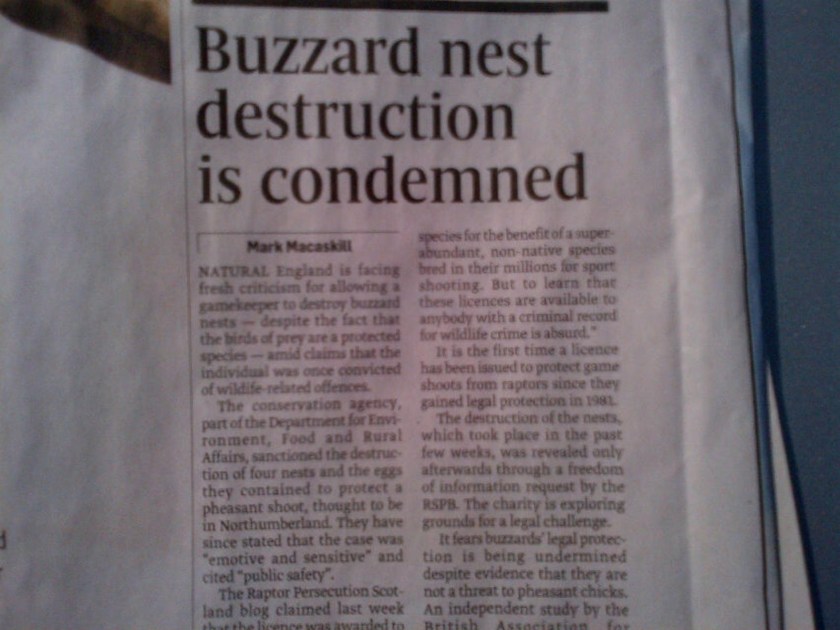
A few of our regular blog followers have previously commented about the apparent lack of interest in illegal raptor persecution by many mainstream journalists. Well here’s one (of several) bucking the trend – Mark Macaskill from the Sunday Times (Scotland), who has, over the years, written quite a few articles on the subject, including this one published today on the absurdity of Natural England seeing nothing wrong in the government’s policy of issuing licences for controlling protected species to people who might previously have been convicted of wildlife crime.

Sunday Times buzzard licence

Surely the buzzard licence applicant doesn’t have prior convictions for poison offences?

poisonLast week we mentioned that further information had emerged about the licences to control buzzards recently issued by Natural England. We said we were seeking legal advice about what information we could and couldn’t publish. That legal consultation has resulted in a decision to publish the following information.

We discovered the name of the buzzard licence applicant last week. Interestingly, someone with the same name, from the same region, and working in the same industry (gamekeeping) was previously convicted for offences relating to banned poisons. It must be just another one of those freak coincidences that seem to pop up with unequal probablity within the world of gamekeeping.

According to legal advice we are at liberty to publish the name of the licence applicant under certain conditions. However, we have chosen not to identify him or to publish any detail that might lead to his subsequent identification. His identity is not important here; there is a wider issue of concern and revealing his identity would not add anything of importance to the debate. Besides, in the context of his licence application he hasn’t done anything illegal; it is not an offence to apply for a licence to control protected species.

So, his identity doesn’t interest us. What does interest us a great deal is a government policy that might enable someone with recent and relevant criminal convictions to be considered as a suitable recipient for a licence to control a protected species.

Natural England’s species licensing role is governed and authorised by DEFRA policy. Within DEFRA’s species licensing policy statement are a number of criteria that should be met by the licensing agency (in this case, Natural England) when assessing a licence application. One of them is that ‘the suitability of the applicant to carry out licensed activities’ must be assessed. That this criterion even exists indicates that DEFRA recognises that unsuitable candidates may apply for a licence and they provide an option (to the licensing agency) for refusing a licence on that basis.

So, just how is ‘the suitability of an applicant’ assessed? It seems to be a subjective test as we couldn’t find any guidelines on the subject. Would someone with recent and relevant convictions be considered a ‘suitable applicant’? What would be the justification for that?

Natural England has already confirmed that relevant past convictions are assessed during the licensing process. Last week, many of you (thank you!) wrote to Natural England to ask for clarification about whether the buzzard licence applicant had an un-spent work-related conviction at the time of his application. On Monday (June 3rd), Natural England responded by issuing a refusal notice, saying they weren’t prepared to divulge that information. In that refusal notice is the following statement:

You may find it helpful to know that it is part of Natural England’s standard procedures to ask all licence applicants for information on relevant past convictions. This information is taken into consideration in the assessment of the application. For example, this may lead to a more in-depth assessment of the application or additional monitoring of licensed actions. However the fact that a person has a previous wildlife related conviction (whether spent or not) does not automatically bar them for obtaining a licence and each licence application is judged on its merits”.

So, did Natural England consider relevant past convictions when assessing this licence application? They certainly mention previous convictions in their Technical Assessment of Application report (see the FoI documents), although the detail of those convictions has been redacted. However, there is no mention anywhere else in this assessment report about an assessment of those convictions or their relevance to this particular licence application, so either Natural England didn’t formally assess them, or they did and just redacted their assessment. There’s so much blacked out text throughout the whole document that it’s impossible to tell.

An interesting aspect in all this is the considerable weight that Natural England placed on the evidence (of supposed raptor predation of poults) provided by the applicant. Indeed, Natural England wrote the following in their technical assessment report:

Conclusions & Justification [of the application]: The quantity and quality of information and evidence provided for this case by the applicant appears to be thorough, systematic and accurate for this type of case”.

Put yourself in the shoes of a Natural England employee charged with assessing licensing applications to control protected species. Would you consider the evidence of a recently convicted criminal as being trustworthy and reliable?

One final point, and equally as interesting. The National Gamekeepers Organisation has repeatedly and publicly stated that illegal gamekeeping activity will not be tolerated within their organisation. We know from the FoI documents that the buzzard licence applicant is a member of the NGO. Last week we (and many of you, thank you) asked them to answer the following question:

Bearing in mind the NGO’s published Disciplinary Procedure, did this gamekeeper [i.e. the buzzard licence applicant] have an un-spent work-related conviction at the time of his application and has he ever been suspended or expelled as a member of the National Gamekeepers Organisation?”

They still haven’t answered.

Buzzard licensing: turning up the heat

buzzard 3Last Thursday we blogged about the buzzard licensing scandal and how new information had come to light (see here). We are still in the middle of taking legal advice on what information we can and can’t release.

We also posed two questions; one to Natural England and one to the National Gamekeepers Organisation:

Question to the National Gamekeepers Organisation: “Bearing in mind the NGO’s published Disciplinary Procedure (see here), did this gamekeeper have an un-spent work-related conviction at the time of his application and has he ever been suspended or expelled as a member of the National Gamekeepers Organisation?”

So far, the NGO has refused to answer.

Question to Natural England: “Did this gamekeeper have an un-spent work-related conviction at the time of his application?”

Today, Natural England has issued a refusal notice, i.e. they are refusing to confirm or deny that they hold any details about convictions on the licence application.

Here is a copy of that refusal notice: 2018_response_RD_tcm6-36002

Natural England claim that the information we have asked for falls into the ‘personal information’ category as defined under the Data Protection Act 2000. As such, they consider it would be ‘unfair’ to disclose the information requested.

We disagree with them. If this individual did have a wildlife crime conviction at the time of his application, then details of that conviction would be a matter of public record, therefore it wouldn’t qualify as protected personal information.

The information we asked for was not, ‘What was the applicant’s conviction?’, it was ‘Did he have a conviction?‘ Natural England could have answered our question with a simple ‘Yes’ or ‘No’. By doing so, the disclosure of the information would not breach the individual’s privacy as the information could not be used to identify him. The question is not so much about the gamekeeper per se, but it is central to questions about Natural England’s policy on licence applications to destroy protected species and/or their nests and eggs. We believe that scrutiny of their policy is very much in the public interest.

As Natural England has issued a refusal notice, we intend to challenge it by asking for a review. We would encourage blog readers to also challenge it. If you’re not sure how to phrase it, you could always just cut and paste the following:

To: foi@naturalengland.org.uk

Dear Natural England,

Thank you for your refusal notice to prevent disclosure of whether the buzzard licence applicant had an un-spent work-related conviction at the time of his application.

I would like to request a review of your decision.

I don’t believe that the disclosure of the information I have requested meets the criteria as defined in the Data Protection Act, because a simple ‘Yes’ or ‘No’ answer would suffice. A ‘Yes’ or ‘No’ answer would not compromise the privacy (hidden identity) of the buzzard licence applicant, but it would inform a wider debate on the policy used by Natural England to issue licences to destroy protected species and/or their nests and eggs. This is clearly in the pubic interest.

I look forward to hearing from you.

And if you’re in an email-writing mood, let’s keep up the pressure on the National Gamekeepers Organisation to answer this very simple question:

To: info@nationalgamekeepers.org.uk

Dear Lindsay Waddell,

Bearing in mind the NGO’s published Disciplinary Procedure, did this gamekeeper have an un-spent work-related conviction at the time of his application and has he ever been suspended or expelled as a member of the National Gamekeepers Organisation?

Two important questions to ask about the buzzard licence applicant

buzzard 3It would appear there’s more to Buzzardgate #2 than first meets the eye.

Apart from the scandalous decision by Natural England (acting on behalf of DEFRA) to issue a licence to a gamekeeper to destroy the nests and eggs of a native species (buzzard) to protect a non-native species bred for sport shooting (pheasant) (see here for previous blog entry on this), further information has come to light.

At this stage we are unwilling to publish the information or reveal how the information can be found. We are seeking legal advice and will come back to the subject if we’re able once the legalities have been clarified.

In the meantime, we would like to ask two important questions, one of Natural England (who worked with this gamekeeper over a period of years and subsequently issued his licence), and one of the National Gamekeepers Organisation (who submitted the licence application on behalf of one of their members). We would encourage blog readers to also ask these questions as we believe they are of public interest:

1. To Janette Ward (janette.ward@naturalengland.org.uk), Director of Regulation at Natural England, who endorsed the issue of this licence:

Question: Did this gamekeeper have an un-spent work-related conviction at the time of his application?

2. To Lindsay Waddell (info@nationalgamekeepers.org.uk), Chairman of the National Gamekeepers Organisation:

Question: Bearing in mind the NGO’s published Disciplinary Procedure (see here), did this gamekeeper have an un-spent work-related conviction at the time of his application and has he ever been suspended or expelled as a member of the National Gamekeepers Organisation?

Natural England issues licence to destroy buzzard eggs & nests to protect pheasants

buzzard 3An article in The Guardian has revealed that the UK’s nature conservation agency, Natural England, has licensed the secret destruction of buzzard eggs and nests to protect a pheasant shoot.

This destruction, which took place in the last few weeks, was only revealed after a Freedom of Information request was made by the RSPB. According to the article, the National Gamekeepers Organisation was ‘closely involved in winning the licences and had threatened Natural England with judicial review if they were not granted’.

Given that the buzzard (and other raptors) are native species with supposed full legal protection, the RSPB is considering its legal options.

The location of the pheasant shoot has not (yet) been revealed, as Natural England stated the case was “emotive and sensitive” and cited “public safety”. Interestingly, this is the same argument the Scottish Government recently tried to use to hide the identities of seal-shooting salmon farms in Scotland. That decision was over-ruled last month by the Scottish Freedom of Information watchdog and the Scottish Government was forced to name the locations (see here).

Article in The Guardian here.

If you want to let DEFRA Minister Richard Benyon know how you feel about this disgusting precedent, email him at: richard.benyon.mp@parliament.uk

The RSPB’s Conservation Director, Martin Harper, has posted all the FoI documents on his blog here.

UPDATE 13.00hrs: Natural England has released what it calls a ‘mythbuster’ about this controversial licence here. The header is ‘Full details of buzzard nest control licence’, only it isn’t the ‘full details’ – the majority of the data have been redacted, which means we can’t assess the scientific evidence used by NE to approve this licence. Where’s the transparency?

If you want to email Natural England and tell them what you think about their decision to licence buzzard control, contact them at: wildlife@naturalengland.org.uk

UPDATE 16.00hrs: An interesting update from the RSPB’s Martin Harper on DEFRA’s deceit here

UPDATE 18.30hrs: An excellent analysis of Natural England’s decision, written by blogger Alan Tilmouth here

UPDATE 22.00hrs: Further evidence, should you need it, that the UK’s government agency for nature conservation is sitting comfortably in the hands of the game-shooting industry – this is absolutely shocking – read it here.

Who’s fooling who?

Spinoculars at the ready, folks….

According to a new website, ‘Cairngorms Nature is a new partnership where people and organisations come together, regardless of sector or background, with one thing in common – a desire to safeguard and enhance the outstanding nature in the Cairngorms National Park’ (see here). An admirable project with an ambitious five-year action plan (see here) to be overseen and delivered by a ‘strategy group’ (see here for members).

Look closely at the detail of this action plan and you’ll find some barely believable action points that include:

Page 60 – Action: Restore the full community of raptor species. Key Partners:

(a) SGA and SLE to trial innovative techniques to increase raptor populations;

(b) Police Service, SLE, SGA, BASC to raise awareness and understanding, provide advice and training on wildlife legislation;

(c) Police Service to monitor wildlife crime in the national park;

(d) CNPA, SNH, SLE, SGA, RSPB to support collaboration to reduce conflicts in species and wildlife management.

Page 62 – Key species for focused action: Golden eagle. Key Actions:

(a) RSPB, CNPA, HFW and SNH to continue and expand Raptor Track project to gather data, raise awareness and understanding, and provide advice and guidance for land managers;

(b) SLE, SGA and SNH to work with moorland managers to manage mountain hare populations for the benefit of golden eagles.

In other unbelievable news, the latest SNH magazine has been published (#17, see here) and includes two contributed articles: one written by an employee of Scottish Land and Estates (page 34) and one by an employee of the Scottish Gamekeepers’ Association (page 54). Both articles, as well as a gushing editorial from SNH Chief Executive Ian Jardine (page 3) would have us believe that these two organisations are dedicated to protecting Scotland’s wildlife.

This magazine also includes an article about Scotland’s so-called Big Five, including the golden eagle (page 13). This is a carefully worded piece that totally ignores the species’ unfavourable conservation status and the reasons for that. The best line has to be: “There are reckoned to be around 440 pairs in Scotland, located mainly in the Highlands and Islands but with a presence in the Borders and Southern Uplands too“. I suppose “a presence” is one way of describing the golden eagle’s precarious status in southern Scotland, where they are barely hanging on by the tip of their talons thanks to the effect of illegal persecution (e.g. see here).

And finally, if you haven’t read enough guff,  the SGA’s Bert Burnett treats us to his thoughts on climate change [since deleted from SGA website] – a worthy contender for a scholarship at the Sarah Palin Institute of Scientific Understanding.

More delay in case against 3 Morvich Estate gamekeepers

00143855The second intermediate diet took place on Monday 13th May in the case against three gamekeepers from Morvich Estate in Sutherland who face charges relating to a number of alleged wildlife crime offences.

There was a further adjournment at Dornoch Sheriff Court at the request of the defence to allow more time for further preparation. The next intermediate diet will take place on 25th June.

For background on the case see here and here.

More on convicted gamekeeper Petrie

Petrie's middenFollowing on from yesterday’s blog entry about the conviction of ‘qualified’ gamekeeper Brian Petrie (here), more information has emerged.

The estate where Petrie committed his crimes has been reported by the Herald (see here) as Logie Estate, near Forres. The Herald article says: “The estate was not aware of Petrie’s actions and had cooperated fully  in the SSPCA’s investigation“. We’ve been told by a local informant who wishes to remain anonymous that Petrie had previously operated a sporting lease (for pheasant shooting) on Logie Estate but apparently did not have the lease at the time his offences were commited. In other words, it seems he had no permission to be setting snares on Logie Estate at that time.

We asked yesterday whether Petrie was a member of the Scottish Gamekeepers’ Association. A statement on the SGA website this morning suggests he was not (see here) and the SGA has strongly condemned his criminal activities (good). They also go on to try and justify the use of snares but clearly miss the point – yes of course if you remove predators then their prey will increase, probably to artificially-high levels – that’s primary school stuff – but the debate is not whether predators should be removed (that’s a whole other argument!) but it’s the way in which they’re removed, and the welfare implications, that are key. For those interested in the snaring debate we recommend OneKind’s SnareWatch web page here. This site includes some useful reports about the use of snares and also provides a facility for the public to report the illegal use of snares. We’d also point readers to our earlier blog entry about how to recognise an illegally-set snare here.

The next case against gamekeepers accused of alleged snare crimes will be heard at Dornoch Sheriff Court next Monday, which is another hearing in the case against three gamekeepers from the Morvich Estate in Sutherland (see here and here for previous blog entries).

‘Qualified’ gamekeeper convicted of snaring offences

petrie_web_2_full_widthA 66-year-old gamekeeper has today been convicted of snaring offences in Scotland.

Brian Petrie, of Woodhead, Dunphail, pled guilty to three charges including setting snares likely to cause unnecessary suffering by partially or wholly suspending animals, setting snares in a manner likely to be dragged, and failing to release or remove an animal from a snare, all contrary to the Wildlife & Countryside Act.

Petrie was fined £500 for each offence, totalling £1,500. Most importantly, his conviction should now preclude him from using a General Licence for five years (unless of course he uses the convenient get-out clause offered by SNH, in which someone convicted of a wildlife crime may still apply to use an individual licence!).

For the gruesome details of the case, read the SSPCA press release here. Congratulations to the SSPCA for yet another successful wildlife crime investigation and prosecution. Isn’t it about time the Scottish Government opened their consultation on increasing SSPCA powers – you know, the consultation that was promised back in 2010 during the WANE bill debates? Three years on and we’re still waiting…

What’s particularly interesting about this case is that it’s reported that Petrie had completed the new snaring training course one year prior to the offences. It’s a good example of how some gamekeepers continue to commit wildlife crime, even though they’re often portrayed as ‘professionals’ and in this case, ‘qualified’ to set snares. Is this snare training course simply a box-ticking exercise that provides an air of respectability to a practice that, on welfare grounds alone, should have been outlawed decades ago? It really doesn’t seem to matter what legislation is put in place, whether it be for snaring or other types of trapping, poisoning, shooting etc – a lot of gamekeepers continue to stick two fingers up to the law and to all of us.

The press release doesn’t reveal the location of Petrie’s crimes, although we have a fairly good idea that he was working on a particular estate. We’ll do some more digging on that and report back if we can verify our suspicions.

It would also be fascinating to know if Petrie was/is a member of the SGA. Shall we ask them? Emails to: info@scottishgamekeepers.co.uk

UPDATE 8th May: see here