Police arrest 75-year old man in connection with murder of Brian Low in Aberfeldy

Police investigating the murder of former Edradynate Estate groundsman Brian Low, who was shot dead on a remote track near Aberfeldy in February this year, have arrested a 75-year old man.

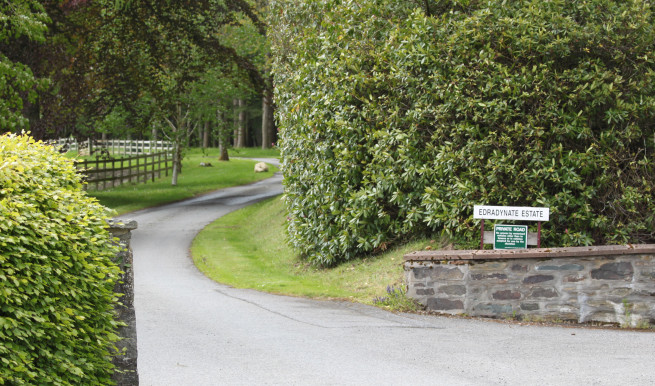
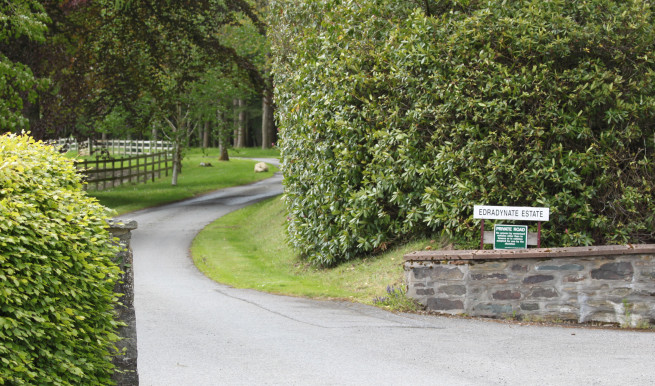
Edradynate Estate driveway. Photo by Ruth Tingay

Police Scotland has issued the following statement this morning:

DEATH OF BRIAN LOW IN ABERFELDY – MAN ARRESTED

A 75-year-old man has today, Friday, 24 May, 2024, been arrested in connection with the death of Brian Low in Aberfeldy.

Around 8.30am on Saturday, 17 February, 2024, 65-year-old Mr Low’s body was discovered in the Pitllie area on the outskirts of the town. He was pronounced dead at the scene.

The arrested man is in custody being questioned by detectives from the Major Investigation Team.

As the investigation is ongoing, we are unable to comment further at this time.

The matter remains active for the purposes of the Contempt of Court Act 1981 and the public are therefore advised to exercise caution if discussing it on social media.

ENDS

UPDATE 25th May 2024: David Campbell charged with murder of Edradynate Estate’s former groundsman Brian Low (here)

UPDATE 28 May 2024: Retired Edradynate Estate gamekeeper David Campbell appears in court accused of shotgun murder of Brian Low (here)

UPDATE 4 June 2024: Retired gamekeeper David Campbell accused of shotgun murder is granted bail – Crown Office appeals Sheriff’s decision (here)

UPDATE 8 June 2024: Former Edradynate Estate gamekeeper & murder suspect David Campbell refused bail (here)

UPDATE 21 March 2025: Murder trial date set for Edradynate Estate ex-gamekeeper David Campbell, accused of shooting former colleague Brian Low in Aberfeldy (here)

UPDATE 22 November 2025: Pre-trial hearing for ex-gamekeeper accused of shotgun murder of former colleague (here)

Former employee of notorious Edradynate Estate shot dead – Police launch murder inquiry

Police Scotland has launched a murder enquiry following the shooting of Brian Low, 65, who was out walking his dog on a remote track in Aberfeldy, Perthshire on 17th February 2024 (see here).

Mr Low had worked as a groundsman for the nearby notorious Edradynate Estate for more than twenty years before retiring last year.

Edradynate Estate driveway. Photo by Ruth Tingay

As many newspapers have been reporting, Edradynate Estate has been at the centre of multiple police investigations over the years, mostly in relation to the illegal poisoning of birds of prey (some details provided here on former Tayside Police Wildlife Crime Officer Alan Stewart’s blog), although if you read Alan’s book ‘Wildlife Detective’ you learn that there were also allegations of local’s dogs and cats being poisoned, a tenant farmer’s dog being shot, and threatening behaviour towards a local resident who had run over a pheasant.

Despite a handful of prosecutions over the years, nobody has ever been convicted of these offences, although Edradynate Estate was the subject of a three-year General Licence Restriction between 2017-2020 in relation to wildlife crimes (see here).

The estate was in the news again in 2019 when the former Head Gamekeeper was cleared of maliciously damaging crops on the Estate, alleged to have been done in revenge for losing his job (see here).

There is no suggestion whatsoever that anyone from Edradynate Estate is involved with Mr Low’s murder but it’s reasonable to assume, as in any murder inquiry, his long-term employment there will form part of the police investigation into his background and to identify any possible motives for this murder.

Police Scotland have been undertaking local enquiries for the last ten days prior to publicising the news of Mr Low’s murder. I sincerely hope they have been able to identify a suspect and that they find sufficient evidence to convict for this appalling crime.

They have opened a Major Incident Portal where members of the public can provide information directly to the investigating team (named Operation Newlane): CLICK HERE.

UPDATE 13 March 2024: Renewed appeal from Police Scotland following murder of Brian Low in Aberfeldy (here)

UPDATE 13 March 2024: The Daily Mail is reporting suggestions that Brian Low was shot at long range (here).

UPDATE 24 May 2024: Police arrest 75-year old man in connection with murder of Brian Low in Aberfeldy (here)

UPDATE 25th May 2024: David Campbell charged with murder of Edradynate Estate’s former groundsman Brian Low (here)

UPDATE 28 May 2024: Retired Edradynate Estate gamekeeper David Campbell appears in court accused of shotgun murder of Brian Low (here)

UPDATE 4 June 2024: Retired gamekeeper David Campbell accused of shotgun murder is granted bail – Crown Office appeals Sheriff’s decision (here)

UPDATE 8 June 2024: Former Edradynate Estate gamekeeper & murder suspect David Campbell refused bail (here)

General Licence restriction for wildlife crime – a wholly ineffective sanction

Just before Christmas Scottish Environment Minister Mairi Gougeon told the Environment Committee that the Scottish Government was ‘actively considering’ additional enforcement measures on wildlife crime.

As part of this discussion, she told Committee member Mark Ruskell MSP (Scottish Greens) that the Government was considering whether current measures, such as General Licence restrictions which are imposed following evidence of wildlife crime, are ‘as effective as they can be’.

The issue of General Licence restrictions had been discussed at an earlier committee hearing where we and RSPB Scotland had argued the sanction was impotent because an estate could simply apply for an individual licence to continue killing the wildlife it would have killed under the General Licence, just with a bit more paperwork to do. However, BASC had disagreed with us and defended the General Licence restriction as an effective sanction as follows:

Ross Ewing (BASC): I disagree with Ruth Tingay and Ian Thomson on the effectiveness of the restriction of general licences. It is important not to underestimate the pivotal role that general licences play on shooting estates in Scotland, where they are an integral part of what the estates do. Restricting a general licence will make it very difficult for estates to carry out an integral function.

Ruth Tingay mentioned applications for individual licences—there is a litany of species for which individual licences would need to be applied for. Moreover, an estate’s having a restriction against it reflects very badly on it, and information about that is publicly available online. I know a number of people who would probably not visit an estate that had a restriction purely on the basis that they would know that wildlife crime was probably being committed there.

The other thing to note about the restriction of general licences is that it takes place under the civil burden of proof— there is no need to surpass the criminal burden of proof, as there would be otherwise. That is a really useful tool. Currently, the police and SNH meet every three months. Perhaps if they met more regularly to review the situation, that might result in a few more restrictions being put in place. As a result, restrictions might act as more of a deterrent.

ENDS

Let’s look at each of those claims in turn.

First, restricting a General Licence does NOT make it ‘very difficult for estates to carry out an integral function‘ (and that statement of ‘integral function’ deserves to be pulled apart, but this isn’t the time). As we’ve pointed out time and time again, when a General Licence restriction has been imposed based on ‘clear evidence’ of wildlife crime, the estate can simply apply to SNH for an individual licence to carry on as before but has to do a bit more paperwork by applying for the licence and then submitting a return at the end of the year, e.g. see here. That’s hardly ‘very difficult‘, is it?

BASC says, ‘There is a litany of species for which individual licences would need to be applied for‘ – this is misleading. As we’ve seen, when a General Licence restriction has been imposed an estate needn’t apply for an individual licence to continue killing each separate species – SNH will simply issue one individual licence (e.g. see here) that permits the gamekeeper and his/her named associates to kill multiple species. Again, this process is hardly ‘very difficult‘.

The BASC rep argued, ‘I know a number of people who would probably not visit an estate that had a restriction purely on the basis that they would know that wildlife crime was probably being committed there’. He may well know a number of people with principles but there is sufficient evidence to demonstrate that a General Licence restriction does not deter others from visiting.

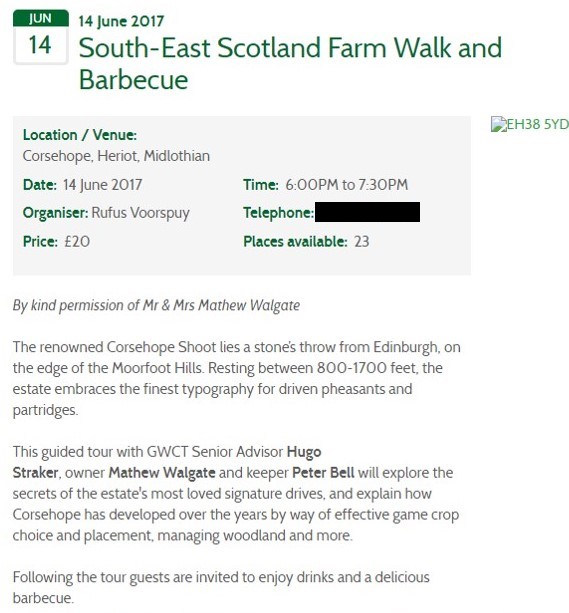
For example, here is evidence of GWCT hosting a guided tour and BBQ on ‘the renowned Corsehope Shoot‘ in June 2017, at the same time that this estate was serving a three year General Licence restriction, along with neighbouring Raeshaw Estate, following evidence of wildlife crime:
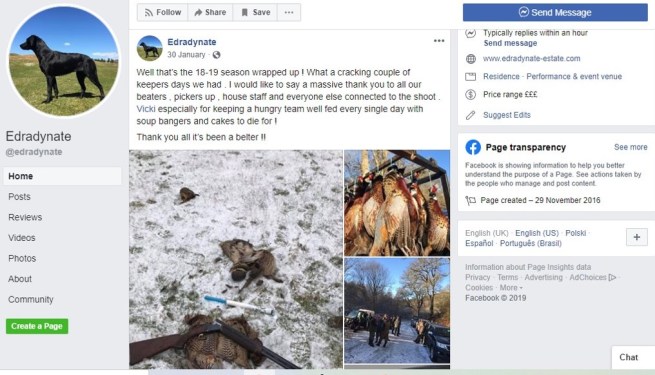
Here’s another example showing how a General Licence restriction is no deterrent to many visitors. This is a social media post on 30 January 2019 by the Edradynate Estate talking about “a belter season“, at the same time this estate was serving a three-year General Licence restriction following evidence of wildlife crime:
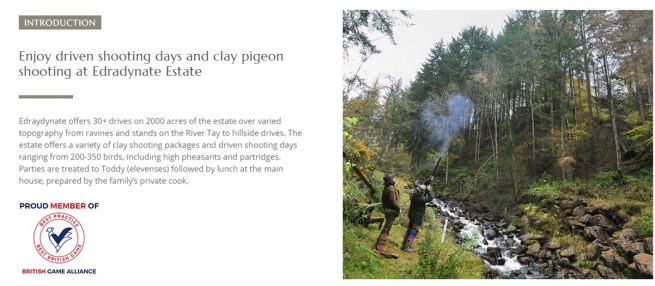
And it’s clear that a General Licence restriction is no deterrent for endorsement from the British Game Alliance, the game shooting industry’s own ‘assurance’ scheme, membership of which is supposed to indicate ‘rigorous and ethical standards’ although we’ve questioned this before (see here and here).
Yep, these General Licence restrictions are really hurting these estates.

BASC’s final argument about General Licence restrictions was a suggestion that if the Police and SNH met more frequently than every three months this ‘might result in a few more restrictions being put in place’. This is simply nonsense. It’s not the frequency of evidence-sharing meetings that has resulted in so few General Licence restrictions being imposed – quarterly meetings have been happening for the six years since the restriction sanction was made available to SNH.

However, the actual reasons behind decisions not to impose a General Licence restriction despite clear evidence of wildlife crime, including actual convictions, are still being kept secret by SNH because, they argue, it isn’t in the public interest to discuss them.

In these post-Werritty months we know the Scottish Government is going to have to make some big decisions about game bird management and its deep association with ongoing wildlife crime. The shooting industry will be doing its level best to maintain the status quo and limit any additional sanctions, which is what BASC is trying to do with this weak defence of General Licence restrictions.

We’ll continue to put evidence in front of Ministers and MSPs to ensure the status quo is not allowed to continue.

Former Edradynate Estate head gamekeeper cleared of crop poisoning charges

David Campbell, the former head gamekeeper of Edradynate Estate in Perthshire, has been cleared of all charges relating to the poisoning of game crops on the estate in April 2017.

It had been alleged that David Campbell had maliciously damaged game crops by spraying them with an unknown substance which caused them to rot and perish. At the time of the alleged offences, Campbell was no longer an employee of the estate, having worked there since 1983 but after falling out with the landowner, millionaire city financier Michael Campbell (no relation), his employment was terminated in February 2017.

[Edradynate Estate, photo by Ruth Tingay]

Michael Campbell had told the court that he believed his former employee had caused the damage ‘in revenge’ and said he could identify David Campbell on CCTV by his distinctive “mutton chop” facial hair. Various witnesses had told the court that David Campbell had been “upset” at having to leave his long-term employment at Edradynate Estate.

Last week, David Campbell’s defence solicitor had argued that the case against his client should be dropped because there was a lack of evidence to show his client was the person caught on the covertly-filmed CCTV. Sheriff Gillian Wade had rejected the argument and said the court had been presented with sufficient evidence for the case to proceed.

However, at Tuesday’s court hearing Sheriff Wade cleared David Campbell after ruling the case against him had not been proved beyond reasonable doubt.

This latest failed prosecution is one of several linked to the Edradynate Estate, although the majority of the previous allegations have related to the alleged illegal poisoning of birds of prey, rather than alleged crop poisoning. Despite at least 22 police investigations over several decades (according to former Tayside wildlife crime officer Alan Stewart), nobody from Edradynate Estate has ever been successfully prosecuted for any of these alleged wildlife crimes.

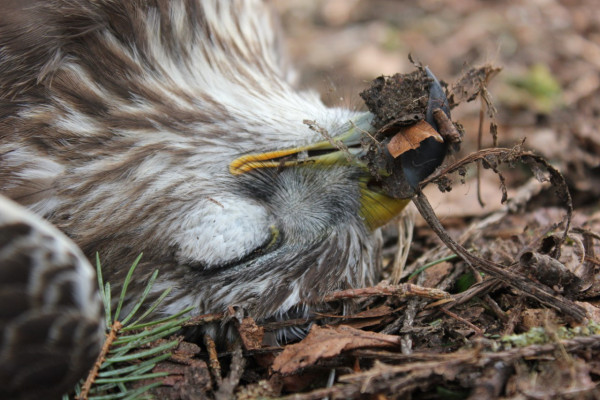
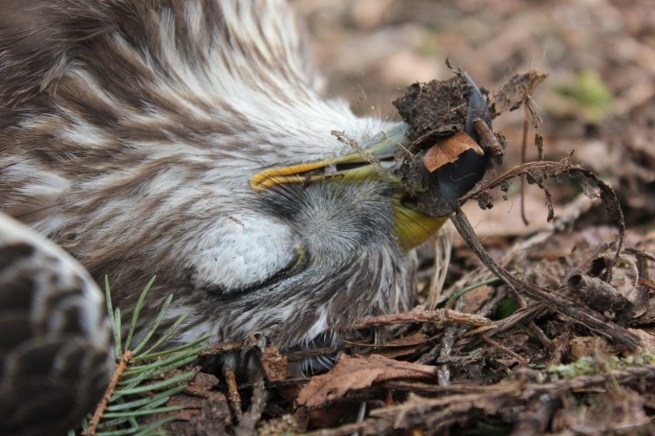
[A poisoned buzzard at Edradynate in 2015, photo RPUK]

We’ve blogged about this estate a lot over the years (see links here), and most recently in relation to the alleged poisoning of two buzzards in 2015 and the Crown Office’s decision in 2017 not to prosecute one of the Edradynate gamekeepers (un-named), despite Police Scotland urging otherwise (see here).

Edradynate Estate is currently serving a three year General Licence restriction, imposed in Sept 2017 and which we believe relates to the alleged buzzard poisonings in March 2015.

Last year three dogs and two more buzzards were reported to have been “deliberately poisoned” in the area but nobody has been charged (see here) and we are not aware of any suggested link between these poisonings and any current employee of Edradynate Estate.

Former Edradynate Estate Head Gamekeeper fails to persuade court to abandon his trial

The trial of Edradynate Estate’s former head gamekeeper continued at Perth Sheriff Court last week.

David Campbell, 69, denies that between 14 and 16 April 2017 at Edradynate Estate he maliciously damaged game crops by spraying them with an unknown substance which caused them to rot and perish.

[Edradynate Estate driveway, photo by Ruth Tingay]

At the time of the alleged offences, Campbell was no longer an employee of the estate, having worked there since 1983 but after falling out with the landowner, millionaire city financier Michael Campbell (no relation), his employment was terminated in February 2017. Michael Campbell told the court in November 2018 that he believed his former employee had caused the damage ‘in revenge’ (see here).

During a hearing in late January, the court heard from various witnesses who claimed David Campbell was ‘upset’ about having to leave his long-term position at Edradynate (see here).

At day three of the trial last week David Campbell’s solicitor, David Holmes, failed to have the case thrown out of court. Mr Holmes argued that there was a lack of evidence to show that his client was the person seen on the covert CCTV images. However, Sheriff Gillian Wade rejected this argument and said the court had been presented with sufficient evidence to let the Crown continue with its prosecution.

The case continues.

It might seem odd that we’re reporting on this case, and although we can’t explain that decision while this trial is on-going, all will become clear in due course.

PLEASE NOTE: We’re not accepting comments on this case until the trial concludes. Thanks.

Trial continues for (now ex) head gamekeeper of Edradynate Estate

The trial of Edradynate Estate’s former head gamekeeper, David Campbell, continued at Perth Sheriff Court in late January.

David Campbell, 69, denies that between 14 and 16 April 2017 at Edradynate Estate he maliciously damaged game crops by spraying them with an unknown substance which caused them to rot and perish.

At the time of the alleged offences, Campbell was no longer an employee of the estate, having worked there since 1983 but after falling out with the landowner, millionaire city financier Michael Campbell (no relation), his employment was terminated in February 2017. Michael Campbell told the court in November 2018 that he believed his former employee had caused the damage ‘in revenge’ (see here).

[Photo by RPUK]

A write-up of the latest court hearing appeared in the Courier & Advertiser as follows:

A disgruntled gamekeeper made sinister threats about what would happen on a millionaire’s shooting estate after he was replaced, a court has been told.

A witness described how David Campbell made the remarks to him at a drinks party some time before game crops were sabotaged on the estate.

Donnie Calder, 44, said: “The new gamekeeper had been appointed. He had stated that he was going to be putting in a lot of new game crops in various places. To the best I can remember, David said ‘as long as he had breath in his body, game crops would not be grown at Edradynaye Estate’. I didn’t really think much of it. David was bitter. He didn’t want to leave his employment as he enjoyed his job. I just assumed he decided there wasn’t going to be game crops. I don’t know why. He was quite calm. It was a matter of fact thing“.

Mr Calder told the trial at Perth Sheriff Court that he was called to the estate some time later to look at damage which had been done to a section of game crop. He said: “The game crops looked like they had been sprayed with a weed killer of some description. I was asked to look at them with the new keeper. The crops were dead. They didn’t die of natural causes – something had been used to kill them“.

Covert CCTV footage taken at the scene of the damaged crops showed a mystery person making a series of 2am raids to spray them. Estate owner Michael Campbell, 76, said he was sure the man in the video was David Campbell, owing to his “mutton chop” sideburns.

Farmer Andrew Kennedy, 62, said he was aware that the accused was “upset” about having to leave his job. “He had worked there for a long, long time and he was aware it was coming to an end, probably a career end“, he said.

The estate’s new head gamekeeper, Ian Smith, told the trial that the area was one of the best on the estate. He said that the damage would have cost “thousands”.

He told the court that the covert CCTV footage showed a “small” person in a white boiler suit spraying the crops with a backpack sprayer. He said the person, who was filmed during the early hours on two days, appeared to be wearing a head torch and a hood or mask.

ENDS

The trial will continue in March.

It might seem odd that we’re reporting on this case, and although we can’t explain that decision while this trial is on-going, all will become clear in due course.

PLEASE NOTE: We’re not accepting comments on this case until the trial concludes. Thanks.

Trial begins for (now ex) Head Gamekeeper of Edradynate Estate

The long-awaited trial of Edradynate Estate’s now former Head Gamekeeper began today at Perth Sheriff Court.

David Campbell, 69, denies that between 14 and 16 April 2017 at Edradynate Estate he maliciously damaged game crops by spraying them with an unknown substance which caused them to rot and perish.

At the time of the alleged offences, Campbell was no longer an employee of the estate, having worked there since 1983 but after falling out with the landowner, millionaire city financier Michael Campbell (no relation), his employment was terminated in February 2017. Michael Campbell told the court today that he believed his former employee had caused the damage ‘in revenge’.

There’s an interesting write-up of today’s proceedings here, revealing an exceptionally close working relationship between David and Michael Campbell over the years.

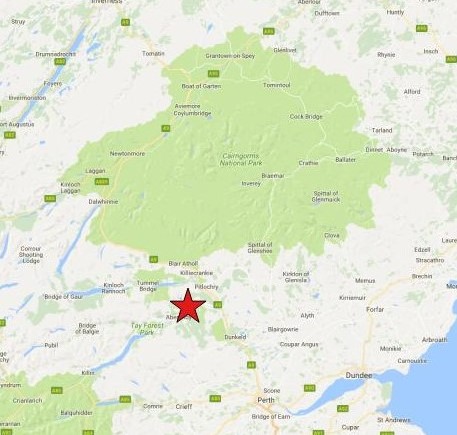
[RPUK map showing location of Edradynate Estate in Highland Perthshire]

[RPUK photo of the entrance to the estate]

It might seem odd that we’re reporting on this case, and although we can’t explain that decision while this trial is on-going, all will become clear in due course.

We understand the current trial against David Campbell is due to continue on 22 January 2019.

PLEASE NOTE: We’re not accepting comments on this case until the trial concludes. Thanks.

British Game Alliance: more greenwash from the shooting industry?

The UK gamebird-shooting industry is in crisis at the moment, with ever-increasing numbers of gamebirds being reared and released (estimated in the region of 50+ million pheasants & red-legged partridge each year) but supply is outstripping demand as game dealers struggle to sell the shot birds for human consumption. This has resulted in the widespread and illegal dumping of shot birds in the countryside (e.g. see here, here, here, here) which is causing serious damage to the reputation of the shooting industry.

Fearing enforced regulation, the shooting industry has come up with ‘the way forward’ and has established an organisation called the British Game Alliance, ‘the official marketing board for the UK game industry’, which, according to the Countryside Alliance, “aims to run a ‘British Game’ assurance scheme to ensure our game meets the highest standards“.

The British Game Alliance’s standards are quite high (see here for what is expected) and apparently compliance with these standards will be regulated and monitored by external auditors.

Sounds good, eh? In principle, yes, but our expectations were low in March 2018 when the Shooting Times revealed some of the individuals involved, including one name that made us laugh out loud given his links to estates with long histories of alleged (and sometimes proven) wildlife crime.

The British Game Alliance was launched with much fanfare and political support in May 2018 and we’ve been watching its website to find out which shoots (and sporting agents) have met the organisation’s ‘shoot standards’ to become listed as an ‘assured’ member. So far, the website hasn’t listed any of its assured members but promises that registered members will be ‘listed soon‘.

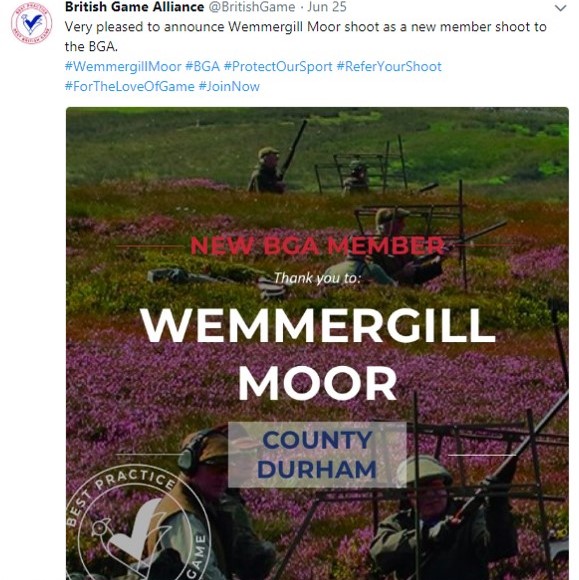
However, the British Game Alliance’s twitter feed (@BritishGame) has been more forthcoming. We were scrolling through this morning and were surprised to read this:

A police investigation took place at Wemmergill in 2015 after the discovery of two short-eared owls which had been shot and their corpses shoved inside a pothole (see here). There wasn’t a prosecution.

Another police investigation took place at Wemmergill in February this year following the sudden and explicable ‘disappearance’ of satellite-tagged hen harrier Marc (see here).

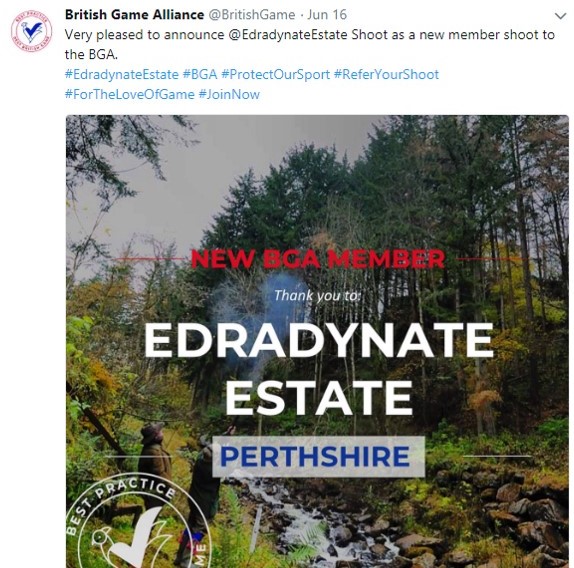
Even more surprising to read on the British Game Alliance’s twitter feed was this:

Edradynate Estate will be a familiar name to regular readers of this blog.

It is currently serving a three-year General Licence restriction imposed by SNH following sufficient evidence (substantiated by Police Scotland) that raptor persecution has taken place but insufficient evidence to prosecute a named individual (see here).

Edradynate Estate has been at the centre of investigations for alleged wildlife crime for a very, very long time. It’s well worth reading an earlier summary we wrote (here) which includes some fascinating commentary about the estate by former RSPB Investigator Dave Dick, who claimed as far back as 2004 that the estate was “among the worst in Scotland for wildlife crime“, and commentary by former Police Wildlife Crime Officer Alan Stewart, who said in 2005, “Edraynate Estate has probably the worst record in Scotland for poisoning incidents, going back more than a decade“.

The details involve a disturbingly high number of poisoned birds and poisoned baits that were found over the years, as well as a number of dropped prosecution cases. The most recent dropped prosecution case came just last year, when the Crown Office refused to prosecute an Edradynate gamekeeper for alleged buzzard poisoning, despite Police Scotland urging otherwise (see here).

Despite at least 22 police investigations over several decades (according to Alan Stewart), nobody from Edradynate Estate has ever been successfully prosecuted for any of these alleged wildlife crimes.

And there lies the problem with the British Game Alliance’s shoot standards. If you look at shoot standard #19, ‘Where a shoot or its employees are successfully prosecuted for wildlife crimes, the shoot will be expelled from the BGA and their membership revoked‘.

Given the well-documented difficulties of securing a successful prosecution for wildlife crime, which is an issue even recognised by the Scottish Government, hence the recent introduction of General Licence restrictions, it’s quite clear that some undeserving estates will get the official seal of approval from the British Game Alliance, thus reducing any confidence the public may have had in this well-intentioned scheme.

Three dogs & two buzzards die after being ‘deliberately poisoned’ in Perthshire

BBC News article (8 May 2018):

DOGS AND BUZZARDS DIE AFTER BEING DELIBERATELY POISONED

Police in Highland Perthshire are appealing for information after three working dogs and two buzzards were deliberately poisoned.

The incidents took place between October 2017 and April this year in and around the Edradynate and Pitnacree Estates area.

The poisons used to kill the dogs and birds are banned in the UK.

[Photo of a poisoned buzzard found in the area in 2015, by RPUK]

A Police Scotland spokesman said the animals’ owners were “understandably upset” at the loss of their dogs.

He said: “Once again, we also find ourselves investigating the illegal killing of raptors and this is extremely disappointing.

We have searched the areas and our investigations to date would suggest that there is not a wider threat to public safety.

However, all members of the public in the area are asked to remain vigilant and report any suspicious behaviour, especially during the hours of darkness.”

ENDS

Hmm. Edradynate Estate has been at the centre of investigations for alleged wildlife crime for a very, very long time. It’s well worth reading an earlier summary we wrote (here) which includes some fascinating commentary about the estate by former RSPB Investigator Dave Dick, who claimed as far back as 2004 that the estate was “among the worst in Scotland for wildlife crime“, and commentary by former Police Wildlife Crime Officer Alan Stewart, who said in 2005, “Edraynate Estate has probably the worst record in Scotland for poisoning incidents, going back more than a decade“. The details involve a disturbingly high number of poisoned birds and poisoned baits that were found over the years, as well as a number of dropped prosecution cases (nobody has ever been convicted for any of the alleged offences). The summary also includes information about links between the estate and the Scottish Gamekeepers’ Association.

[Edradynate Estate, photo by RPUK]

More recently, in March 2015 two dead buzzards were found near to the estate. Toxicology tests revealed they’d been poisoned with a banned substance (although the name wasn’t revealed). A police raid of the estate uncovered a third dead buzzard. A thorough police investigation followed but in May 2017 the Crown Office rejected a plea from Police Scotland to bring proceedings against an estate gamekeeper (see here). The Crown Office has so far not provided a clear explanation for this decision.

However, in September 2017 SNH imposed a three-year General Licence restriction on Edradynate Estate, presumably in response to the alleged buzzard poisonings in 2015 (see here). Some felt sympathy for the new gamekeeper who would now be subjected to these restrictions even though he’d only just begun his employment following the ‘retirement’ of the previous Head gamekeeper in February 2017.

And talking of that previous Head gamekeeper, you may remember last year he was charged with a number of offences including the alleged malicious damage of crops on Edradynate in April 2017 (it is claimed he poisoned them by spraying with an unknown substance, causing them to rot and perish) and the alleged theft of a thermal imaging spotting scope (see here). This resulted in some court proceedings that were mysteriously shrouded in secrecy (here).

Presumably he has pleaded not guilty as we now know a trial will take place at Perth Sheriff Court on 11 June 2018 for alleged ‘malicious mischief’.

Evidence of wildlife crime results in General Licence restriction on Edradynate Estate

As many of you will know, SNH has the ability to impose a three-year General Licence restriction order on land, or on an individual, where there is sufficient evidence, substantiated by Police Scotland, that raptor persecution has taken place (see SNH framework here).

This measure, based on a civil burden of proof, was introduced by then Environment Minister Paul Wheelhouse in 2013 in response to the continuing difficulties of meeting a criminal burden of proof to facilitate a criminal prosecution. The measure became available for incidents that occured on or after 1 January 2014.

Photo of a poisoned buzzard (RPUK)

Since then, only two restriction orders have been imposed, both in November 2014: one for the Raeshaw/Corsehope Estates in the Scottish Borders, and one for the Burnfoot/Wester Cringate Estates in Stirlingshire (see here for details, and an explanation of what a General Licence restriction actually means).

As you’ll also probably be aware, Raeshaw Estate and Corsehope Estate made a legal challenge to SNH’s decision and this resulted in a judicial review. The judicial review dragged on for some time but eventually concluded in March this year, and the court found that SNH had acted fairly and that the General Licence restriction at Raeshaw Estate and Corsehope Estate should remain in place (see here).

While this legal challenge was underway, SNH, quite reasonably, did not impose any further General Licence restrictions, even though there were plenty of candidate estates to consider. Once the legal argument had been settled, we expected SNH to open the floodgates and impose many more restriction orders for offences that had taken place since January 2014. We asked SNH about this in June 2017 and we were told that two notifications were underway, relating to offences in Perthshire and Aberdeenshire, although no further details were given at that time, presumably as SNH was giving the affected parties time to respond/appeal. Fair enough.

Today, SNH has announced that two General Licence restriction orders have been imposed in two separate cases.

The first of those cases relates to Edradynate Estate in Perthshire: SNH_GL Restriction Notice_Edradynate Estate_15Sept2017

Here is the decision notice:

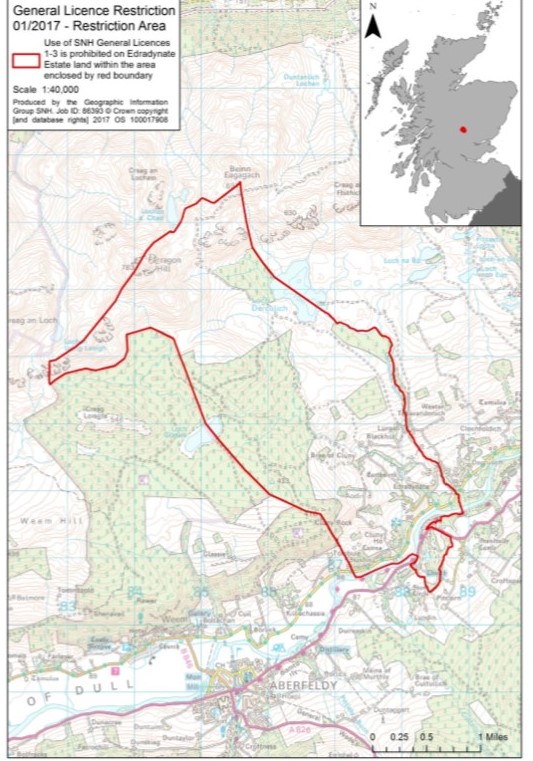
And here is the estate boundary map to which the General Licence restriction applies for the next three years:

For the next three years, Edradynate Estate will no longer be able to enjoy the privilege of using General Licences 1, 2 or 3, but the estate will be entitled to apply for the use of an Individual Licence that will allow them to kill certain bird species but under closer scrutiny than if the estate was using a General Licence. We’ll be monitoring the use of any Individual Licences that SNH approves for this estate, and, if there is any breach of the licence conditions, we fully expect SNH to revoke the Individual Licence just as they did for Raeshaw Estate earlier this year.

SNH has not provided any information about the Police Scotland evidence used as the basis for this General Licence restriction order on Edradynate Estate. However, it’s probably a fair assumption that it relates to the alleged poisoning of several buzzards in 2015. This is one of the five prosecution cases that the Crown Office dropped earlier this year, without explanation. The case did not involve video evidence, as some of the others did, and the case was dropped by the Crown despite a plea from Police Scotland to proceed (see here).

We’ve been blogging about Edradynate Estate for a very long time. It’s well worth reading an earlier summary we wrote (here) which includes some fascinating commentary about the estate by former RSPB Investigator Dave Dick, who claimed as far back as 2004 that the estate was “among the worst in Scotland for wildlife crime“, and commentary by former Police Wildlife Crime Officer Alan Stewart, who said in 2005, “Edraynate Estate has probably the worst record in Scotland for poisoning incidents, going back more than a decade“. The details involve a disturbingly high number of poisoned birds and poisoned baits that were found over the years, as well as a number of dropped prosecution cases (nobody has ever been convicted for any of the alleged offences). The summary also includes information about links between the estate and the Scottish Gamekeepers’ Association.

Now, whether you think a General Licence restriction order is a sufficient sanction against this estate is open to debate. However, while we wait for the Scottish Government to get on with estate licensing, a General Licence restriction order is all that is currently available, so well done to SNH for imposing the General Licence restriction order on this particular estate and for being semi-transparent about the details.

Unfortunately, we can’t say the same about the second General Licence restriction order that SNH has just imposed. We’ll be blogging about that one in the next blog…..it’s an absolute shocker.

Edradynate Estate (photo by RPUK)

UPDATES:

RSPB press statement here

SNH imposes General Licence restriction on ‘mystery’ gamekeeper (here)

More on the mystery gamekeeper with the General Licence restriction (here)