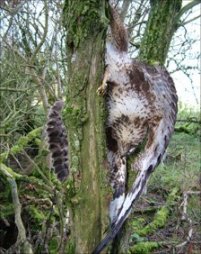
 David Alexander Whitefield, the former gamekeeper at Culter Allers Estate in South Lanarkshire, was today sentenced following his December 2011 conviction for illegally poisoning four buzzards (see here for conviction report).
Before we discuss his latest sentence, let’s remind ourselves of Whitefield’s criminal record: This keeper, who was also a member of the Scottish Gamekeepers’ Association, was convicted in October 2008 for offences relating to the unlawful capture and subsequent welfare of a buzzard. His sentence for that conviction was a £300 fine. He kept his job as the sole gamekeeper and he was not expelled from the SGA. Just six months later, in April 2009, RSPB investigators were alerted to the signs of an illegal poisoning spree on this estate. Obviously, these subsequent poisoning activities, for which Whitefield has now been convicted, demonstrate that the £300 fine had zero effect as a deterrent (no great surprise really).
So then you might expect today’s sentence to reflect not only the seriousness of the crime of poisoning wildlife (and potentially any human and/or domestic animals that happened to wander through the well-used public walking trails on this estate), but also to acknowledge that Whitefield, already previously convicted for wildlife crime there, had shown a complete disregard for wildlife legislation.
You might reasonably expect that the sheriff in this case, Nicola Stewart, might utilise her full sentencing powers and go for the most serious sentence available for this type of crime, which includes a custodial sentence and/or a financial penalty for each poisoned bird. That would see Whitefield put away for a while and would send out a very clear message that this type of crime will no longer be tolerated in this country, just as the Scottish Government has claimed over and over again in recent years.
So why then, was Whitefield handed down a 100 hour community service order as his ‘punishment’?
According to an RSPB press release, Sheriff Stewart is reported to have said the punishment was a direct alternative to a custodial sentence and that poisoning is a serious offence. Why was he given a direct alternative to a custodial sentence and where, in his 100 hour community service order, is there any indication that illegal poisoning is considered a serious offence?
This is a joke sentence, to add to all the other joke sentences that have been handed out to the few criminals that are actually prosecuted for these crimes. As we keep seeing, over and over again, these punishments are not providing the required deterrent so surely it’s now time to introduce mandatory sentences for these offences, and that includes custodial sentences. These are already available to the judiciary – so far, for whatever reason, not one custodial sentence has been given to a convicted raptor poisoner. We need to be asking why that is, and we need to keep asking.
Well done to the SSPCA for some serious doggedness with this case – it’s been a long time in the works and looked at one point to be in danger of failing on a legal technicality. Perseverance paid off, and despite the pathetic sentence, those involved with the groundwork deserve much credit.
BBC news article here
RSPB Scotland press release on Birdguides Blog here

 Following the report that convicted gamekeeper Glenn Brown lost his appeal yesterday (see
 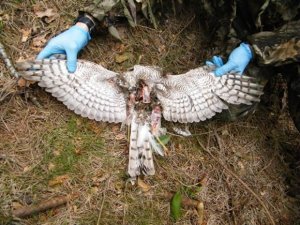 Thomas also writes that since 2006, goshawk and peregrine productivity in the Derwent Valley has collapsed. By coincidence, gamekeeper Brown is reported to have been employed as a gamekeeper since 2006. Amazing.
 The long-running trial that began over two months ago against Derbyshire gamekeeper Glenn Brown concluded today, and he was found guilty of using an illegal trap to try and catch birds of prey on the National Trust’s Howden Moor in the Peak District. The court heard that he was interested in protecting the grouse where he worked. The
  Raptor Persecution UK