We’re still working our way through RSPB Scotland’s recently published twenty-year review (see here) and what a fascinating read it’s proving to be. We’ve already blogged about two things that caught our eye (see here and here), and now here’s the third.
On page 14 of the report, the following has been written:
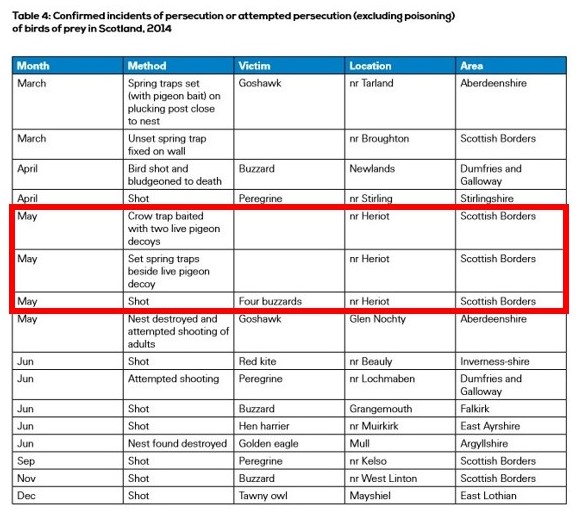
“Lines 5, 6 and 7 of Table 4 describe the finding at one site, in an area intensively managed for driven grouse shooting, of a set crow trap, hidden within a small area of woodland, which was found to contain two feral pigeons indubitably being used as illegal lures to attract birds of prey. Under a tree, only a few metres away, were found the decomposed carcasses of four buzzards that had been shot, while a short distance from the crow trap a pigeon was found in a small circular cage, with four set spring traps set on the ground, hidden under moss, attached to the trap“.
Here’s a copy of Table 4, with lines 5, 6 and 7 highlighted:
Also included in the report is a photograph of the pigeon inside a small cage with the four set spring traps hidden under moss:

So, according to the RSPB report, these offences were uncovered in May 2014 on a driven grouse moor in the Borders, with the location given as “nr Heriot“. Funny, we don’t remember seeing anything in the press about these crimes.
Hmm. Could these wildlife crimes be in any way related to SNH’s recent decision to serve a General Licence restriction order on parts of the Raeshaw Estate and Corsehope Estate (see here)? Both Raeshaw Estate and neighbouring Corsehope Estate can be described as being ‘nr Heriot’; indeed, the recorded property address for Raeshaw Estate is given as ‘Raeshaw House, Heriot, EH38 5YE’ (although the owner is only listed as Raeshaw Holdings Ltd., registered in the Channel Islands, natch), according to Andy Wightman’s excellent Who Owns Scotland website. And according to SNH, the General Licence restriction order on these two estates was served due to “issues about the illegal placement of traps” (see here). It’s possible that they’re connected, but it’s also possible that these crimes are unconnected with SNH’s General Licence restriction order on these two estates because Raeshaw isn’t the only grouse moor that could be described as being ‘nr Heriot’. Unfortunately, the (lack of) detail available in the public domain doesn’t allow us to be conclusive. Perhaps there’ll be some transparency once the legal arguments (see here) about the General Licence restrictions have concluded (which should happen fairly soon). Then again, perhaps there won’t.
If these crimes were not uncovered on either the Raeshaw or Corsehope Estates, we hope there’ll at least be a General Licence restriction order served on whichever grouse moor these traps were found because there’s been a clear breach of the General Licence rules – pigeons are not permitted as decoy birds in crow cage traps; set spring traps are not permitted out in the open; oh, and shooting buzzards is also illegal. There should also be a prosecution of course, but that’s highly improbable given the track record of non-prosecutions for raptor crimes uncovered in this part of the Borders.
There’s been a long history of raptor persecution “nr Heriot“, dating back to at least 2001. Here’s a list we’ve compiled of confirmed raptor persecution crimes, all listed within RSPB annual reports:
2001 May: poisoned buzzard (Carbofuran) “Heriot Dale”. No prosecution
2003 Feb: poisoned buzzard (Carbofuran) “Heriot”. No prosecution
2003 Mar: poisoned buzzard (Carbofuran) “Heriot”. No prosecution
2003 Apr: poisoned buzzard (Carbofuran) “Heriot”. No prosecution
2003 Nov: poisoned buzzard (Carbofuran) “Heriot”. No prosecution
2004 Feb: Carbofuran (possession for use) “Heriot”. No prosecution
2004 Feb: two poisoned buzzards (Carbofuran) “Heriot”. No prosecution
2004 Oct: poisoned buzzard (Carbofuran) “Heriot”. No prosecution
2005 Dec: poisoned buzzard & raven (Carbofuran) “Heriot”. No prosecution
2006 Sep: poisoned buzzard (Carbofuran) “Heriot”. No prosecution
2006 Oct: poisoned buzzard (Carbofuran) “Heriot”. No prosecution
2009 Mar: two poisoned buzzards (Carbofuran) “nr Heriot”. No prosecution
2009 Jun: poisoned red kite (Carbofuran) “nr Heriot”. No prosecution
2009 Jun: 4 x poisoned baits (2 x rabbits; 2 x pigeons) (Carbofuran) “nr Heriot”. No prosecution
2010 Nov: poisoned buzzard (Carbofuran) “nr Heriot”. No prosecution
2011 Jan: poisoned buzzard (Carbofuran) “nr Heriot” No prosecution
2013 Jun: shot + poisoned buzzard (Carbofuran) “nr Heriot”. No prosecution
2014 May: crow trap baited with two live pigeon decoys “nr Heriot”. Prosecution?
2014 May: four set spring traps beside live pigeon decoy “nr Heriot”. Prosecution?
2014 May: four shot buzzards “nr Heriot” Prosecution?
Not included in an RSPB annual report (because it happened this year): 2015 Jul: shot buzzard “found by side of road between Heriot and Innerleithen” according to media reports (see here). Prosecution?
Interestingly, also not included in the RSPB’s annual reports but reported by the Southern Reporter (here) and the Guardian (here), a police raid on Raeshaw Estate in 2004 uncovered nine dead birds of prey, including five barn owls, two buzzards, a kestrel and a tawny owl, described as being “poisoned or shot“. In addition, “a number of illegal poisons were discovered but no-one was ever prosecuted“. According to both these articles, during a further police raid on Raeshaw in 2009 ‘three injured hunting dogs were seized by the SSPCA on suspicion of involvement with badger baiting’. We don’t know whether that resulted in a prosecution.
Also not included in the above list is the sudden ‘disappearance’ of a young satellite-tagged hen harrier in October 2011. This bird had fledged from Langholm and it’s last known signal came from Raeshaw Estate. A search failed to find the body or the tag.
Fascinating stuff.

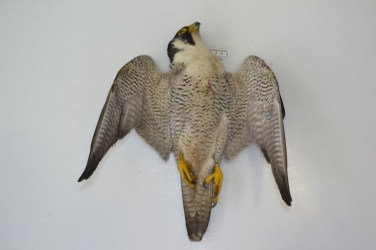 Last month we blogged about a dead peregrine that had been found at a well known persecution hotspot on 11th April 2016 (see here). Laboratory tests have now confirmed this peregrine was poisoned with the banned pesticide Carbofuran.
 Regular blog readers will know we’ve been following the case of Scottish gamekeeper William Curr, who had been charged last year with alleged snaring offences on Glenogil Estate in the Angus Glens, said to have occurred in September 2014 (see
  Regular blog readers will know that we’ve frequently had cause to criticise Police Scotland’s response to suspected wildlife crimes that have been reported to them. Well, we’re about to do it again over their mishandling of two recently reported suspected wildlife crime incidents, one in Dumfries & Galloway and one in South Lanarkshire.


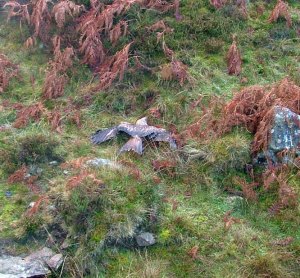 The following press release has been issued today by FoRK (Friends of Red Kites) –
 Raptor Persecution UK