Ross-shire Massacre: police confirm banned poison involved

RK7The following statement has just been released by Police Scotland:

Police Scotland Highland and Islands Division are seeking to reassure the public that enquiries are still ongoing into a wildlife crime investigation regarding the death of birds of prey in the Ross-shire area.

The 22 birds (sixteen red kites and six buzzards) were located in the Conon Bridge area and following analysis of the birds’ remains, fifteen have been confirmed as having digested an illegally-held poisonous substance (twelve red kites and three buzzards). Post mortem examinations and toxicology work continues into all the birds seized.

Police Scotland is continuing to work in close collaboration with partner agencies. Landowners and farmers in the local area are also continuing to assist police with their ongoing enquiries.

Police are keen to speak to anyone who has any information about the incident and would encourage them to contact Police on 101 or Crimestoppers anonymously on 0800 555 111 or online at http://www.crimestoppers-uk.org/. No personal details are taken, information is not traced or recorded and you will not go to court.

ends

So, finally, they’ve managed to confirm that a banned poison was involved. About time, too. They still haven’t named it, but the “illegally-held poisonous substance” will be one (or more) of those named on the Possession of Pesticides (Scotland) Order 2005. These are:

Aldicarb, Alphachloralose, Aluminium Phosphide, Bendiocarb, Carbofuran, Mevinphos, Sodium Cyanide, and Strychnine.

Now, which industry hates raptors and is known to have a close association with these banned poisons…let’s think hard….erm….

It actually doesn’t matter that the police haven’t named the poison(s). Just knowing it’s a banned poison and not a ‘mystery virus’ or an ‘accidental poisoning’ is enough to put a halt to what has recently looked increasingly like a coordinated campaign to associate the deaths with the feeding regime at the RSPB’s Tollie Kite Feeding Station rather than focus attention on the specific area where the poisoned victims, along with poisoned bait, had been found.

It’s funny, isn’t it, that of all the speculation that’s been aired, nobody seems to have wondered about whether there’s any (legal) ‘vermin control’ being done on those farms around Conon Bridge. Perhaps done on a casual basis in return for access for a spot of pheasant shooting by a small shooting syndicate? But then that’s such an obvious angle of inquiry, the police must have covered it months ago…..right?

The number of confirmed poison victims has reached 15 (it really is like pulling teeth trying to get information about this incident) and the police ‘investigation’ continues…..

Previous blog posts on the Ross-shire Massacre here

Sea eagle poisoned in Northern Ireland: police appeal for info one year later!

Last week, at the end of May 2014, the Police Service of Northern Ireland issued a vague press release calling for information about the discovery of a poisoned white-tailed eagle in the Armoy area of Northern Ireland. Toxicology results revealed the bird had been killed by the banned poison, Carbofuran.

The thing is, this bird was discovered in April 2013 – over a year ago – and yet this is the first time the PSNI have published anything about it.

Here’s what their press release said:

“Police are investigating the circumstances surrounding the death of a sea eagle.

During April 2013 police received a report from a member of the public regarding a dead sea eagle found within the Armoy area.

Subsequent toxicology reports confirmed Carbofuran poisoning to be the cause of death.

Carbofuran is a banned substance which is highly toxic and poses a serious risk to public health and safety.

Police are appealing to anyone with information in relation to this incident to contact them on the new non-emergency number 101″.

It’s not known if this was an adult or a juvenile bird, or whether it was from the Kerry reintroduction project in SW Ireland or whether it was a Scottish bird.

It’s also not known whether this appalling delay was due to the toxicology lab, or whether it was due to the police, or both. It’s not the first time that such chronically long delays have occurred here – see here and here for previous blogs. Whichever agency is responsible, it’s shocking that it has has taken over a year for an appeal for information.

It’s worth asking some questions about this. Let’s email the following people to ask about why it has taken so long to (a) appeal for information about this crime, and (b) warn the public in the Armoy area of Northern Ireland about the serious risk of a banned and highly toxic poison lying around in the countryside:

Environment Minister Mark H. Durkan (who incidentally has recently pledged improved action against wildlife crime – see here). His email address: doe.iemonitoring@doeni.gov.uk

Minister for Agriculture Michelle O’Neill (who is directly responsible for overseeing the process of toxicology sampling). Her email address: private.office@dardni.gov.uk

The local police office of the Armoy area: NPTBallycastle@psni.pnn.police.uk

Photo of a white-tailed eagle by Mike Watson


Head gamekeeper convicted of storing 5 banned poisons: gets conditional discharge

Derek Sanderson, a recently-retired head gamekeeper for a shooting syndicate on the Sledmere Estate in Yorkshire, was yesterday found guilty of storing five banned poisons in his house and in an unlocked outbuilding.

Those poisons were Carbofuran, Aldicarb, Mevinphos, Strychnine and Alphachloralose.

His sentence? A conditional discharge and a £15 victim surcharge!!!!!!!

The court apparently accepted that there was no causal link between the possession of these poisons and a dead buzzard found on Sledmere Estate in 2012 – confirmed as having been poisoned with Aldicarb.

Bob Elliot, Head of RSPB Investigations, has written an excellent blog about this, frankly, unbelievable case, here.

What sort of deterrent value is such a pathetic sentence?

Tenuous threat of ‘killer drug’ Diclofenac to Scottish golden eagles

There’s a rather sensationalised article in today’s Scotsman claiming ‘Killer drug threat to Scotland’s golden eagles’ (see here).

The article suggests that Scottish golden eagles, and other raptors, could be under threat from the veterinary drug Diclofenac – the drug responsible for the catastrophic decline of several vulture species in parts of Asia. This drug has recently gone on sale in Europe, causing widespread concern for its probable effect on several European vulture species (e.g. see here).

The Scotsman’s scaremongering headline appears to be based on the results of a newly-published paper that reports on evidence of Diclofenac toxicity in steppe eagles in India. The link to golden eagles has been made because golden eagles and steppe eagles are in the same genus (Aquila).

However, if you actually read the paper, the evidence is based on only two dead steppe eagles. While of concern, it is still quite premature to transpose those results into a headline-grabbing article that suggests golden eagles in Scotland could be at threat. The study’s findings need to be expanded substantially and be based on a lot bigger sample size than just two individuals before the evidence becomes compelling.

Scottish raptors are unlikely to be at the same level of risk as species in Asia, given that livestock carcass dumps are not permitted here. However, some on social media are arguing that Diclofenac may be used (mis-used) as a substance with which to lace a poisoned bait.

Of course, Scottish golden eagles and other raptors could well be at risk, but then it could be argued that they are also at risk from a whole suite of potentially poisonous substances, some of them just ordinary household products, if those wishing to poison raptors choose to try out other chemicals. However, given the apparent availability of large stocks of the banned pesticide Carbofuran, and the known toxic effects of Carbofuran (i.e. fast acting and pretty much 100% effective), why would a poisoner risk using a chemical that ‘might’ work when he knows he’s got something that definitely will have the desired effect?

That’s not to say that we shouldn’t be concerned about the availability of Diclofenac in Europe – of course we should – but those concerns currently focus on the drug’s known effect on Gyps vulture species and thus its significant threat to at least three vulture species in Europe. For that reason, it should be immediately removed from the market.

As for Scotland’s golden eagles, the main threat continues to be the illegal use of the banned poison, Carbofuran. Of 15 eagles (golden & sea eagles) known to have been poisoned since 2006, 13 of them were killed with Carbofuran (see here). This poison has also been used persistently to kill hundreds of other raptors in recent decades, including buzzards, red kites, peregrines etc etc and it is no surprise that it has been named ‘the gamekeepers’ poison of choice’.

A feeble, question-dodging response from the Environment Minister

Peregrine poisoned Leadhills Feb 2014In early April we blogged about the poisoned peregrine that had been found close to the boundary of Leadhills Estate in South Lanarkshire (see here). We encouraged blog readers to email the Environment Minister with a series of questions about this specific incident and the broader topic of long-term raptor persecution in this particular area. We know from our site stats that over 100 of you emailed the Minister (well done and thank you) and perhaps this volume of email traffic was the reason for his delayed response.

Anyway, last week his formal response was eventually mailed out and we’ve been sent a few copies by several readers. As usual, it’s a fairly generic response and here is a general overview of what he had to say (or to be more precise, what his civil servant had to say on his behalf) -:

“Thank you for your letters to the Minister for Environment and Climate Change, Paul Wheelhouse. I have been asked to respond.

The Minister has been appalled at the recent incidents of raptor persecution including the mass poisoning in Ross-shire which has claimed the lives of 16 red kites and 6 buzzards. Clearly there have been other incidents across Scotland involving peregrine falcons and most recently a juvenile sea eagle, the first born to the reintroduced east coast birds, has gone missing in an area where raptors have been lost before. The mass poisoning is a terrible loss for the Black Isle and has rightly been condemned by the local community as well as the wider public. The Minister was heartened however, by the contributions made by members of the public, as well as landowners and farmers, to the reward fund set up by the Royal Society for the Protection of Birds (RSPB) for information which leads to a successful conviction.

These incidents threaten to undermine Scotland’s reputation as a country that cares for its wildlife and natural environment but reinforce the need for the new measures the Minister announced in July 2013.

In addition to these measures, the Scottish Government launched a Consultation to gather views on extending the investigative powers for inspectors in the Scottish SPCA in relation to certain wildlife offences. The Consultation will run from 31 March until 1 September 2014 and of course all views will be taken into account before a decision is made.

The possession of certain poisons is an offence in Scotland and in order to help rid our countryside of these dangerous chemicals, we shall be looking at building on existing mechanisms to remove them from Scotland’s environment.

You raised a number of specific points about the peregrine falcon poisoning incident in Lanarkshire and I will deal with each in turn below.

1. Why did Police Scotland tell a member of the public this was not a police matter? Will you launch an inquiry and publish the findings?

Police Scotland call handlers must consider the information they are given at the time of the call and not all reported incidents may be crimes. It would be inappropriate for the Minister to comment on Police operational matters.

2. Will you launch an inquiry into PC Everitt’s alleged response to this incident and publish the findings?

The Minister will not be making any statement based on speculative comments posted on social media sites about a serving Police officer. This would not be appropriate.

3. Will you launch an inquiry into why illegal raptor persecution continues to flourish in the Leadhills area, and publish the findings?

The area where the poisoned peregrine falcon was discovered was disclosed by Police Scotland as ‘the Abington area of South Lanarkshire’. The Minister will not be drawn into any speculation about a live police investigation which might prejudice the outcome of the investigation.

4. Will SNH use the new enabling clause in the General Licences to withdraw their use in the Leadhills area with immediate effect?

SNH will consider restricting the use of General Licences where they believe it is appropriate to do so, and on a case by case basis.

5. Over what period of time are you going to measure the success of the new measures introduced in July 2013?  It seems the threat of these new measures has not managed to stem the mass destruction of Scotland’s Natural Heritage.

The Minister has decided it would be inappropriate to impose exact time scales on the effect of the new measures as each measure is unique and will require its own consideration. However, it is hoped to report on the findings of the penalties review before the end of 2014.

Once SNH have had the opportunity to implement any General Licence restrictions the Minister will seek an update on how these have worked in practice. The final measure about Police Scotland use of technology can only be considered on a case by case basis and these are decisions made in the course of operational policing. It would be inappropriate for the Minister to seek to influence operational decisions of police colleagues in respect of an investigation.

Whilst current legislation and these new measures should be given due time to take effect, the Minister is on record confirming that he will take further action if it appears that current measures are insufficient. The Scottish Government takes this issue seriously and I hope that this response illustrates the extensive work that is taking place.

Yours sincerely,

Karen Hunter

Wildlife Crime Policy Officer”.

There’s nothing in his response that comes as a surprise. It’s full of the same old rhetoric that we get every time we ask for more robust action to be taken. To be fair to him, we can understand his view that the measures he brought in last July need time to take effect. The problem with that though, is that here we are, 10 months later, still waiting for many of those measures to actually be enacted and meanwhile the filthy criminals continue with their systematic persecution, knowing full well they’re still untouchable. His refusal to set a review date to assess whether his new measures have been effective is very disappointing. We’ll probably be here in the same place two years down the line, still waiting, and still counting the cost (in terms of raptor deaths) of this constant procrastination.

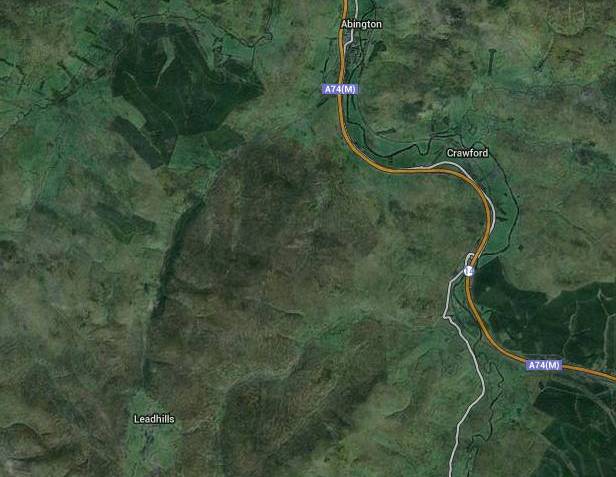
We were particularly disappointed with his answer to question 3. Perhaps he’s not familiar with the geography of South Lanarkshire, and especially the proximity of Abington village to the Leadhills Estate boundary. Here’s a map:

Leadhills Abington map

The big brown smudge in the middle (or, to borrow a phrase from George Monbiot’s latest excellent article, that “bare black misery“) is Leadhills grouse moor. The site where the peregrine was found poisoned with Carbofuran is closer to that grouse moor than it is to Abington village. That’s not to say that we’re accusing anyone from Leadhills Estate of being responsible for poisoning the peregrine, it’s just a clarification that the site falls within what we would describe as the ‘Leadhills area’ – an area with a 40+ year history of illegal killing, including plenty of Carbofuran abuse in recent decades. Perhaps Police Scotland chose to describe the site as being in the ‘Abington area’ to deflect attention from this being yet another persecution incident in what is one of  Scotland’s blackest areas for long-term raptor killing. It’ll make the crime stats look better is this one can’t be attributed to the Leadhills area.

We’ll look forward to hearing the results of their ‘live police investigation’….yeah, right.

Liam McArthur’s parliamentary questions answered (raptor crime in Leadhills area)

Liam McArthur MSPLast month, Liam McArthur MSP posed a series of parliamentary questions following our report on the poisoned peregrine found in the Leadhills area of South Lanarkshire (see here).

His four questions have now been answered; two by the Cabinet Secretary for Justice, Kenny MacAskill, and two by Environment Minister Paul Wheelhouse:

Question S4W-20745: Liam McArthur, Orkney Islands, Scottish Liberal Democrats, Date Lodged: 15/04/2014

To ask the Scottish Government what steps Police Scotland is taking to ensure that its staff are aware of their responsibilities regarding the protection of protected species.

Answered by Kenny MacAskill (15/05/2014):

The training of wildlife crime officers is a matter solely for the Chief Constable. It is not appropriate for Scottish Ministers to seek to intervene on operational policing matters.

I can advise however that since Police Scotland came into being on 1 April 2013, there have been significant changes to the structure and training for wildlife crime officers.

The strategic lead for wildlife crime which sits in the Specialist Crime Division is held by the Assistant Chief Constable. A Detective Chief Superintendent holds the portfolio lead and the post provides essential direction and governance around strategic issues relating to wildlife crime prevention and investigation.

A full time national Wildlife Crime Co-ordinator at Detective Sergeant level provides engagement with national issues relating to coordination, policy, performance and training, and supports the Detective Chief Superintendent.

In each of the 14 territorial divisions there are wildlife crime liaison officers who are supported by a Superintendent (or above). Wildlife crime officer posts can be either full or part-time and deal with crime prevention and investigation when required for operational policing issues.

It is important to highlight that the investigation of wildlife crime is not the exclusive preserve of dedicated staff, and a variety of investigative and intelligence resources and tactics are brought to bear on such matters, from local and national policing.

Our comment: This is basically a cut and paste response from the response he’s just given to Claire Baker MSP. We keep seeing this statement: “It is not appropriate for Scottish Ministers to seek to intervene on operational policing matters”, but hang on a minute, didn’t the Environment Minister ‘seek to intervene’ only ten months ago when he instructed the Lord Advocate to have a word with COPFS and Police Scotland ‘to ensure law enforcement utilises all investigative tools at their disposal in the fight against wildlife crime’? (see here). What’s that if it isn’t an intervention?

Question S4W-20746: Liam McArthur, Orkney Islands, Scottish Liberal Democrats, Date Lodged: 15/04/2014

To ask the Scottish Government whether it will hold an inquiry into reports that Police Scotland told a member of the public that the poisoning of a peregrine falcon in the Leadhills area was not a police matter.

Answered by Kenny MacAskill (15/05/2014):

Police Scotland is committed to investigating wildlife crime and have confirmed that on this occasion well established protocols and processes were adhered to in order to allow the bird to be recovered successfully. As a result of this, and the subsequent analysis carried out by Science and Advice for Scottish Agriculture identified that the bird had been poisoned, Police Scotland is now working in cooperation with both RSPB and National Wildlife Crime Unit to fully investigate this crime.

In any given case, police call handlers must consider the information they are given at the time of the call and not all reported incidents may be crimes. Police Scotland has also confirmed that no official complaint has been received from the reporter of the original incident.

Our comment: The police call handler told the member of the public (who was reporting this dead peregrine that had been found in suspicious circumstances in an area notorious for raptor crime) that it wasn’t a police matter. That is a fact. The police response was not in adherence with ‘well established protocols and processes’, as Mr MacAskill claims, unless those protocols and processes include ignoring a suspected wildlife crime. The only reason this poisoned peregrine was recovered successfully was because the member of the public bothered to call the RSPB, who then attended and collected the corpse. If the member of the public had not bothered to call the RSPB, this poisoned bird would not have been picked up nor recorded in the wildlife crime stats. That is also a fact. Police Scotland screwed up on this one, and rather than admit it and ensure they have procedures in place to stop it happening again, they are claiming success. That’s not very impressive. And they wonder why the public is losing (has already lost?) confidence in their ability to cope with wildlife crime?!

Question S4W-20747: Liam McArthur, Orkney Islands, Scottish Liberal Democrats, Date Lodged: 15/04/2014

To ask the Scottish Government what steps it is taking to combat illegal raptor persecution in the Leadhills area.

Answered by Paul Wheelhouse (12/05/2014):

The Leadhills area has been identified as a poisoning ‘hotspot’ in the maps that are published annually by the Scottish Partnership for Action Against Wildlife Crime. There have also been incidents in the area involving illegal shooting of raptors.

Operational policing and the targeting of enforcement activity in any specific area is a matter solely for Police Scotland.

The Scottish Government works closely with the police, conservation groups and landowners through the Partnership for Action Against Wildlife Crime (PAW) Scotland. The PAW Scotland Raptor Group has established a short-life working group tasked with developing a clear message that raptor persecution must stop now. The message will have the explicit backing of all PAW partners and be aimed in particular at those areas where raptor persecution is most persistent.

See also my response to S4W-20748 on 12 May 2014 which sets out the additional steps being taken by the Scottish Government and partners to combat illegal raptor persecution.

Our comments: Oh brilliant, here comes the PAW Raptor Scotland Group to save the day, once they’ve decided how to ‘develop a clear message that raptor persecution must stop now’. Is Wheelhouse really so stupid? The PAW Scotland Raptor Group has been established since 2009 (formerly called the Scottish Raptor Persecution Priority Delivery Group). They’ve had five (yes, five) years to develop a clear message that raptor persecution must stop! Why the hell do they have to form a ‘working group’ to come up with a few lines?? It’s simple, isn’t it? STOP ILLEGALLY PERSECUTING RAPTORS NOW. There, that’ll do it. Although perhaps when you realise which organisations are represented on this group (see here) it’ll become apparent why they’ve achieved so little in so long. We’ve been particularly scathing of this group before (see here) and we’ve seen no reason to change that view.

Question S4W-20748: Liam McArthur, Orkney Islands, Scottish Liberal Democrats, Date Lodged: 15/04/2014

To ask the Scottish Government whether there is sufficient evidence to assess the effectiveness of the new enforcement measures to tackle raptor persecution announced by the Minister for Environment and Climate Change on 1 July 2013.

Answered by Paul Wheelhouse (09/05/2014):

There is not yet sufficient evidence to assess the effectiveness of the new measures announced on 1 July 2013. A report on the review of penalties is due by the end of the year and the changes to the general licences will be fully implemented by Scottish Natural Heritage over the next few months. The use by the police of the full range of investigative techniques in raptor persecution cases is an operational matter, however it is unlikely that results would be seen less than 12 months after the announcement of new measures.

Our comment: It’s becoming more and more apparent that Wheelhouse won’t be pinned down to give a time scale for how long he’s prepared to wait to see whether these new measures have any effect. Is he thinking in terms of months or years? A lot will probably depend on the number of raptor crimes that are uncovered during the rest of this year, and particularly, the public’s response to those crimes. We must maintain this pressure on the government to act.

Well done again to MSPs Claire Baker and Liam McArthur for keeping these issues at the forefront of parliamentary business.


Parliamentary questions asked about poisoned peregrine at Leadhills

Peregrine poisoned Leadhills Feb 2014Three weeks ago we blogged about the discovery of a poisoned peregrine in the Leadhills area of South Lanarkshire, and the alleged response of Police Scotland & NWCU, who both seemed reluctant to handle the case (see here, here and here).

The authorities have refused to discuss the incident, claiming it would be inappropriate to comment on an on-going investigation. We argue that answering questions about how an initial telephone call was handled would have no impact whatsoever on any ‘investigation’ (and we don’t even believe there is an investigation, as the person who reported the dead bird has apparently been told by Police Scotland that a witness statement is not required!!!).

This stone-walling response is pretty common and we’re used to it by now. Many of us have written to the Environment Minister to demand an explanation about why the police and the NWCU allegedly ignored this reported crime but so far we’ve heard absolutely nothing in return. This silence doesn’t fill us with confidence that raptor persecution is being taken seriously.

One MSP isn’t satisfied with this official wall of silence.

Liam McArthur MSPLiam McArthur MSP, a Scottish Liberal Democrat representing the Orkney Islands (a very long way from Leadhills!!) has submitted a series of parliamentary questions about this Leadhills case, and more generally about the effectiveness of current enforcement measures to deal with raptor persecution. Good on him.

Question S4W-20745: Liam McArthur, Orkney Islands, Scottish Liberal Democrats, Date Lodged: 15/04/2014

To ask the Scottish Government what steps Police Scotland is taking to ensure that its staff are aware of their responsibilities regarding the protection of protected species. [Current Status: Expected answer date 15/5/2014].

Question S4W-20746: Liam McArthur, Orkney Islands, Scottish Liberal Democrats, Date Lodged: 15/04/2014

To ask the Scottish Government whether it will hold an inquiry into reports that Police Scotland told a member of the public that the poisoning of a peregrine falcon in the Leadhills area was not a police matter. [Current Status: Expected Answer date 15/05/2014].

Question S4W-20747: Liam McArthur, Orkney Islands, Scottish Liberal Democrats, Date Lodged: 15/04/2014

To ask the Scottish Government what steps it is taking to combat illegal raptor persecution in the Leadhills area. [Current Status: Expected Answer date 15/05/2014].

Question S4W-20748: Liam McArthur, Orkney Islands, Scottish Liberal Democrats, Date Lodged: 15/04/2014

To ask the Scottish Government whether there is sufficient evidence to assess the effectiveness of the new enforcement measures to tackle raptor persecution announced by the Minister for Environment and Climate Change on 1 July 2013. [Current Status: Expected Answer date 15/05/2014].

UPDATE: Answers to Liam McArthur’s questions have now been published – see here.

That poisoned peregrine at Leadhills

Leadhills peregrine Sunday Express April 2014Last week we blogged about a poisoned peregrine that had been found in the Leadhills area of South Lanarkshire and the alleged response of Police Scotland and the National Wildlife Crime Unit (NWCU) to the incident (see here).

There have now been some official responses.

The NWCU has stated: “Formal operational procedures have been followed throughout and whilst the investigation is on-going further comment is inappropriate. The investigation is being conducted with utmost care, and third-party reports in the media of improper conduct are wholly uninformed” (see here for full statement).

NWCU has chosen to use the ‘it’s an on-going investigation so we can’t comment’ card. Quite how explaining their response to an initial telephone call would impact on an investigation is unclear, but there you have it. Transparency and accountability don’t seem to be high on the agenda.

Police Scotland are quoted in an article that was published in the Sunday Express yesterday: “There was no suggestion from the person reporting the dead bird that it had been poisoned or appeared in any way suspicious, and we responded accordingly“. The article can be read here: Leadhills peregrine Sunday Express April 2014

The member of the public who reported the dead peregrine to the police has told us they are furious with this response and they have put in a complaint to Police Scotland. They argue that Police Scotland are well aware of the long history of raptor persecution in the area: 45 reported incidents since 2003, and of those, 34 incidents involved the poison Carbofuran – the same poison that killed this peregrine. Of course the discovery of this poisoned peregrine was suspicious – how could it not be?

The member of the public also told us about the ‘on-going investigation’. The police contacted this person to advise of their theory about who might have poisoned the bird (we can’t publish that theory but it’s quite astonishing). The member of the public asked the police officer whether they needed a statement about the discovery of the dead bird: they said ‘no’.

That’s that then. The Untouchables: 45. Justice: 0.


Correspondence between SLE and Scot Gov re: poisoned eagle Fearnan

McAdam 2A freedom of information request has revealed some interesting correspondence between Doug McAdam, the CEO of the landowners’ organisation Scottish Land and Estates, and Paul Wheelhouse, the Scottish Environment Minister, on the subject of ‘Fearnan‘, the poisoned golden eagle found dead on a grouse moor in the Angus Glens in December 2013.

McAdam wrote to the Minister in January, setting out SLE’s “total condemnation” of the poisoning incident. He went on to say that SLE members in the area where Fearnan’s corpse was found were “perhaps more keen than anyone” that the culprit was found and prosecuted. He assured the Minister that these landowners had conducted their own enquiries and were sure that none of their staff were involved. He said that gamekeepers were “helping the police in all aspects of the investigation” (presumably this doesn’t mean giving a “no comment” response to any questions they are asked, as recommended by official SGA policy!). McAdam also emphasised how the introduction of vicarious liability had had an impact on best practice sporting management and besides, that gamekeepers love golden eagles, so much so that plans were under way to initiate ‘a golden eagle monitoring or conservation project’ in the Angus Glens.

You can read his letter here: SLE letter to Wheelhouse re Fearnan Jan 2014

Environment Minister Paul Wheelhouse, to his credit, wasn’t convinced.

In what we would call a fairly robust response, Wheelhouse told McAdam that he was going to be frank with him. He pointed out that the illegal poisoning of Fearnan was just one of “a catalogue of incidents associated with the Angus Glens area“. He went on: “I understand in fact that there has been something like a dozen incidents in this area since 2008“. [We actually know of at least 26 incidents since 2008, (36 if you go back to 2004) and we also know that several others have never been publicised: see here].

Wheelhouse continued: “In the absence of any other credible explanation, I can only conclude that, despite all our efforts, there remains an element of sporting managers and owners who continue to flout the law and defy public opinion for their own selfish ends…”.

He also pointed out that any carcasses or baits that were discovered were probably representative of “only a fraction” of those put out by the criminals (in other words, he agrees with the long-held view that what is discovered is just the tip of a very large iceberg).

He warned McAdam that if persecution didn’t stop he would be put under increasing pressure to impose further measures and he suggested that the game-shooting industry would do well to stop issuing media statements of condemnation [about persecution] that give the impression of being defensive and resentful.

You can read his letter here: Wheelhouse response to SLE Fearnan letter Feb 2014

We were quite pleased with Wheelhouse’s response – a definite baring of the teeth – but as we’ve often said, it’s his actions that count, not just words. We’re waiting to see whether he can bite.

It’s interesting that he hasn’t yet made a public comment about the discovery of those five red kites and one buzzard that was all over the news yesterday, suspected to have been poisoned. We understand the death toll has since risen but more on that later. We’ll be watching with very close interest to see whether SNH will now enforce the new enabling clause to restrict the use of General Licences on the land where these corpses were found. A conviction is not required for them to exercise this new clause; SNH must just have ‘reason to believe that wild birds have been taken or killed by such persons and/or on such land other than in accordance with the general licence’ (see here).

SGA donor owns estate ‘among the worst in Scotland for wildlife crime’

SGA donors 2014 EdradynateThe Scottish Gamekeepers’ Association publishes a quarterly magazine for its members. The latest edition (winter/spring 2014) includes a list of recent donors. We were intrigued to see the following entry:

MDCC Campbell Edradynate Estate (Donation: £1720)

Could this be Michael David Colin Craven Campbell, who resides in Hampshire but owns Edradynate Estate? So why would this entry be intriguing? Why wouldn’t they accept funding from Mr Campbell, who was awarded an MBE in 2008 for services to charity, was appointed by the Queen to become High Sheriff of Hampshire 2008-2009 and has an entry in Debretts? No reason whatsoever to reject a generous donation from such an upstanding and distinguished gentleman whose Debrett’s entry lists ‘shooting’ and ‘escaping to Scotland’ amongst his recreational activities. Right?

Edradynate Estate near Aberfeldy in Perthshire was described in 2004 by the then RSPB Investigations Officer Dave Dick as being “among the worst in Scotland for wildlife crime” (see here).

In January 2005, the then Police Wildlife Crime officer for Tayside Police, Alan Stewart, described Edradynate Estate as follows:

Edradynate Estate, which is owned by an absentee landlord from Hampshire, has probably the worst record in Scotland for poisoning incidents, going back more than a decade. In 14 separate incidents since 1998, 16 poisoned victims (9 buzzards, 1 cat, 1 tawny owl, 2 sparrowhawks, 1 common gull, 1 polecat and 1 carrion crow) and 12 poisoned baits (rabbits, wood pigeons and a pheasant) have been found, with traces of the pesticides Mevinphos, Carbofuran and Alphachloralose” (see here, page 3).

These two prominent wildlife crime investigators were commenting following the collapse of a case against two gamekeepers from Edradynate Estate. In 2002, the Head gamekeeper and an under keeper had been charged with nine offences relating to the alleged use of poisoned baits and bird cruelty, including the use of spring traps. These charges followed a police raid on Edradynate Estate where three rabbit baits, a dead buzzard and a dead crow had been found. Lab tests detected Carbofuran and Alphachloralose. A game bag and a knife seized during the search showed traces of these poisons when swabbed.

On 22 July 2004, two years after the original arrests and 13 court hearings later, the Fiscal dropped the case following a series of adjournments called by both the defence and the prosecution. A Crown Office spokeswoman admitted that the time taken to prepare the case for trial had been a major factor in the decision to drop the case.

The 2002 raid was the second police search on Edradynate Estate. In Alan Stewart’s book, Wildlife Detective, he writes the following:

This would be our second major search of the estate under warrant and we hoped this time to find sufficient evidence to bring to an end the catalogue of poisoned baits and victims that had turned up on the estate with the worst record by far not just in Tayside but in Scotland”.

The crimes didn’t end there.

a dead red kiteIn July 2010 a poisoned red kite was discovered in the area (see here). According to Tayside Police, ‘five buzzards and a tawny owl met with the same fate in the same area in the last year’.

In September 2010, an un-named gamekeeper from Edradynate Estate, a self-proclaimed member of the SGA, talked to the Courier about the discovery of the poisoned red kite:

As a member of the Scottish Gamekeepers’ Association, I am against anything illegal. Anybody who does this should be jailed because it’s not on and I have never done anything like this in my life. To find a poisoned bird on my ground is just wrong because I don’t use poison and wouldn’t know how to.

There is something funny about this and I think someone else has killed this bird and planted it on my estate. Why they have done that, I don’t know. We have never seen a red kite, living or dead, in the Strathtay valley so I don’t know where this has come from. The laird is so upset about it, as am I, because it besmirches our reputation and it’s reflecting badly on me.

I am a professional person and I have worked hard for all these years on the estate and never had anything against my name. This is causing me a lot of stress and strain because I don’t know what is going to happen next. I’ve never been involved in anything like this before.

It’s very reassuring to know that I have the full support of the laird because this job is something I love doing.” (see here).

In March 2011 two poisoned buzzards and two poisoned crows were discovered, along with two poisoned pheasant baits. Carbofuran was detected this time. Tayside Police conducted another search (their third on this estate?) and it was reported that a 62 year old man was taken in for questioning but was released pending further enquiries (see here). We’re not aware of any other media statements about this incident.

In September 2013, the Crown deserted a case against Edradynate Estate’s Head gamekeeper on alleged firearms and explosives charges. The reason for this desertion was not made public (see here).

Nobody has ever been convicted for any of the alleged offences on Edradynate Estate.

Alan Stewart wrote about a 1995 incident on Edradynate Estate in his Wildlife Detective book, concerning the discovery of a poisoned cat belonging to the occupier of a cottage on Edradynate Estate. A search in a nearby wood had recovered a poisoned pheasant bait and a poisoned tawny owl – later all found to contain traces of Mevinphos. A further search had recovered two wood pigeon baits and a poisoned sparrowhawk, all found inside a pheasant pen. They all contained traces of Mevinphos. Stewart wrote:

I visited a number of residents on the estate and was absolutely shocked at what I learned. According to the interviews I carried out, my suspect had, at various times, set up a gun with a string attached to the trigger to pepper with wheat any intruder who brushed against the string. He had allegedly driven into Perth to the workplace of a person who lived on the estate, to remonstrate with him after a pheasant had been knocked down and killed by the person’s car. He had allegedly poisoned a tenant farmer’s collie, and also shot dead the dog of a visitor to a neighbouring estate after the dog had run off and was being pursued by its owner. I was taken aback by the vitriol these people had for my suspect but their hatred was tempered with fear and all interviews were ‘strictly off the record’. All those I spoke to were in tied houses and none wanted to become involved in a prosecution. News of my investigation had travelled fast and out of the blue I received a telephone call from a former factor for the estate. He had anticipated the reluctance of those who could potentially help, wished me the best of luck, but doubted that my enquiry would ever result in court proceedings”.

A prosecution in this case was attempted but the case was deserted after it became time-barred due to a lack of available evidence to link the individual suspect to the alleged offences.

Alan Stewart wrote:

The following week [just after the case had been deserted] I learned that another employee had borrowed the suspect’s Land Rover but it had broken down. In his search for tools to repair it, he had lifted up the passenger seat to search the compartment underneath as the most likely place for tools to be stored. Instead of tools there were three dead sparrowhawks. I am sure this would have clinched the case but naturally the employee wanted to keep his job and his house and the information came to me via a third party”.

Stewart wrote about another incident in 2001 – the discovery of a poisoned buzzard on the estate that had been killed by Carbofuran:

The usual enquiries were made and the usual suspect interviewed, but his involvement could not be established……..In the investigations on Edradynate Estate, we could prove beyond reasonable doubt that baits and dead birds and animals were being found with monotonous regularity on the estate. We could prove beyond reasonable doubt that the baits were laced with particular pesticides and that the victims had been poisoned after having consumed part of these baits. What we were so far unable to prove was who set the baits”.