I’ve blogged recently about a number of illegally-killed Hen Harriers whose deaths have not been publicised by the authorities (Hen Harrier ‘Susie’ who was found dead with gunshot injuries on a grouse moor in the North Pennines, here; and Hen Harrier ‘254843’ who was found dead on moorland in Northumberland National Park with shotgun damage to her satellite tag, here).
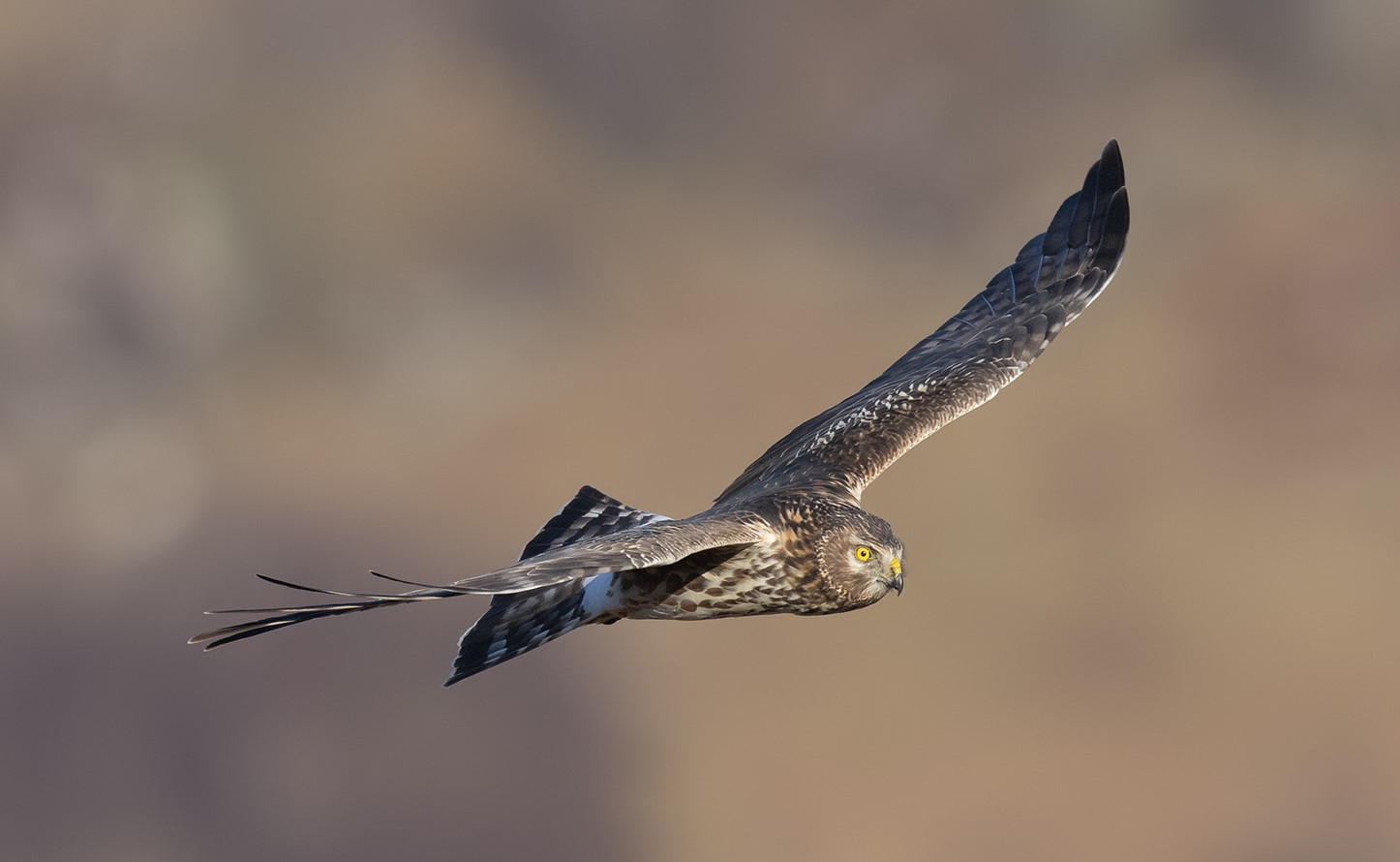
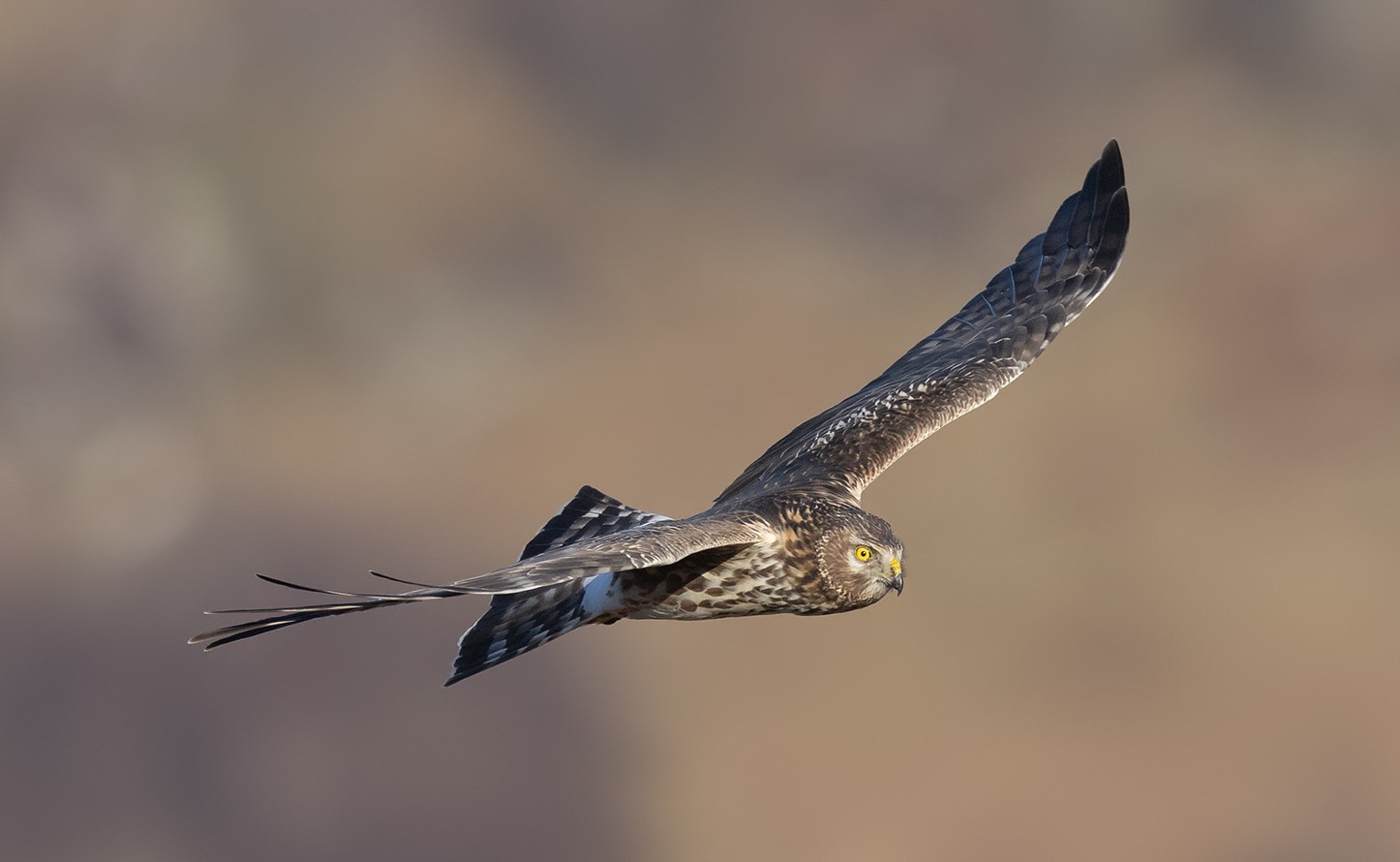
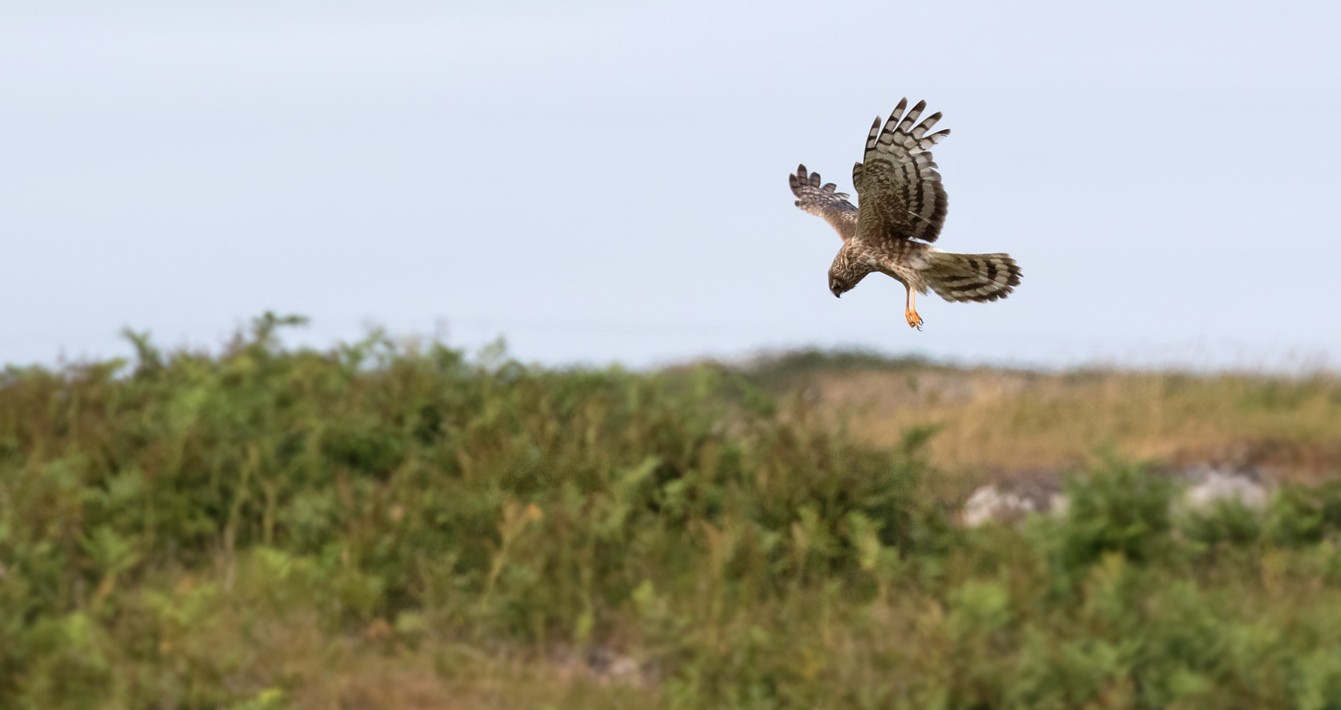
Here’s another one. This time found illegally poisoned on a grouse moor in North Yorkshire.
Once again, the details of the illegal killing of this latest Hen Harrier have only become public after careful scrutiny of a national database (this one operated by the Health & Safety Executive) – an entry on a spreadsheet rather than a full-blown press release from the investigating authorities.
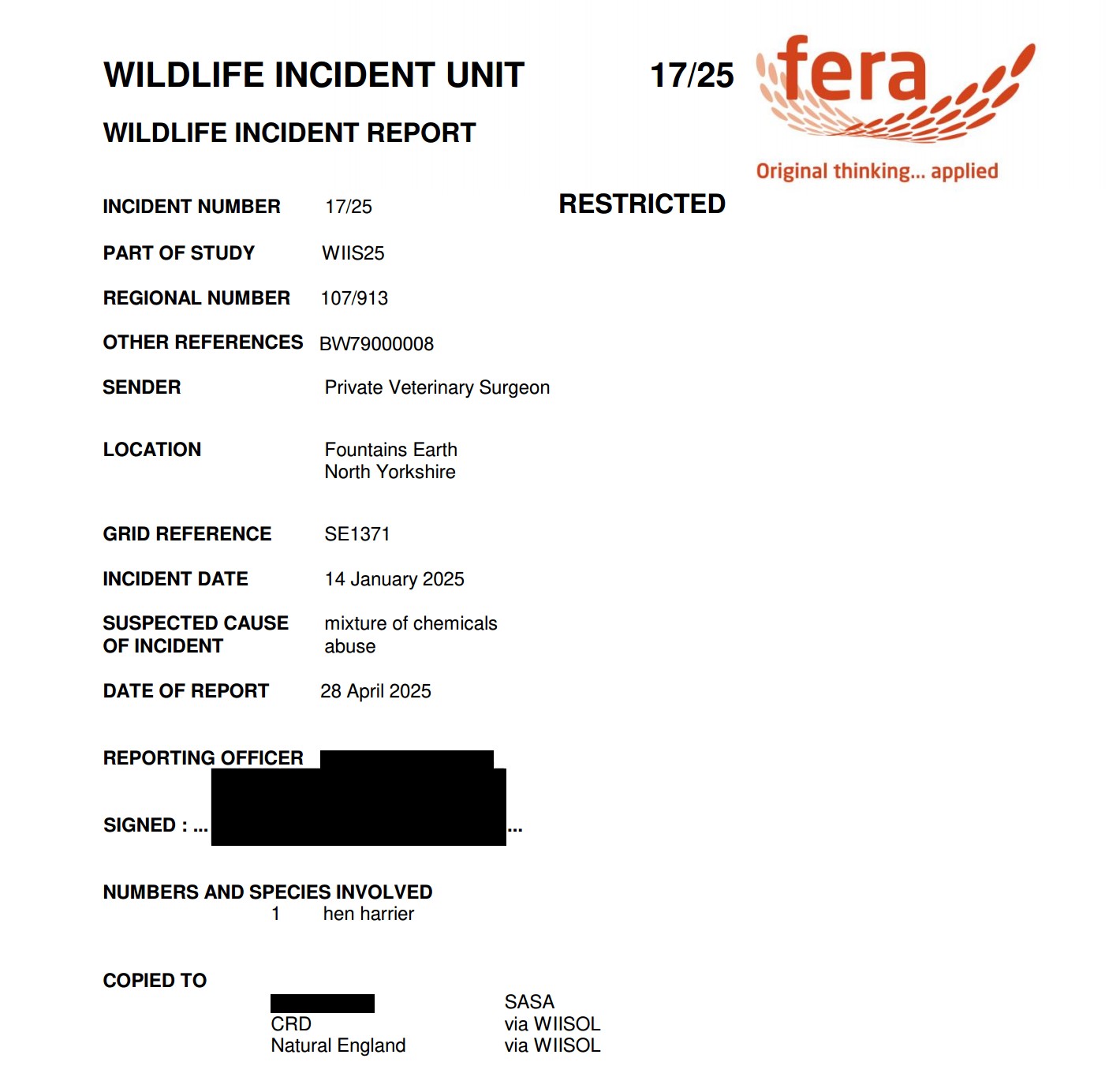
Here are the limited details that I’ve found:
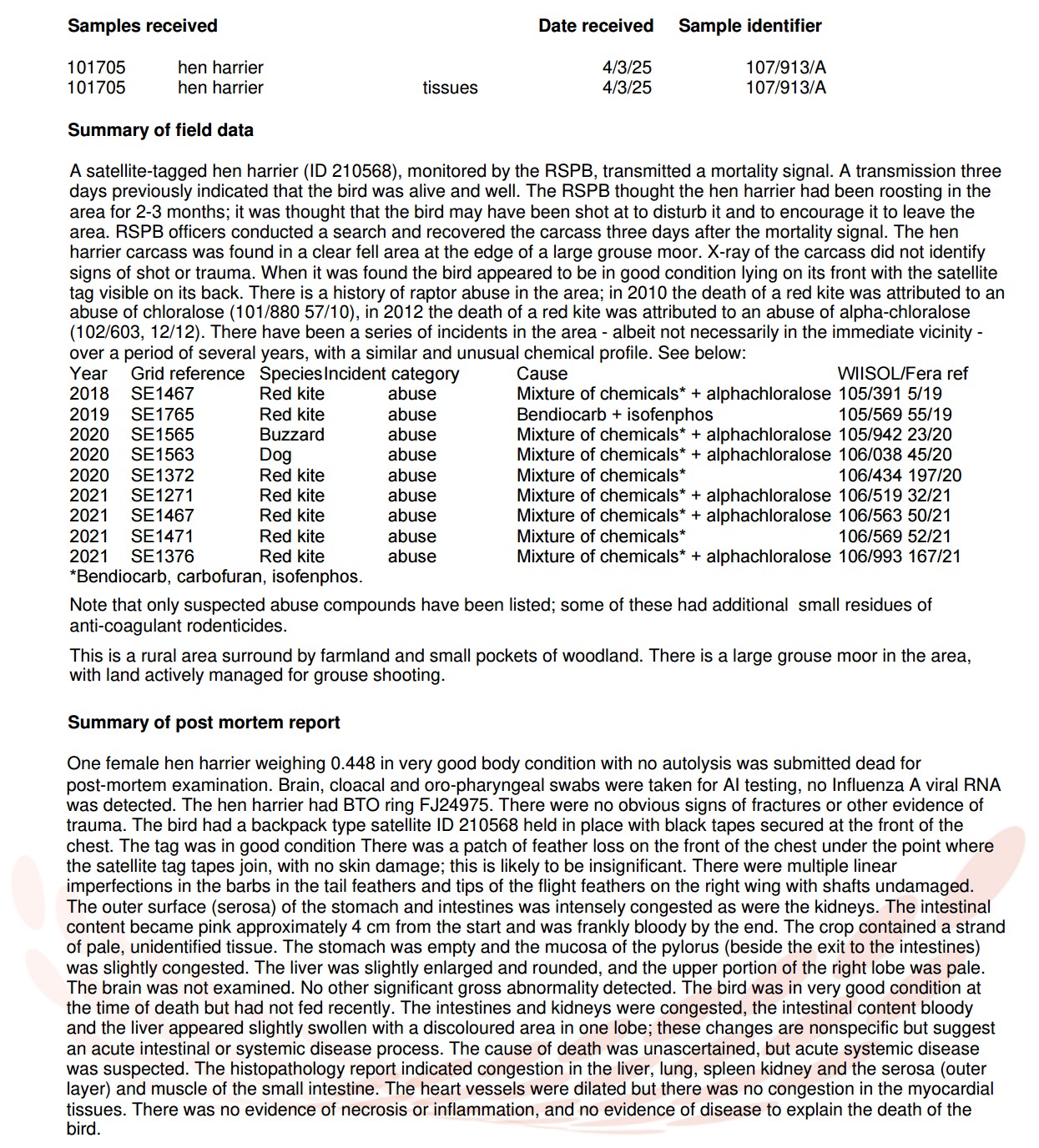
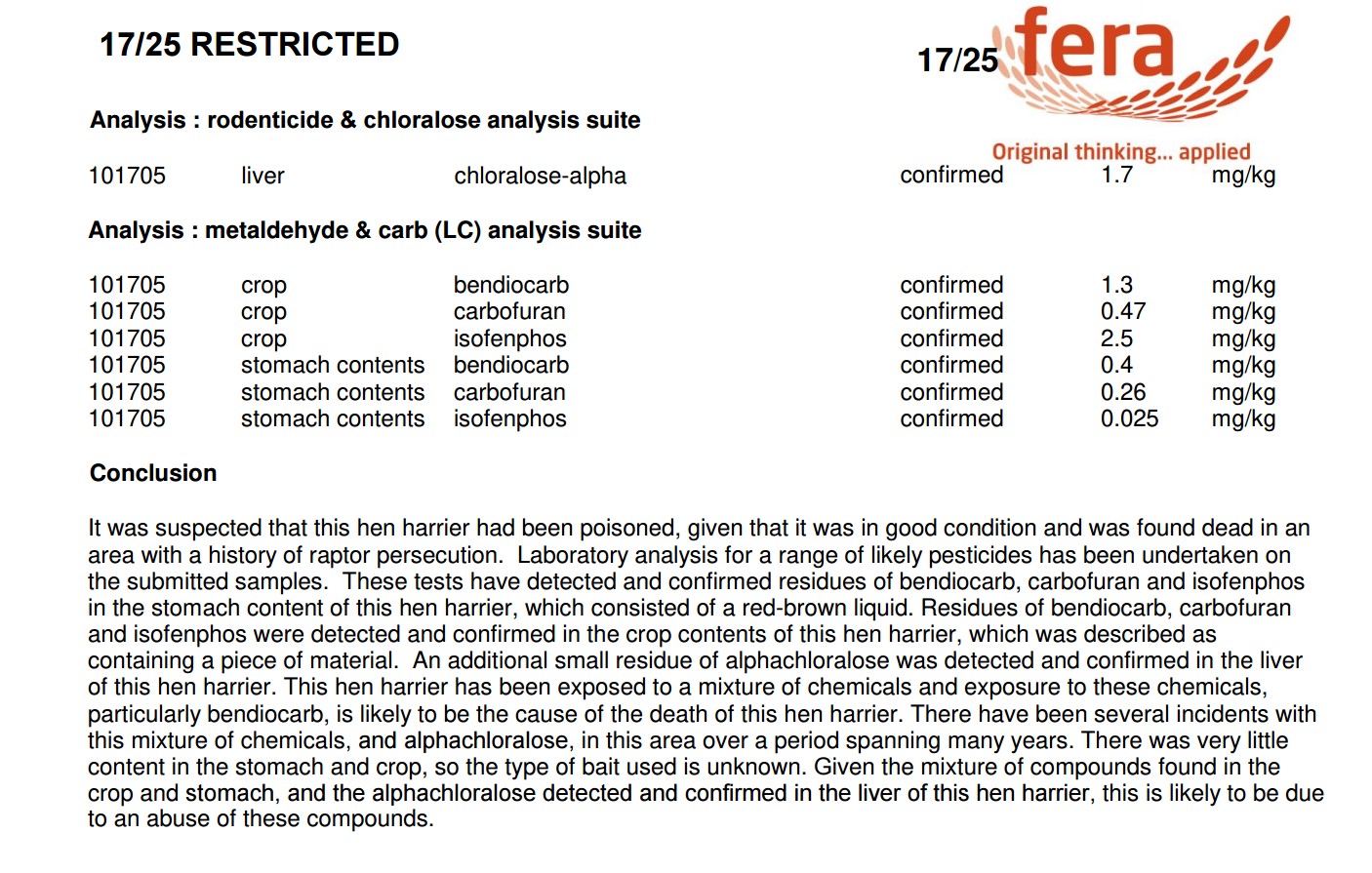
HSE Ref number 107/913. Confirmed poisoning, North Yorkshire, January 2025. Chemicals Bendiocarb, Carbofuran, Isophenphos, Alphachloralose. Notes: ‘A dead Hen Harrier was found on a grouse moor. Residues of Bendiocarb, Carbofuran, Isophenphos and Alphachloralose were found in the samples analysed, which is an abuse of these compounds. Case closed as passed to the Police‘.
I haven’t seen ANY police appeal or press release about the illegal poisoning of this Hen Harrier or the discovery of its corpse in North Yorkshire 11 months ago in January 2025. Not a single word.
Where is the publicity from the National Wildlife Crime Unit-led Hen Harrier Taskforce? The specialist group set up explicitly to tackle the ongoing illegal killing of Hen Harriers. Not a single word.
Where is the publicity from the police-led national Raptor Persecution Priority Delivery Group (RPPDG), one of whose functions is apparently ‘awareness raising‘ and ‘raising the profile [of illegal raptor persecution] via media exposure‘? Not a single word.
Poisoning is not a commonly-used method for killing Hen Harriers because this species is not a routine carrion eater. Typically they are shot when foraging low for live prey or flying towards a roost site, or trapped on or next to their nest sites and then bludgeoned to death instead. Although there was one case of a Hen Harrier being found poisoned on a Pheasant-shoot in County Meath, Ireland in 2019 (here).
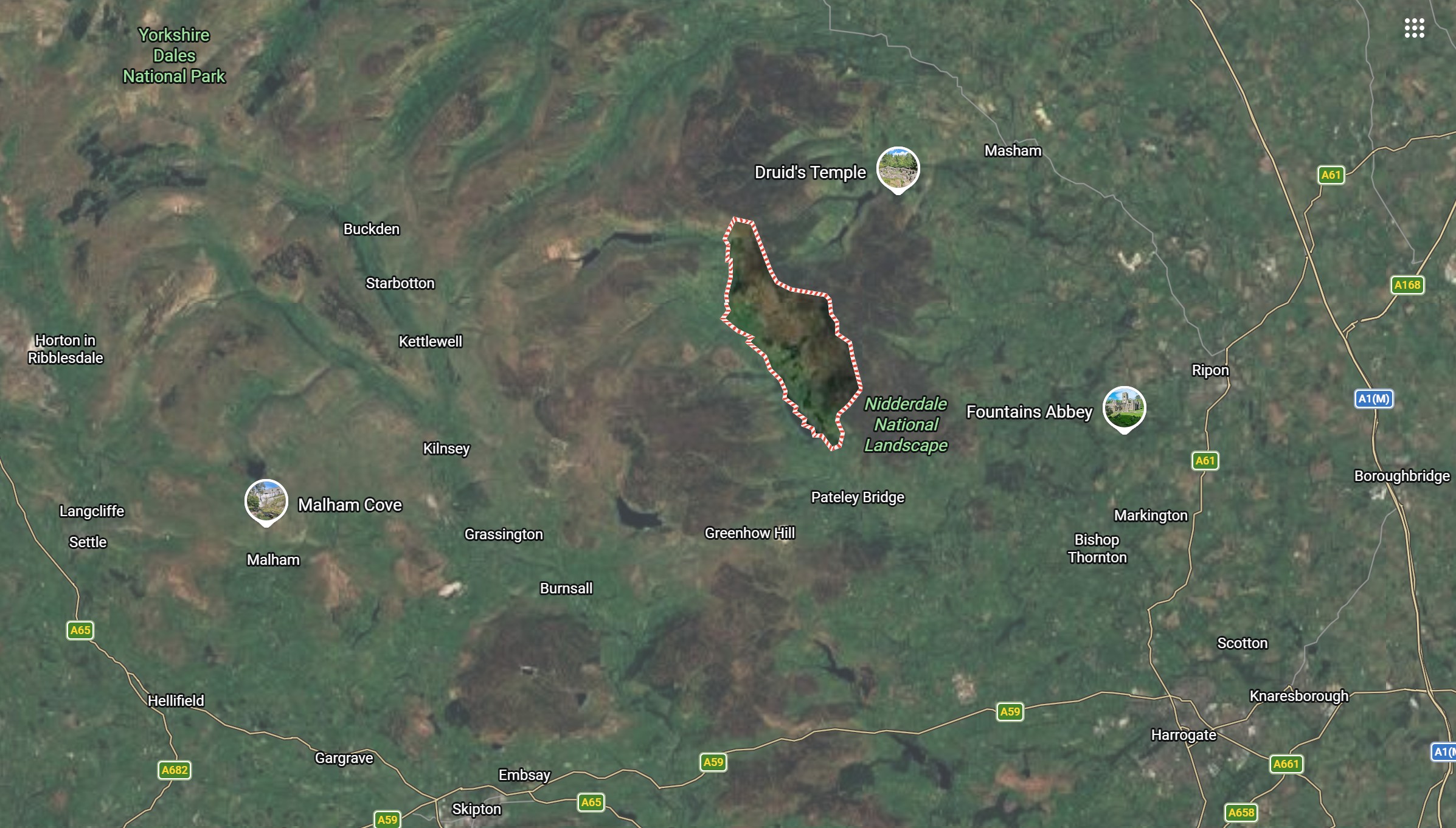
The information I’ve gleaned so far about this latest Hen Harrier poisoning just refers to ‘North Yorkshire’. It’s a huge county, with grouse moors in the Yorkshire Dales National Park, Nidderdale National Landscape (previously called an AONB), and the North York Moors National Park.
However, the eagle-eyed amongst you will have noticed the distinctive combination of chemicals used – a highly lethal mixture widely known as the ‘Nidderdale Cocktail’, so described due to the frequency of use of this nasty combination in Nidderdale, where it has killed a number of birds of prey over the years, particularly Red Kites, and also a pet dog (see here).
That might suggest a Nidderdale grouse moor as the location of the January 2025 Hen Harrier poisoning, although the Nidderdale Cocktail has also been detected in other poisoning cases as far north as Scotland, perhaps indicative of gamekeepers moving jobs, so it’s not conclusive.
This isn’t the first time that I’ve been critical of an apparent lack of action from North Yorkshire Police in relation to a national wildlife crime priority incident. Just a couple of years ago they refused to investigate the circumstances of an illegally poisoned Red Kite that had been found dead on Swinton Estate (see here).
This apparent lack of inertia is in direct contrast to how North Yorkshire Police’s Rural Crime Team used to function a few years ago, under different leadership, when it was proactive and very public about its work (e.g. see here, here, here, here etc).
I’ve submitted a number of FoIs to various agencies about this latest Hen Harrier persecution incident. I’ll report more when they respond.
The BBC’s Highland Cops programme has entered its third series and episode 2 features the police investigation in to an active Goshawk nest that had been shot out on a sporting estate near Kingussie, on the western side of the Cairngorms National Park.
This investigation took place in June 2024 – see here for the police’s appeal for information at the time.
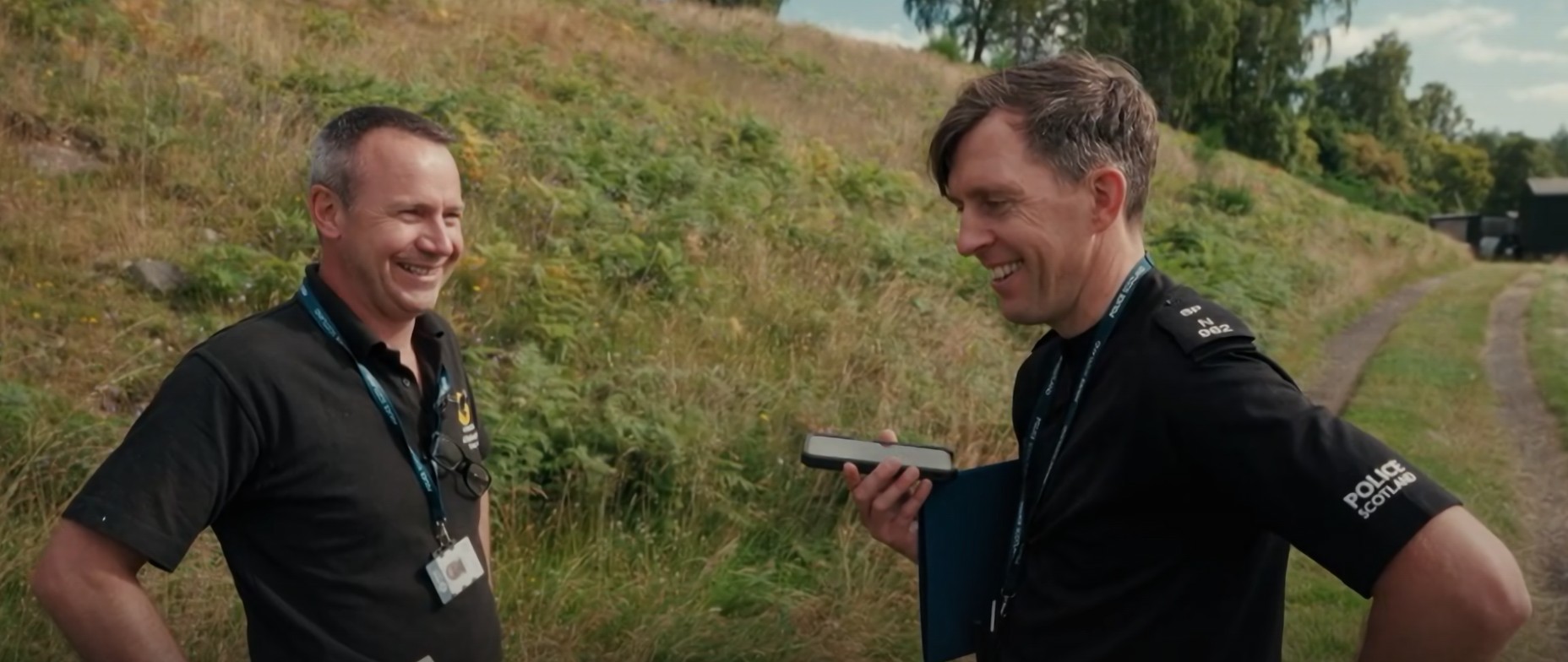
Screengrab from BBC Highland Cops programme
Officers had received a report of the active Goshawk nest being found abandoned in suspicious circumstances in a forest near Loch Gynack, and the programme follows experienced wildlife crime officer PC Dan Sutherland throughout his investigation.
The commentary from Dan is excellent – he speaks calmly and with authority about the link between illegal raptor persecution and gamebird shooting estates, and how the criminals have been getting away with their crimes for so long. That’s not opinion or conjecture, it’s based on factual evidence, and I applaud him for being prepared to say it on camera, knowing full well that it will attract vicious retaliation from some within the gamebird shooting industry, including, I have no doubt, official letters to his superior officers demanding punitive action against him.
Dan visits the abandoned Goshawk nest where he finds empty shotgun cartridges at the base of the tree and a shotgun wad is found lodged in the bottom of the nest.
The nest is removed for forensic examination, along with several nearby tree branches. They’re taken to the Kincraig Wildlife Highland Park for x-rays, which reveal a large number of shotgun pellets:
As Dan says, the evidence is damning.
He then teams up with PC Gavin Ross from the National Wildlife Crime Unit (NWCU) and they set out to visit all the people who legally own shotguns in the area, to either rule them out of the enquiry or to see if they can provide assistance.
The first person they visit is a gamekeeper who lives on the estate. They knock at his house and a woman speaks to them through a crack in the door, telling them he’s not in. As the officers leave to go and visit the next person on their list, Dan gets a phone call from a solicitor who tells him that none of his clients will be talking to the police without him being present.
“It’s the nature of the beast”, says Dan.
Dan and Gavin comment to one another that the speed of the solicitor’s phone call is probably some kind of record – coming in less than ten minutes after they’d knocked on the gamekeeper’s door. Their wry smiles tell you this is a common occurrence and was not unexpected. It puts a halt to their investigation until they can organise a time to meet with the shotgun owners and their legal representative.
PC Gavin Ross & PC Dan Sutherland take a call from the gamekeeper’s solicitor (screengrab from BBC Highland Cops).
If someone had shot out a Goshawk nest on my land, potentially killing any adults or chicks present on the nest, and the police knocked on the door to see if I could assist, I’d be welcoming them in with open arms, breaking out the tea and posh biscuits and offering up all the assistance I could muster to help them find the culprit, especially if there was evidence that armed criminals had been active on my property. I certainly wouldn’t be calling in my attack dog solicitor to warn off the cops. Why would I?
At the end of the programme there’s an update on the case – the police did meet with the shotgun owners and their solicitor. The text on the screen says:
‘However, with no new leads the case has been closed‘.
I guess it was probably the usual ‘no comment’ interviews, then.
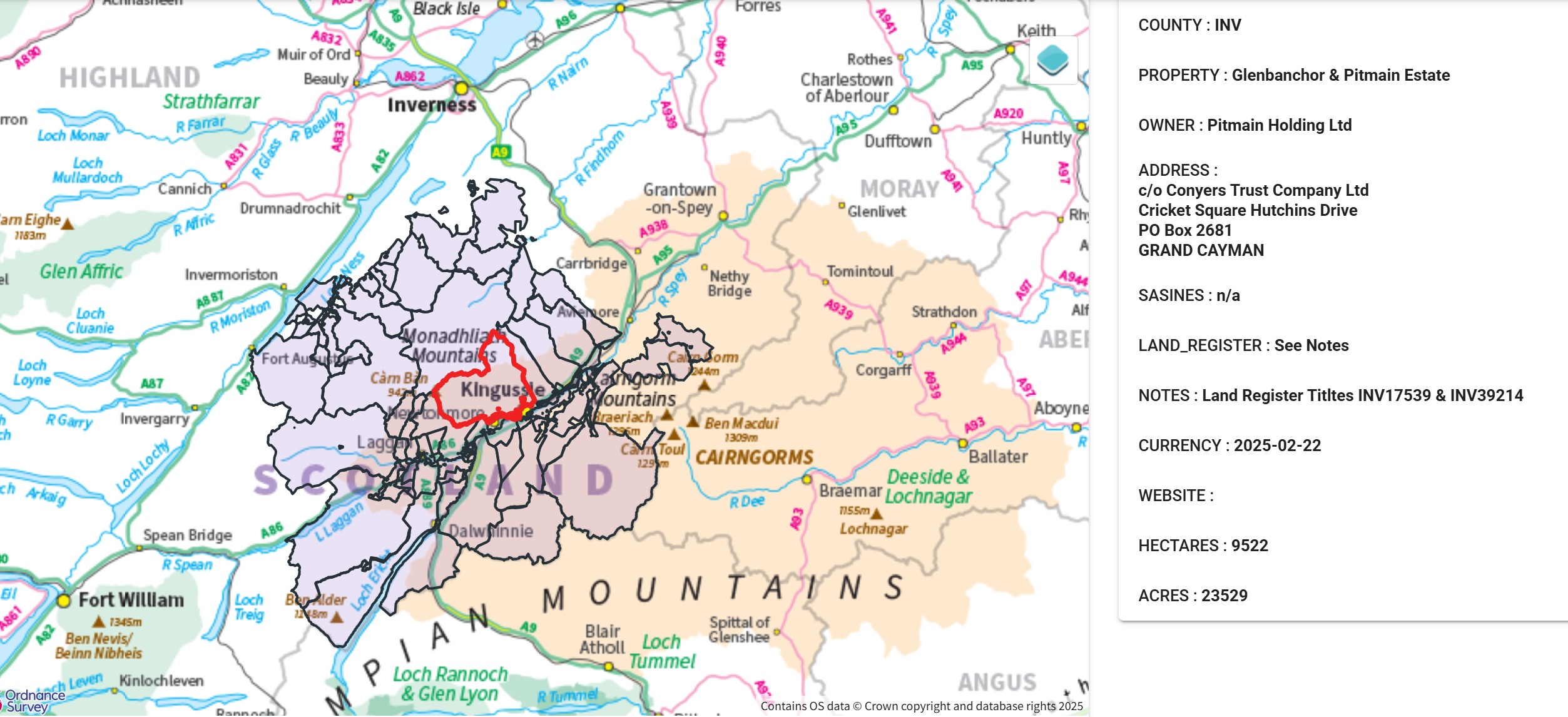
According to Andy Wightman’s excellent Who Owns Scotland website, Loch Gynack is situated on the Glenbanchor & Pitmain Estate, whose owner, Pitmain Holding Ltd, is registered in Grand Cayman:
It’s not the first time a police investigation has taken place there in relation to suspected wildlife crime. In 2019, four Greylag Geese were found poisoned at Loch Gynack – toxicology results showed they’d ingested the banned pesticide Carbofuran, so dangerous that it’s an offence to even possess this chemical in Scotland, let alone use it.
The birds had been found by estate workers who reported the incident to the police. There wasn’t any information about whether poisoned bait had been discovered and so no information about where they’d come in to contact with the Carbofuran, although given how fast-acting it is and the fact the geese were found dead together in one place, I’d think it unlikely they’d been poisoned far away.
Nobody was charged and the estate was not subject to a General Licence restriction.
Back to the Goshawk case…
The police were first notified about the abandoned Goshawk nest on 8 June 2024. This was after the enactment of the Wildlife Management & Muirburn (Scotland) Act 2024 on 30 April 2024, which introduced a licence for grouse shooting in Scotland.
I don’t know whether the Glenbanchor & Pitmain Estate applied for a grouse shooting licence in 2024. I don’t even know if they still shoot Red Grouse there (they certainly have done previously – e.g. see here and here) or whether they’ve switched to Red-legged Partridges and Pheasants as alternative quarry due to low grouse stocks, in which case they’d be exempt from needing a grouse shooting licence because the Scottish Government refused to include the shooting of RLPs and Pheasants as part of the requirement for a grouse shooting licence, despite being warned about this massive loophole.
It would be interesting to know whether (a) Pitmain Estate did apply for a grouse shooting licence in 2024, (b) if so, did NatureScot grant them a licence even though this wildlife crime investigation was ongoing, and (c) if the estate does have a five-year grouse shooting licence, will the licence be withdrawn following this incident or was the Goshawk nest beyond the area where the licence applicant indicated Red Grouse are ‘taken or shot’ (yet another loophole)?
Aside from the questions around a potential grouse shooting licence, I’ve been interested in whether NatureScot would impose a General Licence restriction following the police investigation in to the shot out Goshawk nest.
In June this year I submitted an FoI to NatureScot to ask about the status of any pending General Licence restriction decisions. My main focus was on the case concerning a Golden Eagle called ‘Merrick’ who had been shot and killed whilst she was sleeping in the Scottish Borders in October 2023.
You’ll already know that NatureScot has still not made a decision on whether to impose a General Licence restriction as a result of that crime, two years after it happened (see here).
But as well as asking about the Merrick case, I also asked how many other cases were pending.
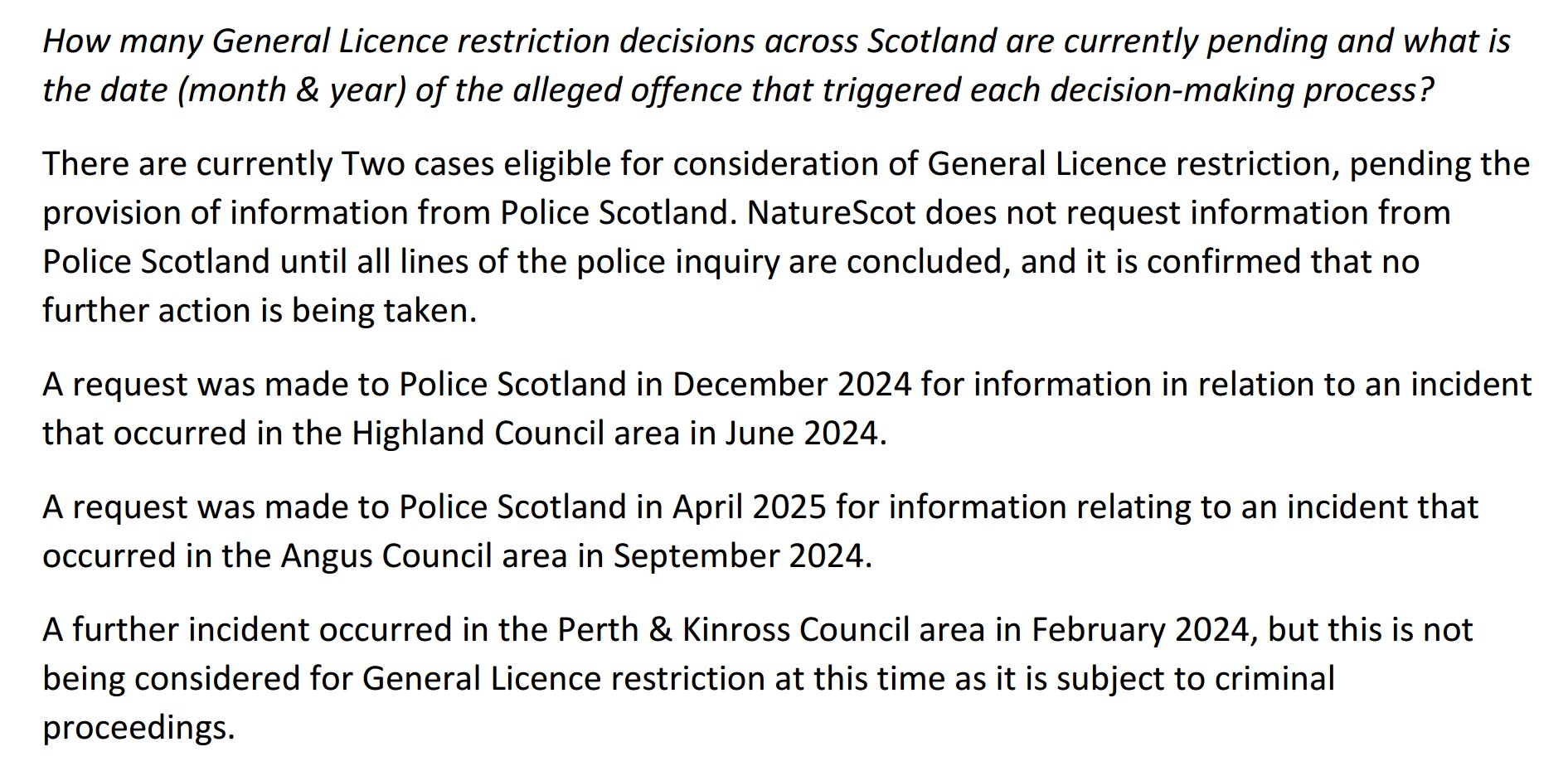
NatureScot wrote back to me in July and said this:
You can see that the case involving the shot out Goshawk nest is included on the list (‘an incident that occurred in the Highland Council area in June 2024‘).
NatureScot says it asked Police Scotland in December 2024 for the information package NS would need to begin the process of considering whether to impose a General Licence restriction.
Seven months on, in July 2025 when NatureScot responded to my FoI, Police Scotland hadn’t provided the information to NatureScot.
The Highland Cops programme demonstrates the evidential difficulties faced by the police when investigating suspected wildlife crimes, particularly those that take place on privately-owned gamebird shooting estates, and the lengths the police will go to to find out who was responsible. It was the very reason that the Scottish Parliament introduced grouse shoot licensing as part of the Wildlife Management & Muirburn (Scotland) Act 2024.
The efforts made by PC Dan Sutherland and his colleagues were exemplary in this case. But someone, somewhere, has dropped the ball in the later stages of the enforcement process by not providing an information package in a timely manner. That’s just not good enough.
The Highland Cops episode (series 3, episode 2) is available on the BBC iPlayer here. It’s well worth an hour of your time.
A new BBC documentary aired last night that charts the police investigation into a missing charity cyclist, Tony Parsons, who vanished at the Bridge of Orchy in 2017 and whose remains were found three years later buried in a stink pit on the Auch Estate.
The programme follows the criminal trial of twin brothers Alexander (Sandy) and Robert McKellar from the Auch Estate, initially charged with murder but in 2023 Alexander was eventually convicted for the lesser offence of culpable homicide and Robert for attempting to defeat the ends of justice.
This case was of interest to me because the Auch Estate was at the centre of another criminal investigation in 2009 after walkers discovered a dead Golden Eagle. Tests revealed it had been illegally poisoned with the banned pesticide Carbofuran.
In 2012 Auch Estate farm manager Tom McKellar was convicted and fined £1,200 for possession of Carbofuran (not for poisoning the eagle, even though he had reportedly admitted during interview of putting out poisoned baits). He was also found to be in possession of two unlicensed handguns but instead of receiving a mandatory five-year custodial sentence he was given a 300-hour community service order.
From the Guardian, June 2009
The new BBC documentary provides a fascinating insight into the difficulties of investigating serious crime on a remote rural estate and the parallels with investigations into illegal raptor persecution in these glens will not be lost on blog readers. The ease with which the McKellar twins could hide their appalling crimes for so long is sobering.
Many, many thanks to all of you who signed the Northern Ireland Raptor Study Group’s (NIRSG) petition calling for a ban on the possession of dangerous, raptor-killing pesticides.
The petition has just passed its target of 50,000 signatures and the NIRSG has issued the following press release:
The NIRSG held a recent Raptor Conference which provided incredible insights into a range of topics locally and globally. Many of the talks raised a consistent theme of targeted persecution of birds of prey. Not least amongst these was the on-going issue in Northern Ireland of the Possession of Dangerous pesticides.
Some of the NIRSG 2025 conference attendees supporting the call for a ban on dangerous, raptor-killing pesticides. Photo by Marc Ruddock
The NIRSG highlighted that 63 raptors have been killed between 2009 and 2023 with a range of poisons, dominated by Carbofuran which has been banned for nearly 25 years. There have been at least 30 buzzards, 16 peregrine falcons, 13 red kites, 3 white tailed eagles and 1 golden eagle all poisoned in this time frame.
This evidence is collated by the Partnership for Action Against Wildlife Crime in Northern Ireland (PAW NI) and published in raptor persecution reports, which include ‘hotspots’ of illegal killing of our native birds of prey. These reports are publicly available on the PAWNI webpage available here and also aggregated in the RSPB Bird Crime reports available here.
In 2011, the wildlife legislation in Northern Ireland was strengthened, resulting in increased sentences of £5,000 fines (per offence) and up to 6 months imprisonment. The updated laws included a provision to ban the possession of prescribed ingredients under “Section 15B Possession of pesticides harmful to wildlife” of the Wildlife (Northern Ireland) Order 1985 as amended.
As part of that legislation there should have been an attached Order listing the banned chemicals. That list has never been created. Wildlife has continued to be poisoned by these dangerous and banned substances.
The legislation states in Section 15B Part 2: “A prescribed ingredient is one which is prescribed for the purposes of this Article by an order made by the Department; but the Department may not make an order under this Article unless it is satisfied that it is necessary or expedient to do so in the interests of protecting wild birds or wild animals from harm”. [Emphasis added by NIRSG]
There is significant evidence of continued harm from banned pesticides to birds of prey, based on robust post-mortem and laboratory results, which has been published in many reports. We believe it is indeed expedient for Minister Andrew to implement this Order to protect our birds of prey from harm. 50,000 people agree with us. Thank you to everyone who has supported the petition and helped give a voice to our wildlife.
The NIRSG will be seeking a meeting with Minister Andrew Muir to present the petition now that it has surpassed 50,000 signatures.
Press release from PSNI (Police Service for Northern Ireland), 13 December 2024
POLICE CONFIRM BIRD POISONING IN ARMAGH
Police have confirmed that an adult bird of prey was found dead in the Forkhill area of Armagh in June of this year was poisoned.
It was reported on the 12th June that a Peregrine Falcon was found dead in the Forkhill area. The bird was retrieved by our search and rescue team and underwent testing to ascertain the exact circumstances, with enquiries ongoing the last number of months.
Constable Millen said: “We can now confirm the Peregrine Falcon found was poisoned with Carbofuran which is very concerning. This is not only a dangerous substance but it has been banned since 2001.
“We would remind the public if there is a suspicion of a crime, such as poisoning on any bird of prey in their local area, to leave the bird(s) and/or bait in situ and to call the police as soon as possible for officers to action.
“We have been working closely with our partners in Northern Ireland Environment Agency and National Wildlife Crime Unit and Northern Ireland Raptor Study Group regarding the matter and will continue to do so, in the hope to find those responsible.
“Police would appeal to anyone who has information on any suspected bird poisoning to please make contact via our non-emergency number 101, or online at http://www.psni.police.uk/makeareport/ or you can contact Crimestoppers anonymously on 0800 555 111 or online at http://crimestoppers-uk.org/.
ENDS
As far as I’m aware, nobody has ever been prosecuted for the illegal poisoning of any wildlife in Northern Ireland, which might explain why poisoning offences, especially against birds of prey, continue.
The Police waiting for six months before issuing an appeal for information about a poisoning crime won’t help, either.
Following the illegal poisoning of two white-tailed eagles in May 2023, found dead together on Northern Ireland’s only driven grouse moor at Glenwherry in the Antrim Hills (here), the Northern Ireland Raptor Study Group launched a petition calling for a ban on the possession of dangerous pesticides (here).
This petition is still live and has attracted almost 46,000 signatures. If you’d like to support it, please click here (you don’t have to be a resident/citizen of NI to sign – it’s open to anyone).
To learn more about recent raptor persecution incidents in Northern Ireland, this excellent report is well worth a read. It covers incidents reported in 2021 and 2022 (published May 2024).
The bird had consumed a banned pesticide which has a history of being used to kill birds of prey.
Red Kites are fully protected by law, and to kill or harm one could result in jail.
The illegal poisoning of birds of prey is a national issue and poses a potentially deadly danger to people, pets and wildlife.
A protected Red Kite endured an ‘agonising death’ after being killed by a banned pesticide, one quarter of a teaspoon of which is enough to kill a human.
RSPB Scotland received a call in April 2024 from a dog walker who had found a red kite dead on the ground near to a popular woodland walking trail, adjacent to hill farm land at Spinningdale, near Dornoch in East Sutherland.
RSPB Investigators notified Police Scotland, collected the bird and sent it for a post-mortem examination and toxicology analysis. The results were consistent with Carbofuran poisoning being the cause of the bird’s death, a pesticide banned for over 20 years.
Police Scotland and partner agencies conducted a search of the area but found no evidence that enabled them to identify a suspect.
It is a crime to kill or attempt to kill a bird of prey, and anyone caught doing so faces a fine or even jail.
The latest Birdcrime report, released last month found there were 159 poisoning incidents involving birds of prey between 2009-2024 in Scotland. In recent years, Carbofuran has become the pesticide most frequently associated with bird of prey persecution.
And of all UK counties, the Highland area had the second highest number of confirmed incidents of raptor persecution during the same 15-year period.
Ian Thomson, RSPB Investigations Manager, said:
“We are very grateful to the person that found this dead kite for reporting it to us. It is appalling that individuals are still using this poison, decades after it was banned, and this bird will have suffered an agonising and horrific death.
Carbofuran is a highly toxic substance and is one of several banned pesticides still used by criminals targeting birds of prey or other protected wildlife. Its possession or use is illegal and placing it out in the open poses a potentially deadly and indiscriminate risk not only to wildlife but to people and pets.
We ask anyone using the area to be vigilant if they find anything suspicious, don’t touch, but do take photos and report to Police Scotland immediately on 101.”
If you notice a dead or injured bird of prey in suspicious circumstances, call Police Scotland on 101 and fill in the RSPB’s online reporting form here.
If you have information about anyone killing birds of prey which you wish to report anonymously, call the RSPB’s confidential Raptor Crime Hotline on 0300 999 0101.
POISONED BUZZARD LEADS TO ASHLEY GAME FARM & THE COMPANY’S DIRECTOR PAYING OVER £40,000 IN FINES
The discovery of a poisoned Buzzard next to a poisoned bait led to the search of a gamebird breeding farm in Chulmleigh, Devon conducted by Devon and Cornwall Police in March 2021.
A number of pesticides offences were discovered including the presence of Carbofuran, the same highly toxic chemical found on the poison bait that had killed the Buzzard.
On 18 July 2024 after pleading guilty to multiple pesticide offences Ashley Game Farm Ltd was ordered to pay £40,000 in fines and the company’s Director, Christopher Hodgson, was fined £1,500.
In October 2020, a member of the public discovered a dead Buzzard– a protected species under the Wildlife and Countryside Act 1981 – lying on top of a pheasant carcass by a pheasant release pen, near Hollocombe in Devon, and promptly reported it to Devon and Cornwall Police.
The two birds and a second dead pheasant found nearby were submitted by the police to the Government’s Wildlife Incident Investigation Scheme (WIIS) for examination and toxicology testing. Meat found in the Buzzard’s beak and both pheasant carcasses tested positive for Carbofuran. This evidence confirmed that the Buzzard had died as a result of feeding on the illegally placed poison baits.
In March 2021, following the toxicology results, a search of land, buildings and vehicles led by Devon and Cornwall police, supported by the National Wildlife Crime Unit, Natural England and the RSPB, took place at Ashley Game Farm in Chulmleigh, Devon. During the search significant amounts of prohibited and unauthorised pesticides and veterinary medicines were found stored around the property. A forensic search of two vehicles detected positive traces of the banned pesticide Carbofuran – the same banned pesticide which had been found on the pheasant carcasses and which had caused the Buzzard’s death.
Photo by RSPB Investigations
Ashley Game Farm is a member of the Game Farmers Association and a leading UK supplier of game birds including (Pheasant and Red-legged Partridge) which are sold as young birds to shooting estates across the UK and Europe, where in many cases they are reared and released to be commercially shot.
The insecticide Carbofuran has been banned in the UK since 2001 because of its high toxicity and associated risks. Although the storage and use of any product containing Carbofuran is an offence, it is one of the most commonly abused substances associated with the illegal poisoning of birds of prey, accounting for almost one third of all bird of prey persecution poisoning incidents in England between 2018 and 2022.
The practice of laying poisoned baits to persecute protected birds of prey is often associated with areas managed for gamebird shooting where these birds are perceived by some as a threat to gamebird stocks. Deliberate poisoning has resulted in the death of many species of protected birds of prey over decades. Historic incidents have shown this indiscriminate illegal practice has also resulted in the death of domestic animals and poses significant risks to humans, wildlife and the environment.
On 18 July 2024 at Exeter Magistrates Court, Ashley Game Farm and the Director of the company were charged with the following offences:
Ashley Game Farm:
On or before 26/03/2021 at Ashley Game Farm Limited, namely stored a plant protection product, namely Rivett MAPP 11300, without a valid authorisation or permission granted in accordance with Retained EU Regulation 1107/2009. Contrary to section 24 and 27 of the Plant Protection Products (Sustainable Use) Regulations 2012.
Between 01/10/2020 and 27/03/2021 at Ashley Game Farm Limited, used a plant protection product, namely Carbofuran, in contravention of Article 28 (1) of Retained EU Regs 1107/2009. Contrary to section 24 and 27 of the Plant Protection Products (Sustainable Use) Regulations 2012.
On or before 26/03/2021 at Ashley Game Farm Limited, used a Biocidal product, namely Lodi’s Sapphire Grain otherwise in accordance with the terms and conditions of its authorisation under Article 22 (1) and the labelling and packaging requirements of Article 69. Contrary to section 24 and 27 of the Plant Protection Products (Sustainable Use) Regulations 2012.
On or before 26/03/2021 at Chulmleigh contravened a requirement imposed by a prohibition notice served under section 22 of the Health and Safety at Work etc Act 1974 in that used a Biocidal product, namely Mole Valley Farmers Difenacoum Cut Wheat Rat Bait without authorisation being in force allowing for its use. Contrary to sections 22 and 33(1)(g) of the Health and Safety at Work etc Act 1974.
On or before 26/03/2021 at Chulmleigh in the county of Devon possessed an unauthorised veterinary medicinal product, namely possessed an unauthorised veterinary medical product, namely Dimetridazole (DMZ). Contrary to regulations 26(1), 43(r) and 44(1) of the Veterinary Medicines Regulations 2013.
Christopher Hodgson, Director of Ashley Game Farm:
On or before 26/03/2021 at being a Director of Ashley Game Farm Limited, a body corporate who had committed an offence, stored a plant protection product, namely Rivett MAPP 11300, without a valid authorisation or permission granted in accordance with Retained EU Regulation 1107/2009 and the offence was committed with the consent or connivance, or attributable to the neglect of Christopher Hodgson. Contrary to section 24 and 27 of the Plant Protection Products (Sustainable Use) Regulations 2012.
The company Ashley Game Farm Ltd pleaded guilty to all five charges and was ordered to pay £40,000 in fines and £590 in costs. Christopher Hodgson pleaded guilty to the one offence and was ordered to pay £1,500 in fines and £150 in costs.
Mark Thomas, RSPB Head of Investigations UK: “Yet again the discovery a dead bird of prey and poisoned baits leads to the detection of lethal banned poisons. This is the latest example of highly toxic pesticides being stored and used illegally in connection with the gamebird industry. As past cases have demonstrated these chemicals are extremely hazardous to our wildlife and environment, but also pose a considerable risk to members of the public and domestic animals. In this case, we welcome the significant fines despite not knowing who exactly killed the protected bird of prey.”
Howard Jones, RSPB Senior Investigations Officer: We would like to thank Devon and Cornwall Police, Natural England, NWCU, CPS and Defra. This successful outcome was the result of some incredibly effective partnership working. The fact that Carbofuran is still being found 20 years after it was banned shows the lack of reform, as the law stipulates, being shown by some within the gamebird industry. As this case has shown, individuals and businesses that chose to store and use these types of highly toxic pesticides are taking significant risks and committing serious criminal offences.
Jenny Mashford, Devon and Cornwall Police: “This incident was brought to the police’s attention thanks to a member of the public who identified the poisoned raptor. We carried out a warrant at the defendant’s premises with the assistance of several other agencies including Natural England, the National Wildlife Crime Unit, the RSPB and Defra. It is a very positive outcome in our fight against wildlife crime, of which bird of prey crime is a national wildlife crime priority. We would like to thank all those involved for their hard work and assistance with this case.”
If you notice a dead or injured bird of prey in suspicious circumstances, call the police on 101 and fill in the RSPB’s online reporting form HERE.
If you have information about anyone killing birds of prey which you wish to report anonymously, call the RSPB’s confidential Raptor Crime Hotline on 0300 999 0101.
Prominent gamebird breeder Christopher Hodgson, Director of Ashley Game Farm Ltd in Wembworthy, Chulmleigh, Devon appears to have pleaded guilty to multiple offences including the use of the banned pesticide Carbofuran.
Ashley Game Farm Ltd is an exceptionally large breeding facility that, according to its website, ‘specialises in supplying pheasants and partridges to shoots in the west country and all areas of the UK and Europe‘. It claims to have ‘a hatching capacityfor 410,000 eggs per week along with further investment in a second location atTarrington, Hereford‘ and ‘retains around 80,000 chicks at Ashley Game Farm every week‘.
A multi-agency raid was carried out at Ashley Game Farm in March 2021 (here) following the discovery of a poisoned buzzard and poisoned baits in 2020.
Officers from Devon & Cornwall Police, Natural England, National Wildlife Crime Unit and the RSPB recovered a number of substances during the raid that were then sent for expert analysis.
Multi-agency raid in 2021. Photo by RSPB Investigations
This led to charges being laid against Christopher Hodgson as well as Ashley Game Farm Ltd in relation to the alleged use of Carbofuran and the alleged possession, storage and use of various plant protection, veterinary medicine and rodenticide products without authorisation at the game farm (see here).
Despite being banned for use in the EU for over 20 years, Carbofuran remained the ‘gamekeepers poison of choice’ for the illegal killing of raptors in the UK for many years, although in the last few years it has been overtaken by Bendiocarb.
Hodgson was due to appear in court today but information provided by the North and East Devon Magistrates Court indicates he and Ashley Game Farm Ltd have already pleaded guilty and will be sentenced in July.
Here are the details of the offences provided by the court:
Ashely Game Farm:
On or before 26/03/2021 at Ashley Game Farm Limited, namely stored a plant protection product, namely Rivett MAPP 11300, without a valid authorisation or permission granted in accordance with Retained EU Regulation 1107/2009. Contrary to section 24 and 27 of the Plant Protection Products (Sustainable Use) Regulations 2012.
Between 01/10/2020 and 27/03/2021 at Ashley Game Farm Limited, used a plant protection product, namely Carbofuran, in contravention of Article 28 (1) of Retained EU Regs 1107/2009. Contrary to section 24 and 27 of the Plant Protection Products (Sustainable Use) Regulations 2012.
On or before 26/03/2021 at Ashley Game Farm Limited, used a Biocidal product, namely Lodi’s Sapphire Grain otherwise in accordance with the terms and conditions of its authorisation under Article 22 (1) and the labelling and packaging requirements of Article 69. Contrary to section 24 and 27 of the Plant Protection Products (Sustainable Use) Regulations 2012.
On or before 26/03/2021 at Chulmleigh contravened a requirement imposed by a prohibition notice served under section 22 of the Health and Safety at Work etc Act 1974 in that used a Biocidal product, namely Mole Valley Farmers Difenacoum Cut Wheat Rat Bait without authorisation being in force allowing for its use. Contrary to sections 22 and 33(1)(g) of the Health and Safety at Work etc Act 1974.
On or before 26/03/2021 at Chulmleigh in the county of Devon possessed an unauthorised veterinary medicinal product, namely possessed an unauthorised veterinary medical product, namely Dimetridazole (DMZ). Contrary to regulations 26(1), 43(r) and 44(1) of the Veterinary Medicines Regulations 2013.
Christopher Hodgson:
On or before 26/03/2021 being a Director of Ashley Game Farm Limited, a body corporate who had committed an offence, stored a plant protection product, namely Rivett MAPP 11300, without a valid authorisation or permission granted in accordance with Retained EU Regulation 1107/2009 and the offence was committed with the consent or connivance, or attributable to the neglect of Christopher Hodgson. Contrary to section 24 and 27 of the Plant Protection Products (Sustainable Use) Regulations 2012.
Between 01/10/2020 and 27/03/2021 being a Director of Ashley Game Farm Limited, a body corporate who had committed an offence, namely used a plant protection product, namely Carbofuran, in contravention of Article 28 (1) of Retained EU Regulation 1107/2009 and the offence was committed with the consent or connivance, or attributable to the neglect of Christopher Hodgson. Contrary to section 24 and 27 of the Plant Protection Products (Sustainable Use) Regulations 2012.
Ashley Game Farm Ltd displays the logo of the Game Farmers’ Association on its website:
The Game Farmers’ Association (strapline: ‘representing the UK’s game farmers & promoting high standards‘) is one of the eight organisations in the shooting industry’s umbrella partnership, ‘Aim to Sustain‘, a lobbying campaign group aimed at promoting ‘sustainable and responsible’ game shooting. Presumably Christopher Hodgson and Ashley Game Farm Ltd will be expelled as a result of this criminal conviction.
Hodgson will appear in court in Exeter on 18 July 2024 for sentencing.
Well done to Devon & Cornwall Police, National Wildlife Crime Unit, Natural England and the RSPB’s Investigations Team for excellent partnership-working.
UPDATE 20 July 2024: Poisoned buzzard leads to discovery of multiple pesticide offences – Ashley Game Farm & Director Christopher Hodgson fined £40,000+ (here)
The prosecution continues of Christopher Hodgson, Director of Ashley Game Farm in Devon following the discovery of a poisoned buzzard and two poisoned baits.
The discovery, in October 2020, led to a multi-agency raid of the premises in March 2021 with assistance from Natural England, RSPB and the NWCU (see here) and which identified a number of alleged pesticide and veterinary medicine offences at the address.
Multi-agency search team attended Ashley Game Farm in March 2021. Photo: RSPB Investigations
I understand that the prosecution is against Christopher Hodgson as well as against his company, Ashley Game Farm.
Ashley Game Farm is an exceptionally large breeding facility that, according to its website, ‘specialises in supplying pheasants and partridges to shoots in the west country and all areas of the UK and Europe‘. It claims to have ‘a hatching capacityfor 410,000 eggs per week along with further investment in a second location atTarrington, Hereford‘ and ‘retains around 80,000 chicks at Ashley Game Farm every week‘.
Ashley Game Farm Director and owner Christopher Hodgson, 69, was due in court in Barnstaple on Friday 2 February 2024 to face multiple charges in relation to the alleged use of Carbofuran and the alleged possession, storage and use of various plant protection and veterinary medicine products without authorisation at the game farm.
Mr Hodgson has not yet entered a plea.
The case has now been adjourned until 28 May 2024.
As this case is still live, comments won’t be accepted on this blog until criminal proceedings have concluded. Thanks for your understanding.
UPDATE 28 May 2024: Devon gamebird breeder guilty of using banned pesticide Carbofuran (here).
UPDATE 20 July 2024: Poisoned buzzard leads to discovery of multiple pesticide offences – Ashley Game Farm & Director Christopher Hodgson fined £40,000+ (here)
A prominent gamebird breeder is due in court this week to face multiple charges following the discovery of a poisoned buzzard and two poisoned baits at Ashley Game Farm in Chulmleigh, Devon in October 2020.
The dead buzzard and the two pheasant carcasses, which were discovered by a member of the public, all tested positive for Carbofuran.
Following these toxicology results, Devon & Cornwall Police led a multi-agency raid at Ashley Game Farm in March 2021 with assistance from Natural England, RSPB and the NWCU (see here) which identified a number of pesticide and veterinary medicine offences at the address.
Multi-agency search team attended Ashley Game Farm in March 2021. Photo: RSPB Investigations
Ashley Game Farm is an exceptionally large breeding facility that, according to its website, ‘specialises in supplying pheasants and partridges to shoots in the west country and all areas of the UK and Europe‘. It claims to have ‘a hatching capacityfor 410,000 eggs per week along with further investment in a second location atTarrington, Hereford‘ and ‘retains around 80,000 chicks at Ashley Game Farm every week‘.
Ashley Game Farm Director and owner Christopher Hodgson, 69, is due in court in Barnstaple on Friday 2 February 2024 to face multiple charges in relation to the alleged use of Carbofuran and the alleged possession, storage and use of various plant protection and veterinary medicine products without authorisation at the game farm.
I think this is Hodgson’s first appearance so he hasn’t yet entered a plea.
As this case is now live, comments won’t be accepted on this blog until criminal proceedings have concluded. Thanks for your understanding.
UPDATE 9 February 2024: Prosecution continues against Ashley Game Farm Director Christopher Hodgson after discovery of poisoned buzzard, baits & other pesticide offences (here).