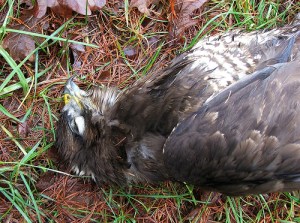
Landowners demand right to kill protected birds

Not content with the annual mass slaughter of millions of animals across Scotland (e.g. hares, rabbits, foxes, crows, stoats), landowners are pushing the Scottish government to issue licences to kill protected birds, including raptors.

According to an article in today’s Scotsman, in a forthcoming documentary on illegal raptor persecution in Scotland, Douglas McAdam of the SRPBA puts forward the argument for licences, claiming that they will reduce the incentive for landowners and gamekeepers to illegally poison and shoot protected species.

So what’s wrong with this logic? Well, in my opinion, nothing if you are a criminal, wanting to commit a crime but not be prosecuted for it. Perhaps we should all ask the government for a licence to walk into shops and take what we want? It would certainly be an incentive to stop the criminal activity of shoplifting but the only ones to benefit would be the shoplifters, not society as a whole. Who would benefit from the licensed killing of protected birds? The landowners. The rest of society would be left all the poorer for the loss of our magnificent species.

There’s nothing illegal about the SRPBA asking for the issue of licences – they are perfectly entitled to do this, and there is even a provision in the Scottish legislation to allow for the issue of licences. Fortunately, so far, our government has not been swayed by the argument and has called instead for a reduction in raptor persecution. So far this year there isn’t any evidence that raptor persecution is on the decline – the discovery of poisoned buzzards, poisoned bait, and most recently another poisoned golden eagle, tells us that these filthy criminal activities are continuing with impunity on Scottish shooting estates.

Of course, this isn’t the first time we have heard about the call for licences. The SGA has been campaigning for over ten years for the right to kill protected raptors, including hen harriers and buzzards. We have covered this topic extensively – see herehere, here, here, here, herehere and here.

No doubt these licence requests will persist – regardless of all the scientific evidence that shows how badly damaged our raptor populations already are thanks to the efforts of landowners and gamekeepers across Scotland.

Scotsman article about forthcoming documentary: http://www.scotsman.com/environment/Landowners-demand-right-to-cull.6764420.jp

BBC news: http://www.bbc.co.uk/news/uk-scotland-13339288

Case against Skibo Castle gamekeeper opens at Inverness Sheriff Court

Following blog post 12 May 2010…

A year on from the discovery of THREE poisoned golden eagles, 1 buzzard and 1 sparrowhawk in or close to the grounds of Skibo Castle Estate, the case against one of the gamekeepers opened today at Inverness Sheriff Court.

The case against Dean Barr, originally from Northern Ireland, is to be continued on 26 May 2011. The charges against him are not yet being reported as he has not yet entered a plea. Last year, Mr Barr made a public statement in The Daily Record suggesting that the dead birds had been ‘planted’ by the RSPB – see blog post 22 June 2010 here: https://raptorpersecutionscotland.wordpress.com/2010/06/22/skibo-gamekeeper-blames-rspb-for-stuff-turning-up/

Poisoned buzzards and bait reportedly found on Edradynate Estate

Following blog posts on 6, 7 and 11 April….

The name of the Perthshire sporting estate raided by Tayside Police earlier this month, following the discovery of poisoned buzzards and poisoned bait in March 2011, has been recently reported on the raptor study group website as Edradynate Estate.

Described by Tayside Police Wildlife Crime Officer Alan Stewart in 2005, “Edradynate Estate, which is owned by an absentee landlord from Hampshire, has probably the worst record in Scotland for poisoning incidents, going back more than a decade. In 14 separate incidents since 1998, 16 poisoned victims (nine buzzards, a cat, a tawny owl, two sparrowhawks, a common gull, a polecat and a crow) and 12 poisoned baits (rabbits, woodpigeons and a pheasant) have been found, with traces of the pesticides mevinphos, carbofuran and alphachloralose”.

His comments were made after the collapse of a trial concerning two gamekeepers from the estate, who were charged with various offences involving the alleged poisoning and trapping of birds of prey. The case was dropped by the Procurator Fiscal, reportedly because of the time taken for the case to be heard. Full story here: http://www.rspb.org.uk/Images/legaleagle43_tcm9-132966.pdf

Since his comments, there have been more discoveries of poisoned birds on this estate, and public denials in the media of any involvement by estate gamekeepers, who claim the dead birds must have been ‘planted’ by someone else. Nobody has ever been convicted for wildlife crime offences on this estate and still the poisoning continues. Let’s hope that Tayside Police are able to detect the perpetrator(s) of the most recent poisoning incident.

Interestingly, it is also reported on the raptor study group website that Edradynate Estate is believed to be a member of the SRPBA and that at least one gamekeeper is a self-confessed member of the SGA. This is difficult to verify though as, conveniently, neither group publicises the names of their members. Both of these groups have made many public statements about how they deplore illegal raptor persecution and how they are working hard to eradicate it. They are both also members of PAW Scotland. It was reported last year that the CEO of the SRPBA paid a visit to Edradynate Estate – perhaps to apply some much needed ‘peer pressure’. If he did, then he is to be congratulated for his efforts, although judging by recent events it would appear that peer pressure was unsuccessful. Or perhaps it was successful, and the latest deaths were attributable to those pesky carcass planters – you know, the ones who have never been seen or heard but who are managing to plant poisoned birds on sporting estates up and down the country…

Dead Silence

Last week’s police raid on a sporting estate in Perthshire was widely reported in the media. We were told that three week’s earlier, two poisoned buzzards and poisoned bait had been discovered on the estate, and that this had led to the issuing of a police warrant to search various properties on the estate. What we weren’t told was the name of the estate in question. Was this omission just a genuine oversight? Apparently not. According to an article published in The Courier on 8 April 2011, Tayside Police ‘refused to disclose the exact location of the estate’. This suggests that the journalist from The Courier had specifically asked for the name of the Estate but Tayside Police decided to keep it a secret. Courier article here: http://www.thecourier.co.uk/Living/Outdoors/article/12730/inquiry-into-discovery-of-poisoned-birds-of-prey-on-a-perthshire-estate-continues.html

Similarly, the other agencies involved with the raid (reported to be the RSPB, National Wildlife Crime Unit and the Scottish Government Rural Payment Inspections Directorate) have remained tight-lipped about the operation.

Let’s contrast this silence with the report of another police raid that Tayside Police undertook last week. According to a news item on the Tayside Police website, they raided six properties across Dundee last Friday ‘as part of a pre-planned operation aimed at disrupting a serious and organised crime group believed to be involved in a number of offences including drug dealing, money laundering and mortgage fraud’. Were they silent about the locations of the raids and the on-going inquiries? Were they heck. They named the actual streets where these properties were located, the type of property searched and even disclosed what they’d found so far. See news item here: http://www.tayside.police.uk/default.aspx.locid-013new0k8.Lang-EN.htm

Let’s also contrast the silence with the reporting of the two poisoned peregrines that were discovered at the base of a block of flats in Motherwell in February. The SSPCA, who are leading that particular investigation, immediately released the location of where those poisoned birds had been found. And quite right too. See their press release here: http://www.scottishspca.org/news/571_warning-after-falcons-poisoned

So, why would Tayside Police, the RSPB, NWCU and SGRPID not want to reveal the name of the Estate where they have discovered poisoned birds and poisoned bait? They might argue that revealing the Estate’s name is likely to defeat the ends of justice, for example, that evidence could be destroyed or removed. That would be a perfectly legitimate concern BEFORE the raid took place, but their news release was made AFTER the raid and AFTER they had collected potential evidence, so that particular argument doesn’t wash here.

This silence is also an interesting strategy considering the recent launch of the Tayside Policing Plan 2011-2014 (available for download on the Tayside Police website). This Policing Plan sets out the Force’s ‘high level aims for serving and supporting local communities, the local economy and the environment over the next three years. The plan focuses on two Community Priorities – Public Safety and Public Reassurance’. So, how does keeping quiet about the location of potentially lethal poison (which could kill humans and pets, as well as the wildlife it has already killed), fit in with this new Policing Plan? Does this secrecy benefit public safety? Does this secrecy benefit public reassurance? That’s for the local community to decide – although hang on, they can’t decide because they haven’t been told that this poison was found within their community.

Imagine if Tayside Police had discovered a car bomb in, say, Perth town centre. Would they be so coy about revealing the location? Would we see a press release along the lines of ‘We have discovered a car bomb but we’re not telling you where it is and we’re keeping its location a secret’?

I think not. It would obviously be in the public’s interest to be informed about such a threat. So why does Tayside Police and these agencies think that it’s ok not to tell the public where poisoned birds and poisoned bait has been discovered, regardless of whether they can or cannot identify the individual who laid the bait? It’s all very curious.

Update on yesterday’s police raid

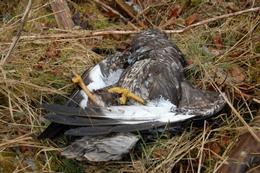
Tayside Police have released a statement about the raid on a Scottish sporting estate that took place yesterday, following the discovery three weeks ago of two poisoned buzzards and poisoned bait. A 62 year old man was taken in for questioning but has been released pending further enquiries.
Tayside Police statement: http://www.tayside.police.uk/default.aspx.locid-013new0k6.Lang-EN.htm

Poisoned baits found in Ayrshire: dogs and buzzards reported poisoned

A recent spate of poisoning has been reported at Fullarton Woods, Troon, Ayrshire over the last month, apparently resulting in the death of one dog, one fox and possibly two buzzards. A second dog was poisoned but survived. Strathclyde Police are reported to have launched an investigation.

The first incident was reported in the Troon Times on 1 March 2011 and the Ayrshire Birding Forum on 2 March 2011. Rabbit baits laced with poison were discovered in Fullarton Woods on the Fullarton Estate (this is not a sporting estate – it is a public amenity run by South Ayrshire Council that includes a play-park for children). A local resident’s dog was poisoned but made a recovery. Two dead buzzards were apparently discovered, although it has not been confirmed if they had been poisoned.

Troon Times: http://www.troontimes.com/news/troon/articles/2011/03/01/410725-beware-poisoned-carcasses-left-in-troon-woods/

Ayrshire Birding Forum: http://www.ayrshire-birding.org.uk/

On 22 March 2011, Troon Times reported the death of a two-year old golden retriever and linked it to the discovery of a poisoned fox in Fullarton Woods: http://www.troontimes.com/news/troon/articles/2011/03/22/411384-more-animals-poisoned-in-woods/

Five separate poisoning incidents unreported at end of 2010

Earlier this month, PAW Scotland released the ‘2010 poisoning hotspots’ maps as part of their annual reporting. Along with the maps, they released a report called ‘Bird of Prey Poisoning Incidents 2006 to 2010 – Incident Details’. Here is a PDF of that report: 0114784
The name is a bit of a misnomer, as the ‘incident details’ are about as vague as you can get. However, the report does have its uses. There appear to be five separate poisoning incidents that took place between October and December 2010 that were not apparently reported/publicised in the press; three incidents in Tayside and one each in Lothian & Borders and Strathclyde. An internet search has failed to locate any information about these cases. Why do you think Tayside Police, Lothian Police, Strathclyde Police, and the RSPB (if they were involved in the investigation) were so quiet about these incidents?

Ref 10192: 1 buzzard poisoned by carbofuran, 2 pigeon baits. Oct 2010, Tayside.

Ref 10196: 2 buzzards poisoned by carbofuran isofenphos. Oct 2010, Tayside.

Ref: 10204: 1 buzzard poisoned by carbofuran. Nov 2010, Lothian & Borders.

Ref 10206: 1 buzzard poisoned by carbofuran, 1 pheasant bait. Nov 2010, Strathclyde.

Ref 10225: 1 red kite poisoned by chloralose. Dec 2010, Tayside.

Suspected Buzzard Poisoning on Mountquhanie Estate, Fife

POLICE in Fife are investigating the suspected poisoning of a buzzard north of Cupar.

The bird of prey was found dead by a member of the public close to Lewes Wood on the Mountquhanie Estate near Hazelton Walls.

It has been sent for post-mortem examination to confirm the cause of death and identify any poison that may have been used.

PC Ian Laing, Fife Constabulary’s wildlife and environmental crime co-ordinator, said: “Fortunately, Fife has not experienced raptor poisoning as much as other areas, but this case is a concern.

“Once we have confirmed the cause of death, we will be able to look at the potential source of any poisons used with a view to tracing those responsible.”

Kath Leys, area operations manager with Scottish Natural Heritage, added: “We’re very concerned about this suspected poisoning case in Fife.

“Buzzards may be fairly common nowadays, but they’re beautiful birds which are an important part of biodiversity.”

Full story here –

http://www.fifetoday.co.uk/news/local-headlines/fife_police_probe_buzzard_poisoning_1_1459717

Update on pending court cases

Nicholas Parker, head gamekeeper on the Holkham Estate, Norfolk, was due to appear before King’s Lynn Magistrates on Wednesday 9 February 2011 to answer the following charges:

  • Killing a Schedule One bird
  • Taking game out of season
  • Possessing ammunition for a firearm without a certificate
  • Possessing a shotgun or rifle for committing an ‘either way’ offence
  • Possessing a shotgun without a certificate
  • Contravening the Wildlife & Countryside Act.

Parker’s case has been postponed and is now due to be heard on 2 March 2011. (See blog post 25 January 2011 for original story).

A convicted gamekeeper in Scotland (name removed for legal reasons) was due back in court on 2nd December 2010 to face charges of using poison to kill multiple buzzards on a sporting estate. This case was postponed due to bad weather and was re-scheduled for 23 December 2010. The second trial was postponed after the defendant lodged an appeal on a legal technicality. This appeal is still pending. We will post an update in due course. (See blog posts Dec 1 & 21 for original story).

HOT OFF THE PRESS – there will be a forthcoming trial in March/April concerning alleged raptor persecution incidents in Derbyshire. Watch this space!

buzzard poisoners in Derbyshire get away with it

On 30 April 2010, an article was posted on this blog about an investigation by Derbyshire police into the apparent poisoning of six buzzards. Here’s a quick re-cap:

On 22 February 2010, two dead buzzards were found in Jebbs Lane, Idridgehay, nr Ashbourne in Derbyshire. The birds were believed to have been poisoned. On 7 April 2010, a further four buzzards were found dead nr Kirk Ireton, just a few miles away from the dead buzzards that had been found in February. These four buzzards were also believed to have been poisoned, and were found next to a dead pheasant, believed to have been used as a poisoned bait.
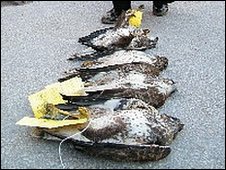
In a recent report, the following details have emerged on the outcome of this investigation:

Feb 22 2010: 2 dead buzzards found on the ground and chicken bait found in a tree. Analysis has confirmed a residue of Carbofuran in the gizzard of both birds, which is likely to be the cause of death. As the police have failed to identify a suspect, this case is now closed“.

April 7 2010, link to Feb 22 case: 4 buzzards found dead, 2 baits (pheasant & hare). Six buzzards have now been found on this estate. The estate is trying to make the shooting part of the estate viable and new gamekeepers have been employed. Analysis has confirmed a residue of Carbofuran in the crop content of the birds. The amounts are significant and are likely to be the cause of death. An advisory letter to dispose of Strychnine found has been sent and complied with. This case is now closed“.

So, six buzzards are confirmed to have been poisoned by Carbofuran (a banned pesticide) and two poisoned baits were found on the same sporting estate within a small period of time. The name of the estate has not been published (surprise!). Presumably, a search of the un-named estate failed to uncover any stocks of Carbofuran, but did uncover a stock of Strychnine. Strychnine is also a banned pesticide, outlawed in the UK since September 2006 by the EU’s Biocide Directive, which states that it can no longer be sold or stored in the UK. Instead of being prosecuted for this illegal stash, the criminals get sent an ‘advisory letter’. No action is taken against them for the six illegally poisoned buzzards.

And if you think this is an unacceptable outcome, the news we will release shortly (about another case) will blow your mind….