
Poisoned buzzard & ravens – appeal for info comes three months later

A news item posted today on the RSPB website reveals that a buzzard and two ravens were found dead in Monmouthshire in July. Tests reveal they had been poisoned by the banned pesticide Carbofuran. Two dead pigeons were also found which had been laced with an un-named pesticide and the news report suggests these were put out as illegal poisoned bait. Last year, two dead peregrines, poisoned with Carbofuran, were found at the same site (see here).

The article reports that Gwent Police, the Welsh Government and the RSPB are appealing for information. The RSPB is reported to be offering a £1,000 reward for information leading to a conviction.

Three months after the incident? What’s the point? Why is it that media reports about wildlife crime, and particularly illegal raptor persecution incidents, are now consistently delayed for several months? What other areas of crime are reported this way? If my house was burgled in July and I waited for three months before I reported it to the police, what do you think the chances would be of catching the burglar? About the same as catching the raptor poisoners, I reckon.

Talking of delayed reports…why is it that the 2011 SASA poisoning report, which is supposed to be updated every quarter, has not been updated since March 2011? Are we to believe that raptors are no longer systematically poisoned in Scotland because none have been handed in for analysis for the last seven months? If anyone feels like doing a Freedom of Information Request, this would seem to be a good place to start (FoI on SASA website here).

News story about the poisoned buzzard & ravens on RSPB website here
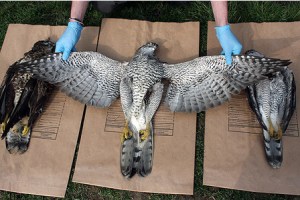
Four goshawks and a buzzard found poisoned

The RSPB has put up a reward of £1,000 for information about the deaths of four goshawks and one buzzard which have been found poisoned in Devon. They were discovered in Forestry Commission woods near to Exeter and had been poisoned with the bannned pesticide Carbofuran.
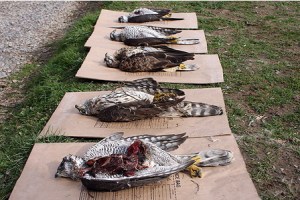
A recent survey suggests that there are no more than 20 breeding pairs of goshawk in Devon.

Ian Parsons, a Forestry Commision ranger, said: “The people that do this to our wildlife not only deprive people of the chance to see these rare birds but they also put the public at risk. The poison involved is lethal to dogs and humans and the land where this happened is open to the public. These people obviously don’t care about the dangers of doing this“.

Anyone with information about these crimes is urged to call Crimestoppers, in confidence, on: 0800-555-111, or email Devon & Cornwall Police Wildlife Crime Officer P.C. Josh Marshall directly: Joshua.MARSHALL2@devonandcornwall.pnn.police.uk

PC Marshall said: “We rely on the public to be our eyes and ears in wildlife crimes such as this. If anyone knows anything about this, please get in touch“.

BBC News story here

Western Morning News article here

Poisoned raptors ‘flung from vehicle’

Police are investigating after four birds of prey were poisoned and dumped in a lay-by in Midlothian, according to a report in today’s Scotsman.
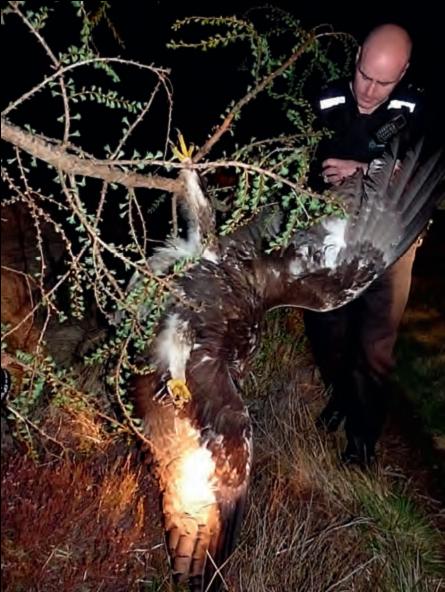
Two buzzards and two sparrowhawks were found by a dog walker next to the A68, south of Pathhead, a few miles from Edinburgh, on Monday 5th September. They are believed to have been killed by ‘industrial grade chemicals’ and thrown from a passing vehicle. The bodies are currently undergoing toxicology tests to determine which poison was used. The police are asking anyone with information to contact them.

Well done to Lothian & Borders police for publicising this incident in a timely manner.

Scotsman article published here and reproduced here:

Scottish Police are investigating after four birds of prey were poisoned and dumped in a remote lay-by in Midlothian. Two buzzards and two sparrow hawks were found by a dog walker next to the A68, south of Pathhead, after being killed with what is thought to have been industrial grade chemicals.

Police believe the birds may have been thrown from a moving vehicle as it drove past the stop point and appealed for any witnesses to help.

The incident comes just weeks after the Evening News told how officers were still hunting criminals who killed two peregrine falcons and took the head of one as a trophy.

Pc Hannah Medley, Midlothian wildlife and environmental crime officer, said the birds in the latest incident were discovered on Monday, September 5.

“It appears to be two sparrowhawks and two buzzards which have been dumped, possibly thrown from a car, in a lay-by on the A68. We’re appealing for any witnesses who may have seen anything in the area on that day. We’re still waiting to find out what the poison is, but these poisoned baits are often fairly strong and would be well capable of killing a family pet.”

She added: “It’s very unusual for this to happen in Midlothian, and we haven’t really had anything like this recently. I’d say to anyone who knows what has happened to contact police. It could possibly be a car speeding off or anything suspicious in the area that didn’t look quite right.”

The incident also came as the Royal Society for the Protection of Birds Scotland prepares to publish its annual report into illegal killings of birds in Scotland last year.

The report includes details of golden eagles and red kites, and a raid on an estate in Sutherland in which 10 kilos of lethal poison were found.

Ian Thomson, investigating officer at RSPB Scotland, said: “This is an absolutely heartless crime and the fact that people are still committing this kind of acts in 2011 is disheartening. This case is very unusual, why someone would want to dump these in a lay-by isn’t clear. One of the key things coming from our annual 2010 report into illegal killings of birds is the amount of illegal poisoning that is going on. We’ve seen four golden eagles, seven red kites and these are just the ones found”.

UPDATE June 2012: SASA toxicology results have confirmed all four birds were poisoned with Carbofuran.


RSPB publishes 2010 raptor persecution report

The RSPB has just published its annual report on raptor persecution in Scotland. The report, ‘The Illegal Killing of Birds of Prey in Scotland 2010‘ is the only known published record of all known persecution incidents including poisoning, shooting and trapping, in contrast to the PAW Scotland annual report which only details poisoning incidents. As well as the confirmed incidents of persecution, the report also provides information about ‘probable’ incidents (those where the available evidence points to illegality as by far the most likely explanation but where the proof of an offence is not categorical) and ‘possible’ incidents (where an illegal act is a possible explanation but where another explanation would also fit the known facts).
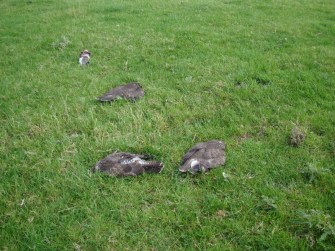
The report provides details of several confirmed and probable persecution incidents that didn’t make it into the public domain at the time they occurred, including two shot sparrowhawks (Dingwall, Inverness-shire & nr Dolphinton, South Lanarkshire), a goshawk killed in a pole trap (nr Dalwhinnie, Inverness-shire), a shot short-eared owl (Leadhills, South Lanarkshire), 5 separate incidents involving peregrines (Stirlingshire, South Lanarkshire and Dumfries-shire), ‘disappearing’ hen harrier chicks (nr Knockando, Moray), a member of the public witnessing the shooting of a buzzard (nr Leadhills, South Lanarkshire), the discovery of a heavily decomposed buzzard carcass found in a stink pit (nr Dornie, Inverness-shire) and the discovery of a suspected pole-trapping site (nr Dornie, Inverness-shire).

Interestingly, although the report doesn’t go as far as naming estates in most incidents (apart from the reports of successful prosecutions), it does go further than the vague information provided in the annual PAW statistics. For example, in the PAW Scotland ‘Bird of Prey Poisoning Incidents 2006-2010 – Incident Details’ report (that we discussed here in March 2011), there are several cases of buzzard poisoning that were just listed as ‘Tayside’. The RSPB report clarifies this a little bit, and lists the locations as ‘Glenogil’ and ‘nr Kinross’.

This annual report makes for grisly reading, but as the report says, these incidents no longer shock or surprise us. The evidence yet again points to the involvement of people within the game-shooting industry; the latest statistics show that of all those convicted for illegal raptor persecution in Scotland between 2003-2010, 88% were involved with gamekeeping (the rest involved pest controllers, farmers and pigeon racers at 4% each).

The RSPB makes several recommendations in the report that would considerably reduce the difficulty of bringing these criminals to justice. They include recommended action for the police, the crown office & procurator fiscal service, the Scottish government, and representatives from the game-shooting industry. Some of these recommendations have been made before but have apparently remained unheeded.

Well done to the RSPB for publishing this report and for keeping the issue high on the political and public agenda.

The report can be downloaded here

Police apparently fail to attend suspected multiple buzzard poisoning

Late last week, three dead buzzards were found next to a suspected poisoned rabbit carcass in an area with a long track record of raptor poisoning incidents. The person who found the dead birds took some photographs before returning home to alert the police. The police allegedly informed him later that night that they couldn’t attend, and instead they asked him to collect the evidence(!). When he returned to the scene, unsurprisingly the three dead buzzards and the suspected rabbit bait had vanished. A dead magpie, perhaps missed by the suspected poisoners, was recovered from the scene and has been sent for toxicology testing.
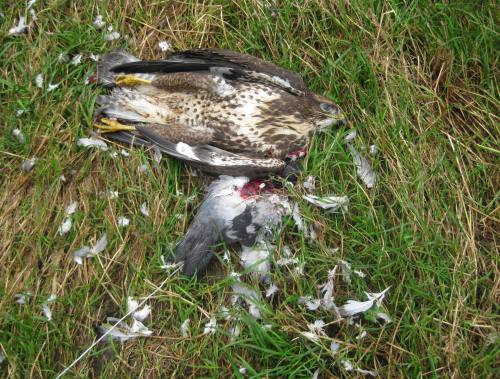
Clear cut evidence, if it was needed, that the ‘official’ annual poisoning figures released each year are indeed just the tip of the iceberg. These three buzzards will not be included because they’re unavailable for analysis.

The location where they were discovered was in the Drumbanagher/Poyntzpass area of Northern Ireland, an area known for commercial game-shooting interests. The following birds have all been confirmed poisoned in this area in recent years:

2006 – 1 x buzzard confirmed poisoned.

2008 – 4 x buzzards confirmed poisoned (alphachloralose).

2009 – 2 x red kites confirmed poisoned (alphachloralose). One survived, the second bird died.

2011 – 1 x buzzard found under a hedge, too badly decomposed for analysis. 3 x buzzards suspected poisoning – carcasses removed before police investigate. Dead magpie sent for analysis.

Thank you to the contributor who sent us this information.

UPDATE: The magpie tested positive for Alphachloralose.

More raptor poisonings in Ireland

Two young buzzards and a sparrowhawk have been illegally poisoned in Ireland. The bait this time? Live pigeons, that were smeared with the banned pesticide Carbofuran, tethered to the ground with wire with their wings clipped.
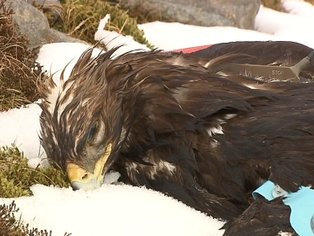
These disgraceful events were discovered last month near Roscrea, close to the Offaly and Tipperary border. Two young volunteers from the BirdWatch Ireland Raptor Conservation Project were alerted to the scene by a local farmer. They tell the story here, illustrated with some pretty graphic photographs.

How many more of these disgusting incidents have to be reported before there is a crackdown? Whether it be Ireland, Northern Ireland, England, Scotland or Wales. IT HAS TO BE STOPPED!

Thank you to the contributor who sent us this link.

Are the raptor poisoners in Scotland changing their bait?

Are the raptor poisoners in Scotland changing their bait? Maybe they are, according to an article published in the Guardian on Wednesday:

Rat poisons are posing a significant threat to wild animals because they are being misused or even deliberately abused to target birds of prey, wildlife experts fear.

Figures published on Wednesday on wildlife poisoning in Scotland identify legally available rodenticides as the cause of death of 15 birds of prey, including nine red kites and three sparrowhawks, and six mammals, including two dogs and a cat.

At least one case, where six red kite chicks were killed by extremely high levels of rat poison, has been identified as “suspicious” by the Scottish government’s testing laboratory. Several chicks were seen bleeding from their beaks before death.

The laboratory, Science and advice for Scottish agriculture (SASA), also said that it had detected rodenticide traces in 38% of the 214 dead animal livers it tested last year, with 32 buzzards, 17 red kites and 10 sparrowhawks testing positive. Kites and buzzards are scavengers, so will prey on dead or poisoned rats, but SASA believes its data suggests that rodenticides are now extremely widespread in the foodchain.

One of the chemicals found repeatedly by SASA is only licensed for indoor use [Brodifacoum]. Mike Taylor, head of pesticides and wildlife at SASA, said: “We’ve certainly got evidence of widespread exposure and it’s of concern, but it’s very difficult to enforce because it’s very difficult to collect dead or dying rats [to study].”

Alex Hogg, chairman of the Scottish Gamekeepers Association is reported as saying he had never been aware of rodenticides being  used to deliberately target birds of prey.

To read the full article in the Guardian, including quotes from the National Farmers Union Scotland and the RSPB, click here.

To download the advisory leaflet, ‘Rat Poison and the Threat to Wildlife’, click here.

Scotland’s shame: 2010 poisoning figures published

Today the Scottish government has published its latest report on animal poisoning in Scotland. The figures relate to recorded incidents in 2010 and demonstrate a sharp rise in the number of wildlife poisonings, including the widespread illegal poisoning of raptors. The report shows that 69% of all ‘abuse’ cases involved the poisoning of birds of prey, covering a wide area including Borders, Dumfries & Galloway, Highland, Lothian, Strathclyde and Tayside. The illegal pesticide Carbofuran was detected in half of these incidents. The raptors that tested positive for poisons included 40 buzzards, 4 golden eagles, 1 sea eagle, 1 kestrel, 5 barn owls, 2 tawny owls, 2 peregrines, 21 red kites and 11 sparrowhawks.
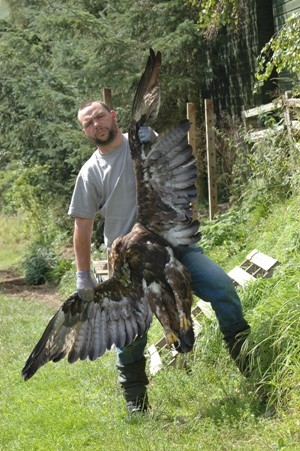
Unsurprisingly, some are trying to play down the appalling statistics. The Scottish Land and Estates Chairman, Luke Borwick, is reported to have said that the organisation is working hard to reduce such incidents “…and there is evidence these joint efforts are beginning to pay off“. He was referring to what he called a “significant decrease” (in illegal raptor poisonings) in the first half of 2011. The Environment Minister Stewart Stevenson also made the same comment. Unfortunately, we are not able to make the assessment for ourselves because the published government figures for 2011 only cover the period January to March 2011. However, the figures for this three-month period tell a very different story to the one that Luke and Stewart are pushing: they include 3 buzzards, 1 golden eagle, 1 red kite and 2 peregrines all illegally poisoned in the first three months of 2011 (see here for earlier report). Hmmm.

There are other reactions from various bodies, including the RSPB, the Police and the Scottish Environment Minister – these can be read on the BBC website here and the Scottish government website here.

To read the depressing SASA government report with all the gory details, click here.

SGA call for buzzard, badger and raven culls (again)

The following article was published in the 10 August 2011 edition of Country Life:

The Scottish Gamekeepers’ Association (SGA) is renewing calls for licences to control buzzards. In a survey of some 950 gamekeepers across Britain, 76% said buzzards had a detrimental effect on game birds and 63% said they had a negative effect on wildlife. Sparrowhawks and goshawks were considered a similar nuisance, but marsh harriers, merlins, barn owls and ospreys were viewed more benignly, and the majority of keepers said kestrels and red kites had little or no adverse effect. More than 70% said badgers are a serious problem and the figure for pine martens was even higher on those estates that have them. Charles Nodder, political advisor of the National Gamekeepers’ Organisation, commented: “The idea that keepered land is a raptor desert is nonsense. But keepers understand the countryside and there is a clear indication that certain species are prevalent and having a deleterious effect on wildlife”.

The SGA came close to getting buzzard-control licensing in 2009, but incidents of raptor poisoning – including that of a golden eagle – weakened the case. SGA chairman Alex Hogg says: “We’ve lost the plot when it comes to the control of buzzards, badgers and ravens. Their populations need to be properly assessed each year and, if necessary, action should be taken to redress the balance. There’s no doubt buzzards have changed their predatory habits in the past 30 years. ‘Rogue’ buzzards have learned to predate chicks – and not just game birds: I saw one take three lapwing chicks. We don’t want to shoot every buzzard in Britain, we just want to control the rogue ones, but birds of prey are ‘sexy’ birds and nobody wants to take the first step to control them”.

The encouraging aspect of the survey was the spread and volume of wildlife; 83% of shoots reported the presence of lapwings, 75% had skylarks and 79% cuckoos. The geographic area covered – 1.3 million hectares (3.2 million acres) – is significant, too: five times that of the area of designated nature reserves, more than 13 times that of the RSPB reserves and nearly 60% of national parks.

The ‘survey’ referred to in the article was the ‘survey’ we discussed here on 21 July 2011. Since then, the report has been made public. You can read it, along with an interesting and entertaining discussion about its credibility, here.

Welcome to the inglorious twelfth!

Today is the inglorious 12th, the start of the four-month grouse shooting season in the uplands of northern England and Scotland. Today, and for many days to come, ridiculously rich people will dress up in clownish outfits and head for the moors in the hope of shooting dead some birds. Many will pay an estimated average of £15,000 for the experience. I wonder how many of them will enjoy the sight of a hunting hen harrier or a golden eagle quartering across the moor? Very few, infact probably none of them because scientific evidence shows that hen harriers and golden eagles have been exterminated on most grouse moors in the UK, with just a few notable exceptions. Has anyone been convicted? One person was once convicted for killing a hen harrier, and that’s it. Nobody has ever been convicted for killing a golden eagle (someone was once taken to court a few years back but the case was dropped). Even though several dead eagles and the UK’s biggest stash of the poison they died from were all found on a sporting estate last year, still nobody has ever been convicted.

Four years ago today, this golden eagle (pictured) was found dead in Peebleshire. She was one half of the last breeding pair of golden eagles in the Borders. She had been poisoned by the banned pesticide Carbofuran and was found dead under her nest tree. Her death caused outrage and triggered the thematic inspection into the prevention, investigation and prosecution of wildlife crime in Scotland (read the resulting 2008 ‘Natural Justice’ report here). This report highlighted the problems that stand in the way of effective wildlife crime law enforcement in Scotland. Four years later, many of the same problems still exist. Nobody has been charged with the illegal killing of that female golden eagle in Peebleshire and according to a report by the Wildlife Incident Investigation Scheme, the case is now closed.

Since the year she was killed (2007), how many other protected raptors have suffered the same fate? The following have all been confirmed poisoned in Scotland over the last four years – the vast majority of them were found dead on grouse moors:

8 golden eagles, 3 sea eagles, 63 buzzards, 25 red kites and 8 peregrines.

These numbers do not account for birds that were trapped, shot, or had their heads smashed in with a shinty stick while their broken legs were pinned in an illegal spring trap. Nor do they account for the ‘missing’ birds – including over 2,000 hen harriers.

Today, the grouse-shooting industry will have filled the media with stories about how ‘great’ grouse moors are for conservation, how ‘great’ grouse shooting is for the economy, how ‘great’ grouse-shooting is for biodiversity. Fortunately, the general public are becoming wise to the propaganda.