
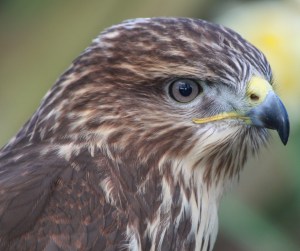
Another poisoned buzzard in Scotland

buzzard 3Scotland’s shameful catalogue of illegally-killed raptors continues to rise, with news today of yet another poisoned bird – this time a buzzard in Fife.

Here’s a press release from Police Scotland:

Police in Fife are conducting investigations after a dead buzzard was found in woods to the north of Ballingry in late April.

Enquiries at that time suggested the bird had died of natural causes but this was further explored by means of toxicology tests carried out by a Scottish Government laboratory.

This week it has been confirmed the bird died from ingesting a banned pesticide, and the matter has now been referred to the Police.

Detective Inspector Colin Robson, who is leading the inquiry, said: “The bird was found on land in an area commonly used by dog walkers. From the toxicology results, I believe it is probable that the bird has fed on an animal carcass deliberately laced with this poison. Such an act is both illegal and highly irresponsible in an area regularly used by members of the public, and the placing out of poison baits like this is indiscriminate in its victims. This illegal chemical is highly toxic, and the ingestion of even minute quantities by a wild animal or a pet is likely to have fatal consequences. Although relatively remote, I would urge anyone who frequents this area to contact the Police if they saw anyone or anything suspicious around this time or have knowledge of this or similar incidents. Since the discovery there have been no reported linked incidents locally and the area where the bird was found has been searched and there has no trace of the poison or other carcasses. Police Scotland are committed to tackling wildlife crime and this matter is being robustly investigated in close collaboration with partner agencies.”

Ian Thomson, Head of Investigations at RSPB Scotland said: “The recent incident on the Black Isle, where 22 birds of prey were killed, showed very clearly the horrendous impact that the illegal use of poisons can have on wildlife. It is of great concern that someone has placed a bait laced with this illegal chemical out in the countryside in an area well-used by the public and close to our own nature reserve at Loch Leven. I urge anyone who has information about this incident to contact the police as soon as possible.”

Brent Meakin, Forestry Commission Scotland’s district manager for the Lowlands said: “It is appalling that individuals are carrying out this illegal and barbaric practice. The persecution of raptors must stop. Any poisoning of these birds is one too many, no matter the species. We will continue to work with the Police and other agencies to stamp out this activity. The Commission would also like to ask the public for their help as they too can be our eyes and ears and report any suspicious activity.”

Ends

So, once again the name of the banned poison has not been made public, although from the comments made by Det Insp Robson, it sounds suspiciously like it was Carbofuran.

Shall we ask Environment Minister Paul Wheelhouse what he intends to do in response to this, and the other recently-reported raptor crimes from Scotland? It’s yet another illegally-killed raptor on his watch. Shall we ask him when he intends to actually address this issue, instead of making trite old threats that he’ll ‘deal with it if things don’t improve’? Things are not improving, despite the introduction of his ‘new measures’ a year ago, so it’s not unreasonable for us to ask our elected representative whether he’s as good as his word. Emails to: ministerforenvironment@scotland.gsi.gov.uk

UPDATE 15.00hrs: The specific location where the poisoned bait is suspected to have been laid out has been named as Benarty Wood, managed by Forestry Commission Scotland. Dog-walkers beware – see here for site info.
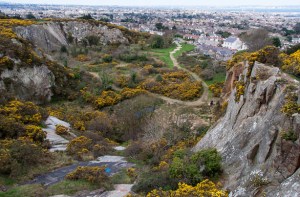
Members of public foil attempt to poison peregrine family

dalkey_quarryAn attempt to poison a family of peregrines (two adults and four youngsters) at Dalkey Quarry, part of the Killiney Hill Park in Co. Dublin, has been foiled thanks to three observant members of the public.

On the evening of 11th June, three walkers noticed two pigeons in distress at the quarry, close to the well-known peregrine’s nest ledge. On closer inspection, the pigeons were found to be tethered with fishing line and had had their wings clipped to prevent them from flying. While rescuing the pigeons, a wet substance was noticed on the back of their necks. It is suspected that this was poison, placed there in a deliberate attempt to kill the peregrines. The substance is being tested at a specialist lab.

If it was poison, those members of the public are lucky not to have been affected.

Full details of the story can be found on the BirdWatch Ireland website here.

It wouldn’t be the first time this barbaric method has been used to kill raptors. In 2011, two buzzards and a sparrowhawk were killed in Ireland after being attracted to live tethered pigeons that had been smeared with the banned poison Carbofuran (see here).

Scottish gamekeeper accused of bludgeoning then stamping on buzzard that had been shot

A Scottish gamekeeper is facing trial over allegations that he bludgeoned and then repeatedly stamped on a buzzard.

William Dick, 24, of Whitehill Cottages, Kirkmahoe, Dumfries, denied the charges at Dumfries Sheriff Court last week. The alleged offences reportedly took place in Sunnybrae, Dumfries in April this year.

Dick also denies two charges of breaching firearms regulations by leaving a bolt-action rifle and a Beretta self-loading shotgun loaded with five shells out-with a secure cabinet in his kitchen.

The case has been continued for one month to fix a trial date.

Thanks to the blog reader who sent us a local newspaper report about this hearing.

We’ll be following this case with interest.

UPDATE: 15th October 2014 here

UPDATE: 22nd October 2014 here

Ross-shire Massacre: police confirm banned poison involved

RK7The following statement has just been released by Police Scotland:
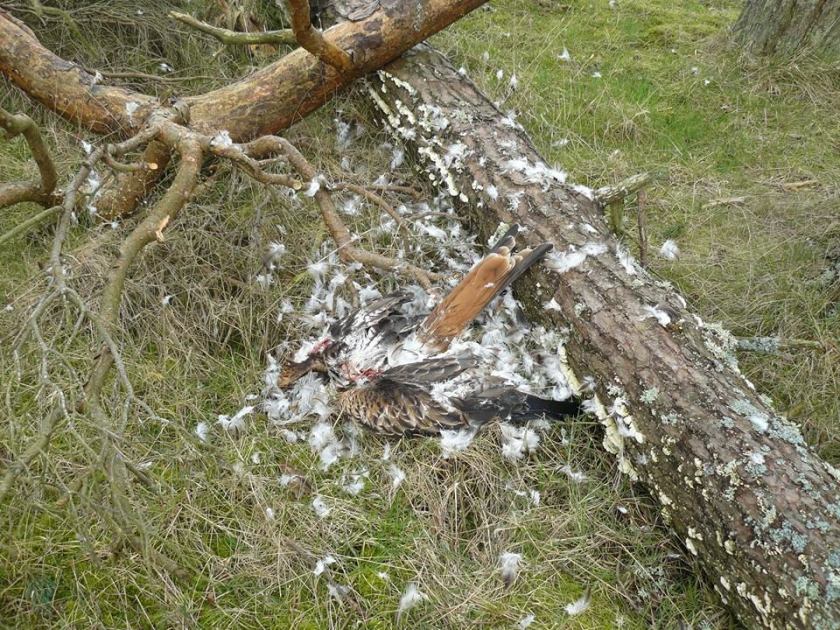
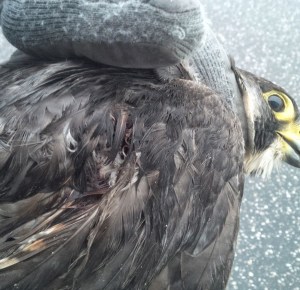
Police Scotland Highland and Islands Division are seeking to reassure the public that enquiries are still ongoing into a wildlife crime investigation regarding the death of birds of prey in the Ross-shire area.

The 22 birds (sixteen red kites and six buzzards) were located in the Conon Bridge area and following analysis of the birds’ remains, fifteen have been confirmed as having digested an illegally-held poisonous substance (twelve red kites and three buzzards). Post mortem examinations and toxicology work continues into all the birds seized.

Police Scotland is continuing to work in close collaboration with partner agencies. Landowners and farmers in the local area are also continuing to assist police with their ongoing enquiries.

Police are keen to speak to anyone who has any information about the incident and would encourage them to contact Police on 101 or Crimestoppers anonymously on 0800 555 111 or online at http://www.crimestoppers-uk.org/. No personal details are taken, information is not traced or recorded and you will not go to court.

ends

So, finally, they’ve managed to confirm that a banned poison was involved. About time, too. They still haven’t named it, but the “illegally-held poisonous substance” will be one (or more) of those named on the Possession of Pesticides (Scotland) Order 2005. These are:

Aldicarb, Alphachloralose, Aluminium Phosphide, Bendiocarb, Carbofuran, Mevinphos, Sodium Cyanide, and Strychnine.

Now, which industry hates raptors and is known to have a close association with these banned poisons…let’s think hard….erm….

It actually doesn’t matter that the police haven’t named the poison(s). Just knowing it’s a banned poison and not a ‘mystery virus’ or an ‘accidental poisoning’ is enough to put a halt to what has recently looked increasingly like a coordinated campaign to associate the deaths with the feeding regime at the RSPB’s Tollie Kite Feeding Station rather than focus attention on the specific area where the poisoned victims, along with poisoned bait, had been found.

It’s funny, isn’t it, that of all the speculation that’s been aired, nobody seems to have wondered about whether there’s any (legal) ‘vermin control’ being done on those farms around Conon Bridge. Perhaps done on a casual basis in return for access for a spot of pheasant shooting by a small shooting syndicate? But then that’s such an obvious angle of inquiry, the police must have covered it months ago…..right?

The number of confirmed poison victims has reached 15 (it really is like pulling teeth trying to get information about this incident) and the police ‘investigation’ continues…..

Previous blog posts on the Ross-shire Massacre here

Natural England says no to buzzard-killing licence

buzzard 3A couple of days ago we learned that Natural England had received a licence application to permit the capture and killing of ten buzzards (well done to the RSPB for getting the info – see their blog on the subject here.)

The licence application was made by somebody who had applied for licences before and the justification for wanting to trap and shoot ten buzzards was to prevent so-called “serious damage” to pheasant poults.

Natural England has just made the following announcement about this year’s application:

Decision on buzzard control licence

On 23 April 2014 Natural England received an application for a licence to cage trap and shoot ten common buzzard (Buteo buteo) in the vicinity of a site which has experienced loss to pheasant poults in recent years.

The application had been made by the operator of a pheasant rearing and shooting business on the site and is supported by the National Gamekeepers’ Organisation. After careful consideration, Natural England has concluded that the application does not meet the criteria that would permit lethal control to be licensed.

ENDS

Unlike last year, so far this year we haven’t seen the actual licence application, although we strongly suspect that this year’s licence applicant is the same individual as last year, working with the help and support of the National Gamekeepers Organisation (NGO). We blogged a lot about this gamekeeper last year, and particularly about his previous criminal conviction for poison offences and questioned why the NGO were still supporting him instead of booting him out of their club for being a convicted wildlife criminal. Astonishingly, we were told that they hadn’t booted him out because the NGO apparently doesn’t see poison offences as either a ‘game-keeping activity’ or a wildlife crime! We also learned that having a wildlife crime conviction was no barrier to applying (and receiving) a licence from Natural England to destroy protected wildlife (e.g. see here, here, here, here, here). The whole affair was illuminating, to say the least, and that’s without even going in to the arguments against killing a protected native species in order to protect an exotic, introduced species that is bred and released into our countryside by the tens of millions every year so that they can be later shot for ‘sport’.

Today’s announcement is very welcome news indeed, although most (all?) of the game-shooting lobby will disagree. We expect them to launch a judicial review of Natural England’s decision, as they threatened to do last year if they didn’t get their way. That might be quite interesting, especially when they get to the bit where they’re asked to provide scientific evidence about the ‘serious damage’ caused by buzzards….

UPDATE 7pm: The NGO has issued a statement about Natural England’s decision (here). In it, they claim the gamekeeper involved is “close to financial ruin”. Here’s a tip for that gamekeeper – if your business is reliant on the killing of protected species, it ‘ain’t viable in the long term. Try another ‘profession’.

Ross-shire Massacre: RSPB denies ‘accidental poisoning’ claims

The Ross-shire Massacre fiasco continues, with yet another claim that the 22 dead red kites and buzzards were ‘accidentally poisoned’ by contaminated meat put out at the Tollie Red Kite Feeding Station.

This latest claim was made by a local farmer (who wishes to remain anonymous) who believes the birds were fed sheep carcasses containing legal treatments used to prevent fluke, which can be toxic to birds.

The claim has been strongly denied by RSPB Scotland (see here).

It’s not the first time this claim has been made. Jamie McGrigor MSP gave credence to it when he mentioned it during a parliamentary debate last month (see here), although he did admit it was based purely on rumour.

We think the claim is as plausible as the ‘mystery virus spoof‘ we wrote in response to Conon Bridge farmer Ewan MacDonald’s suggestion that the birds had been killed by a ‘mystery virus’. Incredibly, there were some people who actually believed the spoof, and thus it follows that there will be some who are gullible enough to believe the ‘accidental poisoning’ claim, just as there are those who believe the ridiculous claims that gamekeepers don’t put out poison baits – they’re just the victims of an elaborate set-up designed to blacken their reputations; set-ups that apparently include planting poisoned carcasses as well as planting jars of poison in gamekeepers’ vehicles, game bags, out-buildings and even in their homes.

Far more plausible is the suggestion put forward by the RSPB’s Red Kite Officer, Brian Etheridge, that the Ross-shire Massacre was caused by “somebody who knew what they were doing” when they placed small poisoned baits in various locations around Conon Bridge (see here). It has previously been reported that poisoned bait had been found at the crime scene, and, given the small area of farmland in which the majority of the birds were discovered, the poison was obviously fast-acting and highly toxic. Hmm, whatever could it be?

Meanwhile, as speculation rages, Police Scotland remain tight-lipped about their ‘investigation’. Two weeks ago they managed to say that 14 of the 22 dead raptors were now confirmed to have been “illegally poisoned” (11 red kites and three buzzards) but they were still apparently waiting for post mortem results on the remaining eight victims – see here. They are still refusing to name the poisons discovered by SASA scientists during their toxicology analyses, because the investigation is apparently ‘ongoing’.

Two and a half months down the line, nobody has been charged.

Previous blogs on the Ross-shire Massacre here.

Head gamekeeper convicted of storing 5 banned poisons: gets conditional discharge

Derek Sanderson, a recently-retired head gamekeeper for a shooting syndicate on the Sledmere Estate in Yorkshire, was yesterday found guilty of storing five banned poisons in his house and in an unlocked outbuilding.

Those poisons were Carbofuran, Aldicarb, Mevinphos, Strychnine and Alphachloralose.

His sentence? A conditional discharge and a £15 victim surcharge!!!!!!!

The court apparently accepted that there was no causal link between the possession of these poisons and a dead buzzard found on Sledmere Estate in 2012 – confirmed as having been poisoned with Aldicarb.

Bob Elliot, Head of RSPB Investigations, has written an excellent blog about this, frankly, unbelievable case, here.

What sort of deterrent value is such a pathetic sentence?

Ross-shire Massacre: RSPB considers alternative use of reward fund

A couple of weeks ago we blogged about the Ross-shire Massacre, two months on from the initial discovery of poisoned red kites and buzzards in the Conon Bridge area.

We suggested that it was now highly unlikely that anyone would be prosecuted for this disgraceful crime and we encouraged blog readers to contact RSPB Scotland Director Stuart Housden, to ask whether the reward fund, to which many of us contributed, could now be put to better use by their Investigations team rather than having it festering in some dusty account for years with virtually no prospect of ever being claimed (see here).

Thanks to those of you who did contact Stuart. It’s pleasing to see that he has taken note – the following statement has appeared on the RSPB’s reward fund website:

Update – 23rd May 2014:

We are extremely grateful for the huge public support and demonstration of outrage following the illegal killing of a large number of red kites and buzzards in Ross-shire just over two months ago. Your support via this Just Giving appeal has been incredible, and we have taken on all of your comments left on this page. The collective reward for information leading to a conviction over this atrocity has now grown to £27,000 (including pledges from Scottish Land and Estates and others) – demonstrating how strong the public feeling is for tackling wildlife crime in Scotland. In our appeal, we stated that if this money was not claimed as part of the Ross-shire reward fund, it would be channelled to RSPB Scotland Investigations team to help with their work supporting the police to tackle raptor crime in Scotland. Further to a number of enquiries from supporters over progress with this case, we will now be speaking to Police Scotland to seek their advice over use of your donations to this reward fund. If agreed by the police, we will use this money shortly to fund satellite tags for hen harriers and golden eagles, to be fitted by experienced and qualified RSPB Scotland staff, as well as other high technology equipment for RSPB Scotland Investigations. Thank you for all your support in helping combat crimes against birds of prey in Scotland, from all of us at RSPB.

That’s excellent news! The reward fund stands at £27,423 and of that, £10, 423 was donated by ordinary members of the public wanting to help. It’s this £10, 423 that could be released, if Police Scotland agree.

It’ll be interesting to see the police response to the RSPB’s question. If they agree (and we hope they do), they will be admitting that their investigation has failed, which will probably be quite embarrassing given the enormous public and political interest in this case. It would be the right thing to do though, and they’d deserve some credit for being honest about it. They won’t get any credit at all if they insist on claiming this is still an on-going investigation with a good chance of a prosecution, because we, and they, know it definitely isn’t that.

Previous blogs on the Ross-shire Massacre here.

Red kite photo by Claire Marshall

Ross-shire Massacre: two months on

It’s been two months since the massacre of 22 birds of prey was first uncovered near Conon Bridge in Ross-shire.

We know that 12 of the victims were poisoned (nine red kites and three buzzards) but there has been a complete lack of information about the other seven red kites and three buzzards.

RK5

Although it is known that some sort of poison was involved,  there hasn’t been any information about the type(s) of poison used. The police and the Environment Minister have both said this information hasn’t been released for ‘operational reasons’. This lack of information has led to a great deal of speculation, even from inside the Parliamentary Chamber, where one MSP suggested the whole incident might have been ‘an awful accident’ – perhaps from, he suggested, unintentionally-contaminated meat at the Tollie Red Kite feeding station.

Whilst it is perhaps understandable that, in some circumstances and for a limited period, the specific type of poison is not revealed to the public, there is no reason whatsoever why the police can’t confirm whether the poison(s) used was a banned pesticide (as is common in most raptor poisoning incidents in Scotland), without having to actually name it specifically. By withholding this information, the police and the government are allowing this incident to be dismissed as a possible inadvertent/unintentional poisoning when actually it is anything but.

So, two months on and it’s all gone quiet. Six weeks ago the police were surprisingly willing to allow their official searches of various properties in the Conon Bridge area to be photographed and publicised in the media – we counted at least five different photographs depicting police officers or police vehicles at the scene of the crime – that level of media exposure of an investigation is relatively rare, but perhaps it was an attempt to demonstrate that the investigation was being taken seriously, in response to the huge outpouring of public anger and demands for action.

It’s probably obvious to most of us who follow these crimes that it is highly unlikely, two months on, that anyone will be prosecuted for this offence. Just like the majority of these crimes, the weeks will turn into months and then into years and we’ll hear nothing more about it. Just look at any of the high-profile incidents of the last few years – they all follow the same pattern – e.g. see here.

The Ross-shire Massacre was different in some respects, in that the corpses were discovered over a period of five weeks and each discovery led to a new press release, which led to a steady rise of public fury. That fury led to an unprecedented public demonstration in Inverness town centre, as well as an influx of public donations towards a reward fund for information leading to the successful prosecution of the poisoner(s).

That reward currently stands at £27,423. Of that total, £10,423 came from 217 members of the public. RSPB Scotland, who set up the donations website, told us that if the reward wasn’t claimed it would be put towards the work of their wildlife crime investigations team in Scotland. It seems to us that, two months on, the reward is unlikely to be claimed (because a prosecution is so unlikely) and so some of us that donated might want to ensure our money is put to good use now, instead of it languishing in an account for three years while the police claim they’re still working on a ‘live investigation’. Ten and a half grand is a lot of money and could be used to buy all sorts of equipment that might just lead to the prosecution of another raptor killer somewhere else in Scotland.

If this is your view (and it’s certainly ours) and you’d prefer your donation to be made immediately available to the RSPB’s Investigations Team, we’d recommend you contact the Director of RSPB Scotland, Stuart Housden, and tell him (don’t forget to mention how much you donated). His email address: stuart.housden@rspb.org.uk

Previous blogs on the Ross-shire Massacre here.

Peregrine shot in Devon as this year’s tally continues to rise

Perg shot seaton Devon May 2014A critically-injured peregrine was found at Seaton Beach in Devon on Bank Holiday Monday. The bird, soaked and unable to fly, was found by members of the public.

It was taken to a vets but had to be euthanized. Its injuries were consistent with a gunshot wound.

The police quickly issued an appeal for information (see here) and local birder Steve Waite has written about the incident on his blog (see here).

So here we are, another month, another reported raptor persecution crime to add to the year’s growing death toll:

Jan 2014: Shot buzzard, Norfolk.

Jan 2014: Dead bird (species unknown) & poisoned bait, South Lanarkshire.

Feb 2014: Shot buzzard, North Yorkshire.

Feb 2014: Shot buzzard, Norfolk.

Feb 2014: Shot sparrowhawk, Norfolk.

Feb 2014: Spring-trapped buzzard, West Yorkshire.

Feb 2014: Poisoned peregrine, South Lanarkshire.

Mar 2014: Shot peregrine, Dorset.

Mar-April 2014: Poisoned red kites (x 16) & buzzards (x 6), Ross-shire.

April 2014: Man arrested for alleged attempted raptor trapping, Aberdeenshire.

April 2014: Shot buzzard, North Yorkshire.

April 2014: Shot red kite, Northamptonshire.

April 2014: White-tailed eagle ‘disappears’ in suspicious circumstances, Aberdeenshire.

April 2014: Peregrine ‘illegally killed’, Stirlingshire.

May 2014: Shot peregrine, Devon.

Meanwhile, over in Northern Ireland a wildlife crime summit has learned that 90 raptors have been found poisoned there since 2006 – see here.