Criminal Dorset gamekeeper Paul Allen receives suspended custodial sentence, despite multiple wildlife, poisons & firearms offences

BREAKING NEWS…..

Further to this morning’s blog (here), criminal gamekeeper Paul Allen, 54, of Baileys Hill, in Brockington, near Wimborne, has been given a suspended custodial sentence and a small fine after he pleaded guilty to multiple wildlife, poisons and firearms offences whilst working on the Shaftesbury Estate in Dorset in March 2021.

For possessing the dead birds (nine buzzards, six confirmed to have been shot), Allen received a total of 15 weeks in prison, suspended for 12 months.

He also received fines totalling £2,022 and compensation to the value of £844.70.

He avoided an immediate custodial sentence on the basis of ‘strong personal mitigation’, which basically means he was saved from jail because of the impact it would have on the care of his two teenagers.

More to follow….

UPDATE 10pm: There’s a really good article on the Dorset Live website about what happened in court this afternoon – well worth a read (here)

UPDATE 17th February 2023: RSPB’s response to sentencing of criminal Dorset gamekeeper, Paul Allen (here)

UPDATE 20th February 2023: Game-shooting industry’s response to sentencing of Dorset gamekeeper Paul Allen (here)

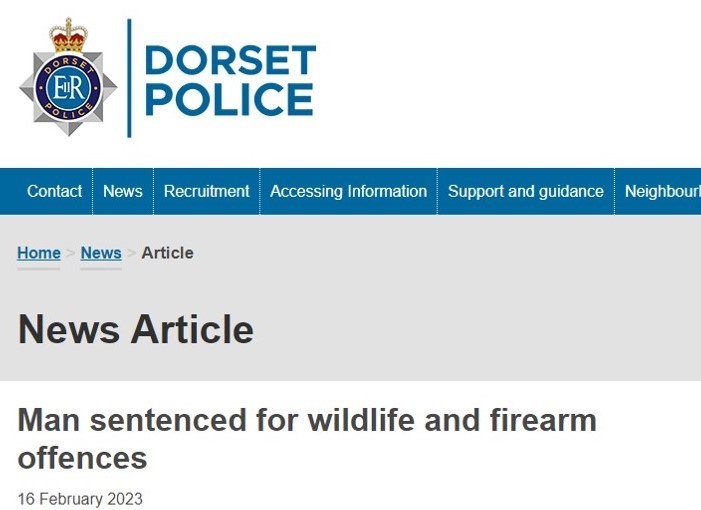
UPDATE 20th February 2023: Dorset Police response to sentencing of criminal gamekeeper Paul Allen (here)

UPDATE 24th February 2023: Natural England’s response to sentencing of criminal gamekeeper Paul Allen (here)

Convicted Dorset gamekeeper Paul Allen due to be sentenced today

Paul Allen, 54, the gamekeeper convicted last month of multiple wildlife, poisons and firearms offences committed on the Shaftesbury Estate, Dorset in March 2021 (here) is due to be sentenced at Weymouth Magistrates Court this afternoon.

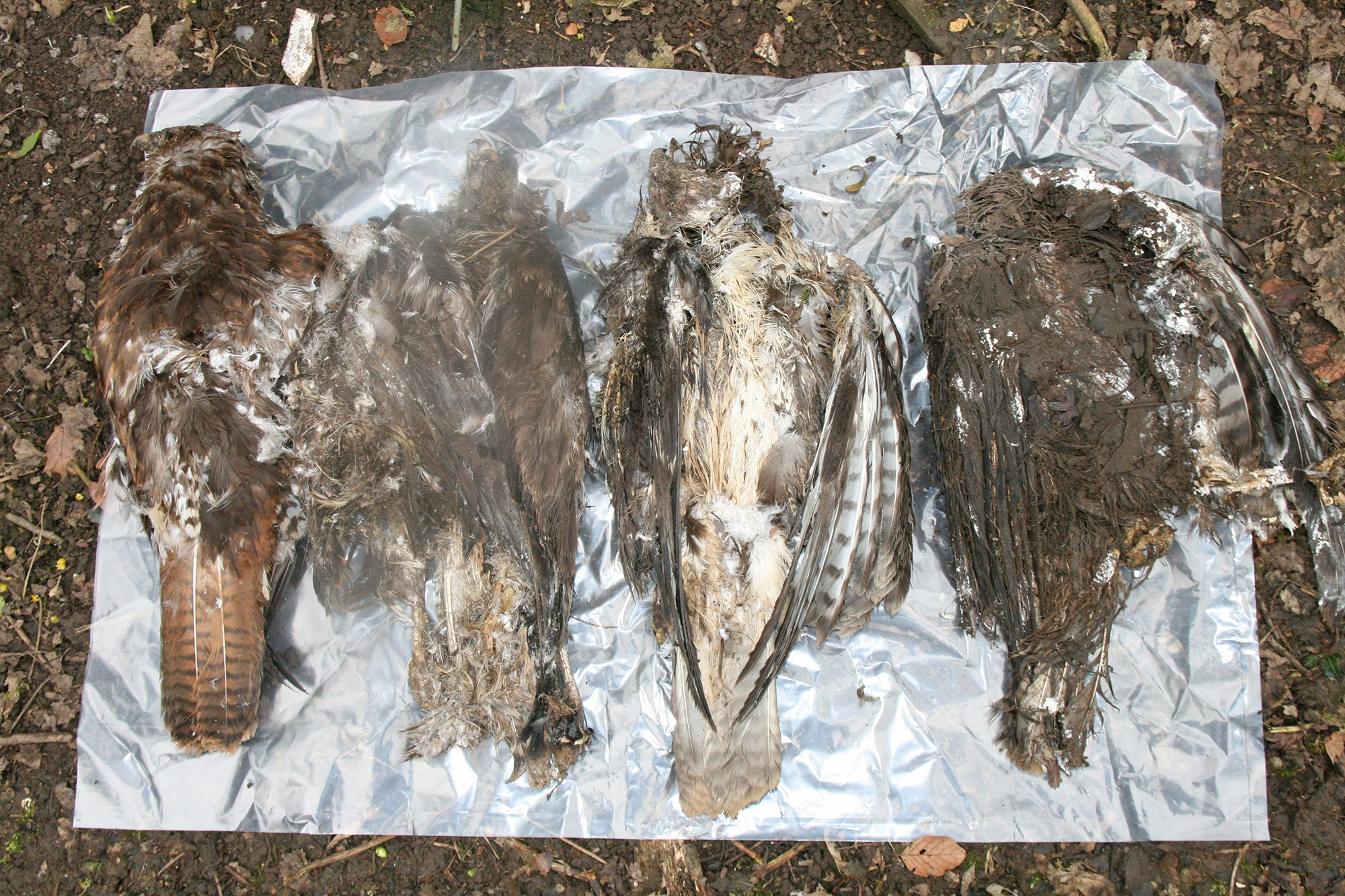
You may recall, following the discovery of a poisoned red kite on the estate in November 2020, a multi-agency raid led by Dorset Police’s (now former) wildlife crime officer Claire Dinsdale took place in March 2021 (see here) where the corpses of six dead buzzards were found by a pen behind his house (tests later showed they had all been shot, including one that was was estimated to have been shot in the last 24hrs). Officers also found the remains (bones) of at least three more buzzards on a bonfire.

A loaded shotgun was found propped up behind a kitchen door (!) and 55 rounds of ammunition were found in a shed. Both the gun and the ammunition should have been inside a locked, specifically-designed gun cabinet, by law. The ammunition was not covered by Allen’s firearms certificate.

Officers also found a number of dangerous, and banned, chemicals, including two bottles of Strychnine, two containers of Cymag and a packet of Ficam W (Bendiocarb) in various locations, including in a vehicle used by Allen.

Four of the nine dead buzzards found. Photo: RSPB

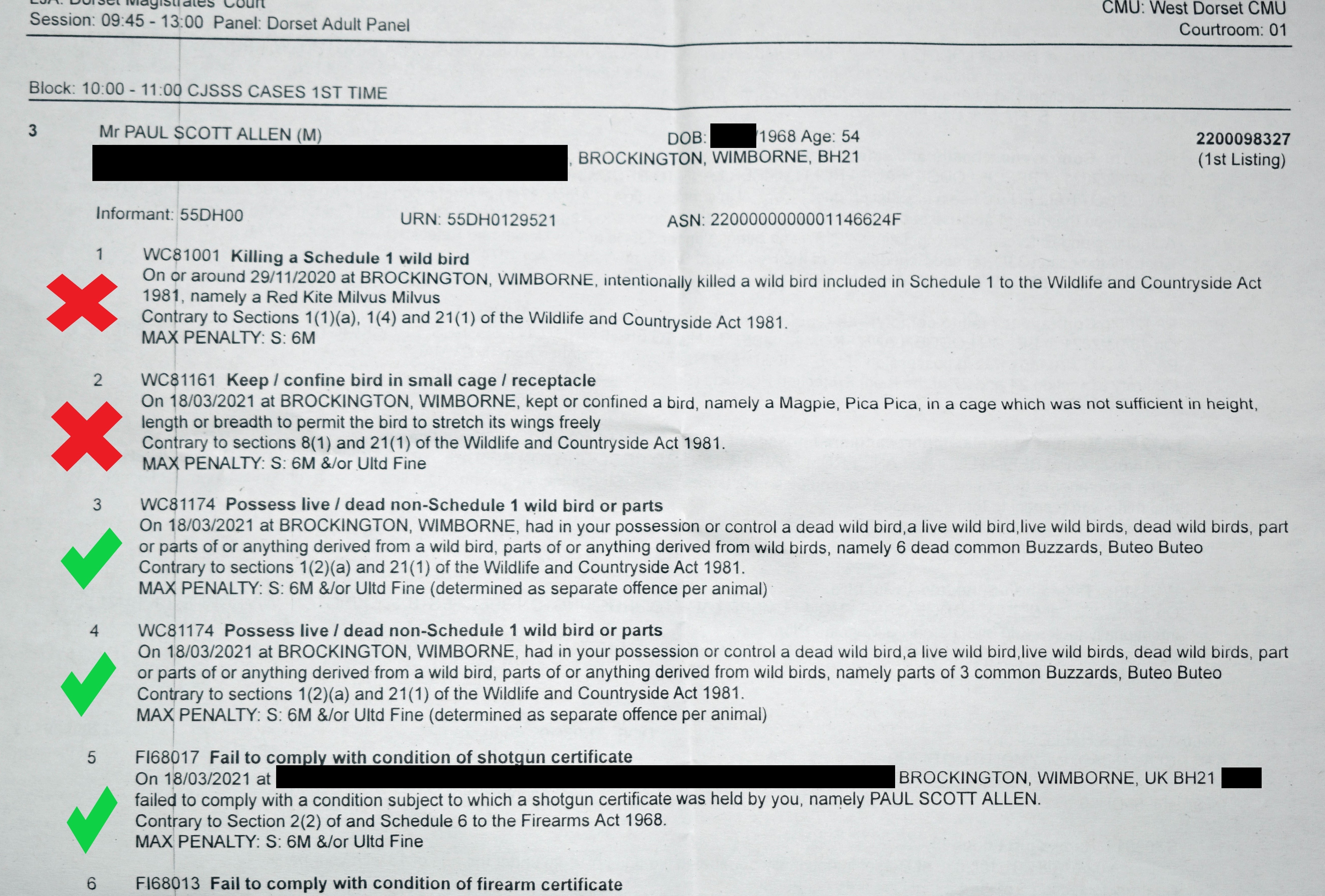
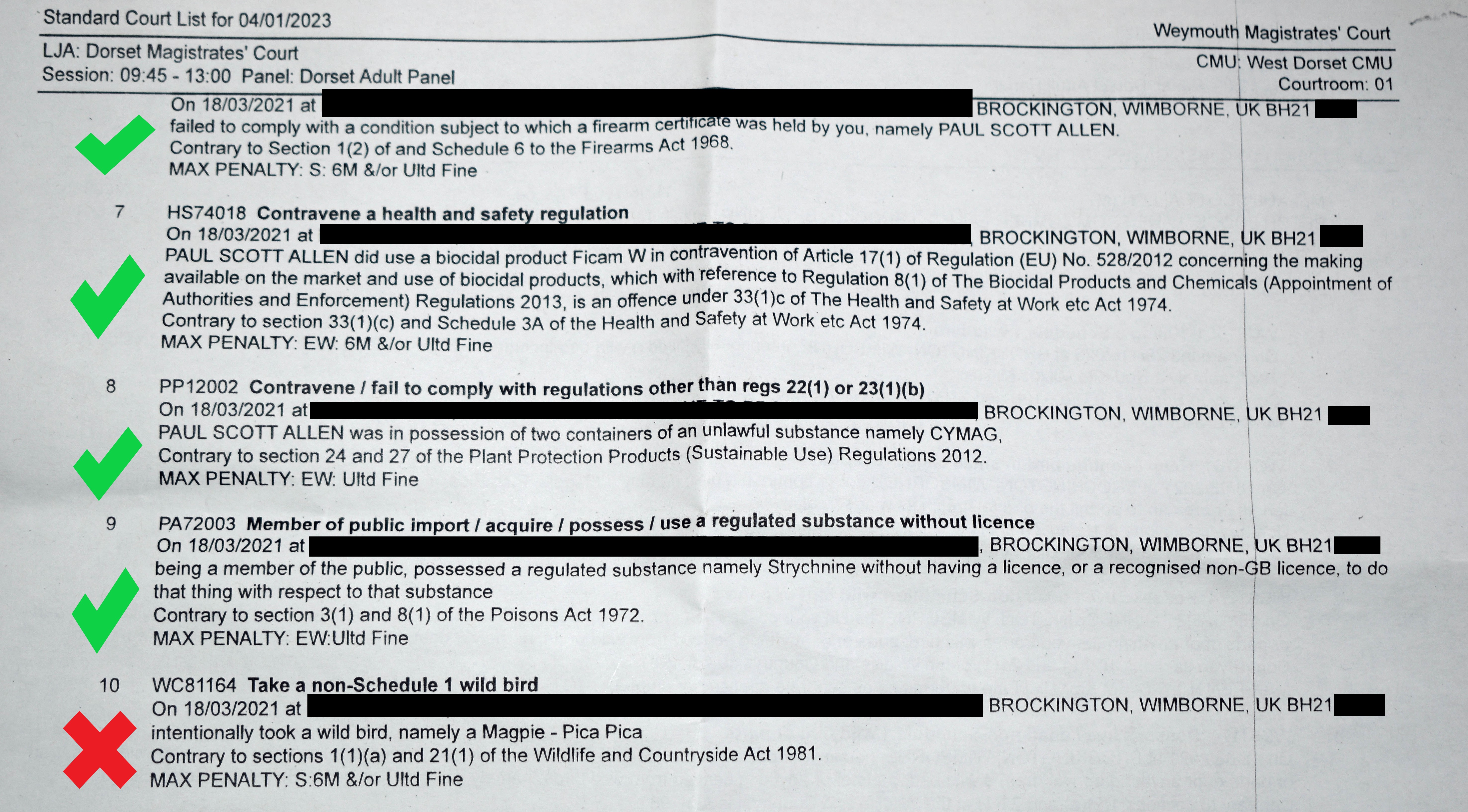
At a hearing on 4th January 2023, Allen pleaded guilty to seven charges including two counts of possessing a live or dead bird, or parts thereof, one charge of failing to comply with the conditions of a shotgun certificate, one charge of failing to comply with the conditions of a firearms certificate, one count of possessing a regulated substance without a license, one count of failing to comply with  regulations in accordance with the Plant Protection Products (Sustainable Use) Regulations 2012 and one charge of contravening a health and safety regulations.

A number of other charges were dropped minutes before the start of the hearing after some discussion between the defence and the CPS. I’ve annotated this court listing to demonstrate the changes. The court listing was provided by a court clerk at last month’s hearing (thanks to the blog reader who sent it to me).

The court deferred sentencing until today to allow reports to be complied on Allen, to help inform sentencing. In my view these crimes pass the custody threshold but the court will need to consider any mitigating factors. For example, it has been reported elsewhere that Allen is recently widowed and has two teenage children. If he is the sole carer for these children then that will likely impact on the type of sentence he receives, although I would argue that having unsecure, highly dangerous poisons and an unsecure loaded shotgun propped up behind his kitchen door is questionable behaviour for an apparently responsible parent.

Sentencing takes place this afternoon and a large amount of media coverage is anticipated. I’ll report back later.

UPDATE 16.30hrs: Criminal Dorset gamekeeper Paul Allen receives suspended custodial sentence despite committing multiple wildlife, poisons and firearms offences (here)

Red kite found poisoned on Swinton Estate – North Yorkshire Police refuses to investigate

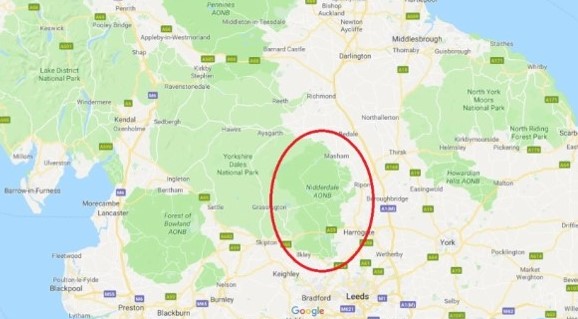
Last November I was reading an online article on the Teeside Live website about the Nidderdale Area of Outstanding Natural Beauty (AONB) in North Yorkshire being dubbed ‘the bird poisoning capital of the UK‘ (here).

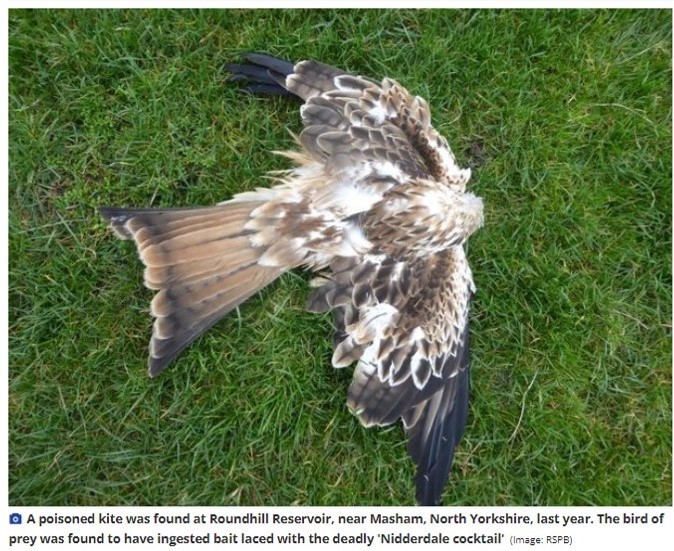
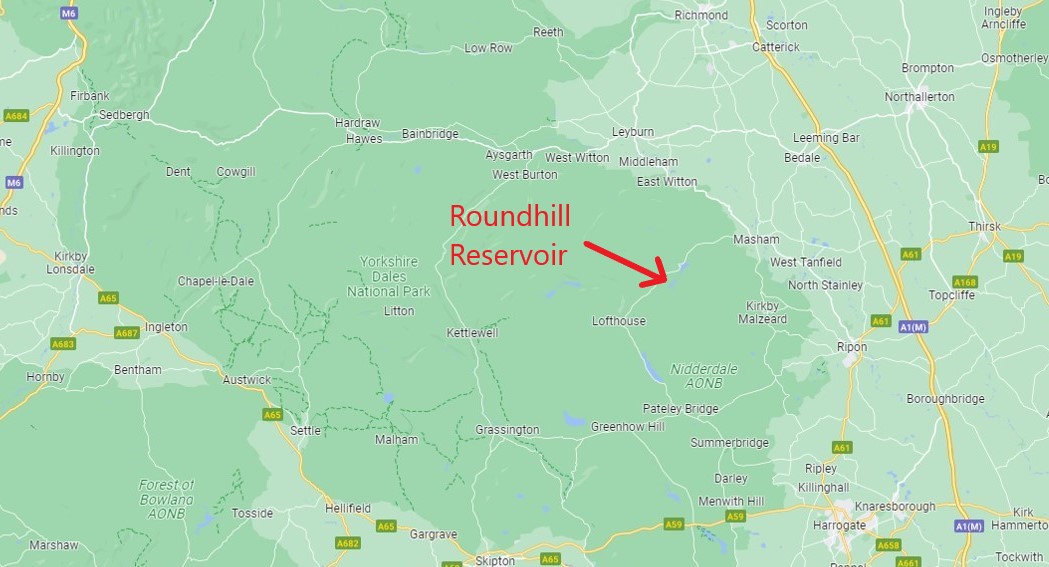
The article was illustrated with various photographs, including this image of a poisoned red kite that was reportedly found dead at Roundhill Reservoir, near Masham in 2021:

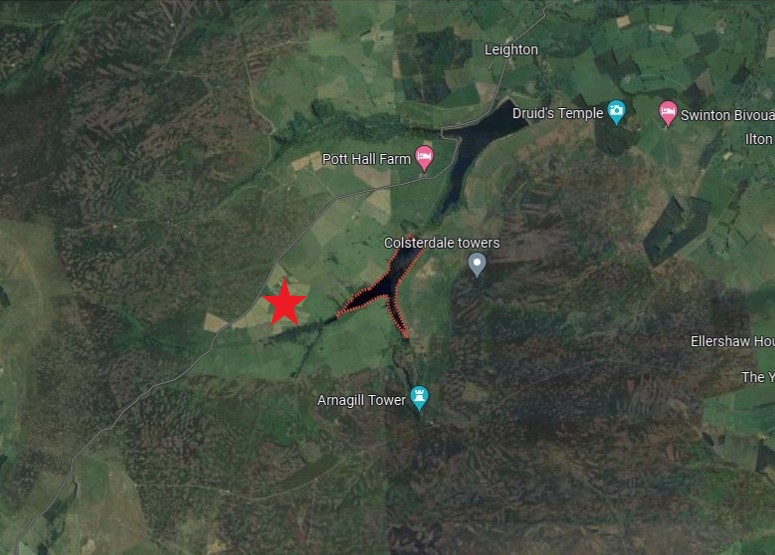
The given location caught my eye as I understand the Roundhill Reservoir is surrounded by the Swinton Estate, a notorious grouse-shooting estate that has been at the centre of police investigations into confirmed and alleged raptor persecution for years.

For example, this is the estate where hen harrier ‘Bowland Betty’ was found dead in 2012, later confirmed to have been shot (here & here) although it has never been established whether she was shot on or off the estate. It’s also where a Swinton Estate gamekeeper was convicted for twice setting an illegal pole trap in 2013 (here) and where another hen harrier, ‘River’, was found shot dead in 2019 (here). Around the same time as River’s demise, an unidentified gunman had been filmed with two dogs walking through a hen harrier roost on the estate (here). There have also been reports from local raptor workers of the ‘mysterious disappearances’ of many raptors on this estate for over a decade.

The owner of Swinton Estate is Mark Cunliffe-Lister, Earl of Swinton, who in 2020 became the new Chairman of the grouse moor owners’ lobby group, the Moorland Association (here). This is a high profile position and in recent years Mr Cunliffe-Lister’s estate has become somewhat of a poster child for DEFRA’s ludicrous hen harrier brood meddling trial, where the estate has championed the removal of some hen harrier chicks in return for permitting others to remain and to be diversionary fed by estate staff, although this hasn’t been without controversy either after it emerged that Natural England had appeared to ‘bend the rules’ in favour of estate activities (e.g. see here). Controversially, in 2021 a Guardian journalist described Swinton Estate as the ‘hen harrier’s friend’ (here), supported by a statement from Stephen Murphy (Natural England) about the estate’s head gamekeeper, “What he’s done for harriers, word’s can’t describe“. Murphy also claimed that hen harrier Bowland Betty had definitely been shot elsewhere and merely flew on to the estate to die – an unevidenced claim that was later amended in the article. Last year the estate won what was described as ‘a prestigious conservation award’ for its involvement in the hen harrier brood meddling trial (here).

So, back to that article I was reading in November 2022. I didn’t recall hearing about a poisoned red kite being found on the Swinton Estate in 2021 and I’m pretty sure I would have remembered, given the location, so I did some digging to make sure the poisoning had been confirmed and the location verified, just in case the journalist had cocked up (she’d already mistakenly described Nidderdale as a ‘village’ instead of a region so I couldn’t rely on her account of the poisoned red kite to be accurate).

The Nidderdale Area of Outstanding Natural Beauty (AONB), North Yorkshire
Roundhill Reservoir in the Nidderdale AONB

I found details about this crime on the HSE’s Wildlife Incident Investigation Scheme spreadsheet, which confirmed the kite had been found poisoned on a Right of Way footpath in November 2021. The poisons found in the kite’s stomach included Bendiocarb, Carbofuran, Chloralose and Isofenphos – this highly toxic combination has become known as the ‘Nidderdale Cocktail’ as it’s so frequently used to kill birds of prey in this region, especially red kites (e.g. see here, here, here).

The red star denotes the approximate location of the poisoned red kite found in November 2021, close to Roundhill Reservoir and surrounded by the grouse moors of Swinton Estate

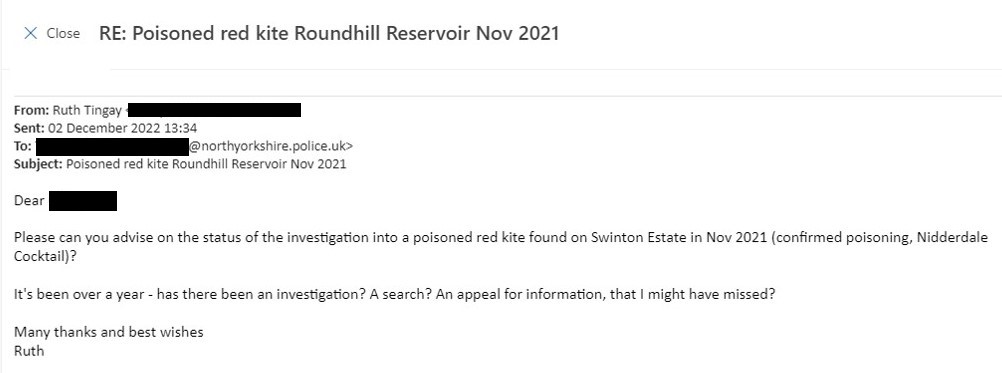
However, I couldn’t find any media coverage of this crime, nor any police appeals for information, nor any warnings to the public about the continued use of poisons so dangerous that some of them have been banned for years. Given that a year had already passed since the poisoned kite was discovered, I found this puzzling. So I contacted North Yorkshire Police’s rural crime team and asked them about the status of the investigation:

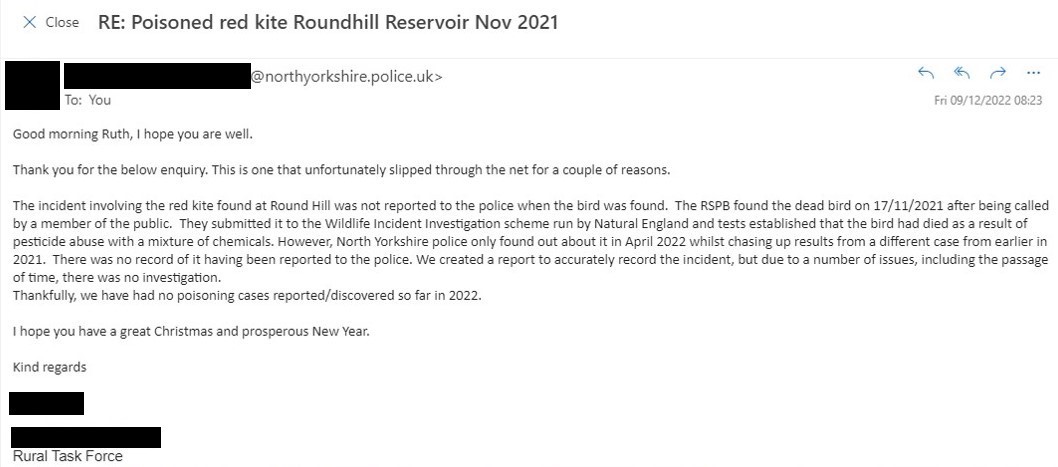
Here’s the astonishing response I received:

This North Yorkshire Police Inspector admitted that this poisoned red kite “unfortunately slipped through the net” but then went on to justify the police’s decision not to investigate by accusing the RSPB of failing to notify the police about this incident when the poisoned kite was first picked up. He claimed the police only found out about it five months later, in April 2022, whilst chasing the lab for the results of another investigation.

His allegations about the RSPB aside (and which I’ll come to, below), I was still stunned that he thought that launching an investigation, and issuing a public appeal for information, let alone issue a warning to the public about the use of poisons in the countryside, wasn’t worthwhile due to the ‘passage of time’ (five months), especially given the location where the poisoned kite had been found.

A couple of years ago a previous North Yorkshire Police Inspector had issued a public appeal/warning, ten months after the discovery of another poisoned red kite in Nidderdale (see here), so it seemed to me that there was no reason not to issue one after a five month delay.

I wrote back to North Yorkshire Police asking for an explanation:

Apparently, it wasn’t up for debate. Here’s the response I received:

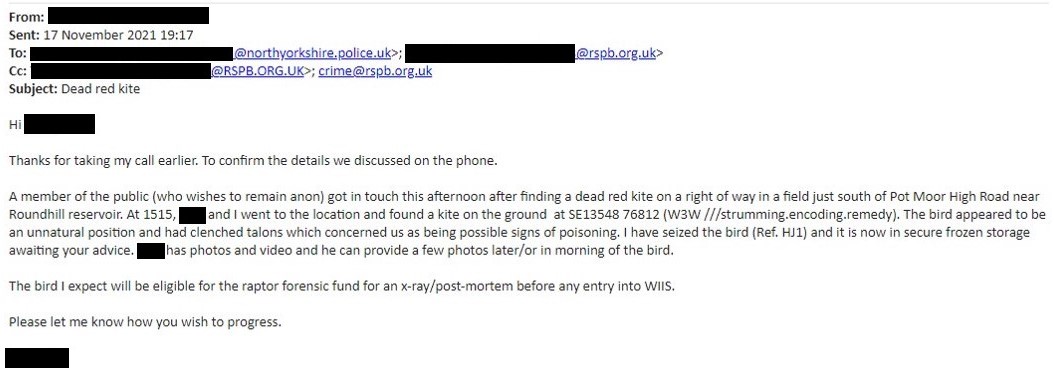
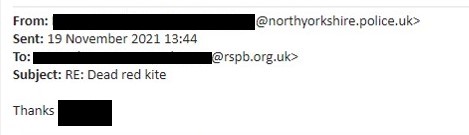
Meanwhile, I contacted the RSPB and put to them the allegations this Inspector had made, that the RSPB hadn’t notified the police about the discovery of this red kite. It turns out those allegations were utterly unfounded/untrue. The RSPB DID contact North Yorkshire Police, on the day the poisoned kite was discovered, and took instruction from the police about submitting the corpse for toxicology analysis. Furthermore, they had the email correspondence to prove it:

So what are we to make of North Yorkshire Police’s refusal to investigate a confirmed poisoning incident (a so-called national wildlife crime priority), on an estate with a long history of alleged wildlife crime, that has enjoyed recent adulation from Natural England staff and the media, that has played a significant role in the hen harrier brood meddling trial, and whose owner is a high profile representative of the grouse-shooting industry?

Does Mr Cunliffe-Lister even know about this poisoned kite being found on his estate? Given the Moorland Association’s claimed ‘zero tolerance’ of raptor persecution, and Mr Cunliffe-Lister’s widely-reported apparent welcoming of birds of prey on his estate, I’d have expected him to speak out and condemn this disgraceful poisoning incident, as any decent landowner would. It’d be interesting to know whether North Yorkshire Police have informed him, or not.

Whatever, North Yorkshire Police’s refusal to investigate this crime is wholly unacceptable. In the first instance, I’ll be writing a letter of complaint to the North Yorkshire Police, Fire and Crime Commissioner, Zoe Metcalfe.

In her Police and Crime Plan 2022-2025 (here), she details an objective of ‘an improved [police] response to crime in rural areas, especially wildlife crime...’ as this had been identified as a major concern for North Yorkshire residents in the recent PCC consultation.

UPDATE 23.30hrs: Natural England’s senior management team has a lovely day out…on Swinton Estate!! (see here).

Death of white-tailed eagle on Isle of Wight recorded as ‘uncertain’ as presence of avian flu restricted toxicology tests

In March last year a young, satellite-tagged white-tailed eagle was found dead on the Isle of Wight in what were considered to be suspicious circumstances and a police investigation was launched (see here).

This was the third white-tailed eagle death since October 2021 and all three birds were from the Isle of Wight Reintroduction Project,  a Government-backed five-year project bringing young sea eagles from Scotland and releasing them on the Isle of Wight to re-establish this species in part of its former range.

The two other dead eagles found during that period included the one found on the Shaftesbury Estate in Dorset in January 2022, which was confirmed to have been illegally killed by ingesting an extraordinary high quantity of the rat poison Brodifacoum but the subsequent police investigation was botched by Dorset Police (see here); and the eagle found dead on a game shoot in West Sussex in October 2021, confirmed to have been illegally killed by ingesting the poison Bendiocarb and whose death is currently the subject of an on-going police investigation (see here).

A preliminary post-mortem on the eagle found dead on the Isle of Wight revealed it was carrying avian flu, but at that time it was unknown whether avian flu had been the cause of death. Later tests revealed it had not.

The presence of avian flu has important consequences for how the corpse is handled and stored under strict government rules, and unfortunately this impacts on the ability to conduct standard toxicology analyses for other potential causes of death, notably the detection of certain poisons.

Last week Hampshire & Isle of Wight Constabulary issued the following statement about the death of this eagle:

Death of White-tailed Eagle remains uncertain after conclusion of police investigation.

A police investigation into the death of a satellite-tracked White-tailed Eagle on the Isle of Wight has found no evidence of unlawful killing.

It comes after Hampshire Constabulary were called shortly after 5pm on Thursday 24 February 2022 to a report of a dead sea eagle on Bowcombe Road on the Isle of Wight.

The circumstances surrounding the death were investigated by local Country Watch officers, along with the support of various partners including the Animal and Plant Health Agency, DEFRA, Forestry England and the Roy Dennis Wildlife Foundation.

Officers explored all possible lines of enquiry into the death, including; analysis of satellite tracking data, evidential land searches in and around the site where the bird was found deceased, obtaining accounts from witnesses in the local area at the time, comprehensive veterinary x-rays as well as conducting specialist post mortem examinations.

The bird initially tested positive for Avian Influenza (AI), but subsequent post-mortem examination carried out under strict AI protocols concluded that this was not the cause of death.

Standard toxicology testing was not possible due to the AI positive test, but the limited analysis that was undertaken did reveal elevated background levels of two rodenticides, brodifacoum and difenacoum, though not at sufficiently high levels to have caused the death of the bird. As such the post-mortem concluded that the actual cause of death of the White-tailed Eagle remains uncertain.

During the post mortem, there was no evidence of any lesions on the sea eagle to explain the cause of death.

Police Sergeant Stuart Ross of Hampshire Constabulary’s Country Watch team, said: “Hampshire Constabulary has carried out a thorough criminal investigation into the death of the White-tailed Eagle and have found no evidence of unlawful killing from the lines of enquires carried out and evidence gathered by officers.

“As such, we are satisfied that there is no evidence of criminal offences having taken place and that the death of the White-tailed Eagle is being treated as uncertain at this time”.

“The criminal aspect of this investigation has now concluded, but we urge all users of rodenticides, particularly brodifacoum, which is known to be highly toxic to wildlife, to follow all guidelines regarding use. Brodifacoum should only be used in and around buildings.”

The reintroduction of White-tailed Eagles on the Isle of Wight is part of a dedicated scheme run, under a Natural England licence, by Forestry England and the Roy Dennis Wildlife Foundation.

ENDS

There are no complaints about Hampshire & Isle of Wight Police’s handling of this investigation. They were responsive, thorough and transparent.

The police statement, above, is fairly detailed and informative. However, caution should be applied when interpreting the statement about the presence of ‘elevated background levels of of two rodenticides, brodifacoum and difenacoum, though not at sufficiently high levels to have caused the death of the bird. As such the post-mortem concluded that the actual cause of death of the White-tailed Eagle remains uncertain‘.

Whilst this is factually accurate, and I’m sure not intended to mislead in any way, readers should be aware that the storage of the eagle’s tissues in formalin (as required for AI positive birds) reduces the laboratory’s ability to determine the significance of these rodenticides.

Here is an excerpt from the final lab report:

‘It was suspected that this white-tailed sea eagle had been poisoned, or possibly exposed to anticoagulant rodenticides. Laboratory analysis for some likely pesticides has been undertaken on samples of fixed tissue only, although it is possible that typical abuse pesticides (such as bendiocarb) would not be detected within this sample type. These tests have detected and confirmed a residue of the anticoagulant rodenticides brodifacoum and difenacoum in the fixed liver from this eagle, but the significance of these residues is uncertain given the prior treatment of the sample with formalin. Therefore, the actual cause of death of this white-tailed sea eagle remains uncertain, but this result confirms that it had been exposed prior to death to brodifacoum and difenacoum’. 

Unfortunately we won’t ever now know whether this eagle had ingested high quantities of rodenticides, or whether it had been poisoned with a banned substance such as Bendiocarb, because of the rules on the handling and storing of tissues containing Avian Influenza. And this may prove to be an issue that hampers other investigations if avian flu is detected in a raptor that has died in what are perceived to be suspicious circumstances.

But at least in this case, the police did conduct searches of the land where the eagle was found dead, and have also included a warning in their press statement about the proper use of rodenticides.

To follow news about the reintroduced white-tailed eagles please visit the Roy Dennis Wildlife Foundation website here.

Police Scotland confirm red kite found poisoned on grouse moor had been killed with banned pesticide

Last month I blogged about a poisoned red kite that had been found dead, laying close to a poisoned bait (a Lapwing, of all things) on Dava Moor, a grouse moor in the Scottish Highlands, just outside the boundary of the Cairngorms National Park (see here).

The poisoned red kite laying dead next to poisoned bait (a lapwing)

The poisoned red kite and the poisoned bait had been found after the kite’s satellite tag indicated the bird was dead on 21st May 2021 and Police Scotland launched an investigation. They collected the kite and the bait and sent them off to a specialist lab for toxicology analysis and they conducted a search of the grouse moor the following week. Toxicology tests confirmed the presence of poison in both the kite and the lapwing.

Sixteen months later in September 2022, Police Scotland notified the finder that ‘enquiries are complete, nobody has been charged and the case is now closed‘.

However, the police withheld the name of the poison, failed to issue an appeal for information, and failed to warn the public that dangerous poisons were in use in the area. The crime was only made public after a tip off to this blog. If I hadn’t been told about it, none of us would be any the wiser.

After writing the blog and criticising Police Scotland’s decision to keep this crime a secret, a journalist from The Strathy decided to submit a Freedom of Information request to Police Scotland to ask for more details. Last week they received a response:

The poison used to kill the red kite was Bendiocarb, a dangerously toxic substance so lethal that it has been an offence to even possess it in Scotland, let alone use it, since 2005.

The police also revealed that, “One individual was arrested, interviewed and released without charge due to insufficient evidence.

No charges were ever brought because one of the main responsibilities of Police in Scotland is to investigate crimes and criminal offences and where there is a sufficiency of evidence, report the circumstances to the Crown Office and Procurator Fiscal Service.

Investigation of this particular incident did not provide sufficient evidence to charge any individual.

To clarify, corroborative evidence is required to liable any charge in relation to the poisoning of birds of prey. The decision not to issue a press release was an operational one, balancing risk versus reward.

To explain, the locus was remote, the bait and bird had been removed and no longer posed a risk.

Given there was no nearby path it was deemed highly unlikely that any members of the public would have been able to provide useful or relevant witness evidence.

From the main road nearest the locus any persons on the land would not have been able to identify any suspect given the distance involved. Further consideration was given in regards to the requirement not to alert the accused to the investigation at this time to aid further investigative strategies.

Any intelligence identifying the methodology or focus of this activity could have been used to the advantage of the perpetrator to frustrate such investigations and/or seek support other individuals to do so.

As such, any press release would have been detrimental to planned further enquiry and police activity.”

That’s just not acceptable. Yes of course, withhold details during the early stages of the investigation so as not to alert the offender, but not saying anything about it for 19 months after the offence was committed? That plays straight into the hands of the grouse-shooting industry whose representatives will (and have been) quite happily writing letters to national newspapers claiming that raptor persecution on grouse moors is an ‘historical issue’ and no longer a problem.

And even more importantly, it puts members of the public, and their pets, at risk of coming into contact with deadly poisons where they’d be least expecting it. Somebody had deliberately placed a deadly poisoned bait out in the open on that moor, with the intention to kill. Police Scotland stated, “the bait and bird had been removed and no longer posed a risk” but who knows how many more baits have been placed there? Where’s the duty of care from Police Scotland, to warn the public of this danger?

Police Scotland’s silence also misses an important opportunity to raise awareness amongst the public that these crimes ARE still being committed, and to encourage them to report anything suspicious that they may stumble across whilst out on the hills, as well as eroding public confidence and trust in the police’s interest in dealing with wildlife crime.

To be clear, I’m not criticising the initial police response to the report of the poisoned kite and the poisoned bait. By all accounts it was a rapid reaction and a thorough investigation by officers on the ground. This isn’t like Dorset Police’s botched response to a confirmed poisoning – where they refused to conduct a follow-up search to look for evidence after the discovery of a poisoned white-tailed eagle (see here). That the Dava Moor poisoning didn’t lead to a prosecution is not a reflection on the investigating officers at Police Scotland – everyone knows how difficult it is to get these despicable offenders into court.

But the decision, presumably made by senior officers, to keep quiet about it for so long? That sounds like a deliberate cover up to me.

I await with interest NatureScot’s decision about whether a General Licence restriction will be imposed on this grouse moor (see here).

This case exemplifies the importance of the Government’s forthcoming Wildlife Management (Grouse) Bill, where there is a proposal to utilise the civil burden of proof (the balance of probability) to determine whether a sanction should be imposed (i.e. the estate’s grouse shooting licence removed), rather than relying upon the criminal burden of proof (beyond reasonable doubt). Police Scotland has admitted, in its FoI response, that in this case corroborative evidence was required to progress any sanction. Had a grouse-shooting licence scheme been in place, the licence would probably, and in my opinion justifiably, have been revoked.

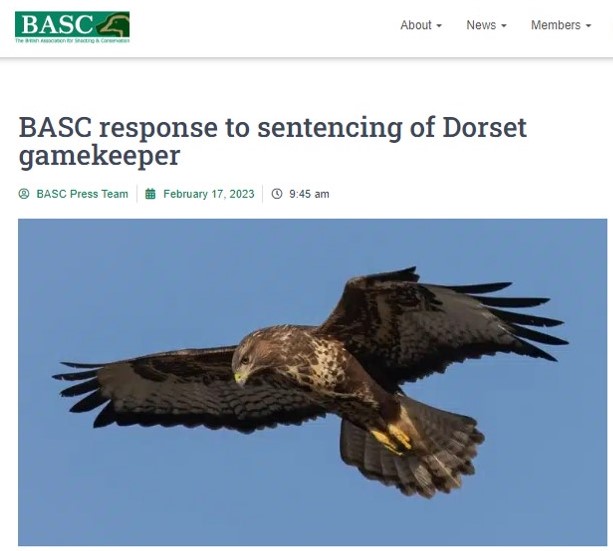
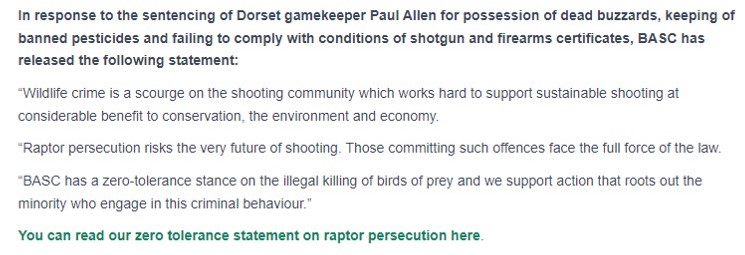
How has the game-shooting industry reacted to the conviction of gamekeeper Paul Allen?

Five days ago, 54 year old gamekeeper Paul Allen pleaded guilty to seven counts of wildlife, poisons and firearms offences, which he committed in March 2021 whilst working on the Shaftesbury Estate in Dorset (see here).

A poisoned red kite had been found dead on the estate in November 2020 (confirmed Bendiocarb poisoning) which triggered a multi-agency search of his premises in March 2021. During that search, investigators found nine dead buzzards (six confirmed shot, the remains of 3 others were pulled out of the ashes of a bonfire), three lots of banned poisons (Bendiocarb, Strychnine and Cymag), a loaded shotgun propped up behind his kitchen door (instead of being inside a locked gun cabinet) and some shotgun ammunition, for which he didn’t have a licence, was found in an unlocked outbuilding.

Four of the nine dead buzzards found by investigators. Photo: RSPB

Allen’s court hearing last week generated widespread local, regional and national media coverage so I fully expected to see full and frank statements of condemnation of his crimes by the game-shooting industry – you know, the industry that claims to have ‘zero tolerance’ of raptor persecution.

I was especially interested in the responses of those game-shooting organisations that serve on the national Raptor Persecution Priority Delivery Group (RPPDG). One of the main stated objectives of the RPPDG is to raise awareness of raptor persecution crimes with the wider public and to encourage people to report such crimes to the police.

Five days on from Allen’s multiple guilty pleas, here’s what those organisations had to say in condemnation:

British Association for Shooting & Conservation (BASC) – nothing

Countryside Alliance – nothing

Country, Land & Business Association (CLA) – nothing

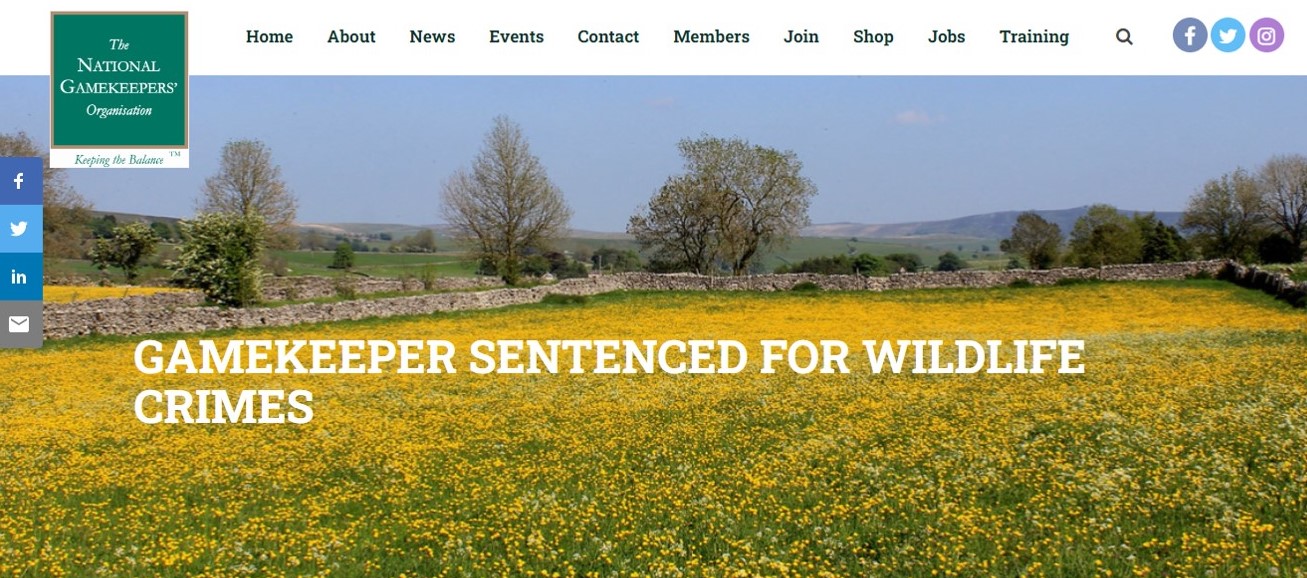
National Gamekeepers Organisation (NGO) – nothing

Oh, no, hang on a minute, something was posted on the National Gamekeepers Organisation website, the day after Allen’s guilty pleas, as follows, under the headline, ‘Gamekeeper has NGO membership suspended‘:

Does this statement of ‘membership suspension’ relate to gamekeeper Paul Allen? Who knows? It’s deliberately cryptic and any casual visitor to the NGO membership wouldn’t have a scoobies to who or what this statement referred. I think that’s the intention. ‘Don’t draw attention to our criminal members and certainly don’t condemn the crimes this one has committed and subsequently admitted to after being caught with all those dead raptors, banned poisons and unsafe firearms and ammunition because it’ll tarnish the image we’ve been so desperately trying to present to the world‘.

It’s been suggested to me that perhaps all these organisations are waiting to make their statements of ‘zero tolerance’ until after Allen has been sentenced next month. Perhaps they are. Although I remember the same excuse was suggested when gamekeeper John Orrey was convicted last year and then sentenced at a later date. How many of them condemned his criminal activities (beating buzzards to death with a stick) after he was sentenced? Take a look for yourselves (here).

I don’t know who’s advising the PR strategy of the game-shooting industry but I suspect the decent, law-abiding members of these shooting organisations will be furious that their so-called leaders are refusing to distance them from the criminals within.

So, the illegal killing continues, the shooting industry organisations say nothing, and public anger grows.

Thanks, BASC, CA, CLA, NGO et al – this is only heading in one direction and you’re all helping it reach the end game so much more quickly than we could get it there on our own. Cheers.

Unusual silence from Dorset Police after conviction of gamekeeper Paul Allen

You’d think, after the high profile conviction of gamekeeper Paul Allen two days ago, who pleaded guilty to multiple counts of wildlife, poisons and firearms offences on the Shaftesbury Estate (see here), that Dorset Police might have issued a statement.

You might think that Dorset Police would have wanted to publicise the conviction, not only to inform the public that a conviction had been secured thanks to the hard work and expertise of its wildlife crime officer Claire Dinsdale and the other partner agencies that Claire drafted in (National Wildlife Crime Unit, RSPB Investigations and Natural England), but also to send a message of deterrence to any other person thinking of committing these crimes.

It’s not as though Dorset Police doesn’t routinely publish statements on its website about other forthcoming court appearances and subsequent convictions for a wide range of offences such as assault, drug supply, sexual assault, murder, driving offences, fatal collisions etc (e.g. see here, here, here, here, here, here, here) and yet Dorset Police has remained tight-lipped about how this long and complex investigation, led by one of its own officers (the now former WCO Claire Dinsdale), resulted in seven guilty pleas at court on Wednesday.

Why would they want to keep quiet about that, do you think? It’s almost as though Dorset Police isn’t that bothered about raptor persecution, a police national wildlife crime priority.

Another gamekeeper convicted for poison offences on a pheasant shoot, but not charged for poisoned kite & shot buzzard

David Matthews, a gamekeeper with 50 years experience, has been convicted at Wrexham Magistrates Court for poison offences uncovered on the McAlpine Estate in Llanarmon Dyffryn Ceiriog, North Wales, where he has worked for 25 years.

In February 2021 a dead red kite was found on the estate by a member of the public and a later toxicology analysis revealed it had been poisoned with Bendiocarb.

[The poisoned red kite. Photo by RSPB]

When RSPB Investigations Officers subsequently visited the McAlpine Estate they found a dead buzzard inside a pheasant release pen. When the body was x-rayed, a piece of shot could be seen lodged in the bird’s skull.

[The shot buzzard found inside the pheasant release pen. Photo by RSPB]

A multi-agency search in October 2021 by North Wales Police, the Welsh Government, RSPB and the National Wildlife Crime Unit uncovered an unlocked barn containing 18 highly toxic products, including Cymag which has been banned since 2004. They also found the remains of a pheasant, inside a game bag on a bonfire site inside a pheasant release pen. The pheasant tested positive for Bendiocarb. Another dead buzzard was too badly decomposed to be tested.

Gamekeeper Matthews pleaded guilty to one charge relating to the possession of unauthorised pesticides. He received a total fine of £219.

You can read the full details of this case on the RSPB’s blog here.

In that blog, the RSPB state, ‘It remains unknown who killed the buzzard and the kite‘.

I’m pretty sure that the RSPB investigators, just like the rest of us, have a pretty good idea who might have been responsible but presumably there was insufficient evidence to charge anyone. Such is the nature of this game that it would be libellous to suggest a suspect.

It seems odd to me, though, that a gamekeeper who had worked on the estate for 25 years wouldn’t have noticed someone laying poisoned baits, placing the bait inside a game bag and leaving it on a bonfire site inside a pheasant release pen, and shooting dead a buzzard and leaving its corpse inside a pheasant release pen.

His £219 fine makes a total mockery of the system. Had this case been in Scotland, the fine for possessing an unauthorised poison would now be £40,000. That’s a serious deterrent.

£219 is not.

This is the reality and I’ll be reminding DEFRA Minister Lord Benyon of this the next time he repeats the Westminister Government’s tediously predictable claim that raptor-killing criminals face ‘significant sanctions…including an unlimited fine and/or a six month custodial sentence‘ (e.g. see this from Environment Minister Rebecca Pow in September 2021, and this from Richard Benyon in February 2022, and this from Rebecca Pow in February 2022, and this from Richard Benyon in April 2022).

Matthews is the 7th gamekeeper to be convicted in seven months across England, Scotland and Wales. There are still multiple cases pending court in the coming months. Clear evidence then that the game-shooting industry’s supposed ‘zero tolerance’ policy towards raptor persecution is simply just rhetoric and that the Government’s so-called ‘significant sanctions’ are complete bollocks.

The other convicted gamekeepers in recent months are:

Gamekeeper Shane Leech who was convicted in November 2021 for firearms and pesticides offences after the discovery of a poisoned buzzard found close to pheasant-rearing pens in Lakenheath, Suffolk (here);

Gamekeeper Peter Givens who was convicted in November 2021 for causing the death of a goshawk and a barn owl which starved to death in an illegally-operated trap on the Cathpair Estate in the Scottish Borders (here);

Gamekeeper Hilton Prest who was convicted in December 2021 for causing a sparrowhawk to starve to death in an illegally-operated trap in Cheshire (here);

Gamekeeper John Orrey who was convicted in January 2022 for battering to death two buzzards he’d caught in a cage trap on a pheasant shoot in Nottinghamshire (here);

Gamekeeper Rhys Davies from the Millden Estate in the Angus Glens, Scotland, who was convicted in May 2022 for animal cruelty relating to badger baiting (he’ll be sentenced at the end of June – here);

Gamekeeper Archie Watson who was convicted in June 2022 for raptor persecution and firearms offences after he was filmed throwing 8 dead raptors down a well on a pheasant-shoot in Wiltshire (here).

Well done to the multi-agency search team involved in bringing David Matthews to court.

Wildlife Crime Working Group seeks (& receives) assurance from Sussex Police re: poisoned eagle investigation

In February this year, I blogged about the suspicious deaths of two white-tailed eagles on two separate game-shooting estates – one in Dorset and the other one rumoured to be in West Sussex (see here).

Both eagles were from the Isle of Wight Reintroduction Project – a privately-funded but Government-backed five-year project bringing young sea eagles from Scotland and releasing them on the Isle of Wight to re-establish this species in part of its former range.

The dead eagle found poisoned on an unnamed shooting estate in Dorset remains an ongoing issue of concern, not least because Dorset Police chose to close the investigation prematurely without a proper explanation (see here, and more on that case shortly).

The dead eagle found poisoned on an unnamed shooting estate in West Sussex has received less attention, although in April I revealed this eagle had been poisoned with Bendiocarb and that toxicology results from a dead dog found on the same shooting estate were pending (see here).

The reason this eagle poisoning case has received less attention is simply down to the fact that Sussex Police has failed to publicise the crime, even though it took place seven months ago (Oct 2021)! However, I was pleased to see The Independent picked up the story from this blog, as did The Telegraph, so it did make the national news but we’ve heard nothing more from Sussex Police.

To ensure that Sussex Police doesn’t ‘do a Dorset Police’ and drop this investigation without an explanation, Wildlife & Countryside LINK’s Wildlife Crime Working Group, England’s largest coalition of organisations working to tackle wildlife crime, has written to the Chief Constable of Sussex Police seeking assurance to that effect.

Here’s the letter that was sent last week:

To her absolute credit, Chief Constable Jo Shiner phoned LINK that afternoon to reassure the Wildlife Crime Working Group that the Sussex investigation is very much ongoing and that she understands the need for possible raptor persecution crimes to be looked at closely. I’m told, by people who know these things, that a fast and personal response like this is unheard of.

Compare and contrast Jo Shiner’s response to that of the Chief Constable of Dorset Police, who had also received a letter from LINK (see here) seeking an explanation about the Force’s failure to investigate the poisoned eagle found dead in Dorset. He has yet to reply.

I’m really pleased to see LINK’s Wildlife Crime Working Group applying pressure in these cases to ensure they’re taken seriously by the respective police forces (not that that should even be needed), but should it really be down to wildlife and conservation NGOs to do this? Surely this is what our statutory agencies should be doing? Wilful blindness, writ large, again.

Another dead buzzard in Dorset – Police warn public of suspected poisoned baits

Yet another dead buzzard has been found in North Dorset.

Whilst the cause of death has yet to be ascertained (presumably the carcass has been sent for post mortem), yesterday PC Rob Hammond warned the public to keep their dogs on leads to avoid the risk of them coming into contact with potential poisoned baits.

Well done to PC Hammond for putting out this timely warning. Even though poisoning has not yet been confirmed, the potential risk to the public and their dogs is high so he’s done exactly the right thing.

Dorset is fast becoming quite the hotspot for raptor persecution. I’ve been looking through some reports from the last few years and have found the following incidents of raptor persecution recorded in the county:

May 2018: Buzzard found shot dead (here).

May 2018: Suspicious deaths of two barn owls and several more buzzards (here).

March 2020: Disturbance of nesting peregrines (here).

April 2020: Several buzzards were found dead within close proximity to each other in the Ashmore Wood area near Blandford. These birds were sent for testing and enquiries remain ongoing (here).

August 2020: Two buzzards, one dead, were found near the body of a rabbit. An owl and a further two buzzards were also found. Analysis has confirmed Brodifacoum in the buzzard which is likely to have caused the death. The second buzzard and the owl had background residues and the analysis on the rabbit was negative.

September 2020: A dead buzzard was found on a bridleway, it had been shot.

November 2020: A dead red kite and rat were found near a footpath. Analysis has confirmed Bendiocarb in the stomach contents of the red kite and in pots removed from a vehicle and a sachet in a shed, which is likely to be the cause of death. No residues were found in the rat.

February 2021: A buzzard and a red kite were found in a wooded area. Analysis has confirmed Brodifacoum in the liver of the red kite which will have contributed to its death, the levels of Brodifacoum in the buzzard are borderline and uncertain if the exposure contributed to its death. 

March 2021: A multi-agency raid was carried out on a shooting estate in North Dorset. A number of dead birds of prey and several pesticides, including banned substances, were located at the premises. A firearm was also recovered (here).

January 2022: A dead white-tailed eagle was found poisoned on a shooting estate in North Dorset. The post mortem found its liver contained 7 x lethal dose of rodenticide Brodifacoum. Inexplicably, Dorset Police closed the investigation before conducting a search (here).

February 2022: Another white-tailed eagle was suspected to have been poisoned on another shooting estate in North Dorset. This one survived (here).

February 2022: A dead buzzard and a dead red kite are found dead on a shooting estate in North Dorset, suspected poisoned. Toxicology results awaited (here).

April 2022: A dead buzzard found dead in the Ashmore area. Toxicology results awaited.

It’s pretty clear that Dorset has a raptor persecution issue and I understand there are several more investigations that have yet to be reported in the public domain. Given these incidents, and more, it’s astonishing that the local MP, Chris Loder, thinks the police shouldn’t ‘waste resources’ on investigating wildlife crimes.

It’s even more astounding that Dorset Police shut down the poisoned eagle investigation, without conducting a search, and continue to refuse any explanation for their decision and yet still the top brass claim to be taking raptor persecution ‘seriously’, not that anyone believes them anymore.

It’s heartening then to see on-the-ground officers like PC Rob Hammond, trying to do the right thing. I wonder how long it’ll be before he’s told to drop the case and/or stop investigating wildlife crime, as has his colleague, PC Claire Dinsdale?