spate of recent poisonings kills eagles, kites, buzzards & peregrine

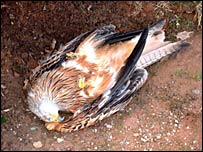
One of the dead white-tailed sea eagles undergoing post mortem

A disgraceful spate of recent poisonings in Ireland has resulted in the death of 2 white-tailed sea eagles, 1 golden eagle, 3 red kites, 3 buzzards and a peregrine.

The sea eagles were poisoned by the illegal pesticide carbofuran. The golden eagle, kites, buzzards and peregrine were killed by alphachloralose, a pesticide still manufactured and legally available in Ireland.

Police investigations are underway.

For the full sorry story: http://www.goldeneagle.ie/news_viewnews.php?x=6&z=132&news_id=11&article=267

Call to control poison in Ireland after more red kite deaths

Another poisoned red kite

Pressure to control the poison Alphachloralose, available over the counter in Ireland, is intensifying following the poisoning of two more red kites in County Wicklow. The young birds were part of an Irish reintroduction project and had only been released in July 2009.

Alphachloralose has been used to kill red kites, golden eagles and white-tailed eagles across Ireland in recent years. The Golden Eagle Trust, a local NGO attempting to re-introduce all three species back to ireland, have lodged a formal complaint with the European Commission over the State’s failure to protect the birds.

Full story: http://www.irishtimes.com/newspaper/ireland/2010/0329/1224267276974.html

Golden Eagle Trust website: http://www.goldeneagle.ie/

Gamekeeper sentenced for wildlife crimes on Redmyre Estate, Abernyte, Perthshire

Further to the blog entry of 3 March 2010……

Gamekeeper Graham Barclay Kerr (53) of Mary Findlay Drive, Dundee, who had earlier pleaded guilty to shooting a buzzard and being in possession of illegal and deadly poisons on the Redmyre Estate, Abernyte, Perthshire on 9 September 2009, has now been sentenced.

His punishment? A pathetic £400 fine for shooting the buzzard with a .243 rifle, and an even more pathetic ‘admonishment’ (which means a telling off) for being in possession of Carbofuran and Alphacloralose. Sentencing him at Perth Sheriff Court on 24 March 2010, Sheriff Robert McCreadie told Kerr, “You may not have appreciated how serious the courts take the illegal destruction of wildlife. I think you will be aware of that now”.

Really? A £400 fine for deliberately shooting a protected species is not what I would call a deterrent for other gamekeepers or their employers. And an admonishment for the possession of illegal and highly toxic poisons is nothing but lamentable. When oh when will the public see the full force of the law being handed down to convicted wildlife criminals? The Scottish judiciary has been given the powers to impose large fines or custodial sentences for convicted wildlife criminals, because that is the punishment that society deems fitting for these crimes. The Scottish government claims to be ‘stamping out’ wildlife crime. Perhaps the government and the judiciary need to get together and make sure they are reading from the same book, let alone the same page, because so far their actions speak louder than their words. This case speaks volumes.

Full story: http://www.perthshireadvertiser.co.uk/perthshire-news/local-news-perthshire/perthshire/2010/03/26/buzzard-killed-my-former-perthshire-gamekeeper-73103-26110898/

Inside case details from Tayside Police: http://www.scotland.gov.uk/Topics/Environment/Wildlife-Habitats/paw-scotland/Resources/Newsletters/Issue2/Inthecourts/GrahamKerr2010

Gamekeeper convicted of crimes on Innes House Estate, Moray

Police raided Innes House Estate near Elgin, Moray in November 2006 after dying buzzards and crows were seen in a nearby field. Later laboratory testing confirmed the birds carried traces of Carbofuran.

At Elgin Sheriff Court on 30 April 2007, head gamekeeper Michael Royan was found guilty of possessing proscribed pesticides (Carbofuran, Cymag & Alphachloralose) and he was also convicted of a firearms offence. He was fined £1,000.

According to the 2010 Innes House Estate website, Michael Royan is still employed as Head Gamekeeper.

poisoned red kite returned to wild

Gamekeeper receives pitiful fine for poisoning offences on Fairnington Estate, Kelso

In August 2003, dead pheasant poults covered in blue granules were found on the Fairnington Estate, Kelso (owned by Mr Nigel Salvesen), close to a pen used to rear pheasants for shooting. Later tests showed the blue granules contained the banned pesticide, Carbofuran. Further searches revealed more carbofuran in a vehicle and in an unsecured shed, as well as alphachloralose and strychnine. The gamekeeper was charged with 48 offences under the Wildlife & Countryside Act 1981, the Food and Environment Protection Act 1985 (FEPA), and the Firearms Act.

At Jedburgh Sheriff Court in June 2005, after plea-bargaining, the keeper admitted just 4 offences under FEPA and the Firearms Act. His pitiful fine was £190, after reference was made to his poor health and that it was his first known offence.

http://campaignwithus.rspb.org.uk/Images/legaleagle46_tcm9-132969.pdf

Golden eagle found poisoned on Cawdor Estate, Invernesshire

A golden eagle found dead on Cawdor Estate, Invernesshire, on 6 August 2001 had been poisoned by Carbofuran. The dead eagle’s decomposed remains were found by a hillwalker.

Cawdor Estate Factor John Higson and Head Gamekeeper Roddy Forbes denied any wrong-doing and suggested that the dead eagle could have been brought in by someone in their rucksack and planted on the estate to cause trouble. This explanation is commonly used by Alex Hogg, Chairman of the Scottish Gamekeepers Association, to account for the numbers of dead raptors that turn up on shooting estates. Our sources suggest that recent DNA evidence has proven these claims unfounded.

Since 1988, there have been six other incidents involving the illegal use of poisons connected to the Cawdor Estate. These include:

1988: A pet labrador dies after consuming the deadly poison, strychnine, while walking on Cawdor estate.

1992: A buzzard, magpie and sheep all laced with strychnine are discovered on the estate.

1993: A buzzard found poisoned by the toxin, alphachloralose, on Forestry Commission land 100 metres from the boundary of Cawdor estate.

1994: Three buzzards and rabbit bait found poisoned by alphachloralose on Cawdor.

1996: Three baits discovered containing poisons: a hare laced with alphachloralose, a goat with aldicarb and a wigeon with strychnine.

1996: A hidden pit containing a suspected birds of prey poisoning kit uncovered by investigators three miles from Cawdor Castle.

1999: A report sent to the procurator fiscal alleging that mountain hares were illegally persecuted in snares.

2000: A second report submitted to the fiscal claiming mistreatment of hares.

2001: A dead eagle found on Cawdor estate confirmed to contain the lethal poison, carbofuran.

No convictions have been made as it has not been possible to identify the individual who laid the bait.

For further information: http://findarticles.com/p/articles/mi_qn4156/is_20010826/ai_n13961693/?tag=content;col1

Gamekeeper admits shooting buzzard on Redmyre Estate, Perthshire

Gamekeepers often refer to buzzards and other raptors as 'vermin' - an attitude carried on from unenlightened Victorian times.

Graham Kerr, a gamekeeper on the Redmyre Estate in Abernyte, Perthshire, has pleaded guilty to shooting a buzzard with a rifle on 9 September 2009, because he believed the buzzards were ‘causing concern’ to the pheasants he was rearing for a commercial shoot.

In court in February 2010, Kerr, 53, of Mary Findlay Drive, Dundee,  also admitted the possession of illegal poisons Carbofuran and Alpha-Chloralose which he intended to use to kill other buzzards. He will be sentenced at a later date.

Further info: http://news.scotsman.com/dundee/Gamekeeper–stockpiled-outlawed-poisons.6078206.jp