 The 2012 annual police wildlife crime conference took place a couple of weeks ago. Quite a few of this year’s presentations were relevant to raptor persecution so we’ll be commenting on these in due course. To start off the series we’ll focus on what Charlie Everitt had to say. Charlie is the Scottish Investigative Support Officer at the UK National Wildlife Crime Unit (NWCU). See here for more details.
Charlie Everitt: Update on Raptor Persecution
“Scottish Raptor Persecution Priority Delivery Group, and that’s a mouthful, erm, has been concentrating more on poisonings just at the moment, and also on processes so that we can get things right in order to take things forward for core purposes. Consequently we’re just finishing off and hoping to sign off at the next meeting an evidence gathering protocol. Now this is guidance and best practice for organisations who are likely to come across raptor persecution victims, er, giving advice and guidance on who they should contact, how the, er, any carcasses should be recovered and where they should be handed in to, so it’s giving best practice in order to maximise our chances for convictions in court so we get the process right. So that should be signed off, er, at the next meeting.” [See here for a previous blog about an earlier draft of this protocol. We haven’t seen the final version yet but look forward to seeing it in the near future].
“And similarly we’re looking at, er, another protocol with regards to satellite tagged birds, and this is a case where we have birds that have been satellite tagged and maybe the tag, er, stops giving off a signal, erm, or the signal remains stationary, just a protocol as to what we should do, er, in order to take the next step in order to recover the satellite and to investigate what’s happened. So just to make sure that we are lawful in what we are doing. So that’s a protocol as well that should get signed off very soon.
And the third angle, and it’s taking up a fair bit of time, is looking at a very new approach to the whole raptor, erm, raptor persecution issue. Now I can’t really say a great deal more on this at the minute, it’s in its early stages of development just now but when it is it will be put through tests and if it is fit for purpose it will be rolled out and, erm, yes you’ll all be made well aware of it when it does emerge.
We’ve also been looking to the use of science to try and benefit from what science can deliver to us. Now the science of course can back up intelligence and information crucially and the science has been used to good effect when combined with information and intelligence in a presentation to Northern Constabulary last year about the red kites on the Black Isle and their failure to manage to expand from there. So I think that was a good example of just how the two can sit together.” [Eh?]
“The Raptor Study Group of course do a lot of good work with regards to monitoring, erm, raptors and are able to work out where black holes might appear where we should have raptors and where there might not be some. Now there might be good reason for these black holes appearing, [no shit, Sherlock!] er, but what it does do, as I say, when you mix the intelligence and information with the science we get the fuller picture of what might be happening on the land there.
And the final thing we’re looking at doing is to ensure that we can capture all the information from the Raptor Study Group because they’re the people who are out on the land and if they do have any snippets of information we want to make sure that we capture all that intelligence and information in the National Wildlife Crime Unit through the five X five X five system, so that’s, er, er, another area which I’m looking to address very soon.
Now we’ve had some prosecutions, er, either concluded, erm, or, er, occurring during 2011, er, just run through some for you just as an update. In May a shoot manager in Skibo was fined £3,300 for possessing 10.5 kilograms of carbofuran, er, that was the biggest haul we’ve ever recovered in Scotland. And also in May last year a keeper from Moy was fined £1,500 for the possession of a dead red kite. On in October a ‘keeper from Huntly was fined £250 for the illegal use of a cage trap and possession of an illegally trapped buzzard. In November two photographers from London and Norwich were fined £600 and £500 respectively for recklessly disturbing a pair of white-tailed sea eagles at a nest in Mull. In January of this year a former gamekeeper from Biggar was ordered to carry out 100 hours of community service for poisoning four buzzards with alphachloralose and this is a guy who had been convicted before back in 2008. And also in January of this year a, er, another keeper from Lamington was fined £635 for possession of carbofuran. Now for me I think that’s a really good return for one year’s worth of work, er, and there used to be years when we only got two or three convictions in a year, now we have a good number and, er, I think buried inside all of those results is excellent partnership working which I think we must recognise with all our partner agencies.”
[We believe it’s misleading to use these cases as an indicator of success. What Charlie failed to mention is that in some of these cases (Skibo, Moy and Lamington) the only successful charges related to ‘possession’. Nobody was actually charged for poisoning the raptors that were found at each of these sites (and in the Moy case, there were also other offences that related to the illegal use of spring traps, for which nobody was charged). It looks like the Crown Office has gone for the minimum charge possible (i.e. possession) just to secure a conviction. To put this in context, it would be like claiming a success if someone had gone on a killing rampage using a car but was only convicted for not having any road tax. One of the other cases mentioned (Biggar – i.e. David Whitefield from Cullter Allers Farm, who already had a previous conviction for wildlife crime) was given a pathetic 100 hours community service order for poisoning four buzzards! Not good enough and certainly not an indication of ‘a really good return for one year’s worth of work’].
“The 2011 poisoning figures as the Minister suggested was significantly down, er, er, which is great news and very, very welcome to us to hear. Erm, all I’ll say is let’s see if we can continue that downward trend for the next three to five years and actually, and then, erm, solidify into a trend so that we do have this downward movement in poisonings but very grateful for anything where we have a drop in poisonings and that is, erm, excellent news.”
[Charlie failed to distinguish between reported poisoning incidents and actual poisoning incidents. There’s quite a difference and this should put the 2011 poisoning figures into context. He also failed to acknowledge the other methods of illegal killing and their impact on the overall issue of raptor persecution in Scotland. See here for previous blog on this].
“The hotspot maps meantime continue to help the police to focus their attention and, erm, identify where the areas need to be for resources to be deployed.
Now a few years back Lothian & Borders police had a pesticides dog that was able to sniff out carbofuran but it was very quickly withdrawn after there were some health and safety concerns. Well I’ve been having this chat with some of the dog handlers across Lothian & Borders and, er, they have told me that that dog is now available again for any searches, er, which Scotland want to undertake with regards to carbofuran. So that’s I think a positive move they’ve managed to sort out any health and safety issues there and just to put a little bit of context into that, Spain now have 15 dogs that can sniff out carbofuran and other poisons. Carbofuran poisoning has dropped by 40% since the early 2000s so we can think about the impact of the dogs.”
[Again, Charlie has only given half the story here. Yes, in parts of southern Spain (but not all!) the number of reported poisoning incidents has dropped by 40% since sniffer dogs were employed from 2004 onwards. However, crucially, there has also been a concurrent effort to increase enforcement against the poisoners. This includes the use of fines that have a real deterrent (up to €200,000 [~£167,000!]) as well as prison sentences; the temporary closure of the hunting area where poison has been detected; the suspension of hunting rights where the hunting methods are considered to have an unsustainable effect on natural resources; the employment of specialised units (x 3, containing 18 dogs) to patrol areas for the detection of poison – these patrols include ‘emergency inspections’ after poison has been reported, as well as ‘routine inspections’ of hotspots where the use of poison is suspected; and the use of three toxicology labs for poison testing. This is particularly interesting as when poison has not been detected in the first lab, but the use of poison is still suspected based on forensic evidence found at the crime scene (e.g. presence of certain insects), then the carcass/bait is submitted to one of two other labs that use more powerful techniques. In 2010, poison was detected in 38% of these carcasses/baits even though it was undetected at the first lab.
So yes, Charlie, the use of one single sniffer dog in Scotland is a positive move, but without the wider enforcement measures as outlined above, we’d be exceptionally naïve to expect that what has been achieved in parts of southern Spain will be replicated here in Scotland].
“Vicarious liability is also, erm, very much in discussion at the moment and I think last year I described myself as being cautiously optimistic about it. Well this year I’m very optimistic about it, er, with all the work that has been going on, er, behind the scenes and, er, what I would say is that this is not something that is just going to be a case of well we can’t get the person who has put out the poison so let’s just go and charge the landowner, this is going to require a lot of work, er, by any police forces looking into it, er, and looking to, to, er, look at charges of vicarious liability. The industry have also looked into it and have indeed a number of organisations in order to understand what they need to do to fulfil their obligations and that is to be welcomed because it does give us a minimum standard across the, er, industries which is as I say very, very welcomed.
So I was interested in the Minister’s comment as well that, erm, I got the impression that he wasn’t really looking for many prosecutions from this, erm, he was hoping that this would sort of be a Sword of Damocles if anybody was to continue poisoning so, er, I think with some of the work that’s been going on in the Raptor Priority Delivery Group that I think that is a very realistic possibility that we will get things sorted before we ever have to resort to vicarious liability.
One final thing, well another thing I’d just like to, er, just bring to your attention is a egg collector who was, lived down in London, erm, and his house was searched, a number of eggs removed including some golden eagle and osprey, erm, eggs which had been taken from Scotland. The CPS did some work, er, with one of the partner organisations and sought an ASBO against him and although he’s currently in jail, when he re-emerges he will not be allowed to enter Scotland during the nesting season for the next ten years. Now that’s a very powerful piece of legislation and a powerful condition to put on him and it’s something which I’ve asked for them to see if we can get hold of the paperwork to look at the procedure to see if we can do some, mirror something like that up in Scotland because it’s not just for, erm, for egg collecting that this is relevant, I can see other angles of hare coursing, er, deer coursing and the like so, er, that is going to be an interesting development to see what how it transpires.
Finally on the raptor persecution side, these are the guys who make up the Scottish Raptor Persecution Priority Delivery Group. Now there have been articles that are out in the public domain where we actually have organisations, people from organisations that are representative of the group, trying to drive wedges in against other organisations which, er, are in that group as well, which is often very disruptive and really doesn’t help us with the trying to take the full raptor persecution debate forward. What I would say to you is that if you do have an issue which you would like to discuss in, er, er, in an appropriate forum, rather than having a, er, er, a rant shall I say for a better word in, er, other media, here is a foum which you could bring this to through your representative in order to get a good full informed debate amongst all the organisations that need to be consulted in it. So that’s what I’d urge you to do if you do have any issues and you want to bring forward then please do not hesitate to contact them through your, through your representative.” [We think this rebuke was aimed at the Scottish Gamekeepers Association who recently published an article that suggested raptor workers could be laundering eggs and chicks on the black market – see here for previous blog on that].

 All sounds very convincing and reassuring, doesn’t it? Why is it then that Northern Constabulary has remained tight-lipped about the discovery, 15 months ago, of a poisoned red kite allegedly found on moorland at the boundary of Skibo Estate? We have been told that the satellite-tagged kite was allegedly found in February 2011. SASA documents show that only one red kite from the Highland region was tested in February 2011 and it had been poisoned by Alphachloralose and was the subject of on ongoing police investigation (SASA ref #11020, see here).
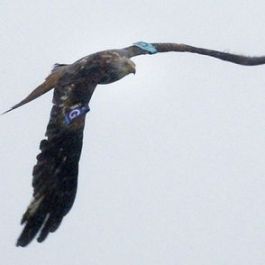 The Belfast Telegraph is reporting that another red kite has been confirmed illegally poisoned – the ninth kite to be killed this way in County Wicklow, Ireland. According to the report, the breeding female (known as Blue Purple G – her wing tag code) was found by Brittas Bay late last year.
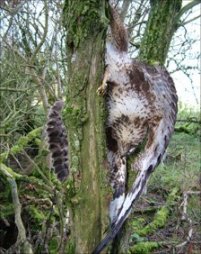 David Alexander Whitefield, the former gamekeeper at Culter Allers Estate in South Lanarkshire, was today sentenced following his December 2011 conviction for illegally poisoning four buzzards (see
 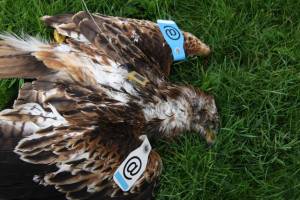 Following the successful release of red kites during the summer in Dublin and Wicklow, it is with disappointment that we report further recent kite deaths in Fingal. Since the release in July, this year, a total of eight (8) kites have now been recovered dead in Fingal since November.
 The substance used to kill the other four kites that have been discovered since November has yet to be confirmed – toxicology tests are on-going. It’s possible they were also unintentionally killed by secondary rat poison, but it’s equally possible that they have been deliberately (and illegally) killed by other poisons. For example, at the beginning of November 2011, it was reported that a red kite and a buzzard had been illegally poisoned in County Wicklow by alphachloralose (see
 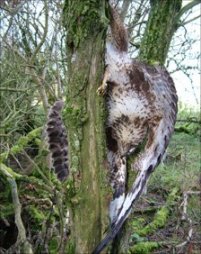 This case has been in the works for some time, first reported a year ago and then delayed for legal technicalities (see
 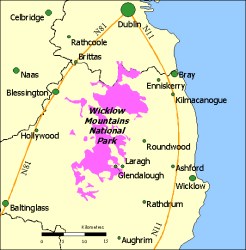 Meanwhile, back in the real world, an article in the Wicklow People yesterday says that a red kite and a buzzard have been found poisoned in County Wicklow, Ireland.
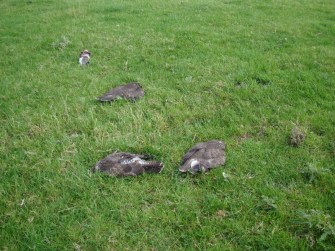 Late last week, three dead buzzards were found next to a suspected poisoned rabbit carcass in an area with a long track record of raptor poisoning incidents. The person who found the dead birds took some photographs before returning home to alert the police. The police allegedly informed him later that night that they couldn’t attend, and instead they asked him to collect the evidence(!). When he returned to the scene, unsurprisingly the three dead buzzards and the suspected rabbit bait had vanished. A dead magpie, perhaps missed by the suspected poisoners, was recovered from the scene and has been sent for toxicology testing.
 Raptor Persecution UK