Poisoned peregrine rescued in Northern Ireland

A farmer, an RSPB warden, a politician and a falconer/gamekeeper have joined forces in Northern Ireland this week to rescue a stricken peregrine falcon believed to have been poisoned.

The bird was found by a farmer in a field at Churchill, Derrygonnelly, County Fermanagh. The farmer contacted an RSPB warden who collected the bird and passed her over to Stormont politician Jim Wells, who also just happens to be a peregrine expert and Chairman of the Northern Ireland Raptor Study Group.

Jim immediately recognised the symptoms of Alphachloralose poisoning (it thins the blood and causes death by hypothermia) and so he whacked up the car heater as he drove the victim towards Lisburn. Once there, the peregrine was passed to registered falconer/gamekeeper Alan Coates.The bird was put in an incubator and given a saline solution and appears to be making good progress, although it is still early days. She remains under Alan’s care and is currently enjoying strips of pheasant breast!

Ireland publishes its first persecution report, with interesting results

94f6f996ec3a866ce6d587d28bd5b809_LThe Irish National Parks and Wildlife Service (NPWS) has published its first national raptor persecution report, relating to reported incidents in 2011.

The NPWS issued the following press release:

“33 poisoning or persecution incidents affecting birds of prey were recorded in Ireland in 2011, according to a report published today by the Department of Arts, Heritage and the Gaeltacht. 

15 birds of prey were confirmed poisoned, and four more suspected cases were recorded. 8 birds of prey were shot.

Some of the deaths were accidental, but many were deliberate. The most frequent casualty was the red kite, a native species that was recently re-introduced to Ireland. It is believed that seven of the ten kites found dead were poisoned by eating rats that had themselves been poisoned. As well as red kite, other raptor species that were deliberately targeted included peregrine falcon, buzzard, sparrowhawk, and kestrel.

The report is the result of cooperation between the National Parks and Wildlife Service, the Department of Agriculture, Food & the Marine’s Regional Veterinary Laboratories and the State Laboratory, and also involves An Garda Síochána, the Golden Eagle Trust and BirdWatch Ireland. 

The report notes that the use of tracking devices on birds has enabled dead birds to be found, but this also means that the true levels of mortality are likely to be significantly higher.

The use of poison has been greatly restricted under EU law in recent years. It is illegal to poison any animal or birds other than rats, mice or rabbits in Ireland and only then using certain registered products. The Campaign for Responsible Rodenticide Use has recently been set up with funding from industry. This campaign aims to promote best practice so that rat poison in particular should not get into the wildlife food chain where it harms owls, kites and other birds of prey.

The poisoning of golden and white-tailed sea eagles has been a particular problem in recent years, but fortunately in 2011, no poisonings were recorded. Records of poisoning and persecution in 2012 are currently being analysed and the second annual report is due for release shortly.

The Minister for Arts, Heritage and the Gaeltacht, Mr Jimmy Deenihan, T.D., welcomed the report. ”This gives us at least a partial view of the scale of the problem in Ireland”, he said. ”It is simply not acceptable for majestic birds of prey and other wildlife to be persecuted or poisoned. First it is illegal, but just as important it harms our reputation as a clean, green country. I would urge anyone to report such incidents to the National Parks and Wildlife Service in my Department. There are alternatives to poison which can be successfully used when control is essential ” he said.”

Here is a copy of the report: Persecution Report Ireland 2011

The publication of this report, and the anticipated future annual reports, demonstrates a basic but very important step forward, allowing the authorities and NGOs to monitor and record raptor persecution incidents in a coordinated effort, to help tackle the issue as well as to improve public awareness and education.

The report includes the usual list of victims and the substances that were used to kill them (Alphachloralose, Carbofuran etc) although we did notice one particular substance that was less familiar – Nitroxynil (also called Nitroxinil). As far as we understand, Nitroxynil is an active ingredient in the veterinary treatment of cattle and sheep, for example in sheep dips. According to this report, Nitroxynil  was detected in the carcases of three poisoned white-tailed eagles and one golden eagle, as well as in several recovered baits, including an egg and two lagomorphs (rabbit or hare).

It would appear, given that it was detected in different baits, that Nitroxynil has been used deliberately in Ireland to target any animal that might scavenge from a bait. It’s also possible that some of the deaths were from accidental poisoning, although fallen stock should not be left out on the hill.

We’re not certain, but we don’t recall seeing Nitroxynil listed in any recent toxicology reports published in Scotland by SASA. We don’t know if SASA tests for this substance when they’re presented with a potentially poisoned animal – it would be fair to say that SASA can’t test for every known poison due to resource constraints, and it’s reasonable for them just to test for the more commonly-used poisons. However, we have noticed in recent SASA reports that there are quite a number of birds for which SASA have been unable to establish the cause of death (i.e. the poisons they regularly screen for have not been detected) even though the circumstances of the bird’s death may have been suspicious. If SASA are not already testing for Nitroxynil, we hope that they pay attention to the frequency of detection in Irish cases and consider including it in the list of poisons for which they routinely screen.

Well done to the Irish NPWS and their project partners for getting this report published.

In Scotland we’re still waiting for the promised 2012 wildlife crime report from the Scottish Government. Environment Minister Paul Wheelhouse told the Police Wildlife Crime Conference in March 2013 that his staff were working on the report. Earlier this month, we asked him if he could tell us when we might expect to see it published (see here). According to our calendar (he has to respond within 20 working days), Mr Wheelhouse is due to provide a response to that question, and the other questions we posed, by this coming Wednesday…..

UPDATE 29th July: SASA are on the ball – they’ve recently started to test for Nitroxynil – see here.

Scottish gamekeeper convicted for poisoning buzzard

Buzzard BellA Scottish gamekeeper has today been convicted for a number of wildlife crime offences, including the poisoning of a buzzard.

Peter Finley Bell (62) pleaded guilty to four charges at Stranraer Sheriff Court and was fined a total of £4,450.

Bell is a full-time gamekeeper and has sole responsibility for rearing pheasants and organising shooting on Glasserton and Physgill Estates which includes land on Glasserton Home Farm, Whithorn.

Bell committed the poisoning offence on 23 December 2012 at Glasserton Home Farm. He had laced the carcass of a pheasant baited with Carbofuran and set the bait in a field. A birdwatcher passing the farm saw something flapping in the field and on closer inspection found that it was a common buzzard, lying on the ground, in the last throws of life.

Subsequent forensic work showed that the buzzard had died as a result of ingesting the poisoned bait.

A search of Bell’s home address on 5 March 2013 revealed poisonous substances in his tool shed and home which are illegal to possess, namely Carbofuran, Strychnine and Aphachloralose.

Bell’s fine was broken down as follows:

£2,450 for killing the buzzard (reduced from £3,500 to reflect his guilty plea)

£1,400 for possession of Carbofuran (reduced from £2,000)

£300 for possession of Strychnine (reduced from £500)

£300 for possession of Alphachloralose (reduced from £500).

There are some interesting points about this case. First of all, the speed of the judicial process – offences committed in December 2012 and March 2013, criminal convicted by June 2013! That has to be some sort of record and it is very, very pleasing to see.

But why, if the poisoned pheasant carcass and buzzard were found in December, did it take more than two months to conduct a search of Bell’s home?

It’ll be interesting to find out if Bell is/was a member of the Scottish Gamekeepers’ Association: info@scottishgamekeepers.co.uk

It’ll also be interesting to find out if Glasserton & Physgill Estates are members of Scottish Land & Estates: info@scottishlandandestates.co.uk

UPDATE: An important question, raised by blog commentator Michael Gill: what about vicarious liability in this case? Shall we ask the Environment Minister? Email: ministerforenvironment@scotland.gsi.gov.uk

UPDATE 16.20: The SGA has issued a statement about this conviction (see here). Interestingly, they do not address the fundamental question of whether this gamekeeper is/was one of their members. The SGA is a member of PAW Scotland and serves on the PAW Scotland Raptor Persecution Priority Delivery Group. Would it be appropriate for the SGA to continue to serve in this capacity (and take credit for its PAW membership) without being transparent about whether it has a convicted poisoner amongst its membership? We think it would be highly inappropriate. Please raise these concerns with the PAW Scotland Chair – Environment Minister Paul Wheelhouse – and demand SGA transparency on this case. Email: ministerforenvironment@scotland.gsi.gov.uk

UPDATE 17.25: Scottish Land and Estates have issued a statement to say that the estate in question has been booted out of their organisation. Good news. Statement here.

UPDATE 19th June 08.30: According to a BBC article (here), this convicted gamekeeper was indeed a member of the Scottish Gamekeepers’ Association and he’s now been kicked out. Strange that the SGA excluded this information from their own statement on their own website.

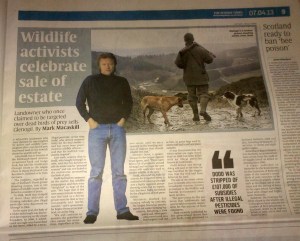
John Dodd sells Glenogil Estate

Sunday Times 7th April 2013 Glenogil saleJohn Dodd, the multi-millionaire owner of the controversial Glenogil Estate, has ‘quietly sold up’, according to an article in the Sunday Times.

The new owner is reported to be Baron Ferdinand von Baumbach, someone we know little about. Although we’re not sorry to see Dodd leave, it’s not so much who owns the estate that interests us, but rather whether (a) they intend to maintain it as a driven grouse moor and if so, (b) who will be advising on grouse moor ‘management’.

It’s been widely reported that Dodd took management advice from ‘grouse wizard’ Mark Osborne (e.g. see here) and indeed Glenogil is promoted on Osborne’s William Powell Sporting website as ‘one of the finest shooting estates in Scotland’ (see here), as well as on the William Powell Country website (here). It’s not just Osborne who rates this estate: last year The Field magazine included Glenogil in an article called ‘Britain’s 50 Great Shoots’ (see here) and in 2008 The Telegraph described it as a thriving grouse moor (see here).

However, for those of us with more of an interest in the area’s wildlife rather than with the artificially-high number of grouse that can be killed, you have to look elsewhere for information. A good place to start is the RSPB’s annual persecution reports. Below is a list of confirmed incidents recorded at Glenogil and ‘Nr Noranside’  from 2006-2010, sourced from these reports and also from Scottish Government data. Not one of these reported incidents has resulted in a criminal prosecution and Dodd has repeatedly and strenuously stated his staff are innocent. Dodd had his farming subsidy cut by £107,650 in 2008 when the Scottish Executive suspected that poisoned baits found on and near to the estate in 2006 were being used to target birds of prey (see here).

2006 March: poisoned rabbit bait (Carbofuran)

2006 April: poisoned buzzard (Alphachloralose)

2006 April: poisoned tawny owl (Alphachloralose)

2006 May: poisoned rabbit bait (Carbofuran)

2006 June: poisoned woodpigeon bait (Carbofuran)

2008 May: poisoned white-tailed eagle (Carbofuran, Isophenfos, Bendiocarb) [‘Nr Noranside’]

2008 May: poisoned buzzard (Bendiocarb) [‘Nr Noranside’]

2008 May: poisoned mountain hare bait (Carbofuran, Isophenfos, Bendiocarb) [‘Nr Noranside’]

2008 May: 32 x poisoned meat baits on fenceposts (Carbofuran, Isophenfos, Bendiocarb) [‘Nr Noranside’]

2008 Oct:  poisoned meat bait (Carbofuran) [‘Nr Noranside’]

2009 March: poisoned buzzard (Carbofuran)

2009 March: poisoned buzzard (Carbofuran)

2009 August: poisoned white-tailed eagle (Carbofuran)

2010 May: poisoned red kite (Carbofuran) [‘Nr Noranside’]

2010 September: poisoned buzzard (Chloralose)

2010 October: poisoned buzzard (Carbofuran)

2010 October: poisoned pigeon bait (Carbofuran)

2010 October: poisoned pigeon bait (Carbofuran)

John Dodd was the co-founder of Artemis Investment Management Ltd., a company that has sponsored the GWCT’s Scottish Game Fair (see here).

The Sunday Times article can be read in two parts:

Part 1 Glenogil sale Sunday Times 7 April 2013

Part 2 Glenogil sale Sunday Times 7 April 2013

Red kite poisoned, 20 months after its mother suffered the same fate

Poisoned kite photo Marc RuddockA young red kite has been poisoned in County Wicklow in the Republic of Ireland, 20 months after its mother was killed the same way.

The young bird was found in January and tests have confirmed it had been poisoned with both Carbofuran and Alphacloralose – the first time both chemicals have been found in an Irish kite. It’s mother was poisoned with Alphachloralose in December 2011.

The Golden Eagle Trust (the group behind the reintroduction of golden eagles, white-tailed eagles and red kites in the Irish Republic) described the poisoning of two generations of a red kite family as “totally devastating”.

The latest bird (Blue White 21) is the first of 21 Irish-born kites to be poisoned. It was found by a member of the public close to the golf club in the town. The bird was still alive but died shortly afterwards.

News article from Golden Eagle Trust here

News article in the Irish Independent here

Purdey Awards: “celebrating greatness”?

The annual Purdey Awards for Game and Conservation were established to celebrate those who achieve most in game conservation, according to the Purdey Awards website (here). These awards are viewed as the game-shooting industry’s most prestigious, giving recognition to those ‘who do most to help our flora and fauna, by improving biodiversity and developing better land management‘.

The 2012 Purdey Award winners were recently announced. We were particularly interested in the ‘Highly Commended’ category:

Brian Kaye of Redmyre Farm Shoot of Invergowrie, near Dundee, has been highly commended for his work in creating a high quality farm shoot and for enhancing the landscape and natural environment. Mr Kaye has not only dramatically improved the habitats and biodiversity for a wide variety of game birds and plant life, but has also demonstrated how shooting goes hand in hand with conservation. The award is made in recognition of outstanding work over 20 years in establishing an exemplary shoot over 320 acres of the Sidlaw Hills“.

Surely not the same Brian Kaye who owns Redmyre Estate near Invergowrie (according to the East of Scotland Association for Wildfowling and Conservation: see here)? Nah, it couldn’t possibly be. A gamekeeper on Redmyre Estate was convicted in 2010 of shooting dead a buzzard and for possession of the banned poisons Carbofuran and Alpha-chloralose (see here, here, and especially here).

Other ‘greats’ that have been celebrated with Purdey Award wins include:

Geoff Eyre, the sporting tenant on Howden Moor (2005 Purdey Gold Award). In 2011, the gamekeeper on Howden Moor was convicted of a series of wildlife crimes (see here).

Jimmy Shuttlewood, the head gamekeeper on Snilesworth Estate (2005 Purdey Special Award).  In 2008, Shuttlewood and two other gamekeepers were convicted of a series of wildlife crimes (see here).

Lochindorb Estate (2008 Purdey Gold Award). In 2010 a dead sea eagle that had been found on the estate mysteriously disappeared just before the police arrived (see here). In 2011, the trial against two Lochindorb gamekeepers began, accused of illegally snaring mountain hares. The case against one gamekeeper was dropped earlier this year; the trial against the other gamekeeper will continue in January 2013 (see here).

Dear Diary…

Here’s a rare opportunity to look into the world of  the ‘modern’ gamekeeper. These are extracts taken from a Scottish gamekeeper’s diary. We were shown these diaries by someone from within the keepering world who wishes to remain anonymous, for obvious reasons. Worryingly, the diary-writer is still currently employed as a full-time gamekeeper. We’ve split the entries into different years – the following is from 2008. See how many wildlife crime offences you can spot:

Thurs 3rd January: set baits in Glen S & right hill

Sat 5th January: John P came for rabbits & Alpha

Weds 16th January: Gassed fox at Black Brae Lower

Fri 25th January: Eggs out on Top Moor + rabbit for crows by Big Wood

Fri 1st February: Lifted eggs Top M & set out at edge of Middle.

Tues 5th February: Shot dog Glen S.

Mon 11th February: Lifted eggs Top M. Shot kestrel.

Tues 19th February: Baits out at Harry’s, rabbits & hares

Thurs 21st February: Pick up gins from Glen side. Got female peregrine.

Fri 29th February: Done traps at S Corner and more eggs out. Saw pair peregrines at Millers.

Sat 1st March: baits out with Jim at Middle. Missed a cock harrier. Staked pigeon at Millers.

Sun 2nd March: Got peregrines at Millers. Eggs out on Broadfield.

Tues 4th March: Got 2 buzzards, 2 rooks + 9 crows. Rabbit out for others.

Fri 7th March: Got a vixen at T Moor. Put out birds by low fence.

Sun 9th March: Eggs at Glen side again.

Weds 12th March: Eggs up, tracks seen. Done baits at Gordon’s. Sheep shot for midden 3.

Thurs 13th March: Got buzzard at Becks. More rabbits out. Alpha.

Sat 15th March: Picked ups crows & eggs Langsmere. Saw 2 harriers.

Tues 18th March: Set eggs JB & baits southside.

Weds 19th March: Got a cat on Red moor.

Thurs 20th March: Got SE owl & set 59 eggs Lower bank.

Sat 22nd March: 1 harrier at Langsmere. Merlins at Merv’s.

Mon 24th March: Snares at Glen side. 26 foxes so far.

Tues 25th March: Missed harrier at Langsmere. Baited Broadfield again.

Thurs 27th March: Got a badger with John S. He heard gos behind Big Wood.

Fri 28th March: Lifted eggs Lower bank. More set at Harry’s.

Mon 31st March: Crow cages out Big Wood.

Wed 2nd April: Harrier trap empty.

Thurs 3rd April: Pair eagles seen southside.

Fri 4th April: Put eggs T Moor. Shot rabbits for baits.

Sun 6th April: Crow cages done. Eggs checked.

Weds 9th April: Baits out Glen side. Tom collected pigeons.

Fri 11th April: Got buzzards at JB.

Tues 15th April: Gos in crow cage. Gave it to PL.

Fri 18th April: Baited traps & re-did snares.

Tues 22nd April: Eggs & hares out in the Sloughs.

Sun 27th April: Eggs lifted Sloughs.

Fri 2nd May: Put out more baits.

Sat 3rd May: Pigeons staked upper side. Got tiercel.

Weds 7th May: Set eggs.

Thurs 15th May: Put baits out at Bothy.

Sat 17th May: 3 buzzards in crow cage. Re-set.

Thurs 22nd May: Two Peres at Glen side. Got one.

Weds 28th May: Eggs lifted more baits out. Rabbit gone at Bothy.

Mon 2nd June: Set pheasant eggs at Big Wood. Did crow traps.

Sun 8th June: Litter of foxes gassed behind GateBridge.

Fri 13th June: Partridges into pen.

Mon 23rd June: Put eggs out Broadfield.

Weds 2nd July: Gassed another litter with Paul at Stebb’s.

Fri 1st August: Got a short eared owl. Lifted eggs Broadfield.

Tues 5th August: Moved crow cages to RT.

Sun 10th August: Spar caught. Trap re-set.

Fri 12th Sept: 42 brace at Sam’s but harrier seen.

Fri 26th Sept: New snares out.

Thurs 2nd Oct: Two eagles seen Glen S. 1 buzzard in crow trap at T Moor.

Tues 7th Oct: Hare baits out Langsmere.

Thurs 16th Oct: Shot sheep for midden 3.

Mon 20th Oct: Pigeons 5pm

Weds 22nd Oct: Shot a kestrel at Sam’s.

Fri 31st Oct: Merlin pair done North Bothy.

Sat 8th Nov: 6 pigeons put out Big Wood.

Tues 25th Nov: Baits out with Paul.

Fri 19th Dec: Put grouse on T Moor.

’36th buzzard found dead’ in persecution blackspot

Thanks to @EimearRooney1 for the following tweet:

36th buzzard found dead at Drumbanagher, Co. Armagh, this week. Coincidence? Unlikely. The PM will be interesting“.

Indeed.

Previous post about this area here.

UPDATE: Buzzard testing positive for Alphachloralose.

Crow traps: what you should know part 2

Following on from our earlier blog – Crow traps: what you should know part 1 (here)

The following information concerns the use of crow cage traps in Scotland; they are also used in other parts of the UK although the terms of use differ slightly (see here for information on their use in England, here for Wales and here for Northern Ireland).

What is a crow trap and why should we be concerned about them?

There are various types of animal traps in use in the countryside but the two we focus on in this article are the ‘ladder’ and ‘funnel’ crow cage traps. These are large, walk-in traps usually constructed with a wooden frame and wire mesh netting. A decoy bird (often a carrion crow but certain other decoy species are also permitted) is placed inside the trap to attract corvids or other target species. Birds that are attracted to the trap can enter via the roof, either through the horizontal slots of the ‘ladder’ or via a ‘funnel’. Once inside the trap it is virtually impossible for the birds to escape unaided. These trapped birds are usually destined to certain death at the hands of the trap operator who is legally authorised to kill them, subject to certain conditions (discussed in Part 3). In some rare circumstances, raptor workers deploy temporary crow cage traps to capture buzzards for marking projects, such as wing-tagging etc. Obviously these buzzards are released as soon as they’ve been marked; they aren’t killed by the trap operator!

There are many concerns surrounding the use of crow cage traps (some we’ll discuss below) but the over-riding concern is the indiscriminate nature of these traps, which means that species other than the target species can be, and often are, caught by gamekeepers, e.g. buzzards, goshawks, golden eagles etc. It is not illegal to (accidentally) trap these non-target species, but it is an offence for the trap operator not to release them, unharmed, at the earliest opportunity. More on this in Part 3.

Crow trap use is governed by a general licence, issued annually by Scottish Natural Heritage (see here). These licences are issued for the purpose of either (a) the conservation of wild birds, (b) to prevent serious damage to livestock, foodstuffs for livestock, crops, vegetables and fruit, and (c) to protect public health, public safety and prevent the spread of disease. Trap operators need not ‘apply’ for an individual licence, hence the name ‘general’ licence. Each general licence is subject to strict conditions (discussed in Part 3). If the trap operator complies with all the conditions of the general licence then the use of the crow trap is legal. However, in practice some of these conditions are ambiguous at best, and this is recognised by SNH who undertake regular consultations aimed at clarifying the terms of use (e.g. see here for their latest consultation plans).

Before we get in to the nitty gritty of how to recognise a legal trap from an illegal trap it’s worth mentioning that the RSPB (and other groups such as OneKind) has long campaigned for a more thorough review of the legal framework concerning these general licences for crow traps, particularly in relation to potential breaches of European legislation, including the EC Birds Directive. For anyone interested in the RSPB’s position, this document from 2007 (here) is informative.

Other concerns include the fact that there isn’t any effective monitoring of the impact these traps have on both target and non-target species. Crow traps are in use across Scotland year-round but are especially associated with upland grouse moors. It isn’t known exactly how many crow traps are in operation in Scotland but a conservative estimate would be in the hundreds, but probably nearer the thousands. There is currently no requirement for trap operators to record and/or report the number of target and non-target species caught and killed inside a trap (and even if there was such a requirement, who would believe the submitted figures? No gamekeeper is going to admit to illegally killing a protected species!). So how can the regulatory body (SNH) monitor the impact of crow trap use when they haven’t got a clue just how many traps are in use and how many birds and of what species are being killed each year? The follow-on question is, how can these general licences still be issued when the regulatory body cannot justify, in quantifiable terms, the need for lethal control measures?

Some may argue that there is now a record of the number of traps in use because recent changes to the general licences now require that a sign is attached to each trap with a unique identifying code issued by the local police force. However, this unique code is not assigned to an individual trap or to an individual trap operator, but rather to a landowner (or occupier) such as a sporting estate or a farm. This means that an estate owner can use the same code for multiple traps on his/her land (e.g. they may have just one trap or they may have 50+ traps depending on the size of the estate); the point is that the authorities do not have any means of knowing how many traps are in use on a particular estate because they only issue one code per estate.

From a law enforcement perspective, this use of a single identifying code for multiple traps makes it almost impossible to prosecute an individual for illegal use of the trap. For example, if a golden eagle is found dead inside a trap, and it’s obviously been there for a long time, then an offence has probably been committed (because traps must be checked at least once in every 24 hour period – see Part 3). Investigators may attend the scene but find that the trap is located on a large estate that employs multiple gamekeepers. None of the gamekeepers admit responsibility, so how does the investigator identify the individual responsible? A prosecution cannot commence unless an individual suspect is identified. It’s the same loophole we’ve seen used so many times when poisoned bait has been found on a large estate; nobody admits responsibility for laying the bait and thus the perpetrator(s) escape justice. It is only when the trap is located on a smaller estate where a single gamekeeper is employed that there is any chance of a prosecution.

Talking of loopholes….we’ve touched on this briefly in previous posts….in 2008 a new condition was added to the terms of use of the general licences. That new condition was that anyone who had a previous wildlife crime conviction was not allowed to use the general licence unless their conviction was considered ‘spent’, i.e. after five years from conviction. (Although even if you did have a recent conviction you could still apply for use of the licence and each case would be considered on merit, so it’s not quite the draconian condition that some imply). However, in 2009 the condition (of being banned for five years) was modified and we don’t recall any consultation about the insertion of this modification! The new modification says that you can still use the general licence if the sentence you received for your wildlife crime was an ‘admonishment’. Talk about a get-out clause! You might think this modification was quite reasonable, after all, an admonishment (effectively a telling off) is only given for minor offences, right? WRONG!!! Because there aren’t any mandatory sentences for wildlife crime offences in Scotland, a sheriff can choose a sentence at will (within the boundaries of sentencing limits at a Sheriff court, of course). In 2010, a sheriff imposed an admonishment on Graham Kerr, a gamekeeper on the Redmyre Estate, for possession of the banned pesticides Carbofuran and Alphachloralose (see here). The maximum penalty available was a £5000 fine and/or a six month prison term, reflecting the gravity of this type of offence. Had Kerr not also been handed a £400 fine for shooting a buzzard on the Redmyre Estate, his admonishment would have allowed him to continue using the general licence to operate a crow cage trap. In our opinion this is outrageous. What’s the point of having a condition of a five-year ban for a wildlife criminal if that condition is modified based on the whim of a sheriff’s sentencing choice rather than the nature of the actual criminal offence committed? It’s total nonsense. Why was this modification added to the terms of the general licence and who instigated its inclusion in 2009 and who approved it? Was anyone given the opportunity to object to its inclusion? Perhaps a Freedom of Information request is called for here…

This leads on to another concern…who is actually monitoring the trap operators? How do we know that someone with a recent criminal conviction (who was given a stronger sentence than an admonishment) is not still operating a crow cage trap? We know that many estates don’t sack their gamekeepers following a wildlife crime conviction, and we know of at least one estate where a previously convicted gamekeeper (guilty of raptor persecution) is now employed as a ‘gardener’!!

The potential for the misuse of crow traps is well known amongst raptor workers.  Previous reports on this issue have been produced by the RSPB (e.g. see here). Although this 2004 report is now fairly dated and some of the report’s recommendations have since been implemented, there is still a great deal of concern that crow traps are still being deliberately used to target raptor species, particularly buzzards and goshawks and in some areas, golden eagles.

So what can we do about it? In Part 3 we’ll explain the basics of what makes a crow cage trap legal, what makes one illegal, and the blurred line in between the two. We’ll also explain what members of the public should and shouldn’t do if you find a crow trap that you suspect is being operated illegally.

Another poisoned raptor, another well-kept secret?

Last week we blogged about Des Thompson’s presentation at the Scottish Wildlife Crime Conference (see here). Here’s a reminder of what he had to say about Northern Constabulary and the problem of red kite persecution in northern Scotland:

So 40% of the dead, just over 100 red kites were poisoned in north of Scotland, without poisoning we should have had 300 plus birds, poisoning of red kites in the north of Scotland is attracting a lot of criticism nationally, and we now know the location of the hotspots problem areas where red kites have been found, poisoned, and we’re working closely with the police to tackle this. And I want to put on record here how grateful we are to Northern Constabulary, er, senior staff at Northern Constabulary for meeting with us to discuss the scientific issues and for taking forward the very ambitious programme of work to tackle this problem“.

So what is this “very ambitious programme of work” and why is it that Northern Constabulary appear to need persuasion to carry out what is its statutory duty to investigate wildlife crime?

If you look at the Force’s website you’ll see that they have 13 police Wildlife Crime Officers (see here) who are overseen by a Force Wildlife Crime Coordinator, Chief Inspector Matthew Reiss. The website also includes a ‘statement of intent’ in relation to tackling wildlife crime and the Force says it is committed to tackling wildlife crime (see here). Further, Chief Inspector Reiss is on record (according to Highland News) as saying Northern Constabulary treats wildlife crime “extremely seriously” (reported here after the convictions of Skibo Estate and Moy Estate employees for wildlife crime offences).

All sounds very convincing and reassuring, doesn’t it? Why is it then that Northern Constabulary has remained tight-lipped about the discovery, 15 months ago, of a poisoned red kite allegedly found on moorland at the boundary of Skibo Estate? We have been told that the satellite-tagged kite was allegedly found in February 2011. SASA documents show that only one red kite from the Highland region was tested in February 2011  and  it had been poisoned by Alphachloralose and was the subject of on ongoing police investigation (SASA ref #11020, see here).

Was there any publicity about this bird? We think we might have remembered if there had been, but we checked back to Northern Constabulary’s archived news items on their website for the month of February 2011 in case we’d missed it – but no, plenty on there about theft of handbags and damage to tractors but not a whisper about the discovery of a poisoned red kite.

Was there a police raid on the surrounding properties where this bird was allegedly found poisoned? If it was found at this location, and given that this is one of the supposed ‘hotspot’ areas for raptor poisoning (three golden eagles and a sparrowhawk found poisoned in 2010 – no convictions; a staked-out poison-laced grouse bait found in 2010 – no convictions) wouldn’t a police raid be the obvious first step in an investigation?

So is that it? No further action? If we hadn’t received a tip-off would it ever have come to light? Where was the RSPB in all of this? Did they know that one of their satellite-tagged kites had allegedly been found poisoned? If they did, why wasn’t the incident publicised? Where was SNH and PAW Scotland in all of this? Did they know that one of the satellite-tagged kites that they’d helped fund had allegedly been found poisoned? Where was their publicity? Where was the NWCU in all of this? Were they notified? Was this alleged incident the trigger for setting up the meeting with senior staff at Northern Constabulary to discuss the red kite persecution ‘science’?

This is the second time in the last few weeks that Northern Constabulary has been at the centre of allegations of secrecy and cover-up when it comes to wildlife crime (see here for earlier report on the suspected shooting and decapitation of a white-tailed eagle on Skye that went unpublicised). How many more incidents are there left to be uncovered? To be fair, Northern Constabulary does sometimes get it right, with current ongoing court cases including the alleged hare snaring at Lochindorb (here) and alleged egg theft (here), but ‘sometimes’ just isn’t good enough. Nobody’s suggesting these investigations are easy – we’ve all seen how difficult it can be to get COPFS to agree to a prosecution – but Northern Constabulary (and others) don’t help themselves when they choose not to publicise, or sometimes even investigate these alleged crimes.

How about everyone stops all the politically-motivated soundbites about commitment and very ambitious work programmes and just focuses on getting the basics right?