
Yesterday, the Irish radio station ‘Newstalk’ broadcast a discussion on the theme ‘Are the birds going the way of the dinosaur?’
The presenter, Pat Kenny, was interviewing Professor Luke O’Neill, a prominent biochemist from Trinity College, Dublin. This leading academic was introduced as someone who has been studying the depletion of bird populations. According to Professor O’Neill, worldwide bird declines are attributable to “horrible” raptors that “are going up in numbers” and are “becoming more aggressive“. He also said a lot of other really stupid and inaccurate things.
You can listen to the broadcast here.
Is it any wonder that raptors continue to be persecuted when idiots like this are given air-time? His comments have probably set back raptor conservation in Ireland by years.
We were intrigued about O’Neill’s credentials in the field of raptor ecology and biology so we checked out the Professor’s webpage on his university’s website. We couldn’t find any evidence of his academic involvement in bird population studies, or any other ecological expertise for that matter. Have a look at his research publications here.
In response to the Professor’s unsubstantiated and moronic vilification of raptors, Dr Allan Mee, a leading raptor ecologist working with the Golden Eagle Trust in Ireland (specifically, managing the White-tailed Eagle Reintroduction Project) has today written to Professor O’Neill (email reproduced here with Dr Mee’s permission) –
Dear Prof O’Neill,
I was astonished at many of your statements made yesterday during your piece on the Pat Kenny show. I’ve made my feelings known to Newstalk and asked then for a right to reply. I’m not saying everything you said was factually incorrect but much was. Even disregarding the jocular tone of the programme the scene was set by focussing on raptors…..“the raptors, which are the horrible birds of prey, they’re going up in numbers some of those and one reason for the decline is they’re getting more aggressive” (no idea of source for this). This is set out as the centrepiece of your argument for the causes of declines in birds (songbirds, all birds?) and sets the tone for the rest of the piece and the general implications that raptors are the prime cause of bird declines.
Please by all means show me a scientific paper which shows this? No I don’t think you will find one.
Please show me a paper which attributes population declines and/or extinction to raptors? I don’t think you will find any evidence of this either apart from possibly the impacts of hen harriers on grouse on grouse moors in the UK where raptors are persecuted (shot, poisoned, trapped) because they conflict with the grouse moor owners desire to artificially maximise grouse numbers and thus profit. Look at all the evidence for declines in birds worldwide (see for example the data published by BirdLife International referenced below) or even closer to home where all our farmland birds and breeding waders have declined to the brink of extinction in many cases. No you won’t find any discussion of raptors as a causal factor there either because there are NO data to support this, rather the overwhelming evidence of declines due to farmland modernisation, loss of hedgerows, ryegrass monocultures replacing traditional meadows etc. Moreover it’s a long held tenet of ecology that predator populations respond to and are maintained by changes in prey populations, NOT the other way round.
Even your claim that climate change only changes the distribution of birds (they just move elsewhere) is wide of the mark. Birds can and do of course “respond” by changing their distribution/extending their ranges as has recently happened with Little Egrets in Ireland (if the raptors don’t get them first). But in many cases birds can’t just go somewhere else. They may be non-migratory or the habitat in “somewhere else” is already saturated with populations of that species. Or they literally have nowhere to go such as arctic relict species such as Ptarmigan on Scottish montane plateaux. The prognosis for such species isn’t good as climate warms up the montane environment and habitat changes so that the montane zoo moves further up the mountain until there is nowhere else to go. For many endemic species confined to a single island site these changes are likely to mean extinction.
You mention Red Kites increasing. Yes these have recently been reintroduced back to Ireland after being lost to human destruction 200-300 years ago. Their numbers are approx 30-50 pairs largely confined to Wicklow. They eat very few birds being largely specialist on rodents (rats), crows (young from nests), young rabbits and even earthworms. Even if they were to feed only on small birds this wouldn’t explain a decline in songbird numbers given that the numbers don’t stack up: 30-50 pairs or some 100-120 individuals compared to some hundreds of thousands of “small birds”, even if these are declining. Don’t take my word for it. Go to Avoca in Wicklow in winter to witness the stunning spectacle of many of the Wicklow kites roosting together just outside the town in winter. No you won’t find any sitting on garden bird feeders waiting for an easy meal and you’ll probably find lots of small birds feeding away happily.
Funnily enough, just to reinforce the point that raptors and healthy populations of small birds (their prey) do coexist, we once had at least 6 species of raptor in Ireland that became extinct in the last 300 years due to human persecution. Along with all that diverse and much larger raptor population there existed a diverse assemblage of bird species and much greater “small bird” populations in historic times when Ireland was still relatively pristine, lots of native woodland, intact bogs, stunningly rich marshes, healthy unpolluted rivers and lakes, beautiful extensive upland blanket bog and moorland etc. Oddly enough small birds did survive and thrive in the presence of all those raptors!
Over the past 10+ years we have been working hard to spread awareness among the public regarding the vital role birds of prey have in our ecosystem in the face to human persecution such as shooting and poisoning. There are plenty of folk out there who take what they hear on radio as “fact” especially when delivered by a Prof and backed up by a well-known presenter. It is a shame this lack of understanding still abounds even in academic circles and has the potential to damage years of conservation work by reinforcing long-held but misguided beliefs.
Over the past 25 years I have worked on species from golden eagles in Scotland, California Condors in the US and currently White-tailed Sea Eagles in Ireland (as well as being chairman of the Irish Raptor Study Group……at our annual conference in Dublin on 31 Jan we have several talks including one on raptor persecution entitled Natural Injustice – the failure of wildlife crime enforcement in Scotland) where the common theme has been the destructive effects of human misconceptions regarding raptors and their role in ecosystems. It seems like not much has changed.
Allan
Complaints to Newstalk can be emailed to the Station Editor Garrett Harte: garrett@newstalk.com
Complaints to Professor O’Neill can be emailed to: laoneill@tcd.ie
UPDATE: Complaints from other organisations & individuals have already been made – see here.
Another UPDATE: Commentary on cause of bird population declines, and the valuable role of raptors in the environment, provided by real ecology experts from Trinity College, Dublin, not a pretend one – see here.
 Sometimes, we despair.

 A young peregrine falcon has had to be euthanised after it was illegally shot in Co Wexford, Ireland.
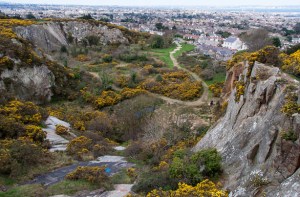 An attempt to poison a family of peregrines (two adults and four youngsters) at Dalkey Quarry, part of the Killiney Hill Park in Co. Dublin, has been foiled thanks to three observant members of the public.
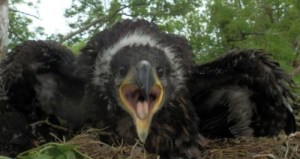 Some good news for a change….
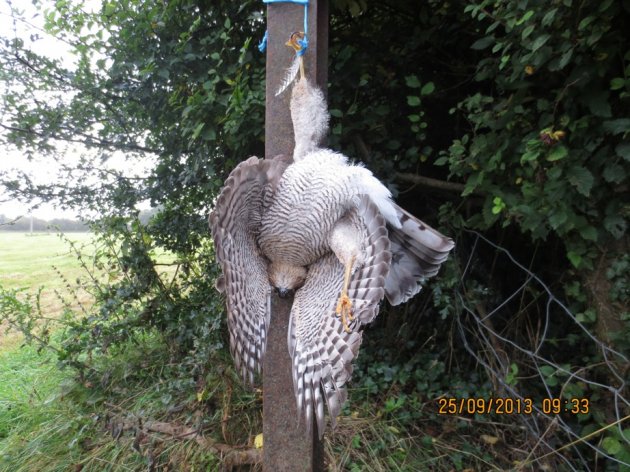 The Irish National Parks and Wildlife Service are appealing for information after the discovery of a sparrowhawk found hanging from a gatepost. It had been shot and then strung up with a piece of string.
 Following on from Thursday’s news that yet another red kite has been illegally poisoned in the Irish Republic (see
  The following is a press release from the Golden Eagle Trust in the Irish Republic:
 Raptor Persecution UK