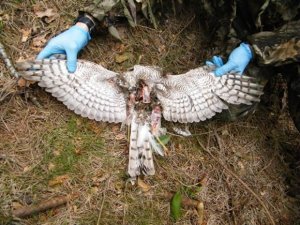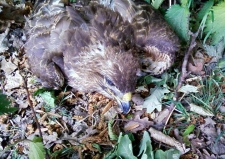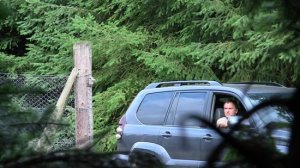
Derbyshire gamekeeper in 8-day trial

A gamekeeper has appeared in court at Chesterfield Magistrate’s today on the first day of a trial where he is accused of seven charges under the Wildlife & Countryside Act 1981 and the Animal Welfare Act 2010.

Glenn Brown, 39, of Old Henry’s Schoolhouse, Derwent Valley, is accused of illegally using a crow cage trap to catch birds of prey on National Trust property, Howden Moor in the Derwent Valley. The case was brought after covert operations carried out by the RSPB.

The District Judge, Caroline Goulborn, is clearly taking an interest in the details of this case as she and other court officials spent the afternoon visiting the trap site. Good on her. The eight-day trial is to be continued…with some high profile expert witnesses for both prosecution and defence…

News story here: http://www.ripleyandheanornews.co.uk/news/regional/gamekeeper_denies_cage_trap_charges_1_3276704

A bit more detail here: http://www.guardian.co.uk/environment/2011/apr/12/gamekeeper-live-pigeon-trap

Thanks to the contributor who sent us the original link.

Peregrine Found Shot Dead in Lincoln

Police are investigating after a one-year-old peregrine falcon was found shot dead in Lincoln.

The falcon, which was killed by shotgun wounds, was recovered from Brayford Pool in the city.

It was unclear at first how the bird died, but post-mortem results have confirmed it was shot, Lincolnshire Police said.

Full Story Here – http://www.bbc.co.uk/news/uk-england-lincolnshire-12682039

Holkham Estate advertises for new head gamekeeper

Former Holkham Estate Head Gamekeeper Nicholas Parker’s employers have advertised for a new head keeper in the 2 March edition of the Shooting Times.

Many thanks to the contributor who sent us this copy of the Shooting Times jobs page.

Update on Holkham Estate head keeper’s pending court case

Further to blog posts on 25 January and 11 February….

Nicholas Parker, head gamekeeper on the Holkham Estate in Norfolk was due in court this morning to face a number of charges relating to alleged wildlife and firearms offences carried out on the Holkham Estate. His case was originally due to have been heard on 9 February 2011, which was then postponed until 2 March 2011.

Parker has pleaded not guilty to some of the charges, and, given the seriousness of these charges, his case has now been adjourned until 1 April 2011 as it has been moved to Norwich Magistrate’s Court where his case will be heard by a more senior District Judge.

Head gamekeeper charged with wildlife crime & firearms offences at Holkham Estate, Norfolk

The head gamekeeper at Holkham Estate, Norfolk, has been charged with  a series of wildlife crime and firearms offences following a police investigation, according to The Fakenham Times.

41 year-old Nicholas Parker of Main Road, Holkham, has been charged with the following: killing a Schedule One wild bird, taking game out of season, possessing ammunition for a firearm without a certificate, possessing a shotgun or rifle for committing an either way wildlife offence, possessing a shotgun without a certificate, and contravening the Wildlife and Countryside Act.

He has apparently been suspended from his job since the allegations came to light last year. The report says he has been released on police bail and will appear before King’s Lynn magistrates on Wednesday 9 February 2011.

News story here: http://www.fakenhamtimes.co.uk/news/country_estate_head_gamekeeper_charged_1_782567

Nicholas Parker joined the Holkham Estate staff in April 2008, after working for six years for the Van Cutsem shoot on Mossdale Estate in North Yorkshire. Here’s his self-introduction in the Holkham Estate newsletter (page 13): Holkham Estate newsletter 2008

It’s not the first time that Holkham Estate has been at the centre of a wildlife crime investigation. In March 2000, a Holkham Estate gamekeeper was fined £850 for the killing of three kestrels on the estate. He admitted to shooting two birds and poisoning a third with a Carbofuran – baited pheasant carcass because he blamed them for attacking young partridges. Following the keeper’s conviction, a 37 year-old land agent and a 62 year-old head keeper were both convicted of three charges of allowing the gamekeeper on the 25,000-acre estate to illegally store poison. Although they denied the charges, they were fined £1,200 and £750 respectively. They both appealed and their cases were heard at Norwich Crown Court on 9 October 2000. Judge Lawrence stated that, although the standard of supervision of the use of poisons on the estate “left something to be desired”, he had reached the conclusion that the gamekeeper was acting independently. Both appeals were upheld.

Twelve charges were also brought against Viscount Coke, heir to the family’s estate in north Norfolk, for allowing the gamekeeper to illegally use poison on the estate. However, Fakenham magistrates said the Viscount had no case to answer. It is claimed that Viscount Coke threatened to sue the police and the crown prosecution service after he was cleared of all involvement. News story here: http://www.independent.co.uk/environment/peers-gamekeeper-fined-for-killing-three-kestrels-721792.html and here: http://nwhsa.redblackandgreen.net/convicted_gamekeepers.htm

It’s very interesting to note that the name of the convicted gamekeeper appears in the latest edition of the Holkham Estate newsletter (Winter 2010) – still employed there then, even with a criminal conviction? So much for estates wanting to rid the industry of those who persecute raptors!

The now 45 year-old Viscount Coke appears to be quite a character. Educated at Eton, he was apparently a former page of honour to the Queen. He took over the estate when his father retired in 2007 and lives with his family in Holkham Hall on the estate. It has been reported that he is a principal trustee and spokesperson for the charity Songbird Survival – notorious for its views against raptors: http://www.againstcorvidtraps.co.uk/songbird_survival/bloodsports

According to the current Holkham Estate website, nine gamekeepers are employed and “a predator control programme is exercised within the law”: http://www.holkham.co.uk/html/farming.html

A former head keeper at Holkham is Simon Lester, now head keeper at the Langholm Moor Demonstration Project in Scotland. Simon & the Viscount’s father, the Earl of Leceister, express their views about raptors in a revealing article here: Holkham Estate partridges & raptors 2006

buzzard poisoners in Derbyshire get away with it

On 30 April 2010, an article was posted on this blog about an investigation by Derbyshire police into the apparent poisoning of six buzzards. Here’s a quick re-cap:

On 22 February 2010, two dead buzzards were found in Jebbs Lane, Idridgehay, nr Ashbourne in Derbyshire. The birds were believed to have been poisoned. On 7 April 2010, a further four buzzards were found dead nr Kirk Ireton, just a few miles away from the dead buzzards that had been found in February. These four buzzards were also believed to have been poisoned, and were found next to a dead pheasant, believed to have been used as a poisoned bait.

In a recent report, the following details have emerged on the outcome of this investigation:

Feb 22 2010: 2 dead buzzards found on the ground and chicken bait found in a tree. Analysis has confirmed a residue of Carbofuran in the gizzard of both birds, which is likely to be the cause of death. As the police have failed to identify a suspect, this case is now closed“.

April 7 2010, link to Feb 22 case: 4 buzzards found dead, 2 baits (pheasant & hare). Six buzzards have now been found on this estate. The estate is trying to make the shooting part of the estate viable and new gamekeepers have been employed. Analysis has confirmed a residue of Carbofuran in the crop content of the birds. The amounts are significant and are likely to be the cause of death. An advisory letter to dispose of Strychnine found has been sent and complied with. This case is now closed“.

So, six buzzards are confirmed to have been poisoned by Carbofuran (a banned pesticide) and two poisoned baits were found on the same sporting estate within a small period of time. The name of the estate has not been published (surprise!). Presumably, a search of the un-named estate failed to uncover any stocks of Carbofuran, but did uncover a stock of Strychnine. Strychnine is also a banned pesticide, outlawed in the UK since September 2006 by the EU’s Biocide Directive, which states that it can no longer be sold or stored in the UK. Instead of being prosecuted for this illegal stash, the criminals get sent an ‘advisory letter’. No action is taken against them for the six illegally poisoned buzzards.

And if you think this is an unacceptable outcome, the news we will release shortly (about another case) will blow your mind….

police investigate suspicious red kite deaths in Northumberland

Police are investigating the deaths of five red kites in the North-East of England. The deaths in the Northumberland area span a period of seven months and appear to be the results of poisoning.

Full story here: http://www.thenorthernecho.co.uk/news/8683086.Red_kite_deaths_could_be_due_to_poisoning/

young osprey dies of gunshot wounds in England

A £1,000 reward has been offered by the RSPB and Sussex Police for information that leads to the conviction of the person who shot a young osprey in Sussex. The shooting comes one month after a similar incident in Caithness, Scotland (see blog posts 15th & 18th September 2010) . In both cases, the young ospreys were found alive but died later from their injuries.

The latest osprey to die was born in Sweden earlier this summer and was migrating through the UK on its long journey south towards Africa. It was one of three chicks that hatched in a National Park and had been tagged by biologists from the Swedish Bird Ringing Centre.

Full BBC news story: http://www.bbc.co.uk/news/uk-england-sussex-11514737

Peregrine Falcon Shot and Injured

A male peregrine falcon has been shot and badly injured on the banks of the River Eden near Armathwaite in Cumbria.

A cyclist found the bird flapping in a field, bundled him up in a towel and put him in his rucksack before cycling to Carlisle to seek veterinary assistance.

Vet Edda Pohlandt, of Falcon Vets, London Road, Carlisle said: “The man who brought him in was cycling from Penrith to Carlisle for a physio appointment when he came across the bird. “He brought him straight in and I took a look at him. I did an x-ray and saw the pellet and the shattered bones. I put him under anaesthetic and then operated on him”

The injured wing must be kept in a sling for four weeks before Edda can carry out another x-ray. She said: “Birds tend to heal faster than humans. I’ll make a decision in a few weeks whether or not to take the pins out and see how he goes.

We have no further information at this stage as to any possible police enquiry

More on this story – http://www.cumberlandnews.co.uk/news/cumbria-vet-saves-life-of-shot-peregrine-falcon-1.761740?referrerPath=2.1825/2.1825

And here – http://raptorpolitics.org.uk/?p=1988#more-1988

RSPB Birdcrime 2009 Report Shows Continuing Raptor Persecution

The RSPB’s annual Birdcrime 2009 report was published today and shows that 2009 was the second worst year for raptor persecution in the last decade.

This depressing report shows that there were 384 reported persecution incidents against birds of prey in the UK  during 2009, 123 in Scotland, 224 in England, 17 in Wales and 11 in Northern Ireland, 9 incidents could not be allocated to a single country and were recorded at a UK level. Incidents include trapping, shooting, poisoning and nest destruction.

Again the trend showed that most incidents involved game shooting interests with a bias towards the upland grouse moors in Scotland and Northern England where the main victims of persecution are: golden eagle, white-tailed eagle, hen harrier, goshawk, peregrine and red kite.

In the report, the RSPB has made 11 recommendations for government action, so that these appalling crimes can be eradicated. These include the introduction of a “vicarious liability” offence which would make land managers and owners responsible for the actions of their employees.

Despite several successful prosecutions the conviction rate and subsequent sentencing appears pitifully poor and ineffective.

Full RSPB Report – http://www.rspb.org.uk/Images/birdcrime_tcm9-260567.pdf