Case against Stody Estate gamekeeper Allen Lambert: part 3

A case management hearing was heard today at Kings Lynn Magistrates Court regarding the remaining charges against Stody Estate gamekeeper, Allen Lambert.

In December 2013, Lambert was charged with seven alleged offences including the killing of 14 buzzards, 1 sparrowhawk and 1 tawny owl (see here).

Lambert, 64, of Old Lodge House, Stody, Melton Constable, Norfolk pled guilty to storing the pesticides Mevinphos and Aldicarb but denied killing and possessing the dead birds.

His case was adjourned today and is expected to continue in February 2014.

Case against Stody Estate gamekeeper Allen Lambert: part 2

Last week we blogged about Norfolk gamekeeper Allen Lambert who had been charged with seven alleged wildlife crime offences including the killing of 14 buzzards, 1 sparrowhawk and 1 tawny owl (see here).

The case against 64-year old Lambert, a gamekeeper on the award-winning Stody Estate, was heard last Thursday (19th December 2013) at Kings Lynn magistrates court.

It has been reported that Lambert pled guilty to keeping banned pesticides (Mevinphos & Aldicarb) but denied killing raptors and keeping some of their bodies.

His case was adjourned until 22nd January 2014.

Interestingly, the news report calls Lambert a ‘former’ gamekeeper.

News report from EDP24 here.

Gamekeeper convicted of setting an illegal pole trap

Here’s another example of how our fine ‘custodians of the countryside’ are the “most effective conservationists working in the British countryside today“.

On 9 December 2013 at Herefordshire Magistrates Court, 39-year old gamekeeper Wayne Priday was convicted of setting an illegal pole trap close to his pheasant release pen near Elton, close to Ludlow, in August this year.

He was fined £375 and ordered to pay £170 costs. Gosh, a £545 fine – that’ll learn ‘im.

Priday was caught thanks to covert video footage filmed by the RSPB Investigations Team. (Remember, this is in England where covert video evidence is readily accepted by the courts, unlike here in Scotland).

RSPB investigators visited Priday’s pheasant pen on 7th August 2013 and found a pole trap set in position on top of a post. The trap had been camouflaged with moss. Investigators disabled the trap and set a covert camera in place to identify the trap user.

The following day, along came Priday who was filmed examining the trap and clearly looking puzzled that it had been sprung without catching anything (see the covert video footage here – it’s hilarious). He unfastened the trap, put it in his vehicle and drove away.

Priday was later interviewed by West Mercia Police and he admitted setting the trap, although he claimed it was for squirrels.

Well done to the RSPB Investigations Team and also to West Mercia Police for a successful conviction.

We wonder whether Priday is a member of the National Gamekeepers Organisation? And if so, whether they will be expelling him from their club or whether they think Priday’s crime is not a ‘wildlife crime’ (e.g. as they did here). Shall we ask them? Emails to: info@nationalgamekeepers.org.uk

Pole traps have been illegal in the UK since 1904. Essentially they consist of a spring trap which is attached to a post, often by a chain. Posts are often used by birds of prey to perch on to give them a good vantage point. When the raptor lands on the set pole trap, one or both of its legs gets caught in the jaws of the trap. When the bird attempts to fly away it is prevented from doing so because the trap is attached to the post. This causes the bird to dangle upside down where it will inevitably die a prolonged and horrific death. It is probably one of the most barbaric traps around, hence it being banned for over 100 years.

Here is a photograph of a buzzard (still alive) caught in another pole trap. It did not survive its injuries.

Norfolk gamekeeper faces series of raptor persecution charges

A Norfolk gamekeeper is facing seven charges of alleged wildlife crime.

Allen Lambert, 64, of Stody, near Melton Constable, has been charged with killing 16 wild birds (14 buzzards, 1 sparrowhawk and 1 tawny owl), possession of nine birds (buzzards), failure to comply with a firearms certificate, and four counts of possession and storage of banned poisons (Aldicarb and Mevinphos).

The alleged offences took place between January and April 2013.

Lambert is currently on bail and will appear before King’s Lynn Magistrates court on Thursday (19th Dec).

News articles here and here

Two marsh harriers and a red kite poisoned: late appeal for info

The RSPB and two county police forces have put out an appeal for information following the discovery of a poisoned pair of Marsh Harriers and a Red Kite.

According to the press release (see here), the two breeding Marsh Harriers were discovered in April on land adjacent to the RSPB’s Nene Washes Nature Reserve in Cambridgeshire. The Red Kite was discovered in Old Leake, Boston, Lincolnshire in May. Toxicology analyses showed that all three birds had been poisoned with the banned pesticide Aldicarb.

So here we are again, a ridiculously late appeal for information, seven and six months respectively after the birds had been found. Further more, according to the press release, the Chemicals Regulation Directorate (CRD) who funds the toxicology testing programme has already declared the two cases closed!

It seems there is more to these cases than meets the eye. Rumour has it that these cases have not been thoroughly investigated due to a lack of police resources. If that’s true, then why weren’t other agencies drafted in to help? Where’s all the much-heralded ‘partnership working’?

And why the bloody hell are appeals for information still coming so late? Every single bloody time it’s the same old story. What’s the point? Why is it so difficult to get these investigations right? That will be a question we’ll be posing in due course (and you can, too) to the newly-appointed ACPO (Association of Chief Police Officers) lead on Wildlife and Rural Crime, Chief Constable Simon Prince (from Wales). Watch this space.

In the meantime, we had a look at the quarterly poisoning results published by the CRD’s Wildlife Incident Investigation Scheme (see here). Have a look and see how many confirmed poisoning cases you can spot in England and Wales between Jan – June 2013 that have not been publicised in the media.

It seems the influence of The Untouchables spreads far and wide throughout these isles.

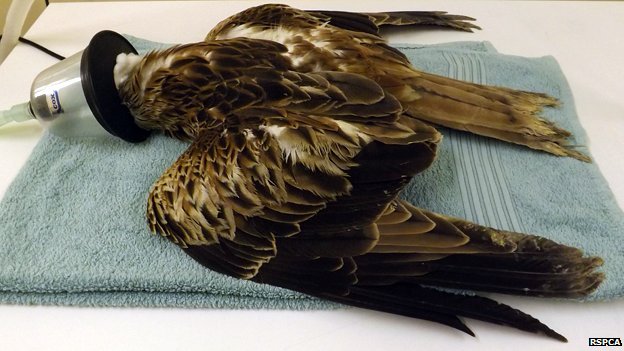
Here are the two poisoned Marsh Harriers

Marsh Harriers poisoned Nene 2013

And here is the poisoned Red Kite

RK poisoned Lincoln 2013

Countryside Alliance disputes evidence that Bowland Betty was shot

Those luminaries of hen harrier conservation, The Countryside Alliance, are claiming that the scientific evidence used to show that Bowland Betty was shot was actually just ‘supposition’.

For those who don’t remember, Bowland Betty was a young satellite-tagged hen harrier who was found dead on a Yorkshire grouse moor in 2012 (see here). There followed a post-mortem carried out by the Zoological Society of London, which showed she had a fractured left leg which led to her death. There was then a pioneering forensic examination by scientists at the University College London Institute of Orthopaedics and Musculoskeletal Science, which found a tiny fragment of lead at the site of the fracture, confirming that she had been shot (see here, scroll down to news item 9th January 2013, and later published in the journal Veterinary Record in 2015: hopkins-et-al-2015_bowlandbetty_vetrecord ).

According to a press statement on the Countryside Alliance website (see here), “The Countryside Alliance team has accessed and reviewed autopsy reports and has serious concerns about this claim“.

Hmm, I wonder how many professional forensic scientists are employed on the CA’s team? Probably the same number as the number of professional veterinary pathologists employed by the SGA when they challenged the findings about what had happened to the Deeside eagle (see here).

Of course, it’s not the first time that the Countryside Alliance have been in denial about the extent of hen harrier persecution – see here, here, here and here for starters. Blimey, even Nick Griffin MEP has a greater grasp of the dire straits this species is in (see here) and that’s saying something!

It’s worth remembering that the Countryside Alliance was a participant in the charade that was the ‘Hen Harrier Dialogue’ – until the RSPB, Northern England Raptor Forum and the Hawk & Owl Trust finally had enough after six years of utter game-playing and walked out. Also interesting to note that the Countryside Alliance is still a participant in the PAW England and Wales Raptor Persecution Priority Delivery Group, along with the likes of the Moorland Association (see here for their view on hen harrier conservation) and the National Gamekeepers’ Organisation (we wrote recently about their contribution to tackling illegal raptor persecution here). Yet another charade, almost identical to the Scottish Raptor Priority Group, portrayed as ‘partnership working’ when it’s anything but.

The illegal killing of Bowland Betty provided tangible evidence of what we all knew was happening to the thousands of ‘missing’ hen harriers on UK grouse moors, just as the Countryside Alliance’s latest denial lays bare what we already knew was their real attitude to hen harrier conservation. Bowland Betty wasn’t the first silent witness and certainly isn’t the last…..watch this space…

Buzzard dies from gunshot injuries in Northumberland

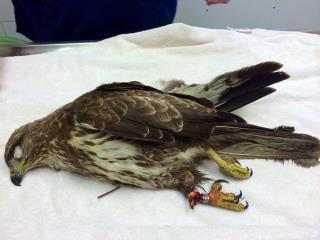
Hexham buzzardAn injured buzzard was found by a member of the public at Blanchland near Hexham, Northumberland at the weekend.

It had been shot.

The bird was taken to a wildlife sanctuary at Ladyhill Farm, Simonburn, Hexham where it later died of its injuries.

More info on the Falconry Days  facebook page here.

UPDATE 25th September: Police have now issued an appeal for information about this case, and a similar one in the same area involving a shot tawny owl. Read the press release here.

Pathetic fine & curfew order for kestrel chick thief

Here’s a very good example of how just how useless the court system is at addressing wildlife crime.

Last week at Wolverhampton Magistrates Court, 38-year-old Cogoo Sherman Bowen was fined £210 and given a six-week curfew after his conviction for being in possession of four x 2-week-old kestrel chicks.

He was caught with the chicks in the dead of night on 19th June in the grounds of St Mary’s Church in Bushbury. The police had been alerted to suspicious activity on the church roof and had turned up expecting to find metal thieves; instead they found the defendant in his car with the bag of kestrels.

Quick-thinking RSPCA officials and the police wildlife crime officer, PC Chris Watson, found the nest ledge on the side of the church and were able to return the chicks, which fledged safely several weeks later.

Great work by the investigating authorities but a pathetic result in terms of the magistrate providing any sort of deterrent to other would-be chick thieves or indeed a meaningful punishment to the convicted criminal in this case.

Full story in the Express and Star here

Red kite poisoned N Yorkshire: police appeal 11 months later

North Yorkshire Police are appealing for information 11 months after a red kite was found poisoned in Tadcaster. The RSPB has also put up a £1,000 reward for information leading to an arrest and charge.

The dead bird (a three-year old believed to have been part of a breeding pair) was discovered by a member of the public at Toulston Polo Ground in October 2012. Toxicology results have revealed the bird had been poisoned with Carbofuran.

On the face of it, this looks like another farcical mishandling of a raptor persecution crime by the police, with an exceptionally long delay between the discovery of the victim and an appeal for information. However, rumours from colleagues in Yorkshire suggest that the initial testing (post-mortem) was not straightforward, leading to a prolonged delay. It is also rumoured that the bird was eventually submitted for toxicology analysis under a private submission co-funded by the Yorkshire Kite Group and the RSPB, leading to the detection of the banned poison Carbofuran.

The bird is believed to be the 20th poisoned red kite reported in North Yorkshire since 2000.

North Yorkshire police press release here

Young peregrine shot

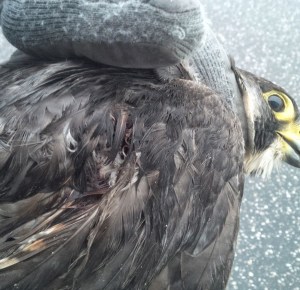
peregrine shotPolice in Bristol are appealing for information after a young peregrine was found injured by the side of the road in Queen Charlton, near Keynsham earlier this month. An x-ray revealed the bird had been shot.

The bird, which had been ringed as a chick in July, is now in the care of a local rehabilitation expert.

More details in The Bristol Post here.