Langholm Project winding down prematurely

Langholm moorFollowing the news last month that Langholm Project head gamekeeper Simon Lester was resigning (see here), the project directors have now issued a statement about what will happen for the duration of the Project’s final 18 months:

Undertaking a review of structure and activity over the final year and a half of the project, the LMDP Board Directors have confirmed the project will continue until October 2017, with important changes to the management of the moor.

Directors acknowledged significant project successes in recovering heather habitats, stimulating black grouse numbers and demonstrating the role of diversionary feeding in reducing hen harrier predation on red grouse broods. The many and varied visitors to the project have illustrated the contribution of LMDP to demonstrating good moorland practice. The hard work of the keepering team was central to these results, with valuable support from the project science and volunteers.

However Directors agreed that with no realistic chance of reaching the target grouse density necessary for driven shooting, game keepering should be wound down, ending fully by April 2016. As well as the cessation of traditional keepering activities, there will be no diversionary food provided at the harrier’s nests or further novel habitat restoration. SRDP funded habitat management measures will continue through Langholm Farms.

Importantly the project will carry out another full year and half of monitoring, tracking habitat quality, numbers of moorland birds and the breeding success of the hen harriers over the 2016 and 2017 breeding seasons. This gives the project time to gather further information on the beneficial effects of moorland management, while the project scientists finalise a variety of reports for the Directors to review before publication.

A detailed review of the project’s achievements is available in the 7-year review. A Question & Answer paper, covering the next steps in more detail, will be available on the website soon“.

So, as predicted (here), it looks very much like this project is being set up to be seen as a ‘failure’ by the grouse-shooting industry, based on the claim that red grouse density has not recovered sufficiently to enable driven grouse shooting to occur. That’s a highly contentious position, as the data have shown the red grouse population at Langholm has recovered sufficiently, without the need for raptor culling, to a density which previously supported driven grouse shooting activity (see here, here and here). For some (as yet unexplained) reason, the target density for red grouse in the current Langholm 2 project has been set absurdly high at 200 birds per kmsq, rather than the standard 60 birds per kmsq that has been touted for years by the grouse-shooting industry as being the suitable target density required for driven grouse shooting to take place.

We already know that one of the project directors, Mark Oddy (representing Buccleuch Estates), wants “lethal control” [of raptors] at Langholm (see here); can we expect to now see further calls for raptor culls on grouse moors, based on the ‘evidence’ (ahem) of Langholm 2? We’d put money on it.

The petition to ban driven grouse shooting is doing well – please sign HERE

RSPB news black out on hen harrier persecution? This can’t be right

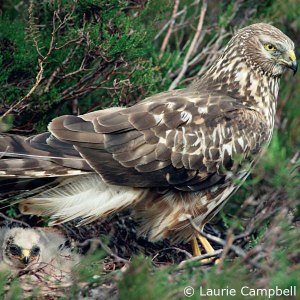
hh LAURIE CAMPBELLIf we’ve interpreted this correctly, there’s something very odd going on with the RSPB this year.

Two days ago, RSPB Conservation Director Martin Harper wrote a blog entitled ‘Thoughts on this year’s hen harrier breeding season‘ (see here).

Much of the content isn’t new – it’s just reiterating the RSPB’s supportive position of DEFRA’s Hen Harrier Inaction Plan and Martin’s desire to see an improvement in hen harrier breeding success this year. However, there are a few additional sentences in this article, relating to the RSPB’s planned media strategy, that really require close attention and, hopefully, some clarification:

To ensure focus remains on the conservation outcome we want, we won’t be providing day by day updates on the breeding season. Instead, we’ll provide a mid-season update on 6 June and then let everyone know how the season has gone in late August with a detailed update“.

Eh?

Does this mean that if hen harriers are persecuted during this year’s breeding season, we might hear about it on 6th June (although the news could easily be suppressed by the police if the persecution incidents happen just before 6th June – live investigation and all that) but if it happens after 6th June we won’t find out about it until ‘late August’?

If that’s the case, it’s an extraordinary move by the RSPB. It’s like telling the criminals, ‘Wait until after 6th June to bump off the harriers because there won’t be any publicity about it until late August’.

Nobody expects a ‘day by date update’ from the RSPB – we’ve never had that before and we wouldn’t expect it this year, but what we would expect is to be told, in a timely manner, if hen harriers have ‘disappeared’ in suspicious circumstances from active breeding sites, or if they’ve been found killed. That’s what the RSPB did last year, so why is this year so different?

Imagine this scenario. There are 20 breeding pairs of hen harriers across northern England this year (yes, hard to believe). What if one harrier got shot each week during the season. We might hear about the first three or four deaths on 6th June, but then nothing of the other 16 until late August?

How does a news black out “ensure focus remains on the conservation outcome we want“? It makes no sense at all, other than to give the grouse-shooting industry a PR-disaster-free ride in the run up to the Inglorious 12th. How is that in the interests of conservation?

And assuming the RSPB will again be involved in this year’s Hen Harrier Day (7th August 2016), are they really going to turn up with nothing to tell us?

Do they really want us to instead rely on the media propaganda that will inevitably be churned out by You Forgot the Birds throughout the season?

If our interpretation of Martin’s statement is correct, then it sounds very much to us like the RSPB has been knobbled.

What we should expect is a clarifying statement from Martin, something along the lines of ‘If you don’t hear from us during the breeding season, take that as no news is good news’.

It would be an absolute disgrace if hen harriers are persecuted this year and the RSPB stays quiet.

Please, Martin, tell us we’ve misunderstood.

Please sign this e-petition calling for a ban on driven grouse shooting HERE

UPDATE 15.05hrs: Martin Harper replies & says no media black out – see here.

Head gamekeeper Simon Lester resigns from Langholm Moor Demonstration Project

Langholm moorThere had been rumours for a few days and now it’s confirmed: Simon Lester, the head gamekeeper at the Langholm Moor Demonstration Project has resigned.

A statement has appeared on the Langholm Project website and is reproduced as follows:

Simon Lester, the LMDP’s headkeeper, has resigned from the project and will be leaving at the end of March 2016. Simon has provided tireless leadership to the five-man keepering team which has undertaken the key management actions for the project. These have resulted in significant improvement of the heather habitat, the effective use of fiversionary feeding of hen harriers each summer and the management of parasites and predators. These measures have increased the numbers of red and black grouse, and breeding raptors, notably hen harriers. This mixture of traditional and novel management has been successfully demonstrated to hundreds of project visitors by Simon in collaboration with the project’s science team.

Despite a larger grouse population than at the start, the project has not been able to produce a sustainably large, harvestable surplus of driven grouse to economically underpin the management. LMDP is now close to its formal end point and the board is reviewing what can and should be achieved in the remaining term of the project. The project board would like to thank Simon for his exceptional contribution.

It’s an interesting time for him to go, eight years in to a ten-year project. The official statement doesn’t explain his reasons, and nor should it as they’re personal, but it will inevitably lead to speculation.

Perhaps it’s because there (supposedly) hasn’t been an opportunity to begin driven grouse shooting on the moor, which is one of the fundamental aims of this project, although it has been argued that the decision not to shoot has been a political one. Grouse densities at Langholm in 2014 had recovered to the same densities that had allowed driven grouse shooting to take place there in the early 1990s, so why the decision not to shoot now? Many of us think it’s so the grouse-shooting industry can claim that the Langholm Project has ‘failed’, in order for them to persist with their argument that driven grouse shooting can’t function with all those pesky raptors around, even though years of research at Langholm have not produced a scrap of scientific evidence to show raptor predation has a large impact on the red grouse population. According to Langholm Project director Mark Oddy (of Buccleuch Estates), what is required now is lethal raptor control at Langholm (see here). Ah, there’s that ‘local knowledge is just as important as scientific evidence’ piece of guff theory.

Given Simon Lester’s view on raptor culling (he thinks it should happen – see here and here), we thought he might have stuck around at Langholm to see his dreams fulfilled. Although perhaps he realises that the chances of licences being issued to kill buzzards, based on no scientific justification whatsoever, are limited.

Scrolling down the Langholm Project website, it’s fascinating to see what else has been mentioned, or more interestingly, what hasn’t been mentioned.

There’s a bit about one of the guest blogs that appeared on Mark Avery’s website (here) that reported on a presentation given at a GWCT seminar about the Langholm Project, but strangely, there’s no mention of the second guest blog (here) where Mark Oddy (Buccleuch Estates) proclaimed lethal raptor control as the next step forward in the Langholm Project. How odd!

Scroll down a bit further on the Langholm Project website and you’ll find a statement about the illegal shooting of hen harrier ‘Annie’, one of the Langholm-hatched birds. Strangely, there’s no mention of where Annie’s corpse was discovered other than “an area over 40km to the north west of Langholm Moor”. The statement is strangely quiet about the fact that Annie’s corpse was found on a grouse moor on, er, Buccleuch Estates, part of the same estate where the Langholm Project is based. Why so coy? Just because her corpse was found there doesn’t mean that’s where she’d been shot, so why exclude this important detail?

All very odd.

It’ll be interesting to see what happens next at Langholm. Will they employ a replacement head keeper and continue for the final two years, or will they decide to close the project early and declare it a failure?

Scottish Moorland Group still in denial about hen harrier persecution on grouse moors

dunceThe Scottish Moorland Group (SMG) has today issued a press statement which refutes the findings of the latest scientific study that has shown hen harriers are being wiped out on Scottish grouse moors in North-east Scotland.

This is no surprise, of course. What is surprising is the ‘evidence’ (ahem) put forward by the SMG to dismiss the findings of the study. Here is their press statement:

Moorland group denounces ‘deeply flawed’ hen harrier report

The Scottish Moorland Group today denounced a report by a raptor study group claiming that sporting estates had virtually exterminated hen harriers in the North-East of Scotland.
The report, which was published using data from Aberdeenshire and Moray, is deeply flawed and shows a lamentable lack of evidence.

Tim Baynes of the Scottish Moorland Group said: “There are serious problems with this report, most notably that there has been very little Harrier surveying conducted recently in the area, with only 4% of harrier breeding areas covered in 2014. The authors identify 118 harrier breeding areas which they have traditionally surveyed but by 2012 only 38% of these were being covered, in 2013 it had decreased to 10% and by 2014 the number covered had halved again.

“We work with Scottish Natural Heritage and others in the Heads Up for Harriers Partnership and in 2015, five grouse moor estates were asked by the project to host nest cameras to determine the causes of Harrier nest failure, some of which were in the north east of Scotland.  In all cases nest failures were shown on camera to be due to weather or fox predation – nothing to do with human disturbance.

“Sadly, this seems to be another instance where raptor study groups have made little or no attempt to engage with land managers who could have helped their research. Even once data is produced, it often incomplete or only selectively shared in an attempt to besmirch grouse moor management. Looking backwards in this way is really unhelpful when collaborative initiatives are being developed by other organisations to ensure a more positive future.”

END

So, let’s start with Tim (Kim) Baynes’ assertion that “there has been very little Harrier surveying conducted recently in the area, with only 4% of harrier breeding areas covered in 2014. The authors identify 118 harrier breeding areas which they have traditionally surveyed but by 2012 only 38% of these were being covered, in 2013 it had decreased to 10% and by 2014 the number covered had halved again“.

It seems that Tim (Kim) is unable to read and/or comprehend scientific papers. Had he read the actual paper, he would have seen the following statement:

There was thorough coverage of all suitable Hen Harrier breeding habitat during 1980-2014” (with the exception of one area where coverage was incomplete between 1980-1987).

He would also have read the following statement:

Annual coverage was thorough and the vast majority of Hen Harrier breeding attempts were believed to have been recorded“.

So why would Tim (Kim) say that survey coverage of hen harrier breeding areas in 2012, 2013 and 2014 was only 38%, 10% and 5% respectively? Well, it appears that Tim (Kim) has chosen to ignore the methods section of the paper (there is a reason the methods section is there, Tim, it tells you how the data were collected!) and instead looked elsewhere to find some data that, on the face of it, support his claim of incomplete survey coverage. His data sources are the annual reports of the Scottish Raptor Monitoring Scheme, which do indicate that the number of checked hen harrier home ranges during this period is lower than the claims made in the paper. You can imagine Timbo, or one of his idiot subordinates, finding these data and thinking, ‘Yeah! We’ve got them now! Let’s write a press statement!”.

What thicko Tim (Kim) has failed to comprehend is (a) the data provided in the SRMS annual reports are grossly under-recorded (because not all raptor workers submit their data to the SRMS because they don’t trust SNH to use the data wisely – see earlier post on SNH’s failure to designate the Ladder Hills as a Special Protection Area for hen harriers!) and (b) the primary survey data used in the hen harrier scientific paper were collected by the papers’ authors. They did not rely on the SRMS data for their calculations. If they had done so, they would have mentioned this in the methods section of the paper. They didn’t mention it, because, they didn’t use SRMS data – they used their own! Is that simple enough for you to understand, Tim? By the way, what are your scientific credentials? Are you suitably qualified to assess the scientific rigour of this, or any other scientific, peer-reviewed publication? No, thought not.

Let’s now turn to another statement in Tim’s press release:

We work with Scottish Natural Heritage and others in the Heads Up for Harriers Partnership and in 2015, five grouse moor estates were asked by the project to host nest cameras to determine the causes of Harrier nest failure, some of which were in the north east of Scotland.  In all cases nest failures were shown on camera to be due to weather or fox predation – nothing to do with human disturbance“.

Again, at face value, this appears to support the grouse-shooting industry’s claims that illegal persecution isn’t an issue for hen harriers on grouse moors. But Tim’s statement doesn’t tell the whole story. It doesn’t tell you that those five grouse moors were in fact, not driven grouse moors. i.e. they were not intensively managed for grouse-shooting and neither were they on the radar as raptor persecution hotspots. So actually, the results from these nest cameras don’t tell us anything about the impact of persecution on hen harrier breeding success on estates where we know hen harrier persecution is endemic. What we’d like to see, as the Heads up for Hen Harriers project goes forward, is nest cameras being placed on driven grouse moors in areas where persecution is known to happen. It is pointless, propaganda-fuelling bollocks to place cameras on nest sites in areas where persecution isn’t an issue (walked-up grouse moors) and then use those results to claim that persecution isn’t an issue on driven grouse moors.

Gift of GrouseTalking of propaganda-fuelling bollocks, has anyone read this piece on the Gift of Grouse website? [UPDATE 8th Feb – the linked article is no longer available as its author has asked the Gift of Grouse website to remove it]. It’s a personal account of a young lad’s first ever experience on a driven grouse moor – Invermark Estate – last summer. James Common was there for three months as part of a team of ecologists (headed up by a gamekeeper’s daughter) employed to document biodiversity on the estate. We’ve already blogged about the (lack of) credibility of that team’s report (see here) but this latest article is more of a personal perspective of his time there.

Isn’t it interesting that Tim (Kim), who directs the Gift of Grouse project, would seek to discredit a scientific, peer-reviewed paper authored by acknowledged, experienced experts, but doesn’t question the ramblings of a young, inexperienced ecologist straight out of college?

As you’d expect, James’ account is very positive about management for driven grouse shooting (if it wasn’t positive there’s no way the Gift of Grouse project would be promoting it!) but it reveals an incredible level of naivety. For example:

Hen harriers also performed admirably – shimmering males and roving ringtails were found with relative ease. Indeed, if these popular moorland denizens had not been present, I may have worried, but they were and so I stand fully content“.

Jesus. If this is the level of ecological curiosity displayed by a young graduate in the conservation sector then there’s no hope. Did he not think to question why, if the hen harriers were so prevalent, they haven’t bred successfully in the Angus Glens since 2006? Apparently not.

Now, Invermark Estate is certainly not the worst estate in the Angus Glens, although it’s had its moments (see here). It is one of the less intensively-managed estates in the region and as such, the level of biodiversity should be relatively good, in comparison to some of its neighbours at least (although where are its breeding hen harriers??). However, James thinks that it’s ‘a tad unfair’ that this ‘good’ estate is unfairly ‘tarred and feathered’ alongside other grouse moor estates where raptor persecution is frequently uncovered. That’s a fair enough comment, although he doesn’t mention that this estate has aligned itself with other, less impressive estates, under the banner of the Angus Glens Moorland Group. If Invermark Estate has chosen to closely associate itself with other estates where raptor persecution crimes keep cropping up, then why the hell should we make any distinction between them?

At least James has the sense to recognise that illegal raptor persecution does happen on some driven grouse moors. That’s more than can be said for Tim (Kim) and his cronies at the Scottish Moorland Group. Does he not realise that by continuing to deny the 30+ years of scientific evidence, his group just looks complicit with it all?

Addendum 7th February 2016 11pm:

For the amusement of those of you not on Twitter, the following is an exchange from earlier this evening featuring Scottish Land & Estate’s CEO, Doug McAdam, who seems to think that data published in a scientific, peer-reviewed paper don’t qualify as ‘verified’, whatever that means. He aborts the discussion when it gets a bit tricky….

Rob Edwards @robedwards53: Hen harriers virtually exterminated on sporting estates in northeast Scotland, says experts. [Links to his article in the Sunday Herald].

Doug McAdam @DougMcAdam: Well “the experts” study seems to be based on very limited data. Comment from Scottish Moorland Group here [Links to SMG press statement].

Simon Brooke @simon_brooke: Hold the front page, wrongdoers say their accusers are biased.

Doug McAdam: Have you even read/looked into the study? Other who have comment here [Links to Gift of Grouse blog].

Simon Brooke: They would say that, wouldn’t they? Do not look to partisan blogs for informed opinion.

Doug McAdam: So you haven’t read/researched it. Thought not.

Simon Brooke: No, I haven’t. Fortunately others have [Links to RPS blog]. Read it and weep. For shame.

Doug McAdam: I rarely put any store in blogs or accusations from anonymous sites. That site is no exception!

Simon Brooke: So we are to trust a pro grouse-shooting blog, but not an anti-crime blog? I wonder why.

Doug McAdam: I’m not telling you to do anything. Anonymous blogs lack credibility and are treated as such.

Simon Brooke: Given that all the assertions in the blog I indicated are easily verifiable….

Doug McAdam: I guess that’s where we differ on this. It hasn’t been verified at all. Accusations without evidence worthless.

Simon Brooke: Have you read the paper? The methodology section either does say what the blog claims it says, or it doesn’t.

Doug McAdam: Read blog you quote, your answer is there. Data not reported to SNH, kept secret etc. Just bizzare. Over and out.

Simon Brooke: It’s hardly ‘kept secret’ if its published in an academic journal.

Doug McAdam: I’m talking about the actual survey data. It’s not officially reported or recorded. Offline now. G’nite.

More shameless spin-doctoring from the Gift of Grouse

Gift of GrouseTim (Kim) Baynes, Director of the grouse-shooting industry’s propaganda campaign, The Gift of Grouse, is shameless. He must be to have penned his latest bout of spin-doctoring, this time pointing the finger at raptor workers.

Before we begin, here’s a definition of a spin doctor:

A person whose job involves trying to control the way something is described to the public in order to influence what people think about it“.

Ladies and gentlemen, the spin doctor is IN.

The following article, authored by Tim (Kim) Baynes, appears in today’s Courier and is entitled: ‘Trust needs to develop quickly between raptor groups and land management‘.

Despite the grouse season ending more than a month ago, our moorland continues to fire passions on all sides.

Since Jim Crumley’s last column, The Courier letters’ pages have been alive with debate. Yet, much of the criticism levelled at estates does not reflect what I see on our moors.

The Gift of Grouse campaign demonstrates the benefits of moorland, including species conservation.

Since then, a number of reports have been publicised. One looked at species present on Invermark, the estate cited by Jim Crumley. It found that 81 different bird species were breeding or feeding there, including a range of ‘red-listed’ most at risk birds. Amongst those present were 10 species of raptor including peregrine, golden eagle and hen-harrier.

Similar is happening on many Scottish estates. Yet disappointingly, the politics of the past – pitting raptor enthusiast versus gamekeeper – are still being played. The RSPB’s report uses incidents from two decades ago to influence present-day policymaking.  But, official figures from the past five years demonstrate raptor incidents are now in the teens per annum, with only some linked to land management. There is always work to be done but the law is tough on anyone convicted of wildlife crime, and even higher sentences are likely soon.

At the heart of this is continuing mistrust between some raptor enthusiasts and land managers. There are also internal rivalries within the raptor groups on who monitors which area, and this leads to secrecy. This is a serious issue as land managers need to know which birds are on their land in order to better manage them, but the survey results are often not shared with them, even when funded by bodies such as Scottish Natural Heritage.

To break down mistrust, we must develop ways of maximising both raptors and prey species alongside grouse.  It should not be an either/or scenario. The persecution of raptors is becoming a thing of the past, but there is also a duty on raptor lobby to engage and share information. Trust is developing in some places but it needs to spread – and rapidly.

ENDS

Oh god, where to begin?

For context, perhaps we should begin by pointing out to those who don’t already know, Tim (Kim) Baynes is employed by the lairds’ lobby group Scottish Land & Estates as Director of the Scottish Moorland Group. The Scottish Moorland Group is chaired by the one and only Lord Hopetoun – he of the Leadhills (Hopetoun) Estate – an estate with one of the worst records of illegal raptor persecution in the country.

Tim (Kim) is right in his assertion that there is distrust between some raptor workers and some landowners. Of course there is, and with bloody good reason!

Scottish Land & Estates (SLE) portrays itself as a wildlife-crime-fighting organisation and frequently points to its membership of the Partnership for Action Against Wildlife Crime (PAW Scotland) as evidence of this. SLE has consistently stated that it is working hard to eradicate wildlife crime, and particularly illegal raptor persecution. The thing is, many raptor workers simply don’t believe them. Why not? Well probably because SLE has not sought to expel several member estates that have been implicated, over many years, in raptor persecution crimes. It would be an easy thing for them to do, but they haven’t done it. Until they do, raptor workers (and the general public) are justified to view SLE and their land-owning members with deep suspicion.

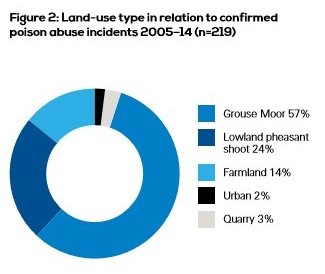
Another good reason for distrusting SLE is their continued denial of the extent of illegal raptor persecution, and their denial that the grouse-shooting industry (some of whom are members of SLE) is in any way implicated with these crimes (e.g. see here and here for just two recent examples). Where clear evidence has been provided, (e.g. 81% of all reported poisoning incidents in Scotland between 2005-2014 were on land used for game-shooting – see here), SLE has simply dismissed the figures and slagged off the RSPB for providing them (here).

RSPB persecution review 1994 2014 land use

In his article for the Courier, Tim (Kim) tries to claim that grouse moors are ‘good’ for species conservation and refers to a recent ‘study’ of breeding birds on Invermark Estate to back up this claim. The problem is, the full details of that ‘study’ (and a couple of others) have not been made available for public scrutiny, despite several requests to see it, and therefore has naff all credibility, especially when the ‘study’ of breeding birds was conducted, er, outside of the breeding season (see here).

But what interested us the most about Tim’s (Kim’s) article in the Courier was his (false) accusations (he’s good at those) about the raptor study groups. He said:

There are also internal rivalries within the raptor groups on who monitors which area, and this leads to secrecy. This is a serious issue as land managers need to know which birds are on their land in order to better manage them, but the survey results are often not shared with them, even when funded by bodies such as Scottish Natural Heritage”.

This is absolute rubbish. The Scottish Raptor Study Group comprises 12 regional branches. These branches organise raptor monitoring within clearly-defined geographic regions, to avoid over-lapping and thus avoid ‘double-counting’ as well as ‘double disturbance’ of sensitive species. All the raptor workers who monitor Schedule 1 species are licensed (by SNH) to do so. These Schedule 1 disturbance licences are issued for specific areas; so if you have a licence to monitor, say, golden eagles in one area, you can’t use the same licence to monitor them in another area unless your licence specifically includes another area. Again, this is to regulate the amount of disturbance to sensitive species. There is no “internal rivalry” – raptor workers simply get on with monitoring in their own patch.

Raptor workers DO share their data – they provide their results to the Scottish Raptor Monitoring Scheme (SRMS) and have been doing so since 2002! Tim (Kim) is obviously annoyed that landowners aren’t given access to those data “in order to better manage” those species. We all know what he means by “better manage” and that is precisely why raptor workers would be reluctant to share location data about highly persecuted species with dodgy landowners. Duh!

Tim (Kim) tries to imply that raptor workers are funded by SNH and as such, the data they collect should be made publicly available. Again, he either misunderstands the system or he’s trying to spin it so that raptor workers look like the bad guys. The truth is, raptor workers are not ‘funded’ by SNH, or by anyone else. SNH does provide SOME funding to the SRSG, but this amounts to a small contribution towards raptor workers’ fuel costs. It certainly doesn’t cover the full fuel costs (the funding is actually well below the commercial mileage rate claimed by consultants) and it does not cover the thousands and thousands of hours of time that raptor workers put in to their monitoring efforts. As such, the data collected by raptor workers belong to the individual raptor worker; not to SNH, not to the SRSG, and not to anybody else. These raptor workers are volunteers – nobody pays for their time, experience and expertise. They can do what they like with their data. That they contribute those data to the SRMS is to their credit, and they do so because they know their data will be useful to conservation and scientific organisations who want to keep tabs on species’ populations. Tim (Kim) Bayne’s inference that raptor workers are the problem is disgraceful.

Trust him and the grouse-shooting industry? Not a bloody chance. Not until we see SLE expelling the estates where persistent raptor persecution continues. Not until we see SLE supporting the work of RSPB Scotland’s investigations team. Not until we see SLE acknowledging the extent of illegal raptor persecution. Not until we see healthy, sustainable breeding populations of raptors such as golden eagles, hen harriers, peregrines, over  a period of years, on driven grouse moors in central, eastern and southern Scotland.

By the way, Kim, you still haven’t provided an explanation for why hen harriers have been absent as a breeding species in the Angus Glens since 2006 (here). Try and spin-doctor your way out of that.

Countryside Alliance (aka Leery lunatics on acid) think hen harriers doing just fine

image001 - CopyHere’s some more comedy gold from the Countryside Alliance (Leery lunatics on acid, for you anagram fans). The following letter was published in a recent (January) edition of Countryfile mag:
Hen harrier ups and downs

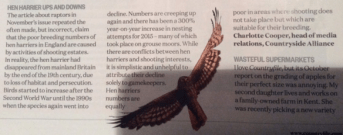
The article about raptors in November’s issue repeated the often made, but incorrect, claim that the poor breeding numbers of hen harriers in England are caused by activities of shooting estates. In reality, the hen harrier had disappeared from mainland Britain by the end of the 19th century, due to loss of habitat and persecution. Birds started to increase after the Second World War until the 1990s when the species again went into decline. Numbers are creeping up again and there has been a 300% year-on-year increase in nesting attempts for 2015 – many of which took place on grouse moors. While there are conflicts between hen harriers and shooting interests, it is simplistic and unhelpful to attribute their decline solely to gamekeepers. Hen harrier numbers are equally poor in areas where shooting does not take place but which are suitable for their breedingCharlotte Cooper, Head of Media Relations, Countryside Alliance.

It’s not the first time the Countryside Alliance has been in full-blown denial about the extent of hen harrier persecution on driven grouse moors (e.g. see here), and undoubtedly it won’t be the last.

The real reality (not the CA’s version of it) looks like this, this, thisthis, this, this etc etc. The persistent denial of what everyone else knows to be true (including the Westminster & Scottish governments), is yet another reason why DEFRA’s Hen Harrier Action Plan is set to fail. There are many other reasons too, and some of them have been described here.

The e-petition to ban driven grouse shooting closes this Thursday. So far, over 30,000 UK citizens have signed it. It’s a much more effective Action Plan than anything DEFRA and it’s grouse-shooting-hen-harrier-killing-mates have come up with. Please sign HERE

DEFRA finally publishes its Hen Harrier Action Plan

hh LAURIE CAMPBELLDEFRA has today published its long awaited Hen Harrier Action Plan.

As expected, the six ‘actions’ that apparently will contribute to the recovery of the hen harrier are as follows:

  1. Monitoring of hen harrier populations in England and the UK
  2. Diversionary feeding of hen harriers on grouse moors
  3. Analyse monitoring data and build intelligence picture
  4. Nest and winter roost site protection
  5. Reintroduce hen harriers to southern England
  6. Trial a brood management scheme

In its current format, the Action Plan provides a general overview and outline of all six actions. There’s very little detail available, which makes it a difficult plan to critique in full, but a few things did jump out.

Diversionary feeding has proven to be successful at deterring hen harriers from eating loads of red grouse at the Langholm Moor Demonstration Project. However, in this action plan grouse moor owners are only being ‘encouraged’ to use diversionary feeding as a course of ‘best practice’. That means that they are not obliged to implement diversionary feeding as a first course of action to reduce the conflict, which seems a bit odd.

Monitoring of hen harrier populations and the subsequent analysis of those data will continue, to ‘build the intelligence picture’. Nothing new there, and monitoring would continue with or without this action plan anyway. How those data will be used isn’t all that clear. The action plan states that a direct benefit will be ‘increased awareness of any hotspots of illegal activity and may allow better preventative measures to be taken at specific sites‘. That’s hardly inspiring. The hotspots are already well known (just look for the nearest driven grouse moor) and there’s not much that can be done if adult males are being killed away from the nest whilst they forage on neighbouring ground. We saw that last May with the ‘disappearance’ (killing) of five adult males.

Nest and winter roost site protection. Again, the nest sites (when the birds have been allowed to settle) are already well monitored and that would continue without this action plan. Protection of roost sites is much more problematic, especially when the harrier killers are armed with night vision and thermal imaging kit, and there isn’t any information about how this protection might be delivered.

The plan to reintroduce hen harriers to the lowlands of southern England needs much further scrutiny. At the moment the proposal is based on an unpublished feasibility report so it’s hard to comment on that. Nevertheless, the general principle of reintroducing the hen harrier is open to question. One of several IUCN criteria that have to be met before a reintroduction of any species can go ahead is that the cause of the species’ (local) extinction needs to have been both identified and rectified. If persecution of the hen harrier is the main reason for its absence in these areas, where’s the evidence that persecution has been addressed?

The final action point is undoubtedly the most controversial – a trial brood management (meddling) scheme. Brood management, in this context, means removing hen harrier eggs/chicks from driven grouse moors when hen harriers have reached a certain density on that moor (or on nearby moors) and rearing them in captivity and then releasing them at fledging age. We’ve blogged about this a lot, ever since the Hawk & Owl Trust announced almost a year ago that it was the way forward. It’s not an action we would support under any circumstances, no matter what the hen harrier population size is. In our view, it amounts to legalised persecution. If driven grouse shooting can’t exist without the need to remove hen harriers then it either needs to lower its expectations (bag size) or cease to exist.

Nevertheless, it’s interesting to read what this action plan says about the proposed brood meddling trial. It refers to a paper that was published last August (Elston, Spezia, Baines & Redpath: Working with stakeholders to reduce conflict – modelling the impact of varying hen harrier densities on red grouse populations). The action plan says brood meddling will be guided by hen harrier densities as determined in this paper. The generally accepted consensus is that once there are 70 breeding pairs of hen harriers in the English uplands, then brood meddling can be considered (depending on the density of hen harriers at a local scale). However, this calculation was made based on the cyclical boom and bust of red grouse populations. Not only have those natural grouse cycles now been eradicated (by the use of medicated grit – see here), but post-breeding densities of red grouse are currently higher than in previous years (an incredible mean density of 382 red grouse per km2, according to the GWCT – see here), which means that those moors can support a higher density of hen harriers. In real terms, this means the target density for hen harriers should be increased accordingly (i.e. there should be more than 70 breeding pairs before brood meddling is implemented).

Having said that, we’re not too concerned about the immediate onset of a brood meddling trial in England because we simply can’t see the driven grouse shooting industry tolerating 70 (+) pairs of breeding hen harriers. Last year there were six successful pairs in the whole of England – an area capable of supporting 300+ pairs. And that pathetic figure was a result of the driven grouse shooting industry supposedly ‘being on side’ and ‘fully supporting hen harrier conservation’!

Interestingly, Martin Harper (RSPB Conservation Director) has blogged about the launch of the action plan (here) and although he acknowledges it isn’t perfect, he says he welcomes it. Eh? The last we heard, the RSPB was still challenging the brood meddling aspect of the plan – what’s changed?

No doubt we’ll be blogging more about the action plan as the 2016 hen harrier breeding season pans out.

Download DEFRA’s Hen Harrier Action Plan here: DEFRA hen-harrier-action-plan-england-2016

No breeding hen harriers on Angus Glens grouse moors since 2006

hh LAURIE CAMPBELLWe were just doing a bit of background research on claims made by the grouse-shooting industry’s propaganda campaign website, The Gift of Grouse (more on that shortly) and we thought we’d share some startling figures.

The following data are from the Scottish Raptor Monitoring Scheme (SRMS) annual reports. The SRMS was established in the summer of 2002 (website here) and is currently a consortium of eight organisations who pool their data to provide information on raptor trends across Scotland (distribution, abundance, breeding success etc).

Here are their results on hen harrier monitoring in Angus from 2003-2014 (2015 data not yet available).

2014: 26 x HH home ranges checked; 0 occupied by breeding pairs.

2013: 23 x HH home ranges checked; 0 occupied by breeding pairs.

2012: 30 x HH home ranges checked; 0 occupied by breeding pairs.

2011: 31 x HH home ranges checked; 0 occupied by breeding pairs.

2010: 23 x HH home ranges checked; 0 occupied by breeding pairs.

2009: 1 x HH home range checked; 0 occupied by breeding pairs.

2008: 27 x HH home ranges checked; 2 occupied by breeding pairs; 0 fledglings.

2007: 15 x HH home ranges checked; 0 occupied by breeding pairs.

2006: 5 x HH home ranges checked; 5 occupied by breeding pairs; 1 pair fledged 3 young.

2005: 4 x HH home ranges checked: 4 occupied by breeding pairs; 2 pairs fledged total of 7 young.

2004: 5 x HH home ranges checked; 4 occupied by breeding pairs; 1 pair fledged 5 young.

2003: 5 x HH home ranges checked; 5 occupied by breeding pairs; 2 pairs fledged total of 7 young.

Pre-2003 data are unavailable (as the scheme only started in late 2002) but a comment next to the 2003 data is quite telling: “Noteworthy are the two pairs that successfully reared young on the grouse moors of Angus, the first for many years“.

So, despite comprehensive monitoring efforts since 2007 (with the exception of 2009 when only one known home range was checked), hen harriers have failed to breed successfully on the grouse moors of the Angus Glens since 2006.

Why is that?

And why hasn’t the Gift of Grouse campaign mentioned this on their website, on their social media accounts, in their press releases, or during the parliamentary receptions they’ve been enjoying at Holyrood where they’ve been feted as environmental champions by some pretty naive MSPs?

More raptor persecution uncovered in the Scottish Borders

We’re still working our way through RSPB Scotland’s recently published twenty-year review (see here) and what a fascinating read it’s proving to be. We’ve already blogged about two things that caught our eye (see here and here), and now here’s the third.

On page 14 of the report, the following has been written:

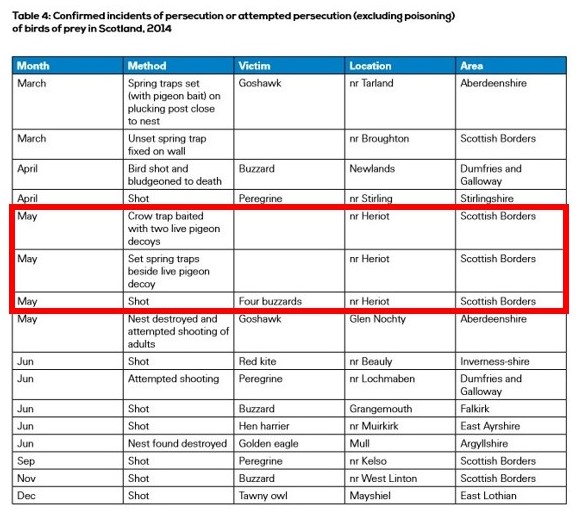
Lines 5, 6 and 7 of Table 4 describe the finding at one site, in an area intensively managed for driven grouse shooting, of a set crow trap, hidden within a small area of woodland, which was found to contain two feral pigeons indubitably being used as illegal lures to attract birds of prey. Under a tree, only a few metres away, were found the decomposed carcasses of four buzzards that had been shot, while a short distance from the crow trap a pigeon was found in a small circular cage, with four set spring traps set on the ground, hidden under moss, attached to the trap“.

Here’s a copy of Table 4, with lines 5, 6 and 7 highlighted:

Nr Heriot 2014

Also included in the report is a photograph of the pigeon inside a small cage with the four set spring traps hidden under moss:

Pigeon in trap Heriot 2014

So, according to the RSPB report, these offences were uncovered in May 2014 on a driven grouse moor in the Borders, with the location given as “nr Heriot“. Funny, we don’t remember seeing anything in the press about these crimes.

Hmm. Could these wildlife crimes be in any way related to SNH’s recent decision to serve a General Licence restriction order on parts of the Raeshaw Estate and Corsehope Estate (see here)? Both Raeshaw Estate and neighbouring Corsehope Estate can be described as being ‘nr Heriot’; indeed, the recorded property address for Raeshaw Estate is given as ‘Raeshaw House, Heriot, EH38 5YE’ (although the owner is only listed as Raeshaw Holdings Ltd., registered in the Channel Islands, natch), according to Andy Wightman’s excellent Who Owns Scotland website. And according to SNH, the General Licence restriction order on these two estates was served due to “issues about the illegal placement of traps” (see here). It’s possible that they’re connected, but it’s also possible that these crimes are unconnected with SNH’s General Licence restriction order on these two estates because Raeshaw isn’t the only grouse moor that could be described as being ‘nr Heriot’. Unfortunately, the (lack of) detail available in the public domain doesn’t allow us to be conclusive. Perhaps there’ll be some transparency once the legal arguments (see here) about the General Licence restrictions have concluded (which should happen fairly soon). Then again, perhaps there won’t.

If these crimes were not uncovered on either the Raeshaw or Corsehope Estates, we hope there’ll at least be a General Licence restriction order served on whichever grouse moor these traps were found because there’s been a clear breach of the General Licence rules – pigeons are not permitted as decoy birds in crow cage traps; set spring traps are not permitted out in the open; oh, and shooting buzzards is also illegal. There should also be a prosecution of course, but that’s highly improbable given the track record of non-prosecutions for raptor crimes uncovered in this part of the Borders.

There’s been a long history of raptor persecution “nr Heriot“, dating back to at least 2001. Here’s a list we’ve compiled of confirmed raptor persecution crimes, all listed within RSPB annual reports:

2001 May: poisoned buzzard (Carbofuran) “Heriot Dale”. No prosecution

2003 Feb: poisoned buzzard (Carbofuran) “Heriot”. No prosecution

2003 Mar: poisoned buzzard (Carbofuran) “Heriot”. No prosecution

2003 Apr: poisoned buzzard (Carbofuran) “Heriot”. No prosecution

2003 Nov: poisoned buzzard (Carbofuran) “Heriot”. No prosecution

2004 Feb: Carbofuran (possession for use) “Heriot”. No prosecution

2004 Feb: two poisoned buzzards (Carbofuran) “Heriot”. No prosecution

2004 Oct: poisoned buzzard (Carbofuran) “Heriot”. No prosecution

2005 Dec: poisoned buzzard & raven (Carbofuran) “Heriot”. No prosecution

2006 Sep: poisoned buzzard (Carbofuran) “Heriot”. No prosecution

2006 Oct: poisoned buzzard (Carbofuran) “Heriot”. No prosecution

2009 Mar: two poisoned buzzards (Carbofuran) “nr Heriot”. No prosecution

2009 Jun: poisoned red kite (Carbofuran) “nr Heriot”. No prosecution

2009 Jun: 4 x poisoned baits (2 x rabbits; 2 x pigeons) (Carbofuran) “nr Heriot”. No prosecution

2010 Nov: poisoned buzzard (Carbofuran) “nr Heriot”. No prosecution

2011 Jan: poisoned buzzard (Carbofuran) “nr Heriot” No prosecution

2013 Jun: shot + poisoned buzzard (Carbofuran) “nr Heriot”. No prosecution

2014 May: crow trap baited with two live pigeon decoys “nr Heriot”. Prosecution?

2014 May: four set spring traps beside live pigeon decoy “nr Heriot”. Prosecution?

2014 May: four shot buzzards “nr Heriot” Prosecution?

Not included in an RSPB annual report (because it happened this year): 2015 Jul: shot buzzard “found by side of road between Heriot and Innerleithen” according to media reports (see here). Prosecution?

Interestingly, also not included in the RSPB’s annual reports but reported by the Southern Reporter (here) and the Guardian (here), a police raid on Raeshaw Estate in 2004 uncovered nine dead birds of prey, including five barn owls, two buzzards, a kestrel and a tawny owl, described as being “poisoned or shot“. In addition, “a number of illegal poisons were discovered but no-one was ever prosecuted“. According to both these articles, during a further police raid on Raeshaw in 2009 ‘three injured hunting dogs were seized by the SSPCA on suspicion of involvement with badger baiting’. We don’t know whether that resulted in a prosecution.

Also not included in the above list is the sudden ‘disappearance’ of a young satellite-tagged hen harrier in October 2011. This bird had fledged from Langholm and it’s last known signal came from Raeshaw Estate. A search failed to find the body or the tag.

Fascinating stuff.

New report reveals hundreds of raptors illegally killed on game-shooting estates in Scotland

RSPB persecution review 1994 2014Yesterday the RSPB published its latest figures on illegal raptor persecution in Scotland.

Rather than their usual annual review, this time they’ve produced a 20-year review covering the period 1994-2014. This is a really useful exercise as it puts the scale of (known) persecution in to perspective. It’s a sobering read.

A total of 779 birds of prey were confirmed to have been illegally killed during this period, either by poisoning, shooting or trapping. The known victims included 104 red kites, 37 golden eagles, 30 hen harriers, 16 goshawks, 10 white-tailed eagles and 458 buzzards.

In addition to these confirmed victims, a further 171 incidents are documented where poisoned baits and/or non-birds of prey victims were found, including 14 pet cats and 14 pet dogs, and then a further 134 incidents where no victim had been found but clear attempts to target raptors had been uncovered (e.g. illegally-set traps).

The report includes a map showing the landholdings of all known persecution incidents during this period. As ever, it’s pretty revealing, with a handful on the west coast but the vast majority in the uplands of central, eastern and southern Scotland – areas dominated by driven grouse shooting.

RSPB persecution review 1994 2014 map

Drilling down in to the detail, there’s a useful analysis of land-use type of confirmed poisoning incidents between 2005-2014 (219 incidents). A shocking (or not) 81% of confirmed poisoning incidents during this nine-year period were on land used for game-shooting: 57% on grouse moors and 24% on land managed for lowland pheasant shoots. This tells us a great deal about who is responsible for the vast majority of illegal raptor poisoning. Despite their continued denials and protestations, and their increasingly-desperate attempts to minimise the scale of these crimes (“it’s just a few rogues”, “it’s just a small minority”), this graphic exposes the criminality at the heart of the game-shooting industry:

RSPB persecution review 1994 2014 land use

Further damning evidence, which isn’t needed by most of us but for the benefit of those who are still in denial of the bleedin’ obvious, is this graph showing the occupations of those convicted of raptor persecution between 1994-2014. Surprise, surprise, 86% of them were gamekeepers:

RSPB persecution review 1994 2014 occupation

RSPB Scotland is to be commended for publishing this exceptionally detailed and meticulously-researched report. There are a number of things in it that are of particular interest to us and we’ll come back to those in due course. For now though, particular recognition should go to the Investigations team – they may be small in number but their contribution to exposing the disgraceful continuation of illegal raptor persecution in Scotland is enormous. They, and their colleagues south of the border, are worthy of high acclaim. If anybody reading this is in a position to recognise excellence in the field of raptor conservation, e.g. a nomination for an award, this team should be at the top of your list.

So, how has the Environment Minister, Dr Aileen McLeod, responded to such an embarrassing report? She said: “There is no doubt that the figures in this report make for uncomfortable reading, but we have made progress in recent years with the new vicarious liability provisions, the publication of the report from the Wildlife Crime Penalties Review Group, new measures implementing restrictions on the use of General Licences and earlier this year the Scottish Government funded pesticide disposal scheme that removed over 700kg of illegally held poisons in Scotland“.

We have made progress…” Hmm. Let’s have a look:

Vicarious liability – introduced almost 4 years ago and only two successful convictions to date. A slow (but good) start, but we need to see many more convictions.

Wildlife Crime Penalties Review – Commissioned over two years ago, published last month. An excellent report calling for tougher sanctions but we’re waiting to hear whether the Environment Minister will act on the recommendations. Can only be defined as ‘progress’ if she agrees to act.

General Licence restrictions – available to be used against landholdings where raptor crimes committed/suspected from 1st January 2014. So far, only two restrictions have been implemented and those only lasted for six days each before they were suspended as legal arguments continue. A slow start, and the legal challenges were to be expected, but can’t be defined as ‘progress’ unless the restrictions are fully implemented. There should also be a lot more of them.

Pesticide disposal scheme –  implemented this year and resulted in the removal of some illegally-held poisons. That is progress, although it is tinged with frustration that the game-shooting industry was given yet another chance to avoid justice as this scheme (the second of its kind) comes 14 years after the pesticides were originally banned. It’s also interesting to note in the RSPB’s report (page 18) that evidence suggests a number of individuals have retained their illegal stocks. This is supported by more poisoning incidents that have taken place this year, after the disposal scheme ended.

So some progress has been made (and almost entirely due to the efforts of Dr McLeod’s predecessor, Paul Wheelhouse) but it is glacially slow and, so far, has not stemmed the occurrence of illegal persecution, as the damning figures in this report show all too clearly. Much, much more can and needs to be done before we’ll be convinced that Dr McLeod is having any sort of impact. She has, though, announced that tenders have just been invited for a review of game licensing practices in other countries (to inform a possible decision of introducing licensing to game-shooting estates in Scotland), and that’s a good thing, but again, the research needs to be done and then a decision made, which probably won’t happen for a number of years if past performance is anything to go by. She’d find herself with a lot more support if she got on with announcing increased investigatory powers for the SSPCA – the public consultation closed 1 year and 3 months ago – and still we await her decision as the criminals continue their rampage. It’s not impressive at all.

And what of the response of the game-shooting industry itself? Some didn’t bother to publish a statement (Scottish Gamekeepers’ Association), which ironically tells us quite a lot, although they are quoted in an article by STV (see media coverage below) where they revert to type and simply deny the evidence and slag off the RSPB instead. And remember, the SGA is a fully-paid up member of the Partnership for Action Against Wildlife Crime (cough).

Scottish Land and Estates (SLE), another PAW partner, did manage to issue a statement, via their Scottish Moorland Group (see media coverage below). Again, it’s the usual lamentable denial, characterised beautifully by this statement from Director Tim (Kim) Baynes:

Bird of prey deaths……have fallen dramatically over the last five years in particular“.

Er, here are some persecution figures that Kim might want to re-punch in to his calculator:

2012 – 18 confirmed deaths

2013 – 28 confirmed deaths

2014 – 37 confirmed deaths

There’s also this statement:

Our condemnation of wildlife crime is unquivocal...” All very touching but how is that “condemnation” manifested in the real world? It’s been brought to our attention that the current head gamekeeper on a Scottish grouse shooting estate has a (spent) conviction for shooting dead a raptor when he worked on another Scottish grouse moor. How does a criminal with a conviction like that (spent or not) remain employed in the game-shooting industry, let alone get a senior position on another Scottish grouse moor? Was he one of the posse of moorland gamekeepers recently invited to Holyrood to mingle with, and be applauded by, a number of MSPs, as part of the Gift of Grouse propaganda campaign? Surely not…

Download the RSPB report here

Media coverage

RSPB press release here

Statement from Environment Minister Dr Aileen McLeod here

Scottish Moorland Group statement here

BBC news here

STV article here

BBC Radio Scotland (Newsdrive) interview with Ian Thomson, Head of Investigations RSPB Scotland here (starts at 21.50, available for 29 days)

Guardian article here (a mis-leading headline but nevertheless good to see coverage in this paper)