shooting times magazine names the countryside’s “most wanted pests”

Game shooting’s top magazine, The Shooting Times, has published an article on the countryside’s “most wanted pests”, which speaks volumes on the true attitude of the game shooting industry to our protected wildlife.

The Shooting Times, 6th February 2006 reports,  The golden eagle, red kite, osprey, heron, peregrine falcon and buzzard stand accused with the hedgehog, otter, badger and the domestic cat of being “voracious predators” that affect the game shooting and fishing industries.

The 114-year-old title describes the animals on its list as “pricey pests” that devour pheasant, partridge, grouse, salmon, trout, hare, pigeon, woodcock, snipe, duck, goose and deer or snatch wild birds’ eggs. The losses hit the profits of estate owners and shooting and fishing syndicates.

Jim Knight, the Rural Affairs Minister, joined animal welfare groups and the Countryside Alliance in criticising the magazine for vilifying wildlife. He was shocked by the article’s emotive language. “The list includes a number of precious species that are protected by law. Readers of this article may agree that some species can be a nuisance — but this does not excuse their destruction.”

Camilla Clark, editor of Shooting Times, said: “The purpose was to assess the economic impact of predators and pests on game birds in the UK. Shooting Times would never advocate the illegal killing of a protected species.”
give credit where it’s due: gamekeeper saves kite on craigiehowe mains shooting estate, ross-shire

An all-too rare example of a good gamekeeper came to light in August 2009, when a red kite was rescued by keeper Bob Colyer on the Craigiehowe Mains shooting estate on the Black Isle, Ross-shire.

The recently-fledged young bird, called ‘H’, had crashed into the side of a pheasant-rearing pen and had become entangled in the netting when Bob found him. After carefully removing him, ‘H’ was given a night’s recuperation with the local SSPCA before being released the next day, with no obvious signs of injury.

Bob said: “The kite was looking very sorry for itself when I found it and didn’t seem grateful to be rescued. However, I’m delighted to have been able to help and even more pleased to hear that it has been able to take to the air once more”.

Well done Bob!

Full story: http://thescotsman.scotsman.com/birdsofprey/Unlikely-hero-saves-bird-of.5565759.jp

Environment Minister appreciates the efforts of the Scottish Gamekeepers Association

Scottish Environment Minister, Roseanna Cunningham, really showed those pesky gamekeepers that she means business when it comes to stamping out wildlife crime. In her speech at the Scottish Gamekeepers Association’s (SGA) annual general meeting on 5 March 2010, hard-hitting Roseanna gave them what for. Well actually, she didn’t.

Here is an excerpt from her speech:

Unfortunately, the illegal killing of birds of prey in Scotland remains at an unacceptably high level, as shown by the recent high profile cases such as the poisoning of the golden eagle, Alma, which was being radio-tracked by SNH. Raptor persecution is one of the UK Wildlife Crime Priorities and we are committed to tackling this.

In Scotland even one incident of deliberate, illegal poisoning would be one too many. It is shameful that some of our most iconic species continue to face illegal persecution.

We all know that the illegal killing of birds of prey is having a serious impact on the populations of iconic species such as golden eagles and hen harriers. Birds of prey are our national assets, with huge public, cultural and tourism appeal. 

However, I realise that those responsible for these illegal activities are in the minority.

I am most grateful for the efforts of the SGA who are trying to conserve birds of prey and the support that the SGA gives to the Partnership for Action Against Wildlife Crime Scotland (PAWS), in helping to defeat this type of crime.

The partnership approach taken in tackling this issue is apparent in the mix of people you see here today. We all have the same goal of defeating wildlife crime. Working together to share knowledge, resources and skills to deal with these issues is the only way to tackle this problem”.

Roseanna, it might be time to change your political advisors because they are clearly not giving you the full picture. What ‘efforts’, exactly, has the SGA made to try and conserve birds of prey? Perhaps you are referring to their long-running campaign (since 2000) to get licences to cull raptors? SGA chairman Alex Hogg even goes as far as saying if they had licences to kill raptors legally then the wildlife crime would stop ‘overnight’. http://www.independent.co.uk/environment/nature/birds-of-prey-persecution-a-special-ios-online-report-396066.html Is that an admission that if licences to kill raptors are not forthcoming then gamekeepers will continue the criminal activity of killing protected species? Wonderful! What a great effort they are making to conserve birds of prey!

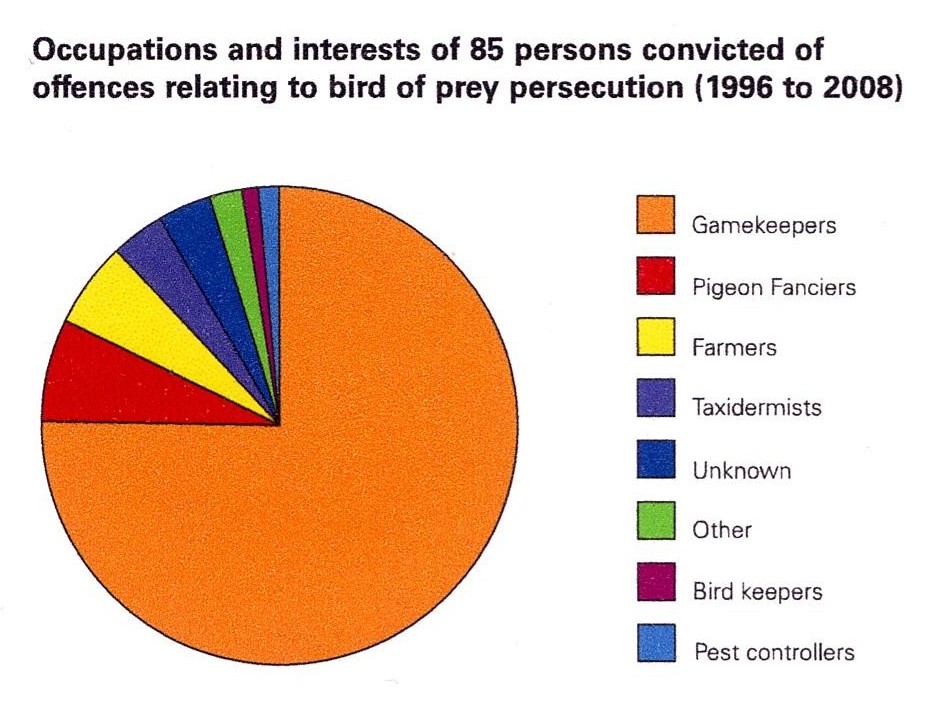
Gamekeepers unfairly blamed for raptor persecution? Let’s look at the facts…

We regularly hear the bleatings of Alexander Simpson Hogg, 51, (known to many of us as simple Alex Hogg), chair of the Scottish Gamekeepers Association, that gamekeepers, those “professional wildlife managers”, are blamed unfairly for raptor persecution events. Really, Alex? Let’s look at the facts, shall we?

Here is a pie chart compiled from RSPB data on raptor persecution incidents in the UK (reproduced from the RSPB publication Birdcrime 2008). From 1996 to 2008, 75% of people convicted of offences relating to bird of prey persecution have been linked with game interests; all 64 of these were gamekeepers, nearly all full-time.

In an article published in the Scotsman newspaper on 26 March 2004, Alex Hogg stated: “We [the SGA] have made it absolutely clear to our members that anyone found guilty of perpetrating these acts of serious wildlife crime will be expelled from our organisation immediately”.

And in an article published in the Independent on 7 October 2007, it was reported that the SGA had released the following statement: “If any of our members are convicted of a wildlife crime offence appropriate measures will be taken. Sanctions include the withdrawal of membership. In particular, conviction for poisoning offences will be treated with the utmost severity”.

So, Alex, here’s your opportunity to demonstrate that the SGA doesn’t merely pay lip service to the task of addressing wildlife crime- can you produce a list of members who have been expelled from the SGA for being convicted of a serious wildlife crime?

As a member of the government-led Partnership for Wildlife Crime (PAW), this should be the least you have to do to demonstrate your organisation’s sincerity.

“Eagles have no place on my grouse moor”, allegedly said former Laird of Fordie Estate, Perthshire

It is often said that gamekeepers only persecute raptors because they are acting upon the orders of their employer, and fear losing their job and often a tied cottage if they refuse. Here is an example of an estate manager who refused.

Ian Thomas (42) had worked on the Fordie Estate near Comrie, Perthshire for 15 years, when the estate was bought by former banker Lord Anthony Tryon (former husband of Lady ‘Kanga’ Tryon). During an inspection of his newly-acquired grouse moor, Lord Tryon allegedly became irritated at finding piles of grouse feathers indicating kills by birds of prey. According to Ian Thomas, Lord Tryon allegedly said, “Eagles have no place on my grouse moor” and “I have bought an estate and I will do what I like”.

Thomas claims that he was instructed by Lord Tryon to shoot a golden eagle and use illegal poisons to rid the estate of other raptors. Thomas refused and reported him to the authorities, saying he felt “morally obliged” to blow the whistle. Thomas claimed he was constructively dismissed after being branded a trouble-maker by Tryon and took his claim to an employment tribunal.

To avoid giving evidence in court, Tryon made an undisclosed settlement to his former estate manager in 2004.

Full story: http://news.scotsman.com/birdsofprey/Shooting-row-laird-agrees-to.2526404.jp

The Fordie Estate was bought from Lord Tryon in 2009 and is now owned by designer luggage tycoon, Luis Vuitton. The Fordie Estate is one of eight estates in Perthshire who have joined the Countrywatch Partnership, working to protect three key raptor species in the area (golden eagle, hen harrier and peregrine).

Thomas has gone on to establish his own forestry consultancy business. Here is a man with whom it’s worth doing business.

“Map of Shame” doesn’t say anything new

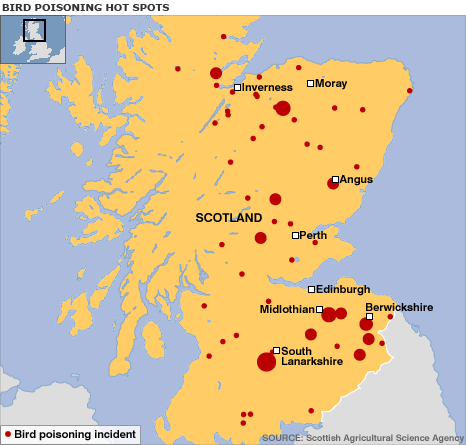
Map of Shame 2004-2008

In January 2009, the Scottish government released its ‘Map of Shame’ showing confirmed poisoning incidents between 2004-2008. The map, using data from the Scottish Agricultural Science Agency (SASA), was hailed as a “significant step” in the fight against wildlife crime as it showed the scale of raptor persecution.

In reality, the map doesn’t tell us anything new at all. The RSPB has been producing these maps for years; the difference with this one is that for the first time, the Scottish Rural Property & Business Association (SRPBA) which represents landowners, agreed to its contents.

The map locates 88 incidents in which raptors were poisoned over the previous 5 years, including iconic species such as the golden eagle, white-tailed sea eagle, red kite, buzzard, tawny owl and peregrine.

http://news.scotsman.com/birdsofprey/Bird-of-prey-poisoning-map.4864489.jp

What the map fails to tell us is the name of the shooting estates involved. What is the point of providing such a vague map? There is no point, other than to confirm what was already known – raptor persecution incidents are widespread across Scotland. If the SRPBA is as committed to stamping out wildlife crime as it claims it is, why wouldn’t it take every opportunity to name and shame those known to be involved?

It is not just wildlife-interest groups that are asking for the estates to be named. In September 2009, MSP Sarah Boyack (Scottish Labour) called for the government to name and shame the offending estates and said taking steps to reduce the number of incidents of wild raptors being shot and poisoned was a “matter of urgency”. http://news.stv.tv/scotland/121040-msp-name-and-shame-bird-killers/

The government is due to release the official 2009 raptor poisoning figures shortly….

8 shooting estates deserve recognition for their conservation measures

After a quick glance through the pages of this blog, readers may be forgiven for thinking that raptor persecution is rife on every single shooting estate in Scotland. Yes, it’s true that illegal raptor persecution in Scotland is widespread, as our ‘Named Estates’ page will testify; currently 57 shooting estates are named, and more are still to be named. However, as we mentioned on the introduction page, it is unfair to tarnish every estate and gamekeeper as wildlife criminals as some are actively involved in raptor conservation initiatives. For example, a joint initiative between Scottish Natural Heritage, Tayside Raptor Study Group, Tayside police, RSPB and eight shooting estates has been underway in Perthshire for several years. The Operation Countrywatch Partnership launched in 2004 (formerly known as Operation Countrywatch that launched in 2000) and provides a framework for supporting healthy populations of three key species in a 70,000 ha area: golden eagle, hen harrier and peregrine. Currently, eight shooting estates are partners in this innovative scheme and we applaud their contribution: Ardtalnaig Estate Atholl Estate Drummond Estate Fordie Estates Glenbeich Estate Glenturret Estate Invergeldie Estate Remony Estate

Guess what? Not much has changed over the last 30 years!

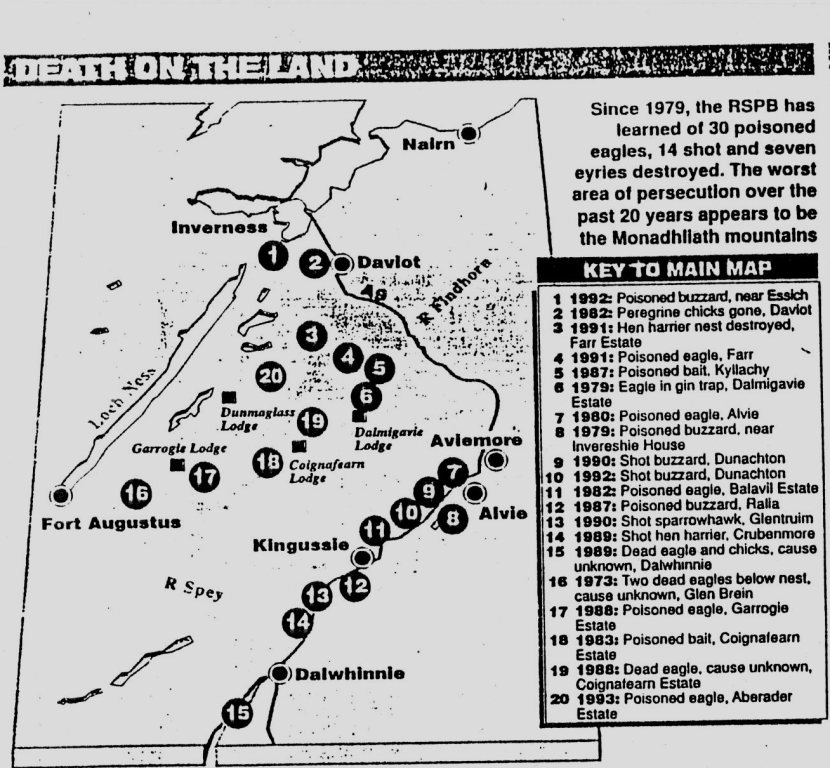
Raptor persecution in the Monadhliath Hills, reported in 1993

It’s interesting to look back over the decades to see how our enforcement agencies have been addressing the issue of raptor persecution in Scotland. A rudimentary search on Google will reveal endless statements of intent from a succession of Ministers determined to “stamp out” wildlife crime. Well guess what? Not much has changed over the last 30 years! Yes, yes, they may have established ‘partnerships’ with the very bodies whose members are behind some of the crimes, and they may have written attractive little soundbites about how disgusted they are every time the body of yet another poisoned eagle/kite/buzzard/harrier/peregrine etc has been found. But what progress has been made on stopping the actual killings? You only have to read the pages of this blog to see that the killing continues.

Here is a map taken from an article that was published in the Scotsman newspaper on March 11 1993. It portrays a series of raptor persecution incidents in the Monadhliath Hills, south of Inverness, as recorded by the RSPB over several years. The article explains that the Monadhliath Hills is prime habitat for golden eagles, hen harriers etc. And now here we are 17 years later, do you think that the area now holds many breeding pairs of eagles and harriers? You can probably guess the answer to that.

So come on Scottish Ministers, it’s time to stop talking about it and take some action!