eagle killers getting away with it

The aim of this blog is to monitor the occurrence of illegal raptor persecution incidents across Scotland, and to report on the outcome of each case. As you will already know from reading the blog entries, persecution incidents have been occurring for many years and involve most of our raptor species, including golden eagles, white-tailed eagles, red kites, hen harriers, buzzards, goshawks, sparrowhawks, ospreys, kestrels and owls. Let’s see what progress, if any, has been made by our law enforcement bodies,  starting with our most iconic species, the golden eagle and white-tailed eagle.

When the news hits that another eagle has been illegally poisoned or shot, there is, quite rightly, public outrage. Each event is usually followed by a statement from those responsible for upholding the law that they are determined to stamp out these crimes and bring the guilty party to justice. Let’s see how well they’ve been doing. The following is a review of cases involving 13 dead eagles since 2006:
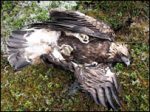
MAY 2006: A dead adult golden eagle is found on the Dinnet & Kinord Estate, near Ballater, Aberdeenshire. A post-mortem reveals it has been poisoned by the illegal pesticide, Carbofuran. Grampian Police launch an investigation. As of September 2010, nearly 4.5 years later, no arrests have been made.
 

 JUNE 2006: A dead golden eagle is found on Glen Feshie Estate in the Cairngorms. A post-mortem reveals it has been poisoned by the illegal pesticide, Carbofuran. Northern Constabulary launch an investigation. As of September 2010, nearly 4.5 years later, no arrests have been made.


AUGUST 2007: A dead adult female golden eagle is found on a Peebleshire estate. A post-mortem reveals she has been poisoned by the illegal pesticide, Carbofuran. This female was part of the only breeding pair of golden eagles remaining in the Scottish Borders. She had a young dependent chick still in the nest. Lothian & Borders Police launch an investigation. As of September 2010, over 3 years later, no arrests have been made. 
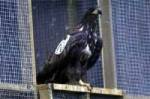


AUTUMN 2007: Tayside Police receive a detailed tip-off that a young male white-tailed eagle (known as ‘Bird N’) has allegedly been shot on an estate in Angus. The tip-off included the name of the alleged shooter and that the body had been burned to hide the evidence. ‘Bird N’ was part of the cohort of reintroduced sea eagles that were donated by Norway and released in Scotland in August 2007. The timing and location included in the tip-off coincided with the timing and location of the last-known radio signal of this bird. As of September 2010, 3 years later, no arrests have been made.
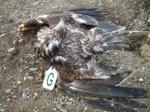
MAY 2008: A one year old male white-tailed eagle who hatched on Mull in 2007 and was known as ‘White G’ is found dead on the Glenquoich Estate, Angus. A post-mortem reveals he has been poisoned by an unusual concoction of pesticides that includes Carbofuran, Bendiocarb and Isofenphos. A police search in the area also reveals a poisoned buzzard, a baited mountain hare and 32 pieces of poisoned venison baits placed on top of fenceposts on the neighbouring Glenogil Estate. Laboratory tests reveal the baited mountain hare and the 32 poisoned venison baits contain the same unusual concoction of highly toxic chemicals that had killed the white-tailed eagle, ‘White G’. As of September 2010, nearly 2.5 years later, no arrests have been made.
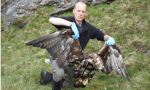
JUNE 2009: An adult golden eagle is found dead at Glen Orchy, Argyll. A post-mortem reveals it has been poisoned by the illegal pesticide, Carbofuran. Strathclyde Police launch an investigation and state they are “following a positive line of inquiry“. As of September 2010, 15 months later, the outcome of this “positive line of inquiry” has not been made public.
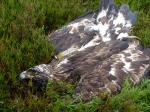
 

JULY 2009: A two year old female golden eagle, known as ‘Alma’, is found dead on the Millden Estate, Angus. A post-mortem reveals she has been poisoned by the illegal pesticide, Carbofuran. Alma is a well-known eagle  – born on the Glen Feshie Estate in 2007, she was being satellite-tracked and her movements were followed by thousands on the internet. Tayside Police launch an investigation. As of September 2010, over a year later, no arrests have been made.

AUGUST 2009: A young white-tailed eagle is found dead on Glenogil Estate, Angus. A post-mortem reveals it has been poisoned by the illegal pesticide, Carbofuran. Reports circulate that this bird actually died in March 2009, but RSPB fieldworkers could not locate the transmitter signal. The decomposed body was eventually found in August 2009, after an expert fieldworker was brought in. Tayside Police did not release a press statement about this alleged persecution incident until January 2010, 6 months after the dead body was discovered, and probably 9 months after it was killed. As of September 2010, over a year later, no arrests have been made.

MAY 2010: Three dead golden eagles are found on Skibo Estate, Sutherland. They are found with a dead buzzard and a dead sparrowhawk. All are suspected victims of illegal poisoning and the bodies are sent for forensic post-mortem in Edinburgh. Northern Constabulary launch an investigation. As of September 2010, 4 months later, the post-mortem results have not been made publicly available. The result of the police investigation has also not been made publicly available. UPDATE Nov 2010: SASA report indicates the golden eagles were poisoned.

JUNE 2010: Two dead eagles are discovered on a grouse moor nr Inverness. The golden eagle and the white-tailed eagle were collected by the RSPB and sent to the SASA lab for inspection. They are later confirmed to have been poisoned by Carbofuran. Northern Constabulary does not make any public appeal for information – nor does the RSPB. You have to ask why not?

SGA wants buzzards back on the vermin list

A recent episode of Fieldsports TV was dedicated entirely to the views of the Scottish Gamekeeper’s Association Chairman, Alex Hogg, who, according to the programme’s presenter, wants buzzards back on the ‘vermin’ list. And there was me thinking we were in 2010, not 1910.

What justification does Alex use to support this Victorian attitude?  “The biodiversity in Scotland is seriously being threatened by buzzards“. Presumably then, Alex doesn’t view buzzards as a fundamental component of biodiversity! I would argue that biodiversity in Scotland is seriously being threatened, but not by buzzards, nor any other predator for that matter, but by the actions of those gamekeepers who persecute raptors and also release millions of non-native gamebirds into the environment with little apparent consideration for the ecological impact of these birds.

In the revealing interview, Alex argues for the provision of government-endorsed licences to kill buzzards. He then realises that this view probably does not fit with the recent image he has been trying to portray of the gamekeeper, and that his view is probably going to be distasteful to the majority of the general public, so he modifies it by saying, “We don’t need a licence to kill that many – it’s just a few rogue buzzards“. Are these “few rogue buzzards” in addition to the many buzzards (and kites, eagles, harriers, peregrines, goshawks, sparrowhawks, owls) that continue to be illegally persecuted by gamekeepers across Scotland? And how many is “just a few“? In his recent application for a licence to kill buzzards on the estate where he works, he asked to kill 12. Let’s do a crude estimate here – let’s say there are approximately 400 sporting estates in Scotland, and each one wants to kill 12 buzzards a year – that would be a total of 4,800 buzzards killed per year. Hardly “a few“.

If you want to hear more of Alex’s views, the episode is available on YouTube here: http://www.youtube.com/watch?v=8nlcfdmUX4I

Scottish Countryside Alliance’s interesting Statistics

On the run up to “the glorious twelfth” as many gamekeepers and their employers wait to see how effective their pest control regimes have been, various pro-game shooting bodies spew out some new statistics which “reveal” that grouse shooting is worth £zillion to the Scottish economy or supports 99% of all Scottish jobs. One that caught my eye this week was the survey conducted by the Scottish Countryside Alliance (SCA) and publicised fairly widely.  Here’s an extract:

“An online survey has revealed a great deal of support for grouse shooting in Scotland, with 95% of respondents saying it would be ‘bad news for the Scottish countryside’ if grouse shooting were to stop.”

“The depth of support for one of the country’s most famous sporting events is highlighted by a survey carried out by the Scottish Countryside Alliance, a campaigning organisation which represents rural interests.”

“The survey also showed that 26% reported having a direct business interest in grouse shooting; 44% have an indirect business interest; and 69% think the sport is good for their community”

Anyone could be forgiven for thinking, Impressive figures! Who would have thought that grouse shooting was so important to the Scottish economy? This is until after some research, we discover that the survey was conducted online by visitors to the SCA website and restricted to the first 100 respondents. It’s like the first 100 visitors to a golf website saying that they like golf!

Only an idiot would be impressed by the biased results of this straw poll and pathetic attempt to generate a positive profile for driven grouse shooting.

Ross Montague, Director of SCA commented on the results of this survey, saying:  

This bolsters what we have been saying for quite some time now, that land management for country sports in general is important for the bio-diversity of the land and especially jobs. And it seems people living in the countryside agree.

Shooting is worth £240 million to the Scottish economy and this survey reveals that people realise its benefits. To lose grouse shooting would be akin to stopping golf throughout the country.

I think this last sentence demonstrates just how far into the world of fantasy the SCA is willing to go to portray a positive image of driven grouse shooting and ignore the illegal raptor persecution that this industry generates.

“the 12th is glorious for conservation” – is it really?

“The 12th is glorious for conservation”, according to the Countryside Alliance. In a remarkable and desperate piece of journalism, their website heralds new survey results collected by the Moorland Association:

“Everyone who loves country sports loves a good statistic: shooting contributes £1.6bn to the economy; 4 million people go angling every year; 57% of people believe the Hunting Act is not working. Now, to celebrate its 25th anniversary, the Moorland Association has carried out a survey that shows how much time and money is put into shooting and conservation in upland areas, and there are plenty of positive statistics to enjoy. 

Where moorland has been managed for grouse shooting, everything flourishes – the landscapes, the people and the economy. An uplands future based on shooting’s successful management model, with responsibility lying with those who already manage the land is common sense and we hope the healthy snapshot described by the Moorland Association’s survey can continue for many decades to come. Grouse moors are a true conservation success story, and something glorious to be celebrated.”
 
Hmm. Given they like statistics so much, how about this one, which they conveniently ‘forgot’ to include:
IN SCOTLAND, 85% OF PEOPLE CONVICTED FOR RAPTOR PERSECUTION CRIMES FROM 2003-2008 WERE GAMEKEEPERS. 
 
Not what I’d call “glorious for conservation”.
Figures from the latest RSPB report of illegal raptor persecution:

Hogg Wash…

The Scottish Gamekeepers Association website is always an entertaining read. Whether it’s Alex Hogg, that self styled guardian of the countryside, promoting the idea of law abiding gamekeepers becoming special constables or discussing whether Scotland or Ireland is the most likely place for eagles to be poisoned.  It’s like a tweed clad version of the ministry of misinformation.

I particularly look forward to the rather infrequent entries in our old friend Alex Hogg’s blog. In this most recent entry on “Hogg Blog” ,Alex tells us of his continuing battle with the Scottish Government over licences to kill buzzards and his apparent disbelief and frustration that he will not be granted a licence to kill these pesky birds that  have the audacity to eat a few of his pheasants. I can’t imagine why he sounds so surprised as none other than the Environment Minister, Roseanna Cunningham had announced this fact weeks ago.

It seems incredible that in a modern forward thinking country, in this International Year of Biodiversity and with Scotland’s shocking record of raptor persecution that the legalised killing of raptors should be on anyone’s agenda.  Anyway, here’s his entry for 4th Aug 2010 a mere 12 days after the RSPB announced that 2009 had been the worst year for raptor persecution for 20 years.

Its buzzard central here and they’re not just predating the release pens. Only an hour ago I watched one fly off with a poult it killed within a few yards of the garage beside my house and I’m pulling my hair out with frustration.

We put in every possible deterrent and I really thought the problem wasn’t going to be so bad this year but the last week has been a nightmare. So on Friday I contacted the local Government office and asked inspectors to come and see the problem and issue a licence to control the buzzards that are doing most of the killing. They came yesterday (four days later) and heard and saw the menace for themselves. At one point we could hardly hear ourselves speak for the noise the birds were making.

But the officials confirmed what we have suspected for the last six weeks: that despite the SGA negotiating the conditions for the issue of such licences with Government at numerous meetings over the past year, the process has come to an abrupt halt. No licences will be forthcoming. No matter how severe the problem.

What the hell do I do now?


My goodness Alex, it looks like you’ll be trawling ebay for a set of ear defenders and a wig.

Record Year for Raptor Poisoning

Published on Friday an annual RSPB Scotland report confirmed that 2009 marked the highest number of raptor poisoning incidents for 2 decades. “The Illegal Killing of Birds of Prey in Scotland in 2009”  indicates that human persecution continues to have a serious impact on the populations of some of the country’s most vulnerable species.

Last year, 21 buzzards, 4 red kites, 2 golden eagles and 1 white-tailed eagle, the latter gifted to Scotland from Norway as part of a reintroduction programme, were among the victims in 46 poisoning cases confirmed by Scottish Government testing.

Illegal killing, through shooting, nest destruction or the use of spring traps, were also confirmed in nine incidents. As many raptors are long-lived and have slow reproduction rates the killing of these species, particularly adult breeding birds, has dire consequences for their populations as a whole. This illegal persecution is affecting the conservation status of raptors such as hen harriers, golden eagles and red kites.

The vast majority of poisoning incidents were associated with shooting estates and in particular grouse moors. Predictably, various pro-shooting bodies have attempted to discredit the RSPB Scotland figures and  fudge the issue.  Notably, the landowners’ organisation, the Scottish Rural Property and Business Association (SRPBA) said the figures were misleading.

A spokesman said: “The official government report on the illegal poisoning of birds of prey for 2009, published in March 2010, shows the level has stayed the same for the last three years with the exception of 2008 when there were 16 incidents. There is ample legislation in existence to deal with this problem and we support the full weight of the law being brought to bear on those using illegal poisons.”

As these crimes are mainly committed in extremely remote areas and discovered by hill walkers and similar outdoor enthusiasts stumbling upon dead birds, it must be remembered that these “confirmed” cases must represent only a fraction of the true number of raptors illegally killed each year.

The increase in these incidents proves beyond reasonable doubt that the perpetrators of these crimes have little  fear of the Scottish judiciary system. Perhaps if the penalties for killing our birds of prey were more of a deterrent we would see this disgraceful trend reverse.

Press and Journal report. http://www.pressandjournal.co.uk/Article.aspx/1838869

BBC News Report. http://www.bbc.co.uk/news/uk-scotland-10730222

RSPB Report. http://www.rspb.org.uk/Images/illegalkillingscotland_tcm9-256571.pdf

Duncan Orr-Ewing, RSPB Scotland discusses the report on Radio 4’s Today http://news.bbc.co.uk/today/hi/today/newsid_8847000/8847745.stm

landowners’ condemnation of raptor persecution revisited

Last week, I reported that 23 of the shooting estates that had signed the letter to condemn raptor poisoning had had wildlife crime incidents recorded on their properties, and in some cases, employees had criminal convictions associated with wildlife crime. I decided to give them all the benefit of the doubt, as they may all have since changed ownership and/or staff since those incidents and subsequently changed their attitude towards raptor killing.  After some heavy duty googling, it appears that 6 of the 22 have changed ownership, 11 have not, and inconclusive material was found for 6.

Estates that do not appear to have changed ownership and/or staff since incidents of wildlife crime have been recorded on their land, yet are asking us to believe they now ‘condemn’ raptor poisoning are as follows:

Careston Castle, Dochfour Estate, Invercauld Estate, Haystoun Estate, Dougarie Estate, Haddo Estate, Dunecht Estate, Roxburghe Estate, Seafield & Strathsprey Estates, Innes Estate.

Estates that do appear to have changed ownership and/or staff since incidents of wildlife crime were recorded on their land are as follows:

Coignafearn Estate, Dunachton Estate, Glenfeshie Estate, Lothian Estate, Islay Estate, Wemyss & March Estates.

Inconclusive evidence of a change of ownership and/or staff since incidents of wildlife crime were recorded on their land include the following:

Rosehaugh Estate, Dinnet & Kinord Estate, Balmanno Estate, Straloch Farm, Aberarder Estate.

One estate that deserves special mention is Coignafearn Estate in the Monadhliaths. Previously known by raptor workers as a notorious eagle black-spot in the 1980s when it was owned by an age-ing Belgian, Baron Douharty, Coignafearn was bought by Dr Sigrid Rausing in 1998. The daughter of Tetra Pak billionaire Hans Rausing, she has since made tremendous efforts to run this estate positively for raptors, including building artifical nest sites to try and encourage breeding golden eagles back to her land.

If only all landowners were as enlightened as Dr Rausing.

landowners’ condemnation of raptor persecution exposed as a sham?

On 21 May 2010, this blog reported on the news that over 200 landowners (members of the Scottish Rural Property & Business Association – SRPBA)  had written a letter to Environment Minister Roseanna Cunningham MSP, condemning the continued practice of illegal raptor persecution on Scottish sporting estates.

This letter has now become available for public viewing: SRPBA LETTER MAY 2010

On close scrutiny of the signatories to this letter, it is now apparent that on 23 of the estates listed, wildlife crime incidents have been recorded, and on seven of them, estate employees have criminal convictions. Here they all are in their full glory:

Careston Estate, Brechin: Buzzard found poisoned by Chloralose 1992.

Dochfour Estate, Inverness: Buzzard found poisoned by Chloralose 1992.

Invercauld Estates, Braemar: Buzzard found poisoned by Chloralose 1992; Three Buzzards and a raven found poisoned by Carbofuran 2005; Gamekeeper convicted for illegal use of spring trap 1997.

Balmanno Estate, Bridge of Earn: Buzzard found poisoned by Carbofuran, illegal gin traps and egg collection – Gamekeeper convicted 2003.

Haystoun Estate, Peebles: Gamekeeper filmed allegedly removing Peregrine chick from nest – evidence ruled inadmissable in court (a legal technicality) – but keeper convicted of firearms offences 2003.

Haddo Estate, Aberdeenshire: Gamekeeper convicted for  laying poisoned baits and illegal traps and fined £2,600 in 1989.

Dunachton Estate, Kincraig: Buzzard found shot 1990; Buzzard found shot 1992.

Dougarie Estate, Isle of Arran: Eagle found poisoned by Chloralose 1991.

Rosehaugh Estate, Black Isle: Buzzards found poisoned by Mevinphos 1991.

Dinnet & Kinord Estates, Aboyne: Gamekeeper convicted for firearms offences and trespassing on neighbouring estate while carrying a firearm 2006; Golden eagle found poisoned 2006.

Straloch Farm, Blairgowrie: Buzzard found poisoned by Chloralose 1992.

Lothian Estates, Jedburgh: Osprey found shot 1993.

Glenfeshie Estate, Kincraig: Golden eagle found poisoned by Carbofuran 2006.

Islay Estates, Islay: Raven found poisoned by Mevinphos 1989; Buzzard found poisoned by Mevinphos 1989.

Dunecht Estates, Aberdeenshire: Buzzard found shot 2007.

Coignafearn Estate, Tomatin: Poisoned bait found 1983; Golden eagle found poisoned 1988.

Roxburghe Estate, Kelso: Buzzard found poisoned by Mevinphos 1989.

Seafield Estate, Strathsprey: Buzzard found poisoned by Chloralose 1991.

Innes Estate, Elgin: Dead Buzzards and crows found dying after poisoned by Carbofuran – Michael Royan (head gamekeeper) convicted of firearms offences and possession of illegal poisons 2007.

Carbeth Estate, Stirlingshire: Buzzard found poisoned by Chloralose 1989.

Wemyss & March Estates, Longniddry: Managers of the Barns Estate in Peebleshire, where gamekeeper was convicted of poisoning 20 raptors, described at the time as “Britain’s worst wildlife crime” 2004.

Alvie Estate, Kincraig: Golden eagle found poisoned 1980.

Aberarder Estate, Strathnairn: Eagle found poisoned 1993.

One has to ask, why are these estates still allowed a membership of SRPBA? Doesn’t their continued membership ruin any credibility of the SRPBA’s public pronouncements against illegal raptor persecution? Indeed, it seems to go against the SRPBA’s very own Code of Practice: http://srpba.com/view_item.aspx?item_id=136&open2=false

Although of course, we should point out that some of these Estates may have changed ownership/staff since some of these incidents occured – we should probably give them all the benefit of the doubt because after all, the SRPBA has ‘repeatedly condemned the illegal poisoning of wildlife’ and of course we should all accept that their members are all above board and not engaged in criminal activities.

The SRPBA is also a fully-fledged partner in the Partnership Against Wildlife Crime (PAW Scotland) – as a commited partner, I’m sure that the SRPBA has expelled any members that are associated with wildlife crime. Otherwise, what is the point of SRPBA being a partner in PAW Scotland? No point, other than paying lip-service to raptor conservation in a feeble attempt to protect their public image. But we are giving them the benefit of the doubt, aren’t we.

At the latest PAW Scotland meeting  that was held on 25 May 2010, Environment Minister Roseanna Cunningham MSP apparently congratulated the SRPBA on their letter. Let’s give her the benefit of the doubt too and assume she hadn’t read it yet.

Roseanna Cunningham claims government is committed to tackling wildlife crime

Labour MSP Elaine Murray asked the Scottish government on 25 March 2010 what action it is taking to tackle wildlife crime.

Roseanna Cunningham, Scottish Environment Minister, claimed the government was committed to tackling wildlife crime and used four examples to support her assertion:

1. Strengthening and re-structuring the Partnership for Wildlife Crime (PAW) to improve its effectiveness. [Presumably this ‘strengthening’  includes supporting the words of Sheriff Kevin Drummond, Paw Chair, who recently told a wildlife crime investigator to “Get a life” after he dared to suggest that sentencing for wildlife crime was too lenient].

2. Establishing a fund aimed at supporting innovations in combating wildlife crime. [This is good – is there a report available to show what innovations have been funded?].

3. Taking action to reduce the single farm payments made to five claimants in cases connected with poisoned birds. [Excellent. Is there a report available to show which five claimants have had their subsidies withdrawn? We are only aware of two –

  • James McDougal (Blythe Farm near Lauder, Scottish Borders) who had £7,919 withdrawn in January 2008 after his gamekeeper, George Aitken, was convicted of wildlife crimes – see blog entry 6 March 2010.
  • John Dodd (Glenogil Estate, Angus) who had £107,000 withdrawn in September 2008 after poisoned baits were found strewn across his estate. Dodd is apparently contesting this decision – see blog entry 3 March 2010.

So who are the other three claimants who have had their subsidies withdrawn? The two we know of happened in 2008, during the tenure of the previous Environment Minister, Michael Russell. How many withdrawals happened in 2009 when Roseanna Cunningham took office?]

4. The recent appointment of a special lawyer to act as Crown Council for Wildlife Crime. [Excellent – we look forward to seeing an increase of successful prosecutions in the very near future].

Full report: http://www.theyworkforyou.com/spwrans/?id=2010-03-25.S3O-9994.h

2009 Map of shame: why not name the estates?

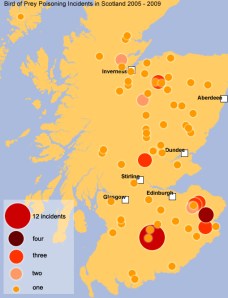
Raptor persecution incidents Scotland 2005-2009

As reported on this blog yesterday, the latest figures of confirmed bird of prey poisoning events in Scotland were just released and guess what? Poisoning in 2009 was at an all time high, despite the succession of statements from the Scottish government over the last 40 years that they are “determined to stamp out” wildlife crime. By anybody’s standards, the government has failed miserably, along with the judiciary, who have never given a custodial sentence to a convicted poisoner, even though they have the sentencing powers to do so. It’s pathetic.

The latest ‘map of shame’ is a pointless piece of work in its current format. What does it tell us? It tells us that raptor poisoning is widespread in Scotland. We already knew that. What it doesn’t tell us is which Estates were responsible. A carefully-worded explanation for this lack of detail goes like this:

Exact locations of incidents are not shown, in recognition of the fact that birds may travel some distance after ingesting poison. The map therefore randomises precise locations of incidents to produce a variation of around 1km. This avoids any inference being drawn from the exact point of discovery of the bird, but still allows an overview of the worst affected areas“.

Now, I’m no expert geographer, but I’m fairly certain that most Estates in Scotland are bigger than a kilometre. So if a poisoned raptor has been found on an estate where the boundary fence is greater than 1km away, we can be fairly certain that the bird has been poisoned on the estate where it was found, can’t we? And where did this arbitrary distance of 1km originate from anyway? Surely, a forensic expert would be able to calculate the distance a poisoned bird could travel based on the type, amount and toxicity of the poison used? Just look at some of the images on this blog – many dead raptors are found in very close proximity to the actual poisoned bait, sometimes even slumped over it, leaving no doubt whatsoever how and where the bird was killed. Why are these locations not published?

Leaving the dead raptors aside for one moment, why is there not a map showing the location of poisoned baits that have been found? There can be none of this hiding behind concern over an ‘incorrect inference’ for these cases – a posioned bait can’t “travel some distance” from where it was laid, so why are we not seeing the names of the Estates where these baits have been found (with the exception of Glenogil Estate in Tayside, which we all know about)? According to the latest figures released yesterday, 63 poison baits were discovered between 2005 and 2009. And these only relate to incidents involving birds of prey. A quick scan of SASA poisoning reports shows that there are plenty more poisoned baits out there in the countryside that do not get mentioned in the lastest government report. Isn’t it in the public’s interest to know where these baits have been found? I certainly wouldn’t want my children or my pets to be walking in these areas. It only takes one granule of the commonly-used (but illegal) pesticide Carbofuran to kill a human. Why should my children and pets be put at risk, just because the government is too weak and timid to stand up to the (highly rich and influential) members of the SRPBA (Scottish Rural Property & Business Association), who are allegedly behind the secrecy of poisoning locations in Scotland. Not good enough.

If you share this view and wish to express your disgust and concern, you can email the Scottish Environment Minister, Roseanna Cunningham, to let her know your thoughts: ministerforenvironment@scotland.gsi.gov.uk