Scottish birdfair: unaware or just dinnae care?

Some surprising news emerged this morning….an announcement has been made that the RSPB’s Scottish Birdfair will probably take place again next year (ironically 2013 is ‘The Year of Natural Scotland’) at the same venue: Hopetoun House (see here for announcement).

Why is this surprising? Well, for a start this choice of venue for the inaugural Scottish Birdfair 2012 raised plenty of eyebrows, and for very good reason (see here). If that wasn’t reason enough for RSPB management to reconsider their options (and it clearly wasn’t), then how about this:

Scottish Land & Estates (Andrew Hopetoun is a Director, remember?) issued a press release a couple of weeks ago that implied their support for buzzard ‘control’ (for control read ‘licences to kill buzzards’), basing their argument on the ‘evidence’ from that now infamous ‘buzzard snatches osprey chick’ video. The Chief Exec of SLE (Douglas McAdam) said:

 “This video provides the sad but clear and conclusive evidence of the serious impact that this growing population of Buzzards is now having“. [See here for SLE’s press release].

Actually Douglas, it provided no such thing. What it showed was an example of intraguild predation – a common and perfectly natural ecological phenomenon where a competitor kills and eats another competitor.

Come on, RSPB. Surely you can find a more suitable venue and partner for the next Scottish Birdfair? Sure, there are advantages to holding it at Hopetoun, e.g. the geographic location can catch punters from both sides of the border, then there’s……well actually it’s hard to think of another advantage. But maybe things like venues and partners don’t matter to the public? Another surprise this morning was to learn that this year’s Birdfair at Hopetoun House attracted almost 4,500 visitors. Were those visitors unaware of the Hopetoun/Leadhills connection, or was it just a case of knowing but not caring? You’d have to guess that if they were attending a Birdfair then they were probably into birds, in which case it’s probably likely that they were unaware of the connection, rather than not caring. You’d hope so anyway.

Wriggling out of vicarious liability?

Regular blog readers will be well aware that the concept of vicarious liability in relation to raptor persecution became enacted in Scotland on January 1st 2012 as part of the WANE Act. For new readers, some background can be found here. Vicarious liability has had its critics but until the first test case in court, nobody really knows just how strong, or weak, the new legislation will prove to be.

An interesting comment about vicarious liability was received on the blog at the end of last week; it suggests legal loopholes may be being exploited to avoid possible conviction. Given the interest in VL, we’ve decided to re-post the comment here. Thanks to Steve from OneKind for submitting it:

Information gathered by Onekind suggests how some estate owners may try to avoid vicarious liability in the future by sending their game keepers on all the trapping and best practice courses there are going. According to our intelligence, top lawyers are being hired to travel around the country lecturing to gamekeepers on the law related to wildlife crime. Our information suggests that the idea behind this action, being taken by landowners and worked on by these top Lawyers, is that if a wildlife crime were to occur on their land by one of their keepers then the landowner can say that he put his keeper through the relevant courses and that he doesn’t know why the keeper did what he did. They hope that this will be enough to persuade the court that they were not complicit with the crime carried out on their land. Further information we have acquired tells us that a well-known land owner has been urging other landowners to take this idea on and which will probably be up and running properly within the next few months“.

I guess we’ll wait and see whether this defence is used if/when charges of vicarious liability are ever brought against anyone. It’s an interesting one because what they are allegedly proposing to do is not illegal, but its hardly in the spirit of moving towards the elimination of raptor persecution from the game-shooting industry, is it? In its defence, some will probably argue that we should all be thankful that gamekeepers are receiving such excellent training, but some may argue that some of the training is far from excellent. For example, OneKind has concerns about the adequacy of the snare training courses and suggests there may be an ulterior motive for running them (see here).

The use of legal loopholes to avoid possible conviction is a well-known tactic in many areas of crime, not just wildlife crime, although wildlife crime does have its fair share of examples. A recent one was reported in a newspaper at the beginning of July (sorry, no URL available) concerning the case of a gamekeeper on the Airlie Estate at Kirriemuir, Angus. He was accused of alleged criminal activity after the discovery of three buzzards inside a crow cage trap. However, he was acquitted after Sheriff Kevin Veal decided that the keeper was not given proper information about why he was being interviewed by an SSPCA inspector and a Tayside Police wildlife crime officer. Some lawyers are very good at their jobs.

It certainly pays to employ a professional lawyer rather than a pretend one. An employee from a very well-known organisation recently sent an email to a group (no, not us!) who publish the names of convicted gamekeepers and other wildlife criminals on their website. The email suggested that certain names should be removed from the website because the convictions were considered spent. The email explained the relevant law under which the names should be removed and went into some detail about how the law applied. The employee signed off with an impressive number of letters after their name, including LLB (a law degree). Uncannily, the information that the impressively-qualified employee wrote about this particular law bore an incredibly close resemblance to a Wikipedia entry on the same subject. Hmm, not quite so impressive now!

English hen harriers flying around in invisible cloaks

‘Given the population of hen harriers in Europe, it is wrong to talk of “extinction”‘ [in relation to the single hen harrier breeding attempt in England this year], claims Alasdair Mitchell in his latest article for Shooting Times. He goes on to say, “To talk in emotive terms about “a second extinction” is a tad over the top“.

I don’t think there’s anything emotive or over the top about stating that England’s HH breeding population is on the verge of extinction – it’s a biological fact! With only one known nesting attempt in 2012 (and rumours circulating that the attempt has failed), the species is most definitely on the brink of an extinction as an English breeding species. What else would you call it? Birds-now-wearing-invisible-cloaks?

The term ‘extinction’ is a valid, scientific term that can be used to describe the loss of a species (in this case a breeding species) at a local, regional, national or international level. In this case, the first three levels are applicable. Perhaps Mitchell objects to the word because he knows it is a word the general public can understand far more easily than other scientific terms such as ‘population decline’, which just infers a loss but doesn’t explain the extent of that loss. The public understands that ‘extinction’ means curtains, lights out, elimination, end of the line. This is probably of concern to the game-shooting industry as they realise there’ll be no place to hide once the public understands the full impact of all that illegal killing.

Mitchell points to the hen harrier’s international conservation status as a species of ‘least concern’ to support his view and says: “There are many thousands flying around Western Europe – including several hundred pairs breeding happily in Scotland“. What he (deliberately?) fails to mention is that Scotland’s breeding HH population fell by more than 22% between the 2004 and 2010 national surveys (633 pairs recorded in 2004; 489 pairs recorded in 2010) (see here). He also fails to comprehend the concept of biological diversity and it’s importance on various scales, including, again, local, regional, national and international scales. It’s illogical to ignore the loss of local, regional and national biodiversity just because the species’ international status is still ok. Yeah, let’s kill all our native wildlife – we don’t need it ‘cos it’s all doing fine in other parts of Europe.

Mitchell is a hill farmer in Northumberland. In addition to his weekly column for Shooting Times (under the heading ‘Sharpshooter’) he has also written for the National Gamekeepers’ Organisation as well as acting as their media advisor. In May 2012 (see here) Mitchell was appointed as the Northern Regional Director for BASC (British Association for Shooting and Conservation). That potted bio probably explains Mitchell’s failure to grasp the principles of biodiversity conservation, although to give him his due, he ends his article by saying:

I am not pretending that illegal persecution has not had an impact, over the years, on the hen harrier population. It has – and that’s bad. We need to find ways of hosting more hen harriers but without destroying the commercial grouse shooting that actually pays for their moorland habitat“.

It’s certainly refreshing to hear someone from the shooting industry admit that persecution has affected HHs – it’s usually just outright denial, and it’s also encouraging to hear him calling for more hen harriers, although that now seems an unlikely prospect without formal government intervention. In the meantime, while we all argue about the semantics of extinction, the UK’s breeding hen harrier population continues to fade.

Mitchell’s full column can be read on the Shooting Times website (although it appears that this one hasn’t yet been posted).

SGA leaders try to spin the science….but fail

Those award-winning scientific gurus at the Scottish Gamekeepers’ Association have been sharing their intellectual acumen as they interpret recent scientific research relating to raptors.

First up is Professor Bert Burnett, who chose Facebook as his outlet (well, scientific journals are just so passé) for an examination of the recent paper on historical eagle distribution in the UK and Ireland (see here). His thesis starts with this:

The RSPB are even more powerful than i thought. The are now able to contact the dead, who had the foresight to record raptor numbers on blocks of stone knowing that the RSPB would be needing the info in 3,000 years time. Has anyone actually checked the validity of this latest garbage from RSPB? We have also had teradactals  etc in the uk, have the RSPB got the population info on them as well? With a bunch of irate 21st century farmers breathing down their necks, me thinks the RSPB are getting fidgity“.

Thirty-four minutes later, Professor Burnett decided that actually, this peer-reviewed scientific paper might be useful after all, as it appears to support his hypothesis that eagles are not constrained by persecution and certainly not by gamekeepers, no siree bob:

looking at the post 3000 year population figures from RSPB i note that the golden eagle pop. was 650 for the uk as a whole. Scotland has 440 now, living in a much changed counryside from 3000bc, i would think this is a huge success story not the doom and gloom pushed out by the RSPB“.

Had Professor Burnett studied the data in a little bit more detail, he would have noted that the golden eagle breeding population estimate for c. 500 was actually 1,000 – 1,500 pairs. Oops.

Professor Burnett’s esteemed colleague, Professor Alex Hogg, also had his own unique interpretation on recent scientific research, this time on the DEFRA buzzard ‘study’. Choosing that highly-acclaimed scientific journal Shooting Times to report his scientific results, Prof Hogg wrote this:

In Scotland, we are already ahead of where England is now with this [the proposed buzzard ‘study’ that included the destruction of nests and permanent removal of adult buzzards into captivity]. The trials have been done“. (Read full article here).

Really? Where and when were these trials done in Scotland, and where are the published, peer-reviewed results?

Professors Burnett and Hogg are not the only ones from the game-shooting community who have been demonstrating a shocking ability to misinterpret science….more in a following post.

Bend it like Beckham: the rules of admissable evidence

Last week we blogged about what we see as double standards being applied to decide whether evidence is considered admissable or inadmissable in certain wildlife crime cases (see here). This stemmed from the COPFS decision not to proceed with a prosecution against the gamekeeper who was filmed apparently battering crows to death with a stick inside a crow cage trap, because COPFS decided the film evidence was inadmissable. Basically COPFS decided that the public interest was best served by concentrating on the legality of the evidence as opposed to focusing on the alleged crime itself.

It’s been a source of frustration for many of us that the prosecutors will accept what seems to us as improbable evidence such as, ‘I wasn’t using that illegal poison you just found in my shed; I just had it in there because I didn’t know how to dispose of it properly. Honestly officer, I had nothing to do with the poisoned raptors that you’ve found nearby even though government testing has shown they were poisoned by the same illegal substance I’ve got in my shed” and yet they seem so reluctant to accept evidence from those who are legitimately undertaking raptor site monitoring and who happen to find evidence of alleged wildlife crime during the course of their legitimate monitoring activities.

Our article attracted a number of comments and one in particular stands out. Rather than have it ‘lost’ in the comments section of the blog, we’ve decided to re-post it here to make sure that it is read by as many people as possible, and especially by those who are out and about and likely to stumble across evidence of wildlife crime. It is an articulate and insightful comment and we thank the commentator, ‘Edinburgh Observer’, for taking the time and trouble to write it.

Why should the interests of justice be compromised by an interpretation of the law that is seemingly biased in favour of the criminal? Perhaps it’s time to play them at their own game. Here’s what Edinburgh Observer had to say:

This thread begs two questions: (1) what types of access are lawful and what is not? and (2) in each case, what factors affect the admissibilty of any evidence secured in relation to a crime wirnessed in the course of exercising such access.

First, access: as the posts indicate the Land Reform (Scotland) Act 2003 provides rights of responsible access to most land, and certainly all land where wildlife crime is an issue – but not, of course, to dwellings or buildlings. Unfortunately, however, these rights are associated with the purpose of the visit. These are primarily for recreation or education – the latter including wildlife research or monitoring. So, if one visits land for those purposes and happen, by chance, to encounter a crime, the evidence is probably admissable. However, it is arguable that visiting land primarily or knowingly for the express purpose of obtaining or seeking to find such evidence, makes that access unlawful. This ‘unlawfulness’ is, however, only in relation to statutory access rights under the 2003 Act (see below), and the admissibility or otherwise of any evidence must be subjected to the second issue (see further below).

Notwithstanding the above, the 2003 Act also creates a statutory right to “cross land” that is not conditional on the purpose – so any access for the purpose of obtaining or seeking to find evidence while “crossing land” should be lawful – perhaps all raptor workers/OneKind staff should be forever heading somewhere else and, therefore, only “crossing land”!!?!

As well as statutory access rights under the 2003 Act, many access campaigners also argue that, in Scotland, there are traditional rights of ‘customary access’ (see Blackshaw, 1999 in Edinburgh Law Review at http://www.euppublishing.com/doi/abs/10.3366/elr.1999.3.3.368). Such rights would apply to the kind of open countryside where wildlife crime is an issue – and are not subject to the limitations of purpose described above. Thus, access for any purpose could – according to Blackshaw be lawful.

Secondly, is evidence obtained by lawful or unlawful access (as distinguished above) admissible? This boils down to a decision, ultimately, for the court to determine – on the basis of balancing competing concerns. Of course, in the OneKind case referred to above (and in several other wildlife cases), the Court has not been asked to make a determination because the Procurator Fiscal has (pre)determined the answer and decided not to proceed. Procurators should, of course, make such judgements in cases where the balance of competing interests is so obvious that no reasonable court would reach an alternative conclusion. However, in these wildlife cases, this obvious-ness is less clear and Procurators appear to be pre-judging the answer – and, as suggested, creating double standards.

The origin of the doctrine of balancing competing interests was the case of Lawrie v Muir (1950 JC 19, 1950 SLT 37, [1949] ScotHC HCJAC_2, see http://www.bailii.org/scot/cases/ScotHC/1949/1950_JC_19.html) and has developed since, and is discussed in detail in “Illegally Obtained Evidence and Scots Law: A Fair Balance?” (Stark and Leverick, 2010 – online but as a word document – google it!). The rule seems to be that a court, in determining admissibility, should balance the “upside” of securing justice via prosecution against the “downside” of seeming to allow irregularity or unlawfulness in the securing of the evidence. In extreme cases, for instance, where a housebreaker witnesses a murder, the unlawfulness of housebreaking may be overlooked to secure prosecution for murder – and, of course, the housebreaking could be subsequently prosecuted. These issues, of course, will mean lots of variables in comparing and contrasting the interests of justice with the interests of the accused or other deterring other irregularities, and are affected by various modern legislation both on access and on human rights. However, as Stark and Leverick rightly conclude the approach of the Scottish courts to the question of whether illegally obtained evidence should be admitted in or excluded from criminal proceedings is “unsatisfactory” and “largely incoherent”. They also discuss the need for reform of the law which has gone unaddressed for over fifty years.

So, in the wildlife cases, it seems the procurator has taken the view that the court would consider the irregularity of unlawful access (trespass!?) to be a more serious issue than the alleged wildlife crime, and not a matter of such relative insignificance that it might be overlooked by the court. However, one might ask, when has the Crown ever tested such an argument in Court? Very few reported cases are available – and those that are have special circumstances. To date, no Court has determined whether the public interest in securing justice, convicting an offender and deterring wildlife crime is or is not greater than the public interest in not encouraging the (potential) unlawfulness of ‘irregular’ access to open countryside.

In this issue, the comparison with Malta above, and incidentally England, is notable – the post above suggests that the Maltese jusisdiction has admitted such evidence, as has regularly been the case in England. It is scandalous that this is not, apparently, the case in Scotland – but perhaps even more scandalous that the determination of the public interest has, to date, rested with the COPFS. It is time that the relevant arguments were made in Court – to date, no full exploration of all the issues has been made or a definitive Court judgement sought. Pressure should be applied to the COPFS to make a test case of one such as that described above – or do they find it useful to have “unsatifactory” and “incoherent” law that allows them to make arbitary decisions as they wish?

In addition, of course, it is probably time that wider concerns raised by Stark and Leverick were addressed. Something for the Scottish Parliament?

George Monbiot: a journalist who says it like it is

George Monbiot is fast becoming my favourite journalist (and not just because he uses this blog as a source of information!).

In his latest article, due to be published in the Guardian tomorrow but released on his website tonight (see here), Monbiot digs a little deeper inside the #buzzardgate debacle and uncovers some fascinating information.

In addition to #buzzardgate he also discusses the scandalous state of the English hen harrier population. He is one of very few authors willing to state, categorically and without caveats or apologies, that the missing English hen harriers [approx 329 pairs] ‘have been shot or poisoned by grouse-shooting estates’. There’s no dilution or ‘maybes’ or ‘possiblys’ in the name of so-called ‘partnership building’ – English hen harriers have been wiped out by grouse-shooting estates and Monbiot is not afraid to say so.

If you read Monbiot’s biography  (here) you’ll see that the thing he fears is ‘other people’s cowardice’.

We can all learn from him.

Inadmissable evidence: double standards for wildlife crime offences?

In February we blogged about the Crown Office & Procurator Fiscal Service (COPFS) decision not to accept the video evidence showing a head gamekeeper apparently bludgeoning crows to death with a stick inside a crow cage trap on a Scottish sporting estate (see here). The video had been filmed by a field officer from the charity OneKind who, by chance, happened to be in the right place at the right time (or the wrong place at the wrong time, depending on your view).
OneKind appealed against the COPFS decision not to initiate court proceedings against the gamekeeper but the Lord Advocate ruled that the COPFS decision would stand. In response, OneKind submitted a petition to the Scottish Government, signed by over 2,000 members of the public who were disgusted by what they’d seen in the video. OneKind asked the Scottish Environment Minister, Stewart Stevenson, for greater clarity on what is / isn’t considered admissable evidence in wildlife crime cases.

Here’s his reply:

“….the Scottish Government believes it is vital to all our efforts in tackling wildlife crime, for members of the public who come across anything suspicious to report what they have seen to the police.

I would however note that there is a difference between cases where members of the public come across evidence that seems to point to a wildlife crime, and those cases where a person who is employed as, or is acting in some capacity as, a wildlife crime investigator, reports such evidence. It is for the Crown Office to decide on how a court would deal with evidence in either of those cases, and their decision on whether to prosecute a case is final”.

See here for the full update on the crow-killing incident provided by OneKind.

So, what have we learned? If you’re a member of the public who doesn’t really know what you’re looking at, or how to record evidence that might be crucial in a subsequent prosecution, then your ‘evidence’ will probably be admissable. However, if you’re someone who knows exactly what you’re looking at and has been trained in the best techniques of evidence collection and preservation, then your evidence will probably be inadmissable.

And the logic in that is….what, exactly? Are there any other areas of criminal law where these double standards apply? (This is a genuine question – we don’t know the answer but would like to hear from anyone who can enlighten us and help us to understand these rules).

Is it any wonder our wildlife crime conviction rates (and especially for raptor persecution incidents) are so pathetically low? How many more legal obstacles are going to be placed in the way of bringing these criminals to justice?

Yet another golden eagle mysteriously ‘disappears’

Last month we blogged about the ‘disappearance’ of a satellite-tagged golden eagle (see here). Now 22 days later we’re blogging about another one. Isn’t it strange how many UK satellite-tagged raptors go ‘missing’; not just golden eagles, but white-tailed eagles, hen harriers and red kites too. Wonder how these figures compare with tagged raptors in other parts of the world?

The last signal from the latest young golden eagle (#32857) to go ‘missing’ was received on May 11, just to the north-east of the Cairngorms National Park (see here).

Was it just a satellite tag failure and the eagle is still alive and well? Possibly.  Did it die of natural causes? Possibly. Was it poisoned? Possibly. Was it shot? Possibly. Was it caught inside a crow cage trap and bludgeoned to death? Possibly. Will we ever find out? Possibly. If it is found to have been killed illegally, will the perpetrator be brought to justice? Probably not (see here for the ever-growing list of dead and/or missing eagles in recent years for which nobody has ever been prosecuted).

Somebody asked a question the other day and we’ve still not been able to provide an answer:

What does it take to secure a conviction for killing an eagle in the UK?”.

We’ve heard all the excuses in the book, some valid, some not:

(i) The discovery of a poisoned eagle on a sporting estate isn’t enough to secure a conviction because either it could have been poisoned elsewhere and then flown to die at that location, or, it could have been ‘planted’ on the estate by the anti-game-shooting lobby (according to claims made by various gamekeepers over the years although without any actual evidence).

(ii) The discovery of a poisoned eagle lying next to a poisoned bait on a sporting estate isn’t enough to secure a conviction because it’s virtually impossible to identify which individual gamekeeper laid the bait, especially when they all deny it.

(iii) The discovery of a poisoned eagle and a stash of the same poison found on premises on the same sporting estate, and an admission from an individual gamekeeper that he had sole access to the poison isn’t enough to secure a conviction because….well, we don’t know the answer to that one, you’d have to ask COPFS.

(iv) The discovery of a poisoned eagle and a stash of the same poison found in vehicles and traces of it on knives and gamebags on the same estate isn’t enough to secure a conviction because….we don’t know the answer to that one either – ask COPFS.

(v) What if somebody was filmed laying out a poisoned bait and was then later filmed returning to remove the eagle poisoned by that bait? The film evidence would probably be ruled inadmissable because the cameraman was operating ‘covertly’ (i.e. without the landowner’s permission!).

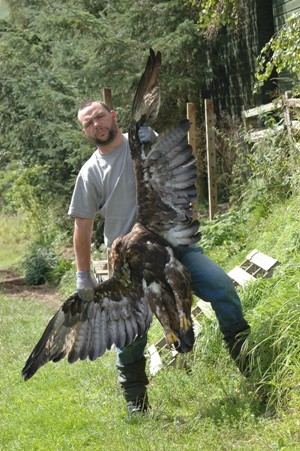
(vi) What if a gamekeeper was found with a dead eagle in the back of his vehicle, and the eagle had injuries consistent with being caught in an illegal spring trap (e.g. broken legs) and having had its head caved in with a blunt object (e.g. smashed skull)? This wouldn’t be enough to secure a conviction because the keeper would probably claim he had just found the dead bird and was taking it home to report it to the authorities. At best he’d be charged with ‘possession’.

The shocking truth is, there has never been a successful prosecution for the illegal killing of an eagle in the UK, in spite of the sometimes overwhelmingly compelling evidence in some cases. So, just what does it take for someone to be convicted of killing an eagle in the UK?

Add your name to petition against buzzard ‘management’

A petition has been set up against DEFRA’s outrageous plan to ‘manage’ buzzards. Please sign it! (It doesn’t matter which country you’re in, anyone can sign this) –

http://www.thepetitionsite.com/304/227/564/defra-dont-spend-taxpayers-money-on-harassing-buzzards/

DEFRA responds to public outcry over buzzard ‘management’ trial

The weight of public pressure on DEFRA after it was revealed they were funding a ‘study’ to explore methods of buzzard ‘management’ (see here, here and here) has led them to put out a statement.

You can read it here

The statement is just as laughable as their study idea. They’ve completely missed the point of the public’s anger – DEFRA thinks that we’ve all misunderstood the proposal and we’re worried about them ‘killing’ buzzards; they don’t get it that we’re all opposed to the use of public funds to ‘control’ buzzards (native species just recovering from decades of persecution) for the benefit of 40 million non-native gamebirds that are released into the environment every year for the purposes of being shot for ‘sport’!

Here are some of the ludicrous sentences in their statement:

‘We work on the basis of sound evidence’ (er, you clearly don’t!)

‘This would only be in areas where there is a clear problem’ (how have you quantified a ‘clear problem’? Where’s the scientific evidence to back it up?)

‘…destroying empty nests…’ (note the inclusion of the word ’empty’ to try and convince us that adult birds, or eggs or chicks won’t be shot out of the tree).

‘The results of this scientific research will help guide our policy on this issue in the future’. (Just because you’ve used the term ‘scientific research’ doesn’t make this a valid scientific study. For it to be that, a hypothesis would first need to be tested (e.g. do buzzards have an impact on pheasant poults?) instead of going straight in with the assumption that they do have an impact and so let’s remove some to see what happens).

Interestingly, DEFRA doesn’t mention anything about the illegality of their methods (well, methods #3 & #4 anyway – permananent translocation [removal of adult birds] to captivity at falconry centres and shooting out nests with a shotgun). Hopefully the RSPB will get their lawyers on to this!