Purdey Awards to tighten their vetting procedures

purdey_logoThis is topical, given how we were just blogging about the need for strong leadership and zero tolerance…

In December we blogged about the results of the 2012 Purdey Awards (see here). These awards are held in high esteem by the game-shooting industry, recognising ‘those who achieve most in game conservation’ (Purdey Awards website here). We questioned whether one of the 2012 award winners was a suitable recipient, as we believed he may have been connected to a gamekeeper who was recently convicted for wildlife offences relating to raptor persecution. [As it turns out our suspicions were correct, but the gamekeeper was apparently sacked once his offences had come to light].

In response to that blog entry, one of our contributors contacted the Purdey Awards to ask them about the eligibility rules for Purdey Award nominees.

Yesterday, that contributor sent us the letter that he had received in reply from Richard Purdey: Purdey Reply

It is well worth a read. It’s impressive on a number of fronts. First, that he bothered to engage at all. Second, that he instigated an internal investigation into the alleged connection between the award winner and the criminal gamekeeper. Third, that he has now decided to strengthen the vetting procedures for potential Purdey Award winners, which will come into force with immediate effect. And fourth, that he kept our contributor fully updated with a comprehensive response to the questions that had been raised.

Well done Richard Purdey. He sounds like a man of integrity and sincerity. Time will tell when the 2013 winners are announced but we hope he is a man of his word. We also hope that others within the industry follow his lead and start to demonstrate that they, too, are willing to discern between the good and the bad. It will take a lot to restore the confidence of conservationists but this is a damn good start.

Also well done to the contributor who took the time to contact the Purdey Awards. An excellent example of how one person CAN make a difference, and in this case, have a significant influence. Nice one.

National Wildlife Crime Unit – worthy of more funding?

NWCUThere has been a lot of media attention in recent weeks over the issue of whether the UK government would provide continued funding for the National Wildlife Crime Unit (NWCU). Journalists, bloggers, campaigners, concerned members of the public…all wrote in support of the unit and such was the strength of feeling that even a petition was started to lobby the government into committing to another round of funding.

We wonder how many of those lobbyists were campaigning on the principle alone, or perhaps just because of the unit’s name, without actually knowing whether the NWCU is effective or whether it’s actually a drain on scarce resources that could be better utilised elsewhere? Many people argued that by dragging their heels on the funding decision, the government was sending a clear message to the wildlife criminals: ‘Wildlife crime isn’t a priority for us so go ahead, fill your boots, we don’t care what you do’. The sentiment of the campaigners is one with which it’s easy to sympathise. Nobody wants to see the government send out that sort of message, whether intentionally or not. But the big question, for us at least, is whether the NWCU is actually delivering and therefore worthy of more funding.

This questions is asked from the standpoint of raptor persecution alone. We are well aware that the NWCU has a much wider remit than just this one issue – for example it is well-documented that NWCU has worked well on international projects aimed at targeting the international wildlife trade. Perhaps that alone is worthy of more funding – the wildlife trade is horrific, incredibly damaging, and deserves our full attention.  However, the NWCU is also tasked with addressing wildlife crime in the UK, and particularly five currently recognised UK-specific priorities: Badger persecution, Bat persecution, Freshwater Pearl Mussels, Poaching, and Raptor Persecution. We do not have the expertise to be able to assess their delivery on four of these priorities, but we can try to evaluate their delivery on raptor persecution.

So, what has the NWCU acheived, in terms of addressing raptor persecution, since the unit was first established in 2006? Well, it’s very hard to tell. If you go to their website (here), you’ll be disappointed to see that it is still not functioning. It has been ‘under construction’ for several years now. The next-best information outlet would be their annual report.  However, the last one published (that we’ve been able to find) relates to 2010. This isn’t helpful if you’re looking for information on their recent activities.

So what is it they do, exactly, in relation to addressing raptor persecution? Two of their staff gave presentations about their work at last year’s wildlife crime conference (here and here).

We also know that they’re quite big on ‘paperwork’ crime, particularly in relation to captive birds of prey, e.g. the bird is unregistered or has been stolen from the wild. That’s good work, and it’s important work, but it isn’t the main issue in terms of addressing raptor persecution.

We know that they also participate in the Raptor Persecution Priority Delivery Group – another one of those ‘partnership working’ initiatives that includes many ‘partners’ that really don’t like raptors. This group has been going for several years and has just, in the last week, produced its first output. (This relates to reporting raptor persecution incidents and we’ll be blogging about that shortly). Not quite what you could call a productive initiative, although that’s hardly the fault of the NWCU.

What else do they do? If you look in the 2010 annual report (here) under the heading of Conservation and Prevention Work, sub-heading ‘raptor persecution priority delivery group’ (p.13), you’ll see they only list one output. This relates to the annual persecution maps produced to highlight raptor persecution hotspots. What they don’t say is that the RSPB have been producing these maps, on their own, for years. Now they’ve just been hijacked by several groups (PAW Scotland included) who seem to want to take credit for the work.

So is that the extent of their acheivements? We look forward to seeing the latest annual reports covering the years 2011 and 2012 to see what else they’ve been up to, and hopefully the list of activities will be a bit longer.

Actually, they have, allegedly, done one other thing. We have it on very good authority that the NWCU has spent valuable time and resources trying to find out who is behind this blog. Why would they do that? Are we wildlife criminals? Do we poison raptors? Do we go hare coursing? Are we badger baiters? Are we pulling the wings off bats? Are we selling ivory? Trading illegal egg collections? No, we don’t do any of these things. So why is the National Wildlife Crime Unit wasting tax-payers money on trying to find out the identity of some perfectly lawful bloggers? More to the point, who put them up to it, and what were they planning to do with the information had they been able to get it? We know that at least one NWCU staff member has what we’d call a ‘very close relationship’ with the game-shooting lobby…

This blog entry is getting a bit depressing, but that wasn’t the intention. We really would like to see the NWCU succeed and have a major impact on raptor persecution crimes in the UK. Have they done that yet? In our opinion, no, although as already mentioned, it is hard to evaluate their effectiveness when there’s so little information being made available about their work.

Today it was announced that the UK government has agreed to continue the NWCU’s funding for another year (see here). We actually welcome that news, not just because it sends a message to the wildlife criminals, but also because it gives the NWCU another 12 months to prove the doubters (including us) wrong. It’s a shame that the funding is only for one year though – as the RSPB say in their press release (here), the NWCU really needs long-term funding so that a strategic approach can be undertaken. Nevertheless, we hope they put the funding they have got to good use.

Strong leadership and zero tolerance required

There’s been quite a reaction to the strong words of condemnation provided by the National Association of Regional Game Councils (NARGC) in response to the recent shooting of a buzzard in Ireland.

For anyone who missed it, here is the story and here is what Des Crofton, Director of NARGC had to say:

“The shooting of birds of prey, who are all protected, can only be condemned in the strongest possible terms. The person who shot this bird is not fit to have a firearm. I would urge the authorities, if the person is identified, that they are prosecuted, have their firearm licence revoked and never allowed have one again. This is inexcusable. If I ever found one of my members was responsible for something like this, he would be out of the association so fast his feet wouldn’t touch the ground”.

Have we seen the same level of leadership from the equivalent groups in Scotland when raptor persecution incidents hit the news? If only. To be fair, sometimes there will be a public statement of condemnation, but more often than not there’s either silence, or an attempt to deflect the blame, usually onto the RSPB who have been consistently accused of stashing raptor carcasses in freezers and then wheeling them out and ‘planting’ them on various estates up and down the country as some sort of elaborate plot to ‘frame’ the estates!

The Scottish (and English for that matter) game-shooting industry would do well to follow the example of Des Crofton. He left no room for misinterpretation. The NARGC is clearly operating a zero tolerance policy and that’s what we should all expect from the Scottish and English counterparts, as a bare minimum.

There will be those within the game-shooting industry who claim that they ARE working against raptor crime. They’ll cite their membership on various ‘partnership working’ initiatives such as PAW Scotland and the Environment Council’s Hen Harrier Dialogue process. That’s all fine and good for what it’s worth (which so far is very little – the persecution continues), but when you examine their activities outwith these groups, it begins to look more and more like they’re just paying lip-service to it all.

For example, if you were a leader within the game-shooting lobby and you had a serious intent to crack down on raptor persecution, would you want your organisation to attend an industry-related event on an estate with a shocking record of raptor persecution? Would you accept raffle prizes from estates with a known track record for persistent illegal raptor persecution? Would you list notoriously bad estates in a Top 20 of ‘great shoots’? Would you run ‘best practice’ training courses on estates with a long history of raptor persecution? Would you give a ‘prestigious’ industry-award to an estate with a history of raptor persecution? Would you accept sponsorship from a company owned by someone who also owns a notoriously bad estate? Would you have the owner of an estate with a 20+ year history of raptor persecution on your governing Board?

No, you wouldn’t. Not if you were serious about eliminating raptor crime. You’d blacklist them as soon as there was the faintest whiff of criminality. You’d distance yourself from them at every opportunity. If you were serious.

These ‘leaders’ need to stop legitimising the criminals. Only by doing so will we believe that their intentions are credible. If the industry itself doesn’t distinguish between the ‘good’ and the ‘bad’ guys, why the hell should we?

RSPB hits back at Scottish Land & Estates

scotsman_logo_200The thin veneer of ‘partnership working’ is slipping.

Following recently published letters in the Scotsman concerning the grouse moor/raptor ‘debate’ (see here and here), today’s paper included a response from RSPB Scotland. It seems we weren’t alone when we described Scottish Land and Estate’s contribution as misleading guff:

Doug McAdam of Scottish Land and Estates (Letters, 16 January) implies that the RSPB is not committed to resolving the conflict grouse moor managers perceive with birds of prey, and is not supportive of the Langholm Moor Demonstration Project. This is disingenuous.

Mr McAdam knows that RSPB Scotland was a founding partner in the Langholm project, contributes funding and remains a partner. We are encouraged that the project identified diversionary feeding as a viable tool allowing co-existence of grouse shooting and raptors.

We are disappointed by the lack of update of this by grouse moor managers. Why reject a tried and tested method that reduces (to zero at Langholm) harrier predation of grouse chicks?

Harriers at Langholm remain below the optimum and below the partners’ agreed target.

Continuing intolerance of this species outwith Langholm may well explain this sad failure.

The RSPB withdrew from one English initiative. Over the seven years of our engagement, the English hen harrier population declined to a single breeding pair. In such circumstances it seems pointless to discuss harrier management with none left to manage!

Nevertheless, we remain in dialogue with government and moor managers south of the Border and will direct our energies to any initiatives we believe can work.

The near-complete annihilation of breeding hen harriers in England shows signs of being repeated in large parts of Scotland.

Honest and meaningful dialogue is essential to stop this. Without it, Logan Steel’s hypothesis (Letters, 14 January) that raptors cannot live with intensive driven grouse shooting, may well be correct. Stuart Housden, RSPB Scotland, Edinburgh”.

[Link to the letter here]

Misleading guff from Scottish Land and Estates

scotsman_logo_200The following letter has appeared in The Scotsman in the continuing ‘debate’ on grouse moor management (see here to read the earlier articles).

“Logan Steele’s letter (14 Jan) which alleges that driven grouse shooting is only viable with the persecution of birds of prey, particularly the hen harrier, is misleading.

First, official statistics demonstrate a clear decline in the number of incidents of raptor persecution.

Second land management for driven grouse shooting delivers a huge benefit for other protected wildlife, especially waders, and sustains employment and communities in remote rural areas. This is something the suggested alternative of walked-up grouse-shooting would not do.

Of particular significance is clear evidence that where grouse and hen habitat and vermin management have declined in some hen harrier “special protection areas”, this has actually resulted in lower harrier populations, as well as declines in other species such as waders.

This is a more complex situation than some make out.

The Langholm Moor Demonstration Project, set up in partnership with the government to bring back driven grouse shooting in the presence of sustainable numbers of hen harriers, is where the best hopes of progress on this issue lie.

Results at Langholm so far are that neither harriers nor grouse have recovered – not what anyone expected, but each year scientific understanding improves and practical solution gets closer.

Making progress will involve compromise on all sides.

Organisations representing grouse moor managers such as SLE are fully behind this process and it is unfortunate that RSPB has pulled out of the mediation process in England. Perhaps Scotland provides the best opportunity to make progress now.  Douglas McAdam, Scottish Land & Estates, Musselburgh”

[Link to the letter here].

And he accuses Logan Steele’s letter as being misleading!

First, which “official statistics demonstrate a clear decline in the number of incidents of raptor persecution” is Doug McAdam referring to? The ones we know of only relate to known poisoning incidents, although they are limited to poisoned birds; they do not include the discovery of poisoned baits and nor do they include suspected poisoning incidents or unreported poisoning incidents. More to the point, they do not relate to other types of raptor persecution, such as shooting, trapping, nest destruction, ‘disappearing’ birds etc. The only statistics that account for all types of raptor persecution incidents are those compiled annually by the RSPB; statistics that have never been accepted by SLE or any other game-shooting organisation.

Second, McAdam says “land management for driven grouse shooting delivers a huge benefit for other protected wildlife, especially waders, and sustains employment and communities in remote rural areas“. Another misleading statement. Land managed for driven grouse shooting is not only bad for protected wildlife (golden eagles, white-tailed eagles, hen harriers, goshawks, red kites, buzzards, peregrines, ravens, pine martens, mountain hares etc etc) but it is catastrophic for other species too (foxes, weasels, stoats, crows etc etc). And that’s without even touching on the landscape-level environmental damage.

McAdam goes on to suggest that “making progress will involve compromise on all sides“. No it won’t. Making progress will depend entirely on whether the grouse-shooting industry will accept that they have to work within the law and put an end to illegal persecution. If they do, all well and good. If they won’t, then they face a direct action campaign to ban driven grouse shooting by those of us who are sick of waiting for the government to act on our behalf. Hollow promises just don’t wash anymore. Time’s up.

McAdam’s penultimate sentence is laughable. He’s trying to suggest that the RSPB are the unreasonable ones in this 20+ year saga, for walking away from the six-year long Hen Harrier Dialogue process (see here). They are definitely not the unreasonable ones – they recognised a sham process and got out. Until SLE start to publicly expel their member estates where raptor persecution is rife (and we all know who they are, and so should McAdam – if he doesn’t, he’s in the wrong job), then the credibility of SLE’s involvement in ‘making progress’ will be viewed with as much contempt as it deserves.

“Why does a ‘keeper need an incinerator again?”

scotsman_logo_200The title for this blog entry is taken from a comment written in response to an article in the Scotsman this weekend.

The article, written by Alastair Robertson, is entitled: “Shooting and Fishing: It is relatively easy to whip up antagonism towards grouse moor owners” and discusses the precarious position of England’s hen harrier breeding population. Robertson mentions Mark Avery’s proposed campaign to ban driven grouse shooting if there isn’t a marked improvement in this year’s nesting pairs. Robertson suggests that the campaign would probably be unsuccessful, although he doesn’t write it off completely. He’s smart to not underestimate the public’s growing anger and frustration on this issue. The article can be read here.

There’s a good counter-argument to Robertson’s article, published today on the Scotsman’s letters page. Read it here.

The importance of the “vicious” gamekeeper’s conviction

Hebblewhite carbofuranFollowing on from yesterday’s blog about the conviction of “vicious” gamekeeper Robert William Hebblewhite (see here), more information has emerged about what happened in court.

We mentioned yesterday how unusual it was for a gamekeeper to be convicted of actually killing the dead raptor(s) found on their land; typically, in case after case, the gamekeeper is convicted for the lesser offence of “possession” (e.g. of poison) and the charge for the actual killing is dropped. This has caused an immense amount of frustration, not only for those investigators who often spend months working on getting a case to court, but also for us, the members of the public, who feel a massive sense of injustice every time it happens.

Well, not so in this case. If you read the article published here, you’ll notice that the judge (in this case District Judge John Stobard) was having none of it.

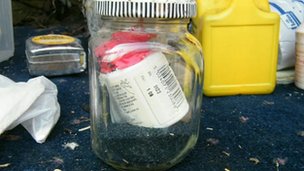
The prosecutor (Mark Holmes) contended that Hebblewhite’s motive was clear. He was the gamekeeper on this shoot, with responsibilities for pest control. The shoot had been losing birds because buzzards were in the area (his words, not ours!). Pheasant carcasses laced with Carbofuran had been found next to the Carbofuran-poisoned buzzards. A jar of Carbofuran was found in Hebblewhite’s van (see photo). Hebbelewhite’s van had been seen going to the scene on several occasions.

Hebblewhite had pleaded guilty to possession of Carbofuran (the lesser offence) but not for poisoning the buzzards.

The defence argued that the poisoner could have been anyone.

District Judge John Stobard wasn’t fooled. He is reported to have said this:

The birds died from Carbofuran and here in a van is the very stuff  that killed them. The defence says it could have been anyone. Well, could it? I’m not here to discuss the case as a philosophical argument. What is the reality of the matter?

This defendant is here to secure the presence of the shoots that take place by the way of being a gamekeeper. He must look after the pheasants and protect them from other animals.

I think he has done so in an old fashioned and particularly nasty way by lacing the pheasant with Carbofuran in the full knowledge the buzzards would be killed.

It can only point to one conclusion – he did it“.

So finally, here’s a judge who put two and two together and didn’t make five. It’s quite telling though, that this is such an unusual result that we need to highlight it here. What does that say about how our justice system deals with raptor persecution crimes? What does it tell us about our low expectations for these court cases?

In Scotland we’re so used to seeing ridiculous legal obstacles placed in the way of justice that we now expect the poisoner/trapper/killer to get off. “Did you see the defendant place the poison? Did you see the eagle/buzzard/goshawk/red kite actually eat from that very poisoned bait? Was it filmed? Did you have permission to film on that land? Can you forensically match the poison on the bait/inside the dead raptor with the big stash of illegal poison found in the defendant’s house /shed /garage /vehicle /porch /gamebag /jacket pocket? No? Well then he can’t be convicted”.

Well done again to the RSPB Investigations Team, to the CPS, and particularly to District Judge John Stobard for seeing the bleedin’ obvious and acting upon it.

UPDATE: There’s an excellent news piece on this conviction from BBC Look North. Decent coverage and explains that raptor poisoning is a national issue. Great stuff. Available on BBC iPlayer here for limited period (starts at 11.58 – ends at 14.40).

Approval of clam traps: incompetence or corruption at SNH?

snh_logoOn Dec 5th we blogged about the changes being brought in by SNH to the 2013 General Licences following a period of public consultation (see here).

We suggested that it looked like SNH had listened to the recommendations made by the game-shooting lobby and had ignored those made by the pro-raptor groups. This was pure speculation because at that time SNH hadn’t actually published the responses they’d received during the consultation. We (and many of you) asked for them to be published. They did so on 21st December. Click here to read them.

Having now had the chance to review all these responses in detail, we believe that SNH has indeed favoured the recommendations made to them by the game-shooting lobby and ignored the recommendations made by the pro-raptor groups. But on a much more serious level, we now also believe that SNH’s decision to approve the use of clam traps in the 2013 General Licences before conducting an independent assessment of their suitability is based on a flawed interpretation of the responses.

In the letter sent by SNH to the consultees, dated 4th December (see here), SNH wrote this:

On the basis of the feedback received we have made a number of decisions for changes for 2013”.

 One of these changes was this:

Traps permitted under General Licences 1-4 will be clarified, including authorisation to use ‘clam’-type traps”.

Later in the same letter they further explained this change:

In the consultation we asked whether there was a need to clarify the traps that are permitted for use under the General Licences. Our proposal was to provide further clarification and to specifically permit the use of ‘clam’-type traps. These traps have been available and used for a number of years but whether or not their use is covered by the General Licences has been debated due to unclear trap definitions in the General Licences to date.

Whilst the majority of consultees supported the proposed amendments, concerns were expressed by a number of respondents over potential welfare implications of these traps and how they could be used to trap non-target species”.

So, in this letter, SNH told us that the “majority of consultees supported the proposed amendments” [to explicitly authorise the use of clam-type traps before conducting an independent assessment of their suitability] and that SNH’s decision to authorise their use was based on “the feedback received”.  According to our analyses of the responses, this is blatantly untrue on both counts.

We divided the respondents into four groups:

(1)   Those who explicitly supported the use of clam-type traps prior to an independent assessment of their suitability;

(2)   Those who didn’t expressly mention clam-type traps in their response;

(3)   Those who did specifically mention clam-type traps but were unclear about whether they supported use prior to independent assessment; and

(4)   Those who explicitly did not support the use of clam-type traps prior to an independent assessment of their suitability.

In group (1) –

Scottish Countryside Alliance, Scottish Association for Country Sports, Scottish Gamekeepers’ Association, Scottish Land & Estates Moorland Group, Game & Wildlife Conservation Trust, British Association for Shooting and Conservation.

TOTAL: 6

In group (2) –

National Farmers Union Scotland, Scotland for Animals, Animal Concern Advice Line, Scottish Tree Trust, Individual B, Grampian Wildlife Crime Unit, Grampian Police, Glasgow City Council, Individual C, University of Stirling.

TOTAL: 10

In group (3) –

National Wildlife Crime Unit

TOTAL: 1

In group (4) –

OneKind, RSPB, Scottish Raptor Study Groups, SSPCA, Against Corvid Traps, Kindrogan Field Centre (Field Studies Council), Individual A, Individual D, Individual E, Individual F, Individual G, Individual H, Individual I.

TOTAL: 13

For the purposes of this analysis, groups (2) and (3) can be discounted. That leaves us with groups (1) and (4).

It is clear that the number of respondents in group (4), i.e. those opposing the use of clam-type traps prior to independent testing, is more than double those in group (1). Thirteen respondents were against the use of clam-type traps; only six were supportive.

So how on earth can SNH justify their decision, “based on feedback received”, to authorise the use of these traps prior to independent testing? At best this appears to be incompetence; at worst, corruption.

This is a serious issue. Has SNH intentionally misled the public to believe that the majority of respondents supported the use of clam traps prior to independent testing? Why hasn’t SNH heeded the majority of the responses, which clearly stated their opposition to the use of clam-type traps prior to independent assessment?

We demand an immediate review of this consultation process and we urge you to seek the same. In the first instance, we suggest you contact SNH Chief Executive Dr Ian Jardine: ian.jardine@snh.gov.uk

If you don’t know how to phrase your complaint, you could simply cut and paste from this blog or provide a URL to this posting.

SNH have a duty to respond to emails within 20 working days. If Dr Jardine’s response is unsatisfactory, then we have the right to ask the Scottish Public Services Ombudsman to investigate the complaint.

RSPB walks out of hen harrier ‘dialogue’

tec_logo_16271This isn’t especially new news, as it happened in the summer, but we were reminded of it today after reading something on Mark Avery’s blog – more on that later – and it does seem pertinent to blog about it now.

So, most readers will be aware of the Environment Council’s ‘Hen Harrier Dialogue’ – a process that started in 2006 that aimed to bring ‘stakeholders’ together to try and work out a way of resolving the hen harrier / grouse moor conflict in England (see here for website). Those stakeholders involved in these dialogue meetings included the usual suspects such as BASC, Countryside Alliance, Country Land and Business Association, GWCT, Moorland Association, National Gamekeepers’ Organisation, RSPB, Hawk & Owl Trust, Northern England Raptor Groups etc.

The ‘dialogue’ process has produced an awful lot of documents (and a lot of awful documents, see here) and meeting reports (see here), and a strong interest in pursuing a trial on a ‘quota system’ for hen harriers – a controversial idea spawned by Steve Redpath several years ago. In simplistic terms, this quota system would mean that grouse moor owners would ‘allow’ a certain number of breeding pairs (number yet to be established) and once a ‘ceiling’ had been reached, then they would be ‘allowed’ to remove harrier broods (non-lethally) to other parts of the UK away from grouse moors. This idea is still being discussed, although it brings with it obvious ethical and legal debates.

Hen harrier being removed from illegal trap on Moy EstateSome argue that conservation groups shouldn’t be sitting at the table with representatives from an industry that has been responsible for killing off England’s breeding hen harrier population. Others argue that the quota scheme may be the best way forward because at least there’d be some harriers, which is a better proposition than having none. Others have suggested that the quota system would never get off the ground anyway because the grouse moor owners would have to ‘allow’ a certain number of breeding hen harriers on their estates and they’ve shown themselves incapable of tolerating any.
Whatever your point of view, the bottom line is that six years on from the start of the dialogue process, and after all that talking over egg sandwiches and coffee, the English hen harrier breeding population has been reduced to one known pair. That’s it. Just the one pair. In a country that has suitable habitat to support over 300 breeding pairs.

This summer, the RSPB made a bold move and decided to walk away from the dialogue process. They said that as hen harriers have been systematically eradicated from English grouse moors then there was no longer any conflict and therefore no point in spending any more time talking about it. Instead, they intended to get on with their own plans for hen harrier recovery.

It’s not yet known what will happen to the Environment Council dialogue process now a major player has walked away. As far as we’re aware, there are still many questions about the lawfulness of the proposed trial quota scheme so it’s unclear whether attempts will still be made to push that through.

So what next for English hen harriers? After the recent sad story of the illegal shooting of Bowland Betty (see here), in addition to all the other horror stories we keep reading about from English and Scottish grouse moors (e.g. see here, here, here, herehere), is it time for a different approach? It’s obvious that the authorities can’t, or won’t deal with illegal persecution, and the grouse-shooting industry can’t, or won’t put a stop to it either. An alternative suggestion has been put forward by Mark Avery – unless things miraculously improve for breeding hen harriers in Northern England in 2013 then it will be time to start the campaign, on 12 August 2013, to end grouse shooting (see here for Mark’s blog).

Up until now we’d been supporters of the idea of estate-licensing schemes rather than an outright ban. Licensing seemed a fair and reasonable approach to regulate an industry so clearly incapable of expelling its criminal elements. But now?  The time for being reasonable has long since passed. Count us in, Mark.

For our anagram fans: Grouse moor – morgue or so

Scottish Birdfair 2013: disappointing venue choice

RSPB Scotland have just announced their choice of venue for the 2013 Scottish Birdfair. Astonishingly, they’ve chosen Hopetoun House again (see announcement here).

The Scottish Birdfair is not to be confused with the excellent British Birdfair which is held at the Rutland Water Nature Reserve, where raptor conservation is actively practiced and promoted, e.g. see here.

The inaugural Scottish Birdfair took place in 2012 and was held at Hopetoun House. This choice of venue did more than raise a few eyebrows because of the link between Hopetoun and the Leadhills Estate. For background:

https://raptorpersecutionscotland.wordpress.com/2012/03/13/rspb-criticised-over-link-to-hopetoun-estate-for-scottish-bird-fair/

https://raptorpersecutionscotland.wordpress.com/2012/03/19/unravelling-the-relationship-between-hopetoun-and-leadhills-estates/

https://raptorpersecutionscotland.wordpress.com/2012/08/17/leadhills-hopetoun-getting-closer-to-the-truth-part-1/

https://raptorpersecutionscotland.wordpress.com/2012/08/20/leadhills-hopetoun-getting-closer-to-the-truth-part-2/

https://raptorpersecutionscotland.wordpress.com/2012/07/13/scottish-birdfair-unaware-or-just-dinnae-care/

https://raptorpersecutionscotland.wordpress.com/2012/11/07/sign-of-the-times/

The concept of the Scottish Birdfair is great; who would argue that holding an event to promote Scottish birds and their conservation among the general public is a bad thing? But we’re at a complete loss to understand the venue choice; it seems to be a massive kick in the teeth for all those people, including the RSPB’s own Investigations Team, who have spent years and years uncovering allegations of illegal raptor persecution at Leadhills and fought hard battles to get some of those allegations proven in a court of law.

RSPB Scotland has previously defended its venue choice by saying they accept the Earl of Hopetoun’s condemnation of illegal raptor persecution. There’s no doubt that the Earl has repeatedly condemned such activities, but then so did over 200 Scottish landowners in a 2010 letter (see here) to the then Environment Minister, Roseanna Cunningham and yet still the persecution continues…

We expected better of the RSPB, especially as one of the leading groups fighting against illegal raptor persecution. What’s their strapline these days? It used to be ‘Standing up for Nature’, now they use ‘Nature’s Voice’. Hmmm, really?