Senior SGA man calling for complete eradication of sea eagles?

Remember last week when we blogged about the calls from a former Crofting Commissioner, Donnie Ross, for the ‘complete eradication’ of sea eagles (see here)?

Well have a look at the response of George Macdonald, the Scottish Gamekeepers’ Association’s Development, Education & Training Officer – this is what he posted on his Facebook page (and we got a screen shot before he deleted it):

George MacDonald SGA sea eagles Feb 10 2014

To us, and to others, it seems, this looks like the senior SGA man is endorsing the former Crofting Commissioner’s view that sea eagles (and pine martens) should be ‘absolutely destroyed’.

Mr Macdonald has denied the claims – see here. He says he ‘was meaning that people need to look at the issue’. If that’s what he meant, why not say, “People need to look at the issue” rather than say, “Mr Ross of Leault is absolutely correct with his observations”?

The SGA is a member of the Partnership for Action against Wildlife Crime, and they are also represented on the PAW Scotland Raptor Group – a consortium of organisations supposedly working towards the eradication of raptor persecution in Scotland (see here).

Is it any wonder that this group has been so utterly ineffective?

Isn’t it time that the SGA was booted off this group?

Some comments on that Channel 4 News report

Channel-FourFor those who missed it, the Channel 4 News report on the illegal persecution of raptors on Scottish grouse moors can be watched here for a few days.

First of all, we need to be celebrating that raptor persecution has been featured on a national mainstream TV news channel. What a long way this subject has come. The awareness-raising power of a news report like this should not be underestimated. Since the programme aired four hours ago, we’ve already been contacted by three journalists whose interest has been piqued. Well done Channel 4 News.

There were excellent interviews with Ian Thomson, Head of Investigations at RSPB Scotland, who referred to “an absolute catalogue of illegal killing” over the last few years in the Angus Glens (e.g. see here), and Logan Steele of the Scottish Raptor Study Group, someone who has decades of first-hand experience recording the deaths of illegally-killed raptors in this area and beyond.

But perhaps the best interview was that with Scottish Gamekeepers’ Association Chairman, Alex Hogg. We couldn’t have wished for a better performance. Telling lies on national telly is never a good strategy. Especially when you deny that gamekeepers are involved with the poisoning, shooting and trapping of raptors, knowing full well that there is a public record of gamekeepers who have been convicted for doing just that, as well as committing other wildlife crimes. Here is a quick list of 14 convicted gamekeepers just covering the last two years (full details of each case can be found elsewhere on this blog) –

Jan 2012: Gamekeeper David Whitefield convicted of poisoning 4 buzzards.

Jan 2012: Gamekeeper Cyril McLachlan convicted of possessing a banned poison.

April 2012: Gamekeeper Robert Christie convicted of illegal use of a trap.

June 2012: Gamekeeper Jonathan Smith Graham convicted of illegal use of a trap.

Sept 2012: Gamekeeper Tom McKellar convicted of possessing a banned poison.

Nov 2012: Gamekeeper Bill Scobie convicted of possessing and using a banned poison.

Jan 2013: Gamekeeper Robert Hebblewhite convicted of poisoning buzzards.

Feb 2013: Gamekeeper Shaun Allanson convicted of illegal use of a trap.

Feb 2013: Gamekeeper (un-named) cautioned for illegal use of a trap.

May 2013: Gamekeeper Brian Petrie convicted for trapping offences.

June 2013: Gamekeeper Peter Bell convicted for poisoning a buzzard.

July 2013: Gamekeeper Colin Burne convicted for trapping then battering to death 2 buzzards.

Sept 2013: Gamekeeper Andrew Knights convicted for storing banned poisons.

Dec 2013: Gamekeeper Wayne Priday convicted for setting an illegal trap.

There are a further six cases either currently under way or due to start, all involving gamekeepers and all accused of alleged persecution including the poisoning, shooting, trapping and battering to death of birds of prey.

After lying about the involvement of gamekeepers in raptor persecution crimes, Hogg then went on to say that gamekeepers want a system in place whereby “if the populations [of raptors] are too high all over the United Kingdom” then a decision needs to be taken as to whether the species needs to be culled on grouse moors. But, “We don’t want to cull them; we’d rather the government done it”.

If anyone can explain to us (a) what is a “too high” population? and (b) why a species’ national population size should have any bearing on a proposed cull of that species on a particular grouse moor, please do enlighten us.

The final interview was a very short one with the Environment Minister, who was asked why he won’t “just fully regulate the [game-shooting] industry like other countries”?

His answer: “We want to avoid putting in place something that might be seen as a draconian response, or too restrictive a response. We’re not saying we wouldn’t do this, eventually…”

In other words, giving current measures ‘time’ to take effect (without actually defining the time scale) is just an excuse to do nothing and appease the mighty landowners.

Sea eagles should be “absolutely destroyed”, says Crofting Commission rep

Here’s yet another example, as if we need it, of persistent, ignorant Victorian attitudes towards raptors in 21st Century Scotland.

Check out this letter, published this week in the Scottish Farmer:

Vacate your perch!

 SIR, – Listening to and reading about the Winter Watch tv programme regarding sea eagles, I found most of it incredible and so ‘too bad’ as far as the loss of lambs was concerned – they didn’t even mention hoggs or ewes.

Then, for Mr Warnock of NFUS to say: “Sea eagles are here to stay”. Surely it’s time for him to vacate his perch – and if that is the view of the NFUS, what a precarious position hill sheep farmers and crofters are in.

Nothing short of complete eradication will do, and it is the same for the pine martin – both should be absolutely destroyed. The National Sheep Association, the Crofting Commission and Crofting Federation should be backing this to the hilt.

Will Mr Lochhead or Mr Wheelhouse do anything about the sea eagle? No, they didn’t even prick their ears until a danger to our native eagle was mentioned and, for Mr Lochhead to say they are a tremendous tourist attraction is rubbish. If, like me, he had spoken to tourists from all over the world over the last 20 years at ‘Working Sheepdogs’ here, he would know they don’t come for one attraction but to see as much as they possibly can. The oblivion of the sea eagle wouldn’t matter and, indeed, would be an absolute blessing for the countryside and its animals.

DW Ross,

Leault, Kincraig

We believe the author is Mr Donnie Ross, a now retired shepherd who was elected in 2012 to represent the East Highlands constituency of the Crofting Commission (see here). It’s quite incredible that someone in this position of influence is so utterly mis-informed and able to incite the illegal killing of two protected species.

UPDATE 14.30: Looks like Mr Ross resigned from the Crofting Commission in Sept for reasons that are now not altogether surprising (see here).

On a related note, Environment Minister Paul Wheelhouse has just answered a Parliamentary Question on the subject of crofters, farmers and sea eagles:

Angus MacDonald (Falkirk East) (Scottish National Party): To ask the Scottish Government how many (a) farmers and (b) crofters applied for compensation under the Sea Eagle Management Scheme, broken down by parliamentary constituency.

(S4W-19252). Paul Wheelhouse: “The Sea Eagle Management Scheme pays for positive management of sheep flocks, in order to reduce conflict with sea eagles. It does not pay compensation for lamb losses. The scheme ran for three years from 2011-13, and closed in summer 2013, but Scottish Natural Heritage (SNH) will honour all agreements entered into under the scheme. Through the scheme, SNH offered three-year management agreements (MAs) to land managers.

SNH received 70 applications, all of which resulted in management agreements being offered to the applicants. Of those 70 management agreement offers, 62 have been accepted or concluded by the land manager and 7 agreements were rejected by the applicants. The final management agreement was only offered recently, so it is not known whether the land manager will accept the offer.

Of the 62 concluded agreements:

1 contains ‘special measures to reduce impacts from sea eagles’;

2 contain ‘promotional measures’;

4 contain ‘special measures to benefit sea eagles’;

58 contain ‘sheep management measures’ (The numbers add up to more than 62 because some MAs contain more than 1 element).

Of the 62 concluded agreements:

17 are with crofters/common grazings;

9 are in Skye, Lochaber and Badenoch;

1 in Argyll and Bute;

5 in Caithness Sutherland and Ross (Wester Ross);

2 in Na h-Eileanan an Iar;

2 are with constituted community groups (these are the two ‘promotional measures’ agreements);

1 in Argyll and Bute (Mull);

1 in Na h-Eileanan an Iar;

43 are with farms/ estates (i.e. not registered croftland);

31 in Argyll and Bute;

9 in Skye, Lochaber and Badenoch;

3 in Caithness, Sutherland and Ross (Wester Ross).

SNH has commissioned a review and evaluation of the scheme, on behalf of the assessment panel, and this will be completed by the end of March 2014. It will help inform the design of a new scheme, along with advice/input from the Sea Eagle Stakeholder Group, which advised on the design of the current management scheme.

The expectation is that a new scheme will be launched in late spring 2014. The budget for this has not yet been agreed, nor has its scope and geographical extent. SNH look forward to working with key interested bodies including the National Farmers Union Scotland and the Scottish Crofting Federation over the coming months to design a scheme that best meets the needs of land managers and others with an interest in sea eagle management.

In the meantime, SNH will continue to provide advice and assistance to land managers concerned by sea eagle impacts on their livestock”.

Let’s hope the new ‘scheme’ includes compulsory attendance on a ‘Basics of Sea Eagle Natural History & Ecology’ course before any more tax-payers’ money is handed out.

For other recent examples of blind prejudice against Scottish sea eagles see here, here and here.

White-tailed eagle photo by Mike Watson.

Environment Minister dismisses calls for more action against raptor killers

Fearnan Angus Glens Dec 2013Over recent weeks we’ve blogged about the increased calls on the Scottish Government to do more in the fight against raptor persecution.

First there were the hundreds of emails sent by the general public following the discovery of poisoned golden eagle Fearnan, found dead on an Angus grouse moor in December (see here). This was followed by a parliamentary motion condemning the illegal killing of birds of prey in Scotland (see here), closely followed with an amendment calling for sufficient resources to tackle raptor persecution and a review of game management legislation to assess whether further measures could be introduced (see here). Shortly afterwards came calls from the RSPB, the Scottish Raptor Study Group and the Scottish Ornithologists’ Club for estate licensing to be introduced (see here and here).

This was a prime opportunity for our Environment Minister, Paul Wheelhouse, to take advantage of such overwhelming public backing and really put his money where his mouth is. Instead, we got this, his generic response sent out by his aide towards the end of January:

Dear Sir or Madam,

Thank you for your recent letter to the Minister for Environment and Climate Change, Mr Paul Wheelhouse. I have been asked to respond.

Mr Wheelhouse was appalled to hear that the young golden eagle Fearnan had been illegally poisoned in Angus. This was particularly disappointing coming as it did at the end of the Year of Natural Scotland, which had seen the golden eagle voted as Scotland’s favourite of the ‘Big Five’ species in an exercise conducted by Scottish Natural Heritage. While it is entirely understandable that there is a strong public interest in knowing more about the case, the Minister hopes you will understand that as there is a live and ongoing police investigation, it would be inappropriate for Scottish Ministers to comment further.

Clearly this has focused the attention of all who care about our wildlife on raptor persecution issues more generally. In recent years we have made some progress in reducing the number of raptor poisonings – down to three in 2012, but at the time of publication the Minister made it abundantly clear there would be no room for complacency, given the risk of a change to other forms of persecution. However, while the final numbers for 2013 have not yet been published, it does appear that there was an increase in confirmed poisonings. There were also a number of illegal shooting and trapping incidents involving raptors last year.

Mr Wheelhouse believes that these crimes have only served to reinforce the need for the new measures he announced in July 2013. These new measures were:

  • Scottish Natural Heritage to restrict the use of General Licences on holdings of land where there is reason to believe that wildlife crime has taken place. The 2014 General Licenses now contain an enabling paragraph making it clear to users that SNH can act where they believe it is appropriate to do so.
  • A review of the penalties associated with wildlife crime. The aim here is to ensure that the penalties for these offences are an adequate deterrent and that they properly reflect the damage that can be caused to ecosystems. The Minister will shortly announce further detail on the nature and scope of this review.
  • To encourage the use of the full range of investigative techniques at their disposal by Police Scotland, to identify and bring to justice the criminals responsible for wildlife crimes in Scotland, a measure fully and publicly supported by the Lord Advocate. A number of meetings have taken place involving the Lord Advocate in ensuring this is delivered.

Tackling raptor persecution remains a key priority for the Scottish Government and we will monitor the impact of these new measures. We believe there is a strong legal framework in place in Scotland. The key now to defeating wildlife crime is effective and robust enforcement action and we will work hard to ensure support and encouragement for those involved in law enforcement to put an end to this blight on Scotland’s reputation. Yours sincerely,

Karen Hunter

Wildlife Crime Policy Officer

Paul-Wheelhouse-MSP So here we have a situation where the Minister actually admits that the measures are not working (he acknowledges an increase in the reported poisoning figures from 2012-2013) but claims ‘we have made some progress’. Let’s just be clear – no, we haven’t made any progress. Raptor persecution continues on land used for game-shooting, just as it has for decades, and most of the criminals are still getting away with it without any fear of being prosecuted, with just a handful of exceptions. How that can be dressed up as ‘progress’ is unfathomable.

Wheelhouse still claims that the latest measures need to be given time to take effect (see here for his comments to the BBC two weeks ago). One of the measures he’s talking about is the introduction of vicarious liability. VL was introduced from 1st January 2012 – that’s more than two years ago – and still there hasn’t been a single prosecution. A more recent measure is one he suggested last July that has just come in to effect (as of Jan 1st) – the power given to SNH to restrict the use of general licenses on land where they suspect illegal persecution has taken place. Can anyone actually see landowner-loving SNH enforcing this restriction? Time will tell – and given that we’ve already had the first reported illegal poisoning incident this year (see here) it’ll be a good test. We’re not holding our breath.

For how much longer does Wheelhouse expect us to stand by and watch as our raptors are poisoned, trapped, shot and bludgeoned to death while he’s still dicking around saying ‘we need more time, more time’? Conveniently, he hasn’t actually stipulated a time frame.

We don’t need more time at all. NOW is the time to get hold of these filthy criminals and he’d find he has the support of thousands of people if only he had the guts to do what he knows is needed.

Ironically, he also told the BBC this: “Robust and effective law enforcement is the next step in the continued efforts made here in Scotland to tackle ongoing crime“.

He knows fine well that the most effective and robust law enforcement will come by increasing the investigatory powers of the SSPCA. We’ve been waiting for three years now for the promised public consultation on this important issue – here’s the timeline:

Feb 2011: The consultation was first suggested by former MSP Peter Peacock as an amendment during the WANE Bill debates. The then Environment Minister Roseanna Cunningham rejected it as an amendment but suggested a consultation was in order.

Sept 2011: Seven months later MSP Elaine Murray lodged a parliamentary motion that further powers for the SSPCA should be considered.

Nov 2011: Elaine Murray MSP formalised the question in a P&Q session and the next Environment Minister, Stewart Stevenson, then promised that the consultation would happen in the first half of 2012.

Sept 2012: 9 months later and nothing had happened so we asked Paul Wheelhouse, as the new Environment Minister, when the consultation would take place. The response, in October 2012, was:

 “The consultation has been delayed by resource pressures but will be brought forward in the near future”.

 July 2013: 10 months later and still no sign so we asked the Environment Minister again. In August 2013, this was the response:

 “We regret that resource pressures did further delay the public consultation on the extension of SSPCA powers. However, I can confirm that the consultation document will be published later this year”.

Sept 2013: At a meeting of the PAW Executive Group, Wheelhouse said this:

The consultation on new powers for the SSPCA will be published in October 2013“.

Jan 2014: In response to one of our blog readers who wrote to the Minister to ask why the consultation had not yet been published:

We very much regret that resource pressures have caused further delays to the consultation to gain views on the extension of SSPCA powers. It will be published in the near future“.

Does anyone still believe that tackling raptor persecution is a Scottish Government ‘key priority’?

The SOC joins call for game-shooting regulation

soc-logoColourThe Scottish Ornithologists’ Club (SOC) has joined the voices rising against raptor persecution in Scotland. In a significant move, the President of the SOC has written to Environment Minister Paul Wheelhouse about the continuing levels of crime against raptors, despite all the ‘new measures’ designed to combat the killing, and has asked him to consider introducing further measures to regulate the game-shooting industry. Read his letter here. Why is this significant? Well, the SOC is a long-established organisation, well known and respected for its long-term bird monitoring activities and publications and for keeping its own counsel. It is not an organisation known for political campaigning on conservation policies.
The catalyst for change? The same catalyst that triggered similar recent moves by the RSPB, various MSPs, the Scottish Raptor Study Group, and hundreds of members of the public who wrote to the Minister over the Xmas period – the illegal poisoning of golden eagle Fearnan, found dead on a grouse moor in December. But not just the death of Fearnan – the SOC has recognised the other persecution incidents recorded during 2013, referring to them as ‘the catalogue of appalling wildlife crimes against birds of prey’. Indeed.

Last week we said we’d be blogging about the Minister’s response to all these calls for stronger action – that blog is coming shortly….

‘Are buzzards now vermin?’ asks Country Life magazine

The campaign against raptors is relentless. It seems barely a week goes by without someone having a go, whether it be a high profile politician, a high profile journalist, or a high profile [and self-appointed ‘countryman’, whatever that is] – see here for a few examples.

This week, following the astonishing claims of an MSP that the golden eagle reminds people of Nazis and is therefore an unsuitable choice for a national bird (see here), we come back to the more typical claim that buzzards are vermin and need to be ‘controlled’; a view (mantra?) repeated with tedious frequency by those with a vested interest in game-shooting and always, always based on prejudice rather than scientific evidence.

If you can be arsed to read it, it’s here. The first half of the debate is by a gamekeeper in southern England and the second half is by the RSPB’s Conservation Director.

See if you can spot the unintentional irony in the gamekeeper’s article – you’ll find it nestled in between all the inaccuracies.

Sea Eagle poll results: 92% against ‘control measures’

SF WTE pollThe results of the Scottish Farmer’s sea eagle poll have been published.

For anyone who missed it, last week the Scottish Farmer conducted a poll on the following question:

“Should the Scottish sea eagle population be controlled?” 

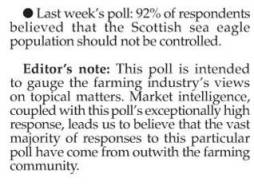
The result? 92% of respondents believed that the Scottish sea eagle population should not be controlled.

What’s amusing about this, apart from the obvious overwhelming support for sea eagles, is the Editor’s note published directly underneath the poll result. It seems that the editor is prepared to dismiss the poll result because he doesn’t think it’s representative of the farming industry’s views.

Now, had the poll result been different, i.e. ‘92% of respondents did believe that the Scottish sea eagle population should be controlled’, do you think the editor would still be dismissive of the result?

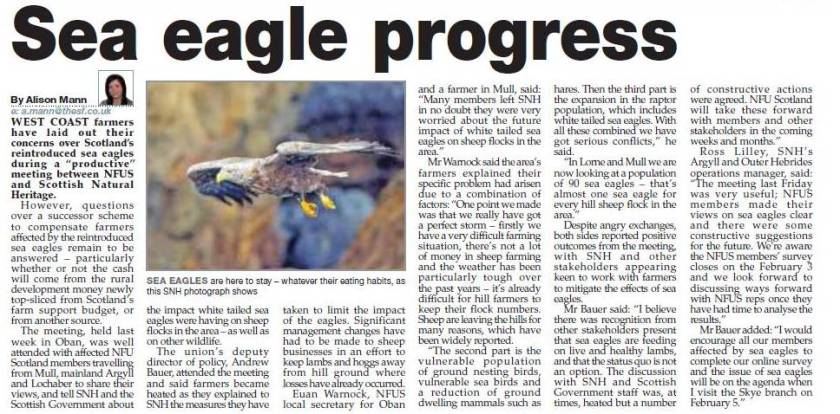
Elsewhere in the latest edition is an article on the NFUS meeting with SNH in Oban last week. It’s not that informative in terms of telling us the outcome other than “there were some constructive suggestions for the future” but it did include some information about the farmers’ specific concerns. These were divided into three parts:

1. “There’s not a lot of money in sheep farming and the weather has been particularly tough over the past years“.

2. “The vulnerable population of ground nesting birds, vulnerable sea birds and ground-dwelling mammals such as hares“.

3. “The expansion in the raptor population, which includes white-tailed sea eagles. With all these combined we have got serious conflicts“.

They also claim that, “In Lorne and Mull we are now looking at a population of 90 sea eagles“. Really? There aren’t even 90 breeding pairs in the whole of Scotland! There are, at a stretch, probably no more than 25 breeding pairs in the whole of Argyll, and being highly territorial they will be foraging on their ‘own patch’, vigorously defending their resource from neighbouring pairs and opportunistic transient juveniles. To imply that 90 sea eagles are descending on sheep farms in this area is just absurd.

As we pointed out in our previous blog on this subject (here), it is well recognised, through peer-reviewed science, that some eagles do eat some live lambs (although with minimal impact) but where this does occur then it is fair that the farmer receives compensation. What isn’t acceptable is grossly exaggerated claims of marauding eagles wiping out sheep flocks, ground-nesting birds, sea birds, hares and small children.

It seems that no matter how much evidence is put to them, it’s simply not enough to suppress an inherent prejudice against anything with talons and a hooked beak.

ScotFarmerWTE

Farmers taking aim at sea eagles, again

Scottish Farmer eagle eaction call front pageRepresentatives of NFU Scotland are meeting with SNH today in a ‘call for action’ against white-tailed eagles.
They haven’t exactly specified what ‘action’ they want from the government although the words ‘control measures’ are mentioned. These words are the more palatable version of  ‘kill/cull’.

Why do they want sea eagles to be ‘controlled’? Ah, the usual arguments – the sea eagle population is out of control, sea eagles are out-competing golden eagles, sea eagles are eating all the lambs, sea eagles are eating everything else as well as all the lambs, sea eagles might eat a child, sea eagles are ‘impacting’ on the wider biodiversity, sea eagles are eating all the hares, sea eagles are eating all the goats, sea eagles are causing emotional damage…. Oh, and the government’s ‘eagle-damage’ compensation scheme for farmers/crofters just happens to have ended.

The NFU Scotland ‘call for action’ features on the front page of the Scottish Farmer today (see here).

Unfortunately, the article doesn’t include any information about the findings of previous studies looking at the so-called impact of reintroduced sea eagles on lambs (answer = negligible, see here and here).

Nor does it include any reference to two recent scientific studies looking at the presumed competitive effect of white-tailed eagles on neighbouring golden eagles. Both concluded no evidence of effect:

Evans et al. (2010). Comparative nest habitat characteristics of sympatric White-tailed and Golden Eagles in western Scotland. Bird Study 57 (4): 473-482 (read it here).

Whitfield et al. (2013). Breeding season diets of sympatric white-tailed eagles and golden eagles in Scotland: no evidence for competitive effects. Bird Study 60 (1): 67-76 (read it here).

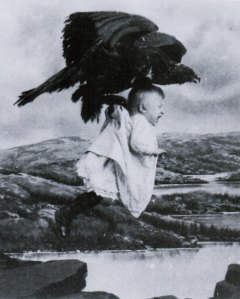
baby-and-eagleOf course, this is just the latest in a long line of alarmist nonsense from both farmers and gamekeepers (who can forget the SGA’s recent claim that sea eagles might eat children – see here!) and then there was this, and perhaps best of all, this.

Not to be deterred by scientific evidence, or even just plain common sense, the editor of the Scottish Farmer, Mr Alasdair Fletcher, has set up a survey to ask whether the sea eagle population should be ‘controlled’ (in his opinion the answer should be ‘yes’). You, too, can take the carefully considered, unbiased survey here!

UPDATE 26th JANUARY 2014 – POLL RESULTS HERE!

Latest measure to tackle raptor persecution now in place

Last July, following a series of raptor persecution incidents, Environment Minister Paul Wheelhouse announced his intention to introduce ‘further measures’ to tackle the ongoing problem (see here).

One of those measures has recently come in to force (as of 1st Jan 2014).

That measure is an enabling paragraph in some of the 2014 General Licences that says this:

SNH reserves the right to exclude the use of this General Licence by certain persons and/or on certain areas of land where we have reason to believe that wild birds have been taken or killed by such persons and/or on such land other than in accordance with this General Licence.

First of all, we applaud Paul Wheelhouse’s intentions, at least, and his determination to make sure this measure has been enacted. Good for him. However, as we blogged at the time, we really don’t see how this latest measure can be enforced (see here for our reasons).

For once, it seems that many of the game-shooting organisations are in agreement with us. Before SNH issued the 2014 General Licences, they had their usual consultation period and asked for comments about this new enabling paragraph, amongst other things (see here). They have just published those consultation responses and all the respondents from within the game-shooting lobby raised many of the same concerns as us.

So, even though this new measure is now in place, it is highly unlikely that it will ever be effectively deployed….a bit like the legislation relating to vicarious liability. We might be wrong, of course, but only time will tell.

In general terms, the 2014 General Licences are not much better than the 2013 General Licences in that many of the previous concerns raised (going back several years!) have still not been addressed. We’ve blogged about this a lot (e.g. see here, here, here, here, herehere, here, here, here, here) and don’t intend to go over all the points again….not just yet, anyway. We understand that SNH is intending to organise further research in 2014 to address many of the concerns, although they said that when they issued the 2013 General Licences and yet here we are, another year gone by and we’re still waiting for that research.

While we wait, it’s worth you having a look at the responses to the 2014 General Licence consultation – especially the response from the Scottish Gamekeepers’ Association, who once again are asking for ‘quota systems’ for buzzards, ravens, pine martens and badgers.

Download the PDF here: Consultation responses to General Licences 2014

Naturally, we’ll be watching with interest to see whether SNH has cause to withdraw the use of the General Licences, on the basis that they have ‘reason to believe’ that wild birds have been illegally taken or killed. The enabling paragraph probably cannot be used retrospectively so we’ll just have to wait until we see the next incident of criminal activity, which probably won’t be too far off, and then we’ll see what happens.


Red-faced police admit ‘skinned badgers’ were actually roe deer

Ah, police wildlife crime investigations at their finest.

It has emerged that the ‘six skinned badgers’ reported by the police as having been found dumped by a road in Peebles last Friday (see here) were actually roe deer remains.

A news release put out this morning (see here) confirms that the mis-identification was revealed during post-mortem tests at the Scottish Agricultural College in Edinburgh.

Quite how roe deer remains can be mistaken for badger carcasses is anyone’s guess.

The revelation will be doubly embarrassing for Police Scotland, as the ‘six skinned badgers’ report had led to a question in the parliamentary Chamber yesterday (see here).

We had expected Environment Minister Paul Wheelhouse to field the question, although it turns out that the Cabinet Secretary for Justice, Kenny Macaskill, had to answer instead, given that the question centred on ‘police resources’ for tackling wildlife crime.

His response was predictable – almost as if reading from a script. Video footage of the question and answer session can be viewed here (from 06.32 onwards). There was also a question from MSP Nigel Don (SNP, North Angus) about the poisoned eagle ‘Fearnan’ and the effectiveness of vicarious liability. Again, the answer was predictably staid.

Whilst this latest police fiasco reassures us that, on this occasion at least, six badgers have not been brutally killed and skinned, it does nothing to increase our confidence in Police Scotland’s ability to effectively tackle wildlife crime, especially if they can’t even tell the difference between two mammals that bear absolutely no resemblance to each other.