New study suggests that killing crows is mostly pointless, most of the time

Yesterday saw the publication of a new scientific research paper entitled: A review of the impacts of corvids on bird productivity and abundance. The paper is available for free download here.

If you want to skip over the technical details, the authors have helpfully issued a press release which provides a more general overview for the more casual reader. It reads as follows:

A MURDER OF CROWS?

They steal, raid nests, and keep the company of witches. But the unpopular crow may not be as big a menace as people think.

A new study has found that crows – along with their avian cousins the magpie and the raven – have surprisingly little impact on the abundance of other bird species.

Collectively known as corvids, these birds are in fact being menaced by mankind in the mistaken belief that removing them is good for conservation.

The new study was led by researchers at the University of Cape Town and published this week in the leading ornithological journal Ibis. It found that in the vast majority of cases (82 percent), corvids had no impact at all on their potential prey species.

“Many nature lovers have been distressed to witness a crow or magpie raiding the nests of their beloved garden songbirds, stealing their eggs or eating their defenceless chicks,” said study co-author Dr Arjun Amar from the Percy FitzPatrick Institute for Ornithology. “Although this predation is entirely natural, these observations can be upsetting to witness and often leave people wondering if these predators might be reducing bird numbers.”

“However, our global review suggests that we should be cautious before jumping to conclusions over the impacts these species may have. Just because a predator eats something occasionally does not always mean that they have an impact,” Dr Amar said.

The study, the first of its kind, reviewed all published evidence on whether predation by corvids actually reduces the overall breeding performance of birds or, more importantly from a conservation perspective, reduces their numbers. Data were collated from 42 studies of corvid predation conducted across the globe over the last sixty years.

Not only were corvids unlikely to have any impact on their potential prey species, if there was an impact it most often affected the breeding success of the prey species rather their subsequent numbers. Half of cases found that corvids reduced breeding success whereas less than 10% of cases found that they reduced prey numbers in the long term.

“These results have big implications for the likely benefits of corvid control,” Dr Amar said. “They suggest that killing corvids will be of most benefit to those interested in gamebird shooting rather than conservationists.” He added: “Bird hunters are usually most interested in increasing numbers of birds available to shoot immediately after the breeding season and this appears to be where corvids have most impact”. “Conservationists on the other hand, are usually interested in increasing a species population size and our results suggest that only in a very few cases did corvids have an influence on this aspect of their prey,” Dr Amar said.

The review analysed the impact of six corvid species on a variety of prey species including gamebirds, songbirds, waders, herons, cranes, sea birds, waterfowl and raptors. The 42 studies incorporated into the review included 326 cases of corvid – bird prey interaction Most of the data stemmed from field research in the UK, France and the United States. The impacts were determined partly by comparing bird counts before and after corvids were either removed or their numbers reduced.

The review also found large differences between the impacts of crows, historically considered the most ‘cunning’ corvid, and magpies which are sometimes killed by home owners hoping to protect songbirds in their gardens. Crow species were six times more likely to have an impact on bird prey species than Magpies.

Mistaken assumptions about corvid predation were possibly explained by the birds’ diurnal nature and the fact that they are conspicuous nest predators: “Their importance in prey population regulation is often assumed prior to any assessment of the evidence,” the study warned.

Chrissie Madden, the lead author on the paper, hoped that the review would challenge the perception that all corvids were bad, thereby preventing needless killing: “Our results suggest that this is a mistaken belief and that generally speaking people would be wasting their time killing corvids to increase bird numbers”.

“Overall therefore, our study points to the fact that we are often too quick to jump to the conclusion that crows and magpies may be the cause of bird population declines,” she said.

END
SNH logo 2The paper itself is an interesting bit of science, but of more interest (to us at least) is the potential application of the research results. Basically, this review paper has shown that in the vast majority of cases, corvids (including crows and ravens) have little effect on their prey populations, and thus this raises an important question about the validity (and legality) of Government-issued General Licences which allow the mass killing of corvids, supposedly for the purposes of ‘conserving wild birds’.

General Licences have long been an issue of concern to conservationists, and we have blogged about this a lot (e.g. see here & scroll down through the posts and links). General Licences are routinely used by gamekeepers and land managers for the largely unregulated practice of killing so-called ‘pest’ species, especially corvids, in Larsen traps, clam traps and crow cage traps, or by shooting them. However, General Licences are not permitted to be used to kill ‘pest’ species for the purposes of protecting surplus stocks of gamebirds, even though that is exactly what gamekeepers have been doing, although they don’t admit to that – they simply claim they are ‘controlling vermin’ to protect wild birds such as waders.

How will SNH deal with the results of this latest study, given the overwhelming evidence that corvid predation isn’t having a significant impact on wild bird species in the majority of cases?

Don’t expect a quick response from SNH. We are still waiting for them to deal with other concerns that have been raised about the use of General Licences, some of which were raised in a publication dating back 15 years:

dick-stronach-1999-use-abuse-misuse-of-crow-traps

Interestingly, SNH has recently announced that their suite of 2015 General Licences will shortly (this week) be published on their website, WITHOUT conducting a public consultation and WITHOUT any substantive changes to their 2014 licences. Robbie Kernahan (SNH licensing dept) said:

From our previous consultations and discussions on the GL suite, I think we have a good understanding of the key issues and your outstanding concerns relating to General Licences“.

So that’s ok then. SNH understands the key issues and concerns but has decided not to address them. Brilliant.

Although, they are apparently addressing one aspect of trap use and have been conducting a questionnaire survey of trap-users (see here). As we blogged at the time, asking trap-users for a truthful account of their activities is, frankly, ridiculous. We all saw quite graphically last week, with the conviction of gamekeeper George Mutch, how some of these trap-users are operating.

We’ll be re-visiting this topic in the New Year.

New venue announced for 2015 Scottish Birdfair – hurray!

Scottish BirdfairRSPB Scotland has announced its new venue for the 2015 Scottish Birdfair – Levenhall Links, east of Edinburgh.

Thank god they’ve finally ditched Hopetoun House, the controversial venue that hosted the Birdfair for the last three years.

The controversy centred on Hopetoun’s relationship with the Leadhills (Hopetoun) Estate in South Lanarkshire – a driven grouse moor with a shocking record:

2003 April: hen harrier shot [prosecution failed – inadmissible evidence]

2003 April: hen harrier eggs destroyed [prosecution failed – inadmissible evidence]

2004 May: buzzard shot [no prosecution]

2004 May: short-eared owl shot [gamekeeper convicted]

2004 June: buzzard poisoned (Carbofuran) [no prosecution]

2004 June: 4 x poisoned rabbit baits (Carbofuran) [no prosecution]

2004 June: crow poisoned (Carbofuran) [no prosecution]

2004 July: poisoned rabbit bait (Carbofuran) [no prosecution]

2004 July: poisoned rabbit bait (Carbofuran) [no prosecution]

2005 February: poisoned rabbit bait (Carbofuran) [no prosecution]

2005 April: poisoned buzzard (Carbofuran) [no prosecution]

2005 June: poisoned rabbit bait (Carbofuran) [no prosecution]

2005 June: poisoned rabbit bait (Carbofuran) [no prosecution]

2006 February: poisoned buzzard (Carbofuran) [no prosecution]

2006 March: poisoned buzzard (Carbofuran) [no prosecution]

2006 March: poisoned pigeon bait (Carbofuran) [no prosecution]

2006 April: dead buzzard (persecution method unknown) [no prosecution]

2006 May: poisoned rabbit bait (Carbofuran) [no prosecution]

2006 May: poisoned rabbit bait (Carbofuran) [no prosecution]

2006 May: poisoned egg baits (Carbofuran) [no prosecution]

2006 June: poisoned buzzard (Carbofuran) [no prosecution]

2006 June: poisoned raven (Carbofuran) [no prosecution]

2006 June: 6 x poisoned rabbit baits (Carbofuran) [no prosecution]

2006 June: poisoned egg bait (Carbofuran) [no prosecution]

2006 September: 5 x poisoned buzzards (Carbofuran) [no prosecution]

2006 September: poisoned rabbit bait (Carbofuran) [no prosecution]

2006 September: poisoned rabbit bait (Carbofuran) [no prosecution]

2007 March: poisoned buzzard (Carbofuran) [no prosecution]

2007 April: poisoned red kite (Carbofuran) [no prosecution]

2007 May: poisoned buzzard (Carbofuran) [no prosecution]

2008 October: poisoned buzzard (Carbofuran) [listed as ‘Nr Leadhills’] [no prosecution]

2008 October: poisoned rabbit bait (Carbofuran) [listed as ‘Nr Leadhills’] [no prosecution]

2008 November: 3 x poisoned ravens (Carbofuran) [listed as ‘Nr Leadhills’] [no prosecution]

2009 March: poisoned rabbit bait (Carbofuran) [no prosecution]

2009 March: poisoned raven (Carbofuran) [no prosecution]

2009 April: poisoned rabbit bait (Carbofuran) [gamekeeper convicted]

2009 April: poisoned magpie (Carbofuran) [no prosecution]

2009 April: poisoned raven (Carbofuran) [no prosecution]

2010 October: short-eared owl shot [no prosecution]

2011 March: illegally-set clam trap [no prosecution]

2011 December: buzzard shot [no prosecution]

2012 October: golden eagle shot (just over boundary with Buccleuch Estate) [no prosecution]

2013 May: shot otter found on estate [no prosecution]

2013 June: significant cache of pre-prepared poisoned baits found on estate [no prosecution]

2013 August: red kite found shot and critically-injured in Leadhills village [no prosecution]

2014 February: poisoned peregrine (Carbofuran) [‘Nr Leadhills] [no prosecution]

Why RSPB Scotland ever thought that holding their prestigious event at Hopetoun House was a good idea remains a mystery – we blogged about it extensively and the RSPB’s decision to stay there caused many visitors, exhibitors and speakers to boycott the event (see here for an overview).

So we’re delighted, as probably are many others, to hear that the 2015 Scottish Birdfair will be at a new venue – Levenhall Links – a place with no known links to driven grouse shooting or any type of wildlife crime. Well done, RSPB Scotland.

RSPB press release here

Scottish Birdfair website here

RACCE committee writes to new Environment Minister re: wildlife crime

RACCEYou’ll recall last month that the Scottish Parliament’s cross-party Rural Affairs, Climate Change & Environment (RACCE) Committee took evidence on wildlife crime, following the publication of the Government’s 2013 annual report on wildlife crime in Scotland.

We blogged about the evidence given by Police Scotland and the Crown Office (here) and the evidence from (now former) Environment Minister Paul Wheelhouse (here).

We said at the time that the RACCE Committee were a pretty well-informed bunch and, with the publication of their letter to the new Environment Minister Aileen McLeod, we continue to be impressed.

It is clear from their letter that they are no push-over, and that they intend to hold the Minister, as well as Police Scotland and the Crown Office, to account. Good on them!

The letter sets outs their views on the issues that were discussed during the two hearings. These include their continuing concerns about the inconsistent presentation of data in the annual wildlife crime reports; their concerns about recorded wildlife crimes being ‘the tip of the iceberg’ and how this needs to be addressed; continuing concerns about police under-resourcing; and a suggestion that PAW Scotland should include incidents of poison baits and illegal traps in their annual wildlife crime mapping exercise. Excellent stuff.

There is a rather pointed comment about Police Scotland’s last press release on the Ross-shire Massacre, basically agreeing with the general view that their press release was ridiculous (although they’re a bit more diplomatic than that, obviously). Talking of that press release, has anyone had a response from Assistant Chief Constable Malcolm Graham about his claim that other agencies had supported that press release (see here)? We haven’t heard a word from him, even though he was asked for information on 31st October – we’d be interested to know if anyone else has received a reply or if ACC Graham is ignoring everyone? If he is, then we’ll be encouraging you to contact the Information Commissioner to seek a review.

Staying on the Ross-shire Massacre for a minute, there’s also a claim in the RACCE’s letter that Police Scotland undertook “a full review” of the inquiry, including the investigative approach, the media strategy and the forensic investigation, and that “this process has involved partners including RSPB Scotland and the SSPCA”. Really? Disppointingly, the RACCE Committee didn’t ask to see the results of that “full review” and instead just commented that “once the case has concluded, Police Scotland and PAW Scotland are asked to consider what lessons are to be learned for the future”. Let’s be realistic here – this case isn’t going to ‘conclude’ – it’s been nearly nine months since 22 raptors were killed in a mass-poisoning with a banned poison and nobody has been arrested, let alone charged. The lessons need to be learned now, not in three years time when everyone has forgotten about it.

The letter also includes the Committee’s concerns about the poor detection and conviction rates associated with wildlife crime, and suggests that these crimes are “insufficiently prioritised” by COPFS. We’re greatly looking forward to the publication of a forthcoming report that will examine, amongst other issues, the detection and conviction rates of some wildlife crimes in Scotland. The report is due out shortly and apparently there’ll be a presentation on its findings at the BAWC Wildlife Crime Conference in March. Should be interesting.

All in all then, a promising letter from the RACCE Committee and we’ll wait with interest to read the new Environment Minister’s response.

Download the letter here: RACCE letter to Env Minister re Wildlife Crime Dec 2014

Sporting estates “are a rural perversion”

Journalist Jim Crumley has a wonderful turn of phrase.

Last month he called the Scottish Gamekeepers’ Association “the UKip of the natural world” (see here). Yesterday, in his latest article in the Courier he said:

The sporting estate is not a rural business model, it is a rural perversion“.

He was referring to the SGA’s response to the SNP’s proposed land reforms in his article entitled ‘Land reform: predictably, the bleating has begun‘. Here’s an excerpt –

“……….Ladies and gentlemen, I invite you to raise your glasses to the Scottish Government’s ‘radical programme of land reform’. And once you’ve done that, I further invite you to arm yourselves with hammer and symbolic nails, the better to nail down the coffin of the stranglehold that has given us the deer forest and the grouse moor. And not to mention the exorcism of the ghost of Queen Victoria that has presided over the monstrous abuse of Scottish land for almost 114 years and not to mention the decades of her life during which she actively promoted it.

Much of mainland Europe gave up such ghosts aeons ago. It is time – it is long, long past time – that Scotland addressed head-on the most entrenched and sustained injustices that ever clung to the fair face of the land, that still cling, a clenched grasp on the land to which we should belong and to which belonging is denied to almost all of us.

The bleating of landowners, factors and gamekeepers have already begun and it will get louder until this new, flowing tide of post-referendum optimism drowns them out and lets in sunlight and brisk winds to illuminate and banish the stourie, cobwebby old gloom of their oppressive regime. Its days are numbered.

In its predictable response to Nicola Sturgeon’s announcement, the Scottish Gamekeepers’ Association’s spokesman said: “There has to be an acknowledgement that some rural business models already deliver in the public interest”.

The sporting estate is not a rural business model, it is a rural perversion; one that puts hundreds of thousands of acres far beyond the reach of the public interest, or for that matter far beyond the well-being of nature; one whose management wraps the land in a time warp that honours Victorian practices of raptor control and of obliterating at every opportunity those of nature’s creatures it deems inconvenient and dumps the carcasses in stink pits marked “vermin”. The reforms should outlaw the very word.

As with the Smith Commission, the land reform legislation will be seen by many Scots as a first step on a new, progressive and optimistic journey rather than a destination in itself. Ending business rates exemptions for sporting estates and using the resultant millions to swell the Land Fund and foster more community ownership ventures may seem a startling initiative to many Scots, but all over mainland Europe they will be wondering why it took us so long.

There should be two essential elements to land reform. One, which these new proposals serve, and which is indeed a rural business model that delivers in the public interest, brings much more land under the essentially benevolent influence of many more communities. The other is to create opportunities for nature that have been denied to it for centuries, and that is a cause that can perhaps best be served by bringing a large area of land into state control to create a showpiece national park devoted to species conservation and reintroduction, native habitat restoration, recreation and expansion.

A national park owned by the nation may sound like shooting for the moon, but again, in mainland Europe and North America, it is simply the norm and always has been. Our peculiarly Scottish (peculiarly in both senses of the word) land use history has left us far, far behind the times, so that our new aspirational frame of mind has to be willing to think big just to achieve these norms that are a facet of life in so many modern, independent nations.

Imagine a Heartland National Park that stretches from the Moor and the Black Wood of Rannoch south to Loch Tay and Glen Dochart and west across the Black Mount, Glencoe and Glen Orchy to the shores of Loch Etive.

It would also link our existing national parks and serve as a role model in matters like prioritising the needs of nature over development and tourism. It would lead by example in teaching new community-owned estates how to be better neighbours with the natural world, so that the growing rural population of people would relearn something of the old skills our ancestors once knew about honouring the company of the growing population of nature, rather than obliterating it with shotguns, traps, and a Victorian apothecary’s arsenal of poisons…………..”

END

All eyes are on the land reform proposals right now, and there’s huge anticipation that maybe, just maybe, they’ll provide a means of finally holding The Untouchables to account.

The Scottish Government has launched a public consultation on the proposed reforms (here). The document includes a foreword by new Environment Minister Aileen McLeod (whose portfolio now includes, Environment, Climate Change and Land Reform – she’s going to be busy!).

If you’re interested in an incredibly well-informed view on land reform issues in Scotland, we recommend you subscribe to Andy Wightman’s blog.

There’s also a good article from George Monbiot today – see here.

Below is a photograph of an intensively driven-grouse moor in the Eastern Highlands, by Chris Townsend (for background see here and especially Chris’s blog here).

east-highlands-devastation-chris-townsend

GWCT takes aim at Scottish pine martens

The GWCT are at it again. First they wanted buzzards and sparrowhawks added to the Scottish General Licences to allow the legal killing of these protected species in order to protect non-native gamebirds bred and released in their millions for leisure shooting. Then they went for the legal ‘removal’ of hen harriers from English grouse moors to protect artificially-high stocks of red grouse for leisure shooting. Now their plan to ‘remove’ pine martens from several Scottish forests, under the guise of a ‘research trial’, has been leaked.

Their ‘plan’ is to ‘remove’ 120 pine martens (a highly protected species that is recovering from persecution) from four forests in Strathspey, including inside the Cairngorms National Park, over a six-year period to see whether their ‘removal’ has any affect on the breeding success of Capercaillie. The plan suggests that the martens could be killed but a ‘translocation’ to other areas would be preferable. Conservationists have called the plan ‘deeply flawed’.

The story has been published by environmental journalist Rob Edwards and can be read here, including a copy of the GWCT’s ‘plan’.

We’ve got a bit more to add to this story. A freedom of information request has revealed some interesting facets. It seems that GWCT has been pushing this proposal for some time, in discussion with SNH, Forestry Commission Scotland and Cairngorms National Park Authority. The RSPB has ruled itself out of any involvement. There has been a lot of unease about the GWCT’s proposed methods amongst SNH, FCS and CNPA and also the likely adverse publicity that this ‘trial’ would generate.

GWCT has been told that licences to permit the killing of pine martens are unlikely to be supported, and also licences to permit the live-trapping of pine martens during the lactation period (15 March-31 July) are unlikely to be supported on animal welfare grounds. However, SNH suggested that the martens could be live-trapped BEFORE mid-February to avoid catching them before they become pregnant!

It’s also revealed that the Vincent Wildlife Trust are ‘not receptive’ to hosting translocated pine martens, which basically scuppers the GWCT’s proposal because they had been relying on the VWT’s cooperation.

The original plan was to start live-trapping pine martens in early 2015. However, SNH has put the brakes on and has asked GWCT for an extended development plan before the research proposal can be considered further. SNH has said they probably won’t consider the experimental removal of pine martens before the start of 2016 at the earliest.

Here are the FoI documents:

Information Request 1

Information Request #1 includes various versions of GWCT’s proposal, including comments from SNH; RSPB Scotland’s position statement on the trial; the Mammal Society’s position statement on the trial (and that is really worth a read!); and some email correspondence.

Information Request 2

Information Request #2 includes a letter from SNH to GWCT outlining what needs to be done before the proposal will be further considered; and a summary of GWCT’s baseline data collected in 2014. There are a few pages of redacted information but these relate to Capercaillie locations so it’s understandable that they should remain undisclosed.

Information Request 3

Information Request #3 includes a series of emails (many reproduced in the other information notes) and minutes from a meeting held on 2nd October 2014 between GWCT, SNH, FCS and CNPA. There’s also confirmation that the Vincent Wildlife Trust are ‘unreceptive’ to receiving translocated pine martens.

Pine Marten photograph by Gary Faulkner.

Last night’s Countryfile

Last night’s Countryfile featured a section on raptor persecution and was actually fairly well balanced, in terms of the amount of air time given to both ‘sides’ of the debate.

First up was Bob Elliot, the RSPB’s Head of Investigations. He talked about the effect of persecution on certain raptor populations and the need for better legislation, vicarious liability, estate licensing and greater penalties for those convicted of illegally killing raptors. It was a well-delivered performance.

The presenter, Tom Heap, claimed that there is “some evidence that vicarious liability has reduced the illegal killings of birds of prey” in Scotland. Rubbish. That’s what the landowners would like everyone to believe because then it makes it more difficult for the Government to introduce even further measures against them. As the (now former) Environment Minister Paul Wheelhouse said recently, there isn’t any evidence to suggest that vicarious liability  has reduced raptor persecution. Indeed, the latest Government statistics show that raptor killing is actually back on the increase in Scotland, which demonstrates that so far, vicarious liability is not having the deterrent effect that we’d all like.

Next we heard from a poor guy whose dog had died after it had minimal contact with a poisoned bait whilst out on a walk on a Yorkshire moor. This was followed by North Yorkshire Police Wildlife Crime Officer Gareth Jones, who discussed another poisoning incident he’d investigated that involved a poisoned fox, crow and two red kites.  This was a bit strange because he mentioned that a local gamekeeper had put out a poisoned rabbit bait to target a fox that had been eating his pheasant poults and that the keeeper hadn’t intended to kill the kites, only the fox. But then we heard that there wasn’t enough evidence to make a ‘definitive link’ to the culprit and so there wasn’t a prosecution. Eh? If the keeper had admitted putting out the bait to target a fox, surely that’s the link? If the keeper hadn’t admitted targeting the fox, how did the Police know the kites hadn’t been deliberately targeted? Very odd.

Duncan Thomas BASCNext up was Duncan Thomas from BASC. What he had to say was quite interesting, but not as interesting as what he didn’t say (or maybe he did say and it was just edited out). For context, it’s worth bearing in mind that before joining the BASC payroll, Mr Thomas was a Police Wildlife Crime Liaison Officer with Lancashire Constabulary, and his patch included the Forest of Bowland, a well-known raptor persecution hotspot.

We were told that he’d been involved with game-bird shooting at Bowland for 20 years and he was filmed waxing lyrical about one of this year’s successful hen harrier nests in Bowland. But no mention of the ‘disappearance’ of two of the nest’s sat-tagged fledglings, Sky and Hope, both vanishing without trace on the Bowland moors just a few weeks after fledging (see here and here).

When asked about the RSPB’s call for game-shooting leaders to acknowledge the role of gamekeepers in raptor persecution, Mr Thomas said:

I think that some of the press releases are quite unfair and they don’t represent a true and accurate picture of what goes on here. If you show me direct evidence that leads to the conviction of a gamekeeper for doing that then those people are not welcome within our community. All the shooting organisations, their stance is very clear, we would expel them from any of our organisations“.

So here we have a former police officer claiming that the only convincing measure of criminal activity is a conviction! On this basis, the UK should be considered as a virtually crime-free zone. All those murders, rapes, assaults, burglaries etc for which nobody has been convicted simply didn’t happen because, er, there weren’t any convictions.

Oh, and all that guff about convicted gamekeepers not being welcome….that’s simply untrue. A classic example is the gamekeeper who was convicted for having a banned poison in his vehicle, home and pheasant pen, and yet went on to enjoy the support of the National Gamekeepers’ Organisation who helped him to apply successfully for licenses to destroy buzzard nests and eggs to protect his pheasants!

Mr Thomas was then asked how he felt “when the RSPB seems to be tarring the whole shooting industry“. He said:

Frustrated. And angry. The RSPB appears to be using some EXTREMELY isolated cases to colour us all bad“.

Hmm. Those ‘extremely isolated’ cases actually amount to over 100 gamekeepers convicted of raptor persecution between 1990 – 2010. Not what we’d call ‘extremely isolated’. Our definition of ‘extremely isolated’ would be if, say, a District Nurse had been convicted. There she was, trundling over the uplands on her way to see another patient when she decided to pull over, whip out a shotgun from her medical bag and take a pop at a passing hen harrier. If that had ever happened, then it would clearly be seen as an ‘extremely isolated’ incident and not at all indicative as being representative of her entire profession. But over 100 gamekeepers? Well, those facts speak for themselves. In fact, in the last four years alone, a further 27 gamekeepers have been convicted of wildlife crimes, and at least a further five cases are currently pending. Knowing how difficult it is to actually secure a conviction for wildlife crime, these can only be considered the tip of the iceberg. Here are the latest 27:

Feb 2011: Gamekeeper Connor Patterson convicted of causing animal fights between dogs, foxes and badgers.

May 2011: Gamekeeper Ivan Mark Crane convicted of using an illegal trap.

May 2011: Gamekeeper Ivan Peter Crane convicted of using an illegal trap.

May 2011: Gamekeeper Dean Barr convicted of being in possession of a banned poison.

May 2011: Gamekeeper James Rolfe convicted of being in possession of a dead red kite.

June 2011: Gamekeeper Glenn Brown convicted of using an illegal trap.

October 2011: Gamekeeper Craig Barrie convicted of illegal possession & control of a wild bird

Dec 2011: Gamekeeper Christopher John Carter convicted of causing a fight between two dogs and a fox.

Dec 2011: Gamekeeper Luke James Byrne convicted of causing three animal fights and possession of three dead wild birds (heron, cormorant, buzzard).

Jan 2012: Gamekeeper David Whitefield convicted of poisoning 4 buzzards.

Jan 2012: Gamekeeper Cyril McLachlan convicted of possessing a banned poison.

April 2012: Gamekeeper Robert Christie convicted of illegal use of a trap.

June 2012: Gamekeeper Jonathan Smith Graham convicted of illegal use of a trap.

Sept 2012: Gamekeeper Tom McKellar convicted of possessing a banned poison.

Nov 2012: Gamekeeper Bill Scobie convicted of possessing and using a banned poison.

Jan 2013: Gamekeeper Robert Hebblewhite convicted of poisoning buzzards.

Feb 2013: Gamekeeper Shaun Allanson convicted of illegal use of a trap.

Feb 2013: Gamekeeper (un-named) cautioned for illegal use of a trap.

May 2013: Gamekeeper Brian Petrie convicted for trapping offences.

June 2013: Gamekeeper Peter Bell convicted for poisoning a buzzard.

July 2013: Gamekeeper Colin Burne convicted for trapping then battering to death 2 buzzards.

Sept 2013: Gamekeeper Andrew Knights convicted for storing banned poisons.

Dec 2013: Gamekeeper Wayne Priday convicted for setting an illegal trap.

Feb 2014 Gamekeeper Ryan Waite convicted for setting an illegal trap.

May 2014 Gamekeeper Derek Sanderson convicted for storing five banned poisons.

July 2014 Gamekeeper Mark Stevens convicted for setting illegal traps.

October 2014 Gamekeeper Allen Lambert convicted for poisoning 11 raptors, illegal storage and use of pesticides & possession of a poisoner’s kit.

The final contributor to the Countryfile piece was Amanda Anderson of the Moorland Association, discussing DEFRA’s proposed Hen Harrier Recovery Plan and the ridiculous ‘brood management’ scheme, which we believe is nothing more than legalised persecution. We are supposed to believe that the Moorland Association loves hen harriers (ahem) and that the recovery plan would help prevent hen harriers “eating themselves out of house and home“. Good god. Somebody send her on a basic ecology course, please.

This episode of Countryfile is available on BBCiPlayer for 29 days here.

The petition to ban driven grouse shooting is here.

Cabinet reshuffle: new Environment Minister in post

Wheelhouse RACCEWell this is disappointing.

We’ve been waiting on tenterhooks all day to find out who the new First Minister Nicola Sturgeon would bring in to her Cabinet. We saw that she’d kept on Richard Lochhead as Cabinet Secretary (Rural Affairs & Environment) and so we’d had high hopes that Paul Wheelhouse would be retained in his junior ministerial position as Environment Minister. It wasn’t to be.

It’s just been announced that Wheelhouse has been shuffled off to Community Safety and Legal Affairs and there’s a new Environment Minister in town: Aileen McLeod MSP.

This is a great shame. Yes, we’ve criticised Wheelhouse during his two-year tenure for not doing as much as we would like, and for not doing it quickly enough. However, of all the Environment Ministers we’ve had, he has done far more than any of them to push raptor persecution up the political agenda and he’s recently gained considerable momentum in this regard. Ironically, that’s perhaps why he’s been moved along. The raptor-killing criminals are being squeezed like never before, and they’re definitely feeling the pressure. We wouldn’t be at all surprised to learn that certain organisations have been doing some background lobbying to get rid of him.

It’s to be hoped that Wheelhouse will continue his personal interest and commitment to this issue, in his capacity as an MSP. And who knows, perhaps his latest ministerial post will also link in – community safety (banned poisons being put out in the countryside at great risk to local communities).

Thanks for your efforts, Paul – it may not have seemed like it at times but your purpose and commitment has been appreciated.

So, who’s Aileen McLeod and how long will it take her to get up to speed? We don’t know much about her environmental interests/credentials- read her bio here – but we do know she’ll be advised by the same wildlife crime policy team at Holyrood, and they are a pretty well-informed bunch. No doubt we’ll find out soon enough just how committed she is. Hope she’s been warned about the heavy influx of emails she’s likely to receive from RPS blog readers!

North York Moors really good for waders but really bad for raptors

North York Moors NPTwo weeks ago the Yorkshire Post published an article about how well waders were doing on the North York Moors, according to the results of a survey conducted by the North York Moors National Park Authority (NYMNPA) and Natural England.

According to the North York Moors biodiversity action plan, the North York Moors National Park ‘contains the largest patch of continuous heather moorland in England and holds over 10% of the country’s resource. Most of the moors are privately owned and are managed for sheep grazing and grouse shooting’ [with the Hawk & Owl Trust’s Fylingdales Moor a notable and welcome exception].

The survey suggested that golden plover had reached an 18-year high on these moors, there had been no decline in breeding lapwing and populations of curlew were ‘holding steady, bucking a national declining trend’.

The article included a quote from David Renwick, the Director of Conservation at the NYMNPA:

Thanks must go to landowners and gamekeepers who have not only supported our survey work but are keen to create favourable habitats and conditions for these birds“.

That’s an interesting statement from the National Park’s Director of Conservation, who apparently “is an ecologist by training“. Presumably, his ecology training would have led him to question why these waders are doing so well on these moors. Could it be, perhaps, that all the waders’ natural predators have been eradicated from these moors? Is that what he means when he congratulates landowners and gamekeepers for creating ‘favourable habitats and conditions’?

North Yorkshire has the well-deserved status of being the worst place for reported raptor persecution incidents in the whole of the UK. We’ve blogged about it previously (here and here). It has held this status for six of the last seven years (being pipped to the post in 2011 when it came a close second to Lancashire). Here are the data, sourced from the RSPB’s excellent annual Birdcrime reports:

2013: 23 known incidents of raptor persecution. Status: #1 worst in UK

2012: 34 known incidents of raptor persecution. Status: #1 worst in UK

2011: 33 known incidents of raptor persecution. Status: #2 (Lanacashire #1 with 36 incidents)

2010: 54 known incidents of raptor persecution. Status: #1 worst in UK

2009: 27 known incidents of raptor persecution. Status: joint #1 worst in UK (with Cumbria)

2008: 24 known incidents of raptor persecution. Status: #1 worst in UK

2007: 78 known incidents of raptor persecution. Status: #1 worst in UK

We looked in the biodiversity action plan and on the NYMNPA website for any information about how they specifically planned to address these appalling statistics but couldn’t find very much. We did, though, find an invitation to an open day to ‘meet the countryside protectors’. Marvellous.

Environment Minister gives evidence on wildlife crime to RACCE Committee

Wheelhouse RACCEA couple of weeks ago, Police Scotland and COPFS gave evidence to the Scottish Parliament’s Rural Affairs, Climate Change and Environment (RACCE) Committee about wildlife crime (see here).

Last week it was the turn of Environment Minister Paul Wheelhouse. The archived video can be watched here and the full transcript can be read here.

So what did we learn? Quite a lot.

1. The Minister is “confident” that surveillance cameras can be used in wildlife crime investigations and the Lord Advocate has made it clear that the option is available to Police Scotland. (Interestingly, Police Scotland were not quite so keen when they were asked about it two weeks ago).

2. The Minister will shortly be announcing a forthcoming pesticide disposal scheme (he made it clear it was not an amnesty) – no further details available.

3. The committee reviewing wildlife crime penalties (led by Prof Poustie) will report back early in the New Year, and not in December as originally planned.

4. The Minister recognises the “wall of silence” that so often prevents the reporting of wildlife crime. Good.

5. Two weeks ago, Police Scotland claimed that the number of reported wildlife crimes was more than just the tip of the iceberg. The Minister disagrees with that and cited the large areas of suitable and yet unoccupied raptor habitat as evidence of widespread unreported wildlife crime. However, he suggested that more research was necessary to understand why raptors may be missing from those areas. Eh? What about the twenty years of high quality research that has shown time and time again the link between driven grouse moor management and raptor persecution?

6. The Minister recognises that the (police) response to every wildlife crime incident isn’t perfect. However, he believes that everyone in the law enforcement community takes wildlife crime seriously. He said that with a straight face.

7. On the new General Licence restrictions, the Minister explained that he was taking a ‘targeted approach’ to try and avoid penalising those who are not involved in wildlife crime. He accepts that the restriction measure could easily be by-passed by someone simply applying for an individual licence, although he maintains that SNH may not issue one – each case will be judged on its merit. He has more faith in SNH than we do but time will tell.

He also said that he expects GL restriction cases to be listed publicly on SNH’s website “on a live basis” because he wants the restriction to be used as a ‘reputational driver’. Good.

He made an interesting statement about who is probably responsible for poisoning birds:

In most cases in which we find a dead poisoned bird on a landholding, we can be reasonably confident that the poisoning took place on that landholding and that the bird died on the landholding as a result of that poisoning“.

That’s very encouraging to hear.

8. On the idiotic Police Scotland press release about the Ross-shire Massacre, the Minister said “unfortunately” he didn’t have any input into the wording of the statement and he urged the Committee not to read too much into the statement, but instead to focus on the fact that 16 of the 22 dead birds are confirmed to have been poisoned and that a criminal investigation was continuing. You can read between the lines – he didn’t think much of the police statement.

9. On the SSPCA consultation, the Minister said he hadn’t yet made up his mind about whether to increase their investigatory powers and he was waiting for an analysis of the consultation responses before he decided. He expected to receive the analysis “early next year at the latest“.

10. When asked whether he was considering further measures to tackle wildlife crime, the Minister said he didn’t have a definitive timescale but wanted to give the current measures time to take effect. However, he did say that he had already commissioned a review of game-shoot licensing in other countries, in preparation for consideration of further measures. He wants to know what options are available to him should he decide to take a harder line. The review will be undertaken by Prof Poustie as soon as the wildlife crime penalties review has been completed in the New Year. Excellent.

11. The Minister said he would try to incorporate further data in the next wildlife crime annual report, including reports of illegal traps (but with no apparent victim) and poisoned baits (with no apparent victim). Good.

12. Two weeks ago, COPFS claimed that vicarious liability was already proving to be an effective deterrent against raptor crime (based on what the landowners had been saying). The Minister disagreed, citing on-going wildlife crime as a clear indication that not everyone is deterred by the threat of vicarious liability. He thinks that may change if/when there is a successful VL conviction. Good.

All in all, we think the Minister did pretty well. He may be a bit too light-handed and cautious for many of us, but it’s clear that he has taken a personal interest in addressing wildlife crime, he’s incredibly well-informed, he’s not fooled by the cries of denial from the wildlife killers, and his measures are heading in the right direction, albeit slowly. He thinks the GL restrictions will be the most important step in the process but we disagree. His defining moment will come when he makes the decision on whether to increase the SSPCA’s powers. That decision, and that decision alone, will tell us all we need to know about how seriously committed this Government is to tackling wildlife crime.

Details, details

The following letter appeared in the Press & Journal today:

Wind turbines affecting wildlife – Sir – I congratulate Lyndsey Ward for her excellent letter on windfarms and wildlife. There is absolutely no doubt that the raptors found dead or seriously injured at wind turbines are only the tip of the iceberg. For political reasons, the true figures will never be released. While I fully support Lyndsey’s call for an independent study into the decline of all vulnerable species in areas where there are windfarm developments, I would suggest the study should go further to include the impact protected predators have on species that are in serious decline. The RSPB and Scottish Government would do well to remember and pay heed to the wise words of King George VI: “the wildlife of today is not ours to dispose of as we please. We have it in trust. We must account for it to those who come after”. Peter Fraser, Catanellan, Crathie.

Fascinating, isn’t it, how a discussion about the potential impact of wind farms on raptors is suddenly turned into a dig at the RSPB and an unrelated discussion on ‘the impact protected predators have on species that are in serious decline’?

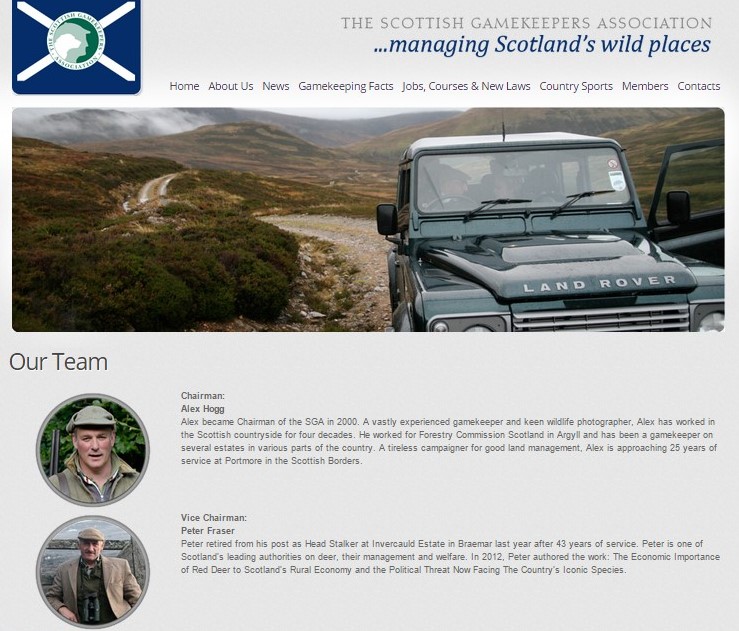
Perhaps not so surprising when you realise that the author, Peter Fraser, just happens to share the same name and address as the Vice Chair of the Scottish Gamekeepers’ Association. The same Peter Fraser who recently retired after 43 years as a gamekeeper and stalker on Invercauld Estate and whose views on who is responsible for illegal raptor persecution are not supported by actual evidence.

In light of Peter Fraser’s background, it’s interesting to re-read the letter and see how highly it scores on the brilliantly-devised Lagopus’s Delusion Index.

SGA Our team