Man charged with shooting a buzzard has case adjourned until March

John Winn Roberts, 43, of Woodend Meadow, Ballymagorry, Strabane, Northern Ireland, appeared in front of magistrates on the Isle of Wight last Friday (20 January 2012) and pleaded not guilty to intentionally shooting a wild bird (a buzzard) on 26 November 2011 at a quarry in Newport, Isle of Wight. The case was adjourned until 22 March 2012 and Mr Roberts was granted unconditional bail.

The alleged offence was reported in the Isle of Wight County Press on 18 January 2012 (see here). Hampshire Constabulary led the investigation, with assistance from the RSPCA and the company ‘Bardon Vectis’, which runs the quarry where the alleged offence took place. The fate of the shot buzzard has not been reported.

More on this case after the next hearing.

Convicted gamekeeper Glenn Brown loses his appeal

The RSPB reports that Derbyshire gamekeeper Glenn Brown has lost his lengthy appeal against his conviction for seven offences relating to the illegal use  of a baited trap to take birds of prey, the intentional taking of a sparrowhawk, and numerous animal welfare offences.

Brown was convicted in June 2011 for the offences that took place on the National Trust’s Howden Moor in Derbyshire. Despite the penalties available, he was only given 100 hours of community service and ordered to pay £10,000 costs (see here, here, here and here for background).

According to the RSPB press release, Brown’s appeal, which began on 3 January 2012 at Derby Crown Court, included ‘a blistering attack against the integrity of the RSPB, claiming evidence had been planted to incriminate Brown’. The appeal was dismissed on 24 January 2012 by Judge Watson, who commented on the credibility of the RSPB witnesses. Brown was ordered to pay a further £7,000 costs.

It is not known whether Brown was/is a member of the National Gamekeepers’ Organisation. You can find out by sending an email to: info@nationalgamekeepers.org.uk

RSPB press release here

Gamekeeper & apprentice avoid jail in cruelty case

Following the blog post on December 9th 2011 (see here), gamekeeper Christopher Carter and his apprentice Luke Byrne have been sentenced for their involvement in an horrendous animal cruelty case on the West Acre Estate in Norfolk.

See here for the sentencing report published in the Daily Mail. Unbelieveable.

The National Gamekeepers’ Organisation has put out a statement to say that neither offender was a member of the NGO. They also say: ‘Independent research has shown that gamekeeping is a force for good in the countryside in terms of conserving wildlife habitat. Moreover, in many remote, rural areas, gamekeepers are in the frontline in the battle against wildlife crime‘. The statement was released by a massive porky pig as it flew over NGO headquarters and can be read here.

Another South Lanarkshire gamekeeper convicted of poison offence

Well well well. Another gamekeeper from South Lanarkshire has been convicted of possessing the banned pesticide, Carbofuran. Police were alerted to the location after a member of the public found a poisoned buzzard lying next to a pheasant bait near Loanhead Farm, Lamington, South Lanarkshire, in November 2010. Lab tests by SASA revealed Carbofuran in both birds.

Today at Lanark Sheriff Court, 63 year old keeper Cyril McLachlan was fined £635 after admitting possession of Carbofuran. Yet again, a weak penalty for what is supposedly considered a seriously grave offence by the Scottish Government. Not good enough.

It is not known whether McLachlan was a member of the Scottish Gamekeepers’ Association at the time of the offence. If anyone can shed any light on this, we’d be happy to hear about it. UPDATE: The SGA has now issued a statement to say McLachlan was not a member (see here).

Well done to RSPB and SSPCA and the other agencies involved in getting this case to court.

RSPB press release here

Cumbrian man ‘not in any way connected’ to red kite deaths

Following the blog post on 6 December 2011 (see here), Cumbrian man Allan Armistead appeared at Preston Crown Court on 6 January 2012. Here is what was reported by the ‘In-Cumbria’ newsletter:

AN investigation into the suspected poisoning and shooting of red kites led to the discovery of breaches of regulations dealing with pesticides and firearms at a farm.

But it was accepted at Preston Crown Court yesterday there was no evidence 74-year-old Allan Armistead was in any way connected with the deaths of the birds.

The pensioner, who lives at Hulleter Farm in Oxen Park, Ulverston, was fined £7,000 and ordered to carry out 140 hours’ unpaid work.

He admitted seven offences in relation to pesticides, plus three other firearm-related offences.

The court heard a search warrant was executed at the farm last July.

Chemicals were found, most of which were unlawful to possess, due to regulations which had come in more than 10 years ago. Some of the pesticides were 60 years old.

Two rusting tins had a chemical capable of producing cyanide gas on contact with air or water. When one of them was open in safe lab conditions, some of that gas had already been produced.

Mr Brett Gerrity, prosecuting, said the finding of those tins had resulted in wildlife officers having to wear full face masks.

Other pesticides were also found. Among them was a bag containing bottles of crystallised hydrochloride strychnine. There was also a bottle of strychnine hydrochloride – a highly toxic poison used for controlling moles.

It was also found Armistead had his late father’s Home Guard rifle without authorisation, had more ammunition than he was allowed and had not disclosed he had at least three other guns. Mr Christopher Evans, defending, said the pensioner was genuinely remorseful. The chemicals had previously been legally held for many years before new regulations came in.

He said Armistead had lived at the farm since he was born. He had worked there all his life, following in his father’s footsteps, and works seven days a week.

His father’s old rifle had been kept for sentimental value.

Judge Graham Knowles QC cancelled the firearms certificate and shotgun licence that Armistead had held.

He told him: “You dealt with the guns and the ammunition and the pesticides as though the law didn’t apply to you, or didn’t matter.”

Armistead was also told to pay a total of £2,300 costs, plus a £15 surcharge.

Joke sentence for second-time convicted gamekeeper

David Alexander Whitefield, the former gamekeeper at Culter Allers Estate in South Lanarkshire, was today sentenced following his December 2011 conviction for illegally poisoning four buzzards (see here for conviction report).

Before we discuss his latest sentence, let’s remind ourselves of Whitefield’s criminal record: This keeper, who was also a member of the Scottish Gamekeepers’ Association, was convicted in October 2008 for offences relating to the unlawful capture and subsequent welfare of a buzzard. His sentence for that conviction was a £300 fine. He kept his job as the sole gamekeeper and he was not expelled from the SGA. Just six months later, in April 2009, RSPB investigators were alerted to the signs of an illegal poisoning spree on this estate. Obviously, these subsequent poisoning activities, for which Whitefield has now been convicted, demonstrate that the £300 fine had zero effect as a deterrent (no great surprise really).

So then you might expect today’s sentence to reflect not only the seriousness of the crime of poisoning wildlife (and potentially any human and/or domestic animals that happened to wander through the well-used public walking trails on this estate), but also to acknowledge that Whitefield, already previously convicted for wildlife crime there, had shown a complete disregard for wildlife legislation.

You might reasonably expect that the sheriff in this case, Nicola Stewart, might utilise her full sentencing powers and go for the most serious sentence available for this type of crime, which includes a custodial sentence and/or a financial penalty for each poisoned bird. That would see Whitefield put away for a while and would send out a very clear message that this type of crime will no longer be tolerated in this country, just as the Scottish Government has claimed over and over again in recent years.

So why then, was Whitefield handed down a 100 hour community service order as his ‘punishment’?

According to an RSPB press release, Sheriff Stewart is reported to have said the punishment was a direct alternative to a custodial sentence and that poisoning is a serious offence. Why was he given a direct alternative to a custodial sentence and where, in his 100 hour community service order, is there any indication that illegal poisoning is considered a serious offence?

This is a joke sentence, to add to all the other joke sentences that have been handed out to the few criminals that are actually prosecuted for these crimes. As we keep seeing, over and over again, these punishments are not providing the required deterrent so surely it’s now time to introduce mandatory sentences for these offences, and that includes custodial sentences. These are already available to the judiciary – so far, for whatever reason, not one custodial sentence has been given to a convicted raptor poisoner. We need to be asking why that is, and we need to keep asking.

Well done to the SSPCA for some serious doggedness with this case – it’s been a long time in the works and looked at one point to be in danger of failing on a legal technicality. Perseverance paid off, and despite the pathetic sentence, those involved with the groundwork deserve much credit.

BBC news article here

RSPB Scotland press release on Birdguides Blog here

Sat-tagged golden eagle ‘disappears’

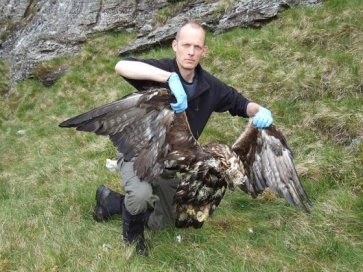
Regular blog followers will remember the golden eagle that was found poisoned on Glenbuchat Estate last March (see here). What wasn’t reported at the time was that this young eagle was one of a pair of twins from 2010 being satellite-tracked by the RSPB (unfortunately, the movement maps of these two birds were not made public). The poisoned eagle found on Glenbuchat Estate never reached her first birthday. Now it seems her twin has ‘disappeared’.

Her last signal was received in the evening of November 22nd 2011 in the Monadhliaths (well-known as a  raptor black-spot). Her next signal was scheduled for noon the next day. It never arrived and no further signals have been received. Up until that time, the signals had all been received without any hint of a technical problem. The location of her last signal has been checked but there wasn’t any sign of her.

Suspicious, or yet another technical malfunction? Draw your own conclusions.

Thank you to the contributor who sent this information.

Eight red kites found poisoned in Ireland since November

We have been asked by the Golden Eagle Trust (Ireland) to publish the following press release:

The Irish Red Kite Reintroduction Project is part of an all-Ireland effort to restore red kites. These attractive birds were extinct in Ireland for about 200 years. The Golden Eagle Trust, National Parks and Wildlife Service, and the Welsh Kite Trust have collected (from Wales) and released 120 red kites in Co. Wicklow between 2007 and 2011 and 39 red kites in Co. Dublin in 2011. The RSPB released 80 red kites in Co. Down between 2008 and 2010. There are now 10-15 pairs of red kites breeding in Co. Wicklow and 5-6 pairs breeding in Co. Down.

Following the successful release of red kites during the summer in Dublin and Wicklow, it is with disappointment that we report further recent kite deaths in Fingal. Since the release in July, this year, a total of eight (8) kites have now been recovered dead in Fingal since November.

The deaths include the satellite tagged kite known as ‘@’ which has flown as far as Co. Mayo on its travels and within a few weeks of returning to Fingal was found dead near Lusk.

Ms Phil Moore, from the Fingal LEADER Partnership expressed sadness saying ‘We just can’t believe ‘our baby’ is dead. We have all been following the satellite tagged kite since her release and have pictures all over the office of her journey; it is upsetting to know she is now dead’. 

There were 39 red kites, collected for Fingal under licence fromWales with project partners, the Welsh Kite Trust. The Fingal Red Kite release programme is part of the final and fifth year of an ambitious project to re-establish red kites in Ireland. The deaths represent just over 20% of the red kites released in the Fingal area.

The Golden Eagle Trust is managing the project, which is funded by Fingal LEADER Partnership through the Rural Development Programme 2007 – 2013 and the National Parks and Wildlife Service (NPWS). Fingal County Council, at Newbridge Demesne, and a private landowner hosted and facilitated the two separate release cages.

The project is widely supported throughout local communities, a suite of volunteers and landowners. There were over 100 people involved in cage building, collections, feeding and subsequent monitoring of the released kites.

Each kite is fitted with a radio tag which has allowed the project team to follow the kites’ movements since release. Whilst these tags allow us to track their daily movements they have also led us to find the dead birds.

Dr Marc Ruddock, Red Kite Project Manager, said ‘There is nothing more heart-breaking than having to pick up the carcass of bird and putting it in a bag for post-mortem after having followed its development from a small, downy chick collected in Wales and then watching it flying free in Fingal’.

Earlier this year, a post-mortem protocol was agreed between NPWS, Department of Agriculture and the State Laboratory. Each of the red kite carcasses has been sent for testing at Backweston Campus, to establish the cause of death. This process and the rigorous work undertaken is fundamental to the growing understanding of environmental issues and the threats posed to kites and other wildlife. 

It has now been confirmed that at least four of the kites contained the second-generation rodenticide, brodifacoum. This is an anti-coagulant rat poison usually recommended for indoor use only, which causes internal bleeding. It is widely recognised that rodenticides can kill non-target species.

Dietary analysis of the red kites, both in Wicklow and Dublin has shown that they are clearly hunting and scavenging rats, providing a natural control on rodent populations. The red kite is a specialist scavenger and is therefore likely to be at high risk of secondary poisoning if feeding on rats which are dead or dying from rodenticides.

We recognise the requirement for rat and mice control in terms of human health and food safety. But we urge amateur and professional users alike to ensure that rodent control programs are carefully planned and follow a defined treatment period to be effective.

The over-use of some chemicals could lead to resistance and accumulation in the environment. Those in the countryside should ensure best practice use of these chemicals to allow for more effective rodent control in the long-term and minimise the secondary poisoning risk to non-target wildlife. This includes other rodent-eating native raptors and owls such as kestrels, buzzards, barn owls, long-eared owls and red kites.

Best practice rodent eradication strategies record information such as the quantity and location of all baits and require baits to be regularly inspected and not left exposed to non-target animals and birds. Furthermore, dead rodents should be collected and disposed of safely and baits should be removed at the end of the treatment. Urban and rural rodenticide users are urged to be mindful of the potential environmental effects of the use of chemicals.

The farming and shooting communities in Fingal are very supportive of the project and are anxious to continue to control rats and mice effectively and minimise unintentional consequences for natural rat predators”. -END-

The substance used to kill the other four kites that have been discovered since November has yet to be confirmed – toxicology tests are on-going. It’s possible they were also unintentionally killed by secondary rat poison, but it’s equally possible that they have been deliberately (and illegally) killed by other poisons. For example, at the beginning of November 2011, it was reported that a red kite and a buzzard had been illegally poisoned in County Wicklow by alphachloralose (see here). In addition, a map produced by the Golden Eagle Trust in 2010 (see figure) shows the extent of illegal poisoning across Ireland (the map does not include instances of unintentional secondary rat poisoning). Species affected include red kites, golden eagles, white-tailed eagles, buzzards and peregrines, killed with alphachloralose or carbofuran.

Golden Eagle Trust website here

Repeat after me: there are too many raptors

I looked for Kim Jong-il’s name listed on the editorial board of Modern Gamekeeping and was surprised not to find it nestled between the names of Peter Carr and James Marchington. I thought he might have been a guest editor in the final weeks before his death. It seems a reasonable explanation for what looks to be obviously editorial-led comments from their four guest gamekeepers in the January issue.

Each month, Modern Gamekeeping invites guest keepers from across Britain to comment about what has kept them busy during the previous month. In the latest issue, keepers from Northamptonshire, Gloucestershire and North Yorkshire all discuss suspiciously similar topics – Is it a coincidence that three of the four keepers mention ‘fox-dumping’ in their articles (a subject prominently covered on the front page of this month’s Modern Gamekeeping), even though all of them admit it’s not a current problem for them? As it seems to have absolutely nothing to do with what has kept them busy during December, why would three of the four keepers mention it at all, unless they’d been ‘influenced’ by the editorial team?

Predictably, all four of the keepers also write about what they perceive to be ‘the raptor problem’. Is this also a coincidence, or have they taken direction from the editorial staff, given that the magazine’s January editorial is all about how raptors need to be [legally] culled (see here)?

Here’s what the keepers had to say about ‘the raptor problem’:

Keeper on Ashby St Ledgers shoot:The vermin haven’t really been a problem as we stay on top of them, but the buzzards and sparrowhawks are getting out of hand, they’re everywhere, and are a real worry“.

Keeper on Ozleworth Park:We have a lot of buzzards that give us some problems early on in the season when birds go to pen. They are also sometimes a bother when we want to move pheasants across the valley when they show themselves and the birds flush the wrong way. Thankfully we don’t get goshawks very often, and when we do they seem to move on quickly, which is good as they could be a real problem“.

Keeper on Shortwood Estate:Sparrowhawks and buzzards are out of control. Eight years ago you were lucky to see a pair of buzzards round here, now it’s a bad day if you don’t see five circling over your woods. There are far too many, and we also had a pair of goshawks this year that have caused me no end of trouble with the partridges“.

Keeper on Spaunton Moor:The biggest threat to game management has to be increasing numbers of birds of prey. The North York Moors in particular have massive blocks of forestry and unkeepered farmland, and every week we’re seeing more and more of every raptor species. What people forget is that 20 years ago, there wasn’t a buzzard, red kite or goshawk up here. Now there are plenty of all of them, and they’ve got to eat something. So the biggest threat, I think, is the increasing number of birds of prey and not being able to address that increase“.

Perhaps I’m being unfair. Perhaps these keepers have not been indoctrinated at all and they all genuinely believe that raptors in their areas are ‘out of control’. Although if that’s the case, their claims are difficult to understand given that they also all wrote about how well their seasons have gone this year!! So, either keepers have been illegally killing raptors to get the fantastic bags that have been reported this year, or, raptors don’t actually have such a high impact on bags as the shooting industry would have us believe. If we believe certain organisations, it’s ‘only a few rogues’ that illegally kill raptors, so logically then, the latter explanation must be accurate. Therefore, there’s no need for licences to be issued to legally cull raptors. Sorted.

Kim Jong-il is dead but the art of propaganda lives on

North Korean despot Kim Jong-il may be dead but the art of propaganda is alive and kicking here in the UK. A fine example of this is displayed in the latest [January 2012] edition of Modern Gamekeeping, the monthly rag for UK gamekeepers, where there are more calls for the introduction of licences to cull raptors.

It begins in the editorial at the front. Peter Carr dedicates a whole page to the issue of raptor persecution, starting off with condemnation of illegal raptor poisoning [good], but quickly moving on to ‘justify’ the need for legal raptor culling [not so good]. Part of this ‘justification’ includes the following statement:

Buzzards, sparrowhawks, goshawks, hen harriers, and tawny owls are the raptor species that cause us the most problems, though the little owl’s destructive power should not be discounted. All are doing well in most areas of the UK…

Oh dear. But when did facts ever get in the way of 100 year-old anti-raptor propaganda? And here is evidence, should any more be needed, that gamekeepers will not stop at licensed buzzard killing. Sparrowhawks, goshawks, tawny owls and little owls are all apparent targets, and hen harriers too, if they can find any left to kill.

Carr goes on to rally the troops, calling for more strenuous lobbying and “the need for a sensible balance in our countryside“. Presumably that ‘sensible balance’ includes the continued annual release of 40+ million non-native gamebirds into our countryside  and the (mis)management of our uplands to produce artificially-high densities of red grouse, all to the detriment of any native predators that share the habitat?

His editorial ends with this: “Raptor control licences will come, but we must hasten the process with valid argument and an impeccable record of keeping our own house in order“. If these two premises are the ones that will dictate whether raptor culling licences are issued, then conservationists need not fear that they’ll be issued any time soon.

The propaganda continues later in the rag….more on this in the next post…