Photo: hiding the evidence

This is a photo of a dead buzzard inside a hole. How did it get there? Did the person who illegally killed the buzzard stuff it inside the hole to hide the evidence from casual passers-by? Or did the buzzard crawl inside the hole to die of natural causes? Yep, that must be it. Didn’t 13 of them do the same thing on a Scottish sporting estate a few years ago? Interesting that they all chose rabbit holes within close proximity to a crow cage trap. Oh and then there were the gunshot wounds…

Red kites have also been known to do it, funnily enough on another Scottish sporting estate. First they removed their wing tags, placed them in a hole and then covered the hole with moss. Then they severed their own legs, placed those in holes and also covered the holes in moss. Remarkable.

Wriggling out of vicarious liability?

Regular blog readers will be well aware that the concept of vicarious liability in relation to raptor persecution became enacted in Scotland on January 1st 2012 as part of the WANE Act. For new readers, some background can be found here. Vicarious liability has had its critics but until the first test case in court, nobody really knows just how strong, or weak, the new legislation will prove to be.

An interesting comment about vicarious liability was received on the blog at the end of last week; it suggests legal loopholes may be being exploited to avoid possible conviction. Given the interest in VL, we’ve decided to re-post the comment here. Thanks to Steve from OneKind for submitting it:

Information gathered by Onekind suggests how some estate owners may try to avoid vicarious liability in the future by sending their game keepers on all the trapping and best practice courses there are going. According to our intelligence, top lawyers are being hired to travel around the country lecturing to gamekeepers on the law related to wildlife crime. Our information suggests that the idea behind this action, being taken by landowners and worked on by these top Lawyers, is that if a wildlife crime were to occur on their land by one of their keepers then the landowner can say that he put his keeper through the relevant courses and that he doesn’t know why the keeper did what he did. They hope that this will be enough to persuade the court that they were not complicit with the crime carried out on their land. Further information we have acquired tells us that a well-known land owner has been urging other landowners to take this idea on and which will probably be up and running properly within the next few months“.

I guess we’ll wait and see whether this defence is used if/when charges of vicarious liability are ever brought against anyone. It’s an interesting one because what they are allegedly proposing to do is not illegal, but its hardly in the spirit of moving towards the elimination of raptor persecution from the game-shooting industry, is it? In its defence, some will probably argue that we should all be thankful that gamekeepers are receiving such excellent training, but some may argue that some of the training is far from excellent. For example, OneKind has concerns about the adequacy of the snare training courses and suggests there may be an ulterior motive for running them (see here).

The use of legal loopholes to avoid possible conviction is a well-known tactic in many areas of crime, not just wildlife crime, although wildlife crime does have its fair share of examples. A recent one was reported in a newspaper at the beginning of July (sorry, no URL available) concerning the case of a gamekeeper on the Airlie Estate at Kirriemuir, Angus. He was accused of alleged criminal activity after the discovery of three buzzards inside a crow cage trap. However, he was acquitted after Sheriff Kevin Veal decided that the keeper was not given proper information about why he was being interviewed by an SSPCA inspector and a Tayside Police wildlife crime officer. Some lawyers are very good at their jobs.

It certainly pays to employ a professional lawyer rather than a pretend one. An employee from a very well-known organisation recently sent an email to a group (no, not us!) who publish the names of convicted gamekeepers and other wildlife criminals on their website. The email suggested that certain names should be removed from the website because the convictions were considered spent. The email explained the relevant law under which the names should be removed and went into some detail about how the law applied. The employee signed off with an impressive number of letters after their name, including LLB (a law degree). Uncannily, the information that the impressively-qualified employee wrote about this particular law bore an incredibly close resemblance to a Wikipedia entry on the same subject. Hmm, not quite so impressive now!

Yet another dead golden eagle: poisoning suspected, again

The Press and Journal is reporting the following story:

Another dead golden eagle: poisoning suspected.

Poison fears after golden eagle found dead in prime island habitat.

Police are investigating another suspicious golden eagle death- this time in one of the heartlands of the species.

The bird of prey was found at Loch Langabhat on Harris at the end of last month. Scotland’s first year round observatory to allow the public to view golden eagles opened on the island earlier this year.

It is understood that the creature was found by rangers working for the North Harris Trust, which runs the observatory.

The area has one of the highest breeding concentrations of the bird in Europe. About 20 pairs of golden eagles are resident on the island.

A police spokesman said: “We are investigating the death of a golden eagle. Its carcase has been sent for analysis to see if it had been poisoned.”

The same day as the Harris eagle was found, tests confirmed that a golden eagle found dead near Morar in Lochaber had been poisoned.

The Royal Society for the Protection of Birds Scotland said it was the third known poisoning incident in the area in 10 years. Two white tailed sea eagles were previously found poisoned.

The latest death in Lochaber was discovered in March and the results of a post mortem examination have now been released. They show banned pesticides were used.

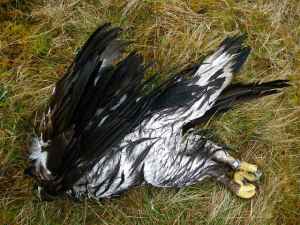
So, if this latest dead golden eagle is found to have been poisoned, it will be the third illegally-killed golden eagle reported in the last three weeks. The first one was the incident we reported on 18 June in the Tayside/Grampian region (see here), which, incidentally, still has not been the subject of a formal press release by either the police or the RSPB. The second one was reported by the RSPB and the police on 28 June and related to a poisoned golden eagle found dead in Lochaber three months earlier (see here) [This is the eagle pictured above].

It seems that ‘someone’ has leaked the story of the Harris dead eagle to the Press and Journal as there doesn’t appear to be any formal press release on any of the other news sites or the Northern Constabulary website. Well done to whoever alerted the P&J. We’ll await the SASA lab tests with interest. It’s quite possible of course that this eagle hasn’t been poisoned, although pesticide-poisoned birds generally exhibit diagnostic signs (like clenched feet and dead insects on the body) – signs with which investigators will be very familiar.

North Harris Eagle Observatory webpage here

Photo: an illegal pole trap

Many of our readers will already know what a pole trap looks like, but for those who don’t, here’s a photograph of one (taken recently in Scotland).

These traps were outlawed in the UK in 1904 but are still in regular (illegal) use today. They are nothing short of barbaric. They are often positioned on posts close to game-rearing pens or on exposed posts on grouse moors with the sole intention of catching a perching raptor. When the raptor lands on the trap the spring jaws snap around the leg(s) with such force that the leg is usually broken. When the raptor tries to fly away it is prevented from doing so as the spring trap is nailed to the post. The raptor is left dangling from the post with appalling injuries and usually suffers a prolonged and agonising death (see Tuesday’s photo here).

If you see a pole trap you should report it immediately (to the police, SSPCA, RSPB). If you have to walk away from the trap (e.g. to get a phone signal), take a photograph of the set trap (preferably with a local landscape feature in the background so the photo can be used as evidence) and then disarm it. Use a stick to disarm it – not your fingers – the spring action of these traps is so powerful it can break an eagle’s legs.

The camera never lies: new photo gallery for the blog

We’ve added a new category to the blog called Photo Gallery. It can be accessed via the category list in the right-hand column. 

Photos will be added to the gallery periodically to create a useful resource of images in one location. The main focus of the photos will be raptor persecution, of course, but we’ll also include other related images.

You can join in! If you’d like to contribute any photographs for publication, please send them to:

raptor.persecution.scotland(at)hotmail.co.uk.

Anonymity goes without saying but photo credit given if that’s what you’d prefer. Get snapping!

First photo to follow shortly…

Species Action Framework conference 2012

Scottish Natural Heritage will be organising a major conference later this year to discuss the results of their five-year Species Action Framework programme, which ended in March 2012.
‘Managing Species in a Challenging Climate: Scotland’s Species Action Framework’ will be held 22-23 November 2012 at the Royal Botanic Garden Edinburgh.

There will be two presentations specifically on raptors; one on the white-tailed eagle and the other on the hen harrier.

The hen harrier presentation should be fascinating, especially as it’s being led by Des Thompson (SNH) and Simon Lester (head gamekeeper at the Langholm Moor Demonstration Project). A recent (2011) SNH-commissioned report (later attributed to JNCC, presumably for political reasons) on the conservation status of the hen harrier identified illegal persecution as one of the key constraints affecting hen harriers in Scotland, and particularly when associated with grouse moor management (see here). However, at the recent 2012 police wildlife crime conference in Scotland, Des Thompson claimed that “the great majority of these [grouse moors] are well managed” (see here). An interesting statement and completely at odds with the findings of the hen harrier conservation framework report as well as with the findings of the SNH-commissioned 2008 golden eagle conservation framework report (see here). Hopefully there will be an opportunity to question Des at this conference, and also Simon Lester – especially about the lack of transparency on the fate of all those satellite-tagged hen harrier chicks from the Langholm project (see here and here).

The Species Action Framework conference programme can be viewed here

Details on how to book your place at the conference can be found here. It’s worth noting that the registration fee rises after 13th July 2012.

Britain’s 50 great shoots: oh how we laughed!

In the latest edition of The Field there’s a big spread on what they consider to be Britain’s top 50 pheasant and partridge shoots. Here’s the opening paragraph to explain their selection:

While there will be many familiar names in The Field’s Top 50 Shoots for pheasants and partridges for 2012, there will be some new names, too. All are recognised as outstanding; either they show reared game very well or they show wild game well. And it is possible to take a day at most of them. Attention to conservation and woodland and land-management also stand at the forefront of these shoots“.

We only got as far as page 1 of the list; it’s hard to read when you’ve got tears of laughter flooding your eyes. The cause? Seeing the names of two estates: Edradynate and Glenogil. Regular readers will be familiar with both names and the ‘outstanding’ attention to conservation that’s at the forefront of their activities.

Well done to the editorial team at The Field – you clearly know your stuff!

Pick a number, any number

It seems to be the in thing to do….pick a random number, insert the name of an animal (e.g. pigeon, lamb, pheasant, grouse) and then insert the name of a predator (e.g. buzzard, sea eagle, peregrine, sparrowhawk, golden eagle) and bingo! You have a totally unsubstantiated ‘fact’ about the effect of raptor predation that can be used to further demonise birds of prey.

Following hot on the heels of Alex Hogg’s flawed mathematical equation on buzzard predation on his estate (see here), an Aberdeenshire farmer is claiming that golden eagles were responsible for 180 missing lambs [presumably on her farm] this year alone (see here). To support her claim, she posted a video on YouTube under the heading ‘Golden eagle attacking ewe and lamb’. What the video actually shows is a young golden eagle taking a curious look at a lamb and ewe – not exactly what you’d call evidence of an eagle attack! (See video here).

Of course this isn’t the first time, nor will it be the last, that  farmers blame eagles for killing absurd numbers of lambs. In 2010 SNH completed a costly study (at the taxpayer’s expense) to investigate the effect of white-tailed eagle predation on lambs. This followed claims by local crofters that the eagles were consuming ‘200 lambs’ per year in Gairloch. Unsurprisingly, the scientific study found differently (see here).

The question of raptor ‘attacks’ was recently raised in the Scottish Parliament by Alex Johnstone MSP (who happens to be the local MSP of the Aberdeenshire farmer mentioned above). Johnstone wanted to know how farmers might be compensated for ‘what I believe are increasing losses’ [from raptor attacks]. Environment Minister Stewart Stevenson responded by saying that any potential action would need to be ‘evidence-based’. Well said that man. Video footage of the parliamentary question & answer here.

Stuff and nonsense

The airwaves are busy with criticism of last night’s episode of Countryfile, which featured a few pieces on evil birds of prey, especially buzzards and peregrines.

It’s too tedious to reproduce all the arguments here – we’ve heard it all before, although the SGA chairman Alex Hogg’s apparent inability to count was quite amusing. In a voiceover we were told that Alex was due to release 700 pheasant poults into his woodland pens (prior to letting them loose into the wider countryside so they can be shot dead). The interviewer (Tom Heap) then asked Alex if he had any idea how many poults he might be losing to buzzards. Alex’s response: “We’re probably losing, getting on for over a thousand pheasants in a year to buzzards“. Hmm.

At least the RSPB’s Duncan Orr-Ewing was able to provide some balanced and constructive discussion, but it was disappointing that the producers failed to include any meaningful discussion on the persecution issue. Tom Heap took to his Twitter account after the programme and offered this:

Am intrigued…many accusing #countryfile of buzzard bias. Why? Real country issue, meticulous balance. Proud of our work“.

For anyone who missed it, the episode can be seen on BBC iPlayer for the next seven days (here).