Vicarious liability: contravention of human rights?

waneThe use of vicarious liability legislation is extremely topical right now, especially as we recently learned there was to be no vicarious liability prosecution in the Kildrummy case. We currently await a response from Police Scotland to explain why the legislation wasn’t enforced in this case (see here).

A couple of days ago a Cambridge University academic, Dr Findlay Stark, contacted us on Twitter to discuss his views about the vicarious liability legislation and whether it was in contravention of the European Convention on Human Rights.

Dr Stark is a lecturer in criminal law and specialises in the philosophical/theoretical aspects of this field. Rather than conduct an unsatisfactorily abbreviated discussion on Twitter, we asked him to consider writing a blog about this issue. He has done so, and it’s a fascinating read.

Dr Stark’s stance is that the current legislation may violate the human rights of the accused in a vicarious liability case. It’s important to point out that Dr Stark’s position is genuinely independent. There’s no hidden agenda for or against landowners/estate managers or conservationists; it’s a purely academic viewpoint and this gives some weight to his arguments.

He provides much food for thought and it’ll be interesting to see whether his recommendation is acted upon by the defence agent in the next vicarious liability prosecution.

Read his blog here

Mick Carroll: obituary

Mick CarrollWe are sad to hear of the passing of Mick Carroll.

Anyone involved with bird of prey protection in northern England in the last few decades would have known, or known of, Mick Carroll. For those who didn’t know him personally, you missed a treat, but you’ll know of his work, without knowing it was his work, if you’ve ever heard anything about the fight against raptor persecution in the English uplands.

The following obituary has been written by his friends and colleagues in the Northern England Raptor Forum (NERF).

MICK CARROLL: 26 August 1947 – 21 October 2015

Mick was born in Lancashire in 1947. He was adopted by John and Edith Carroll when he was six months old and spent his formative years in Colne where he went to the local primary school with his life-long friend, Clive Hartley.

Mick was introduced to the natural environment by his father when he was still a young boy. He was only 5 or 6 years old when they left their industrial home together and made their first trip to the nearby Bouldsworth Moor where he recalls seeing Ring Ouzel, Common Sand Piper and Short-eared Owls. Mick recalls, ‘I didn’t have bins in those days, everything was done by skeg o’t eye’. He would have to wait another six years before he got his first pair of 8 x 32 binoculars, which cost the princely sum of 6.10 shillings. That was a huge amount of money back then; half of the average weekly wage for a manual worker and the equivalent of £136 today. Not a bad gift for a 12 year old. With or without binoculars that first trip to Bouldsworth Moor awakened an all embracing interest in ornithology.

At 15 years of age Mick started work on a local hill farm and joined the Royal Air Force when he was 19. After completing his basic training he became a member of the RAF Regiment, as a gunner. He was initially posted to the RAF Depot at Catterick, North Yorkshire before serving in Bahrain and Cyprus. His next posting took him to Germany where he was involved in helicopter based mobile air operations with the British Army of The Rhine. Shortly after returning to the UK Mick was posted to British Honduras, now known as Belize before his last overseas posting took him to Northern Ireland. Whilst stationed there he suffered a back injury that would eventually force him out of military service at just 30 years of age.

Having left the military Mick moved to Pickering with his wife of 44 years, Helene, and returned to farming. He took an initial course at the agricultural college in Ponteland before moving to Durham to complete a course in farm management.

After qualifying from Durham his first farm job took him to Winteringham. Mick recalls, ‘That’s where I first came into contact with a murderous gamekeeper who shot out a Kestrel nest’. Mick found one of the young that had survived and took it home and cared for it. The bird was released back to the wild once it was fit to fly. Mick decided that if this behaviour towards birds of prey was the norm on the estate he would never be happy there and soon moved on. He spent the next few years farming in North Yorkshire before his old back injury forced him out of the industry. He took a job as Trees Officer with Scarborough Council monitoring Dutch elm disease. Six months later he moved on again.

His next job, with English Country Cottages, allowed him to travel the length and breadth of the North of England and that gave him the opportunity to intensify his passion for bird watching. Coincidentally at the end of the contract with English Country Cottages his military pension increased substantially thereby allowing him to become a full-time birder. He then took on a role at the Blacktoft Sands RSPB Reserve for 12 months and developed a special interest in birds of prey.

This expanded interest led him to monitoring raptors on the North York Moors, initially in the Dalby and Langdale Forests. He was subsequently invited to join the North York Moors Upland Bird [Merlin] Study Group with whom he was involved for many years. Mick had maintained his contact with the RAF Regiment and his love of the natural environment and his determination to protect that environment led to an invitation to join the RAF Fylingdales Conservation Group. Within this Group he was called upon to advise the contractors who were responsible for dismantling the ‘golf balls’. Prior to the structural changes taking place Mick and the team installed a nest box scheme on the base. He continued to provide advice on the environmental management of the site after the work had been completed.

In addition to his conservation commitments at RAF Fylingdales, Mick took on the roles of President of Scarborough Field Naturalists, Chairman of the Ryedale Naturalists, Regional Representative for the BTO, Executive Committee member of the Whitby Naturalists Club and member of the Yorkshire Naturalists’ Union.

When he was not fulfilling his duties with the various conservation groups, Mick and Helene traveled extensively birdwatching across the UK and wider afield including a trip to Israel to celebrate their 25th wedding anniversary and more recently a trip to the Middle East birdwatching in the Dhofar region of Oman.

Mick first encountered Hen Harriers, by chance, on the north-western plain of Germany. At the time he was serving with the RAF and had just bought a local bird guide from the NAAFI. He went to check out the local bird of prey population when he saw his first Hen Harrier. That was the start of his obsession with the species which never left him. Back in the UK, years later, he joined the Natural England Hen Harrier Recovery Project as a volunteer working alongside Stephen Murphy.

Mick didn’t only confine his harrier commitment to Hen Harriers and when Montagu’s Harriers made a second attempt to breed in North Yorkshire he was at the forefront, managing the nest monitoring and protection scheme. Mick was on guard duty every day for two months. This extraordinary commitment put him in bed for the best part of a week but he considered the effort a small price to pay when two chicks fledged from the site.

Mick first attended NERF meetings as a member of the North York Moors Raptor Study Group. However; his greatest achievement within NERF was the formation of the South Ryedale and East Yorkshire Raptor Study Group, which added both a huge geographical expanse to the overall study area and an influx of colleagues dedicated to monitoring and protecting birds of prey.

Since joining NERF he has used his expertise assisting colleagues to organise NERF conferences and has represented NERF on the DEFRA- led Buzzard Stakeholder Group. He was always available to represent NERF and his expertise was regularly sought by journalists and broadcasters.

In a moment of reflection and with typical candour Mick said, “I am really proud to have been a part of NERF but we need to be more politically active if we are to protect our iconic birds of prey. Raptors are under continued and serious threats, particularly from the game shooting industry, which should have been confined to history long ago. NERF is the leading voluntary NGO speaking collectively for raptors and we must continue to work together to ensure that they have a safe future, free from persecution. We will only achieve that goal if we hold successive Governments to account. They have a ‘duty of care’ for our shared environment and they often fail in that duty. When Government departments fail birds of prey, NERF is there to work with like-minded NGOs to challenge decisions that will have a negative impact on raptors. Long may that continue.”

Memories of Mick:

“Michael loved birds and the people who are involved in their conservation. He was a dear friend and a valued Natural England volunteer who played an invaluable part in the study and protection of Hen Harriers. Our thoughts are with Helene and his family”. Stephen Murphy, Natural England Hen Harrier Recovery Team

RSPB staff seconded to the Langholm Moor Demonstration Project [LMDP] really enjoyed his two visits to Langholm Moor in 2015. Despite his illness, he made a tremendous contribution to the task of locating nests on the moor, whilst the Hen Harriers displayed overhead. It was an immensely enjoyable day for everyone. He made a very valuable contribution to the protection of birds of prey in general and Hen Harriers in particular. He leaves a void that will be difficult to fill“. Staffan Roos, RSPB.

‘Larger than life’ is a phrase often used when talking about someone, but rarely is it as apt as when describing Mick Carroll. Mick was large in life and large in the field of nature, his love of birds, of their variety and their diverse behaviour was his passion and brought him endless hours of enjoyment in the field and in his armchair.

Mick was a fighter and has been fighting for the rights of birds for many years, in particular the rights of Hen Harriers to nest and raise their young in the hills of northern England without persecution. This fight is not over but will be carried on sadly without Mick, a man who was truly larger than life. He leaves a great legacy of surveyors, researchers, campaigners and friends in his wake.

Mick came up against an even more pernicious opponent in cancer, a fight he lost but not without bringing his own style to the proceedings; he organised and attended his own wake, a wake with so many friends from the BTO, RSPB, HOT, NERF, Forestry Commission, Natural England, RAF, local Naturalist clubs and neighbours that the Hospice where it was held ran out of visitors badges! Mick Carroll truly was larger than life“. Graham Oliver, SPREYRSG.

The phone rings, the voice of the caller is gruff with a Yorkshire accent and he utters just two words “Now then!” It can only be one person in my world of friends and contacts: Mick Carroll.

I first encountered Mick at an AGM of the North York Moors Forest Bird Study Group, I was late getting to Pickering; I grabbed a pint and went upstairs to the meeting room. Just inside the door a voice said, “You’re late!” That was it; no more, no less, the Hon Sec. had spoken. I suppose that was about 15 years ago.

Mick joined the BTO in 1991 and became Regional Rep for Yorkshire [North East] in 2001. Since then our conversations have become longer that two words, much longer!

As RRs in Yorkshire we have had plenty to talk about and of course for me Mick’s mantra has always been: “We do things our way in Yorkshire, don’t we Mike?” and a slight variation “There’s only one way of doing things and that’s the Yorkshire way!”

However, Mick is a force to be reckoned with, he takes no prisoners as the saying goes and his no nonsense approach to bird protection is refreshing, especially regarding raptors. He has been a tremendous driving force in making the BTO Yorkshire Conference a bi-annual event and although his health has prevented him from being fully involved recently, I very much appreciate his skills as a speaker finder. He must have a good contact book!

Finally, I have an enduring memory of his reaction to a menu selection at a Regional Reps’ weekend away, Main Course: Lasagne, Risotto or Vegetation option. Mick: “Foreign Muck!” That was my friend, Mick“. Mike Brown, BTO Regional Representative for Yorkshire Central.

Mick’s commitment to the protection of birds of prey across the North of England is legendary. He was instrumental in forming the SPREYRSG and overseeing the Group integration in to the Northern England Raptor Form. As you would expect NERF is full of bird of prey experts and Mick was first amongst equals. He was also a man of contradiction. He used his undoubted skill and endless contact list to make projects happen. There was no ‘no’ in Mick’s vocabulary; no compromise. When there was work to do, it was done. Then when it was finished, there was no self-congratulation, just quietly, then not so quietly, moving on to the next protection job. I have been involved in many BoP protection schemes and if I ever got stuck I would simply ask myself ‘what would Mick do?’

Mick has decided that his last contribution to protecting birds of prey will be to haunt the persecutors; the raptor killers. The list is long Mick; no rest for you mate“. Steve Downing, Calderdale Raptor Study Group, NERF.

Red sky on the Black Isle: new film on the Ross-shire Massacre

A short, 12 minute film has been released about the 2014 Ross-shire Massacre, the mass illegal poisoning of 22 red kites and buzzards.

Entitled ‘Red Sky on the Black Isle’, this is an excellent film and includes interviews with some of the key individuals involved with the investigation which, as you’ll know, still remains unsolved 19 months on (see here).

Watch the film here

Rossshire Massacre film

No vicarious liability prosecution for Kildrummy Estate

Last month we blogged about whether anyone from the Kildrummy Estate in Aberdeenshire would face a vicarious liability prosecution for the criminal actions of Kildrummy gamekeeper George Mutch.

Mutch, as you may recall, was convicted in December 2014 for various wildlife crimes he committed on the Kildrummy Estate in August and September 2012, including the trapping of a goshawk which he then beat to death with a stick (see here). In January 2015, Mutch was sentenced to four months in prison; a landmark custodial sentence for a raptor-killing gamekeeper (see here).

In September 2015 we noticed that time was running out for a subsequent potential vicarious liability prosecution because after three years from the date the crime was committed, the case becomes ‘time-barred’ and a prosecution is no longer possible. We decided to ask the Crown Office for information about any pending vicarious liability prosecution (see here) but to be honest, we weren’t expecting much of a response.

However, the Crown Office has surprised us by issuing the following unusually open response:

Wildlife and environmental crime is a priority for the Crown Office and Procurator Fiscal Service. Such cases are investigated and prosecuted by our specialist Wildlife and Environmental Crime Unit, WECU. A report was submitted by the police against George Mutch alleging the unlawful taking and killing of birds of prey by him at Kildrummy Estate, Aberdeenshire in dates in August and September 2012 and considered by WECU. Following further investigation, a criminal prosecution was raised. Mr Mutch pled not guilty but was convicted of the offences after trial and in January 2015 he was sentenced to four months imprisonment.

Despite further investigations including investigations which focused on establishing vicarious liability, no-one else has been reported to COPFS in relation to the events which took place in Kildrummy Estate in 2012 and accordingly, no further prosecution, including any prosecution for a vicarious liability offence, has taken place“.

FAILSo, just to be clear, a vicarious liability prosecution is not underway, and as this case has now become time-barred (because the offences were committed in Aug/Sept 2012), as we understand it there won’t be a vicarious liability prosecution for this case in the future. Massive fail.
This will be a huge disappointment to all those who have been following this particular case, and especially for those who worked so hard to secure the initial conviction of Mutch. But perhaps more importantly, this is yet further evidence that the new and much-lauded Government measures to tackle raptor persecution are simply not working as well as they should be.

So what went wrong, and what are the potential ramifications for future vicarious liability prosecutions?

Let’s go back to that statement from the Crown Office, and particularly the first part of the sentence in the last paragraph:

Despite further investigations including investigations which focused on establishing vicarious liability, no-one else has been reported to COPFS…..”

It’s clear from this that attempts were made to identify somebody for a vicarious liability prosecution. There are at least three possible explanations for what happened next:

  1. An individual was identified but they were able to show that they had exercised ‘due diligence‘ in that they had written records demonstrating that they did not know the offences were being committed AND they had taken all reasonable steps AND exercised all due diligence to prevent the offences being committed. This is possible, of course, but in this particular case is fairly implausible given that during the trial, Mutch was asked, quite pointedly by the Fiscal Tom Dysart, whether he had received training [from his employer/supervisor] for the use of his traps, to which Mutch had replied ‘No’. Given Mutch’s claim, if his employer/supervisor had subsequently claimed due diligence as a defence to a vicarious liability prosecution, the case should have been heard in court where the Fiscal could challenge the veracity of the employer’s/supervisor’s claims.
  2. Police Scotland ran out of time for their investigation. This is plausible, seeing as Mutch was only convicted in December 2014 leaving just nine months before the case became time-barred. Having said that, if this is what happened it would reflect badly on Police Scotland because they should have been thinking about, and planning for, a potential vicarious liability prosecution way back in 2012 when they were first made aware of these crimes. The legislation enabling vicarious liability prosecutions was enacted on 1st January 2012, to much public fanfare, so the police can hardly claim they didn’t know about it at the time they were initially investigating these crimes in September 2012.
  3. It was impossible for Police Scotland to identify a suspect for a potential vicarious liability prosecution due to the complexity of ownership at Kildrummy Estate. On the one hand, this seems a pretty implausible explanation. Mutch, surely, knew who employed him and who paid his wages. But on the other hand, this explanation could be highly plausible given the convoluted information about ownership of the Kildrummy Estate as revealed by Andy Wightman’s excellent investigation earlier this year – see here. If this is indeed what happened in this case, it has far-reaching implications for future vicarious liability prosecutions. All an estate owner has to do to avoid a potential prosecution is register his/her land in an offshore tax haven because then the landowner becomes untraceable. Genius. For a fascinating and detailed explanation of how these tax havens work, and how the Scottish Government has so far refused to legislate against them despite recommendations, have a read of Andy’s latest blog – here.

Given the faith that the Environment Minister has placed in the use of vicarious liability prosecutions as an effective tool to tackle illegal raptor persecution (and thus sees no need to introduce further measures), and given the failure to prosecute in this particular case, as well as the huge public interest, an explanation is required about what did (or didn’t) happen here. The Crown Office has said it didn’t prosecute because Police Scotland didn’t report anybody for a potential vicarious liability prosecution. So, the next port of call for an explanation has to be Police Scotland. They can’t use their usual get out clause of saying ‘Sorry, can’t comment, it’s a live investigation’ because this case is no longer live. It’s very much dead in the water. So will they show some transparency and accountability here? Let’s hope so.

To ask Assistant Chief Constable Malcolm Graham why nobody was reported for a vicarious liability prosecution in relation to raptor persecution crimes at Kildrummy Estate in 2012, please email: ACC.CrimeMCPP@scotland.pnn.police.uk

Two short-eared owls shot dead nr grouse moor in County Durham

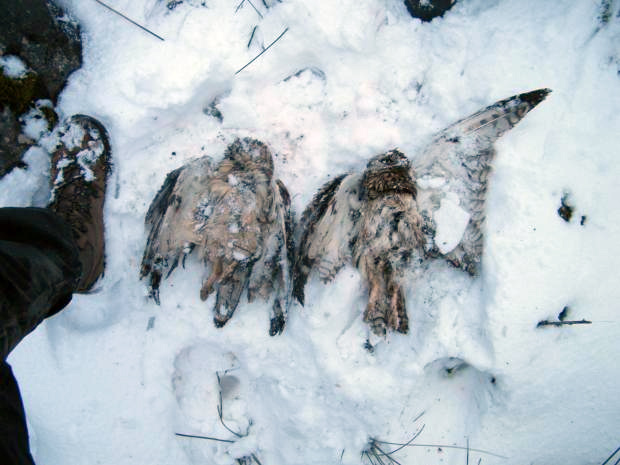
Durham Police are appealing for information following the discovery of two dead short-eared owls in Co Durham.

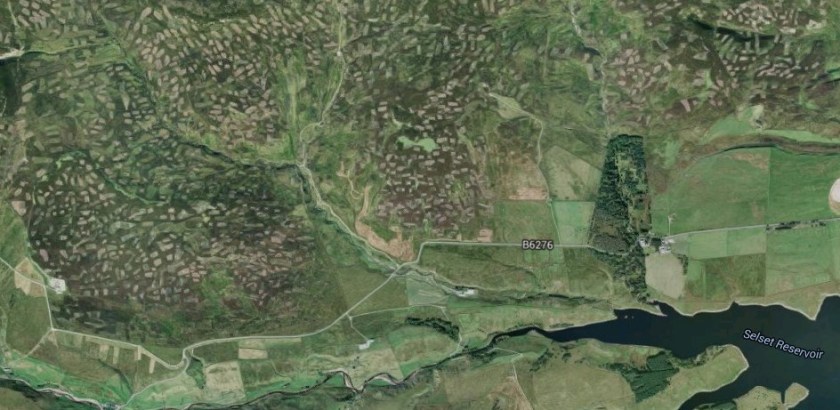
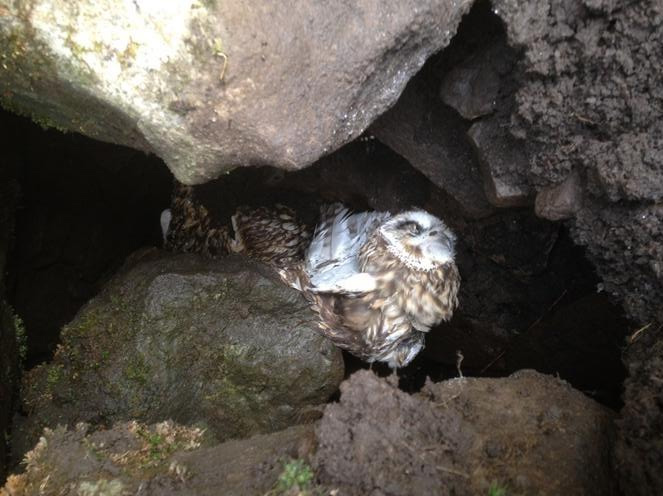
The birds, found on 2nd March, had been shoved inside a pothole near to Selset Reservoir near Middleton-in-Teesdale. Their corpses were sent for post mortem which revealed they had been shot.

News article in the Chronicle here

You have to wonder why it’s taken the police seven months to appeal for information. It’s possible that there was a delay in receiving the post mortem results, but even so, the discovery of two owls inside a pothole surely raises suspicions of criminal behaviour? It’s ironic that the police appeal is eventually made during National Wildlife Crime Aware Week, where police forces across the country are advising the public how to spot signs of wildlife crime and encouraging them to report it. What’s the bloody point if the police then sit on the information for seven months?

Interesting to look at the land-use close to Selset Reservoir…..check out this Google map and note all those weird rectangular shapes (burnt strips of heather) – this is driven grouse moor country.

Ban driven grouse shooting: sign the petition here.

Photos of the two dead short-eared owls by RSPB.

Selset reservoir shot SEOs

SEO_shot_CoDurham_Mar2015a

SEO_shot_CoDurham_Mar2015b

Stody Estate subsidy penalties: another update

IMG_4752 (2) - CopyA year ago, gamekeeper Allen Lambert was convicted of a series of wildlife crime offences on the Stody Estate in Norfolk, including the mass poisoning of birds of prey (10 buzzards and one sparrowhawk) which had been found dead on the estate in April 2013 (see here and here).

We found out that the Stody Estate had received millions of pounds worth of agricultural subsidies (i.e. money given to them from our taxes to help them farm on the condition they look after the wildlife and wildlife habitats under their management) and we wanted to find out whether the Estate would now face a financial penalty in the form of a reduction in their subsidies for what was a very serious breach of the cross-compliance regulations.

One year later and we’re still trying to find out.

In October 2014, the Rural Payments Agency (RPA) told us they “would consider action against Stody Estate“, although one of our blog readers was told, “there is no investigation ongoing” (see here).

In December 2014, one of our blog readers contacted the RPA again to ask for an update. The RPA responded in January 2015 by saying “We are unable to provide you with any meaningful response as we do not hold any information that answers your questions” (see here).

In July 2015, we again wrote to the RPA to ask whether they had imposed a penalty on Stody Estate. We were told that as the convicted gamekeeper wasn’t the actual subsidy recipient, the RPA was trying to determine whether there was “a link” between the convicted gamekeeper and the subsidy recipient (i.e. his employer) and if so, whether the recipient (Stody Estate) could be considered liable for the actions of the gamekeeper (see here). Amazing.

As the one-year anniversary of the gamekeeper’s conviction approached, in September 2015 we wrote to the RPA again to see whether they’d now worked out “a link” between the convicted employee and his employer. Last week they responded with this:

The Rural Payments Agency (RPA) has notified the Stody Estate in Norfolk that a cross compliance breach occurred, as [sic] result of the actions of their gamekeeper. This is because the estate is vicariously liable for the actions of their employees. Under European cross compliance rules, the RPA is obliged to follow-up reports of cross compliance breaches brought to its attention. The rates of applicable reductions are explained in the scheme rules“.

So, the inefficient RPA has taken a year to decide that there was a cross compliance breach, but we still don’t know whether a financial penalty has been imposed, and if it has, what its value is.

According to the RPA’s ‘scheme rules’, cross compliance breaches can be categorised  as either ‘negligible’ or ‘intentional’, and the severity of the penalty is dependent on this.

For negligible non-compliance (falls below the standard of care expected of a competent claimant) subsidy payment is normally reduced by 3% but could range from 1-5% depending on the extent, severity, re-occurrence and permanence of the non-compliance.

For intentional non-compliance, payments will normally be reduced by 20%, but may be reduced to 15% or increased to 100% depending on the extent, severity, re-occurrence and permanence of the non-compliance.

What do you think? Is laying out banned poisons that kill 11 raptors a negligible or intentional non-compliance?

Given that we don’t know how the RPA will determine if the breaches were negligible or intentional, and given that we don’t know how much of our money was awarded to the Stody Estate in 2013 (the year the breaches occurred), although judging by the amounts they received between 2004-2012 it was probably a considerable sum (see here), it’s difficult for us to establish even a rough guesstimate of what the penalty might be, and that’s assuming that the RPA has decided a penalty is warranted.

So, we’ve written, again, to the RPA to ask whether a penalty has been imposed (and if not, why not) and if it has been imposed, how much is it?

What grisly fate awaits these two satellite-tagged hen harriers?

Bowland HH Jude LaneAs part of the RSPB’s Hen Harrier Life+ Project, the movements of two satellite-tagged hen harriers can now be followed online – see here.

The two birds are called ‘Holly’ and ‘Chance’.

Holly had her satellite tag fitted in June this year by members of the Scottish Raptor Study Group, assisted by the MOD Police and was one of three chicks from a nest located on high security MOD land at Coulport. She was named after a member of the production crew from BBC Scotland’s Landward programme after appearing in a special feature about hen harriers and the threats these birds face from illegal killing (see here). Holly fledged in August and has since left her natal area, moving in to the uplands of central Scotland.

Chance had her sat tag fitted in June last year by members of the Scottish Raptor Study Group and was named by RSPB Scotland staff. She travelled south from her nest in SW Scotland to the RSPB Wallasea Reserve in Essex at the end of October (2014), before crossing the Channel to spend the winter months in western France. Chance came back to the UK in spring this year but has since returned to France via Wales.

The RSPB’s explanation for sat tagging these two hen harriers (and others) is: ‘To better understand the threats they face and identify the places they are most at risk‘.

To be frank, there is already a very good understanding of the threats they face and of the places they are most at risk; it’s been known for at least 20 years that these birds are illegally killed by gamekeepers on driven grouse moors. It’s no mystery and it’s no secret.

However, that’s not to say that continued satellite-tagging is without purpose. There’s a very important reason for continuing to do it, and that is to raise public awareness by getting people ‘involved’ with these individual birds (hence, giving them names) and showing people the birds’ movements (via online maps) so that when they are eventually shot, trapped, poisoned, or they simply ‘disappear’ in grouse moor areas (it’s inevitable), the public outcry will be considerable and the subsequent pressure on the authorities to actually do something about it will be greater. That is, assuming the police decide to publish the information, but it’ll be harder for them to keep quiet if we all know the birds have stopped moving.

There are already plenty of examples of satellite-tagged hen harriers either ‘disappearing’ or being found shot, so nobody should expect anything different for Holly and Chance. Here are some of the well-known individuals from the last few years:

Hen Harrier Annie – found shot dead on a Scottish grouse moor in April 2015 (here).

Hen Harrier Heather – found shot dead at a winter roost site in Ireland in January 2015 (here).

Hen Harrier Sky – ‘disappeared’ on a grouse moor in Lancashire in September 2014 (here).

Hen Harrier Hope – ‘disappeared’ on a grouse moor in Lancashire in September 2014 (here).

Hen Harrier Sid – ‘disappeared’ on a grouse moor in North Yorkshire in September 2014 (here).

Hen Harrier Blue – ‘disappeared’ somewhere (location not revealed) in October 2013 (here).

Hen Harrier Bowland Betty – found shot on a grouse moor in North Yorkshire in July 2012 (here).

Hen Harrier Tanar – ‘disappeared’ on a grouse moor in Aberdeenshire in June 2011 (here).

Hen Harrier (unnamed) – ‘disappeared’ on a grouse moor in southern Scotland in October 2011 (here).

And then there were the 47 hen harriers that Natural England sat-tagged between 2007-2014. Last year we were told that four were still known to be alive, six had been found dead, and a staggering 37 birds (78.7%) were ‘missing’ ‘somewhere’ (see here). Natural England has been persistently coy about telling us us where those 37 birds went missing, even though the satellite tagging project has been funded by us taxpayers.

Bowland Betty

And of course it’s not just hen harriers that we’ve watched meet a premature death. Other species have also been sat-tagged in recent years including Montagu’s harrier ‘Mo’, who ‘disappeared’ on the Queen’s Sandringham Estate in Norfolk last year (here) as well as at least eleven golden and white-tailed eagles (listed here), including some very high profile cases such as golden eagle Fearnan (found poisoned on a Scottish grouse moor here), golden eagle Alma (found poisoned on a Scottish grouse moor here) an unnamed golden eagle that had been illegally trapped on a Scottish grouse moor before being dumped in a lay by (here) and the first fledged white-tailed eagle in East Scotland for over 200 years who ‘disappeared’ on a Scottish grouse moor (here).

So, contrary to the belief of the Hawk & Owl Trust who earlier this year told us that fitting satellite tags to hen harriers “would prevent any gamekeepers from shooting them in the sky” (see here), gamekeepers don’t give a toss whether the bird in their gun sight is carrying a transmitter or not because they know full well that they are highly unlikely to get caught, let alone prosecuted. Not one of the above cases has resulted in a prosecution. So, no, the purpose of tagging isn’t to directly save the bird, but indirectly it just might, if enough of us follow the online movements of Holly and Chance and all the other tagged harriers that will be part of the RSPB’s Hen Harrier Life+ Project and then shout from the rooftops when each bird is illegally killed. It’s going to happen, and we are going to shout.

Top photo: Bowland Betty alive (photo Jude Lane).

Bottom photo: Bowland Betty dead (photo RSPB).

New report details grotesque mis-management of Scottish grouse moors

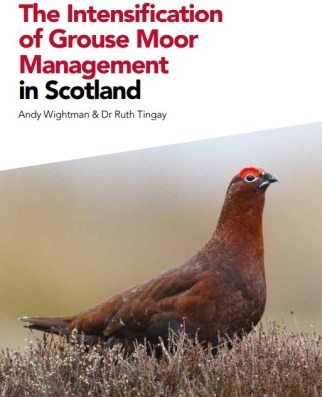
LACSreport cover - CopyA new report has been published today entitled The Intensification of Grouse Moor Management in Scotland.

Commissioned and published by the League Against Cruel Sports, the report provides a succinct overview of many aspects of grouse moor management, bringing these topics together in one place rather than the usual disparate report that focuses on just one or other particular aspect. This approach is useful for gaining the attention of policy makers within the Scottish Government who may be familiar with, say, raptor persecution or the unregulated construction of hill tracks, but perhaps may be unfamiliar with the whole suite of related problems that stem from this industry.

Topics covered in the report include the legal framework of grouse shooting, land ownership & tenure, peatland and burning, tracks and roads, medicated grit, tick management, fencing, lead ammunition, disturbance, raptor persecution, and economics and finance.

There are also eight recommendations, which are measured and reasonable, and all entirely ‘do-able’ without causing the grouse-shooting industry to collapse. There isn’t a recommendation to ban driven grouse shooting, although this may be a strategic political move more than anything else. For those of you who are tired of waiting for a properly regulated and lawful grouse-shooting industry, you can support a call for a ban on driven grouse shooting here.

The report has an accompanying video and press release (see here).

Andy Wightman (one of the report authors) has written an interesting blog on the report (here).

Mark Avery has also written an interesting blog on the report (here).

The report will be officially launched at the SNP Conference this Thursday at 6.30pm. It’ll be interesting to see which MSPs turn out in support or against.

Now sit back and wait for the grouse-shooting industry to dismiss the report out of hand for all sorts of spurious reasons rather than accept that their damaging and unregulated industry needs to change, and fast. Public awareness and scrutiny has never been greater and it’s only heading in one direction. This report will help push things along.

Further declines of breeding peregrines on grouse moors in NE Scotland

Following on from yesterday’s blog about the preliminary National Peregrine Survey results (see here), an important new scientific paper has just been published on the status of breeding peregrines in NE Scotland:

North East Scotland Raptor Study Group (2015). Peregrines in North-East Scotland in 2014 – further decline in the uplands. Scottish Birds 35(3): 202-206.

We’re not permitted to publish the full paper here, but we are able to publish extracts from it. To read the full paper you’ll either need to subscribe to Scottish Birds (published by the Scottish Ornithologists’ Club) or you can email the authors and ask if they’d be willing to provide a copy for personal use: nesrsg@gmail.com

Here is the abstract:

Peregrines in North-east Scotland were surveyed in 2014. Compared with previous studies there was an increase in coastal breeding Peregrines, but a decline in the uplands, trends persistent since 1991. Overall fewer Peregrines were recorded in 2014, but their breeding performance was relatively high. Low occupancy of nesting ranges, with more singletons than pairs, was associated with intensive management for driven grouse shooting. The results document a further decline in the Peregrine breeding population in the eastern Cairngorms National Park.

Here is the table of data:

Peregrines NE Scotland 2014_NERSG - Copy

And here is the discussion section:

The breeding population of Peregrines in the north-east of Scotland has been monitored in detail since 1975 with changes in both numbers and distribution well documented (summarised in Hardey 2011). Together with the earlier studies, the 2014 survey results suggest Peregrines in North-east Scotland have increased further on the coast and continued to decline in the uplands, particularly on intensively managed grouse moor where in 2014 only two pairs and four singletons were found.

Occupancy could be underestimated if not all alternative nesting sites are visited or if breeding attempts fail early and birds abandon the site. In 2014 this was unlikely because nesting ranges were well known, visits were not tardy, and most observers were both experienced and skilled using observations of faeces and prey remains as well as of birds. The survey’s key result involved fieldwork in areas that were easiest to search. Most nesting ranges on moorland were on relatively small rocks which were easily checked for both birds and prey remains. By comparison, birds on the coast were less easy to locate because of the continuous potential breeding habitat, including nesting sites that could not be viewed from above. That said, birds were often obvious as they perched high on sea cliff buttresses, with both droppings and plucked prey remains evident. The change in numbers on the coast might thus be complicated by birds obscurely shifting nest site, but the numbers inland are difficult to dispute. The decline of breeding Peregrines recorded in earlier studies is endorsed; in 2014 there were simply even fewer Peregrines to be found at traditional breeding places in the uplands, particularly on moorland managed for driven grouse shooting.

Both Hardey et al. (2003) and Banks et al. (2010) suggest the decline of breeding Peregrines on grouse moorland is the result of killing by game keepers in a sustained effort to reduce the numbers of grouse predators. It is difficult to argue otherwise. Amongst alternative explanations, for example, a reduction in Peregrine food supply is unlikely because Red Grouse Lagopus l. scotica (the main prey by weight) are superabundant on these intensively managed moors. Indeed, 2014 saw record-breaking grouse bags on many estates (www.shootinguk.co.uk/news/moorsreport-record-grouse-bags-6860). It is possible that some other aspect of management for grouse might be reducing the numbers of Peregrines, such as protracted muirburn or the persistent long term use of anthelminthic drugs (medicated grit), but such speculation lacks rational foundation; the most parsimonious explanation is that, as has been established for other birds of prey (Scottish Raptor Study Groups 1997, Whitfield et al. 2003, Fielding et al. 2011), Peregrines are killed on a broad scale and persistently, as newcomers repeatedly attempt to colonise untenanted breeding sites. Such killing reduces the chance of re-colonisation, and moreover reduces recruitment in nearby less intensively managed upland.

The history of the killing of Peregrines on grouse moors is well documented (Ratcliffe 1993, Hardey 2007) and the decline in breeding pairs since 1991 is well reported, initially published by Scottish Natural Heritage (Hardey et al. 2003) and several times since. Despite previous publication the results from 2014 show further decline. The context and scale of the decline is alone of major concern, but has further significance because the north-east of Scotland forms around 40% of the Cairngorms National Park designated in 2003, and currently claimed to be “a stronghold for Britain’s wildlife” (cairngorms.co.uk, accessed 13 May 2015). The eastern portion of the National Park has 53 known Peregrine nesting ranges and in 2014, 51 of these were visited, but only 17 were occupied, 12 by pairs and five by singletons. In 2014, the North-east Scotland portion of the park held less than a quarter of the number of Peregrines that bred in 1991.

END

This paper, like many before it, presents compelling evidence about the scale of illegal raptor persecution on driven grouse moors, and in this case, notably in the eastern portion of the Cairngorms National Park. We’ve blogged about this notorious raptor-killing hotspot several times before:

In May 2013 we blogged about the launch of ‘Cairngorms Nature‘ – an ambitious five-year action plan to ‘safeguard and enhance the outstanding nature in the Cairngorms National Park’. The proposals for raptor protection were unbelievable – see here.

In May 2014 the Convenor of the Cairngorms National Park Authority complained to the Environment Minister that continued raptor persecution in the area “threatens to undermine the reputation of the National Park as a high quality wildlife tourism destination” (see here). This resulted in a high-level meeting between the Env Minister and various landowners and their representative bodies in January 2015 – lots of talking and ‘partnership working’, natch – see here – but bugger all else.

Almost 45% of the Cairngorms National Park is covered by ‘managed moorland’. And just look at the damage that ‘management’ is causing. Inside a National Park for christ’s sake!

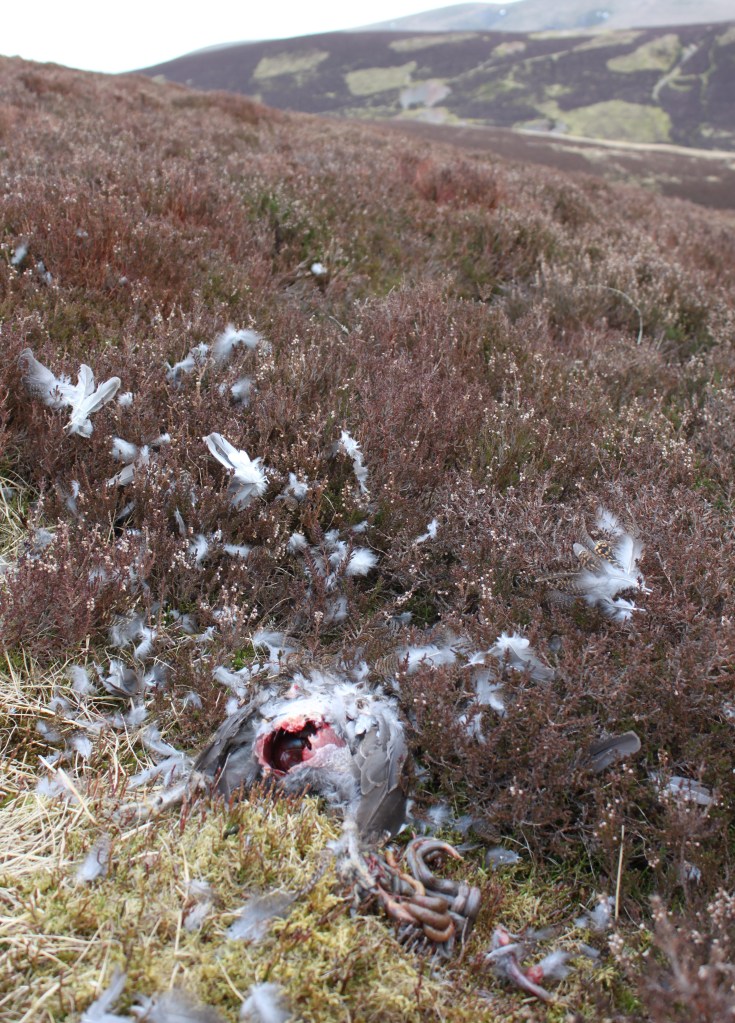
As an aside, on yesterday’s blog somebody asked whether peregrines prey on red grouse. Yes, they do. Below is a photo of a red grouse that was killed by a peregrine on a Scottish grouse moor. We watched the whole spectacular event. It’s what peregrines do and it’s why many grouse moor managers are doing their utmost to eradicate this species, as well as the hen harrier, golden eagle, and anything else with talons, a hooked beak, or sharp teeth that might affect the number of red grouse available to be shot by high-paying customers.

It’s time to ban driven grouse shooting. Please join over 22,000 other voices by signing this e-petition HERE.

IMG_6467 (2) - Copy

National peregrine survey preliminary results: those bloody grouse moors, again

Periodically there are synchronised national surveys for a number of raptor species in the UK, which help to build a picture of national and regional population trends. This year it was the national survey of breeding golden eagles, next year it will be hen harriers, and last year it was the peregrine.

The final results of the 2014 National Peregrine Survey are yet to be published – these things can take time, although we’d hope to see a publication in 2016. In the meantime, the project coordinator, Dr Mark Wilson (BTO Scotland) has written a short piece on the preliminary findings:

2014 National Peregrine Survey

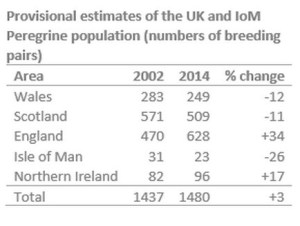
The sixth UK breeding survey of Peregrine was carried out in 2014, providing a provisional estimate of 1480 pairs in the UK and Isle of Man. This initial figure indicates that the Peregrine population in the UK has remained largely stable since the last national survey in 2002. However, this overall stability belies marked variation in the trends of Peregrine populations in different parts of these survey areas over the past 12 years.

Peregrines are now distributed more widely and evenly than ever through the UK, due to decreases in Scotland, Wales and Isle of Man, and increases in England and Northern Ireland (see table). For the first time, the estimated number of breeding Peregrines in England is greater than that in Scotland, though these two countries still hold the majority of the UK’s Peregrines.

Peregrine survey 2014 prelim results - Copy

The country-level changes described above, together with regional trends in peregrine breeding numbers and territory occupancy, suggest that, broadly speaking, Peregrine numbers have decreased in upland areas, remaining stable or increasing in many lowland and coastal areas. The association of Peregrines with wild and remote places in the UK grows increasingly tenuous, as numbers nesting on traditional inland crags decline, and the numbers occupying lowland quarries and man-made structures continue to grow.

This ongoing redistribution of Peregrine numbers across Britain is probably being driven by multiple factors. Food supply is likely to be important; changes in numbers and availability of prey are likely to be having an effect in many areas. Illegal persecution continues to restrict numbers and productivity of breeding Peregrines in some regions, particularly where pigeon racing is practiced and where there is intensive management for red grouse shooting. In contrast, decreases in lowland persecution during the 20th century and the ban on organochlorines have had positive influences on numbers, and allowed Peregrines to expand into many areas where they were previously absent. But more work is needed, particularly on food supply and its role in limiting Peregrine numbers, in order to diagnose the cause of regional declines, and identify measures to halt or reverse them. [Mark Wilson, Research Ecologist, BTO Scotland].

END

So, not many surprises here. It’s been long-established that peregrines are routinely killed on many driven grouse moors but not so much in urban and coastal areas, where they’ve been doing well because, er, they generally aren’t poisoned, shot or trapped there, unless a dodgy pigeon racer happens to live nearby. These latest (preliminary) findings show it’s been business as usual on the grouse moors of northern England and Scotland.

The final sentence of Mark’s article is quite surprising though, and really should have been clarified. Food supply may be an issue for peregrines in some areas but it most definitely is not a limiting factor on driven grouse moors – those moors are heaving with red grouse! A brilliant paper written by Arjun Amar et al (2011 – we blogged about it here) showed pretty conclusively what was happening to peregrines on grouse moors in Northern England and it had absolutely nothing to do with lack of food and everything to do with illegal persecution.

Mark’s suggestion that ‘more research is needed to diagnose the cause of regional declines and identify measures to halt or reverse them’ may be true for some areas but not for areas that are managed as driven grouse moors. Extensive research, over many decades now, has shown exactly what the problem is and it’s high time it was addressed. Here’s the best way to address it – ban driven grouse shooting – please sign the petition here.

Tomorrow we’ll blog about another new paper, just published, that stemmed from the 2014 National Peregrine Survey. It’s about peregrine declines in North East Scotland, particularly in the Cairngorms National Park, and leaves no doubt that grouse moor management is central to the problem.

Peregrine photo by Steve Waterhouse