Earlier this month I blogged about a gamekeeper in Nottinghamshire who is facing trial after he pleaded not guilty to the alleged killing of several buzzards (see here).
Now there’s another case to report. This time it’s a gamekeeper in Suffolk who is due in court on Thursday in relation to the alleged poisoning of a buzzard.
This latest prosecution relates to the joint raid undertaken by Suffolk Police, Natural England and the RSPB’s Investigations Team in January this year (see here).
[Police seized guns and pesticides during the multi-agency raid in January 2021. Photo via Suffolk Police]
Tomorrow’s court hearing will provide an opportunity for the defendant to enter a plea.
If he pleads not guilty, the case is expected to continue to go to trial at a later date.
If he pleads guilty, he may be sentenced tomorrow or the magistrate may ask for background reports before sentencing at a later date.
Please note, as this is a live case no further detail will be provided here until the case has concluded or there is official commentary from the court reporter. Comments on this particular blog also won’t be accepted until the case concludes so as not to prejudice proceedings. Thanks for your understanding.
UPDATE 26th August 2021: Trial date set for Suffolk gamekeeper accused of poisoning buzzard (here)
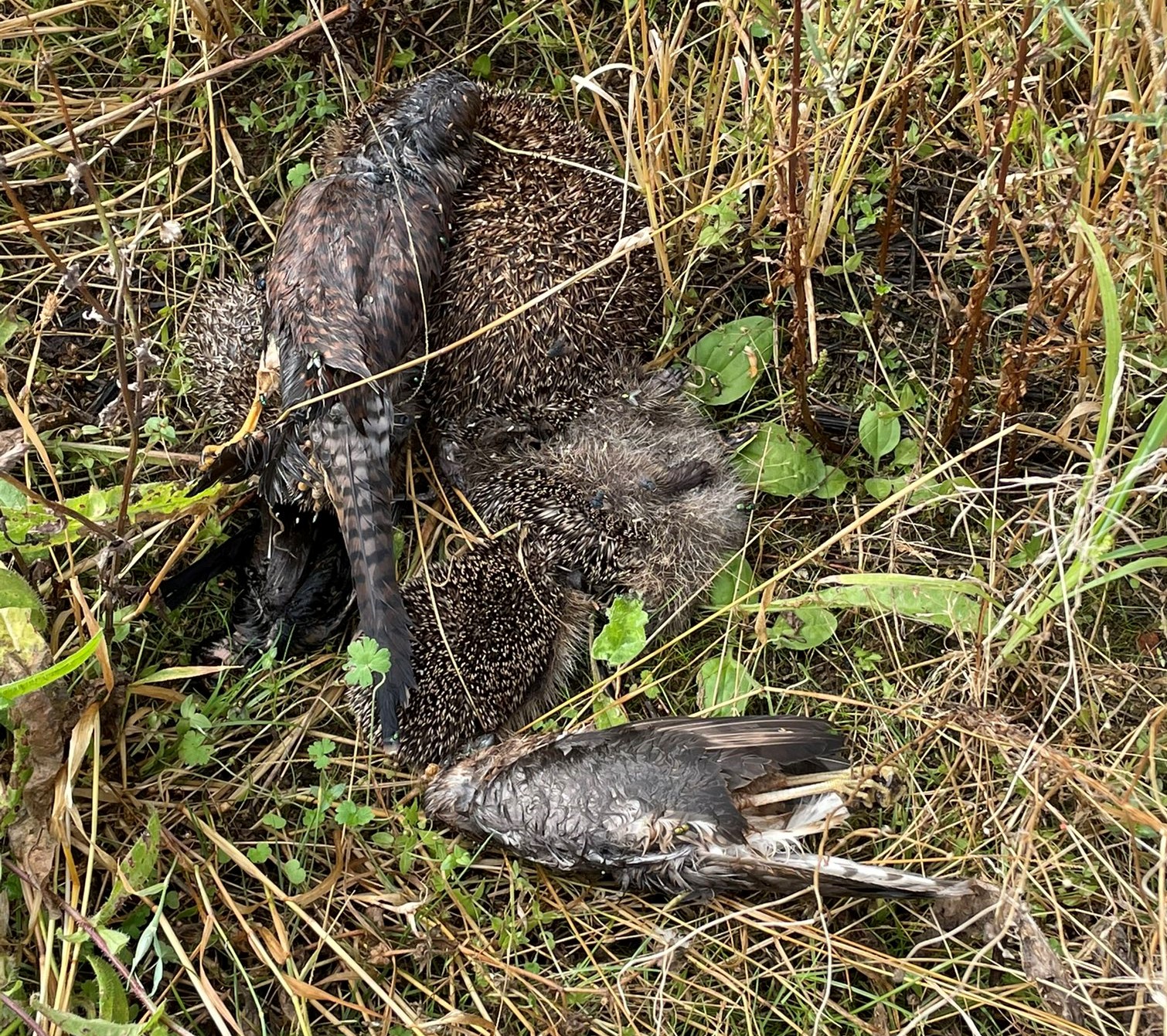
Gruesome photographs have emerged this morning of dead wildlife found dumped in a pile in a layby near Harty on the Isle of Sheppey, Kent.
The person who found the corpses (@neish397) identified them as three kestrels and ten hedgehogs. He posted the photos on Twitter and asked for advice about what to do. He tried to report this incident as a suspected wildlife crime to Kent Police using the 101 reporting system but was apparently told by a call handler that he needed to report it online.
Fortunately, the RSPB Investigations team were also alerted and are currently dealing with this incident.
In response to the news that Police Scotland are investigating the circumstances of five eagles found dead in the Western Isles earlier this month (see here), Scottish Land & Estates (SLE), the grouse moor owners’ lobby group has issued what I’d call a staggeringly disingenuous statement, where the blame for ongoing raptor persecution appears to be being projected on to those of us who dare to call out the shooting industry for its ongoing war against birds of prey.
Here’s SLE’s statement in full, dated 20 August 2021:
Response to raptor fatalities should not depend on location or landuse
Reports of five eagles being found dead on the Western Isles are very serious.
Police Scotland has said that officers are investigating and it is to be hoped that the facts of these potentially shocking incidents are established as quickly as possible.
The birds – four golden eagles and a white-tailed sea eagle – were found at separate locations on Lewis and Harris and it is said that, at this stage, they are not linked.
No grouse shooting takes place on the Western Isles and we wholeheartedly support the police’s appeal for information and anyone who can help should call Police Scotland on 101, or make a call anonymously to the charity Crimestoppers on 0800 555 111.
It has been suggested that intraguild predation – where one species predates on another – may be one possible explanation in these cases but equally we accept there is the prospect that a terrible wildlife crime has been committed to protect livestock.
If that is the case, outright condemnation is the only rightful response.
That applies wherever raptor persecution takes place.
The response from some quarters thus far to the incidents on the Western Isles is in sharp contrast to what happens over alleged incidents that occur in areas where land is managed for grouse shooting. In these cases organisations and campaign groups are very quick off the mark to point fingers. If a wildlife crime takes place on land managed for shooting, livestock farming or any other land use (and such incidents are thankfully rare, becoming more so all the time) then it must be investigated and the culprits should face the full force of the law. It can be difficult to prosecute but Scotland now benefits from some of the most stringent laws against raptor persecution in Europe. A lot more could be achieved with less finger pointing and more constructive collaboration on the ground. Scotland is fortunate to have historically high numbers of golden eagles and we want to see even more of them.
ENDS
So SLE is unhappy that campaigners keep ‘pointing fingers’ at the grouse-shooting industry whenever an illegally shot / poisoned / trapped bird of prey is discovered dead or critically injured on, er, a driven grouse moor?!!!!!!!!!
Or when satellite-tagged hen harriers and golden eagles keep ‘disappearing’ in suspicious circumstances, on or close to driven grouse moors.
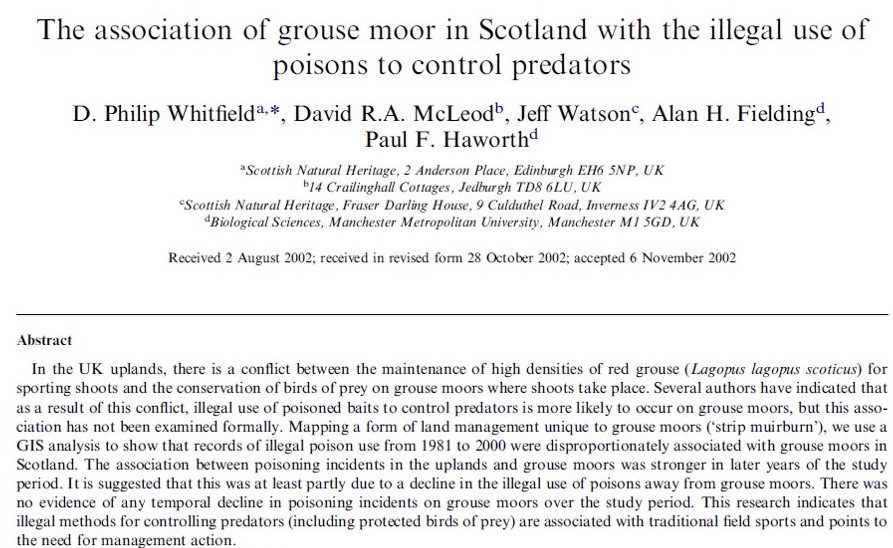
If these crimes were just a one-off, once-in-a-blue-moon occurrence then yes, perhaps SLE would have a point. However, the connection between the driven grouse shooting industry and the illegal persecution of birds of prey has been clear for decades, and backed up with endless scientific papers and Government-commissioned reviews (here are the latest for golden eagle and for hen harrier).
Here’s an example of how long this has been going on – a scientific paper published in 2002, using data from 1981-2000 – demonstrating an indisputable link between grouse moors and illegal poisoning:
1981 – that was 40 years ago!!
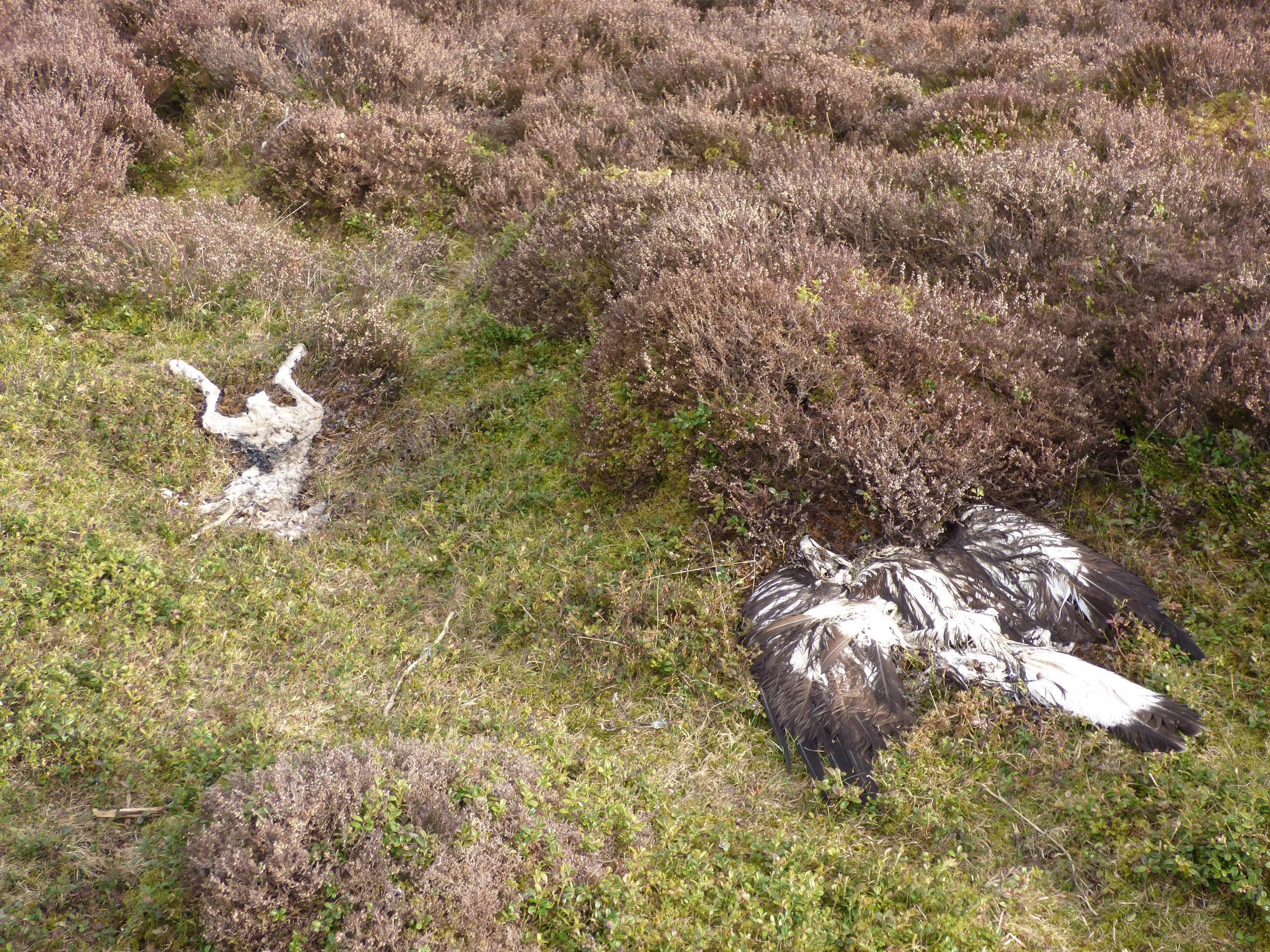
And yet here we are in 2021 and still illegally poisoned golden eagles are being found dead on grouse moors and still nobody has ever been successfully prosecuted in Scotland for killing a golden eagle. The most recently confirmed poisoned eagle was this one inside the Cairngorms National Park, right next door to the royal estate of Balmoral. In fact this eagle is believed to have fledged on Balmoral a few months before it flew to neighbouring Invercauld Estate (an SLE member, no less) where it consumed a hare that had been smothered in a banned pesticide and laid out as a poisoned bait. The person(s) responsible for laying this poisoned bait have not been identified.
[Poisoned golden eagle laying next to poisoned mountain hare bait, Invercauld Estate, Cairngorms National Park. Photo by RSPB Scotland]
Such is the extent of illegal persecution on some driven grouse moors, it is having (and continues to have) a population-level effect on some species, including golden eagles, hen harriers, red kites and peregrines.
And such is the extent and quality of this scientific evidence, the Scottish Government has committed to implementing a licensing scheme for grouse shooting in an attempt to try and rein in the criminal activity that underpins this so-called ‘sport’ because Ministers recognise the grouse-shooting industry is incapable of self-regulation.
I don’t know what SLE means when it says it wants ‘more constructive collaboration on the ground‘. Perhaps it means that gamekeepers will step forward and provide more than ‘no comment’ interviews when the police are investigating the latest crime on a grouse-shooting estate, instead of offering the usual wall of silence?
Perhaps it means the estate owners will refuse to employ the sporting agents and head gamekeepers whose methods are well known to include routine raptor persecution? (These individuals are well known – it’s no secret within the industry who they are).
Or perhaps it means that the shooting industry itself, including the game-shooting organisations, the shooting press etc will blacklist those estates known to still be killing birds of prey, instead of accepting funding donations from them and pretending that they don’t know what’s going on there?
That’d be useful, constructive collaboration, wouldn’t it?
Until all of that happens, SLE and the rest of the grouse shooting cabal can expect people like me and my colleagues in the conservation field to continue shining a bloody great big megawatt spotlight on this filthy industry.
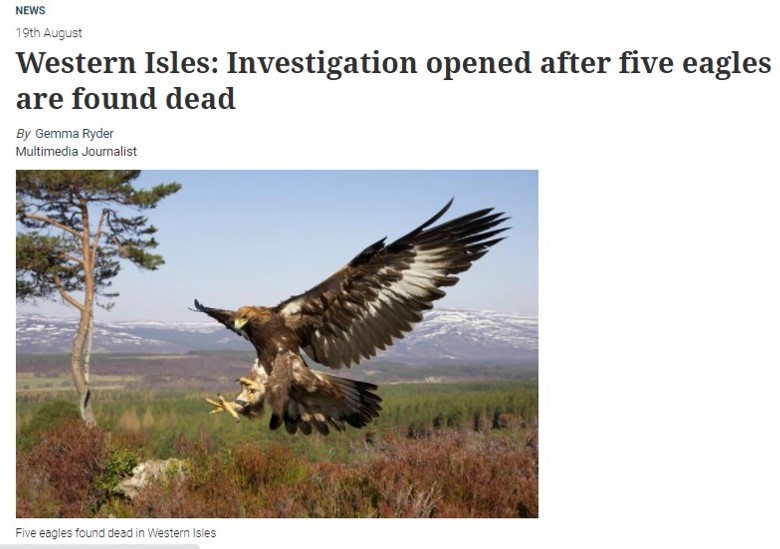
Police Scotland have opened an investigation on the Western Isles after the discovery of five dead eagles within the space of a week.
Two golden eagles and a white-tailed eagle were found dead on the Isle of Harris on 7th August, and another two golden eagles were found dead on the Isle of Lewis on 14th August 2021.
This article about the discoveries appeared yesterday in The Herald:
Police say they are investigating after five eagles were found dead in the Outer Hebrides in a space of a week.
Two golden eagles had been found dead two miles south of Bragar on the Isle of Lewis on August 14.
While two golden eagles and white tailed sea eagle were found dead near Bowglass on the Isle of Harris, a week before on August 7.
The birds found on August 7 were significantly decomposed but forensic work is being undertaken to try to establish how they died.
Although the eagles were found dead in similar circumstances, the incidents are not being treated as linked.
Inspector Jane MacKenzie said: “Around 1.25pm on Saturday 14 August 2021, officers received a report that two golden eagles had been found dead two miles south of Bragar on the Isle of Lewis. Enquiries are ongoing to establish the full circumstances.
“Enquiries are also ongoing after two golden eagles and white tailed sea eagle were found dead near Bowglass on the Isle of Harris on Saturday, 7 August, 2021. They were significantly decomposed but forensic work is being undertaken to try to establish how they died.
“Eagles are protected birds of prey and Police Scotland will always investigate reports of these birds being found dead. It can be highly complex, requiring detailed scientific work, but we will always strive to bring anyone responsible for this type of wildlife crime to justice.
“Anyone with information about these birds, or any wildlife crime, can contact Police Scotland on 101, or make a call anonymously to the charity Crimestoppers on 0800 555 111.”
ENDS
That police quote is fairly circumspect, which is perhaps understandable given the investigation is still in the early stages and this isn’t an official police press release. However, local information provided to me suggests the investigation into the first incident is much further ahead than has been indicated here. Based on that information, I’m very surprised to see the journalist claim the incidents are not being treated as linked (presumably that information came from the police?). Hmm, I wonder…..
Although if a crime is confirmed, don’t expect the investigation to result in a prosecution. Despite Inspector MacKenzie’s fine words, which undoubtedly were given with genuine sincerity, I’m not aware of anybody being convicted for killing an eagle in Scotland.
Ever.
If you have information about these five dead eagles, please contact Police Scotland on 101.
In July this year, a shot goshawk was found in one the country’s most notorious raptor persecution black spots in the northern Monadhliaths in the Highlands (see here).
A member of the public discovered the dead bird in woodland managed by Forestry Land Scotland (FLS), which is close to land managed for grouse and pheasant shooting. The corpse was retrieved by the Police, FLS and the RSPB and sent for post mortem where it was confirmed it had been shot.
It is by no means unusual that masked gunmen will visit public woodland to attack goshawk nests (e.g. see here, here and here) especially as this highly efficient predator is a perceived threat to gamebird stocks and as such is despised by many in the game-shooting industry.
Police Scotland issued a timely appeal for information (here) and opened a criminal investigation.
Unfortunately, as with so many raptor persecution crimes, that investigation has now reached a dead end. A police spokesperson has advised that ‘all lines of enquiry have been completed, including CCTV, door to door enquiries, local enquiries, vet analysis of the remains, x-ray of remains, background checks, social media and traditional media press release‘.
There haven’t been any arrests and there won’t be any prosecutions unless new information comes to light.
Of course, this doesn’t mean that the crime didn’t take place (some in the game-shooting industry would have you believe that no prosecution = no crime), it just means that yet again, someone with access to a gun in this area has been able to commit a crime and will face zero consequences, just like the last time, and the time before that, and the time before that, and…..etc etc.
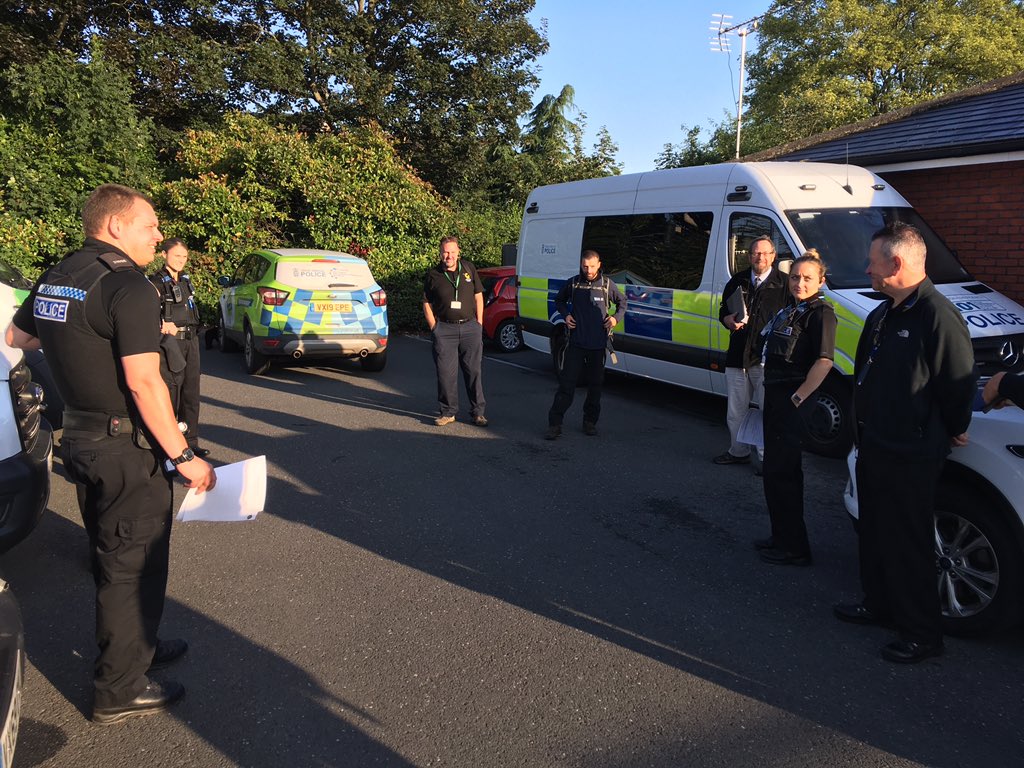
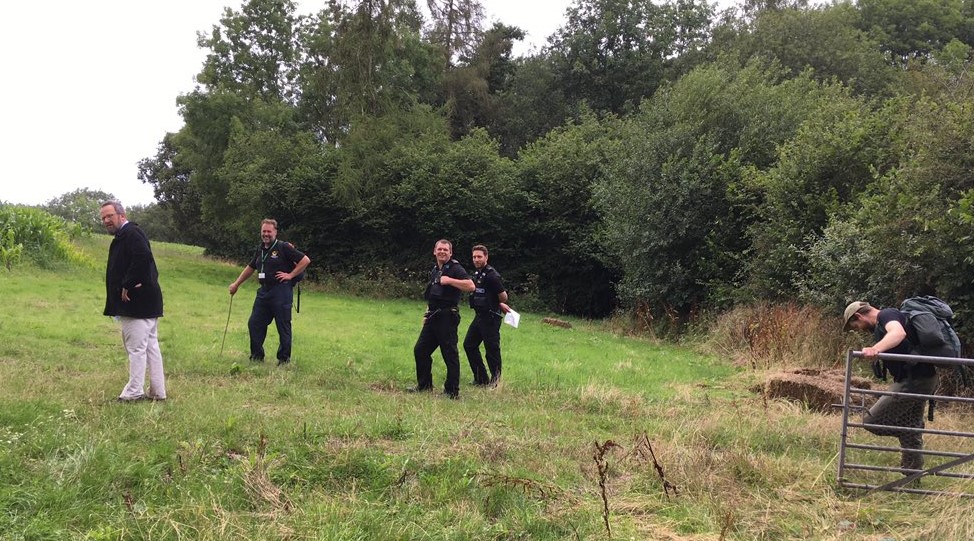
Herefordshire Police led a multi-agency raid on Thursday 12th August following a suspected raptor persecution incident in the south west of the county.
The police were joined by staff from Natural England, National Wildlife Crime Unit and RSPB Investigation’s team. Items were seized and enquiries are apparently continuing.
[Photos from RSPB]
This is at least the 7th multi-agency search in England this year, all in response to raptor persecution crimes. On 18th January 2021 there was a raid in Suffolk (here), on 15th March there was a raid in Lincolnshire (see here), on 18th March a raid in Dorset (here), on 26th March a raid in Devon (see here), on 21st April a raid in Teesdale (here), on 2nd August a raid in Shropshire (here) and now this raid in Herefordshire.
Well done to all the agencies involved in these follow-up investigations. It’s good to see genuine partnership-working in the fight to catch the raptor killers.
A gamekeeper appeared in court on 12th August 2021 accused of the alleged killing of a number of buzzards in Nottinghamshire in January 2021.
He was charged after a joint investigation by Nottinghamshire Police and the RSPB’s Investigations Team (see here).
The gamekeeper pleaded not guilty so this case will now progress to trial.
Trial dates have been set for 6th-7th January 2022.
Please note, as this is a live case no further detail will be provided here until the case has concluded or there is official commentary from the court reporter. Comments on this particular blog also won’t be accepted until the case concludes so as not to prejudice proceedings. Thanks for your understanding.
A gamekeeper is due in court tomorrow (12th August 2021) accused of the alleged killing of a number of buzzards.
This prosecution relates to the joint investigation undertaken by Nottinghamshire Police and the RSPB’s Investigations Team in January this year (see here). It’s a good example of what genuine partnership-working can achieve.
Tomorrow’s court hearing will provide an opportunity for the defendant to enter a plea.
If he pleads not guilty, the case is expected to continue to go to trial at a later date.
If he pleads guilty, he may be sentenced tomorrow or the magistrate may ask for background reports before sentencing at a later date.
Please note, as this is a live case no further detail will be provided here until the case has concluded or there is official commentary from the court reporter. Comments on this particular blog also won’t be accepted until the case concludes so as not to prejudice proceedings. Thanks for your understanding.
UPDATE 15th August 2021: Trial date set for gamekeeper accused of killing buzzards (here)
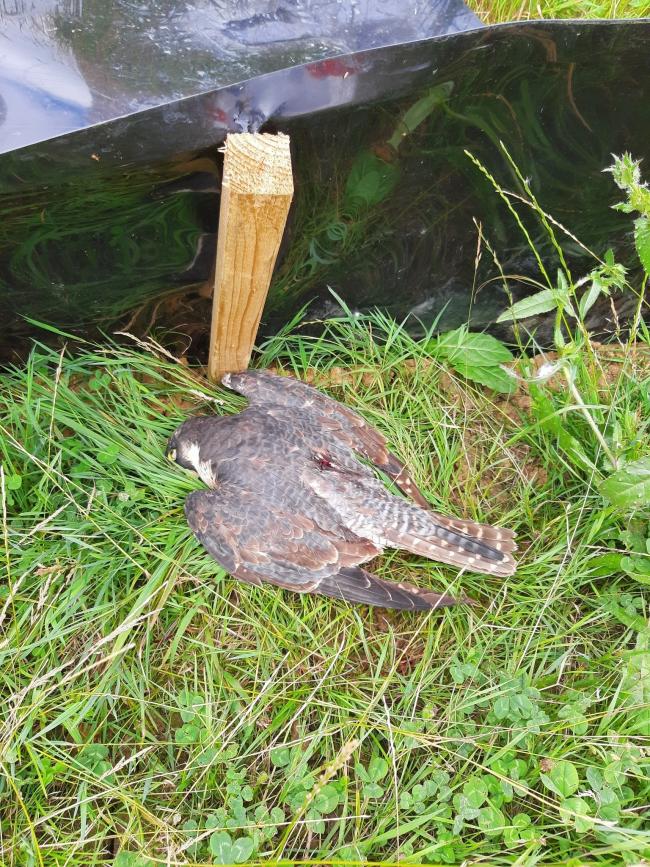
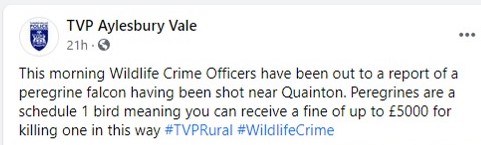
Yesterday, Thames Valley Police (Aylesbury Vale) posted this on Facebook:
I haven’t been able to find any follow-up information, e.g. whether the peregrine was x-rayed to confirm/rule out shooting and there isn’t an incident number or an appeal for information on the Thames Valley Police website.
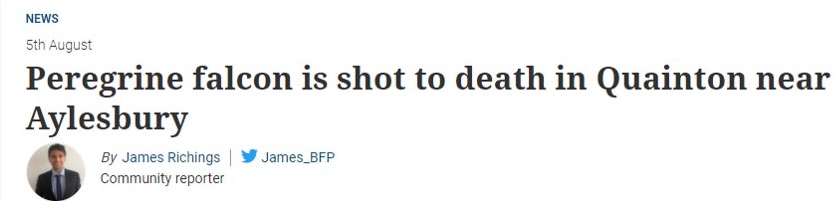
Meanwhile, the local press are reporting this as a confirmed shooting. Eg. see this headline from the Bucks Free Press:
Wouldn’t it be good if there was a national standard on how to report suspected raptor persecution crimes, that every police force could follow? And a central location where these verified reports could be found?
A multi-agency search took place in Shropshire yesterday as part of the ongoing investigation in to the suspected poisoning of a peregrine earlier this year.
You may recall the very prompt appeal for information made by West Mercia Police in May (see here) after the corpse of a female peregrine had been found, along with a suspected pigeon bait, at the notorious raptor persecution blackspot of Clee Hill.
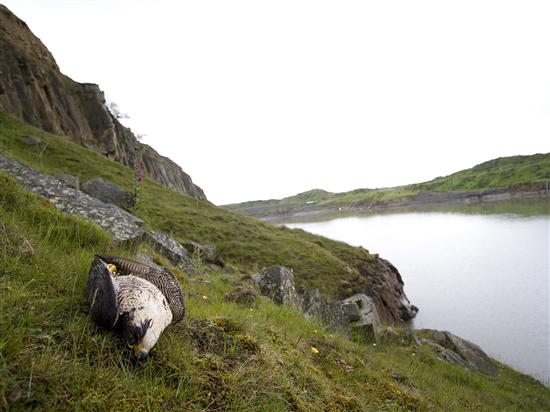
[This is a photograph of another peregrine found poisoned at this site in 2017 (see here). Photo by RSPB]
Toxicology results are apparently still pending on this latest case but given the long history of poisoned peregrines at this site, and the discovery of yet another baited pigeon, it’s more than likely that this latest peregrine victim had also been illegally poisoned.
No doubt this is what prompted the police-led search at a premises yesterday, assisted by experts from Natural England, the National Wildlife Crime Unit and the RSPB Investigations team. The investigation continues.
[Photo via West Mercia Police]
This is at least the 5th multi-agency search in England this year, all in response to raptor persecution crimes. On 15th March 2021 there was a raid in Lincolnshire (see here), on 18th March a raid in Dorset (here), on 26th March a raid in Devon (see here) and on 21st April a raid in Teesdale (here). And now this raid in Shropshire.
Worryingly, all of these cases have involved the confirmed / suspected use of banned poisons to kill birds of prey.
Well done to all the agencies involved in these follow-up investigations. It’s good to see genuine partnership-working in the fight to catch the raptor killers.







 Raptor Persecution UK