Further to yesterday’s blog about the discovery of a poisoned Red Kite, found in close proximity to a poisoned bait (a Lapwing) on Dava Moor in May 2021 (see here), there has been a development.
In yesterday’s blog I mentioned that I was curious about why, 19 months after the crime was discovered, there hadn’t been a General Licence restriction imposed on this grouse moor.
I’ve been in touch with NatureScot about this and they’ve confirmed that they didn’t know the investigation had concluded but now that they do know that, they’ll be contacting Police Scotland and requesting the documentation on this case, which NatureScot will consider under the General Licence Restriction Framework to see whether the threshold for a restriction notice has been met.
Excellent news, well done NatureScot.
Given the lengthy procedure involved under the Framework, including giving the landowner/shoot operator an opportunity to provide a defence, we won’t hear about the decision until well into the New Year.
UPDATE 17th January 2023: Police Scotland confirm red kite found poisoned on grouse moor had been killed with banned pesticide (here)
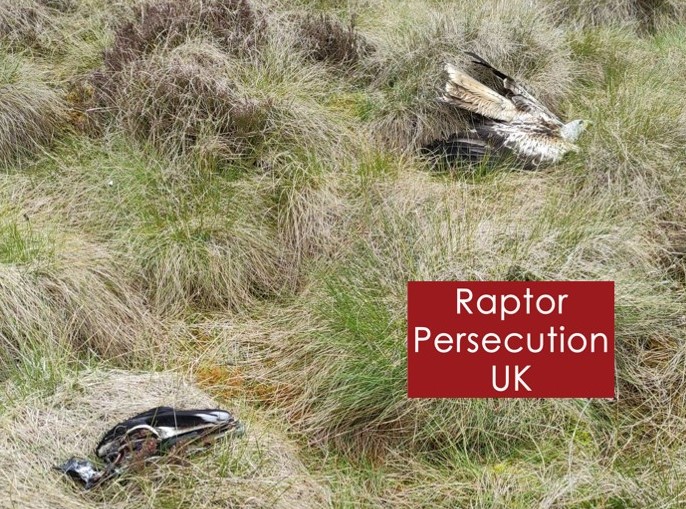
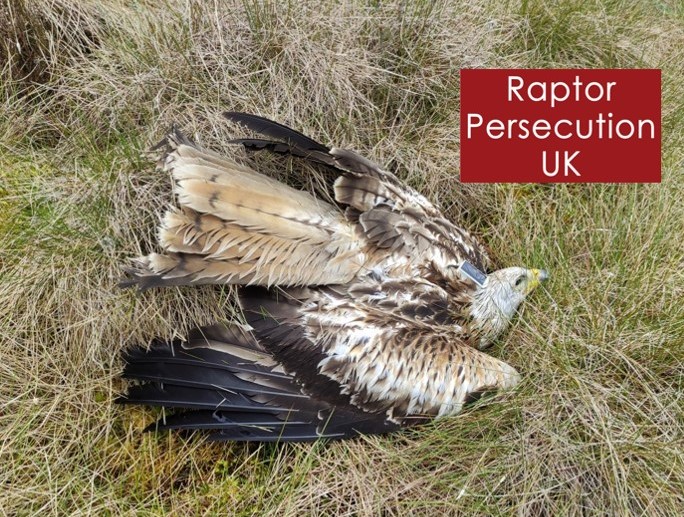
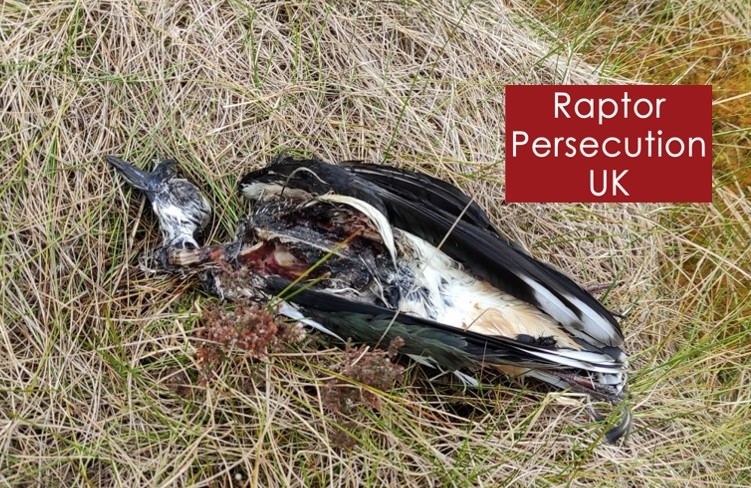
A young satellite-tagged Red Kite has been found poisoned on a Scottish grouse moor, lying next to a poisoned bait, in this case, a Lapwing, whose corpse had been cut open to entice any passing predator and to allow for easy access to the poison.
This gruesome discovery was made by a member of the public on 20th May 2021 on Dava Moor, just beyond the boundary of the Cairngorms National Park.
The Red Kite had hatched in a nest near Grantown on Spey in 2020. This nest was only the second to be located in Badenoch & Strathspey; the first pair at nearby Cromdale disappeared after just one successful breeding season. That only two nests have been located in Badenoch & Strathspey, 32 years after the start of the re-introduction of red kites to the Black Isle, speaks volumes of the ongoing illegal persecution in this region, as noted in a scientific study published in 2016 (here).
Police Scotland attended the scene of the poisoning and collected the Red Kite and the Lapwing for toxicology analysis. They also conducted a search of the grouse moor the following week. Toxicology tests confirmed the presence of poison in both the Kite and the Lapwing.
Sixteen months later in September 2022, Police Scotland notified the member of the public that ‘enquiries are complete, nobody has been charged and the case is now closed‘.
So where was the Police Scotland press release about this serious wildlife crime?
Where was the appeal for information about this serious wildlife crime?
Why has the name of the poison been withheld? Given the proximity of the poisoned Red Kite to the poisoned bait, we can assume it was a fast-acting, highly toxic poison, dangerous to humans as well as to wildlife. Was it one of the eight poisons (Aldicarb, Alphachloralose, Aluminium phosphide, Bendiocarb, Carbofuran, Mevinphos and Sodium cyanide and Strychnine) banned under the Possession of Pesticides (Scotland) Order 2005, so dangerous it’s even an offence to be in possession of these chemicals, let alone to place them out on a bait in the open countryside?
Where was the warning to both locals and visitors to the area from Police Scotland about this serious threat to public safety?
Who benefits from this secrecy? Not the public, that’s for sure, and not wildlife.
Police Scotland has form for withholding information about raptor persecution crimes (e.g. see here, here, here, here). It’s noticeable that yet again, in the RSPB’s latest Birdcrime Report (2021), Police Scotland is the only force (with the exception of Dorset Police – on which more shortly) to withhold details of crimes that took place over a year ago.
I don’t know who’s making these decisions – I doubt very much it’s the wildlife crime officers on the ground, most of whom these days are undertaking prompt and rigorous investigations – but somewhere up the chain of command a decision appears to have been made to keep these serious crimes under wraps. Why is that?
I don’t understand the rationale at all. Certainly, in the early stages of an investigation it often pays for details to be withheld so as not to compromise searches etc. But sixteen months after the crime is discovered? It doesn’t make sense, and all it does is undermine public confidence.
I’d also like to know why a General Licence restriction hasn’t been imposed on Dava Moor. I understand from conversations with locals that somebody other than the landowner may be responsible for the ‘sporting management’ of Dava Moor. I’ve been told who that is by a number of people but have been unable to verify it so I’m not publishing it here. Nevertheless, at least two General Licence restrictions have previously been applied on landholdings that were ‘managed’ by someone other than the landowner so that shouldn’t be a barrier to imposing a restriction in this case.
And this isn’t the only illegal poisoning incident that Police Scotland are withholding from the public…more shortly.
UPDATE 6th December 2022: General Licence restriction to be considered on grouse moor where poisoned red kite and bait found (here)
UPDATE 2nd January 2023: Raven poisoned with banned chemicals – Police Scotland withhold information (here)
UPDATE 17th January 2023: Police Scotland confirm red kite found poisoned on grouse moor had been killed with banned pesticide (here)
Record high wildlife crime levels could be worsened by new Government law, warn wildlife campaigners
*Figures collected annually by nature organisations reveal that wildlife crime rates remained stubbornly high in 2021, following record highs in 2020
*Convictions for most wildlife crime types rose in 2021 from record lows in 2020, with hunting and bat crimes showing the biggest proportional increase in conviction rates (although from low baselines).
*Campaigners are warning reductions in wildlife protections in the Retained EU Law Bill could see further rises in wildlife crime and are calling on Government to stop the Bill and make crucial improvements to wildlife crime monitoring and enforcement recommended by the UN.
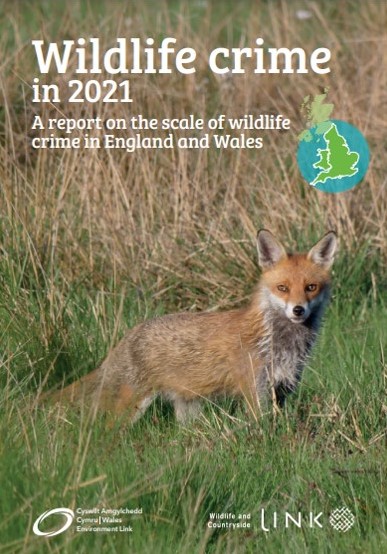
The annual Wildlife Crime Report compiled by Wildlife and Countryside Link, with information from groups including RSPB, WWF UK, and the League Against Cruel Sports, has shown that crime against wildlife in 2021 was at record levels. Wildlife crimes include, for example, hare coursing, persecution of birds of prey, badgers and bats, disturbance of seals and dolphins and illegal wildlife trade.
In England and Wales there were 1414 reported wildlife crime incidents (outside of fisheries), almost exactly the same level as in 2020 (1404). There were 3,337 fisheries crime reports in 2021, down from 4,163 in 2020. The scale of wildlife crime is likely to be far higher than the report details, due to lack of official recording and monitoring of most of the data relying on direct reports from members of the public to nature groups.
Dr Richard Benwell, CEO of Wildlife and Countryside Link, said: “Wildlife crime soared during the pandemic and remained at record levels this year. Progress on convictions is positive, and we welcome DEFRA’s efforts to stiffen sentencing, but overall that is of little use while the rate of successful prosecutions remains so low.
The snapshot in our report is likely to be a significant under-estimate of all kinds of wildlife offences. To get to grips with these cruel crimes, the Home Office should make wildlife crime notifiable, to help target resources and action to deal with hotspots of criminality.
The Retained EU Law Bill threatens to be a serious distraction, and could even lead to important wildlife laws being lost. Instead, seven years on from its publication, the Government should implement the Law Commission’s 2015 wildlife law report. Surely it is better to spend time and money improving laws that are as much as two centuries old, than wasting time reviewing effective environmental laws under the REUL bill.”
Martin Sims, Chair of Link’s Wildlife Crime Working Group, said: “We must empower police forces to act on wildlife crime. We already see how, with proper resources and training, a real difference can be made in the work against awful crimes like hare coursing. It’s the counties with well-funded and resourced projects in place where we’re seeing the most positive progress. Also essential to efforts to better protect our wildlife is making wildlife crime notifiable, and recorded in national statistics. This would better enable police forces to gauge the true extent of wildlife crime and to plan strategically to address it.”
The pandemic contributed to the high wildlife crime reporting figures in both 2020 and 2021. COVID-19 restrictions appear to have increased reporting of wildlife crimes in several ways. Opportunistic offenders may have felt that with the police busy enforcing social restrictions that wildlife could be harmed with relative impunity. With increased use of the countryside and coast in the pandemic more members of the public were also present to witness and report incidents of concern. Increased domestic tourism also played a role in increased wildlife disturbance of marine mammals.
There was a positive increase in convictions in some types of wildlife crime in 2021. But low levels of prosecutions and low conviction rates are an on-going challenge in tackling wildlife crime. Despite the number of convictions in 2021 being more than double the rate in 2020, there were still only 55 convictions for wildlife crimes in the whole year (if well-resourced and enforced fisheries crimes are excluded). And for hunting crimes alone more than half (53%) of prosecutions were unsuccessful in securing a conviction in 2021. This is compared to an 82% conviction rate across all crime. A lack of training and resources is central to this issue.
The report highlights the difference in what can be achieved with the right budget, training, and resources, with concerted action to tackle hare-coursing being a main factor in the increase in convictions in 2021. This follows a nationwide police operation to tackle the issue – Operation Galileo – achieving good results. Consequently 2021 saw the highest number of cases proceeded against accused hunting crimes since 2015, with 80 cases taken to court. The highest increases in prosecutions were in Norfolk and Suffolk where police forces were active in Operation Galileo and other police activities designed to reduce the impact of hare coursing. This policing focus corresponded with legislative action, which has seen hare coursing sanctions increased in the Policing, Crime Sentencing and Courts Act 2022 (rising to up to 6 months imprisonment and unlimited fines). Similar action needs now to be taken to enable the more effective prosecution of other hunting crimes, including the illegal hunting of foxes with dogs.
Despite this positive legislative move, one new Bill from Government could actively worsen wildlife crime. The Retained EU Law Bill is intended to ‘save, repeal, replace, restate or assimilate’ the retained EU law (known as REUL) applying in the UK within a set time period. These laws include the Conservation of Habitats and Species Regulations 2017, which make it a criminal offence to damage the habitats of key species including badgers and bats. Such habitat offences form the majority of the wildlife crimes against badgers and bats. The Bill is likely to lead to the hasty rewriting of the regulations, potentially weakening the legislative underpinning for tackling common wildlife crimes.
To properly tackle the issue of wildlife crime, nature experts are calling for the following actions (most of which were also recommended by a UN report in 2021):
Making wildlife crimes notifiable to the Home Office, so such crimes are officially recorded in national statistics. This would better enable police forces to gauge the true extent of wildlife crime and to plan strategically to address it.
Increasing resources & training for wildlife crime teams in police forces. Significant investment in expanding wildlife and rural crime teams across police forces in England & Wales, and the placing of National Wildlife Crime Unit funding on a permanent basis, would enable further investigations, and lead to further successful prosecutions.
Reforming wildlife crime legislation. Wildlife crime legislation in the UK is antiquated and disparate. A 2015 Law Commission report concluded these laws are ‘‘overly complicated, frequently contradictory and unduly prescriptive’’. Much of this stems from the need to prove ‘intention and recklessness’, which has stunted the potential for prosecution in even clear cases of harm being done to protected and endangered species.
The immediate withdrawal of the Retained EU Law Bill. Retained EU laws include the Conservation of Habitats and Species Regulations 2017, which (amongst other protections for habitats and species), make it a criminal offence to damage the habitats of key species including badgers and bats. These vital protections are at risk of being dropped or weakened, undermining the legislative foundation for tackling common wildlife crimes.
ENDS
Wildlife & Countryside LINK’s previous Wildlife Crime Reports can be read here and the 2021 report can be read here:
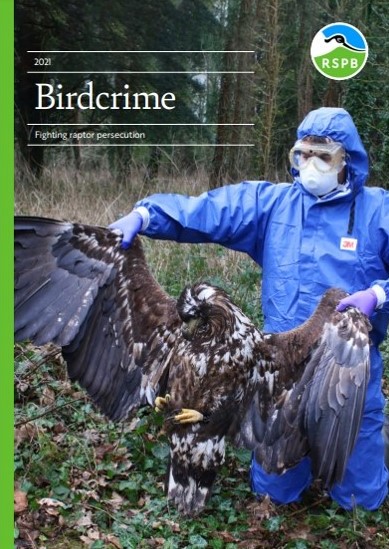
Last week the RSPB published its latest annual Birdcrime report covering the period Jan – Dec 2021.
The headlines from this rigorously-compiled data can be summarised as follows:
Protected birds of prey continue to be illegally killed in high numbers, particularly in relation to land managed for gamebird shooting
Birdcrime report reveals 80 of 108 confirmed incidents were in England alone: the second-highest figure for England on record
Norfolk is now the county with the worst record, followed by Dorset. North Yorkshire, which has topped the table for consecutive years, is now third.
‘Nothing will change’ without urgent government action
The RSPB published two press releases about the report – one covering the crimes in England (here) and one covering the crimes in Scotland (here).
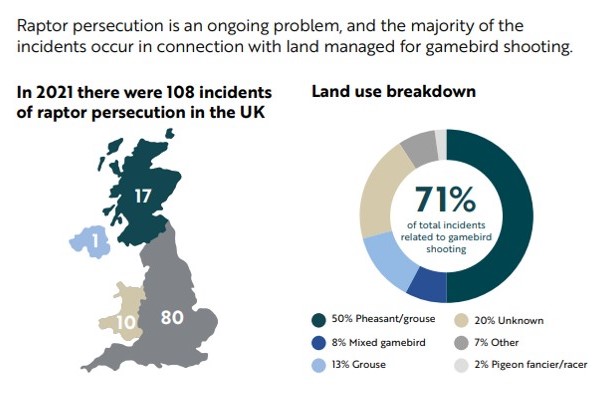
In 2021, yet again, over two thirds (71%) of all confirmed incidents of raptor persecution took place on land managed for gamebird shooting, where birds of prey are seen by some as a threat to gamebird stocks and illegally killed.
[Infographic from Birdcrime 2021]
Unsurprisingly, representatives from the game-shooting industry, all claiming to have ‘zero tolerance’ for raptor persecution, have dismissed the data and some have gone as far as calling the RSPB ‘liars’.
The funniest response I’ve read so far is that written by the Yorkshire Dales Moorland Group, who published this on Facebook:
‘The RSPB has released its Bird Crime Report and once again it predictably focuses an inordinate amount of attention on the gamekeeping profession. Why is the YDMG not embracing the report and working with the RSPB to improve the fortunes of moorland birds? Well to put it bluntly, the report is pure exaggeration, wordsmithing for self-promotion and simply the unjustified stigmatisation of a rural occupation and craft without basis. YDMG will refrain from using too many emotional remarks about the RSPB report but suffice it to say the moorland gamekeeping community is offended by the report and it’s [sic] misrepresentations…’.
It’s worth remembering that members of the Yorkshire Dales Moorland Group, like so many of the other regional moorland groups, have for years been at the centre of police investigations into the illegal killing of birds of prey. Indeed, raptor persecution is such a problem in this area that the Yorkshire Dales National Park Authority has had to include the tackling of illegal raptor persecution as an objective in the Park’s official Management Plan (here) and last year was so incensed at the continued killing, the Park Authority was moved to issue a press statement about it (here).
Of course, disputing the RSPB’s persecution figures is now an annual pantomime by the game-shooting industry, because doing anything else would mean having to admit that some of their members are still killing these birds, nearly 70 years after it became illegal to do so. It seems it’s far easier for them to attack the reputation and credibility of the RSPB than get their own house in order and self-regulate.
In Scotland, this tactic worked for many years but eventually the weight of evidence against the grouse shooters was so great that the Scottish Government was forced to act and we now see the introduction of new legislation, brought in specifically to take action against those who continue to trap, poison and shoot birds of prey.
In England we still have a Government intent on wilful blindness, largely due to many in power having a vested interest in the game-shooting world. However, I read a tweet by ecologist and author Ian Carter recently, who often has a knack of hitting the nail on the head:
I think Ian is spot on with this and I think he summarises the views of many moderates on this subject, including mine.
The RSPB’s 2021 Birdcrime report can be downloaded below, along with the Data Appendices detailing the crimes:
A court hearing has been delayed once again in the case of a Scottish gamekeeper accused of killing a sparrowhawk.
[Sparrowhawk photo by Markus Varesvuo]
The un-named 22-year-old gamekeeper was charged in September 2021 (see here) for the alleged killing on a grouse moor in Inverness-shire and he was due in court on 30th September 2022.
The case was delayed until 10th November 2022 (see here).
The case has now been further delayed and the next court hearing is scheduled for January 2023.
As this is a live case no comments will be accepted on this blog post until criminal proceedings have ended. Thanks for your understanding.
UPDATE 8th February 2023: Scottish gamekeeper charged with killing Sparrowhawk on a grouse moor – new court hearing (here)
I’ve been meaning to write about this for a while but it kept slipping down the list. However, it’s timely to write it now because I’ll be focusing some attention on Strathbraan in some forthcoming blogs.
In November last year, RSPB Scotland published a blog about the Werritty Review of grouse moor management and how the Scottish Government had accepted the Review’s findings but hadn’t yet begun to implement any of the recommendations.
Within that blog, the RSPB highlighted the ongoing illegal persecution of birds of prey on Scottish grouse moors during 2021. Two incidents stood out to me, mainly because it was the first time these two crimes had been reported in the public domain. They concern the illegal shooting of two ravens on two different grouse moors in the Strathbraan area of Perthshire. Here is what the RSPB blog says about them:
‘Ravens continue to be illegally killed on grouse moors with a dead bird found in April, hidden under rocks below its nest high up a hill on a Perthshire estate that had no licence to control them. The post-mortem report indicated that it had been shot, and -previously recovered from its wounds.
The day it was killed, it was again shot, but again this was not immediately fatal. According to the SRUC vet’s report, it then suffered “severe, mostly blunt trauma characterised by broken beak, crushed cranium, fracture-dislocation of the neck, …fracture of the left wing at four sites, fracture of the left leg and massive internal haemorrhage.” As it flapped around on the ground, it appears that the person who shot this bird then stamped on it repeatedly.
Elsewhere, another raven was seen tumbling to the ground after being shot as it mobbed an eagle owl that had been tethered to a post on another moor in February’.
The post-mortem report on that first raven is chilling, and that crime deserves far more publicity than being tucked away half-way down an RSPB blog. As indeed does the shooting of the second raven, where once again the use of a tethered eagle owl deployed as a bait to lure in the victim has been central to the crime.
Regular blog readers will already know that Strathbraan is not only a raptor-killing hotspot, recognised as such in a Government-commissioned report on the illegal killing of golden eagles, but it is also well-known as the location of a five-year raven cull research licence, issued by Scottish Natural Heritage (SNH) to gamekeepers in 2018 ‘just to see what happens‘ but then hastily withdrawn after the threat of a legal challenge by the Scottish Raptor Study Group and an admission by SNH (now NatureScot) that the research licence was was “completely inadequate“, “seriously flawed“, and “will fail to provide any meaningful scientific evidence“.
For anyone who still wants to pretend that the grouse shooting industry isn’t responsible for the systematic extermination of hen harriers on grouse moors across the UK, here’s the latest catalogue of crime that suggests otherwise.
[This male hen harrier died in 2019 after his leg was almost severed in an illegally set trap that had been placed next to his nest on a Scottish grouse moor (see here). Photo by Ruth Tingay]
This is the blog I now publish after every reported killing or suspicious disappearance.
“They disappear in the same way political dissidents in authoritarian dictatorships have disappeared” (Stephen Barlow, 22 January 2021).
Today the list has been updated to include the most recently reported victim, a young satellite-tagged hen harrier called ‘Sia’ that ‘disappeared’ on 10th October 2022 and is the subject of a police investigation (see here).
I’ve been compiling this list only since 2018 because that is the year that the grouse shooting industry ‘leaders’ would have us believe that the criminal persecution of hen harriers had stopped and that these birds were being welcomed back on to the UK’s grouse moors (see here).
This assertion was made shortly before the publication of a devastating new scientific paper that demonstrated that 72% of satellite-tagged hen harriers were confirmed or considered likely to have been illegally killed, and this was ten times more likely to occur over areas of land managed for grouse shooting relative to other land uses (see here).
2018 was also the year that Natural England issued a licence to begin a hen harrier brood meddling trial on grouse moors in northern England. For new blog readers, hen harrier brood meddling is a conservation sham sanctioned by DEFRA as part of its ludicrous ‘Hen Harrier Action Plan‘ and carried out by Natural England (NE), in cahoots with the very industry responsible for the species’ catastrophic decline in England. For more background see here.
Brood meddling has been described as a sort of ‘gentleman’s agreement’ by commentator Stephen Welch:
“I don’t get it, I thought the idea of that scheme was some kind of trade off – a gentleman’s agreement that the birds would be left in peace if they were moved from grouse moors at a certain density. It seems that one party is not keeping their side of the bargain“.
With at least 73 hen harriers gone since 2018, I think it’s fair to say that the grouse shooting industry is simply taking the piss. Meanwhile, Natural England pretends that ‘partnership working’ is the way to go and DEFRA Ministers remain silent.
‘Partnership working’ according to Natural England appears to include authorising the removal of hen harrier chicks from a grouse moor already under investigation by the police for suspected raptor persecution (here) and accepting a £75k bung from representatives of the grouse shooting industry that prevents Natural England from criticising them or the sham brood meddling trial (see here). This is in addition to a £10k bung that Natural England accepted, under the same terms, in 2021 (here).
[Cartoon by Gerard Hobley]
So here’s the latest gruesome list. Note that the majority of these birds (but not all) were fitted with satellite tags. How many more [untagged] harriers have been killed?
February 2018: Hen harrier Saorsa ‘disappeared’ in the Angus Glens in Scotland (here). The Scottish Gamekeepers Association later published wholly inaccurate information claiming the bird had been re-sighted. The RSPB dismissed this as “completely false” (here).
5 February 2018: Hen harrier Marc ‘disappeared’ on a grouse moor in Durham (here).
9 February 2018: Hen harrier Aalin ‘disappeared’ on a grouse moor in Wales (here).
March 2018: Hen harrier Blue ‘disappeared’ in the Lake District National Park (here).
March 2018: Hen harrier Finn ‘disappeared’ near Moffat in Scotland (here).
18 April 2018: Hen harrier Lia ‘disappeared’ in Wales and her corpse was retrieved in a field in May 2018. Cause of death was unconfirmed but police treating death as suspicious (here).
8 August 2018: Hen harrier Hilma ‘disappeared’ on a grouse moor in Northumberland (here).
16 August 2018: Hen harrier Athena ‘disappeared’ on a grouse moor in Scotland (here).
26 August 2018: Hen Harrier Octavia ‘disappeared’ on a grouse moor in the Peak District National Park (here).
29 August 2018: Hen harrier Margot ‘disappeared’ on a grouse moor in Scotland (here).
29 August 2018: Hen Harrier Heulwen ‘disappeared’ on a grouse moor in Wales (here).
3 September 2018: Hen harrier Stelmaria ‘disappeared’ on a grouse moor in Scotland (here).
24 September 2018: Hen harrier Heather ‘disappeared’ on a grouse moor in Scotland (here).
2 October 2018: Hen harrier Mabel ‘disappeared’ on a grouse moor on the edge of the Yorkshire Dales National Park (here).
3 October 2018: Hen Harrier Thor ‘disappeared’ next to a grouse moor in Bowland, Lanacashire (here).
23 October 2018: Hen harrier Tom ‘disappeared’ in South Wales (here).
26 October 2018: Hen harrier Arthur ‘disappeared’ on a grouse moor in the North York Moors National Park (here).
1 November 2018: Hen harrier Barney ‘disappeared’ on Bodmin Moor (here).
10 November 2018: Hen harrier Rannoch ‘disappeared’ on a grouse moor in Scotland (here). Her corpse was found nearby in May 2019 – she’d been killed in an illegally-set spring trap (here).
14 November 2018: Hen harrier River ‘disappeared’ on a grouse moor in the Nidderdale AONB (here). Her corpse was found nearby in April 2019 – she’d been illegally shot (here).
16 January 2019: Hen harrier Vulcan ‘disappeared’ in Wiltshire close to Natural England’s proposed reintroduction site (here).
7 February 2019: Hen harrier Skylar ‘disappeared’ next to a grouse moor in South Lanarkshire (here).
22 April 2019: Hen harrier Marci ‘disappeared’ on a grouse moor in the Cairngorms National Park (here).
26 April 2019: Hen harrier Rain ‘disappeared’ on a grouse moor in Nairnshire (here).
11 May 2019: An untagged male hen harrier was caught in an illegally-set trap next to his nest on a grouse moor in South Lanarkshire. He didn’t survive (here).
7 June 2019: An untagged hen harrier was found dead on a grouse moor in Scotland. A post mortem stated the bird had died as a result of ‘penetrating trauma’ injuries and that this bird had previously been shot (here).
5 September 2019: Wildland Hen Harrier 1 ‘disappeared’ on a grouse moor nr Dalnaspidal on the edge of the Cairngorms National Park (here).
11 September 2019: Hen harrier Romario ‘disappeared’ on a grouse moor in the Cairngorms National Park (here).
14 September 2019: Hen harrier (Brood meddled in 2019, #183704) ‘disappeared’ in the North Pennines (here).
23 September 2019: Hen harrier (Brood meddled in 2019, #55149) ‘disappeared’ in North Pennines (here).
24 September 2019: Wildland Hen Harrier 2 ‘disappeared’ on a grouse moor at Invercauld in the Cairngorms National Park (here).
24 September 2019: Hen harrier Bronwyn ‘disappeared’ near a grouse moor in North Wales (here).
10 October 2019: Hen harrier Ada ‘disappeared’ on a grouse moor in the North Pennines AONB (here).
12 October 2019: Hen harrier Thistle ‘disappeared’ on a grouse moor in Sutherland (here).
18 October 2019: Member of the public reports the witnessed shooting of an untagged male hen harrier on White Syke Hill in North Yorkshire (here).
November 2019: Hen harrier Mary found illegally poisoned on a pheasant shoot in Ireland (here).
14 December 2019: Hen harrier Oscar ‘disappeared’ in Eskdalemuir, south Scotland (here).
January 2020: Members of the public report the witnessed shooting of a male hen harrier on Threshfield Moor in the Yorkshire Dales National Park (here).
23 March 2020: Hen harrier Rosie ‘disappeared’ at an undisclosed roost site in Northumberland (here).
1 April 2020: Hen harrier (Brood meddled in 2019, #183703) ‘disappeared’ in unnamed location, tag intermittent (here).
5 April 2020: Hen harrier Hoolie ‘disappeared’ on a grouse moor in the Cairngorms National Park (here)
8 April 2020: Hen harrier Marlin ‘disappeared’ on a grouse moor in the Cairngorms National Park (here).
19 May 2020: Hen harrier Fingal ‘disappeared’ on a grouse moor in the Lowther Hills, Scotland (here).
21 May 2020: Hen harrier (Brood meddled in 2019, #183701) ‘disappeared’ on a grouse moor in Cumbria shortly after returning from wintering in France (here).
27 May 2020: Hen harrier Silver ‘disappeared’ on a grouse moor on Leadhills Estate, Scotland (here).
2020: day/month unknown: Unnamed male hen harrier breeding on RSPB Geltsdale Reserve, Cumbria ‘disappeared’ while away hunting (here).
9 July 2020: Unnamed female hen harrier (#201118) ‘disappeared’ from an undisclosed site in Northumberland (here).
25 July 2020: Hen harrier Harriet ‘disappeared’ on a grouse moor in the Yorkshire Dales National Park (here).
14 August 2020: Hen harrier Solo ‘disappeared’ in confidential nest area in Lancashire (here).
7 September 2020: Hen harrier Dryad ‘disappeared’ on a grouse moor in the Yorkshire Dales National Park (here).
16 September 2020: Hen harrier Fortune ‘disappeared’ from an undisclosed roost site in Northumberland (here).
19 September 2020: Hen harrier Harold ‘disappeared’ on a grouse moor in the Yorkshire Dales National Park (here).
20 September 2020: Hen harrier (Brood meddled in 2020, #55152) ‘disappeared’ next to a grouse moor in North Yorkshire (here).
24 February 2021: Hen harrier Tarras ‘disappeared’ next to a grouse moor in Northumberland (here)
12th April 2021: Hen harrier Yarrow ‘disappeared’ near Stockton, County Durham (here).
18 May 2021: Adult male hen harrier ‘disappeared’ from its breeding attempt on RSPB Geltsdale Reserve, Cumbria whilst away hunting (here).
18 May 2021: Another adult male hen harrier ‘disappeared’ from its breeding attempt on RSPB Geltsdale Reserve, Cumbria whilst away hunting (here).
24 July 2021: Hen harrier Asta ‘disappeared’ at a ‘confidential site’ in the North Pennines (here). We learned 18 months later that her wings had been ripped off so her tag could be fitted to a crow in an attempt to cover up her death (here).
14th August 2021: Hen harrier Josephine ‘disappeared’ at a ‘confidential site’ in Northumberland (here).
17 September 2021: Hen harrier Reiver ‘disappeared’ in a grouse moor dominated region of Northumberland (here)
24 September 2021: Hen harrier (Brood meddled in 2021, R2-F-1-21) ‘disappeared’ in Northumberland (here).
15 November 2021: Hen harrier (brood meddled in 2020, #R2-F1-20) ‘disappeared’ at the edge of a grouse moor on Arkengarthdale Estate in the Yorkshire Dales National Park (here).
19 November 2021: Hen harrier Val ‘disappeared’ in the Lake District National Park in Cumbria (here).
19 November 2021: Hen harrier Percy ‘disappeared’ in Lothian, Scotland (here).
12 December 2021: Hen harrier Jasmine ‘disappeared’ on a grouse moor (High Rigg Moor on the Middlesmoor Estate) in the Nidderdale AONB in North Yorkshire (here).
9 January 2022: Hen harrier Ethel ‘disappeared’ in Northumberland (here).
26 January 2022: Hen harrier Amelia ‘disappeared’ in Bowland (here).
10 February 2022: An unnamed satellite-tagged hen harrier ‘disappeared’ in a grouse moor dominated area of the Peak District National Park (here).
12 April 2022: Hen harrier ‘Free’ (Tag ID 201121) ‘disappeared’ at a ‘confidential site’ in Cumbria (here).
May 2022: A male breeding hen harrier ‘disappeared’ from a National Trust-owned grouse moor in the Peak District National Park (here).
May 2022: Another breeding male hen harrier ‘disappeared’ from a National Trust-owned grouse moor in the Peak District National Park (here).
14 May 2022: Hen harrier ‘Harvey’ (Tag ID 213844) ‘disappeared’ from a ‘confidential site’ in the North Pennines (here).
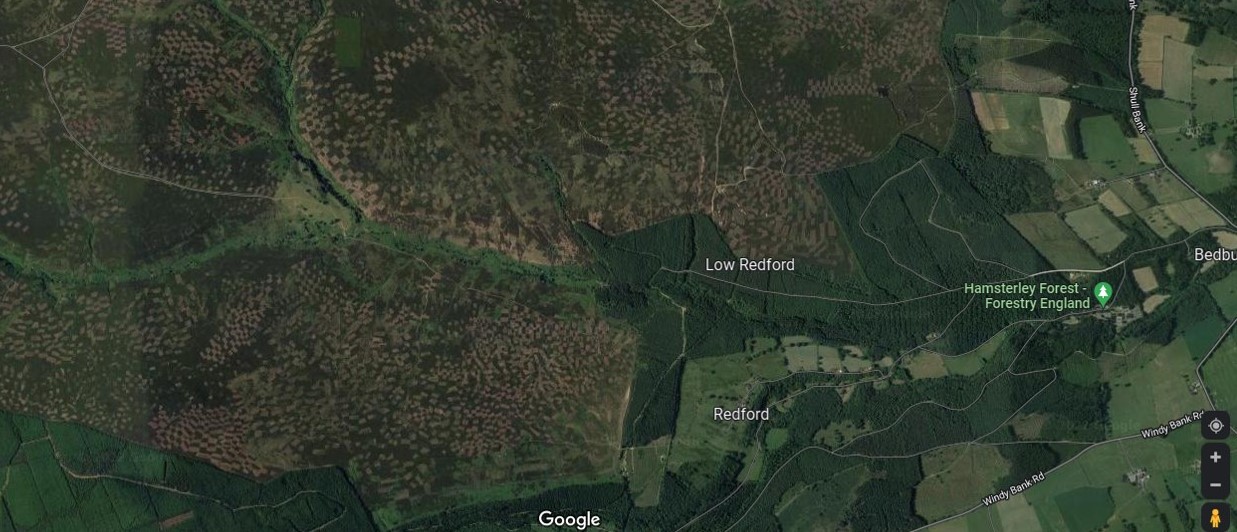
10 October 2022: Hen harrier ‘Sia’ ‘disappeared’ near Hamsterley Forest in the North Pennines (here).
To be continued……..
Not one of these 73 incidents has resulted in an arrest, let alone a prosecution. I had thought that when we reached 30 dead/missing hen harriers then the authorities might pretend to be interested and at least say a few words about this national scandal. We’ve now reached SEVENTY THREE hen harriers, and still Govt ministers remain silent. They appear not to give a monkey’s. And yes, there are other things going on in the world, as always. That is not reason enough to ignore this blatant, brazen and systematic destruction of a supposedly protected species, being undertaken to satisfy the greed and bloodlust of a minority of society.
Please consider sending a copy of this list of dead/missing hen harriers to your elected representative. Ask them for their opinion, tell them your opinion, and demand action (politely please). We know where these crimes are happening and we know why they’re happening. The Government’s own data, published three years ago, have provided very clear evidence (see here). MPs need to know how many of us care about this issue and how we will not be fobbed off by disingenuous platitudes from DEFRA Ministers (e.g. see here, here, here and here for repeated recent examples of this).
Don’t be put off by thinking, ‘Well my MP is a grouse shooter, he/she won’t bother responding so why should I bother?’. Do not give these politicians an easy option out. As your elected representative they have a duty to listen to, and respond to, constituents’ concerns, whether they agree with them or not.
If you use social media, please share this post.
If you fancy scribbling a few sentences to your local newspaper or even a national one, please do.
Please talk to friends, family and colleagues about these 73 birds. They will be horrified about what’s being allowed to go on.
We MUST increase public awareness. It’s up to all of us.
Durham Constabulary have reported the suspicious disappearance of a young satellite-tagged hen harrier called ‘Sia’.
[‘Sia’ after being satellite-tagged in southern Scotland earlier this year. The tag was sponsored by the Lothian & Borders Raptor Study Group]
This is the press statement issued yesterday (4th November 2022):
Officers team up with partners in search for missing hen harrier
Officers have teamed up with partner agencies to investigate a suspected case of raptor persecution.
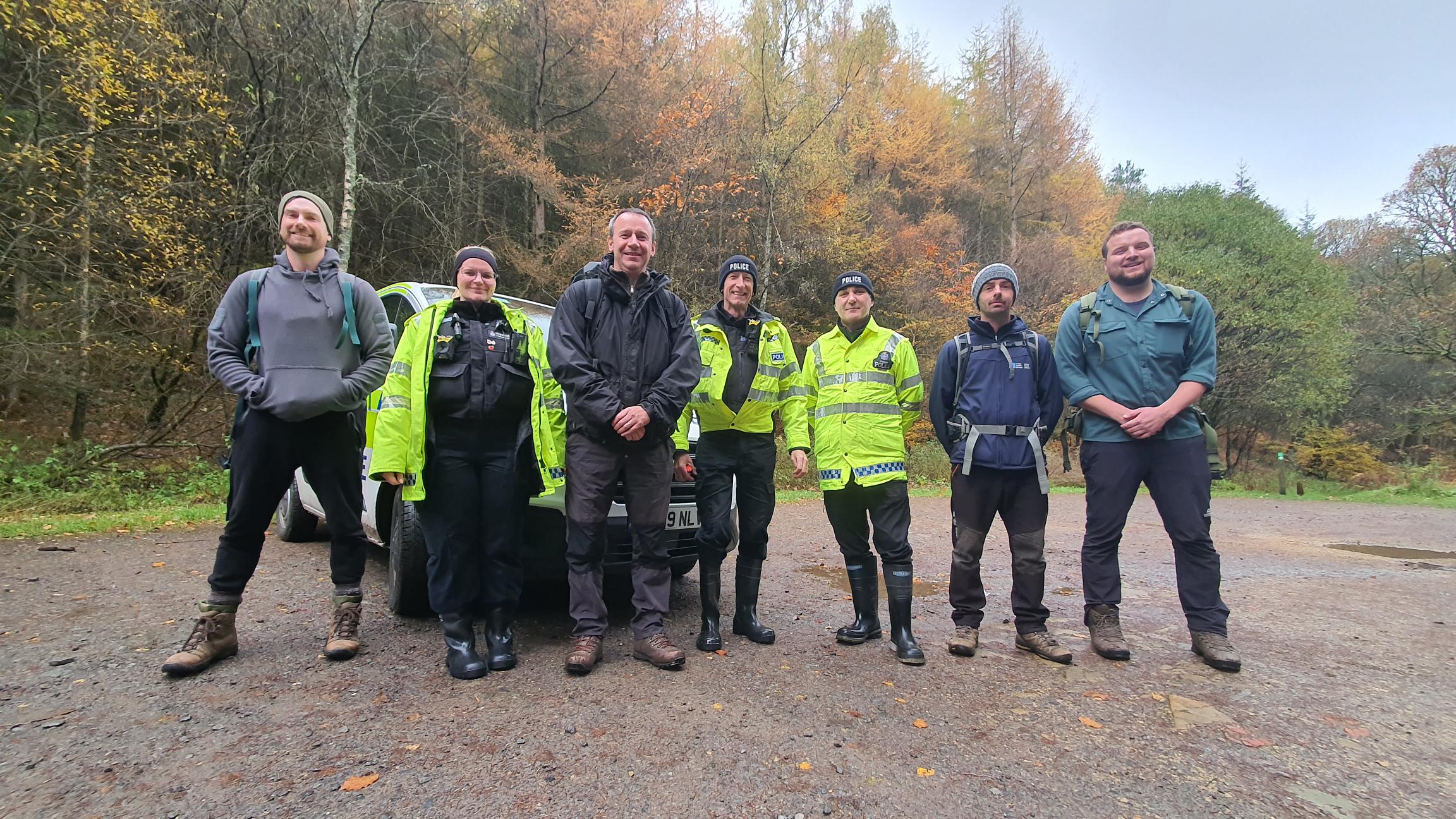
Led by Wildlife Officer, PC Dave Williamson, members of the Barnard Castle Neighbourhood Policing Team, RSPB, the National Wildlife Crime Unit and Police Scotland carried out a search in an area close to Hamsterley Forest on Wednesday morning (November 2).
The activity came after a 2022 female hen harrier called Sia, from Southern Scotland, went missing in the area on October 10 when her tag stopped transmitting.
It is believed the protected species could have been shot down or killed unlawfully.
PC David Williamson, who led the operation, said: “We will always do everything we can to act on information received about alleged criminal activity.
“I would encourage anyone with information about this suspected crime to get in touch.”
If you have any information call 101 quoting incident reference number 79 of October 19, email PC Williamson at david.williamson@durham.police.uk or contact Crimestoppers on 0800 555 111.
ENDS
There’s no detail provided about the last known location of Sia, nor of the area searched last Wednesday, but it’ll come as no surprise to anyone to see that the area next to Hamsterley Forest is intensively managed for driven grouse shooting:
A scientific study published in 2019 showed that hen harriers are ten times more likely to disappear/be killed over areas of land managed for grouse shooting relative to other land uses.
Sia isn’t the first satellite-tagged hen harrier to ‘disappear’ in suspicious circumstances in the North Pennines. Just looking at the data since 2018, there have been seven others:
5 February 2018: Hen harrier Marc ‘disappeared’ on a grouse moor in Durham (here)
14 September 2019: Hen harrier (Brood meddled in 2019, #183704) ‘disappeared’ in the North Pennines (here)
23 September 2019: Hen harrier (Brood meddled in 2019, #55149) ‘disappeared’ in North Pennines (here)
10 October 2019: Hen harrier Ada ‘disappeared’ on a grouse moor in the North Pennines AONB (here)
12th April 2021: Hen harrier Yarrow ‘disappeared’ near Stockton, County Durham (here)
24 July 2021: Hen harrier Asta ‘disappeared’ at a ‘confidential site’ in the North Pennines (here). We learned 18 months later that her wings had been ripped off so her tag could be fitted to a crow in an attempt to cover up her death (here).
14 May 2022: Hen harrier ‘Harvey’ (Tag ID 213844) ‘disappeared’ from a ‘confidential site’ in the North Pennines (here).
And of course, it’s not just the North Pennines where they ‘vanish’. Since 2018, at least 72 hen harriers are known to have either been killed or to have ‘disappeared’ in suspicious circumstances, mostly on or close to grouse moors across the UK. I’ll now have to update that list to 73, and counting.
Why does it keep happening? Simple. Nobody has been caught or prosecuted in any of these 73 cases, the chances of anyone being caught or prosecuted are virtually none existent, and so there is absolutely no deterrent whatsoever to stop this happening again and again and again.
In addition, this systemic criminality is being enabled by a series of DEFRA Ministers who repeatedly and resolutely display wilful blindness at every opportunity (e.g. see here).
Last month, Norfolk gamekeeper Matthew Stroud, 46, of Fengate in Weeting was convicted of multiple offences including:
Three counts of using poisoned bait on or before 19 August 2021 and 14 September 2021.
Six counts of killing a Common Buzzard (a non-Schedule 1 wild bird) at Weeting between 10 August and 14 September 2021.
One count of intentionally killing a Northern Goshawk (a Schedule 1 wild bird) at Weeting on or about 10 August 2021.
One count of possessing a regulated substance – Strychnine Hydrochloride – without a licence on 14 September 2021.
One count of possessing 4 shotguns to kill a Schedule 1 wild bird on 14 September 2021.
One count of releasing 3,400 Common Pheasants into the wild between 1 June and 14 September 2021 contrary to the Wildlife and Countryside Act 1981.
One count of incorrectly storing a biocidal product – Rentokil Phostoxin – on 14 September 2021 contrary to the Health and Safety at Work Act 1974.
Even though Stroud’s crimes easily passed the threshold for a custodial sentence, he received a 12-month Community Order and was ordered to do 200 hours of unpaid work, fined £692 and ordered to pay costs of £145, compensation of £288.72 and a victim surcharge of £95. The court also ordered the forfeiture and destruction of all Stroud’s firearms, mobile phones and any chemicals (see here and here for previous blogs on this).
Stroud’s prosecution and conviction was the result of a well-run multi-agency investigation involving Norfolk Constabulary, Natural England, National Wildlife Crime Unit, Crown Prosecution Service and the RSPB Investigations Team.
Today, the RSPB has published a blog written by RSPB Investigations Officer Tom Grose, reflecting on the investigation and the subsequent sentence. You can read it here. [UPDATE: This link has since broken – the RSPB blog has been copied and pasted at the foot of this blog]
UPDATE 29th June 2023: Another Weeting gamekeeper convicted – Gamekeeper Francis Addison receives suspended jail sentence in relation to five shot goshawks (here)
COPY AND PASTE OF RSPB BLOG:
Reflections on a poisoning, by Tom Grose, RSPB Investigations Officer
On 5 October 2022 gamekeeper Matthew Stroud was convicted of a litany of offences at Norwich Magistrates Court. He pleaded guilty to the killing six buzzards and a goshawk, placing poisoned baits, possession of the banned poison strychnine hydrochloride and the illegal release of gamebirds onto a Special Protection Area (SPA), along with sundry other offences.
Previous cases of this nature have been acknowledged to have crossed the custody threshold by the court (see John Orrey and Allen Lambert). So it was expected that Stroud was facing at the least a suspended prison sentence. The 200-hour community work order and financial penalties totalling £1220 he was given were accompanied by a sense of frustration by those involved in the case, and by shock and outrage by those who learned about it in the media or on social media. Not for the first time….
The long-running investigation that led to Stroud’s prosecution was a shining example of partnership working in action. Initial painstaking fieldwork by RSPB Investigations Officers sparked swift and decisive action by Norfolk Police upon the discovery of a suspected poisoned bait. A combined operation involving the National Wildlife Crime Unit and Natural England alongside the RSPB ensued. A warrant was executed and vital evidence recovered. Then came months of meticulous work involving a long list of dedicated professionals. X-rays, post-mortems, poison testing, feather analysis and police interviews all had to be carried out before the case file could be passed to the Crown Prosecution Service (CPS) and the charges laid. The CPS themselves provided guidance and were of enormous help in the run up to court.
On the day of the hearing itself, the prosecution was able to lay the stark facts of the case before the magistrates. In 2022 a man was jailed for 16 weeks for killing two gulls. So why did Stroud receive far less?
Unfortunately, it seems that the lack of sentencing guidelines available to the courts is at the heart of the matter. We’ve encountered this issue before, with magistrates and judges left without clear principles to follow when deciding how to sentence these relatively rare and complex cases. Each time a raptor killer is in court, it turns into a sentencing lottery. Clearly these guidelines must be put in place to deal with wildlife offences. The killing of so many protected birds, including a Schedule 1 species (the goshawk), and the deliberate use of a banned poison as dangerous as strychnine surely warranted a heavier punishment. This is hardly a deterrent to other wildlife criminals.
Another issue that keeps rearing its head is the lack of any consequences for Stroud’s employers. When a gamekeeper is found to be killing birds of prey it is normally due to pressure to produce enough gamebirds to shoot, and indeed Stroud admitted his motivation was to protect the pheasants in his care. In most other sectors the employer would face repercussions for the actions of staff. This isn’t the case in the English and Welsh shooting industries. Whilst vicarious liability has been introduced into Scotland, we need to see it implemented across the UK.
More positively, Stroud was the first person convicted of illegal gamebird release. The impact of non-native pheasants is poorly understood but of increasing concern. To illegally release them on the Breckland SPA, supposedly an area of international conservation importance, showed a callous disregard for the environment. Alongside the potentially harmful effects of over 60 million gamebirds released into our countryside annually, it’s clear that raptor persecution is a serious issue for lowland shooting.
It’s certainly not the case that raptor persecution is an issue confined to upland grouse moors. Cases like this one (and there are others ongoing), coupled with concerns over the release of non-native gamebirds, are why the RSPB is now calling for greater regulation of large-scale pheasant and partridge shoots. Clearly, self-regulation is not working, and current legislation is not enough. We also call on the courts to make full use of the sentences available to them.
We would like to thank all of those involved in securing this conviction, and particularly PC Chris Shelley of Norfolk Police for his hard work in leading the investigation. Although we are disappointed by the outcome, it has been heartening to work alongside officers and organisations who remain committed to stopping raptor persecution.
Today, the Scottish Government has launched a public consultation as the start of its commitment to introduce a licensing scheme for grouse moor management, following the publication of the Werritty Review in 2019, which was commissioned in 2017 after unequivocal evidence was published of the on-going illegal killing of golden eagles on some Scottish grouse moors.
That illegal killing continues, as evidenced by this young golden eagle recently found poisoned on a grouse moor in the Cairngorms National Park laying next to a dead mountain hare that had been used as the poisoned bait (photo by RSPB Scotland).
As is so often the case, nobody has been charged or prosecuted for this hideous wildlife crime, which is a fundamental reason why the Govt is introducing a licencing scheme, presumably as a means of sanctioning an estate (by withdrawing its licence) when evidence of wildlife crime is discovered. Without knowing the exact details of how the licensing scheme will operate, it’s impossible at this stage to predict its effectiveness. There are many sceptics, and I’m one of them, but I’m also certain that the status quo is untenable and so I view licensing as a step in the right direction, but definitely not the end of the road.
The Government’s licensing consultation preamble reads as follows:
‘A Stronger & More Resilient Scotland: The Programme for Government 2022-23 which was published on the 8 September 2022 committed to introducing the following Bill:
Wildlife Management (Grouse)
The Bill will implement the recommendations of the Werritty Reviewand introduce licensing for grouse moor management to ensure that the management of driven grouse moors and related activities is undertaken in an environmentally sustainable manner. The Bill will also include provisions to ban glue traps.
In November 2020, the Scottish Government published its response to the recommendations made by the Grouse Moor Management Group (“Werritty review”). That report was commissioned by the Scottish Government in response to a report from NatureScot (formerly Scottish Natural Heritage), published in May 2017, which found that around a third of satellite-tagged golden eagles in Scotland disappeared in suspicious circumstances, on or around grouse moors.
The Werritty review made over 40 recommendations regarding grouse moor management. The recommendations, which were accepted by the Scottish Government, seek to address raptor persecution and ensure that the management of grouse moors is undertaken in an environmentally sustainable manner.
As well as proposals relating to grouse moor management, this consultation also considers glue traps. A report from the Scottish Animal Welfare Commission, published on 23 March 2021 stated that
‘……the animal welfare issues connected with the use of glue traps would justify an immediate outright ban on their sale and use. This is our preferred recommendation‘.
This consultation is therefore seeking your views on the Scottish Government’s proposals on:
*Grouse moor licensing
*Muirburn
*Trapping (wildlife traps, glue traps, snares)
You can complete all the sections in the consultation or only those sections which are of interest/relevance to you’.
ENDS
The Government’s proposals for its grouse moor licensing scheme are laid out here:
I haven’t yet looked at the consultation paper so I can’t offer any comments or suggested responses yet but I will do very soon. The consultation will close on 14th December 2022.
The link to the consultation questionnaire can be found HERE.
UPDATE 26th October 2022: REVIVE coalition cautiously welcomes Scot Gov’s consultation on grouse moor licensing (here)
UPDATE 27th October 2022: Grouse shooting lobby quietly seething over proposed licensing scheme (here)
UPDATE 10th December 2022: Last chance to have your say on Scottish Government’s consultation on grouse moor reform (here)




 Raptor Persecution UK