Rising levels of wildlife crime during pandemic, new report from nature experts warns

Press release Wildlife & Countryside Link (25th November 2021)

Rising reports of wildlife crimes during the pandemic spark fresh fears for beloved species

  • Reports of wildlife crimes against many species rose between 35-90% in 2020
  • At the same time convictions on key types of wildlife crime fell by 50%+
  • Nature experts are calling for improved recording and monitoring, better targeting of resources, and enhanced use of expert police and prosecutors to tackle wildlife crime

A new report published today (25 Nov) by nature experts has revealed a worrying increase in reporting of wildlife crimes against badgers, fish, birds of prey, and marine mammals during the pandemic. While a sharp decline in convictions for wildlife crimes including hunting, illegal wildlife trade, and fishing crime was also seen in 2020.

Reports of likely crimes against badgers rose by 36% in 2020, compared to 2019, with reports of potential fishing crimes up by more than a third (35%) and marine mammal incident reports (in Cornwall alone) rising 90%, according to data gathered by the NGOs. The number of confirmed raptor crimes in England & Wales in 2020 was almost double that in 2019, rising from 54 to 104 (the worst year for bird-crime ever as detailed by the RSPB in October).

At the same time fishing crime convictions fell by almost two-thirds from 2037 in 2019 to 679 in 2020, and illegal wildlife trade convictions halved to just 4 convictions. Hunting prosecutions also more than halved, from 49 in 2019 to 22 in 2020, with only 8 convictions. Hunting conviction rates have in fact steadily decreased for the last five years, falling from 54% of prosecutions being successful in 2016 to less than a third (32%) of prosecutions achieving conviction in 2020.

Martin Sims, Director of Investigations at the League Against Cruel Sports and Chair of Wildlife and Countryside Link’s Wildlife Crime group, said: ‘‘Wildlife crime is something that should concern everyone –it inflicts pain, harm and loss for much-loved wildlife and fuels wider criminality against people and property. Despite this the police still don’t gather centralised data on these serious crimes, leaving an incomplete picture from charities, which could be just a drop in the ocean of wildlife crimes. It is high time the Government steps in to treat wildlife crime with the seriousness it deserves. Making key crimes notifiable would enable police forces to better target resources, and track repeat offenders. While better police and prosecutor training and resources would help raise the pitiful 32% conviction rate for hunting prosecutions alone. The system must change to crack down on offences against nature once and for all.”

Dawn Varley, Acting CEO of the Badger Trust, said: Badger crime has been a UK Wildlife Crime Priority for more than a decade, due to the scale of persecution – but sadly this persecution shows no sign of letting up. 2020 saw reports of badger crime rise, driven in large part by a shocking 220% increase in reports of developers interfering with badger setts. A small minority seem to see badger habitat protections as an inconvenience to be quietly bulldozed over, rather than a legal requirement to conserve an iconic British mammal. 2022 must see renewed work by police forces and the Crown Prosecution Service to bring offenders to justice. This must be supported by better monitoring, new training to enable officers and prosecutors to demonstrate criminal intent, and consistently tougher sentencing to deter these crimes.”

Mark Thomas, RSPB Head of Investigations UK, said: In the wake of an emergency climate conference and with all life on earth facing an uncertain future, there has never been a more important time for urgent action to end the illegal killing of wildlife. Wildlife declines are already being felt, and species can ill afford to face the additional pressure of being brutally shot, trapped or poisoned; nor should the public have to put up with these crimes taking place in the wild places they go to for refuge.

Bird of prey persecution reached unprecedented heights in 2020, particularly where land was managed for gamebird shooting. And it is certain that more crimes will have been committed and simply gone undetected and unreported. We urge the public to report dead or injured birds of prey in suspicious circumstances to the police and the RSPB, or pass on any information which may help lead to a conviction.” 

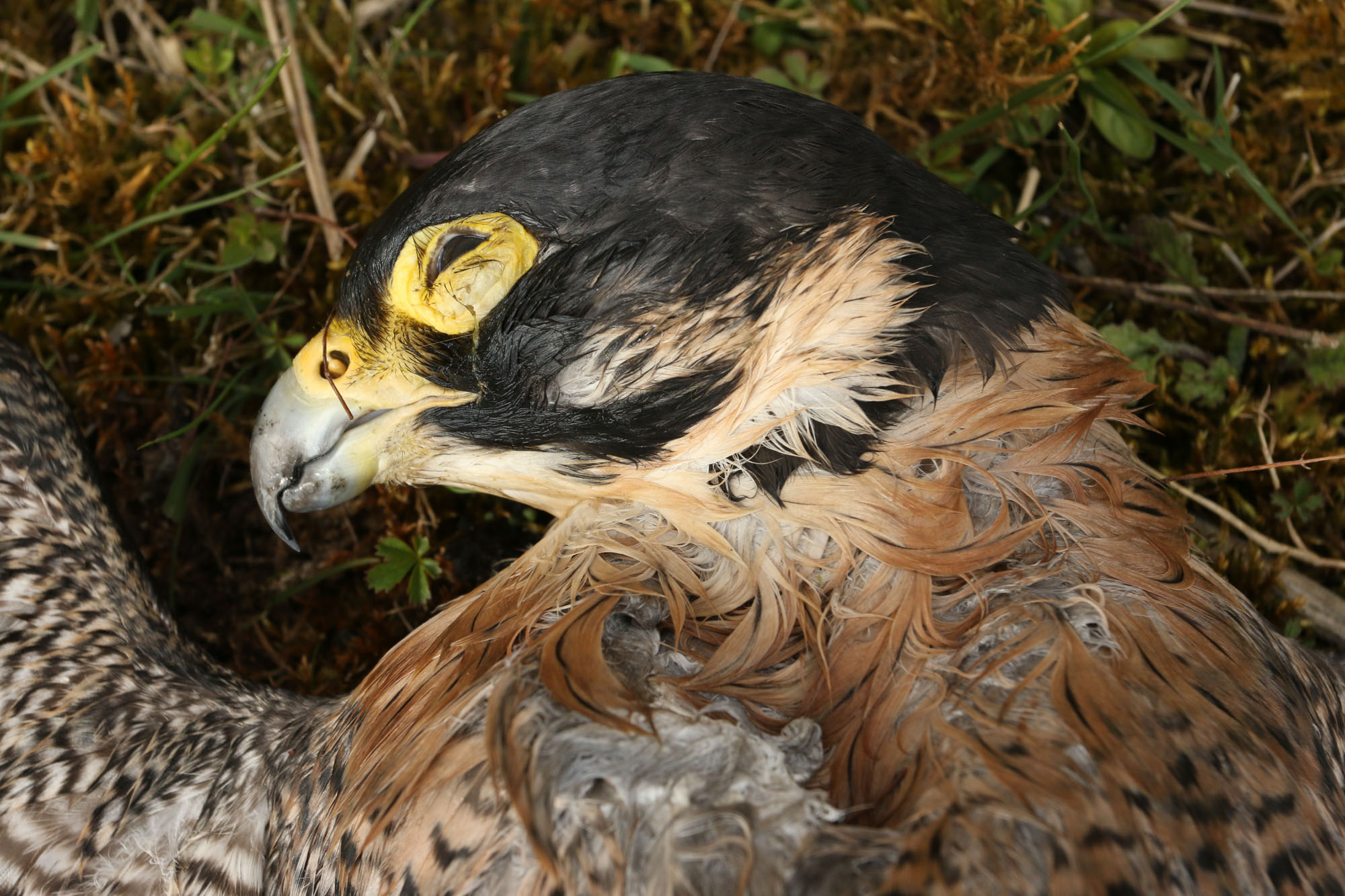
[One of two dead peregrines found illegally poisoned near Tadcaster, North Yorkshire in 2020. Photo RSPB]

The lockdowns and restrictions of 2020 appear to have contributed to rises in reporting of wildlife crimes and falls in convictions in several ways. Opportunistic offenders may have felt that with the police busy enforcing social restrictions that wildlife could be harmed with relative impunity. With increased use of the countryside in the pandemic more members of the public were also present to witness and report incidents of concern. COVID-19 pressures around social restrictions and staff absences appear also to have unfortunately reduced the capacity of police forces and the Crown Prosecution Service, and their ability to both bring hunting and fishing cases to trial and achieve convictions.

While today’s report reveals worrying figures, with impacts for treasured species like badgers, buzzards, kestrels, seals, dolphins and bluebells, it gives an incomplete picture. These organisations all collect data in different ways, with many only holding figures on reporting and convictions for incidents where members of the public have directly contacted them. There is a huge lack of information on wildlife crimes due to police not being required to officially record wildlife offences. Most wildlife crimes are recorded as ‘miscellaneous’ offences and are therefore invisible in police records, with no duty to be reported upon. The scale of wildlife crime is therefore likely to be far greater than the data collected by NGOs suggests. 

The 16 wildlife organisations behind today’s report are warning that the way wildlife crimes are handled by both the police and Crown Prosecution Service must be reviewed and improved, if offences against treasured British wildlife are to be tackled. In particular, the new report highlights that the continued absence of dedicated recording for wildlife crimes means that resources cannot be effectively assessed and targeted. A lack of expertise and resource for police and prosecutors, and deficiency of sentencing guidelines, is also leading to failures in convicting criminals and inadequate penalties for crimes.

Nature experts and conservationists are calling for several key actions to better tackle wildlife crimes:

  • Make wildlife crimes recordable – A shortlist of wildlife offences (compiled by the National Wildlife Crime Unit) is being considered by the Home Office for notifiable status. This must be approved in 2022 to bridge the crippling wildlife crime data gap and help target resources effectively.
  • Ensure effective police & prosecutor action – Staff with expert training on wildlife crimes are critical to effectively building and prosecuting a case against these criminals. Also key is early coordination between the CPS and police on cases, and ensuring prosecutors have adequate preparation time for cases. Ensuring police and CPS training and process reflects this is vital.
  • Produce sentencing guidelines – Unlike most other crimes, the Sentencing Council provides no sentencing guidelines for wildlife crimes. This must be rectified to ensure sentencing consistently reflects the seriousness of these crimes and acts as a deterrent to criminal activity. 

ENDS

The full report can be downloaded here:

Notes:

The new report has been written and published by Wildlife and Countryside Link, the biggest coalition of wildlife and environment charities in England, and Wales Environment Link, a network of environmental, countryside and heritage non-governmental organisations with an all-Wales remit. Both operate as part of a UK-wide coalition – Environment Links UK

Organisations supporting today’s report include: Amphibian and Reptile Conservation, Badger Trust, Bat Conservation Trust, Buglife, Four Paws, Humane Society International UK, IFAW, Institute of Fisheries Management, League Against Cruel Sports, National Trust, Naturewatch Foundation, Plantlife, RSPB, Whale and Dolphin Conservation, Wild Justice and WWF UK.

UPDATE 12.45hrs: Coverage of this new report in The Guardian here

UPDATE 13.00hrs: Coverage on Farming Today (starts at 06.20min) interviewing Mark Thomas, Head of RSPB Investigations here

Gamekeeper convicted for pesticide and firearms offences but buzzard-poisoning charge is dropped

Last week I blogged about how a Suffolk gamekeeper was due at Ipswich Magistrates Court to face a charge of poisoning a buzzard, having already pleaded guilty to several pesticide storage and firearms offences (see here).

This case stemmed from a multi-agency raid last January (here) after the discovery of an illegally poisoned buzzard in September 2020 which had been found close to pheasant-rearing pens near Lakenheath.

[The illegally-poisoned buzzard found close to the pheasant-rearing pens. Photos by RSPB]

The case was heard yesterday and it appears that the buzzard-poisoning charge was dropped, probably due to insufficient evidence, because despite the gamekeeper having this particular poison (Bendiocarb) in his possession, the prosecution would need to demonstrate that he was the person who laid the poisoned bait that subsequently killed this buzzard. The fact that the poisoned buzzard was found in close proximity to his workplace, and that he had the same poison in his possession, is simply not enough.

We can all draw our own conclusions of course, based on the balance of probability, but in English law the balance of probability is insufficient to convict for this particular offence. That’s not the fault of the police, the RSPB, the Crown Prosecution Service or the magistrate.

In this case, the gamekeeper, Shane Leech, 33, of Maids Cross Hill, Lakenheath, Suffolk, was convicted of six charges relating to pesticide and firearms offences and was given a Community Order of 80 hours unpaid work, ordered to pay £105 costs and a £95 Victim Surcharge.

I’ll leave it to you to decide whether the punishment fits the crime(s) and whether it offers any semblance of a deterrent to anyone who might be considering committing similar offences.

The RSPB has published two blogs about this case. The first one provides an overview of the case and offers praise to the work of Suffolk Police and the Crown Prosecution Service (see here).

The second blog is a more detailed discussion about the difficulties of bringing a successful prosecution for the illegal poisoning of birds of prey (see here). It also includes this shocking image of a pile of dead pheasants apparently being prepared for human consumption in the same room where the poison was being stored illegally!

Gamekeeper due in court next week accused of poisoning a buzzard

A gamekeeper is due in court on Monday 8th November accused of poisoning a buzzard.

He has already pleaded guilty to a number of firearms offences and a number of pesticide storage offences.

At an earlier hearing in August, the gamekeeper pleaded not guilty to poisoning the buzzard so the case was sent for trial.

This case stems from a multi-agency raid, led by Suffolk Police, at a property last January (see here).

[Police officers seized a number of firearms during the raid. Photo via Suffolk Police]

Please note, as this is a live case no further detail will be provided here until the case has concluded or there is official commentary from the court. Comments on this particular blog also won’t be accepted until the case concludes so as not to prejudice proceedings. Thanks for your understanding.

UPDATE 9th November 2021: Gamekeeper convicted for pesticide and firearms offences but buzzard-poisoning charge is dropped (here)

Yorkshire Dales National Park Authority reacts to 2020 being ‘worst year on record’ for raptor persecution crimes

Last week the RSPB published its latest annual Birdcrime report which showed that 2020 was the ‘worst year on record’ for confirmed crimes against birds of prey in the UK (see here).

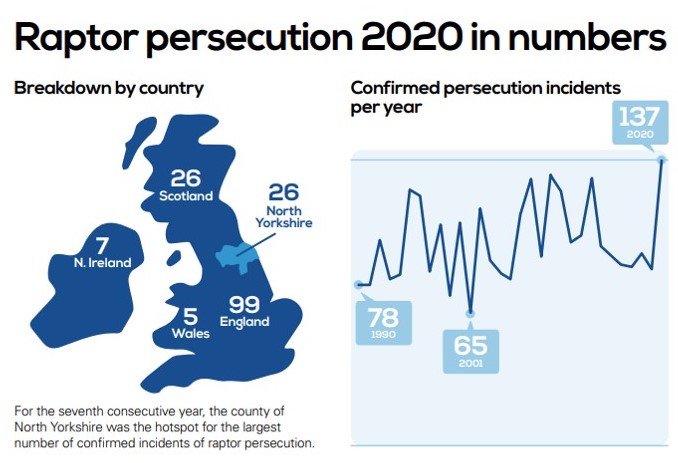
For the seventh year in a row, North Yorkshire had more confirmed raptor persecution crimes than any other county in the UK. Twenty-six of the 137 confirmed UK incidents occurred in North Yorkshire. Of these two thirds were directly related to grouse shooting and a further four incidents to other types of shooting. Victims in the county included 16 buzzards, two peregrine falcons, two red kites and one goshawk.

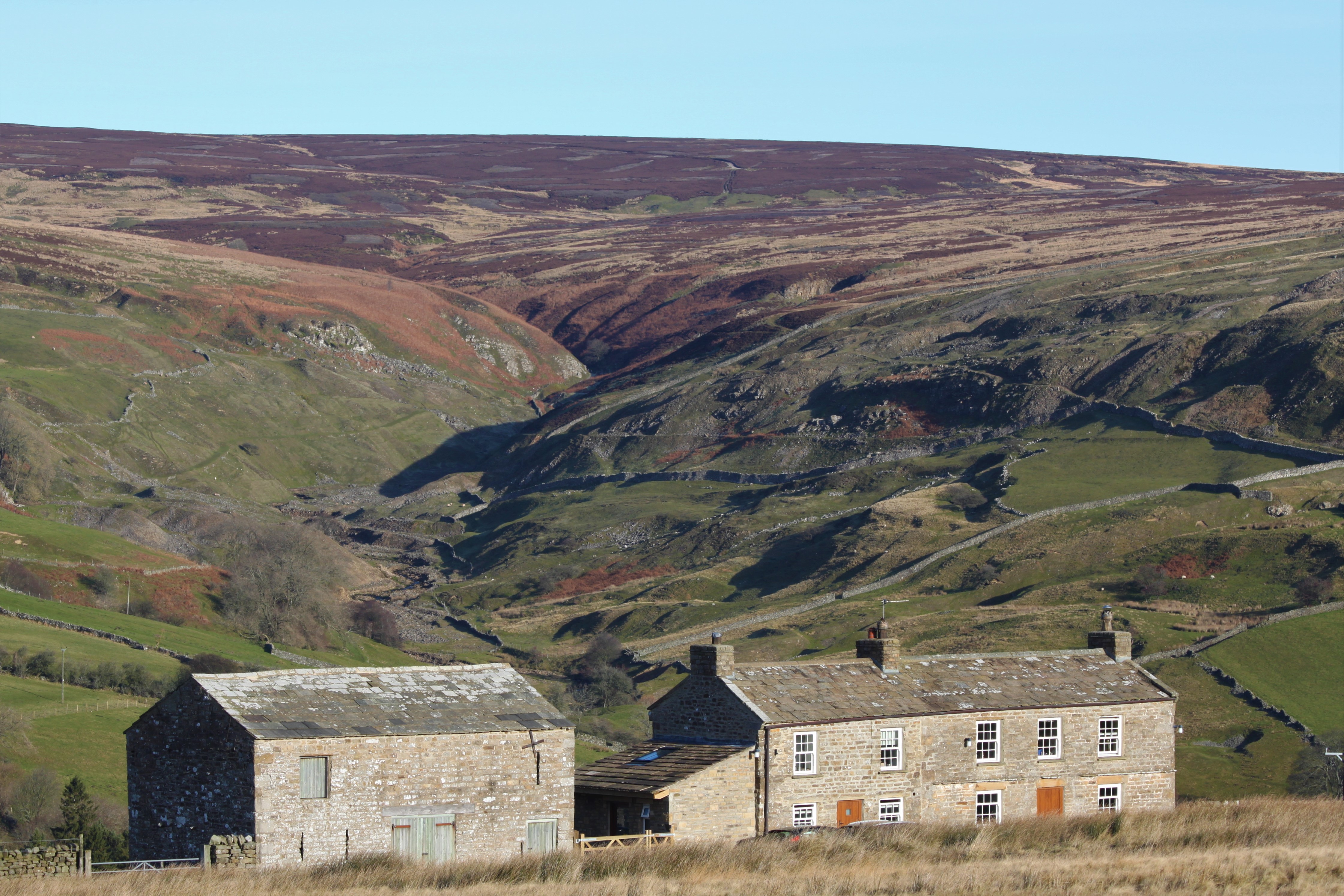
[Grouse moor landscape in the Yorkshire Dales National Park. Photo by Ruth Tingay]

In response to the damning Birdcrime report, the Yorkshire Dales National Park Authority has issued this pretty unequivocal statement:

YORKSHIRE DALES NATIONAL PARK AUTHORITY REACTION TO LATEST RSPB BIRDCRIME REPORT

Commenting on the RSPB Birdcrime Report 2020, Yorkshire Dales National Park Authority Chief Executive David Butterworth said:

“This report makes grim reading for all landscape authorities, landowners, managers and other partners who are working hard to call out and tackle illegal raptor persecution, and it’s embarrassing and humiliating to see North Yorkshire yet again topping the league table with the highest number of confirmed incidents.

“As we’ve said before, the continuing issue of bird of prey persecution in North Yorkshire demands maximum exposure, as do the activities of those who take part in this criminality. People need to know what is happening here and the devastating impact this is having on our protected species. This report lays that bare.

”The Yorkshire Dales National Park Authority condemns raptor persecution in the strongest possible terms and, as highlighted in this report, we will continue to work closely with partners and others to stamp out this crime once and for all.

“I would appeal to anyone, local or visitor, who witnesses any suspicious activity while they’re out and about in the countryside, or anyone who is made aware of it through their networks, to contact the Police”.

The Yorkshire Dales National Park Management Plan objective C5 on illegal persecution of raptors can be viewed here.

For concerns about a possible wildlife crime, you should call 101. If you witness a suspected wildlife crime in action, call 999 immediately and ask for the Police. Finally, you can speak in confidence about raptor persecution directly with the RSPB on 0300 9990101

ENDS

2020 was ‘worst year on record’ for persecution of birds of prey in UK, says new RSPB report

Press release from RSPB (27th October 2021)

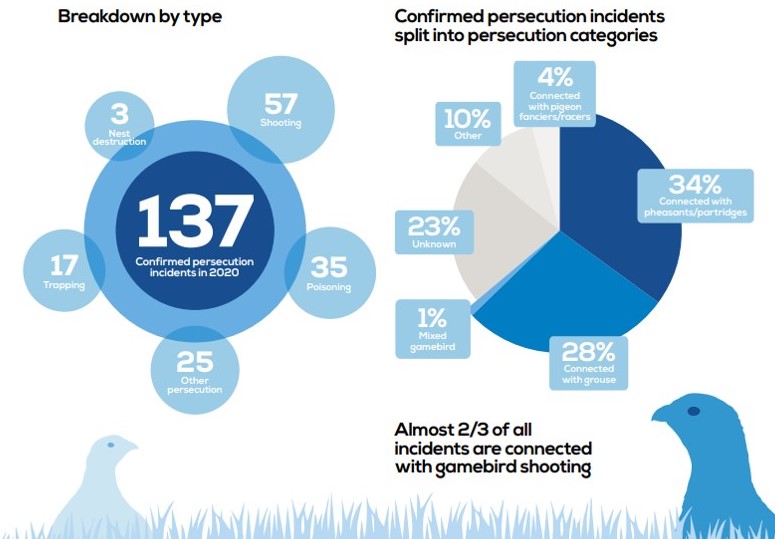
The RSPB’s Birdcrime 2020 report has revealed 137 known, confirmed incidents of bird of prey persecution last year – the highest number recorded in 30 years.

Produced annually by the RSPB’s Investigations unit, Birdcrime is the UK’s only full data set on confirmed incidents of raptor persecution – namely the illegal shooting, trapping and poisoning of birds of prey.

There were 137 confirmed incidents in 2020: the highest total since recording began in 1990. The overall rise in numbers can be attributed to the unprecedented number of incidents detected in England (99) during 2020, many of which occurred during Covid-19 lockdown.

The victims included 58 buzzards, 20 red kites, 16 peregrines, six sparrowhawks, three goshawks and other protected birds of prey including rare hen harriers and golden eagles. Based on population studies for significant species, it’s believed that the true number killed is far greater, with many crimes going undetected and unreported.

The crimes took place across a variety of land uses. However, a minimum of 85 (62%) of all confirmed incidents were in connection with land managed for or connected to gamebird shooting. Bird of prey persecution shows a clear link to pheasant, partridge and grouse shooting, with incidents being more widespread in lowland areas and more concentrated in upland areas. In addition to Birdcrime data, peer-reviewed scientific studies based on satellite tagging and bird of prey populations, crime data and court convictions, show that raptor persecution has the most negative conservation impact on driven grouse moors. A Government study in 2019, identified criminal persecution by humans as the main factor suppressing the UK population of hen harriers: a red-listed bird species which nests on heather moorland.

North Yorkshire is the worst place for birdcrime in the UK for the seventh year in a row. Twenty-six of the 137 confirmed incidents occurred in North Yorkshire. Of these two thirds were directly related to grouse shooting and a further four incidents to other types of shooting. Victims in the county included 16 buzzards, two peregrine falcons, two red kites and one goshawk.

All birds of prey are protected by the Wildlife and Countryside Act 1981. To intentionally kill or injure one is a criminal offence and could result in an unlimited fine or up to six months in jail. Yet in 2020, there were only two prosecutions for raptor persecution offences.

The RSPB is calling on the governments of the UK to act now and implement a system of licensing for driven grouse shooting, to create greater accountability and ensure all estates operate to legal and high environmental standards. Failure to comply with licensing requirements should result in licence revocation for a defined period and therefore removal of the right to shoot as a meaningful deterrent to illegal behaviours.

The wildlife conservation charity is also urging for action to end other associated environmentally damaging land management practices, including a ban on burning on deep peat. The RSPB would also like to see a significant reduction in the numbers of non-native pheasants and red-legged partridges, currently millions, released into the countryside each year as there is growing evidence of environmental harm.

Mark Thomas, the RSPB’s Head of Investigations said “Although we have become used to the illegal killing of birds of prey, the figure for 2020 is truly shocking.

We are in a climate and nature emergency. All land must be managed legally and sustainably for people and for nature, and not accelerate the worrying loss of UK wildlife we are already experiencing.

The RSPB welcomes the announcement by the Scottish Government to licence driven grouse moors there, but this has to happen now in England as well. Licensing should be conditional on compliance with wildlife protection laws, and if breached, should result in removal of the right to shoot. Those shoot operators who behave legally and responsibly should have nothing to fear from this sanction”.

Chief Inspector Kevin Kelly, Head of the National Wildlife Crime Unit (NWCU) said “Raptor Persecution is a National Wildlife Crime Priority. This report puts an emphasis on why it’s a priority and why it will remain a priority for years to come. I am disappointed in such a significant rise in incidents as the crime figures go a long way to undermine the hard work that’s done daily to tackle raptor persecution. I feel the Priority Delivery Group holds the key to success, this has gone through a period of change, bringing leadership, accountability and some fresh positive partners in. That said, the hard work lays ahead of us and we will be judged on our actions, not our words.”

ENDS

The RSPB 2020 Birdcrime report can be downloaded here:

The Birdcrime 2020 appendices (breakdown of data) can be downloaded here:

So you know when the game-shooting organisations say that raptor persecution is in decline, it was an historical issue but it’s no longer a thing, that the industry has a ‘zero tolerance policy’ towards raptor persecution and it’s now just the work of a rogue keeper or two?

They’re lying.

2020 was the worst year on record.

Just think about that.

UPDATE 16.00hrs: “They all know what is going on, and they cover it up” – police inspector’s view on gamekeepers and raptor killing (here)

3 month suspended sentence for possession of two shot buzzards strung up on farmland

Press statement from National Parks & Wildlife Service (Ireland), 21 October 2021:

Three Month Suspended Jail Sentence for the Possession of two dead Buzzards

A County Laois man has been given a three month suspended prison sentence for the possession of two dead Buzzards, which were found strung up on his land.

On Friday the 15th of October, at Portlaoise District Court, Mr. Desmond Crawford, Roskelton, Mountrath, Co. Laois pleaded guilty to the unlawful possession of two dead Buzzards contrary to Section 45 (2) & 45 (7) of the Wildlife Acts. The offence took place on the 19th of April 2020 at Clonadacasey, Mountrath, Co. Laois. The offence was investigated by the National Parks & Wildlife Service (NPWS) of the Department of Housing, Local Government, and Heritage. It was prosecuted under the Wildlife Acts by Rory Hanniffy BL, instructed by Sandra Mahon, State Solicitor for County Offaly.

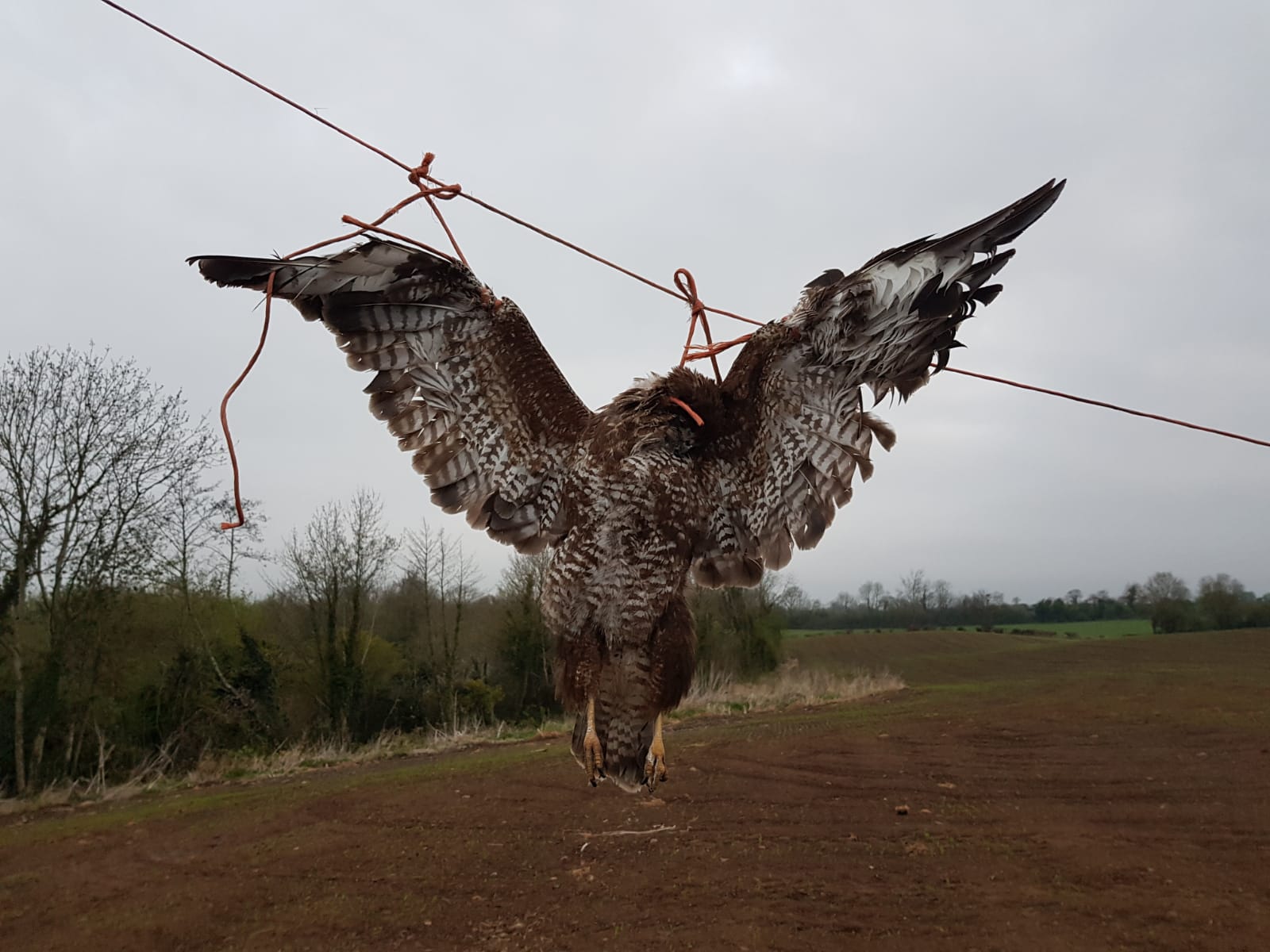
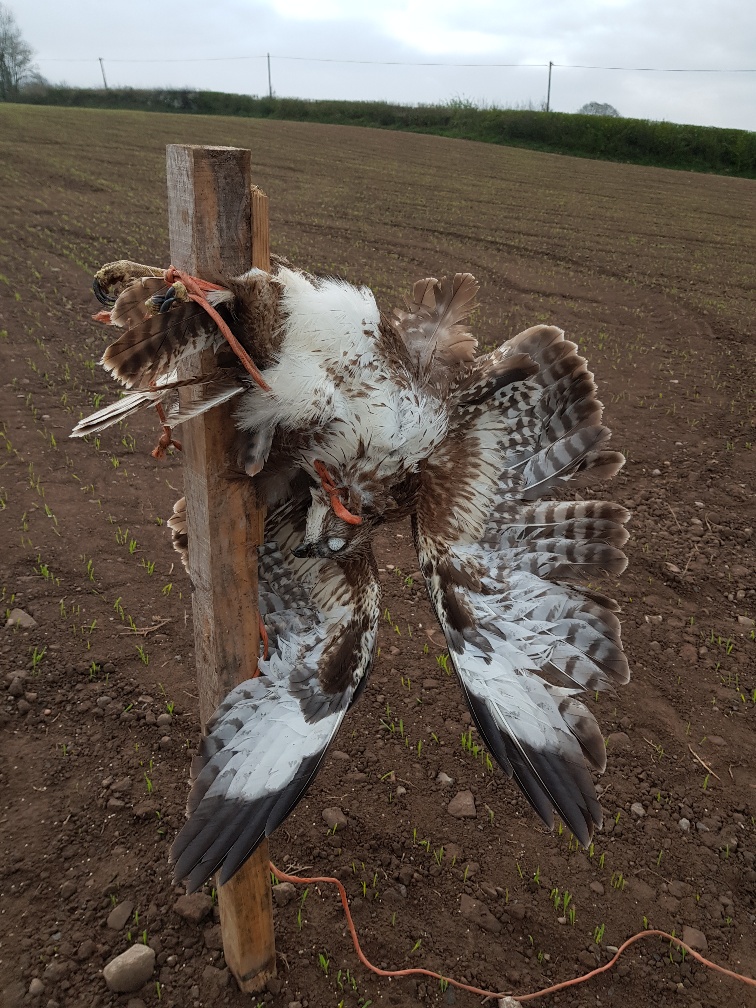
In his evidence to the Court, District Conservation Officer Mr Kieran Buckley of the NPWS told Judge Catherine Staines that he, accompanied by two NPWS Conservation Rangers from neighbouring areas, travelled to Clonadacasey to investigate a complaint from a member of the public that two dead Buzzards were tied up to an electricity post and a fence stake in cultivated fields.

Upon arrival, the NPWS searched the area and found one dead Buzzard strung up by its outstretched wings to an electricity post and another dead Buzzard strung up by its legs to a fence stake. Following a line of inquiry, Mr Buckley established that Mr. Crawford was farming the land where he found the two dead Buzzards. Accompanied by NPWS Officers Robert Edge and Colm Malone, Mr. Buckley then interviewed Mr Crawford under caution about the incident.

At the District Court sitting, photographs of the two dead Buzzards and X-ray evidence were presented to Judge Catherine Staines. Mr Buckley told the Judge that the X-ray evidence left no doubt that both Buzzards had been shot, adding that the tight pattern of the lead shot showed clear evidence that both birds were shot at close range. He added that given the time of year, the dead Buzzards may have been a breeding pair. This, he said, would leave them vulnerable to being shot at their nest. Mr Buckley also told the Judge that Buzzards were the most frequent casualty of bird of prey persecutions and added that the NPWS is determined to tackle wildlife crimes of this nature, particularly when this species has recovered from the brink of extinction.

The defence solicitor, Josephine Fitzpatrick, told the Judge that Mr. Crawford denied he had shot the Buzzards, but he was very sorry for what he had done and apologised to the Court.

In her summation, Judge Staines expressed her abhorrence at the undignified manner in which two beautiful birds were displayed, saying it showed no respect whatsoever. It was, she said, “an example of a disgusting lack of respect in an outrageous act of wildlife crime”.  

Judge Staines then detailed to the court that she had to consider a prison sentence as an appropriate way to deal with this matter. She convicted Mr. Crawford of the possession of the two Dead Buzzards under Section 45 (2) and 45 (7) of the Wildlife Acts and imposed a three-month sentence of imprisonment, which she suspended on the Accused’s own bond for a period of one year.

The Minister of State for Heritage and Electoral Reform at the Department of Housing, Local Government and Heritage, Malcolm Noonan TD said that recent judgements in the District Courts indicate clearly that wildlife crimes have serious consequences:

“I welcome the conviction in this awful case and would like to thank everyone involved in securing it. I particularly welcome the comments of Judge Staines, who acknowledged the outrageousness of the crime and the lack of respect shown to these beautiful birds. Recent judgements being handed down in the Courts to people convicted of deliberately destroying habitats or harming wildlife are sending out a clear signal that, as a society, we will no longer tolerate such actions. Wildlife crime is serious, and it has serious consequences. We need to protect nature,” he said.

Ciara O’Mahony, Regional Manager of the South East Region of the National Parks and Wildlife Service at the Department of Housing, Local Government and Heritage, welcomed the reporting of this matter by a concerned member of the public, and encouraged more who witness wildlife crimes such as this to come forward in confidence to the NPWS.

“We are increasingly receiving contact about wildlife crime and habitat destruction, from people who are concerned about biodiversity loss. We welcome such reports, and the nature conservation consciousness and awareness that they represent,” she said. 

Any member of the public wishing to report possible wildlife crime or illegal habitat destruction in Ireland can contact the NPWS through natureconservation@housing.gov.ie or direct to local NPWS staff. For more detail on wildlife legislation, see www.npws.ie

Information in relation to recording incidents involving birds of prey, including Buzzards, “Recording and Addressing Persecution and Threats to our Raptors. A Review of Incidents” can be found in: https://www.npws.ie/sites/default/files/publications/pdf/IWM126.pdf

ENDS

Leadhills Estate’s reaction to extended General Licence restriction

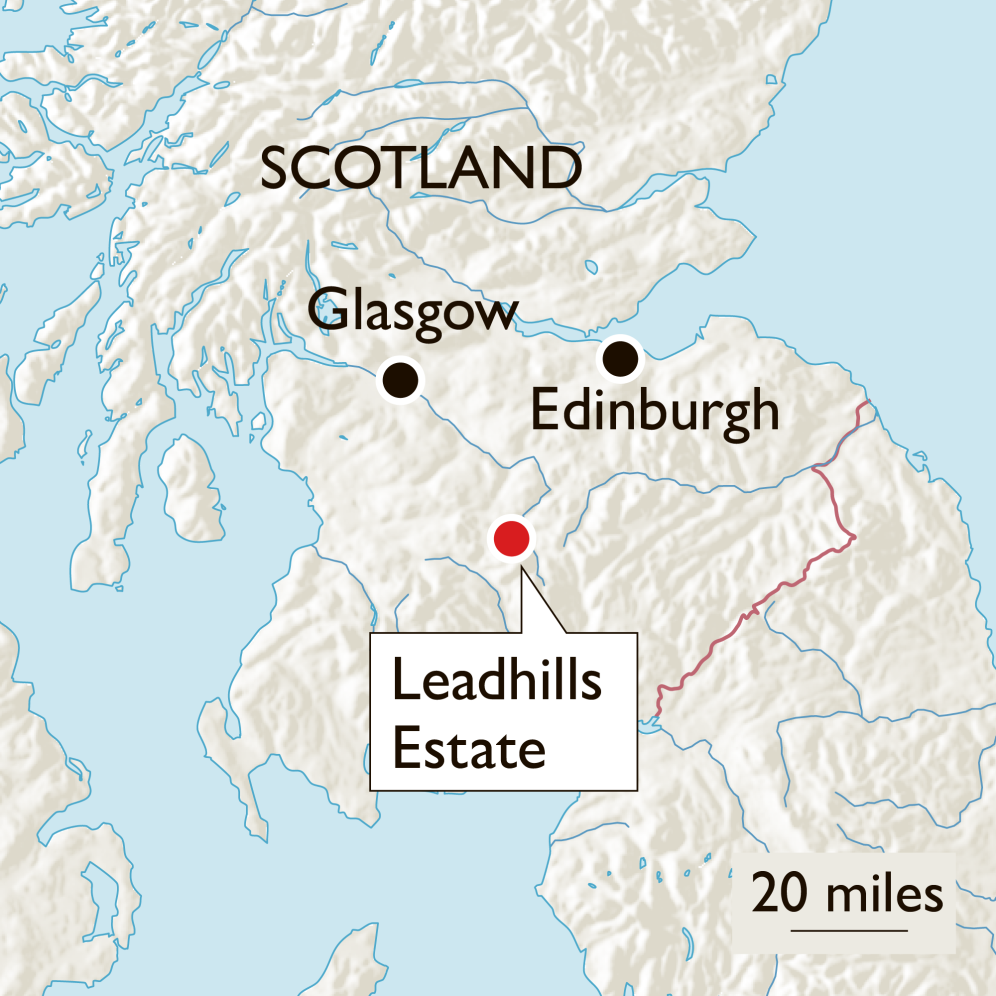
Last week I blogged about how NatureScot has extended the General Licence restriction on the notorious Leadhills Estate after receiving more evidence of wildlife crime (see here). The extension was supposedly for a further three years for alleged offences that were uncovered in July 2020, but in effect is only for eight months because it is running concurrently with the original three year restriction imposed on the estate in November 2019 (see here).

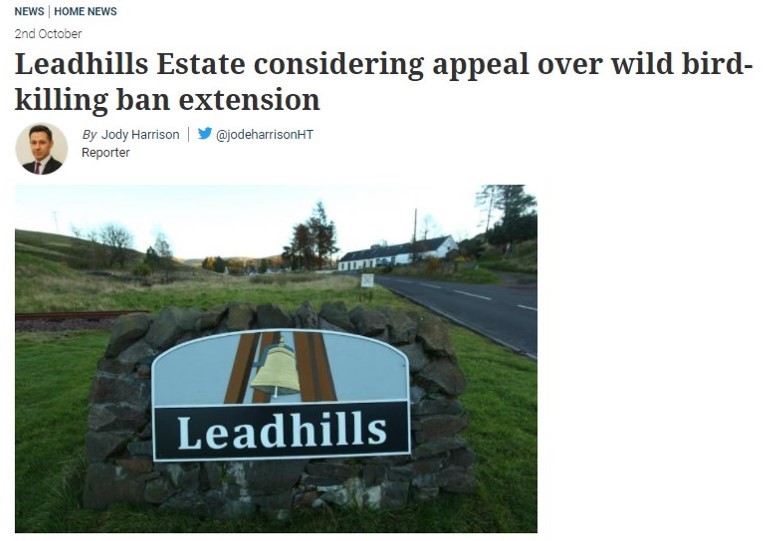
A few days after news of the restriction extension emerged, an unnamed spokesperson for Leadhills Estate has told a journalist at The Herald that the estate is ‘actively considering’ an appeal against the extended restriction and claims not to have seen the evidence behind the restriction decision. The link to the article is here but I’ve cut and pasted it below for posterity:

A sporting estate whose ban from shooting or trapping wild birds has been extended for a further two years has said it is considering an appeal against the ruling

Scottish Government conservation body NatureScot has said that the restriction on “general licenses” at the Leadhills Estate in South Lanarkshire will now last until 2023 after additional evidence was uncovered.

However, a spokesman for Leadhills has questioned the justification for the extra two-year prohibition, saying that it has not been shown the evidence behind the decision. 

The killing of wild birds has been prohibited on the estate since 2019 in response to police evidence of crimes against wild birds occurring on the land.

This included signs of the illegal killing of raptors, chiefly three hen harriers, one short-eared owl and two buzzards, and the illegal disturbance of a wild bird nest.

Leadhills Estate encompasses approximately 19,500 acres, mixed between farming and grouse moors. It is owned by two Trusts, the Leadhills Trust and Glengeith Trust.

The estate’s spokesman said: “The estate is extremely disappointed by this decision and is actively considering an appeal against it.

We have yet to see the evidence leading to this decision and have been requesting this information from the relevant authorities.

Without that evidence, we question the justification for such a decision, which is likely to have an impact on wildlife on the estate.”

General licences are granted to landowners or land managers to carry out actions which would otherwise be illegal, including controlling common species of wild birds to protect crops or livestock.

The spokesman added: “There has been no commercial driven grouse shooting on the estate for several years and the moorland is managed on a care and maintenance basis.

“The estate has a zero tolerance approach to wildlife crime and has robust compliance systems in place.

“Employees are fully aware of their responsibilities with regard to the conservation of wildlife and we are confident that wildlife crimes have not been committed by anyone employed on the estate.”

ENDS

It seems very strange to me that Leadhills Estate claims to be ‘actively considering’ an appeal at this stage. If you read the protocol and process used by NatureScot when making restriction decisions (and decisions to extend the original extension), you’ll see that there are multiple opportunities for an estate to make appeals and challenge the decision, well before now (see here).

Indeed, Leadhills Estate will be very familiar with this appeal process, having gone through it when the original three-year restriction was imposed in November 2019 (and it’s well worth reading the Estate’s appeal letter for it’s comedic value – see here).

It also sounds strange that Leadhills Estate claims not to have been provided with the evidence to justify the restriction extension. Again, have a look at the decision-making process used by NatureScot, particularly this paragraph about notification:

The Head of Wildlife Management will notify the owners and occupiers of the land in respect of which a restriction is recommended (“the Affected Parties”), in writing (“the Notification”). The notification will include a summary of the evidence on which the recommendation is based and will set out the reasons, the land to which the recommended restriction would apply and the duration of the recommended restriction (“the Decision Notice”). The possibility of a restriction being imposed will also be discussed with Police Scotland to ensure there is no risk to any potential prosecutions‘.

Given how risk averse NatureScot is, and its conservative approach when it comes to dealing with General Licence restrictions, I find it very hard to believe that NatureScot staff wouldn’t have followed the protocol and process to the letter.

It couldn’t be that Leadhills Estate is just grandstanding for the press, could it?

Time will tell. I’ve requested details of the correspondence between Leadhills Estate and NatureScot via a freedom of information request.

Extension of General Licence restriction at Leadhills Estate confirmed as pitiful 8 months

Yesterday I blogged (here) about the extended General Licence restriction that has been imposed on Leadhills Estate after further evidence of wildlife crime had come to light since an original three-year restriction was imposed (to run 26 Nov 2019 – 26 Nov 2022).

[The grouse moors of Leadhills Estate. Photo by Ruth Tingay]

However, there was some confusion from the licencing agency, NatureScot, as to just how long this extension was applicable.

Robbie Kernahan, NatureScot’s s Director of Sustainable Growth was quoted in a NatureScot announcement saying ‘…there is enough evidence to suspend the general licences on this property for a further three years‘, which should have taken the restriction to November 2025 but when I looked at the actual detail of the extension on another part of the NatureScot website, the expiry date of the extension was given as 8th July 2023.

I contacted NatureScot’s licensing team this morning and asked them to clarify the apparent discrepancy. I am grateful to Licensing Manager Liz McLachlan for a prompt and clear explanation, as follows:

We have amended the statement on our web-pages as we accept there was some ambiguity in the original wording which you have picked up on. To clarify, the 3 year extension to the restriction is from the date of the most recent (additional) offence, as recorded by Police Scotland, which takes the restriction to July 2023.

For completeness the restriction is from 8 July 2020 to 8 July 2023‘.

I have looked at the amended statement from Robbie Kernahan which now reads:

In this case we have concluded that there is enough evidence to suspend the general licences on this property until 2023‘.

So effectively, this ‘three year extension’ isn’t actually a three-year extension at all. Technically it might be, but in effect it’s actually only an eight month extension because the estate is already serving the original General Licence restriction up until 26 November 2022, so imposing another restriction for the period 8 July 2020 to 26 November 2022, on top of the one already being served, is utterly pointless.

The 8-month extension from 27 November 2022 to 8 July 2023 is the only part of this ‘extended’ restriction that will have any real effect.

And apparently the estate has already served 14 months of the extension, given that it began in July 2020! Why has it taken 14 months for NatureScot to publicise this extended restriction? When was the estate notified of this further restriction? And has it made any difference whatsoever to the estate’s activities, given that the original restriction was already underway (since November 2019)?

And if this extension was in place since July 2020, then why the hell did NatureScot give Leadhills Estate special privileges last year when it granted an out-of-season muirburn licence in September 2020??

What sort of idiotic ‘sanction’ is this? An eight month General Licence restriction for the shooting of a short-eared owl, which is the alleged offence that this extension is based upon. Well that’s really going to put the fear of God up other would-be raptor killers, isn’t it?

It’s a pitiful response.

I don’t know if it’s a result of legal limitations (e.g. can this legal sanction be lawfully applied several years after the original offence?) or if it’s a result of professional incompetence by NatureScot.

I have submitted an FoI to NatureScot to ask for details of the decision-making process in this case and will blog when I receive a response.

[Short-eared owl by Amy Lewis]

Leadhills Estate – General Licence restriction extended after police report more evidence of wildlife crime

Regular blog readers will be well aware that the notorious Leadhills Estate, a grouse-shooting estate in South Lanarkshire that has been at the centre of police wildlife crime investigations at least 70 times since the early 2000s, is currently serving a three-year General Licence restriction based on ‘clear evidence’ of raptor persecution offences, including the illegal killing of a short-eared owl, two buzzards and three hen harriers that were ‘shot or caught in traps’ on Leadhills Estate since 1 January 2014 (see here) and the discovery of banned poisons on the estate in May 2019 (see here).

That original General Licence restriction was imposed on Leadhills Estate by NatureScot in November 2019 and is valid until November 2022.

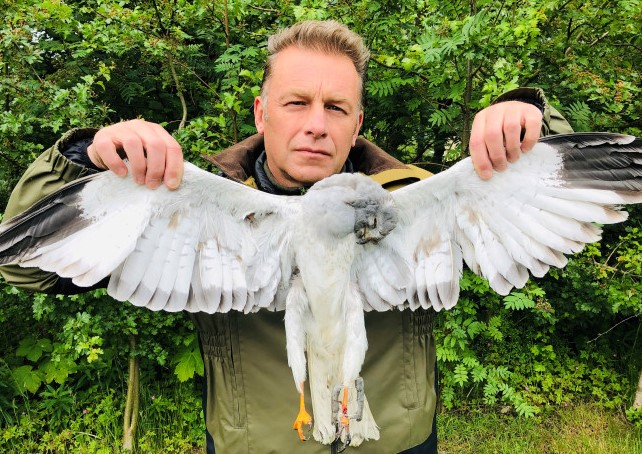
[Chris Packham holds a dead hen harrier. This bird was caught by the leg in an illegally-set trap on the Leadhills Estate grouse moor in May 2019. The trap had been set next to the harrier’s nest and was hidden by moss. The harrier’s leg was almost severed. Unfortunately, extensive surgery could not save this bird. Photo by Ruth Tingay]

However, since that original restriction was imposed on Leadhills Estate in November 2019, further alleged offences have been reported and are the subject of ongoing police investigations (see here) including the alleged shooting of a(nother) short-eared owl by a masked gunman on a quad bike as witnessed by a local resident and his eight year old son in July 2020 (see here) and the discovery of yet another batch of banned poisons, also in July 2020 (here). A satellite-tagged hen harrier (Silver) also vanished in suspicious circumstances on the estate in May 2020 (here), and although NatureScot don’t count missing satellite-tagged raptors as sufficient evidence for a General Licence restriction, the disappearance can be used as supportive evidence if further alleged offences are also being considered.

It’s been over a year since those further alleged offences were reported and we’ve all been waiting to see whether NatureScot would impose a further General Licence restriction on Leadhills Estate. Instead, the licensing team appears to have been focusing on helping out the estate by issuing it with an out-of-season muirburn licence last year (see here) and considering another application from the estate this year (see here). It really beggars belief.

Anyway, NatureScot has finally got its act together and has indeed imposed a further General Licence restriction on Leadhills Estate. Here is the statement on the NatureScot website:

29 September 2021

NatureScot has extended the restriction of the use of general licences on Leadhills Estate in South Lanarkshire until 2023. The decision was made on the basis of additional evidence provided by Police Scotland of wildlife crime against birds.

General licences allow landowners or land managers to carry out actions which would otherwise be illegal, including controlling common species of wild birds to protect crops or livestock.

A restriction of the use of general licences was implemented on Leadhills estate in November 2019, in response to police evidence of crimes against wild birds occurring on the land. This decision extends the period of the existing restriction.

Robbie Kernahan, NatureScot’s s Director of Sustainable Growth, said: “It is hugely disappointing to have to be considering further issues of wildlife crime against wild birds and we are committed to using the tools we have available to us in tackling this. In this case we have concluded that there is enough evidence to suspend the general licences on this property for a further three years. They may still apply for individual licences, but -if granted – these will be closely monitored.

We work closely with Police Scotland and will continue to consider information they provide us on cases which may warrant restriction of general licences. The detection of wildlife crime can be difficult but new and emerging technologies along with a commitment from a range of partners to take a collective approach to these issues will help us stop this from occurring in the future.”

ENDS

NatureScot’s Robbie Kernahan is quoted here as saying the General Licence restriction will apply “for a further three years“, which should take the restriction up to November 2025.

However, when you look at the actual restriction notice on NatureScot’s website, it says the restriction will extend to July 2023.

Eh? That’s not a three-year extension. That’s only an eight-month extension. I sincerely hope this is just a typo and the date should read November 2025.

It’s good to see NatureScot finally get on with this but I have to say that given there’s a need for an extension of the original General Licence restriction on Leadhills Estate, due to further evidence from Police Scotland about ongoing alleged wildlife crime there, doesn’t that demonstrate just how ineffective the General Licence restriction is as a tool for tackling wildlife crime??

I’ve written many times about the futility of this scheme, and have even presented evidence about it to a Parliamentary committee, not least because even when a General Licence restriction has been imposed, estate employees can simply apply to NatureScot for an individual licence to continue doing exactly what they were doing under the (now restricted) General Licence (e.g. see here)!

And although former Environment Minister Paul Wheelhouse, who was responsible for first introducing General Licence restrictions in 2014, considered that it would work as a ‘reputational driver’ (here), I’ve previously shown with several examples how this is simply not the case (e.g. see here) and that a General Licence restriction remains an ineffective sanction.

Nevertheless, it’s all we’ve got available at the moment and on that basis I would like to see NatureScot now get on with making decisions about restrictions on a number of other estates, such as Invercauld Estate in the Cairngorms National Park where a poisoned golden eagle was found dead next to a poisoned bait earlier this year (here).

And Invercauld isn’t the only estate that should be sanctioned, is it, NatureScot?

UPDATE 30th September 2021: Extension of General Licence restriction at Leadhills Estate confirmed as pitiful 8 months (here).

UPDATE 6th October 2021: Leadhills Estate’s reaction to extended General Licence restriction (here).

UPDATE 23rd February 2022: NatureScot refuses to publish details of Leadhills Estate’s general licence restriction appeal (here)

Derbyshire Police refuse to publicise report of two shot buzzards on pheasant estate

The blog I wrote a couple of days ago (here) about Police Scotland’s refusal to publicise the discovery of a shot peregrine found on a grouse moor in the notorious raptor persecution area of Strathbraan drew a lot of criticism of wildlife crime policing.

Some of that criticism was fair, in my opinion, but some of it wasn’t. The main point to be made, as has been discussed many times on this blog, is that not all police forces are the same. There are some brilliant, pro-active and creative police forces in the UK, spearheaded by diligent, hard-working officers who feel the same frustration as we all do when cases cannot proceed to court, and not for lack of trying. We’ve seen evidence of these officers’ work in recent months, including at least eight search warrants executed across the country in relation to suspected raptor persecution offences:

On 18th January 2021 there was a raid in Suffolk (here), on 15th March there was a raid in Lincolnshire (see here), on 18th March a raid in Dorset (here), on 26th March a raid in Devon (see here), on 21st April a raid in Teesdale (here), on 2nd August a raid in Shropshire (here), on 12th August a raid in Herefordshire (here) and on 14th September a raid in Norfolk (here).

Yesterday evening we saw another example (here), this time from Police Scotland, resulting in an individual being charged for an alleged offence that took place last week! Whatever the outcome of this case, Police Scotland’s response cannot be faulted and those officers involved should be commended.

It’s my view that slagging off the police in general, accusing them all of being inept, corrupt, members of the Masons etc, is a lazy and inaccurate response to wider failures within the criminal justice system. I get why people do it – the criminal justice system is hopelessly underfunded and some of the legislation is in dire need of updating to close some gaping loopholes – and the public rightly feels frustrated every time another raptor persecution crime goes unpunished, again and again and again, but that still doesn’t justify some of the criticism aimed at the police in general.

However, I think it’s also fair to criticise police forces and officers when it is obvious that investigative procedures are not up to standard. That was the point of the blog post about Police Scotland’s response to the shot peregrine in Strathbraan and it’s also the focus of today’s blog, which looks at Derbyshire Constabulary’s appalling response to a report of the shooting of two buzzards, witnessed by a member of the public on a pheasant-shooting estate in Derbyshire during last year’s first lockdown (April 2020).

To set the scene, this is a large, private estate in the lowlands, heavily wooded and with some lakes and open parkland. Approximately 20,000 pheasants are released for commercial shooting each year. Some of the estate is closed off to the public but other parts are criss-crossed by public footpaths and bridleways, making this a popular location for visitors.

On 1st April 2020, a visiting member of the public was watching two buzzards circling above a wood when he heard a shot and witnessed the buzzards falling. The incident was reported to Derbyshire Police as a suspected raptor persecution crime. The police quickly attended the scene but, I’m told, did not conduct a search of the wood but did speak to the gamekeeper and a number of other estate residents.

With no corpses found and no other witnesses, the next most obvious move would be for the police to issue an appeal for information. But Derbyshire Constabulary had other ideas.

The following is an email sent by a member of the police wildlife crime team to somebody who was asking whether an appeal for information might be forthcoming, given that raptor persecution is a national wildlife crime priority. The police response is astonishing:

This is such a jaw-dropping response I don’t really know where to begin!

The police officer seems to think that if the estate residents didn’t see anything then there was ‘zero chance‘ of further evidence coming to light. Er….what about other visitors? The country was in lock-down at the time but the estate is located in a village where local residents may well have been taking their daily allowance of exercise and who may have witnessed something of relevance.

The police officer also seems to think that issuing an appeal for information would mean accusing the gamekeeper of shooting the buzzards. That’s not the case at all! Just a statement of the facts was all that was needed – without accusing anybody. Police forces do this all the time. And surely, the gamekeeper and the estate owner would welcome an appeal for information if it was possible that someone without authority was wandering around the estate discharging a firearm?! Fear of upsetting the gamekeeper/estate owner ‘when we may need the cooperation of the estate for future things‘ is not a valid reason for not progressing this investigation.

I think the most worrying aspect of the police response is this:

I think we all know that it would inevitably lead to repeated discussions which we’d have to become part of if it was our publication about gamekeeping practices in general. We’ve found that, for our team’s purposes, propaganda is of no value to us and is something we try to avoid‘.

Again, an appeal for information would not need to include any mention of gamekeeping practices. It would just be a statement of facts – that a member of the public reported what he believed to be the shooting of two buzzards at this location, at xx:xx hours on 1st April 2020, if anyone has any information that might help please contact the police on Tel 101 and quote incident ref number xxxxxxx.

How does Derbyshire Constabulary expect to maintain the public’s confidence to report suspected wildlife crime when reports are likely to be viewed as ‘propaganda’ by the police?

This isn’t the first time that Derbyshire Constabulary has faced criticism for the way it deals with reported raptor persecution crimes.

In January 2020, the RSPB issued a press statement about an illegally poisoned buzzard, found next to a poisoned bait, in the Peak District National Park. This crime had been uncovered the year before, in April 2019, but Derbyshire Constabulary had chosen not to say anything about it, nor to warn the public about the danger of poisoned baits being laid out in the countryside, let alone in a National Park (see here).

In response to that press release and the subsequent criticism of the police, Derbyshire Constabulary issued a remarkable statement on Facebook claiming that the circumstances surrounding the discovery of the poisoned buzzard, lying next to the poisoned bait, were ‘inconclusive’ as to whether the buzzard had been deliberately poisoned (yes, really – see here).

More criticism followed, quite rightly in my opinion, and shortly afterwards Derbyshire Constabulary posted another statement on Facebook, where they discussed the size of the geographic area they had to cover, their high workload, the lack of resources available to them and the small size of the team. They did though, commit to doing better (see here).

Just six weeks later this reported shooting of two buzzards landed on their desks.

As I said at the top of this blog, I have no interest in a general slagging off of the police. And particularly of Derbyshire Constabulary – a few years ago an elderly member of my family, suffering from advanced dementia, was prone to wandering off in a confused and distressed state, often for hours on end. Time and again, officers from Derbyshire Constabulary went looking for him and brought him home safely. I will always be grateful for the care and diligence shown by those officers, who went above and beyond my family’s expectations. Their efforts were exemplary and hugely appreciated.

My point is, again, that bringing the perpetrators of wildlife crime to justice, and particularly those guilty of raptor persecution, is difficult enough without some police officers seemingly doing their best to obstruct investigations. Blogs like this one make for uncomfortable reading but it’s clear that there needs to be a root and branch overhaul of procedures, with examples of best practice being highlighted and encouraged, at a national level. This is a role the so-far useless Raptor Persecution Priority Delivery Group (RPPDG) can play in England & Wales, and by the so-far useless PAW Raptor Group can play in Scotland, supported by the National Wildlife Crime Unit.

There are some seriously good officers dealing with wildlife crime but they need to be seen as the rule, not the exception.