Peregrine found shot dead on grouse moor in Strathbraan – Police Scotland refuse to publicise

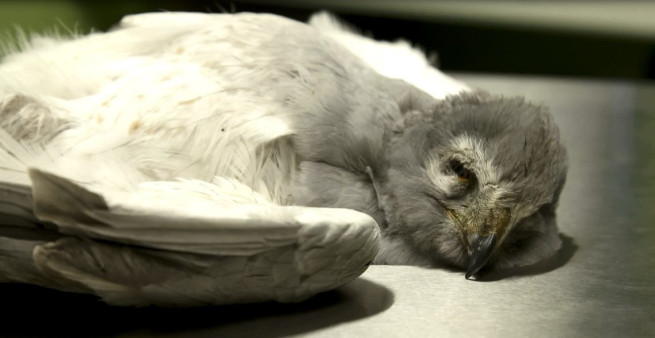
A peregrine falcon was found shot dead on a grouse-shooting estate in the Strathbraan area of Perthshire in November 2020.

The discovery was made during a police-led multi-agency raid following reports of suspected wildlife crime taking place on the estate. I blogged about that raid in February this year (see here).

This is an estate that has previously been under investigation for alleged wildlife crime offences.

My understanding is that the Scottish SPCA are progressing a case for alleged snaring offences but that Police Scotland were dealing with the shot peregrine (because it was already dead and so was beyond the (current) remit of the SSPCA)

Strathbraan is an area that has received much attention on this blog. Dominated by grouse-shooting estates, it has a very well-earned reputation as a wildlife crime hotspot, and is particularly notorious for the suspicious disappearance of satellite-tagged eagles (one of whose tags turned up in a river, its harness cut and the tag wrapped in lead sheeting to prevent transmission – see here). It is also the area where SNH issued a (flawed) licence in 2018 permitting the mass killing of ravens on the basis of ‘seeing what happened’ – but which was later withdrawn after a legal challenge by the Scottish Raptor Study Group.

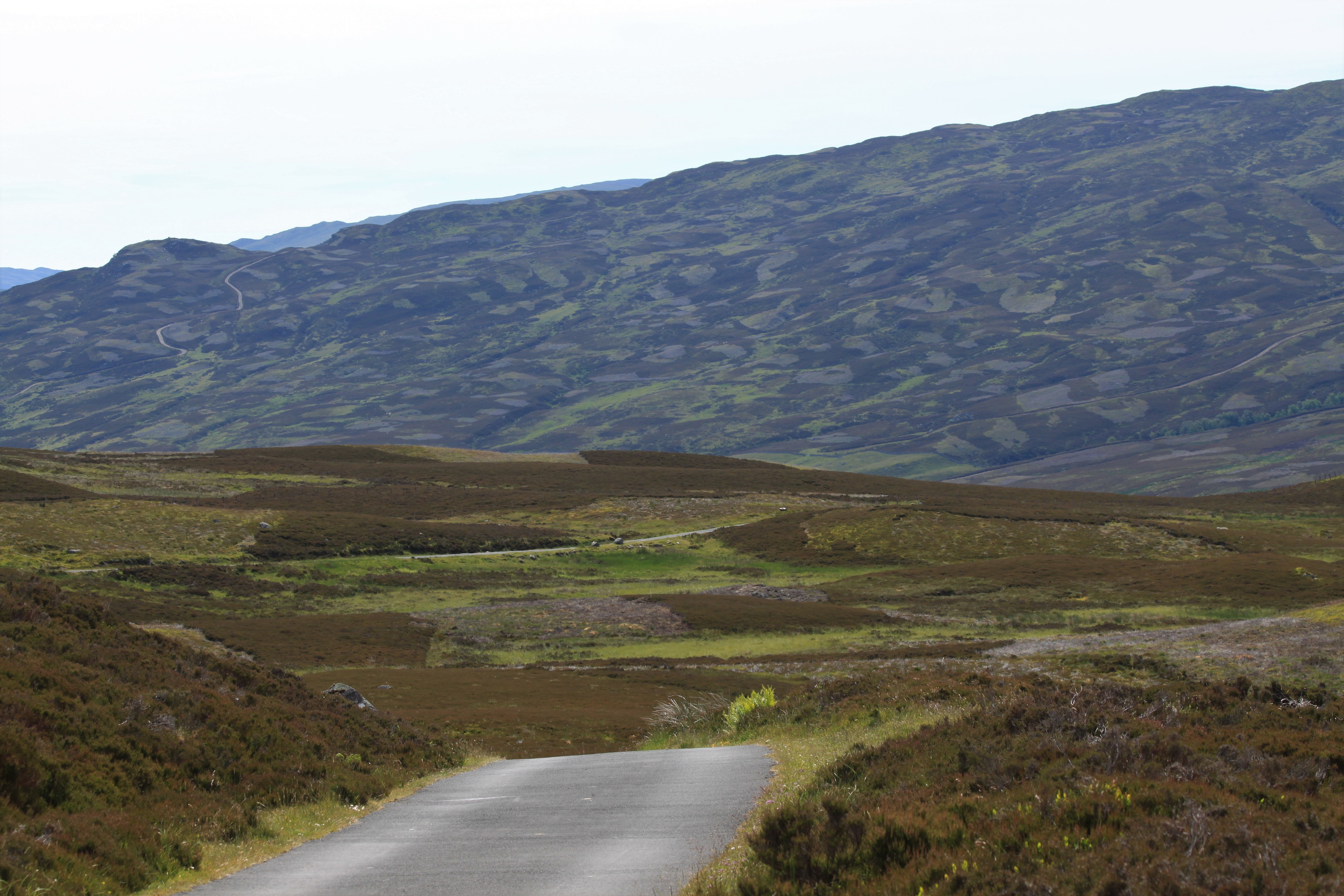
[Evidence of intensive grouse moor management in Strathbraan. Photo by Ruth Tingay]

Given the reputation of Strathbraan as a wildlife crime hotspot, and given that raptor persecution is a national wildlife crime priority, and given that Police Scotland has spent much of the last year with a dedicated campaign to try and raise public awareness of wildlife crime and encourage people to recognise and report suspected incidents, it’s difficult to understand why the police have deliberately withheld this crime from the public.

And it has been deliberately withheld. This wasn’t an oversight, or an admin error. It was a conscious decision not to say anything about it. How do I know that? Well, because I’ve been talking to Police Scotland about this crime since January 2021 and have asked, repeatedly, when they were planning on putting out the news / making an appeal for information because I believed it to be in the public interest to do so.

At first I was told that no press release was planned “until I have done a little bit more enquiry in to the circumstances“.

Fair enough.

Three months later I asked again but got no response. I tried again at four months and then finally five months later I was told, “There was no need for us to put out anything in the press from our perspective“, and “As you say from the evidence we have, we will never know where and when it was shot“.

Good grief.

Where’s the x-ray of the shot bird? An examination of its injuries (e.g. broken wings) would provide a pretty good indication of whether it was shot close to where it had been found dead, or whether it might have had the capacity to fly several miles before succumbing to its injuries. In which case, an appeal for information would have been a logical next-step, surely?

And if the police decide to say nothing, as they have in this case, where is the public record of this offence? It’s been almost a year since it was found.

How many more raptor persecution crimes are Police Scotland keeping quiet about? Quite a few, as it happens. More to come….

UPDATE 21st September 2021: Long-eared owl illegally held in trap on same Strathbraan grouse moor where shot peregrine was found (here)

No prosecution for 5 shot buzzards found hidden on Bransdale Estate, North York Moors National Park

In April 2020, during the first lockdown, North Yorkshire Police conducted a search of Bransdale Estate in the North York Moors National Park where they discovered five dead buzzards that had been shoved in a hole under a large rock, presumably to conceal them.

X-rays confirmed that at least four of those buzzards had been shot. A later post-mortem suggested the 5th buzzard had also been shot.

Eight individuals were interviewed under caution.

North Yorkshire Police issued a press statement in May 2020, including an appeal for information (see here).

The following day, Channel 4 News featured the crime in a six minute film (here) which included shocking footage from the police officer’s body camera of when the dead buzzards were being pulled from the hole.

In early June 2020 I blogged about the game-shooting industry’s response to these abhorrent crimes – see here. Remember, this is the industry that has professed to supposedly having a ‘zero tolerance’ policy when it comes to raptor persecution. I’m not quite sure how a wall of silence from the main shooting organisations reflects this policy.

One group did comment (the North York Moors Moorland Association), some of whose members may well have been among those interviewed under caution by the police in the course of this investigation, but I’m not sure that the group’s decision to slag off the police was all that bright or did them any favours (see here).

Fast forward one year and four months to August 2021, and Inspector Matt Hagen of North Yorkshire Police revealed during an online interview about the difficulty of investigating raptor persecution incidents, that this particular criminal investigation is not going any further:

There was one estate on the North York Moors National Park, there were five dead buzzards that were found. Four of them had definitely been shot and from the post mortem it suggested that the 5th one had been shot as well.

We’ve analysed mobile phones and all this takes such a long time and costs a lot of money and ultimately at the end of it all we are not going to be able to progress this case because we have to be able to prove beyond reasonable doubt, to a court, who is responsible, and on this case we’re not able to do that, unfortunately“.

It’s been suggested to me from several locals that a number of gamekeepers have since ‘moved on’ from this estate (to work on game-shooting estates in other parts of the UK) and also that the shooting rights have changed hands since these crimes were uncovered. If true, all coincidental, I’m sure.

I don’t know whether the estate is still lauded as an accredited member of the British Game Alliance, the industry’s so-called official marketing board, which now appears to have changed its name to British Game Assurance. Ironic really because the BGA doesn’t seem to do transparency (e.g. here and here).

So there we have it. Yet another disgraceful raptor persecution crime uncovered on a UK driven grouse shooting estate, inside a National Park no less, where armed culprits have got away with committing wildlife crimes without suffering any consequence whatsoever. And in this case, not through lack of effort by North Yorkshire Police.

[X-ray of one of the five shot buzzards found concealed in a hole on the grouse shooting estate]

Reports of wildlife crime doubled during lockdown, says Police Scotland Chief

Press release from Police Scotland:

Operation Wingspan, a year-long campaign to tackle wildlife crime, working with partners, including the Partnership Against Wildlife Crime (PAW) Scotland, has seen considerable success and is now entering its final phase.

This involves officers working on the persecution of fresh water pearl mussels and tackling all aspects of poaching, including hare coursing. As with previous phases, it will involve a combination of enforcement action and education.

Overall, the campaign has involved officers engaging with a number of organisations, including the agricultural community, ranger services, land managers and game keepers with the aim of educating the wider public and encouraging them to report wildlife crime to the police.

Detective Sergeant Billy Telford, Police Scotland’s Wildlife Crime Co-ordinator, said: “We have many internationally renowned species that attract thousands of nature lovers and tourists every year to Scotland, but many crimes against wildlife are cruel and barbaric, often involving a painful death.

From hunting deer, hares or badgers with dogs, to using poisons or snares on protected birds, and protecting one of our lesser known species, the critically endangers freshwater pearl mussel, Operation Wingspan is raising awareness and hopefully encouraging people to come forward and report this kind of crime.”

[This young golden eagle was found ‘deliberately poisoned‘ with a banned toxin on an Invercauld Estate grouse moor in the Cairngorms National Park in March this year. Photo by RSPB Scotland]

Operation Wingspan began in October 2020 and Phase One saw officers tackling the trade in endangered species and included visits to over 300 business premises, such as antique dealers, retro shops and pet shops across Scotland to advise owners and provide information about potential contraventions under The Control of Trade in Endangered Species (COTES) 2018 regulations. It resulted in the seizure and recovery of alligator heads from across the country.

Phase Two tackled badger persecution, working with the charity Scottish Badgers, to highlight that badgers and their setts are protected, that it is an offence to harm or interfere with them and that badger baiting is illegal. Where ongoing risks were identified, action was taken to protect the sett and the badgers.

Phase Three saw officers taking part in a construction conference to outline the responsibilities of developers, highlighting that it is an offence to destroy or damage roosts, as well as engaging with bat groups and visiting vulnerable roosts, ultimately leading to people being charged for undertaking development that threatened the welfare of bats.

In Phase Four concentrated on raptor persecution. Officers have carried out a number of activities, including patrols of vulnerable nesting sites, warrants executed in relation to wildlife crime and a social media campaign with an educational video that was produced in collaboration with the RSPB.

Detective Chief Superintendent Laura McLuckie said: “Reports of wildlife crime doubled during lockdown and Police Scotland is dedicated to working closely with a wide range of partner organisations to reduce the harm to species targeted by criminals and the communities who rely on them for employment and tourism across Scotland.

Tackling wildlife crime is not just about enforcement, it is also about working with partners and raising public awareness to prevent it happening. Indeed, the public has an important role in helping up to investigate reports of wildlife crime and I would urge anyone with concerns or who suspect a wildlife crime has been committed to contact us on 101, and if it is an emergency to call 999.”

More information can be found on our website: https://www.scotland.police.uk/wildlifecrime

ENDS

Trial date set for Suffolk gamekeeper accused of poisoning buzzard

A couple of days ago I blogged about a gamekeeper who was due in court this week to face allegations that he was responsible for the alleged poisoning of a buzzard in Suffolk (see here).

This prosecution resulted from a multi-agency investigation and raid conducted at premises in January this year involving Suffolk Police, National Wildlife Crime Unit, Natural England and the RSPB’s Investigations team (see here).

[Police seized guns and pesticides during the multi-agency raid in January 2021. Photo via Suffolk Police]

News from the court today (via the RSPB) is that this gamekeeper has pleaded guilty to some charges but not guilty to others, so this case will now proceed to trial.

The gamekeeper pleaded guilty to six charges relating to firearms and pesticide storage.

He pleaded not guilty to two further charges relating to the illegal buzzard poisoning.

The trial is due to begin on 8th November 2021.

Please note, as this is a live case no further detail will be provided here until the case has concluded or there is official commentary from the court. Comments on this particular blog also won’t be accepted until the case concludes so as not to prejudice proceedings. Thanks for your understanding.

UPDATE 9th November 2021: Gamekeeper convicted for pesticide and firearms offences but buzzard-poisoning charge is dropped (here)

Another gamekeeper in court for alleged poisoning of buzzard

Earlier this month I blogged about a gamekeeper in Nottinghamshire who is facing trial after he pleaded not guilty to the alleged killing of several buzzards (see here).

Now there’s another case to report. This time it’s a gamekeeper in Suffolk who is due in court on Thursday in relation to the alleged poisoning of a buzzard.

This latest prosecution relates to the joint raid undertaken by Suffolk Police, Natural England and the RSPB’s Investigations Team in January this year (see here).

[Police seized guns and pesticides during the multi-agency raid in January 2021. Photo via Suffolk Police]

Tomorrow’s court hearing will provide an opportunity for the defendant to enter a plea.

If he pleads not guilty, the case is expected to continue to go to trial at a later date.

If he pleads guilty, he may be sentenced tomorrow or the magistrate may ask for background reports before sentencing at a later date.

Please note, as this is a live case no further detail will be provided here until the case has concluded or there is official commentary from the court reporter. Comments on this particular blog also won’t be accepted until the case concludes so as not to prejudice proceedings. Thanks for your understanding.

UPDATE 26th August 2021: Trial date set for Suffolk gamekeeper accused of poisoning buzzard (here)

Rare breeding success for sea eagles in Cairngorms National Park but outlook for chick is bleak

The Cairngorms National Park Authority has issued the following press release today (6th July 2021). My commentary on this news is below the press release:

Raptor breeding successes for East Cairngorms Moorland Partnership

The productivity of breeding raptors in the east of the Cairngorms National Park this season is encouraging and includes the hatching of a sea eagle chick on Balmoral, the first time that the species has successfully bred on the estate.

The breeding pair of sea eagles – also known as white-tailed eagles – have been observed on Balmoral for the last few years. Both adult birds carry satellite tags and close collaboration with the Royal Society for the Protection of Birds (RSPB) has allowed the Balmoral Ranger Service to follow their weekly movements during the breeding season. A healthy male chick has now hatched and been ringed. Three golden eagle chicks have also recently been ringed as part of long-term monitoring on Balmoral.

Balmoral Estate is a member of the East Cairngorms Moorland Partnership (ECMP) which has seen breeding success for golden eagles, hen harriers, red kite, osprey, peregrine and merlin, as well as short-eared owls, in 2021, across the various land holdings.

[The young white-tailed eagle chick on the nest at Balmoral. Photo by North East Scotland Raptor Study Group, a member of the Scottish Raptor Study Group]

Richard Gledson, Estate Manager at Balmoral Estate said: “All at Balmoral Estate are delighted that sea eagles have nested successfully for the first time. A previous nesting attempt in 2017 on the same site sadly failed and we have had our fingers crossed since then. The birds have been with us for a couple of years, and we have been working closely with the North East Scotland Raptor Study Group who ringed the chick last week and with the RSPB who have been sending data from their satellite tags.”

Glenavon Estate – which is home to three pairs of golden eagles, including one of the highest nesting sites in Scotland – has had a golden eagle chick satellite tagged for the first time in recent years. Satellite tags are used by biological researchers on a variety of species including eagles and harriers, and provide valuable insight into their movement and survival. Golden eagle chicks have also been tagged on the Glenlivet Estate and Mar Lodge Estate.

Furthermore, Mar Lodge has hosted six hen harrier nests in 2021. One pair failed early in the season, but the other five nests all have chicks. Two hen harrier chicks have been satellite-tagged in collaboration with the RSPB. Evidence from satellite tags fitted to some of the harriers which are now breeding shows that the birds range widely, foraging across ground on neighbouring ECMP estates.

Last year, Mar Estate witnessed the first successful breeding attempt of sea eagles in Deeside for 200 years, but the relatively inexperienced pair failed this season at the hatching stage, with poor weather likely a contributing factor, however hopes are high for success with continued breeding efforts next season and beyond.

Dr Ewan Weston of the North East Scotland Raptor Study Group, who has carried out much of the satellite tagging on ECMP estates, commented: “This year’s raptor tagging on ECMP estates builds on a positive collaboration with the estates over recent years. Despite a very wet, snowy May, the general picture in the area is that raptors, particularly golden eagles, red kites and hen harriers have done well.”

The East Cairngorms Moorland Partnership is a landscape-scale collaboration between five sporting estates and the Cairngorms National Park Authority. The partnership seeks to deliver private interests alongside public benefits, including improving the conservation status of raptors, demonstrating best practice muirburn management, expanding areas of woodland and scrub and peatland restoration. Partners have been collaborating with a wide range of ecologists in the National Park.

Xander McDade, Convenor at the Cairngorms National Park Authority, said: “We are delighted to hear that productivity of raptors in the east of the National Park looks good for 2021. However, we know that we can still do more for the birds and are committed to finding ways of improving the conservation status of moorland raptors, along with other red and amber moorland bird species. This includes working closely with the five estates that make up the ECMP on a range of conservation measures.”

ENDS

First of all, the breeding success of this pair of white-tailed eagles on Balmoral Estate is obviously very good news and long, long over due.

Norway donated 85 sea eagles for a reintroduction project in eastern Scotland between 2007-2012, although over a quarter of those didn’t survive (the main known causes of death included illegal poisoning, illegally shot, accidentally electrocuted and being hit by trains). The East Coast reintroduction was the third phase of a national reintroduction project that started back in 1975 on the west coast of Scotland, after the species was extirpated from Britain thanks to persecution in the late 1800s and early 1900s.

The first successful breeding attempt in east Scotland in 2013, the first for over a century, was an historic milestone in the project and was hoped to be the beginning of a new and vibrant population in the east, mirroring the successful population growth in the west.

So far though, progress has been incredibly slow and ongoing persecution has been at the centre of that (e.g. see here for the news that a sea eagle’s nest tree was deliberately felled on a grouse moor in the Angus Glens, also in 2013-nobody was prosecuted).

A number of young satellite-tagged sea eagles have ‘disappeared’ in suspicious circumstances on or next to grouse moors since then, and only last year a young sea eagle was found dead, illegally poisoned, on another grouse moor inside the Cairngorms National Park (see here). Nobody was prosecuted for that crime.

[A police officer examines the corpse of the illegally poisoned sea eagle found dead on a grouse moor in the Cairngorms National Park in 2020. Photo by Police Scotland].

So yes, it’s excellent news that Balmoral Estate has hosted a successful breeding attempt this year – well done to the team there – but it’s only half of the story. What happens when that young eagle fledges and disperses from Balmoral later this year?

Will it meet the same fate as this young golden eagle, which fledged from a nest site in the eastern Cairngorms last year and was found dead, ‘deliberately poisoned’ on a grouse moor on Invercauld Estate earlier this year?

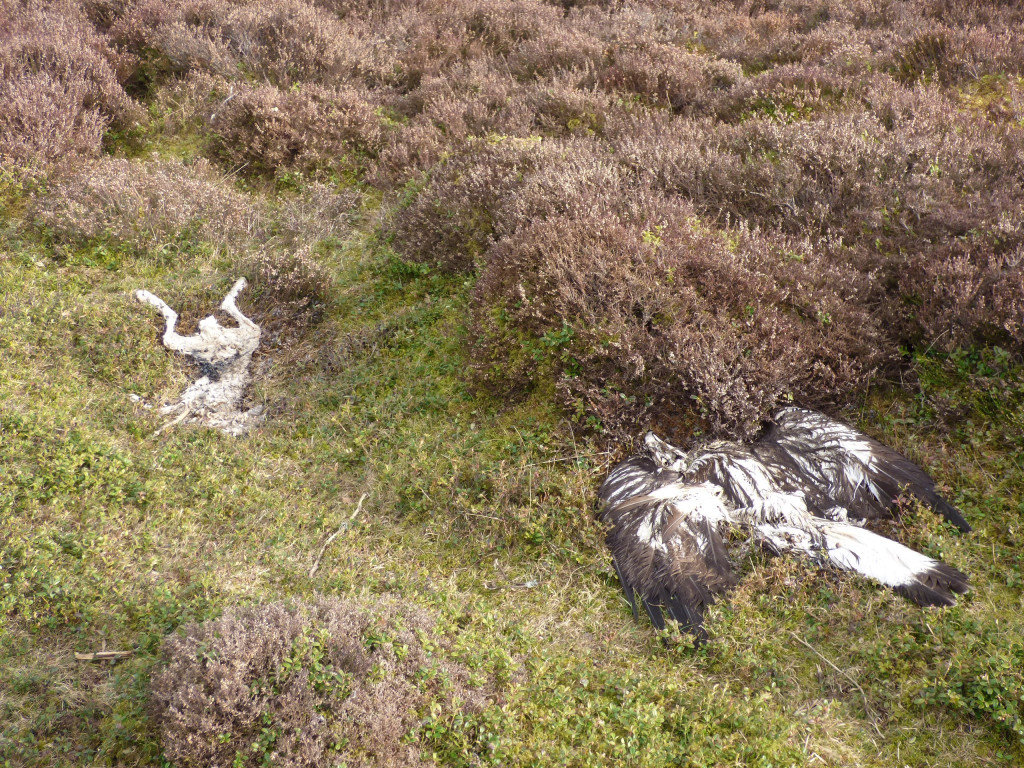
[An illegally poisoned golden eagle, laying next to a poisoned mountain hare bait, found dead on a grouse moor in the Cairngorms National Park in 2021. Photo by RSPB Scotland]

I can see why the Cairngorms National Park Authority would want to issue this press release – not just to deservedly celebrate the successful breeding attempt on Balmoral Estate but probably more cynically, to try and undo some of the reputational damage that has been caused to the Park Authority and to its Eastern Cairngorms Moorland Partnership (ECMP) after the discovery of the poisoned golden eagle earlier this year on one of the ECMP’s partner estates (now no longer a partner) and the deserved criticism that the Park Authority has received for refusing to publish the correspondence it had had with the ECMP about the future of Invercauld Estate as a member of the ECMP following the discovery of the poisoned eagle (see here). This is the same tactic the Park Authority employed a few years ago when illegally-set traps were found on Invercauld Estate (here).

The ECMP can thank its lucky stars that one of its (now five) member estates is Mar Lodge, owned by the National Trust for Scotland, and with a glowing reputation for raptor conservation, especially for breeding hen harriers. Without Mar Lodge’s efforts, the ECMP’s raptor conservation efforts would be looking pretty feeble to date.

Although I noted the irony of the statement in the Park Authority’s press release that, ‘Evidence from satellite tags fitted to some of the harriers which are now breeding shows that the birds range widely, foraging across ground on neighbouring ECMP estates‘.

Er, yeah, but they forgot to mention how many of those hen harriers subsequently ‘disappear’ in suspicious circumstances on grouse moors in the ECMP and beyond (e.g. see here).

It doesn’t matter how far the Park Authority tries to spin the very welcome but too infrequent ‘good news’ stories like the breeding white-tailed eagles on Balmoral – the bottom line remains that large areas of the Cairngorms National Park are still raptor persecution hotspots and until that changes, the outlook for this young sea eagle is bleak.

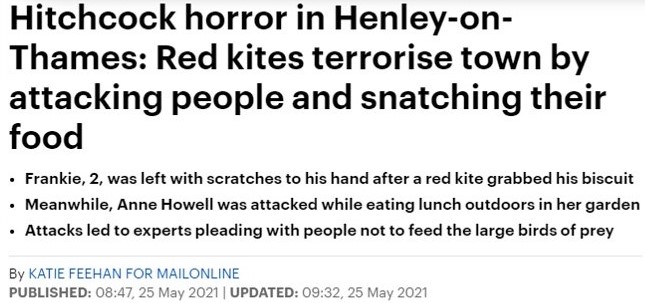
Sensationalist media reporting over red kite ‘attack’ will not help stop persecution

When I talk with international colleagues about the problem we have in the UK with bird of prey persecution, many of them are baffled how it can still be ‘a thing’ over here, so many decades after societies elsewhere developed a much more progressive attitude.

To be honest it’s a question I struggle to answer, but it is indeed still ‘a thing’ in many parts of the UK, as entries on this blog will attest. One of the causes of this ongoing perception that birds of prey are ‘bad’, ‘evil’, ‘vermin’ etc is undoubtedly the sensationalist, distorted version of reality published by mainstream media, designed to grab headlines rather than sensibly inform.

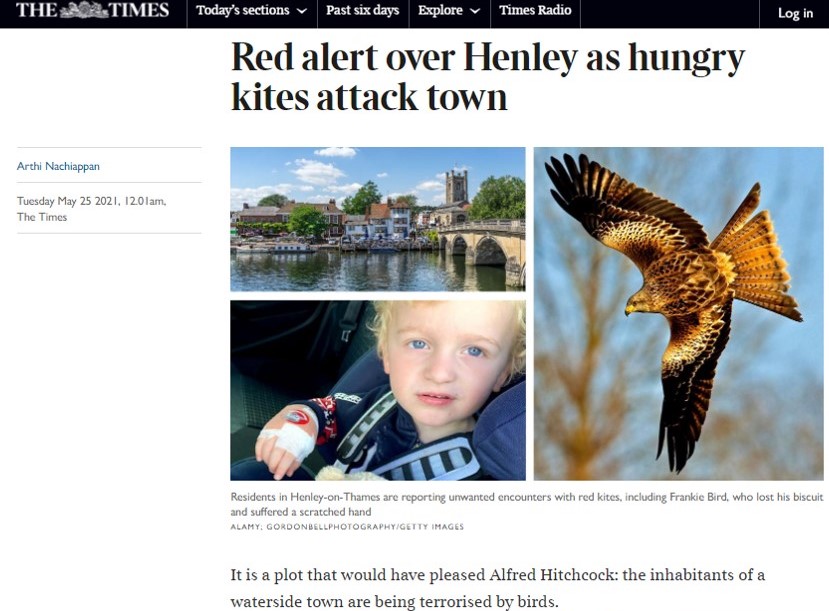
Here’s a classic example from yesterday, after a red kite lifted a custard cream from the hand of a two-year-old boy in Henley, Oxfordshire and accidentally scratched the back of his hand. Here’s how the press responded (The Times, Sky News, The Guardian, Daily Mail):

The toddler wasn’t ‘attacked’, nor was the town, and nor are residents being ‘terrorised’ by red kites, which the Daily Mail says ‘resemble eagles’!

Red kites are skilled opportunists and if there’s an easy meal to be had, they’ll take it. The situation in Henley with red kites coming in close to humans has been exacerbated by some residents feeding scraps to the kites in their gardens, and although this has been widely discouraged some people continue because they still enjoy having the kites around, 30 years on from the reintroduction project just a few miles outside Henley.

I know the Chilterns very well and the draw has always been the kites. The vast majority of people I know there and others I meet when out walking there are not ‘in fear of being attacked’ and nor do they believe they are living in a ‘Hitchcock horror’. Those of us lucky enough to have kites around relish the fact we can live alongside these birds and get enormous pleasure from seeing them every day.

This unsubstantiated hysteria generated by the press does nothing to educate the public about the benefits of having birds of prey in our environment and will not help to stop those still intent on killing any bird of prey whether by trap, poison or the gun.

Just in the last few months alone there have been reports of a poisoned red kite in Scotland (here), a poisoned red kite in Lincolnshire (here), a poisoned red kite in Dorset (here), a shot red kite in the Cotswolds (here), a shot red kite in Norfolk (here), a suspected shot red kite in Warwickshire (here), a red kite killed in an illegally-set trap in Berkshire (here), a poisoned red kite in North Yorkshire (here), dead red kites found in suspicious circumstances in Wiltshire (here), a shot red kite in Wales (here)……and on and on and on.

The UK media needs to get a grip and stop demonising these birds.

56 hen harriers confirmed illegally killed or ‘missing’ since 2018

For anyone who still wants to pretend that the grouse shooting industry isn’t responsible for the systematic extermination of hen harriers on grouse moors across the UK, here’s the latest catalogue of crime that suggests otherwise.

[This male hen harrier died in 2019 after his leg was almost severed in an illegally set trap that had been placed next to his nest on a Scottish grouse moor (see here). Photo by Ruth Tingay]

Just 19 days ago, this list totalled 53 hen harriers, all either confirmed to have been illegally killed or to have ‘disappeared’, most of them on or next to driven grouse moors.

They disappear in the same way political dissidents in authoritarian dictatorships have disappeared” (Stephen Barlow, 22 January 2021).

Today the list has been updated to include the most recently reported three victims: one male hen harrier that vanished from its breeding attempt on the RSPB’s Geltsdale Reserve in 2020 and two more from the same site that yesterday the police reported as ‘missing in suspicious circumstances’ (see here).

The RSPB’s Geltsdale Reserve is located in close proximity to a large area managed for driven grouse shooting and breeding males have disappeared from here prior to 2020 and 2021. In fact, raptor persecution incidents in this area, both on and off the reserve, have been reported by the RSPB since at least the mid 1990s and have included the confirmed shooting of a number of hen harriers (i.e. their corpses were found), witnessed reports of attempted hen harrier shootings, including a gamekeeper from a neighbouring estate filmed with a gun stalking a hen harrier on the reserve, at least one confirmed poisoning of a hen harrier and a wide array of other victims including buzzards, peregrines and ravens either shot or poisoned.

The disgraceful national catalogue of illegally killed and ‘missing’ hen harriers will continue to grow – I know of at least one more on-going police investigation which has yet to be publicised.

I’ve been compiling this list only since 2018 because that is the year that the grouse shooting industry ‘leaders’ would have us believe that the criminal persecution of hen harriers had stopped and that these birds were being welcomed back on to the UK’s grouse moors (see here).

This assertion was made shortly before the publication of a devastating new scientific paper that demonstrated that 72% of satellite-tagged hen harriers were confirmed or considered likely to have been illegally killed, and this was ten times more likely to occur over areas of land managed for grouse shooting relative to other land uses (see here).

2018 was also the year that Natural England issued itself with a licence to begin a hen harrier brood meddling trial on grouse moors in northern England. For new blog readers, hen harrier brood meddling is a conservation sham sanctioned by DEFRA as part of its ludicrous ‘Hen Harrier Action Plan‘ and carried out by Natural England (NE), in cahoots with the very industry responsible for the species’ catastrophic decline in England. For more background see here.

Brood meddling has been described as a sort of ‘gentleman’s agreement’ by commentator Stephen Welch:

I don’t get it, I thought the idea of that scheme was some kind of trade off – a gentleman’s agreement that the birds would be left in peace if they were moved from grouse moors at a certain density. It seems that one party is not keeping their side of the bargain“.

With at least 56 hen harriers gone since 2018, I think it’s fair to say that the grouse shooting industry is simply taking the piss. Meanwhile, Natural England pretends that ‘partnership working’ is the way to go.

‘Partnership working’ appears to include authorising the removal of hen harrier chicks from a grouse moor already under investigation by the police for suspected raptor persecution (here) and accepting a £10K bung from representatives of the grouse shooting industry that prevents Natural England from criticising them (see here).

[Cartoon by Gill Lewis]

So here’s the latest gruesome list:

February 2018: Hen harrier Saorsa ‘disappeared’ in the Angus Glens in Scotland (here). The Scottish Gamekeepers Association later published wholly inaccurate information claiming the bird had been re-sighted. The RSPB dismissed this as “completely false” (here).

5 February 2018: Hen harrier Marc ‘disappeared’ on a grouse moor in Durham (here)

9 February 2018: Hen harrier Aalin ‘disappeared’ on a grouse moor in Wales (here)

March 2018: Hen harrier Blue ‘disappeared’ in the Lake District National Park (here)

March 2018: Hen harrier Finn ‘disappeared’ near Moffat in Scotland (here)

18 April 2018: Hen harrier Lia ‘disappeared’ in Wales and her corpse was retrieved in a field in May 2018. Cause of death was unconfirmed but police treating death as suspicious (here)

8 August 2018: Hen harrier Hilma ‘disappeared’ on a grouse moor in Northumberland (here).

16 August 2018: Hen harrier Athena ‘disappeared’ on a grouse moor in Scotland (here)

26 August 2018: Hen Harrier Octavia ‘disappeared’ on a grouse moor in the Peak District National Park (here)

29 August 2018: Hen harrier Margot ‘disappeared’ on a grouse moor in Scotland (here)

29 August 2018: Hen Harrier Heulwen ‘disappeared’ on a grouse moor in Wales (here)

3 September 2018: Hen harrier Stelmaria ‘disappeared’ on a grouse moor in Scotland (here)

24 September 2018: Hen harrier Heather ‘disappeared’ on a grouse moor in Scotland (here)

2 October 2018: Hen harrier Mabel ‘disappeared’ on a grouse moor on the edge of the Yorkshire Dales National Park (here)

3 October 2018: Hen Harrier Thor ‘disappeared’ next to a grouse moor in Bowland, Lanacashire (here)

23 October 2018: Hen harrier Tom ‘disappeared’ in South Wales (here)

26 October 2018: Hen harrier Arthur ‘disappeared’ on a grouse moor in the North York Moors National Park (here)

1 November 2018: Hen harrier Barney ‘disappeared’ on Bodmin Moor (here)

10 November 2018: Hen harrier Rannoch ‘disappeared’ on a grouse moor in Scotland (here). Her corpse was found nearby in May 2019 – she’d been killed in an illegally-set spring trap (here).

14 November 2018: Hen harrier River ‘disappeared’ on a grouse moor in the Nidderdale AONB (here). Her corpse was found nearby in April 2019 – she’d been illegally shot (here).

16 January 2019: Hen harrier Vulcan ‘disappeared’ in Wiltshire close to Natural England’s proposed reintroduction site (here)

7 February 2019: Hen harrier Skylar ‘disappeared’ next to a grouse moor in South Lanarkshire (here)

22 April 2019: Hen harrier Marci ‘disappeared’ on a grouse moor in the Cairngorms National Park (here)

26 April 2019: Hen harrier Rain ‘disappeared’ on a grouse moor in Nairnshire (here)

11 May 2019: An untagged male hen harrier was caught in an illegally-set trap next to his nest on a grouse moor in South Lanarkshire. He didn’t survive (here)

7 June 2019: An untagged hen harrier was found dead on a grouse moor in Scotland. A post mortem stated the bird had died as a result of ‘penetrating trauma’ injuries and that this bird had previously been shot (here)

5 September 2019: Wildland Hen Harrier 1 ‘disappeared’ on a grouse moor nr Dalnaspidal on the edge of the Cairngorms National Park (here)

11 September 2019: Hen harrier Romario ‘disappeared’ on a grouse moor in the Cairngorms National Park (here)

14 September 2019: Hen harrier (Brood meddled in 2019, #183704) ‘disappeared’ in North Pennines (here)

23 September 2019: Hen harrier (Brood meddled in 2019, #55149) ‘disappeared’ in North Pennines (here)

24 September 2019: Wildland Hen Harrier 2 ‘disappeared’ on a grouse moor at Invercauld in the Cairngorms National Park (here)

24 September 2019: Hen harrier Bronwyn ‘disappeared’ near a grouse moor in North Wales (here)

10 October 2019: Hen harrier Ada ‘disappeared’ on a grouse moor in the North Pennines AONB (here)

12 October 2019: Hen harrier Thistle ‘disappeared’ on a grouse moor in Sutherland (here)

18 October 2019: Member of the public reports the witnessed shooting of an untagged male hen harrier on White Syke Hill in North Yorkshire (here)

November 2019: Hen harrier Mary found illegally poisoned on a pheasant shoot in Ireland (here)

January 2020: Members of the public report the witnessed shooting of a male hen harrier on Threshfield Moor in the Yorkshire Dales National Park (here)

23 March 2020: Hen harrier Rosie ‘disappeared’ at an undisclosed roost site in Northumberland (here)

1 April 2020: Hen harrier (Brood meddled in 2019, #183703) ‘disappeared’ in unnamed location, tag intermittent (here)

5 April 2020: Hen harrier Hoolie ‘disappeared’ on a grouse moor in the Cairngorms National Park (here)

8 April 2020: Hen harrier Marlin ‘disappeared’ on a grouse moor in the Cairngorms National Park (here)

19 May 2020: Hen harrier Fingal ‘disappeared’ on a grouse moor in the Lowther Hills, Scotland (here)

21 May 2020: Hen harrier (Brood meddled in 2019, #183701) ‘disappeared’ on a grouse moor in Cumbria shortly after returning from wintering in France (here)

27 May 2020: Hen harrier Silver ‘disappeared’ on a grouse moor on Leadhills Estate, Scotland (here)

day/month unknown: Unnamed male hen harrier breeding on RSPB Geltsdale Reserve, Cumbria ‘disappears’ while away hunting (here)

9 July 2020: Unnamed female hen harrier (#201118) ‘disappeared’ from an undisclosed site in Northumberland (here).

25 July 2020: Hen harrier Harriet ‘disappeared’ on a grouse moor in the Yorkshire Dales National Park (here)

14 August 2020: Hen harrier Solo ‘disappeared’ in confidential nest area in Lancashire (here)

7 September 2020: Hen harrier Dryad ‘disappeared’ on a grouse moor in the Yorkshire Dales National Park (here)

16 September 2020: Hen harrier Fortune ‘disappeared’ from an undisclosed roost site in Northumberland (here)

19 September 2020: Hen harrier Harold ‘disappeared’ on a grouse moor in the Yorkshire Dales National Park (here)

20 September 2020: Hen harrier (Brood meddled in 2020, #55152) ‘disappeared’ next to a grouse moor in North Yorkshire (here)

24 February 2021: Hen harrier Tarras ‘disappeared’ next to a grouse moor in Northumberland (here)

12th April 2021: Hen harrier Yarrow ‘disappeared’ near Stockton, County Durham (here)

18 May 2021: Adult male hen harrier ‘disappears’ from its breeding attempt on RSPB Geltsdale Reserve, Cumbria whilst away hunting (here)

18 May 2021: Another adult male hen harrier ‘disappears’ from its breeding attempt on RSPB Geltsdale Reserve, Cumbria whilst away hunting (here)

To be continued……..

Poisoned golden eagle: statement from Cairngorms National Park Authority

Further to the news that a poisoned golden eagle was found dead on Invercauld Estate in March 2021 (see here), the Cairngorms National Park Authority has issued the following statement in response:

GOLDEN EAGLE DEATH

The Cairngorms National Park Authority has issued the following statement in relation to the death of a Golden Eagle in Deeside.

The Cairngorms National Park Authority (CNPA) have been informed by Police Scotland that a golden eagle was found poisoned on Invercauld Estate within the Cairngorms National Park. The CNPA condemns this senseless and irresponsible behaviour in the strongest possible terms. Raptor persecution has no place in 21st century Scotland and no place in this National Park. We are working closely with Police Scotland, NatureScot and a range of other partners on an appropriate, coordinated response to this incident, and will continue to work in partnership to prevent incidents like this occurring in future. We cannot make any further comment on this specific case due to the ongoing police enquiry.”

This statement is issued on behalf of Xander McDade CNPA Board Convener and CNPA Chief Executive Grant Moir.

ENDS

This statement from the CNPA is an improvement on the pathetic effort it made in response to the poisoned white-tailed eagle, found dead on a grouse moor inside the National Park last year (see here), and it’s good that this time the CNPA hasn’t had to be nudged into providing a response, which is what usually happens, but even so, this is nowhere near a strong enough reaction or statement of intent.

I’ll be returning to this subject shortly, but for now readers might want to familiarise themselves with the Eastern Cairngorms Moorland Partnership (ECMP). One of the stated aims of this ‘partnership’, comprising six contiguous estates and the CNPA, is to ‘enhance raptor and other priority species conservation’. Invercauld Estate is one of the member estates.

Things need to change in the Cairngorms National Park. Current policies and so-called ‘partnerships’ are obviously not working when atrocities like poisoning eagles is still going on.

Below is a list of all the known raptor persecution crimes uncovered in the Cairngorms National Park since it was established (it was formally established in Sept 2003 but I’ve included 2002 for context and an indication that National Park status has had zero influence). As far as I’m aware, nobody has been prosecuted, yet alone convicted, for any of these offences, with the exception of one for the attempted shooting of a hen harrier in 2003.

ILLEGAL RAPTOR PERSECUTION INCIDENTS CAIRNGORMS NATIONAL PARK

2002

Feb: 2 x poisoned buzzards (Carbofuran) + rabbit bait. Tomintoul (No prosecution)

Mar: 2 x poisoned buzzards (Carbofuran) + 2 rabbit baits. Cromdale (No prosecution)

2003

Apr: 3 x poisoned buzzards (Carbofuran) + 2 grey partridge baits. Kingussie (No prosecution)

Jun: Attempted shooting of a hen harrier. Crannoch (Successful prosecution)

2004

May: 1 x poisoned buzzard (Carbofuran). Cuaich (No prosecution)

Nov: 1 x poisoned red kite (Carbofuran). Cromdale (No prosecution)

Dec: 1 x poisoned buzzard (Carbofuran). Cromdale (No prosecution)

2005

Feb: 1 x poisoned buzzard (Carbofuran). Cromdale (No prosecution)

Feb: 1 x poisoned buzzard (Carbofuran). Cromdale (No prosecution)

Mar: 3 x poisoned buzzards, 1 x poisoned raven (Carbofuran). Crathie (No prosecution)

2006

Jan: 1 x poisoned raven (Carbofuran). Dulnain Bridge (No prosecution)

May: 1 x poisoned raven (Mevinphos). Grantown-on-Spey (No prosecution)

May: 1 x poisoned golden eagle (Carbofuran). Morven [corbett] (No prosecution)

May: 1 x poisoned raven + 1 x poisoned common gull (Aldicarb) + egg bait. Glenbuchat (No prosecution)

May: egg bait (Aldicarb). Glenbuchat, Strathdon (No prosecution)

Jun: 1 x poisoned golden eagle (Carbofuran). Glenfeshie (No prosecution)

2007

Jan: 1 x poisoned red kite (Carbofuran). Glenshee (No prosecution)

Apr: Illegally set spring trap. Grantown-on-Spey (No prosecution)

May: Pole trap. Grantown-on-Spey (No prosecution)

May: 1 x poisoned red kite (Carbofuran). Tomintoul (No prosecution)

May: Illegally set spring trap. Grantown-on-Spey (No prosecution)

Jun: 1 x poisoned buzzard (Carbofuran) + rabbit & hare baits. Grantown-on-Spey (No prosecution)

Jun: 1 x poisoned buzzard (Carbofuran) + rabbit bait. Grantown-on-Spey (No prosecution)

Jul: 1 x poisoned raven (Carbofuran). Ballater (No prosecution)

Sep: 1 x shot buzzard. Newtonmore (No prosecution)

Sep: 1 x shot buzzard. Grantown-on-Spey (No prosecution)

Dec: 1 x poisoned buzzard (Alphachloralose). Grantown-on-Spey (No prosecution)

Dec: 1 x poisoned buzzard (Carbofuran) + rabbit bait. Grantown-on-Spey (No prosecution)

2008

Jan: 1 x poisoned buzzard (Alphachloralose). Nr Grantown-on-Spey (No prosecution)

Mar: 1 x poisoned buzzard (Carbofuran). Nr Grantown-on-Spey (No prosecution)

Dec: 1 x poisoned buzzard (Alphachloralose). Nr Grantown-on-Spey (No prosecution)

2009

May: 2 x poisoned ravens (Mevinphos). Delnabo (No prosecution)

Jun: rabbit bait (Mevinphos). nr Tomintoul (No prosecution)

Jun: 1 x shot buzzard. Nr Strathdon (No prosecution)

Jun: 1 x illegal crow trap. Nr Tomintoul (No prosecution)

2010

Apr: Pole trap. Nr Dalwhinnie (No prosecution)

Jun: 1 x pole-trapped goshawk. Nr Dalwhinnie (No prosecution)

Jun: Illegally set spring trap on tree stump. Nr Dalwhinnie (No prosecution)

Sep: 2 x poisoned buzzards (Carbofuran) + rabbit bait. Glenlochy (No prosecution)

Oct: 2 x poisoned buzzards (Carbofuran) + rabbit bait. Nr Boat of Garten (No prosecution)

2011

Jan: 1 x shot buzzard. Nr Bridge of Brown (No prosecution)

Mar: 1 x poisoned golden eagle (Carbofuran). Glenbuchat (No prosecution)

Apr: 1 x poisoned buzzard (Carbofuran & Aldicarb). Nr Bridge of Brown (No prosecution)

May:  1 x poisoned buzzard (Carbofuran) + rabbit bait. Glenbuchat, Strathdon (No prosecution)

May: 1 x shot short-eared owl, found stuffed under rock. Glenbuchat, Strathdon (No prosecution)

Jun: 1 x shot peregrine. Pass of Ballater (No prosecution)

Aug: grouse bait (Aldicarb). Glenlochy (No prosecution)

Sep: Satellite-tagged golden eagle ‘disappears’. Nr Strathdon

Nov: Satellite-tagged golden eagle ‘disappears’. Nr Strathdon

2012

Apr: 1 x shot short-eared owl. Nr Grantown-on-Spey (No prosecution)

Apr: Peregrine nest site burnt out. Glenshee (No prosecution)

May: Buzzard nest shot out. Nr Ballater (No prosecution)

2013

Jan: White-tailed eagle nest tree felled. Invermark (No prosecution)

May: 1 x shot hen harrier. Glen Gairn (No prosecution)

May: Satellite-tagged golden eagle ‘disappears’. Glenbuchat, Strathdon

2014

Apr: Satellite-tagged white-tailed eagle ‘disappears’. Glenbuchat, Strathdon

May: Armed masked men shoot out a goshawk nest. Glen Nochty, Nr Strathdon (No prosecution)

2015

Sep: Satellite-tagged hen harrier ‘Lad’ found dead, suspected shot. Newtonmore (No prosecution)

2016

May: 1 x shot goshawk. Strathdon (No prosecution)

Jun: Illegally set spring traps. Invercauld (No prosecution)

Aug: Satellite-tagged hen harrier ‘Brian’ ‘disappears’. Kingussie

2017

Mar: Satellite-tagged golden eagle #338 ‘disappears’. Glenbuchat, Strathdon

Aug: Satellite-tagged hen harrier ‘Calluna’ ‘disappears’. Ballater

2018

May: Satellite-tagged white-tailed eagle Blue T ‘disappears’. Ballater

Aug: Satellite-tagged hen harrier ‘Athena’ ‘disappears’. Nr Grantown on Spey

Aug: Satellite-tagged hen harrier ‘Margot’ ‘disappears’. Nr Strathdon

Sept: Satellite-tagged hen harrier ‘Stelmaria’ ‘disappears’. Ballater

2019

April: Satellite-tagged hen harrier ‘Marci’ ‘disappears’. Nr Strathdon

April: Four geese poisoned and Carbofuran bait found on an estate nr Kingussie (no prosecution)

August: Golden eagle photographed with a spring trap dangling from its foot, nr Crathie, Deeside

September: Satellite-tagged hen harrier Wildland 1 ‘disappears’ on a grouse moor nr Dalnaspidal

September: Satellite-tagged hen harrier Wildland 2 ‘disappears’ on a grouse moor at Invercauld

2020

April: Satellite-tagged hen harrier Hoolie ‘disappears’ on grouse moor nr Newtonmore

April: Satellite-tagged hen harrier Marlin ‘disappears’ on grouse moor nr Strathdon

April: Satellite-tagged white-tailed eagle found illegally poisoned on grouse moor in Strathdon.

2021

March: Poisoned golden eagle found on Invercauld Estate.

In addition to the above list, two recent scientific publications have documented the long-term decline of breeding peregrines on grouse moors in the eastern side of the National Park (see here) and the catastrophic decline of breeding hen harriers, also on grouse moors in the eastern side of the Park (see here).

53 hen harriers confirmed illegally killed or ‘missing’ since 2018

For anyone who still wants to pretend that the grouse shooting industry isn’t responsible for the systematic extermination of hen harriers on grouse moors across the UK, here’s the latest catalogue of crime that suggests otherwise.

[This male hen harrier died in 2019 after his leg was almost severed in an illegally set trap that had been placed next to his nest on a Scottish grouse moor (see here). Photo by Ruth Tingay]

Just last month, this list totalled 52 hen harriers, all either confirmed to have been illegally killed or to have ‘disappeared’, most of them on or next to driven grouse moors.

They disappear in the same way political dissidents in authoritarian dictatorships have disappeared” (Stephen Barlow, 22 January 2021).

Today the list has been updated to include the latest victim, Yarrow, hatched in 2020, gone by 12th April 2021 (see here).

This disgraceful catalogue will continue to grow – I know of at least one more on-going police investigation which has yet to be publicised.

I’ve been compiling this list only since 2018 because that is the year that the grouse shooting industry ‘leaders’ would have us believe that the criminal persecution of hen harriers had stopped and that these birds were being welcomed back on to the UK’s grouse moors (see here).

This assertion was made shortly before the publication of a devastating new scientific paper that demonstrated that 72% of satellite-tagged hen harriers were confirmed or considered likely to have been illegally killed, and this was ten times more likely to occur over areas of land managed for grouse shooting relative to other land uses (see here).

2018 was also the year that Natural England issued itself with a licence to begin a hen harrier brood meddling trial on grouse moors in northern England. For new blog readers, hen harrier brood meddling is a conservation sham sanctioned by DEFRA as part of its ludicrous ‘Hen Harrier Action Plan‘ and carried out by Natural England (NE), in cahoots with the very industry responsible for the species’ catastrophic decline in England. For more background see here.

Brood meddling has been described as a sort of ‘gentleman’s agreement’ by commentator Stephen Welch:

I don’t get it, I thought the idea of that scheme was some kind of trade off – a gentleman’s agreement that the birds would be left in peace if they were moved from grouse moors at a certain density. It seems that one party is not keeping their side of the bargain“.

With 53 hen harriers gone since 2018, I think it’s fair to say that the grouse shooting industry is simply taking the piss. Meanwhile, Natural England pretends that ‘partnership working’ is the way to go.

‘Partnership working’ appears to include authorising the removal of hen harrier chicks from a grouse moor already under investigation by the police for suspected raptor persecution (here) and accepting a £10K bung from representatives of the grouse shooting industry that prevents Natural England from criticising them (see here).

[Cartoon by Gill Lewis]

So here’s the latest gruesome list:

February 2018: Hen harrier Saorsa ‘disappeared’ in the Angus Glens in Scotland (here). The Scottish Gamekeepers Association later published wholly inaccurate information claiming the bird had been re-sighted. The RSPB dismissed this as “completely false” (here).

5 February 2018: Hen harrier Marc ‘disappeared’ on a grouse moor in Durham (here)

9 February 2018: Hen harrier Aalin ‘disappeared’ on a grouse moor in Wales (here)

March 2018: Hen harrier Blue ‘disappeared’ in the Lake District National Park (here)

March 2018: Hen harrier Finn ‘disappeared’ near Moffat in Scotland (here)

18 April 2018: Hen harrier Lia ‘disappeared’ in Wales and her corpse was retrieved in a field in May 2018. Cause of death was unconfirmed but police treating death as suspicious (here)

8 August 2018: Hen harrier Hilma ‘disappeared’ on a grouse moor in Northumberland (here).

16 August 2018: Hen harrier Athena ‘disappeared’ on a grouse moor in Scotland (here)

26 August 2018: Hen Harrier Octavia ‘disappeared’ on a grouse moor in the Peak District National Park (here)

29 August 2018: Hen harrier Margot ‘disappeared’ on a grouse moor in Scotland (here)

29 August 2018: Hen Harrier Heulwen ‘disappeared’ on a grouse moor in Wales (here)

3 September 2018: Hen harrier Stelmaria ‘disappeared’ on a grouse moor in Scotland (here)

24 September 2018: Hen harrier Heather ‘disappeared’ on a grouse moor in Scotland (here)

2 October 2018: Hen harrier Mabel ‘disappeared’ on a grouse moor on the edge of the Yorkshire Dales National Park (here)

3 October 2018: Hen Harrier Thor ‘disappeared’ next to a grouse moor in Bowland, Lanacashire (here)

23 October 2018: Hen harrier Tom ‘disappeared’ in South Wales (here)

26 October 2018: Hen harrier Arthur ‘disappeared’ on a grouse moor in the North York Moors National Park (here)

1 November 2018: Hen harrier Barney ‘disappeared’ on Bodmin Moor (here)

10 November 2018: Hen harrier Rannoch ‘disappeared’ on a grouse moor in Scotland (here). Her corpse was found nearby in May 2019 – she’d been killed in an illegally-set spring trap (here).

14 November 2018: Hen harrier River ‘disappeared’ on a grouse moor in the Nidderdale AONB (here). Her corpse was found nearby in April 2019 – she’d been illegally shot (here).

16 January 2019: Hen harrier Vulcan ‘disappeared’ in Wiltshire close to Natural England’s proposed reintroduction site (here)

7 February 2019: Hen harrier Skylar ‘disappeared’ next to a grouse moor in South Lanarkshire (here)

22 April 2019: Hen harrier Marci ‘disappeared’ on a grouse moor in the Cairngorms National Park (here)

26 April 2019: Hen harrier Rain ‘disappeared’ on a grouse moor in Nairnshire (here)

11 May 2019: An untagged male hen harrier was caught in an illegally-set trap next to his nest on a grouse moor in South Lanarkshire. He didn’t survive (here)

7 June 2019: An untagged hen harrier was found dead on a grouse moor in Scotland. A post mortem stated the bird had died as a result of ‘penetrating trauma’ injuries and that this bird had previously been shot (here)

5 September 2019: Wildland Hen Harrier 1 ‘disappeared’ on a grouse moor nr Dalnaspidal on the edge of the Cairngorms National Park (here)

11 September 2019: Hen harrier Romario ‘disappeared’ on a grouse moor in the Cairngorms National Park (here)

14 September 2019: Hen harrier (Brood meddled in 2019, #183704) ‘disappeared’ in North Pennines (here)

23 September 2019: Hen harrier (Brood meddled in 2019, #55149) ‘disappeared’ in North Pennines (here)

24 September 2019: Wildland Hen Harrier 2 ‘disappeared’ on a grouse moor at Invercauld in the Cairngorms National Park (here)

24 September 2019: Hen harrier Bronwyn ‘disappeared’ near a grouse moor in North Wales (here)

10 October 2019: Hen harrier Ada ‘disappeared’ on a grouse moor in the North Pennines AONB (here)

12 October 2019: Hen harrier Thistle ‘disappeared’ on a grouse moor in Sutherland (here)

18 October 2019: Member of the public reports the witnessed shooting of an untagged male hen harrier on White Syke Hill in North Yorkshire (here)

November 2019: Hen harrier Mary found illegally poisoned on a pheasant shoot in Ireland (here)

January 2020: Members of the public report the witnessed shooting of a male hen harrier on Threshfield Moor in the Yorkshire Dales National Park (here)

23 March 2020: Hen harrier Rosie ‘disappeared’ at an undisclosed roost site in Northumberland (here)

1 April 2020: Hen harrier (Brood meddled in 2019, #183703) ‘disappeared’ in unnamed location, tag intermittent (here)

5 April 2020: Hen harrier Hoolie ‘disappeared’ on a grouse moor in the Cairngorms National Park (here)

8 April 2020: Hen harrier Marlin ‘disappeared’ on a grouse moor in the Cairngorms National Park (here)

19 May 2020: Hen harrier Fingal ‘disappeared’ on a grouse moor in the Lowther Hills, Scotland (here)

21 May 2020: Hen harrier (Brood meddled in 2019, #183701) ‘disappeared’ on a grouse moor in Cumbria shortly after returning from wintering in France (here)

27 May 2020: Hen harrier Silver ‘disappeared’ on a grouse moor on Leadhills Estate, Scotland (here)

9 July 2020: Unnamed female hen harrier (#201118) ‘disappeared’ from an undisclosed site in Northumberland (here).

25 July 2020: Hen harrier Harriet ‘disappeared’ on a grouse moor in the Yorkshire Dales National Park (here)

14 August 2020: Hen harrier Solo ‘disappeared’ in confidential nest area in Lancashire (here)

7 September 2020: Hen harrier Dryad ‘disappeared’ on a grouse moor in the Yorkshire Dales National Park (here)

16 September 2020: Hen harrier Fortune ‘disappeared’ from an undisclosed roost site in Northumberland (here)

19 September 2020: Hen harrier Harold ‘disappeared’ on a grouse moor in the Yorkshire Dales National Park (here)

20 September 2020: Hen harrier (Brood meddled in 2020, #55152) ‘disappeared’ next to a grouse moor in North Yorkshire (here)

24 February 2021: Hen harrier Tarras ‘disappeared’ next to a grouse moor in Northumberland (here)

12th April 2021: Hen harrier Yarrow ‘disappeared’ near Stockton, County Durham (here)

To be continued……..