New independent report reveals locations of poisoned raptors in northern England, 2015-2023 – information that has been suppressed by government

Press release from independent group, Wildlife Poisoning Research UK, 15th November 2025.

WHERE THE POISONED BODIES WERE FOUND!

Many people probably imagine that the use of poisons to kill protected wildlife is something out of the pre-Victorian era, like cock fighting and bull baiting.  However, this senseless and cruel slaughter is still happening in Britain, with many mammals and birds of prey suffering horrific and agonising deaths, even though this practice has been banned since 1911.

It is a crime which not only kills wildlife, but also kills much loved family pets and can even kill people.  This is a wildlife crime that frequently occurs on remote and private land where the chance of detection is very low and most victims are never found.  Those cases which are reported and then investigated must be considered to be a very small tip of a very large ‘iceberg’ of sickening rural felonies.

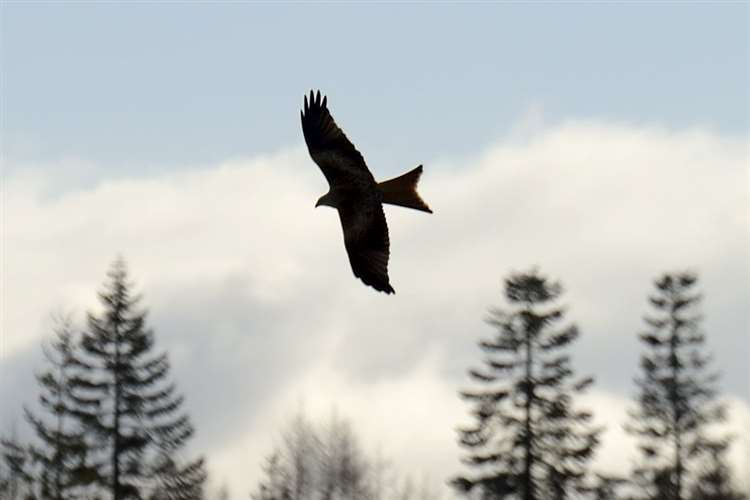
An illegally poisoned Red Kite (photo via WPRUK)

In 2017, in an attempt to combat this wildlife crime, the UK Government initiated a project to map incidents of illegal bird poisonings.  This provided information to the public and other interested parties as to where these crimes were taking place and it was intended that these maps would be updated annually to “provide an invaluable intelligence tool to help fight crimes against birds of prey” (Defra press release 2017).

It now appears that these wildlife poison crime maps have not been updated and there is very little governmental action informing the public that these crimes are still occurring and wildlife is still being deliberately poisoned.

Wildlife Poisoning Research UK (WPRUK) works to place information about the environmental impact of pesticides, biocides and other toxic chemicals into the public domain so that the general public and the media have a better understanding of this situation.  Data on cases of deliberate poisoning of birds has been obtained using Freedom of Information requests.  This has enabled WPRUK to produce maps showing where these poisoned birds have been found.  This is information which the Government, for whatever reason, has now apparently declined to put into the public domain.

WPRUK has now released a report pinpointing where the poisoned birds have been found in Northern England.  Future maps will cover other parts of the UK.

Between 2015 to 2023, the bodies of 73 legally protected birds, mostly birds of prey, were found in Northern England.  These birds had been illegally and deliberately killed using poisons; 31 birds being Schedule 1 Wildlife and Countryside Act (1981) species, which have the highest level of protection.  Due to the very small chance of poisoned birds being found, the real numbers of birds being killed by this criminal activity is likely to be far higher.  To date, no one has been convicted for killing any of these 73 birds.

There were two areas in Northern England where particularly high numbers of poisoned birds were found.  These were Nidderdale in North Yorkshire and the Glapwell area in Derbyshire.

Releasing the report, Dr Ed Blane from WPRUK said: “The fact that 114 years after this sickening practice was banned, individuals are still poisoning our wildlife is deeply disturbing.  People visit the countryside to enjoy nature and they will be truly alarmed to learn that poison is still being used to kill wildlife.”

If this continues it might severely impact on plans to re-introduce white tailed eagles to Northern England.  In the Southern England eagle project, at least 2 birds have been killed by poison.

A comment from Steve Downing Chairman Northern England Raptor Forum:

We proudly, and rightly, identify ourselves as a nation of nature lovers.  Every year tens of thousands of tourists, both domestic and foreign, visit the historic and beautiful countryside throughout the North of England to enjoy the scenery and stunning birds of prey that it supports.  Collectively they spend £millions supporting our rural communities.  What the visitors don’t see is the underbelly of criminality in the countryside where the barbaric practice of deliberately poisoning raptors persists today, as highlighted by the bodies found in Nidderdale, North Yorkshire and around Glapwell in Derbyshire.  Thanks to Ed, a spotlight is being shone on this shocking pernicious activity raising public awareness of the danger presented by these lethal poisons, both to themselves and local birds of prey.

Bob Elliot CEO of Wild Justice said:

Illegal wildlife poisoning hasn’t faded into history; it’s still being carried out in the shadows with very little oversight.  These findings show that wildlife species are still being killed with impunity, and the public is being kept in the dark about the scale of it.  Without transparency, enforcement and the political will to confront those responsible, this criminal abuse of our countryside will continue unchecked.

ENDS

The report can be read / downloaded here:

29 ‘missing’ Hen Harriers & nearly 40 birds of prey poisoned, trapped or shot in Yorkshire Dales National Park since 2015

Media attention has been drawn to the Yorkshire Dales National Park this week, following the RSPB’s press release on the suspicious disappearance of a satellite-tagged Hen Harrier named ‘Sita’.

When it comes to the illegal killing of birds of prey, the Yorkshire Dales National Park is rarely out of the news, and that’s hardly surprising when 29 satellite-tagged Hen Harriers have gone ‘missing’ there and 39 other raptors have been found poisoned, trapped or shot there since 2015, including Peregrines, Hen Harriers, Red Kites and Buzzards.

Yorkshire Dales National Park. Photo by Ruth Tingay

Given these appalling figures, the RSPB has described the Yorkshire Dales National Park as a ‘no-fly zone for birds of prey’.

High profile cases within the National Park have included the conviction of a gamekeeper who was filmed shooting two Short-eared Owls on a grouse moor and then stamping the corpse of one of them into the peat and shoving the other one inside a drystone wall (here); a gamekeeper filmed on a grouse moor using a tethered Eagle Owl to attract Buzzards that he then shot and killed from close range (here); the stamping to death of four Hen Harrier chicks in a nest on a grouse moor (after obscuring the camera pointing at the nest, here); the grisly death of a Hen Harrier caused by his head and leg being pulled off whilst he was still alive (here); and three individuals caught on camera on a grouse moor discussing the shooting and killing of a Buzzard and a Raven before apparently shooting and killing a Hen Harrier (here) – one gamekeeper has been charged with conspiracy to kill a Hen Harrier, he has pleaded not guilty and his case will proceed to trial in January 2026 after his barrister failed in his attempt to have the case thrown out on a legal technicality.

The Yorkshire Dales National Park Authority has also long recognised the extent of this criminal activity and has responded to public concern (e.g. see here and here). Earlier this year the Park Authority terminated its five-year ‘partnership’ with the grouse shooting industry to tackle these crimes, after recognising the futility of this endeavour. Two conservation organisations (the RSPB and the Northern England Raptor Forum) had already walked away from the sham in 2023 and 2024 respectively.

In an article published a couple of days ago by the Craven Herald & Pioneer, Mark Corner, a member of the Yorkshire Dales National Park Authority is quoted saying the continued illegal killing of raptors in the Park was “a crying shame“.

He added: “As the member champion for the natural environment, I’m personally embarrassed that we are the worst spot in the country in terms of the illegal killing of birds.”

In the same article, there’s an hilarious quote from the Yorkshire Dales Moorland Group, which is one of a number of regional groups set up in 2015 to represent local grouse moor owners and their gamekeepers in an attempt to counter the bad publicity about ongoing illegal raptor persecution. I think that members of most of these regional moorland groups have been, or still are, the subject of police investigations into illegal raptor persecution.

A spokesperson for the Yorkshire Dales Moorland Group reportedly told the reporter that ‘hen harrier numbers were at a 200-year high across the uplands’.

That’s simply not true – Hen Harrier breeding attempts on grouse moors across the north of England have been in sharp decline over the last two years – the only areas where they remain stable is on land managed for conservation rather than for Red Grouse shooting.

According to its FaceBook page, the Yorkshire Dales Moorland Group claims to have “around 100,000 acres of managed uplands here in the Dales where the estates are members of this group (virtually all of the moors)“.

Why is it then, there were only two Hen Harrier breeding attempts in 2025 across the whole of the Yorkshire Dales and neighbouring Nidderdale? I’d like the Moorland Group to provide a plausible explanation for these absences.

The Yorkshire Dales Moorland Group also told the Craven Herald reporter:

Our keepers have and will always assist the police in searches for missing persons, lost dogs or missing birds. Tag failure is rare but not unheard of.

The default accusation that persecution is responsible is regrettable. The conservation work undertaken by moor keepers is commendable as can be seen by the abundance of raptors and other rare species in the Dales“.

What “abundance of raptors” are those then? All the dead ones? Or just the ones that are allowed to breed because they don’t pose any threat to Red Grouse stocks?

And if these grouse shooting estates are so keen to help the police, how many of them signed the letter last year agreeing to allow the police to enter the land and use equipment for the purposes of crime prevention and detection? Did any of them sign it?

And if these gamekeepers are so keen to help police investigations, how many of them have given ‘no comment’ responses when interviewed about suspected raptor persecution crimes on these moors? Maybe it’d be quicker to count how many gamekeeper didn’t give a ‘no comment’ interview.

The article also quotes Alex Farrell, Head of Uplands at BASC:

As a committed conservation organisation, we are taking progressive steps with our partners to oversee the continued recovery of hen harriers.

Figures released by Natural England today show that collaborative effort resulted in 106 fledged hen harrier chicks in England this year – up from 80 last year“.

What “progressive steps” is BASC taking?

Oh, and those figures released by Natural England show that the small increase in Hen Harrier fledging rates are in spite of, not because of, any so-called ‘collaborative effort’ from the grouse shooting industry.

The data couldn’t be any clearer (see here).

Lincolnshire gamekeeper guilty of multiple offences in relation to deaths of red kite and buzzards

Another trial and yet another gamekeeper convicted of offences relating to the illegal killing of birds of prey.

The trial of gamekeeper John Bryant, in relation to the illegal killing of a red kite and two buzzards, concluded at Lincolnshire Magistrates Court last week where he was convicted of four of ten alleged offences.

Gamekeeper Bryant, 40, of West Ashby, Horncastle, Lincolnshire had been summonsed to court last September following a police investigation into reports of three birds of prey, a red kite and two buzzards, being poisoned and killed over a five year period between 2017 and 2022.

Buzzard photo by Ruth Tingay

Bryant had pleaded not guilty to ten charges (two charges of using a trap to kill or take a wild bird, six charges of possessing an article capable of being used to commit a summary offence, and two charges of contravening health & safety regulations) so he faced trial starting 6th March 2025.

He will be sentenced for the four offences next week when full details of the case and convictions will be published.

UPDATE 20 March 2025: Lincolnshire gamekeeper John Bryant sentenced for crimes relating to raptor persecution – police statement (here).

Lincolnshire man faces trial in relation to poisoned red kite & buzzards

Further to the blog on 30 September 2024 (here) and 17 October 2024 (here), a trial date has been set for a Lincolnshire man in relation to the discovery of a poisoned red kite and two buzzards between 2017 and 2022.

Buzzard photo by Ruth Tingay

John Bryant, 40, of West Ashby, Horncastle, appeared at Boston Magistrates Court on 20 November 2024 where he pleaded not guilty to two charges of using a trap to kill or take a wild bird, six charges of possessing an article capable of being used to commit a summary offence, and two charges of contravening health & safety regulations.

Mr Bryant was released on unconditional bail and a trial date was set for 6 March 2025.

NB: As this case is live comments are turned off until criminal proceedings have concluded.

UPDATE 12 March 2025: Lincolnshire gamekeeper guilty of multiple offences in relation to deaths of red kite and buzzards (here)

Lincolnshire man in court facing charges related to poisoning of red kite and buzzards

Further to the blog on 30 September 2024 (here), a man attended court yesterday after being summoned in relation to the illegal poisoning of a red kite and two buzzards between 2017 and 2022.

Red kite photo by Andy Howard

John Bryant, 40, of West Ashby, Horncastle, Lincs appeared at Boston Magistrates Court on 16 October 2024 where he confirmed his name, age and address. He didn’t enter a plea.

The case was continued and Bryant will appear again on 20th November 2024.

NB: As this case is live comments are turned off until criminal proceedings have concluded.

UPDATE 24 November 2024: Lincolnshire man faces trial in relation to poisoned red kite and buzzards (here)

UPDATE 12 March 2025: Lincolnshire gamekeeper guilty of multiple offences in relation to deaths of red kite and buzzards (here)

Yorkshire Dales grouse moor owner appointed to ‘key role’ at DEFRA

The owner of a Yorkshire Dales grouse moor has been appointed to a ‘key role’ at DEFRA by the Secretary of State for Environment, Food and Rural Affairs, Therese Coffey.

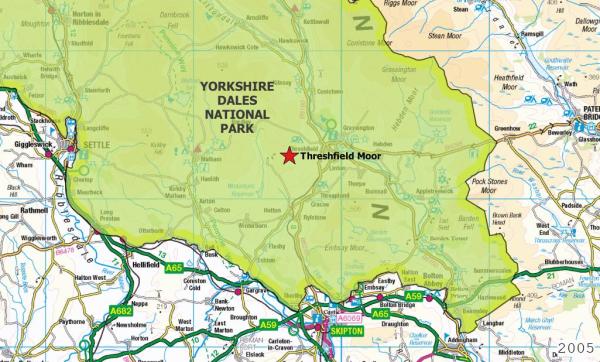
Heather Hancock, who according to her Wikipedia entry owns Threshfield Moor with her husband Mark Hancock, has been given the role of Lead Non-Executive Board Member, ‘appointed to provide challenge to Government departments’, according to this DEFRA press release (here).

Mark Avery has blogged about this appointment this morning (here) and he points out that Hancock’s co-ownership of a grouse moor has been conveniently excluded from the DEFRA press release.

It’s an interesting omission, as this particular grouse moor has been at the centre of two separate police investigations into suspected wildlife crime in recent years.

In October 2017, a young satellite-tagged hen harrier named ‘John’ ‘disappeared’ on Threshfield Moor in the Yorkshire Dales National Park and North Yorkshire Police issued an appeal for information (here).

Like so many other hen harriers that vanish in this hell-hole of a National Park, he’s never been seen again and of course, nobody was ever prosecuted.

In January 2020 Threshfield Moor was once again under investigation after two witnesses reported seeing the shooting of a hen harrier (here). That investigation did lead to an arrest of a gamekeeper but, as ever, there was insufficient evidence to bring charges against him and the investigation was dropped.

Threshfield Moor featured on this blog again just last month after a reader sent in photographs of two gas guns (bird scaring devices) that had been positioned on the grouse moor (see here) during the height of the breeding season.

I can’t imagine that Heather Hancock is going to ‘challenge’ the Government about anything in which she has a vested interest, can you?

Excerpt from Heather Hancock’s Wikipedia entry (27 July 2023)

Grouse moor management in Scotland: Government launches public consultation

Today, the Scottish Government has launched a public consultation as the start of its commitment to introduce a licensing scheme for grouse moor management, following the publication of the Werritty Review in 2019, which was commissioned in 2017 after unequivocal evidence was published of the on-going illegal killing of golden eagles on some Scottish grouse moors.

That illegal killing continues, as evidenced by this young golden eagle recently found poisoned on a grouse moor in the Cairngorms National Park laying next to a dead mountain hare that had been used as the poisoned bait (photo by RSPB Scotland).

As is so often the case, nobody has been charged or prosecuted for this hideous wildlife crime, which is a fundamental reason why the Govt is introducing a licencing scheme, presumably as a means of sanctioning an estate (by withdrawing its licence) when evidence of wildlife crime is discovered. Without knowing the exact details of how the licensing scheme will operate, it’s impossible at this stage to predict its effectiveness. There are many sceptics, and I’m one of them, but I’m also certain that the status quo is untenable and so I view licensing as a step in the right direction, but definitely not the end of the road.

The Government’s licensing consultation preamble reads as follows:

‘A Stronger & More Resilient Scotland: The Programme for Government 2022-23 which was published on the 8 September 2022 committed to introducing the following Bill:

Wildlife Management (Grouse)

The Bill will implement the recommendations of the Werritty Review and introduce licensing for grouse moor management to ensure that the management of driven grouse moors and related activities is undertaken in an environmentally sustainable manner. The Bill will also include provisions to ban glue traps.

In November 2020, the Scottish Government published its response to the recommendations made by the Grouse Moor Management Group (“Werritty review”).  That report was commissioned by the Scottish Government in response to a report from NatureScot (formerly Scottish Natural Heritage), published in May 2017, which found that around a third of satellite-tagged golden eagles in Scotland disappeared in suspicious circumstances, on or around grouse moors.

The Werritty review made over 40 recommendations regarding grouse moor management. The recommendations, which were accepted by the Scottish Government, seek to address raptor persecution and ensure that the management of grouse moors is undertaken in an environmentally sustainable manner.

As well as proposals relating to grouse moor management, this consultation also considers glue traps. A report from the Scottish Animal Welfare Commission, published on 23 March 2021 stated that

‘……the animal welfare issues connected with the use of glue traps would justify an immediate outright ban on their sale and use. This is our preferred recommendation‘.

This consultation is therefore seeking your views on the Scottish Government’s proposals on:

*Grouse moor licensing

*Muirburn

*Trapping (wildlife traps, glue traps, snares)

You can complete all the sections in the consultation or only those sections which are of interest/relevance to you’.

ENDS

The Government’s proposals for its grouse moor licensing scheme are laid out here:

I haven’t yet looked at the consultation paper so I can’t offer any comments or suggested responses yet but I will do very soon. The consultation will close on 14th December 2022.

The link to the consultation questionnaire can be found HERE.

UPDATE 26th October 2022: REVIVE coalition cautiously welcomes Scot Gov’s consultation on grouse moor licensing (here)

UPDATE 27th October 2022: Grouse shooting lobby quietly seething over proposed licensing scheme (here)

UPDATE 10th December 2022: Last chance to have your say on Scottish Government’s consultation on grouse moor reform (here)

Grouse moor estate in Nidderdale with history of wildlife crime to be rewilded

A grouse moor estate in Nidderdale with a history of wildlife crime is set to be rewilded, according to an article in the Telegraph and Argus.

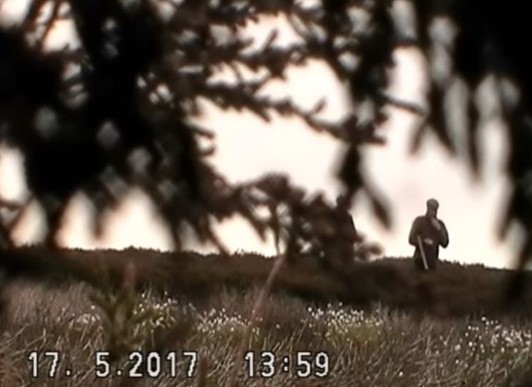
In May 2017, the RSPB’s investigations team filmed two armed individuals, dressed like gamekeepers, appearing to shoot at a nesting Marsh harrier and then apparently removing eggs from the harrier’s nest on Denton Moor (see here). Despite a thorough investigation by North Yorkshire Police, nobody was ever charged for these alleged offences.

[Screengrab from RSPB covert video of two armed men at a Marsh harrier’s nest on Denton Moor]

In February 2019, gamekeeper Austin Hawke was convicted at Skipton Magistrates Court for an offence relating to the death of a badger caught in a snare on the same grouse moor on 28th May 2018. Hawke was found guilty of failing to check the snare contrary to section 11 of the Wildlife & Countryside Act (see here).

In March 2019, the owners of Denton Moor (an engineering company called NG Bailey) announced it would not be renewing its grouse-shooting lease following the spate of wildlife crime (see here).

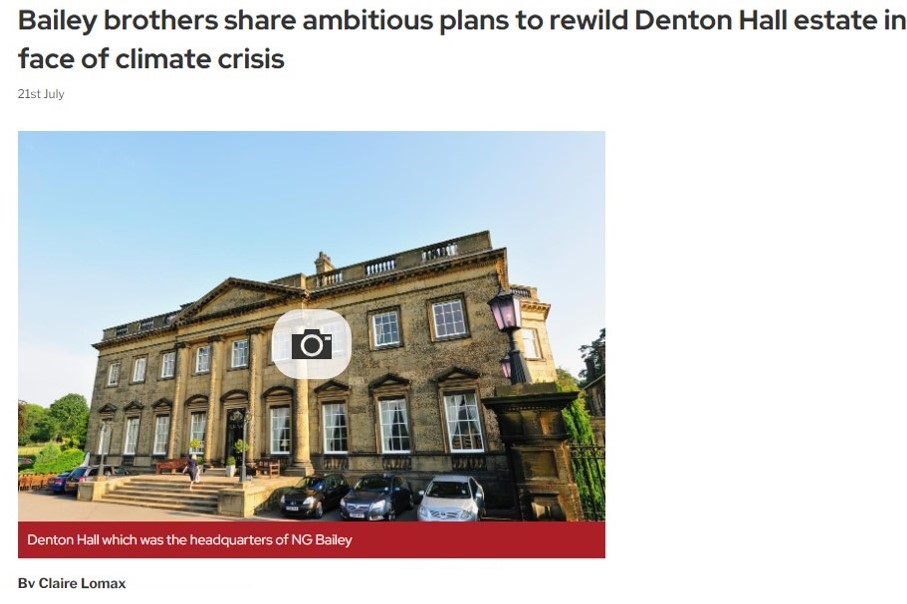
And now the estate owners, brothers Cal and Nick Bailey, have announced an ambitious rewilding project for the estate, according to an article in last week’s Telegraph & Argus (here). The article is reproduced below:

THE two brothers behind an ambitious plan to transform the Denton Hall estate into an exclusive hotel and rewilding project have outlined their ideas for the scheme – and vowed they want to take the local community with them on their journey.

Cal and Nick Bailey are members of the family which set up the huge NG Bailey engineering company and are shareholders in the business.

Denton Hall was bought by NG Bailey in 1976 and the Grade I Georgian Listed building has been used as offices and a wedding and events venue.

The Bailey brothers are in the process of buying the building and its 2,500 acres of land from the company to realise their dream of helping to combat climate change.

It is also something of a home-coming for Cal and Nick, who grew up in the house and roamed the estate’s moorland and woods in the 1970s.

Although the sale is still in the process of going through, the idea is that developing the house into an exclusive boutique hotel will help finance the wider project – turning the estate into a model of biodiversity and regeneration that will be a flagship scheme driving climate change-combatting measures.

At Denton Hall, which from its elevated position looks out over the greater Ilkley area, Cal Bailey says: “The climate crisis is real and nature in the UK and the wider world is seriously under threat.

“There’s a phrase ‘think global, act local’ and what that means for us is taking this opportunity which we are lucky enough to have to buy this estate and realising our three major goals of making a positive contribution in terms of three major areas, carbon, nature and food.”

Their plans are well-thought out and hugely ambitious, and they appreciate that there might be some misgivings among local people, particularly in the close-knit Denton village community neighbouring the estate. But they are determined to allay any fears about the development.

Cal says: “We are very keen that people in the area hear what we are saying and planning. There have been a few voices against our plans, but the overwhelming number of people have been supportive.

“It’s an exciting opportunity and there’s obviously a long way to go. The way we get there is as important as where we get to so we are absolutely determined to get to the end point but we want to take people with us, otherwise, what’s the point?

“We have tried to lean over backwards to share our vision with people because it’s really important that local people are on this journey with us.

“In every example I’ve seen of rewilding or any similar initiative up and down the country, when local people begin to understand what’s happening and begin to feel part of it, they recognise something special is happening and want to be a part of it.”

But what exactly is going to happen on the Denton Park estate? Over to Nick Bailey, to outline the main points of their plan.

Nick says: “We’ve set ourselves a 30-year horizon because with the best will in the world things change. NG Bailey took over the estate in 1976 and started developing what had been a neglected farm, and 50 years ago they had a very different vision and no doubt visions change so they didn’t think too far ahead.

“So one of the things that struck me was that over no other issue almost ever in history had scientists universally agreed, quickly, the climate crisis and the biodiversity challenge is real.

“So anyone who doesn’t face up to that is like a flat earth group. Scientists describe it and come up with suggestions, governments incentivise it and legislate around it, but it’s people who implement change and that’s what we want to do.

“Our aim here is to create an estate that can balance nature with carbon and with food and that can make as full a contribution as it has the capability to do in each of these three areas.”

So what will that mean in practice? Well, there are several schemes that the brothers want to put into motion over the next few years.

* The Moorland — Peat in good condition is one of the best things to sequester carbon but if it’s in poor condition it can contribute to carbon in the atmosphere, so one of the major projects will be to come up with a restoration plan for the Denton Park moorland peat.

* A Hundred Acre Wood – The brothers are working with the White Rose forest organisation to plant something like a thousand trees per acre, on average, which they are hoping to get underway by November.

* Additives – Their farm manager James Bush is looking at ways to reduce all chemical additives used on the land, whether fertiliser, herbicides or pesticides.

* Food partnerships – They want to utilise the land for growing and rearing food and providing local food producers and breweries with the raw materials so that their products are completely locally sourced. This includes fruit and vegetables, meat, and raw materials for alcohol production.

* A Tree Nursery – This would enable them to develop and grow the best varieties to help with the rewilding of the whole site.

* Bees – a mixture of hives and schemes to attract wild bees, which are essential to biodiversity, and also with a view to producing the estate’s very own honey.

* Grazing land – at the moment there are deer and sheep on the land, but they are looking at reintroducing cattle and possibly pigs to have a stronger mix and also provide food production as well.

* A Walled Garden – There’s already one there that has a history of growing food on the estate, and bringing that back into use is part of the plans.

* Water management – This is a hugely important part of the plans. Some 9.5 million tons of rain fall on the estate each year so proper management of the land will help to cut back on potential flooding further down the valley.

These are just some of the plans in the pipeline, and the Bailey brothers are consulting with a wide range of experts and organisations to look at how to put them into practice and to develop new and exciting ideas to help the estate be a model of biodiversity and rewilding.

Cal says: “We have this amazing opportunity to put our beliefs into practice on a bit of land in England that we can buy and manage. Because we have this opportunity and the fundamental belief that the world is in crisis, this is something we want to do.

“Does this mean we are experts in land restoration and farming? Not at all. I’m an accountant by training, a businessman who’s running factories. Nick is an engineer, but he’s been a teacher.”

Nick adds: “I’ve restored a couple of buildings in the past but not to this scale. This is a chance to play and learn, if you like, but I think so many things in my life have given me so much to bring to this project.

“So, no, we don’t have all the skills that we need, we’ll need the help of a lot of other folk. But we want to see our three goals of carbon reduction, food production and nature brought together in one vision on this estate. And the way we will fund it is hopefully bringing visitors to the estate who will stay here.”

It’s a long-term project, though, and the brothers know that. But they want to get local people onside to help them realise this dream.

Nick says: “There will be loads of opportunities for people to get involved and they won’t come all at once, even though people are battering the door down now, but over the next five or 10 years more and more people from the local community will become involved with the projects here, and hopefully inspire more and more people and it will be something for Ilkley to be proud of.”

ENDS

General Licence restriction imposed on Moy, a grouse-shooting estate, after discovery of poisoned red kite

Press release from NatureScot, 21st June 2022:

General Licence restricted on Highland estate

NatureScot has restricted the use of General Licences on Moy Estate for three years

The decision was made on the basis of evidence provided by Police Scotland of wildlife crime against birds.

This evidence included a poisoned red kite found on the estate in 2020, and incidents in relation to trapping offences.

[Red kite. Photographer unknown]

Donald Fraser, NatureScot’s Head of Wildlife Management, said: “We consider the information from Police Scotland provides robust evidence that wild birds have been killed or taken or there has been intention to do so illegally on this land.

“Because of this, and the risk of more wildlife crimes taking place, we have suspended the use of general licences on this property for three years until June 2025. They may still apply for individual licences, but these will be closely monitored.

“NatureScot is committed to using all the tools we have available to tackle wildlife crime. This measure will help to protect wild birds in the area, while still allowing necessary land management activities to take place, although under tighter supervision.

“We believe this is a proportionate response to protect wild birds in the area and prevent further wildlife crime. We will continue to work closely with Police Scotland and consider information they provide on cases which may warrant restricting general licences.”

General licences allow landowners or land managers to carry out control of common species of wild birds, such as crows and magpies, to protect crops or livestock, without the need to apply for an individual licence.

In addition to this restriction, there are currently three other restrictions in place on Invercauld Estate in the Cairngorms National Park, Lochan Estate in Perthshire and Leadhills Estate in South Lanarkshire.

ENDS

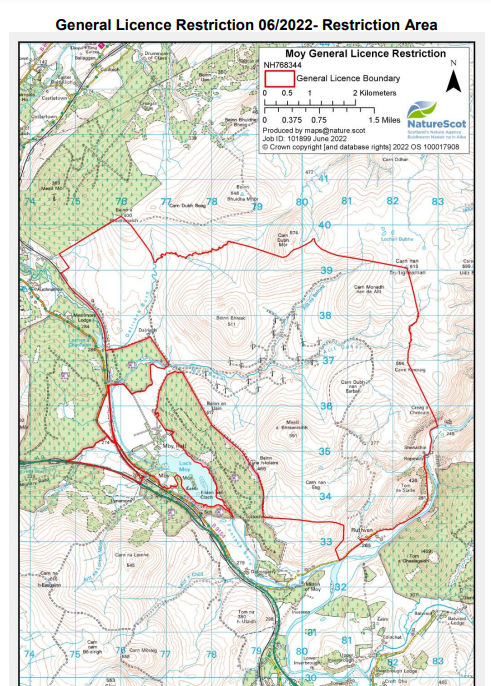
The restriction notice reads as follows:

In line with NatureScot’s published General Licence restrictions: Framework for Implementing Restrictions we hereby give notice that a restriction has been applied to the land outlined in red overleaf. This restriction prohibits the use of General Licences 01, 02 and 03 on that land between 21st June 2022 and 21st June 2025.

Please note that this restriction does not imply responsibility for the commission of crimes on any individuals.

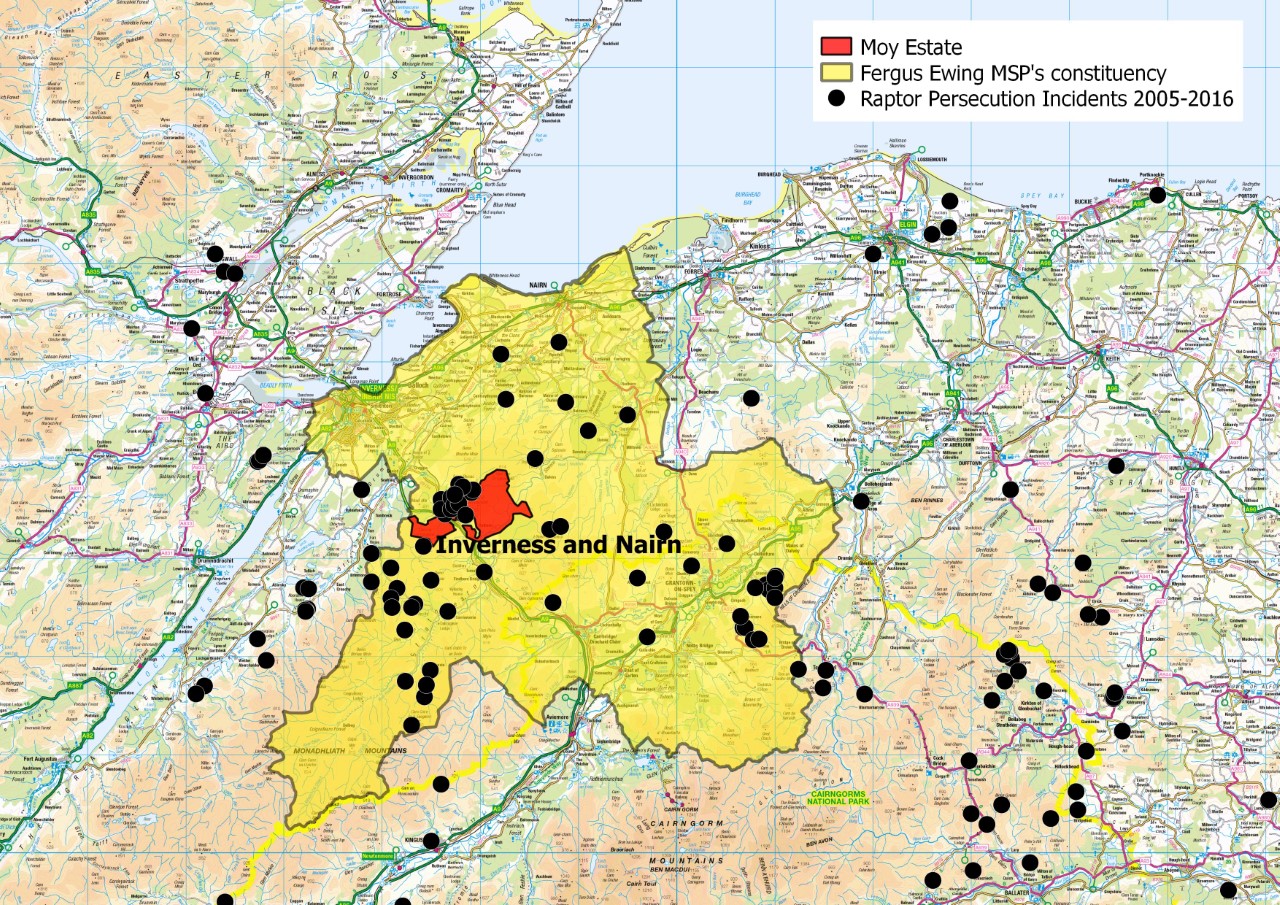
This one has been a long time coming. Moy is one of those estates where if its name comes up in conversation amongst raptor conservationists in Scotland, eyes tend to roll and knowing looks are exchanged. It has been identified as a raptor persecution hotspot for many, many years.

Here is a map we created way back in 2016 to highlight the extent of raptor persecution crimes in former Cabinet Secretary Fergus Ewing’s constituency (given his strong support of the Scottish Gamekeepers Association) and this shows the concentration of incidents on and close to Moy Estate:

Here is a selection of examples, but this is by no means an exhaustive list:

Moy Estate was raided by police in 2010 after the discovery of poisoned bait and dead raptors and illegally set traps. A gamekeeper was later convicted of possession of a red kite after its bloodied corpse was found in the back of his vehicle. It had two broken legs, consistent with being caught in spring traps, and a head injury. A bloodied shinty stick was also found in the back of the vehicle. Notably, the gamekeeper wasn’t convicted for killing the kite, just for having possession of it. Nobody was charged with killing this kite.

These baited traps were discovered on the moor (the illegally-set spring traps were originally disguised under moss, removed here for evidential purposes). No charges were brought.

The remains of two further red kites were discovered on the moor, including a severed red kite leg and some wing tags that had previously been fitted to a kite, all found buried in holes under some moss. No charges were brought.

A jar in one of the gamekeeper’s houses contained the leg rings of four young golden eagles – nobody could account for how they had ended up inside that jar. Perhaps he’d found them whilst ‘metal detecting at his uncle’s farm’ like gamekeeper Archie Watson, who recently gave this implausible explanation to the court for how he’d come to possess BTO leg rings from a buzzard and a red kite attached to his keyring.

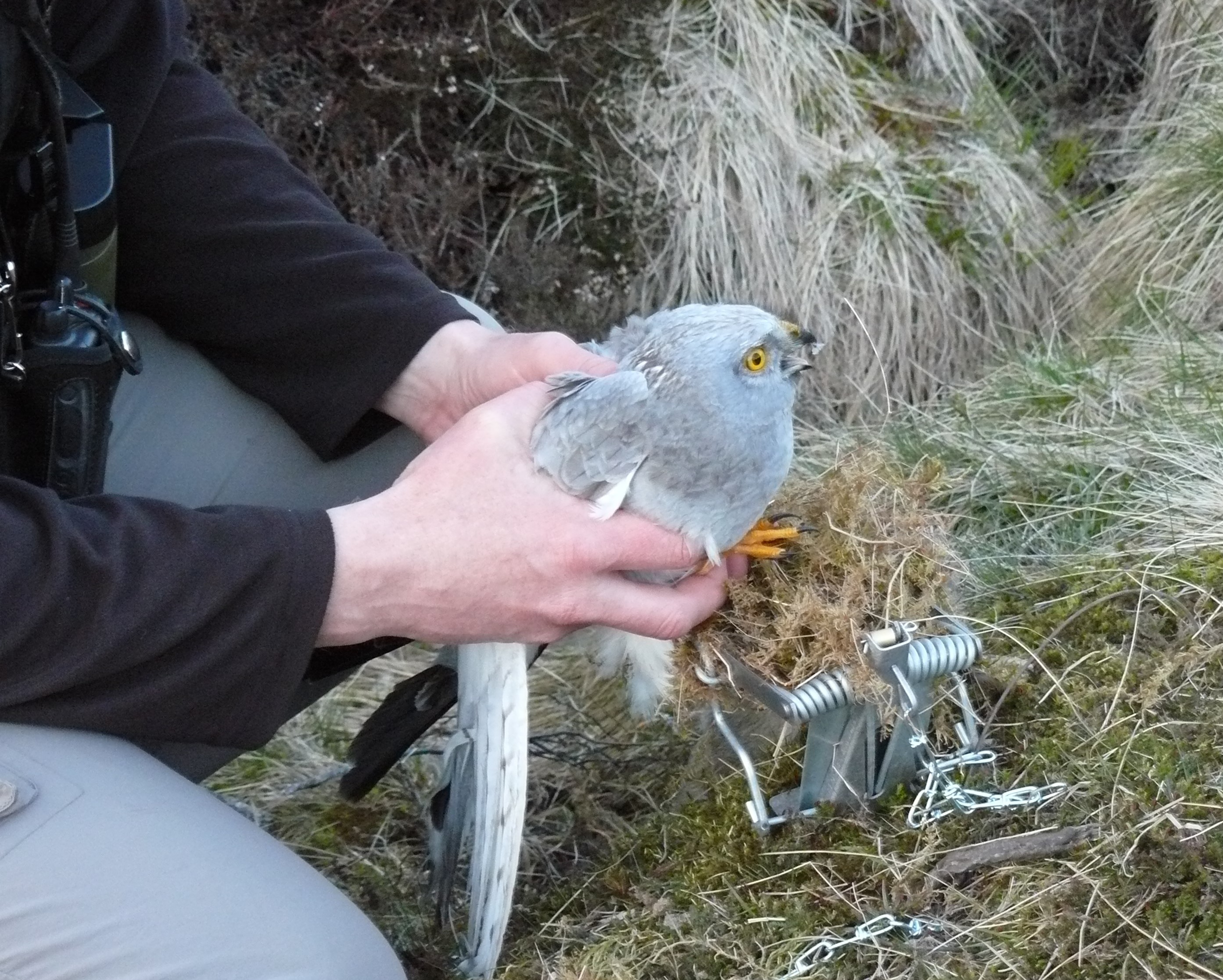
This male hen harrier was found caught by its leg in an illegally-set spring trap on Moy Estate in 2010. No charges were brought. It survived after being rescued by raptor workers from the Scottish Raptor Study Group.

In May 2011 a satellite-tracked red kite ‘disappeared’ on Moy, and another one ‘disappeared’ in August 2011.

In 2016 Police Scotland issued an appeal for information following the discovery of disturbed and abandoned buzzard and goshawk nests in the Moy Forest. One goshawk and four buzzard nests were abandoned in suspicious circumstances, with some evidence of illegal disturbance. These nests were being monitored by staff from Forestry Enterprise Scotland (see here). No charges were brought.

In 2017 masked gunmen were caught on camera at a goshawk nest in Moy Forest. A few days later the nest and a clutch of four eggs was found abandoned (see here). No charges were brought.

In 2018 Police Scotland issued an appeal for information after a buzzard was found caught in an illegal pole trap in the Moy area (see here). No charges were brought.

In 2020 a poisoned red kite was found dead, containing traces of a banned pesticide, leading to a police appeal for information (here).

In 2021 an individual was charged with the alleged killing of a bird of prey in this area. This case is believed to be progressing through the courts so I can’t comment further at this stage.

Of course, a General Licence restriction doesn’t amount to much of a sanction in real terms, as I’ve discussed on this blog endless times before (e.g. see here). However, it’s currently the only tool available to the authorities until we finally see the introduction of the promised grouse moor licensing scheme by the Scottish Government. Had that scheme been in place already, we’d hopefully have seen the removal of Moy Estate’s licence to shoot for a number of years, if not permanently.

Meanwhile, what will be really interesting to see is whether the Moy Game Fair goes ahead this year, given that the shooting organisations have all claimed to have a ‘zero tolerance’ approach to raptor persecution. I don’t think the likes of Scottish Land & Estates, Fergus Ewing MSP and the Scottish Gamekeepers Association can expect anything other than high-level criticism if they attend this event on an estate that has now been sanctioned for wildlife crimes by the statutory nature conservation advisor, based on evidence provided by Police Scotland. Mind you, the conviction of a gamekeeper on Moy Estate in 2011 didn’t stop them attending (see here and here).

UPDATE 14th July 2022: Scottish Gamekeepers Association plans award ceremony at disgraced Moy Estate (here)

UPDATE 6th August 2022: Fergus Ewing MSP & his shooting industry pals disregard sanctions imposed on Moy Estate for wildlife crime (here)

UPDATE 22nd August 2022: Moy Estate loses appeal against General Licence restriction imposed for wildlife crime (here)

Gamekeepers responsible for more illegal raptor killing than any other profession

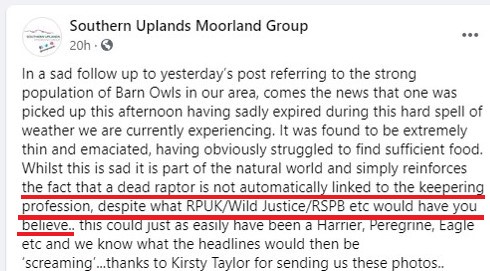
Somebody sent me a screen grab the other day of a statement posted on social media by the Southern Uplands Moorland Group (SUMG), which is one of a number of regional groups representing grouse moor estates around the country and designed to persuade the public that birds of prey are warmly welcomed and that gamekeepers love having birds of prey on their ground.

The statement published by the SUMG is fairly typical of the misrepresentation of facts that we’ve all come to expect from certain quarters of the grouse shooting industry. It reads as follows and I’ve underlined the sentence of interest:

Now, I can’t recall EVER saying on this blog that a dead raptor is automatically linked to the [game]keepering profession and there are numerous examples of illegal raptor killing offences that I’ve reported on here over the years where gamekeepers have quite clearly not been responsible (e.g. see here, here, here, here, here, here, here etc).

As a co-director of Wild Justice I’m also pretty certain that WJ has NEVER made such a claim. If there is such evidence, the SUMG are challenged to provide it.

I can’t speak for the RSPB but I can’t imagine they would EVER make such a ridiculous claim either.

Speaking for myself, I don’t even believe, as some do, that ALL gamekeepers are raptor killers. A lot of them are, of that there’s no doubt whatsoever, and some other gamekeepers will benefit from that killing even if they’re not doing the actual killing themselves, but I also know of some decent, law-abiding gamekeepers who are as thrilled at seeing a raptor as I am. I’ve met them and have worked with them, so I know they exist.

However, there’s no getting away from the undeniable evidence that shows overall, gamekeepers in the UK are responsible for more illegal raptor killing than any other profession. If you want to see the evidence, have a look at this pie chart published by the RSPB last year in their annual Birdcrime report:

Interestingly, one of the individuals included in the convicted gamekeepers section of this pie chart was a certain Alan Wilson, a member of the Scottish Gamekeepers Association who was convicted in 2019 of a catalogue of horrendous wildlife crimes he committed on the Longformacus Estate, a grouse/pheasant shooting moor in, er, the Southern Uplands (see here).

It strikes me that the Southern Uplands Moorland Group would do well to concentrate on ousting the criminals within the gamekeeping industry rather than smearing those of us who report on such crimes and who, quite legitimately, campaign for the Government to clamp down on the criminals involved.