
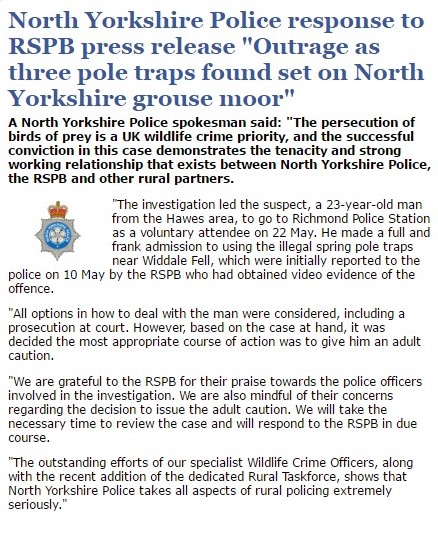
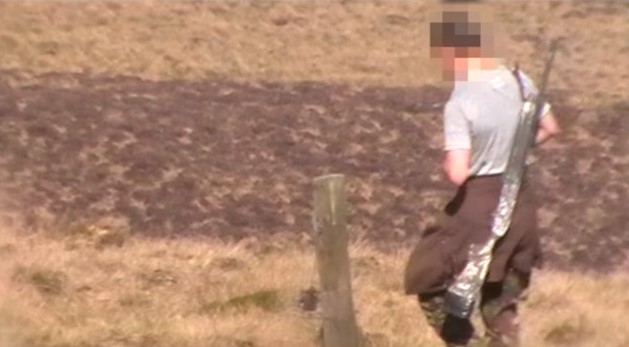
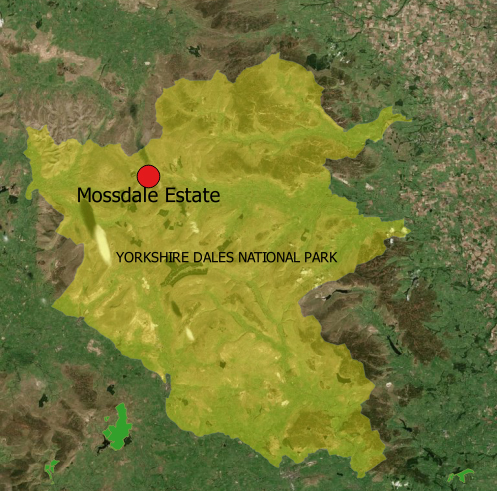
Following today’s earlier blog about the man who was given a police caution after he was filmed setting illegal pole traps on the Mossdale Estate grouse moor within the Yorkshire Dales National Park (see here), North Yorkshire Police has now issued an unbelievable press statement in an attempt to justify their decision to caution instead of prosecute:
Before we take this statement apart, we want to make it clear that our comments are NOT aimed at the three police wildlife crime officers who attended the crime scene. It is obvious from the RSPB Investigation Team’s blog (here) and from recent accounts of police attendance at other raptor persecution crime scenes in North Yorkshire (e.g. see here) that these on-the-ground police officers are doing their utmost to respond quickly, collect evidence, issue early appeals for information, and work inclusively with the RSPB Investigation Team. We sincerely applaud their efforts and they deserve all credit for their actions.
Our comments are aimed directly at senior officers within North Yorkshire Police, i.e. the one(s) who took the decision to issue a caution rather than consider a prosecution.
So, THAT police statement. What an unbelievably stupid, self-congratulatory piece of work. It really beggars belief that this police force, which, incidentally, has just taken on the role of National Wildlife Crime Lead, views this result as a ‘successful conviction’. What interests us the most about the statement is the following sentence:
“Based on the case at hand, it was decided the most appropriate course of action was to give him an adult caution“.
When the police decide on a course of action, they are supposed to refer to official guidance to help their decision-making. The official guidance document relating to whether a caution is appropriate can be read here. This is a fascinating read.
It explains that a ‘simple caution’ (once known as a formal or police caution) is a formal warning that may be given by the police to persons aged 18 years or over who admit to committing an offence. A simple caution must NOT be given if the decision-maker (i.e. senior police officer) considers that it is in the public interest for the offender to be prosecuted. Er, there’s failure #1 for North Yorks Police.
A simple caution may only be given where specified criteria are met. These criteria are listed in what’s called a Gravity Factor Matrix (see here). This matrix sets out the aggravating and mitigating factors that the decision-maker must consider for various types of offence. If you look at page 39, you’ll find the guidance the police are supposed to follow for a wildlife crime offence. Here are the listed aggravating factors, which, in this particular case, should have been considered by North Yorkshire Police:
The offence relates to a wildlife crime priority. Does this aggravating factor apply to this case? Er, YES! Raptor persecution is a national wildlife crime priority. Failure #2 for North Yorks Police.
The conservation impact of the offence. Does this aggravating factor apply to this case? Er, YES! Hen harrier persecution is responsible for the precarious conservation status of this species in England. Failure #3 for North Yorks Police.
The offence results in or is intended to result in financial gain. Does this aggravating factor apply to this case? Er, YES! Raptor persecution on grouse moors is undertaken to maximise the number of red grouse available for paying clients to kill and the number of red grouse killed impacts on the estimated value of the estate/shoot. Failure #4 for North Yorks Police.
The offence involves cruelty. Does this aggravating factor apply to this case? Er, YES! A pole trap functions by crushing the leg(s) of any bird that lands on it and the bird can then dangle upside down from the post for many hours/days, unable to escape. Failure #5 for North Yorks Police.
The offence was planned or pre-meditated. Does this aggravating factor apply to this case? Er, YES! This offender re-set three traps knowing exactly what could result from his actions. Failure #6 for North Yorks Police.
The mitigating factors for the decision-maker to consider for this wildlife crime offence were:
The offence was committed by mistake or misunderstanding. Does this mitigating factor apply to this case? Er, NO!
The offence would result in little or no conservation impact. Does this mitigating factor apply to this case? Er, NO!
So, this offence starts off with a Gravity Score of 3. You then look at the aggravating and mitigating factors and then decide how to proceed. If you look at the guidelines (page 5), you’ll see that the appropriate police action for an offence with this gravity score is ‘Normally charge but a simple caution may be appropriate if first offence’.
We’d like to know why the senior police officer decided that this case was worthy of a simple caution instead of the ‘normally charge’ route, especially given that all five aggravating factors were met and the mitigating factors were inapplicable.
And we’re not alone in our concern. We sent a tweet to North York Police Acting Assistant Chief Constable Amanda Oliver (she with responsibility as the National Wildlife Crime Lead) asking her if she had sanctioned the above statement from North Yorkshire Police. To her credit, she responded as follows:
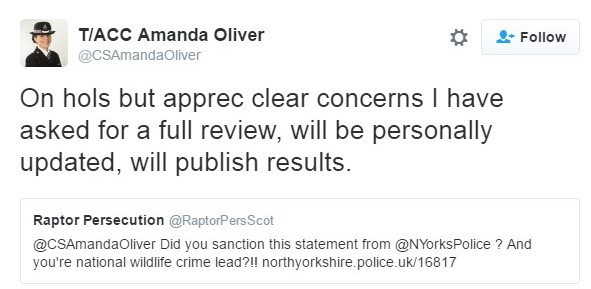
We look forward to learning the details of her review in due course.






 Grant Moir, Chief Executive of the Cairngorms National Park Authority, has today issued a
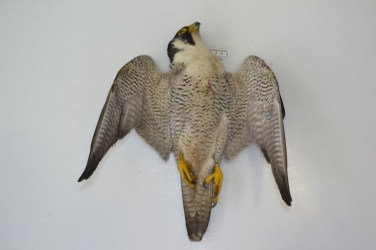 Last month we blogged about a dead peregrine that had been found at a well known persecution hotspot on 11th April 2016 (see
  Raptor Persecution UK