Ross-shire Massacre discussed at RACCE meeting

RK5Back to the Rural Affairs, Climate Change & Environment (RACCE) committee meeting in January….

The topic of the Ross-shire Massacre was raised again. For new readers, the Ross-shire Massacre refers to the discovery of 22 dead raptors in a small area of Conon Bridge in the Highlands in March 2014. Sixteen red kites and six buzzards were found dead: 12 red kites and 4 buzzards have since been confirmed to have been poisoned by a ‘banned substance’. There have been no arrests to date. Our last update was on the 18 month anniversary (here) and we’ll be writing more when the two-year anniversary rolls around in March.

In the meantime, here’s the discussion from the RACCE committee meeting in January. In a nutshell, 22 months on from one of the biggest mass raptor poisonings uncovered in Scotland, the police have no progress to report:

Dave Thompson MSP (Skye, Lochaber and Badenoch) (SNP): This concerns the cases involving raptors up in Ross-shire. I have a couple of letters from Police Scotland in that regard, and I want to tease out one or two little points. One of the letters refers to the “consequence of a … use of a banned substance” and to the belief “that the raptors may not have been the specific target”. The second letter makes it very clear regarding one case that “there are limited opportunities to progress unless someone comes forward with information.”

You are probably aware that I have asked for some kind of interim report into the initial handling of that case. I was told in that letter that “Police Scotland does not produce ‘interim reports’ during a live investigation”. Given that the case in question could be live for the next 20 years, we are never going to get an opportunity to consider how things were initially handled in relation to the matter. There are concerns in the community and elsewhere that there was perhaps some unnecessary delay and so on. Given that there will be “limited opportunities to progress unless someone comes forward” with evidence, have you carried out, or do you plan to carry out, any internal investigation as to how the investigation itself was initially carried out? If so, have you learned any lessons from that? Will you able to make any of that public at any point?

Assistant Chief Constable Graham: We had a fairly lengthy discussion last year about the current state of the case at that stage. Some similar points were raised about the handling of the matter in the media—that was about press statements, if I remember correctly. There was a desire to review our approach.

At the heart of the letter to which you have referred is the point that having the police produce a report is not necessarily the best way to address the issues. However, I would be very happy to be involved in something in future with a range of organisations and interested parties, including yourself, whereby we are able to sit down and gather what the concerns are. We are aware of most of them. We could work through how we could do things differently in future, and we could achieve that even within the scope of a live investigation, which would not require the police to produce a report as such. As I say, producing a report might not be the most effective approach.

As I reported last year, we have done a number of things internally to review the investigation at senior detective level, which is unprecedented in a wildlife crime investigation. We had what we call a major investigation advisory group meeting, with a process around that. That has been subject to both peer and senior officer review, assessment and support. Notwithstanding all that, we have not arrived at a position where we have been able to solve the crimes, as it were, although that is not to say that we will not in the future.

Therefore, I would still be cautious in ensuring that we do not do anything to prejudice any potential future cases. A lot of information is still being received about the case. Much of that is statements or reports along the lines of, “Everybody knows who’s done it”, “We all know what’s gone on”, or “Everybody knows where the police should be looking.” I can assure the committee that we have followed up every statement in which we can identify the individuals involved. That includes people coming to us or people whom we have been made aware of who have made such statements publicly or privately.

The committee might have had feedback indicating that people are surprised when we have taken a statement from them after quite some time has passed. Unfortunately, in every single case, the statement has turned out to be without substance. We have spoken to everybody we possibly could and, although there is a general perception that everybody knows who did it, no one has been able to give us their names. Given the huge effort that has gone into—and continues to go into—the inquiry, we should have a caveat here because of public concern about perceived police inaction. The case is still sitting with the detective superintendent in Inverness, who is the lead investigator. I have been assured by him, as recently as last week, that there is still an active review and engagement on any potential lines of inquiry that come to light.

A short documentary was recently aired on the internet that interviewed a number of people. We picked up a number of lines from that, which were similar to previous statements in which people asserted that everybody knew who had done it. However, no one in the documentary knew who had done it, because we have spoken to them all.

Dave Thompson: You suggested a meeting between a range of bodies and parties, perhaps including myself. It would have to be before 23 March, because I am not standing again, although I am sure that my successor—whoever that is— would be happy to take part. Such a meeting would reassure people. Although the public accept that the police continue to look into the case and that they would dearly like to get any evidence that would allow them to conclude it, there are questions about how the police went about things at the beginning. Such a meeting would be really useful because frank discussions could take place and the issue could be talked through, without you having to divulge things that might prejudice the case. I would welcome such a meeting, if you are offering one.

Assistant Chief Constable Graham: I am, and I offer to do it before 23 March.

Raeshaw & Burnfoot Estates taking SNH to court over General Licence restriction orders

Earlier this week we blogged about how Scottish Natural Heritage had finally issued General Licence restriction orders on two sporting estates in response to raptor persecution crimes that had reportedly occurred on those properties. The two estates are Raeshaw (a grouse moor near Heriot in the Scottish Borders) and Burnfoot (a grouse moor in Stirlingshire) – see here for our earlier blog on this and for an explanation about how these restriction orders work.

This was an important decision by SNH as it was the first time they had imposed the sanction since it became available for use on 1st January 2014. As such, this is a bit of a test case.

We had speculated about whether the estates would try for a Judicial Review, on the grounds that SNH had acted unfairly in applying these sanctions. Today, an article by Rob Edwards in the Sunday Herald confirms that they are indeed going to try for a Judicial Review (see here).

A Judicial Review is not about whether the principle of applying a General Licence restriction order is fair or unfair per se, but is more about the process underlying SNH’s decision. Did SNH act lawfully and follow the right procedures when it made the decision to apply GL restriction orders to these two estates? That’s what the court will have to decide, assuming that the estates’ case gets past the preliminary stage of Judicial Review which involves seeking permission from a Court of Session judge to proceed to a full review.

Assuming it does reach full Judicial Review, the court’s decision will be an important one that will affect whether SNH may apply the same administrative procedure (see here) when considering applying GL restriction orders on other estates where raptor persecution crimes have been uncovered. We wonder whether SNH will delay implementing any more GL restriction orders on other estates while this Judicial Review process is underway? We’ll have to wait and see.

Many commentators on our earlier blog (here) suggested that the GL restriction order wasn’t worth the paper it was written on in terms of the (in)effect it would have on the management practices of these two estates. So it’s interesting to us that the Raeshaw and Burnfoot Estates have decided to go ahead and apply for a Judicial Review, because this type of court action is not a cheap option. To us, this indicates that the GL restriction order is seen as a significant blow by these estates, otherwise why would they bother going to the expense of taking court action?

Also of note in Rob’s article is confirmation of the evidence SNH used in its decision to apply the GL restrictions. At Burnfoot Estate ‘there had been a poisoned red kite, a poisoned peregrine, and a red kite found injured in an illegal trap; the kite had to be subsequently euthanised’. We’ve blogged about these offences here.

At Raeshaw Estate ‘illegal traps had been set’. We’ve previously speculated about whether the illegal traps reported here were found on the Raeshaw and Corsehope Estates. This has not been confirmed.

Both estates have denied any wrongdoing. According to David McKie, the defence agent acting for both estates, “Responsible game management practices are at the heart of what Raeshaw and its employees do” and “Burnfoot consider the decision of SNH to be unjustified and unfair“.

SNH said the police evidence was “strong” and “While it is very clear that offences have been committed, as is often the case with these types of crime, it hasn’t been possible to gather the evidence to identify the person responsible“.

We’ll be following this case with interest.

Vicarious liability prosecution: Andrew Duncan (Newlands Estate) part 3

Criminal proceedings continued yesterday against Andrew Walter Bryce Duncan, who is alleged to be vicariously liable for the crimes committed by gamekeeper William (Billy) Dick in April 2014.

Gamekeeper Dick was convicted in August 2015 of killing a buzzard on the Newlands Estate, Dumfriesshire by striking it with rocks and repeatedly stamping on it (see here). Dick was sentenced in September 2015 and was given a £2000 fine (see here), although we understand he may be appealing his conviction.

Proceedings against Andrew Duncan, 71, who is believed to be responsible for the pheasant shoot on Newlands Estate, began in August 2015 and a provisional trial date was set for 23rd November 2015 (see here). However, at an intermediate diet hearing in October, the November trial date was dumped and a notional diet hearing was set for 18th January 2016 (see here).

A notional diet hearing is where an actual trial date may be set.

However, at yesterday’s hearing proceedings were adjourned again for another notional diet and a debate, to take place on 11th March 2016.

Vicarious liability in relation to the persecution of raptors in Scotland (where one person may potentially be legally responsible for the criminal actions of another person working under their supervision) came in to force four years ago, on 1st January 2012. To date there have been two successful convictions: one in December 2014 (see here) and one in December 2015 (see here).  One further case did not reach the prosecution stage due, we believe, to the difficulties associated with identifying the management structure on the estate where the crimes were committed (see here).

Appalling Police Scotland response to two suspected raptor crimes

BOPwildlifecrimeposter2015 - CopyRegular blog readers will know that we’ve frequently had cause to criticise Police Scotland’s response to suspected wildlife crimes that have been reported to them. Well, we’re about to do it again over their mishandling of two recently reported suspected wildlife crime incidents, one in Dumfries & Galloway and one in South Lanarkshire.

Before we get to the details of the latest fiascos, have a read of the following text that appeared in on page 32 of RSPB Scotland’s recently published 20-year review of raptor persecution:

After the initial finding or reporting of a potential wildlife crime incident, a rapid and properly-directed follow-up is essential to prevent any evidence being removed by the perpetrator, further wildlife falling victim to illegal poisons or traps, removal of victims by scavengers or decomposition of victims. Any of these factors can render obtaining forensic evidence or an accurate post-mortem impossible. In our experience, however, the speed and effectiveness of follow-up investigations and securing of evidence has been highly variable‘.

It is apparent, from the following two incidents, that Police Scotland is still failing to get the basics right.

Incident 1

A member of the public found a decomposing dead buzzard on a grouse moor in an area well-known for its history of raptor persecution. The corpse was found on Saturday 19th December 2015. It was reported to members of the local Raptor Study Group who went to the grid reference provided (just 150 yards from a main road) and confirmed it was indeed a dead buzzard. They reported it to Police Scotland on the morning of Monday 21st December and were told that an officer would attend to collect the corpse and send it for post mortem. Raptor workers went back to the site the next day (Tuesday 22nd) and the corpse was still there. They returned on Wednesday 23rd and the corpse was still there. They returned on Thursday 24th and the corpse was still there. They returned on Saturday 26th and the corpse was still there. They returned on Sunday 27th and the corpse was still there. They returned on Monday 28th December, one week after reporting it to the police, and the corpse had gone. Whether it had finally been collected by Police Scotland or whether it had been scavenged by an animal or removed by a gamekeeper, nobody knows.

Incident 2

On 28th December 2015 a member of the public found a freshly-dead buzzard in a wood, with no obvious cause of death. Previously, snares placed over the entrance of a badger sett had been found in this wood. The nearest grouse moor is approx 1.5 miles away. Because of the history of the location, the member of the public was suspicious and took the buzzard home and called Police Scotland on 101. The member of the public was told by the Police Scotland call operator that the police were unable to help. “In fact at one point he suggested that I take it to a vet or call the ‘RS bird people’. He said that the police could only help if they actually caught the offenders at the scene in which case they would be prosecuted for poaching“. Undeterred, the member of the public found an email address for the local police wildlife crime officer but got an out-of-office reply saying nobody was available until 17th January 2016. Fortunately, a local raptor worker was able to collect the corpse and got in touch with RSPB Scotland who organised for the bird to be sent for post mortem.

The Police Scotland response to both of these incidents was appalling. Now, it may well turn out that in both cases the birds died of natural causes and no crimes had been committed. However, it’s equally plausible, especially given the incident locations, that these birds had been killed illegally. The point is, it’s Police Scotland’s job to investigate these incidents and determine whether a crime has been committed. Their action (and inaction) in these two cases could have severely compromised the outcome.

You may remember a similar incident, not a million miles from these two locations, that happened in 2014. In that case, a dead peregrine had been found by a member of the public but Police Scotland again failed to attend the scene, saying it wasn’t a police matter (see here). The peregrine was collected by RSPB Scotland and the post mortem revealed it had been poisoned with the banned pesticide Carbofuran. Police Scotland’s failure to attend that incident caused quite a stir, with the story being covered in a national newspaper (here) and it also led to questions being asked in Parliament about Police Scotland’s failed response (see here). Police Scotland denied they’d done anything wrong!

In March last year, following the publication of a damning report on the police’s response to various types of wildlife crime incidents over several years, Police Scotland launched an all-singing-all-dancing Wildlife Crime Awareness Campaign, endorsed by the Environment Minister (see here). This campaign (which we welcomed – see here) focused on the six national wildlife crime priorities, including raptor persecution, and included the production of all sorts of campaign material (posters etc) designed to encourage members of the public to report suspected wildlife crimes. That’s all good, but what’s the point if Police Scotland then can’t get their act together to provide a professional response when members of the public report suspicious incidents?

Is it really so hard?

If they’re under-resourced, fine, then they should say so and should be supporting the move to increase the investigatory powers of the SSPCA, not trying to block it. Talking of which, when will Environment Minister Dr Aileen McLeod make a decision on the SSPCA’s powers? It’s now been 16 months since the public consultation closed. Getting to grips with wildlife crime is supposed to be a ‘key priority’ for the Scottish Government. In February, it’ll be five years since the consultation was first proposed!

More raptor persecution uncovered in the Scottish Borders

We’re still working our way through RSPB Scotland’s recently published twenty-year review (see here) and what a fascinating read it’s proving to be. We’ve already blogged about two things that caught our eye (see here and here), and now here’s the third.

On page 14 of the report, the following has been written:

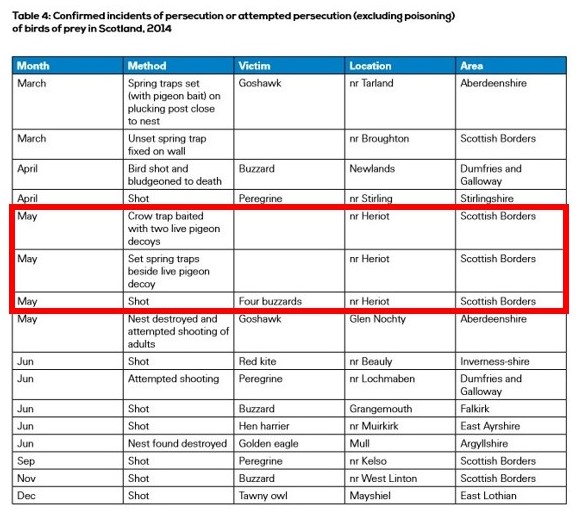
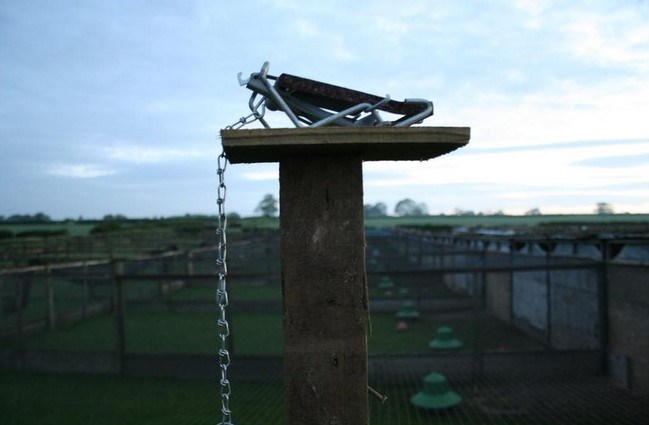
Lines 5, 6 and 7 of Table 4 describe the finding at one site, in an area intensively managed for driven grouse shooting, of a set crow trap, hidden within a small area of woodland, which was found to contain two feral pigeons indubitably being used as illegal lures to attract birds of prey. Under a tree, only a few metres away, were found the decomposed carcasses of four buzzards that had been shot, while a short distance from the crow trap a pigeon was found in a small circular cage, with four set spring traps set on the ground, hidden under moss, attached to the trap“.

Here’s a copy of Table 4, with lines 5, 6 and 7 highlighted:

Nr Heriot 2014

Also included in the report is a photograph of the pigeon inside a small cage with the four set spring traps hidden under moss:

Pigeon in trap Heriot 2014

So, according to the RSPB report, these offences were uncovered in May 2014 on a driven grouse moor in the Borders, with the location given as “nr Heriot“. Funny, we don’t remember seeing anything in the press about these crimes.

Hmm. Could these wildlife crimes be in any way related to SNH’s recent decision to serve a General Licence restriction order on parts of the Raeshaw Estate and Corsehope Estate (see here)? Both Raeshaw Estate and neighbouring Corsehope Estate can be described as being ‘nr Heriot’; indeed, the recorded property address for Raeshaw Estate is given as ‘Raeshaw House, Heriot, EH38 5YE’ (although the owner is only listed as Raeshaw Holdings Ltd., registered in the Channel Islands, natch), according to Andy Wightman’s excellent Who Owns Scotland website. And according to SNH, the General Licence restriction order on these two estates was served due to “issues about the illegal placement of traps” (see here). It’s possible that they’re connected, but it’s also possible that these crimes are unconnected with SNH’s General Licence restriction order on these two estates because Raeshaw isn’t the only grouse moor that could be described as being ‘nr Heriot’. Unfortunately, the (lack of) detail available in the public domain doesn’t allow us to be conclusive. Perhaps there’ll be some transparency once the legal arguments (see here) about the General Licence restrictions have concluded (which should happen fairly soon). Then again, perhaps there won’t.

If these crimes were not uncovered on either the Raeshaw or Corsehope Estates, we hope there’ll at least be a General Licence restriction order served on whichever grouse moor these traps were found because there’s been a clear breach of the General Licence rules – pigeons are not permitted as decoy birds in crow cage traps; set spring traps are not permitted out in the open; oh, and shooting buzzards is also illegal. There should also be a prosecution of course, but that’s highly improbable given the track record of non-prosecutions for raptor crimes uncovered in this part of the Borders.

There’s been a long history of raptor persecution “nr Heriot“, dating back to at least 2001. Here’s a list we’ve compiled of confirmed raptor persecution crimes, all listed within RSPB annual reports:

2001 May: poisoned buzzard (Carbofuran) “Heriot Dale”. No prosecution

2003 Feb: poisoned buzzard (Carbofuran) “Heriot”. No prosecution

2003 Mar: poisoned buzzard (Carbofuran) “Heriot”. No prosecution

2003 Apr: poisoned buzzard (Carbofuran) “Heriot”. No prosecution

2003 Nov: poisoned buzzard (Carbofuran) “Heriot”. No prosecution

2004 Feb: Carbofuran (possession for use) “Heriot”. No prosecution

2004 Feb: two poisoned buzzards (Carbofuran) “Heriot”. No prosecution

2004 Oct: poisoned buzzard (Carbofuran) “Heriot”. No prosecution

2005 Dec: poisoned buzzard & raven (Carbofuran) “Heriot”. No prosecution

2006 Sep: poisoned buzzard (Carbofuran) “Heriot”. No prosecution

2006 Oct: poisoned buzzard (Carbofuran) “Heriot”. No prosecution

2009 Mar: two poisoned buzzards (Carbofuran) “nr Heriot”. No prosecution

2009 Jun: poisoned red kite (Carbofuran) “nr Heriot”. No prosecution

2009 Jun: 4 x poisoned baits (2 x rabbits; 2 x pigeons) (Carbofuran) “nr Heriot”. No prosecution

2010 Nov: poisoned buzzard (Carbofuran) “nr Heriot”. No prosecution

2011 Jan: poisoned buzzard (Carbofuran) “nr Heriot” No prosecution

2013 Jun: shot + poisoned buzzard (Carbofuran) “nr Heriot”. No prosecution

2014 May: crow trap baited with two live pigeon decoys “nr Heriot”. Prosecution?

2014 May: four set spring traps beside live pigeon decoy “nr Heriot”. Prosecution?

2014 May: four shot buzzards “nr Heriot” Prosecution?

Not included in an RSPB annual report (because it happened this year): 2015 Jul: shot buzzard “found by side of road between Heriot and Innerleithen” according to media reports (see here). Prosecution?

Interestingly, also not included in the RSPB’s annual reports but reported by the Southern Reporter (here) and the Guardian (here), a police raid on Raeshaw Estate in 2004 uncovered nine dead birds of prey, including five barn owls, two buzzards, a kestrel and a tawny owl, described as being “poisoned or shot“. In addition, “a number of illegal poisons were discovered but no-one was ever prosecuted“. According to both these articles, during a further police raid on Raeshaw in 2009 ‘three injured hunting dogs were seized by the SSPCA on suspicion of involvement with badger baiting’. We don’t know whether that resulted in a prosecution.

Also not included in the above list is the sudden ‘disappearance’ of a young satellite-tagged hen harrier in October 2011. This bird had fledged from Langholm and it’s last known signal came from Raeshaw Estate. A search failed to find the body or the tag.

Fascinating stuff.

Our year in review: July-December 2015

JULY

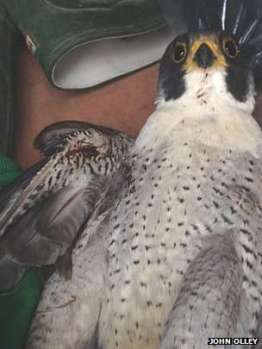
shot perg june 2015 durham_peregrinefalconjohnolleyThe Police and RSPB appealed for information after a male peregrine was found shot on a nature reserve in Co Durham last month. His injuries were so severe he had to be euthanised (here). A female red kite named ‘Fawkes’ was found shot dead in Co Down – the loss of this bird was a huge blow to the precarious reintroduction project in Northern Ireland (here).

The Scottish Environment Minister Dr Aileen McLeod presented the award to the SGA’s Young Gamekeeper of the Year and made an embarrassing speech about how the SGA is implementing best practice conservation (here). There was further embarrassment when one of her civil servants claimed that a Community Payback Order was a more effective deterrent for wildlife criminals than a custodial sentence (here).

The trial of a Shropshire gamekeeper, accused of mis-use of a Larsen trap baited with live quail, collapsed when the court ruled the RSPB’s video evidence ‘disproportionate’ because they didn’t have the landowner’s permission to film there. The gamekeeper, Neil Wainwright, did plead guilty to three other offences and was convicted for failing to properly store ammunition and failing to securely store a dangerous chemical (Phostoxin). He was fined a total of £500 and was ordered to pay £85 costs and a £30 surcharge (see here).

New sentencing powers were given to magistrates courts in England and Wales for wildlife crime, effectively lifting the cap from £5,000 and allowing magistrates to impose unlimited fines for offences that took place after 12th March 2015 (see here).

A series of stunning photographs appeared in the Guardian, showing the incredible work of the Scottish Raptor Study Group as they fitted satellite tags to young golden eagles in the Highlands (here).

The issue of hen harrier persecution made it in to Private Eye (here) and also received wider publicity with the publication of Mark Avery’s book Inglorious, which we’d reviewed (here). DEFRA responded to an FoI from one of our readers and said that despite the ‘disappearance’ of five breeding male hen harriers this spring, they were still intent on pushing forward the (non)Joint Hen Harrier Action Plan, which includes brood meddling (here). For those of us sick of waiting for DEFRA to get to grips with tackling hen harrier persecution, Mark Avery launched his second e-petition calling for a ban on driven grouse shooting (here).

We learned that Iceland supermarkets planned to start selling old, frozen red grouse and we asked their CEO, Malcolm Walker, how this fitted in with Iceland’s stated corporate responsibility policy, including their supposed commitment to providing ‘ethically sourced food’, given that shot red grouse may contain poisonous lead, may be diseased with cryptosporidiosis, and may have been sourced from a grouse moor where illegal raptor persecution is common practice (here). Iceland responded but failed to adequately answer our questions, so we asked some more (here).

SNH’s CEO, Susan Davies, responded to questions we’d asked about SNH’s involvement in the Natural Larder campaign and their claims that red grouse were ‘healthy, natural and sustainable’. Her response (here) was as unconvincing as the one from Iceland, which shouldn’t have been a surprise because it’s virtually impossible to counter the fact that shot red grouse from driven grouse moors is unhealthy, unnatural and unsustainable.

There was a rumour that Marks and Spencer might be thinking about selling red grouse in their shops (here).

The Rural Payments Agency responded to our latest FoI request about whether the Stody Estate in Norfolk had received a subsidy penalty for the mass poisoning of raptors on their estate. This time they told us (here) that they were trying to determine whether there was a relationship between the convicted gamekeeper, Allen Lambert, and the subsidy recipient, Stody Estate (er, Lambert’s employer).

Police in Northern Ireland appealed for information after two peregrines were found shot dead in Co Armargh in May (here) and there was an entertaining debate (here) on Farming Today about banning driven grouse shooting. Mark Avery was pitted against Andrew Gilruth from the GWCT. GWCT still hadn’t learned that they need a scientific representative if they want to sound semi-credible.

Henry had a busy month visiting Bransdale Estate in North Yorkshire (here), the scene of a wildlife crime in Donside (here), Kildrummy Estate in Aberdeenshire (here), Perthshire (here), Nene Washes in Cambridgeshire (here), Walshaw Moor Estate (here), Balmoral (here), Tillypronie Estate in Aberdeenshire (here), Langholm Moor (here), Marks and Spencer (here), Scottish Raptor Study Group (here), Millden Estate in the Angus Glens (here), DEFRA offices in London (here), Countryside Alliance HQ in London (here) and a little village in Oxforshire called Milcombe (here).

AUGUST

Michael Harrison, a 70 year old poultry farmer in the Scottish Borders, was convicted for shooting a buzzard (he claimed he thought it was a crow). He was fined £600 (here).

Scottish gamekeeper William (Billy) Dick, 25, was convicted for killing a buzzard on the Newlands Estate in Dumfriesshire. Two witnesses had observed him striking the buzzard with rocks and then repeatedly stamping on the bird (see here). Sentencing due in September.

A gamekeeper from Glenogil Estate in the Angus Glens was charged with a series of alleged wildlife crimes (see here).

Some (more) lies about the RSPB were published in the Telegraph (which it later had to retract and apologise for), seemingly lifted straight from a YFTB press release (here), accusing the RSPB of failing to protect hen harrier nests in England. Natural England published a statement in response, proclaiming this year to have been the most successful for breeding hen harriers in five years. We wrote an article calling for some perspective on their view: six successful hen harrier nests in the whole of England was nothing to celebrate (here).

Marks and Spencer announced that they wouldn’t be selling red grouse in their shops this year (here).

The second annual Hen Harrier Day came and went, with events held in England and Scotland. One of the Scottish gatherings was held at Glen Turret reservoir in Perthshire. The neighbouring Glen Turret Estate used the event as an opportunity to spin some cynical propaganda, claiming that the protesters could have disturbed the young hen harriers they claimed to have on their estate (here). We were given reliable information that the known hen harrier nesting attempt on this estate had actually failed about a month previously but even if there had been harriers on the estate, the small group of folk chatting quietly by the reservoir were miles away and in no danger of disturbing anything, unlike the crowd of gamekeepers and beaters due to descend on the estate in a few days time to create as much noise as possible to drive red grouse towards the waiting guns in the shooting butts.

The SGA also seized the opportunity to spew out some (more) cynical propaganda and they published a ‘fact sheet’ that implied hen harriers didn’t need conservation action. Naturally, they missed out a few crucial facts (see here). As if that wasn’t embarrassing enough, SGA committee member Bert Burnett was caught out when he posted some vitriol on Facebook about wanting to set fire to the Hen Harrier Day protesters (see here). Remember, this is the organisation the Scottish Environment Minister rated so highly.

Annie Langholm harrier shot April 2015We learned that satellite-tagged hen harrier ‘Annie’, missing since March, had been found shot dead on a grouse moor in southern Scotland (here). Over 300 blog readers wrote to the Environment Minister to demand action against the raptor killers. She published an interim statement (here) which was predictably lame.

A buzzard was found shot dead in the Loch Lomond and Trossachs National Park (here) and a buzzard was found shot and severely injured close to a grouse moor in the Borders. It had to be euthanised (see here).

There was a controversial proposal to take golden eagle chicks from the Highlands and release them in southern Scotland to boost the almost-non-existent population in the Borders (see here) – a proposal we cautiously supported on the proviso that each eagle was satellite-tagged.

Police Scotland announced that more than 100 officers would receive ‘specialist training’ to tackle wildlife crime (here) and it was announced that a vicarious liability prosecution was underway against Andrew Duncan, who was alleged to be vicariously liable for the criminal actions of gamekeeper Billy Dick on the Newlands Estate in Dumfriesshire (here).

RSPB Scotland revealed that two red kites had been illegally killed in the Highlands; one had been shot and dumped on a railway line and the other had been discovered poisoned on Cawdor Estate. Both were killed in 2014 and Police Scotland had apparently ‘concluded their enquiries’ without mentioning either case in the press (see here).

SEPTEMBER

The Scottish Government’s public consultation on whether the SSPCA should be awarded increased powers to investigate more wildlife crimes closed one year ago. Still waiting for the Environment Minister to make a decision (see here).

Gamekeeper William (Billy) Dick, who was convicted last month of killing a buzzard on the Newlands Estate in Dumfriesshire, was sentenced – he received a £2,000 fine (see here). We were able to reveal (here) that the Newlands Estate is a member of Scottish Land & Estates and is also an accredited member of SLE’s Wildlife Estates Scotland initiative (membership requires adherence to best practice standards of animal welfare and, er, not to break the law).

The SGA tried (again) and failed (again) to smear the reputation of the RSPB by claiming the RSPB timed the press release about shot hen harrier ‘Annie’ to coincide with the start of the grouse shooting season (here). SGA Chairman Alex Hogg further demonstrated he had the intellectual capacity of a cabbage when he discussed the reasons he thought golden eagles weren’t doing very well in southern Scotland (here).

We asked both SNH and Natural England to provide urgent guidance on the use of gas gun bird scarers on grouse moors during the breeding season as it had become apparent they were being widely used (here). Both SNH (here) and NE (here) said they would review the issue.

The Environment Minister responded to the hundreds of emails she’d received following the death of hen harrier ‘Annie’ but her response completely missed the point we were trying to make (see here).

The Ross-shire Massacre reached its 18-month anniversary but there was still no progress on Police Scotland’s ‘investigation’ (see here).

We photographed some boxes of old, frozen red grouse being sold in Iceland supermarkets under the banner ‘Food you can Trust’ but sadly Iceland CEO Malcolm Walker hadn’t been able to get back to us to answer our questions about ethical food sourcing or on the levels of poisonous toxic lead contained in his products (here). Not food that we would trust at all.

NEVER-MIND-T-SHIRT-DESIGNThe Countryside Alliance and their new CEO Tim Bonner, (he with a nasty, gloating presence on Twitter), called for the BBC to sack Chris Packham for speaking out against hen harrier persecution and on animal welfare issues. A public petition in support of Chris quickly reached 80,000 signatures (see here). In Packham’s own style, ‘Never mind the bollocks, Bonner, where’s the hen harriers’?

Criminal proceedings continued against a Glenogil Estate gamekeeper accused of carrying out wildlife crimes (here) and we noticed that time was running out for a potential vicarious liability prosecution at Kildrummy Estate. The case would become time-barred in a few days so we asked the Crown Office whether they intended to prosecute anyone from Kildrummy (here).

We were told that a red kite had been found injured ‘near Tomatin’ (driven grouse moor country) but it later died and that ‘its injuries did not appear to have been as a result of natural causes’. In other words, it was illegally killed but Police Scotland didn’t want to tell anyone how it had been killed (see here).

Meanwhile the voluntary group Friends of Red Kites (FoRK) in north east England issued a press release about three poisoned red kites: one found next to a grouse moor in Co Durham (poisoned with banned Carbofuran) and two found near Gateshead (poisoned with banned Aldicarb). We speculated about why FoRK had issued the press release and not the Police or Natural England (see here).

Our FoI request to SNH revealed that they had finally issued notices of intent to restrict the use of General Licences on two (currently unnamed) estates due to evidence provided by Police Scotland that raptor persecution crimes had been committed there (see here).

The grouse shooting industry re-launched its comical propaganda campaign called The Gift of Grouse, aimed at promoting the ‘benefits’ of driven grouse shooting. Unbelievably they used driven grouse moors in the Angus Glens as examples of good practice (see here)!

OCTOBER

The Scottish Government published its annual wildlife crime report for 2014 with misleading conclusions (here) and the case against the Glenogil gamekeeper continued in court (here).

Interim results were published from the 2014 National Peregrine Survey which showed that breeding peregrine numbers had decreased in many upland areas and remained stable or increased in lowland and coastal areas (here). This pattern was highlighted in a new scientific paper that showed a continuing decline of breeding peregrines on driven grouse moors in NE Scotland, particularly in the eastern part of the Cairngorms National Park (see here).

The League Against Cruel Sports published a new report reviewing the intensification and mis-management of grouse moors in Scotland (here) and the RSPB’s Hen Harrier Life+ Project introduced us to two young satellite-tagged hen harriers, ‘Holly’ and ‘Chance’ whose movement maps could be followed online by members of the public (here).

A beautifully-produced short film was released about the Ross-shire Massacre (here) and local MSP Dave Thompson asked again for a review of Police Scotland’s ‘investigation’ of this crime (here).

Another powerful deterrent sentence was handed down to a raptor poisoner in Spain. After laying out poisoned baits that killed six Spanish Imperial Eagles and a fox, the criminal received an 18 month prison sentence, a three year disqualification from hunting, and a massive fine of 259,762.62 Euros to be paid to the regional government as the estimated value of those six eagles (here).

In England, South Yorkshire Police and the National Wildlife Crime Unit appealed for information about the theft of a peregrine chick from a nest. The crime had taken place five months ago in May (here). Police in Co Durham appealed for information about two shot short-eared owls that had been stuffed inside a pot hole close to a grouse moor. That crime had taken place seven months ago in March (here).

A legal academic from Cambridge University raised some interesting questions about whether the vicarious liability legislation in Scotland was in contravention of the European Convention on Human Rights (here). The Crown Office confirmed that they were not pursuing a vicarious liability prosecution against anyone from Kildrummy Estate in Aberdeenshire because Police Scotland hadn’t reported anyone to them. We asked Police Scotland why not (see here). The vicarious liability prosecution against Andrew Duncan of Newlands Estate, Dumfriesshire continued in court but was further delayed as it was rumoured his gamekeeper, Billy Dick, was appealing his conviction for killing a buzzard (here).

The raptor conservation community bid a sad goodbye to long-term fieldworker and friend Mick Caroll (here).

A year on from the conviction of Stody Estate gamekeeper Allen Lambert for the mass poisoning of raptors, the Rural Payments Agency told us that they’d now notified Stody Estate that a cross compliance breach had occurred (here). It took them a year to work this out?! However, they still hadn’t told us whether a financial penalty had been applied and if so, how much? We sent another FoI to the RPA.
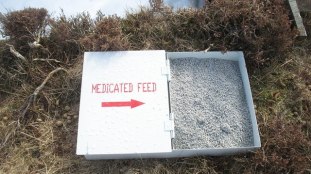
Medicated grit tray by Richard Webb LammermuirsAfter a series of FoIs over the summer months, we published an article on the red grouse/medicated grit scandal (here). It was jaw-dropping. We discovered that grouse moor managers had been using super-strength medicated grit, of at least ten times the licensed strength, to treat red grouse for parasitic worms. The use of the grit had been unregulated and un-monitored and the environmental effects of using such a high-persistence pharmaceutical drug in sensitive ecosystems was unknown. Red grouse that had been shot and had entered the human food chain had not been checked, ever, for residues of these drugs because the regulatory authority (DEFRA’s Veterinary Medicines Directorate) claimed they didn’t know where to find dead birds to test.

NOVEMBER

The National Audubon Society in North America featured a prominent article in its magazine on hen harrier persecution in the UK (see here). A young satellite-tagged hen harrier called ‘Holly’, one of the RSPB’s Hen Harrier Life+ Project’s birds, ‘died’ (see here).

A peregrine was found shot dead in Halifax, West Yorkshire (here) and West Mercia Police appealed for information about a poisoned peregrine in Shropshire that had been found five months ago in June (here).

George Allen, a 61 year-old Scottish gamekeeper, was convicted of snaring offences on Dunecht Estate in Aberdeenshire which had resulted in the horrific death of a badger. He was fined £600 (here).

SNH announced it had implemented General Licence restrictions on four (unnamed) estates in Scotland where evidence of raptor persecution crimes had been provided by Police Scotland. Thanks to Andy Wightman’s brilliant website Who Owns Scotland we were able to name the four estates as Raeshaw and Corsehope (Scottish Borders) and Burnfoot and Wester Cringate in Stirlingshire (see here). SNH later revealed some of the reasons why the restrictions had been put in place (here) but the estates disputed the evidence and said they would appeal the decision (here). Six days later SNH suspended the restrictions as the estates had lodged a legal appeal (here).

The findings of the judicial review against Natural England’s refusal to issue buzzard-killing licences was finally published – the High Court ruled that Natural England had acted unlawfully (see here). Expect to see an increase in buzzard-killing licence applications next year, including in Scotland, as even though the ruling was against Natural England, the same European and domestic licensing laws apply in Scotland.

Police Scotland explained (sort of) why nobody had been reported for a vicarious liability prosecution at Kildrummy Estate. As Andy Wightman had suggested, it was likely due to the difficulties of identification associated with land registered in an off-shore tax haven (see here).

We finally got confirmation from the Rural Payments Agency that Stody Estate had received a cross-compliance subsidy penalty after their gamekeeper had been convicted of the mass poisoning of raptors (here), and although there was still some confusion over the exact amount, it was a massive penalty (see here).

An important new report highlighted the extent of raptor persecution in Northern Ireland (here) and we learned that the five year bird of prey ‘initiative’ between landowners and conservationists in the Peak District National Park had failed to deliver any of its objectives (here).

In Scotland the Wildlife Crime Penalties Review report was finally published and included some impressive recommendations for tougher sentencing (see here), which now need the Environment Minister’s approval to move forward.

Police Scotland appealed for information after the discovery of a poisoned red kite in the Highlands (see here) and a rare red-footed falcon was found shot dead in Cambridgeshire (see here); Rare Bird Alert launched a crowdfunding appeal to increase the reward on offer from the RSPB for information leading to the criminal who’d killed it (see here).

Proceedings from the Oxford University Lead Symposium were published (here), highlighting, again, the risks of lead ammunition to human and environmental health. The RSPB published their annual Birdcrime report (2014) (here) – a shameful catalogue of raptor persecution crimes throughout the UK.

DECEMBER

Sporting agent Graham Christie (Dunmhor Sporting) became the second person convicted under vicarious liability legislation for raptor crime in Scotland. Christie was guilty of not adequately supervising the activities of his gamekeeper James O’Reilly who had used an illegal gin trap to kill a buzzard on the Cardross Estate in Stirlingshire. Christie was fined £3,200 (see here).

Yorkshire game farmer Michael Wood had his earlier conviction quashed for permitting the use of a pole trap at his pheasant-rearing facility (here). Wood’s two employees had earlier received police cautions for setting five (yes, five!) pole traps at the farm, so in effect, nobody has been punished for these crimes.

Police in Co Durham appealed for information after the discovery of a shot, dead peregrine at the edge of a grouse moor four months ago in August (see here).
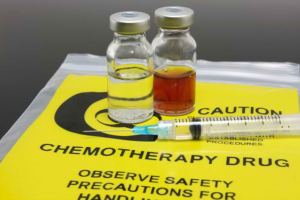
ChemoIt was revealed that red grouse were being force-fed a chemotherapy drug used in the treatment of colon cancer, to combat parasitic worms in the birds (see here). Astonishingly, this drug has been administered during the grouse shooting season, increasing the chances of these drugged birds getting in to the human food chain without any official testing by government regulators. ‘Free chemotherapy when you eat red grouse!’ will be the next SNH slogan in their Natural Larder campaign. It was also revealed that the GWCT’s ‘best practice guidelines’ for medicating red grouse, in use since 2004, were actually illegal (here). Shocker!

Garry Dickson, a lecturer on the gamekeeping courses at Borders College, was caught out spouting anti-raptor rhetoric against goshawks on his Facebook page (here). If you ever wondered why goshawks are the victims of continued persecution by gamekeepers, look no further.

The Scottish Gamekeepers’ Association brought us some festive cheer with their mince (pork) pie lies about how well golden eagles are doing on grouse moors in Scotland, all unquestionably regurgitated by the BBC (see here). After complaints from us, the BBC article was edited to include a damning response from RSPB Scotland.

And finally, RSPB Scotland published an excellent 20-year review of raptor persecution crimes (here), which included an incredible tally of known victims: 779 raptors confirmed as illegally killed either by poisoning, shooting or trapping, including 458 buzzards, 104 red kites, 37 golden eagles, 30 hen harriers, 16 goshawks, and ten white-tailed eagles. How many victims do you think went undiscovered? 81% of known poisoning incidents took place on land managed for game shooting: 57% on grouse moors and 24% on lowland pheasant shoots. That says it all.

Thanks to everyone who has followed, supported and contributed to our blog in 2015 – it is greatly appreciated.

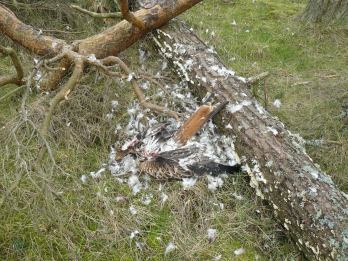
New report reveals hundreds of raptors illegally killed on game-shooting estates in Scotland

RSPB persecution review 1994 2014Yesterday the RSPB published its latest figures on illegal raptor persecution in Scotland.
Rather than their usual annual review, this time they’ve produced a 20-year review covering the period 1994-2014. This is a really useful exercise as it puts the scale of (known) persecution in to perspective. It’s a sobering read.

A total of 779 birds of prey were confirmed to have been illegally killed during this period, either by poisoning, shooting or trapping. The known victims included 104 red kites, 37 golden eagles, 30 hen harriers, 16 goshawks, 10 white-tailed eagles and 458 buzzards.

In addition to these confirmed victims, a further 171 incidents are documented where poisoned baits and/or non-birds of prey victims were found, including 14 pet cats and 14 pet dogs, and then a further 134 incidents where no victim had been found but clear attempts to target raptors had been uncovered (e.g. illegally-set traps).

The report includes a map showing the landholdings of all known persecution incidents during this period. As ever, it’s pretty revealing, with a handful on the west coast but the vast majority in the uplands of central, eastern and southern Scotland – areas dominated by driven grouse shooting.

RSPB persecution review 1994 2014 map

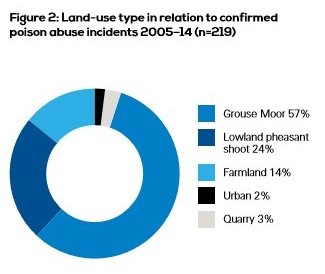
Drilling down in to the detail, there’s a useful analysis of land-use type of confirmed poisoning incidents between 2005-2014 (219 incidents). A shocking (or not) 81% of confirmed poisoning incidents during this nine-year period were on land used for game-shooting: 57% on grouse moors and 24% on land managed for lowland pheasant shoots. This tells us a great deal about who is responsible for the vast majority of illegal raptor poisoning. Despite their continued denials and protestations, and their increasingly-desperate attempts to minimise the scale of these crimes (“it’s just a few rogues”, “it’s just a small minority”), this graphic exposes the criminality at the heart of the game-shooting industry:

RSPB persecution review 1994 2014 land use

Further damning evidence, which isn’t needed by most of us but for the benefit of those who are still in denial of the bleedin’ obvious, is this graph showing the occupations of those convicted of raptor persecution between 1994-2014. Surprise, surprise, 86% of them were gamekeepers:

RSPB persecution review 1994 2014 occupation

RSPB Scotland is to be commended for publishing this exceptionally detailed and meticulously-researched report. There are a number of things in it that are of particular interest to us and we’ll come back to those in due course. For now though, particular recognition should go to the Investigations team – they may be small in number but their contribution to exposing the disgraceful continuation of illegal raptor persecution in Scotland is enormous. They, and their colleagues south of the border, are worthy of high acclaim. If anybody reading this is in a position to recognise excellence in the field of raptor conservation, e.g. a nomination for an award, this team should be at the top of your list.

So, how has the Environment Minister, Dr Aileen McLeod, responded to such an embarrassing report? She said: “There is no doubt that the figures in this report make for uncomfortable reading, but we have made progress in recent years with the new vicarious liability provisions, the publication of the report from the Wildlife Crime Penalties Review Group, new measures implementing restrictions on the use of General Licences and earlier this year the Scottish Government funded pesticide disposal scheme that removed over 700kg of illegally held poisons in Scotland“.

We have made progress…” Hmm. Let’s have a look:

Vicarious liability – introduced almost 4 years ago and only two successful convictions to date. A slow (but good) start, but we need to see many more convictions.

Wildlife Crime Penalties Review – Commissioned over two years ago, published last month. An excellent report calling for tougher sanctions but we’re waiting to hear whether the Environment Minister will act on the recommendations. Can only be defined as ‘progress’ if she agrees to act.

General Licence restrictions – available to be used against landholdings where raptor crimes committed/suspected from 1st January 2014. So far, only two restrictions have been implemented and those only lasted for six days each before they were suspended as legal arguments continue. A slow start, and the legal challenges were to be expected, but can’t be defined as ‘progress’ unless the restrictions are fully implemented. There should also be a lot more of them.

Pesticide disposal scheme –  implemented this year and resulted in the removal of some illegally-held poisons. That is progress, although it is tinged with frustration that the game-shooting industry was given yet another chance to avoid justice as this scheme (the second of its kind) comes 14 years after the pesticides were originally banned. It’s also interesting to note in the RSPB’s report (page 18) that evidence suggests a number of individuals have retained their illegal stocks. This is supported by more poisoning incidents that have taken place this year, after the disposal scheme ended.

So some progress has been made (and almost entirely due to the efforts of Dr McLeod’s predecessor, Paul Wheelhouse) but it is glacially slow and, so far, has not stemmed the occurrence of illegal persecution, as the damning figures in this report show all too clearly. Much, much more can and needs to be done before we’ll be convinced that Dr McLeod is having any sort of impact. She has, though, announced that tenders have just been invited for a review of game licensing practices in other countries (to inform a possible decision of introducing licensing to game-shooting estates in Scotland), and that’s a good thing, but again, the research needs to be done and then a decision made, which probably won’t happen for a number of years if past performance is anything to go by. She’d find herself with a lot more support if she got on with announcing increased investigatory powers for the SSPCA – the public consultation closed 1 year and 3 months ago – and still we await her decision as the criminals continue their rampage. It’s not impressive at all.

And what of the response of the game-shooting industry itself? Some didn’t bother to publish a statement (Scottish Gamekeepers’ Association), which ironically tells us quite a lot, although they are quoted in an article by STV (see media coverage below) where they revert to type and simply deny the evidence and slag off the RSPB instead. And remember, the SGA is a fully-paid up member of the Partnership for Action Against Wildlife Crime (cough).

Scottish Land and Estates (SLE), another PAW partner, did manage to issue a statement, via their Scottish Moorland Group (see media coverage below). Again, it’s the usual lamentable denial, characterised beautifully by this statement from Director Tim (Kim) Baynes:

Bird of prey deaths……have fallen dramatically over the last five years in particular“.

Er, here are some persecution figures that Kim might want to re-punch in to his calculator:

2012 – 18 confirmed deaths

2013 – 28 confirmed deaths

2014 – 37 confirmed deaths

There’s also this statement:

Our condemnation of wildlife crime is unquivocal...” All very touching but how is that “condemnation” manifested in the real world? It’s been brought to our attention that the current head gamekeeper on a Scottish grouse shooting estate has a (spent) conviction for shooting dead a raptor when he worked on another Scottish grouse moor. How does a criminal with a conviction like that (spent or not) remain employed in the game-shooting industry, let alone get a senior position on another Scottish grouse moor? Was he one of the posse of moorland gamekeepers recently invited to Holyrood to mingle with, and be applauded by, a number of MSPs, as part of the Gift of Grouse propaganda campaign? Surely not…

Download the RSPB report here

Media coverage

RSPB press release here

Statement from Environment Minister Dr Aileen McLeod here

Scottish Moorland Group statement here

BBC news here

STV article here

BBC Radio Scotland (Newsdrive) interview with Ian Thomson, Head of Investigations RSPB Scotland here (starts at 21.50, available for 29 days)

Guardian article here (a mis-leading headline but nevertheless good to see coverage in this paper)

Game farmer Michael Wood wins appeal against pole trap conviction

In February this year we blogged about the conviction of game farmer Michael Wood, who was found guilty of permitting the use of a pole trap at his game-rearing facility Westfield Farm in Cropton, North Yorkshire (see here).

Mr Wood’s conviction was based on the magistrate’s opinion that it was “inconceivable” that Wood had not known about the trap, as RSPB surveillance evidence outlined how he had driven past this exposed trap and also another (with the safety catch engaged) a short distance away. Wood had basically claimed it was getting too dark to be able to see the traps. His evidence was contradicted by his wife who outlined the things her husband was checking as he drove around the site.

However, Mr Wood appealed the verdict and the judicial bench at York Crown Court has now upheld his appeal because ‘the prosecution had failed to prove its case’ (see article in today’s Gazette & Herald here).

This is an interesting case. The most interesting feature (from our perspective) is that the RSPB’s surveillance evidence was deemed admissible. At the original trial the defence tried unsuccessfully to have this evidence excluded. At the appeal this was not even contested, neither this time were the actual light levels as shown by photographs taken by the RSPB. Unsurprisingly, Mr Wood’s wife did not give evidence at the appeal. So, it appears the admissibility of the RSPB evidence was NOT an issue at the Crown Court. Mr Wood’s appeal was successful because the prosecution were not able to convince the court that Wood had actually seen the trap, not that he’d been covertly observed driving close to the traps. That’s a very important distinction.

What’s also interesting about this case is that, following the day Wood was seen on site, the North Yorkshire Police, assisted by RSPB, seized a total of five illegal pole traps found set around the breeding facility. However, two employees only received a police caution in relation to these traps – they weren’t prosecuted for setting them. As they’d been cautioned, this infers that they’d admitted to setting them. Why weren’t they prosecuted for setting these illegal traps, if they’d admitted their guilt? In 2014 a gamekeeper on the Swinton Estate (also in North Yorkshire) was convicted of twice setting a pole trap (see here), so how did Mr Wood’s two employees escape prosecution when they’d set five pole traps between them?!

If you look at the position of the traps (see the photo and see the short video made by the RSPB Investigations team here), you can see how discreetly positioned they were. They must have been really easy to miss, eh?

pole-trap-1-of-5-westfield-game-farm-rspb

As we reported in February, Mr Wood has a current criminal conviction for wildlife offences. In 2011 he was successfully prosecuted for releasing thousands of pheasants (for shooting) on a site of special scientific interest when permission had only been granted to release 500 birds. It was argued the birds had caused ‘significant damage’ to the conservation area and Mr Wood and Yorks Sports Ltd (of which Mr Wood was a director) were each fined £20,000, plus £125,000 between them towards the prosecution costs, and they also had to pay a £145,000 defence bill (see here).

Shameful catalogue of raptor persecution revealed in RSPB’s Birdcrime 2014 report

Birdcrime 2014 cover - CopyThe RSPB has today published its latest annual Birdcrime report (2014), documenting the confirmed, probable and unconfirmed incidents of crimes against wild birds in the UK, including crimes against birds of prey.
In 2014, the RSPB received 179 reports of the shooting and destruction of raptors, including the shooting of 23 buzzards, nine peregrines, three red kites and a hen harrier. Confirmed victims of poisonings included 23 red kites, nine buzzards and four peregrines. These victims represent the tip of the iceberg – many more will have gone undetected.

The National Wildlife Crime Unit says, ‘Intelligence continues to indicate a strong association between raptor persecution and grouse moor management‘.

Sign the petition to ban driven grouse shooting HERE

Looking at the breakdown of incidents against birds of prey in 2014, the top five worst regions were:

North Yorkshire (36 incidents)

Highland Scotland (25 incidents)

Norfolk (19 incidents)

Derbyshire (16 incidents)

Northumberland (16 incidents)

The RSPB Investigations team deserves a huge amount of credit for their continued efforts to document these crimes and publish these annual reports. Without their meticulous work many of these cases would remain hidden from public view, which is what the raptor-killing criminals would prefer.

RSPB press release here

Download Birdcrime 2014 here: Birdcrime 2014

General Licence restrictions on Raeshaw & Burnfoot Estates last only six days

On 4th November, we blogged about SNH’s intention to restrict the use of General Licences in two areas, in response to alleged raptor persecution incidents. The two areas included parts of the Raeshaw and Corsehope Estates in the Borders (Restriction #1), and parts of the Burnfoot and Wester Cringate Estates in Stirlingshire (Restriction #2) (see here for our earlier blog about these restrictions, and see here for SNH’s explanation for the restrictions).

The General Licence restrictions were due to begin on 13th November 2015 and run for three years. They actually only ran for six days.

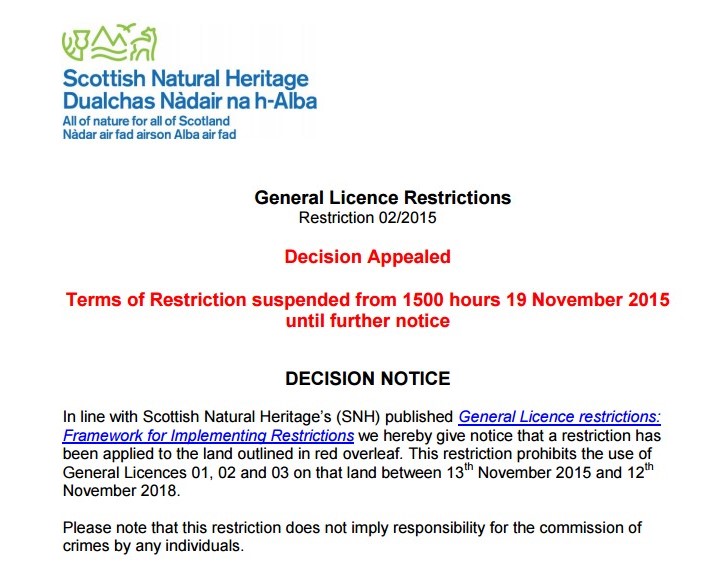
SNH GL restriction 1 SUSPENSION - Copy

SNH GL restriction 2 SUSPENSION - Copy

On 19th November 2015, the General Licence restrictions were suspended in both areas until further notice, because the Estates have lodged legal appeals, as they said they would last week (see here). While the appeals are underway, the Estates can continue to use the General Licences (i.e. continue to set crow traps and Larsen traps to catch and kill corvids, continue to shoot corvids, and continue to kill lots of other stuff that falls under the remit of activities permitted under the General Licences – see here for a list).

We don’t know what the basis of the appeals are, and nor do we know the procedural process of the appeals system, but presumably SNH now has a fixed period of time to respond. If SNH decides to uphold the appeals then the General Licence restrictions will be removed. If SNH decides to stick to its original decision and impose the three-year restrictions, then the restrictions would be re-instated. However, then these Estates would be entitled to apply for a judicial review to test whether SNH has acted fairly.

Settle yourselves in for a long legal battle.