Suspected poisoning of red kite & buzzard in Herefordshire

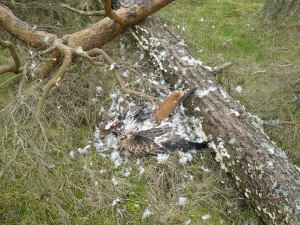
A dead red kite and a dead buzzard have been found in Herefordshire in what looks suspiciously like a poisoning incident.

According to an article in the Western Daily Express (here), the carcasses were discovered on farmland at Pontrilas, south Herefordshire, close to a dead pheasant. The farmer took the corpses to a vet but the vet couldn’t find any obvious sign of injury or disease.

The RSPCA is appealing for information, but strangely, the article doesn’t say whether the corpses have been submitted for toxicology analyses. Given the position of the two dead raptors and their proximity to a dead pheasant (commonly used as bait), it seems quite plausible that this could have been an illegal poisoning incident.

Let’s hope the RSPCA contacts the RSPB Investigations team for advice.

Red kite photograph by Drew Buckley.

Petition for increased SSPCA powers handed in to Holyrood

Goddard petition Wheelhouse august 2014A petition calling for increased investigatory powers for the SSPCA was handed over to Environment Minister Paul Wheelhouse last week, with over 6,000 signatures.

The petition was launched several months ago by Andrea Goddard, a volunteer at the Tollie Red Kite Feeding Station, following the illegal poisoning of 22 raptors (16 red kites and 6 buzzards) in March at nearby Conon Bridge – an incident we’ve termed the Ross-shire Massacre. Five months on, nobody has been charged for this appalling crime.

Great effort, Andrea. Story in the Press and Journal here.

The petition coincided with the long-awaited government-led public consultation on whether the SSPCA should be given additional powers to investigate a wider suite of wildlife crimes. The consultation closes next Monday (1st September) and the consultation responses will be published on the Scottish Government’s website by 11th October. Following the government’s decision-making, a full report (on the consultation) has been promised although a time-frame for this has not been provided.

We’d encourage as many of you as possible to contribute to this consultation. If the proposal is accepted, we believe it will bring significant improvement to the enforcement of wildlife crime legislation in Scotland, leading to many more offenders being brought before the courts – see here for our reasoning.

If you’d like to take part, please click here.

Ross-shire Massacre: five months on

It’s been five months since the discovery of 22 dead raptors (16 red kites + 6 buzzards) near Conon Bridge in Ross-shire – an incident we have termed the Ross-shire Massacre.

Since then, we’ve learned that 16 of these birds (12 red kites + 4 buzzards) were killed after ingesting an “illegally-held poisonous substance“. That information had to be dragged from Police Scotland in June, following some pretty outrageous allegations from the game-shooting industry (and at least one MSP) that the birds had been ‘accidentally poisoned’ by eating contaminated meat at the Tollie Red Kite Feeding Station.

Other than that, Police Scotland has refused to provide any further information, other than to say last month that the investigation “was continuing“.

In June, a member of the public made an FoI request to SASA (the government lab responsible for undertaking the toxicology anlayses on these birds) to ask for the name of the poison(s) and the name of the species affected, amongst other things. He received a reply from SASA on 30th June and he was told that it wasn’t in the public interest to disclose such information. SASA claimed that the public interest test was “outweighed by the public interest in ensuring that the ongoing police investigation is not jeopardised and that incomplete data are not released“. The member of the public submitted a request for a review of this decision and on 24th July 2014 he received a response from Hugh Dignon, a senior civil servant. Mr Dignon upheld the decision made by SASA and added:

By withholding evidence that might, if prematurely released, prejudice a live investigation, we are maximising the likelihood that a conviction could be secured if a prosecution is taken forward“.

Come on, Hugh! There’s not a chance in hell of getting a prosecution, let alone securing a conviction, so many months after the crime took place. Who are you trying to kid? And since when has releasing the name of a banned poison ever jeopardised a live investigation? Er, that’ll be never. SASA has, for years, routinely published the name of the poisons that were used in crimes that are still subject to on-going investigations – why is this case so different? Why all the cloak and dagger? What’s to hide?

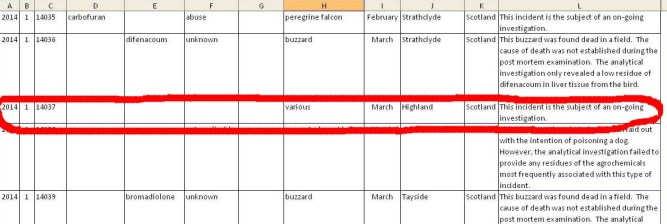
Here’s a screen grab of SASA’s latest poisoning data, which relate to toxicology tests undertaken in the first quarter of 2014. The reference circled in red is the information about the Ross-shire Massacre. SASA has redacted all the detail about the type of poison(s) detected (column 4), whether the incident was ‘abuse/mis-use’ etc (column 6), and they’ve even removed the names of the species they’ve tested – preferring to write ‘various’ instead (column 8). Compare and contrast these redactions to the entry at the top of the image, which relates to a poisoned peregrine found in Strathclyde in February – that case is also an on-going police investigation (ahem) and yet we’re allowed to see the name of the poison (Carbofuran), the type of incident (abuse) and the species affected (peregrine). Astonishing, isn’t it?

 SASA Q1 2014 ROSS-SHIRE MASSACREa

For previous posts on the Ross-shire Massacre click here

More poisoned peregrines in North Wales

North Wales Police are appealing for information following the discovery of a poisoned peregrine in June.

The bird was found at a quarry in Penmaenmawr and toxicology tests revealed it had been poisoned with a rodenticide.

It’s possible then that this was the result of an accidental poisoning (as rodenticides can be used under certain controlled conditions), but the death is being treated as suspicious because two years ago a pigeon was found, at the same quarry, smothered in poison and tethered to a rock – obviously placed as a poisoned bait (see here).

Press release from North Wales Police on the latest peregrine poisoning here.

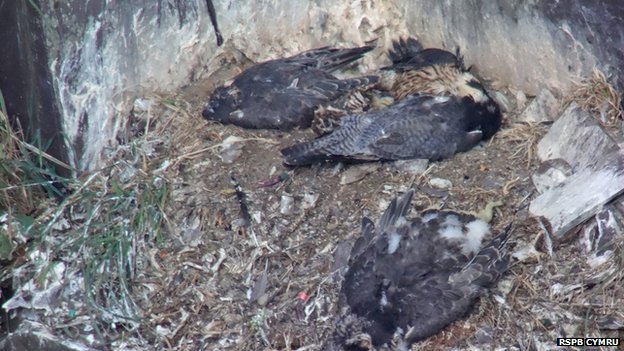
In July this year, four peregrines (3 chicks and 1 adult) were found dead on their nest ledge at a quarry site in the Nantlle Valley, Gwynedd. Police suspect they too had been poisoned (see here).

peregrines x 4 Nantlle valley July 2014

Buzzard shooting condemned as abhorrent

Police are investigating following the discovery of a buzzard that had been shot dead in July.

The bird was found in a wooded area near Dundrum Road, Newcastle, Co Down on 9th July, according to an article in the local Mourne Observer (thanks to the contributor who sent us a copy).

An RSPB spokesperson said: “Any incident of wildlife crime is to be condemned but the shooting of a majestic bird of prey is completely abhorrent”.

Anyone with information about the shooting is asked to contact Newcastle police station on the non-emergency number 101.

Buzzard photograph: unknown photographer.

By the way, in case you’re thinking that due to a paucity of recently reported information, raptor persecution in Scotland has suddenly stopped, think again. We’re just waiting to see how long it takes Police Scotland to make these crimes public…..

Young peregrine shot in Co Wexford

Perg Co WexA young peregrine falcon has had to be euthanised after it was illegally shot in Co Wexford, Ireland.

The news article in the Irish Times (here) doesn’t say when the bird was found but it can be assumed it was quite recently – the young bird had been ringed with a unique identification number so presumably the authorities know it was one of this year’s fledglings.

The bird was found at Ballynastraw near Enniscorthy and an x-ray revealed it had been hit with shotgun pellets in its wings and leg. A vet decided the injuries were too severe for the bird to be rehabilitated.

The National Parks and Wildlife Service has appealed for information. Dominic Berridge of NPWS said: “The finding of this bird is not an isolated incident. There have been attempts to poison and shoot birds at a number of nests and if people see anything suspicious like a tethered pigeon or a trap, NPWS staff should be called”.

Raven found poisoned at Killard Nature Reserve

raven poisoned KillardThanks to the contributor who sent us a copy of the following article, published in the (County) Down Recorder, 23 July 2014. We’ve shortened it slightly:

The poisoning of a raven at Killard Nature Reserve, County Down, has prompted a police investigation and raised serious concerns amongst environmentalists.

The dead bird was found on 15th March 2014 but it has only now been confirmed that it was poisoned with the banned pesticide, Carbofuran.

Situated at the mouth of Strangford Lough opposite Ballyquintin, where walkers are attracted by the area’s rich wildlife and interesting rock formations, the site is managed by the Northern Ireland Environment Agency (NIEA).

An NIEA spokeswoman said they were “deeply concerned” and advised members of the public at Killard not to pick up any dead wildlife in case they are poisoned. She explained that the raven, protected by the Wildlife (NI) Order 1985, was found by one of their wildlife officers on the cliff top above Benderg Beach.

“The dead raven was found in an unnatural posture which, from experience, led the officer to believe that it may have been poisoned”, said the spokeswoman. “Despite a thorough search no evidence was found that poison had been laid in the reserve. Tests completed in early July revealed that the raven had died as a result of ingesting Carbofuran, a poison banned for use throughout the EU. It is likely that the bird picked this up from a poisoned bait within 100 metres of where the raven was found.

“NIEA is deeply concerned, not only the poisoning of a protected species nesting locally, but also that it took place on or near a protected site where wildlife should be safe”.

NIEA said it wasn’t aware of any other incidents at the reserve but issued the following advice: “Members of the public visiting Killard are asked to avoid handling any dead animals such as rabbits or birds in case they may have been poisoned or baited with poison. Dogs should be kept on the lead and prevented from approaching any such corpses, and dogs are not permitted on the Reserve when livestock graze there over the winter months.

“If members of the public in the Killard and Ballyhornan area do come across any dead crows, birds of prey or foxes, or find any suspicious carcasses or rabbits or chickens covered in granular or powdered substances, or see any suspicious activity which could relate to illegal poisoning, they are asked to contact Downpatrick PSNI”.

A spokeswoman for the RSPB in Northern Ireland said the incident was “very disappointing”.

“All cases of birds or wildlife being poisoned by an illegal substance are worrying, but this incident is particularly concerning because the County Down area is a stronghold for the threatened red kite”, she said.

“Having been persecuted to extinction in Northern Ireland more than 200 years ago, kites were reintroduced here in 2008. Sadly, last year alone around 30% of the breeding population were confirmed poisoned, making it more difficult for the species to thrive.

“Leaving out poisoned bait is an illegal practice as it is indiscriminate and can affect not only scavenging birds like red kites, but also pets, livestock and humans”.

East Scotland sea eagle chick fledges: what fate awaits this one?

For the second consecutive year, a young white-tailed eagle has successfully fledged from a nest in east Scotland.

His sibling, who hatched in 2013, un-mysteriously ‘disappeared’ earlier this year in a notorious raptor persecution blackspot in the Cairngorms National Park (see here and here). He was the first sea eagle to fledge in east Scotland in over 200 years but he didn’t even survive to see his first birthday. His satellite transmitter went silent after he’d visited a driven grouse moor where previously a head gamekeeper had been convicted of poisoning offences (2006), a poisoned golden eagle had been found in 2011 (no prosecution), a poisoned buzzard had been found in 2011 (no prosecution), poisoned bait had been discovered in 2011 (no prosecution) and a short-eared owl had been found in 2011 that had been shot and shoved underneath a rock (no prosecution). The police raided the estate in April this year but found no trace of the eagle.

He might not have been the first sea eagle to fledge in Scotland in over 200 years if another east Scotland pair had not had their nest tree felled by someone with a chainsaw (see here – no prosecution).

The BBC is running an article on this year’s fledgling (see here) and includes a telling remark from RSPB Scotland saying they hoped the young bird would avoid areas where birds of prey have been poisoned or trapped. In other words, steer clear of driven grouse moors.

He’s got at least five years in which to run the gauntlet before he becomes mature enough to breed – we don’t rate his chances much.

Go west, kid, go west.

wtse fife 2014 ian francis

Ross-shire Massacre: the pig’s ear of an investigation continues

RK5Ten days ago we blogged about the progress (or apparent lack of) being made in the Ross-shire Massacre case, four months on from the discovery of 22 dead raptors in one of Scotland’s worst raptor poisoning incidents (see here).

A couple of days ago, somebody told us that the ‘official’ number of birds confirmed poisoned was now 16 (12 red kites + 4 buzzards), according to Police Scotland.

We found this news intriguing. Did it mean that the remaining six carcasses (4 red kites + 2 buzzards) had not been poisoned?

No. What it turned out to mean was that toxicology tests on those remaining birds are still “continuing”, according to a news report in The Press and Journal (see here).

Still continuing, four months after discovery? Is that because the poison is proving difficult to detect, or is it because the tests have not been given priority? If not, why not?

What a shambles. And that’s only the start of it…..

Previous posts on the Ross-shire Massacre here

Ross-shire Massacre: 4 months on

It’s been four months since 22 birds of prey (sixteen red kites and six buzzards) were killed in one of the worst poisoning incidents uncovered in Scotland in recent years.

Here’s the latest information about how the police investigation is progressing:

nothing 2

Great, eh?

The Untouchables get away with it. Again.

Tune in next month for more of the same. Probably.

For previous posts on the Ross-shire Massacre click here.