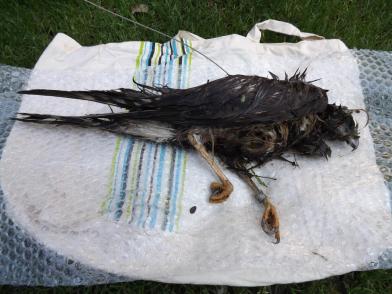
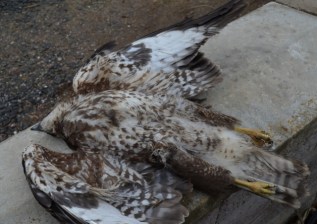
Link between grouse moors & raptor persecution based on ‘ill-informed rumours’, apparently

Fearnan Angus Glens Dec 2013Last month a letter written by Logan Steele was published in the Scotsman, urging the government to introduce a licensing system for grouse shooting estates (see here).

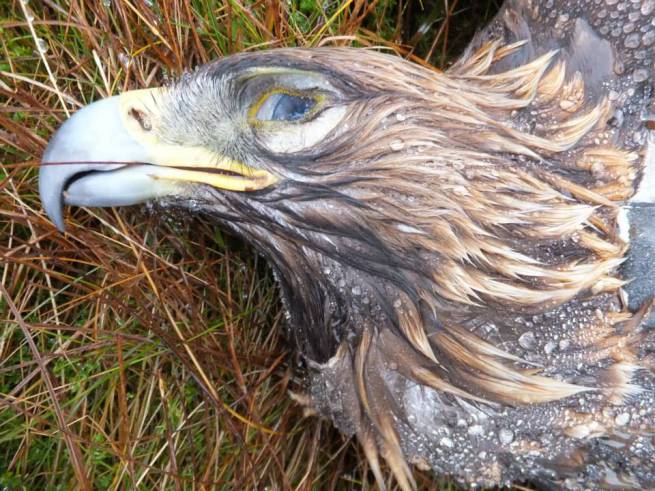
This came on the back of the news that the Scottish Raptor Study Group and RSPB Scotland had written to the Environment Minister to call for estate licensing (see here) following the discovery of poisoned golden eagle ‘Fearnan’, found dead on an Angus grouse moor in December 2013 – the latest in a very long line of victims.

This month, the Scotsman published a response letter, penned by Tim Baynes, the Director of Scottish Land & Estates Moorland Group (a group chaired by Lord Hopetoun [Leadhills Estate] and comprising moorland owners and representatives of GWCT and the SGA – see here).

It’s perhaps then of little surprise to read the content of Mr Baynes’ letter – read it here. Basically, Mr Baynes is suggesting that Logan Steele’s assertions of a strong link between grouse moor management and the illegal persecution of raptors is ‘probably based on ill-informed rumours’.

GE Cons FrThose ‘ill-informed rumours’ no doubt include the following peer-reviewed scientific publications, some dating back over ten years (so the results have been available for a long time), which have all shown a direct link between driven grouse moor management and raptor persecution (and this list is by no means exhaustive – it’s just the ones we have to hand):

Etheridge et al (1997). The effects of illegal killing and destruction of nests by humans on the population dynamics of the hen harrier in Scotland. Journal Applied Ecology 34: 1081-1105.

Stott (1998). Hen harrier breeding success on English grouse moors. British Birds 91: 107-108.

Green & Etheridge (1999). Breeding success of the hen harrier in relation to the distribution of grouse moors & the red fox. Journal Applied Ecology 36: 472-483.

Whitfield et al (2003). The association of grouse moors in Scotland with the illegal use of poisons to control predators. Biological Conservation 114: 157-163.

Hardey et al (2003). Variation in breeding success of inland peregrine falcon in three regions of Scotland 1991-2000. In Thompson et al [Eds] Birds of Prey in a Changing Environment. SNH.

Whitfield et al (2004). The effects of persecution on age of breeding and territory occupation in golden eagles in Scotland. Biological Conservation 118: 249-259.

Whitfield et al (2004). Modelling the effects of persecution on the population dynamics of golden eagles in Scotland. Biological Conservation 118: 319-333.

Whitfield et al (2007). Factors constraining the distribution of golden eagles in Scotland. Bird Study 54: 199-211.

Whitfield et al (2008). A Conservation Framework for Golden Eagles: Implications for their Conservation & Management in Scotland. SNH.

Summers et al (2010). Changes in hen harrier numbers in relation to grouse moor management. In Thompson et al [Eds] Birds of Prey in a Changing Environment. SNH.

Redpath et al (2010). People and nature in conflict: can we reconcile hen harrier conservation and game management? In Baxter & Galbraith [Eds] Species Management: Challenges and Solutions for the 21st Century. SNH.

Smart et al (2010). Illegal killing slows population recovery of a reintroduced raptor of high conservation concern – the red kite. Biological Conservation 143: 1278-1286.

McMillan (2011). Raptor persecution on a large Perthshire estate: a historical study. Scottish Birds 31: 195-205.

Amar et al (2012). Linking nest histories, remotely sensed land use data and wildlife crime records to explore the impact of grouse moor management on peregrine falcon populations. Biological Conservation 145: 86-94.

Watson (2013). Golden eagle colonisation of grouse moors in north-east Scotland during the Second World War. Scottish Birds 33: 31-33.

Those ‘ill-informed rumours’ must also include all the reported incidents of illegally-killed or illegally-injured birds of prey that have been discovered on grouse moors over the last few decades (see here for a list of reported persecution incidents in the Angus Glens and here for a list of reported persecution incidents in South Lanarkshire).  These lists relate to reported incidents from grouse moors at Glenogil, Invermark, Millden, Airlie and Leadhills but don’t include other grouse moors in other parts of the country where illegally-killed raptors have been discovered, such as Farr & Kyllachy, Moy, Skibo, Cawdor, Corrybrough, Glenbuchat, Cabrach, Raeshaw, Invercauld, Glenlochy, Dinnet & Kinord, Glenfeshie, Dunecht, Strathspey and Glenturret, for example. And again, this list is by no means exhaustive.

Mr Baynes is being disingenuous at best to point to the  fact that two months on from the illegal death of Fearnan there is no evidence to link the crime to anyone on a grouse moor. While his assertion is technically correct, it is not an indication that anyone on a grouse moor was NOT responsible. Viewing one incident in isolation is also misleading – and the results of this police ‘investigation’ are more reflective of ineffective policing than anything else – there are many many examples of this ineptitude and include police actions such as delayed appeals for information (often up to 4-6 months after the discovery of a crime against raptors), issuing cryptic police statements about the type of crime and its location, arriving at scenes of crime in highly visible marked police vehicles instead of a covert entry, and failing to undertake timely follow-up searches of associated land, vehicles and buildings to search for evidence. This police ineptitude, followed by plea bargaining and failures to accept evidence by the Fiscals, means that few of the incidents listed above have resulted in a prosecution (although there are some notable exceptions including convictions of gamekeepers at Skibo, Moy, Dinnet & Kinord, Invercauld and Leadhills).

Added to this mix is the legal advice given to gamekeepers should they find themselves at the centre of a police investigation. This legal advice undoubtedly thwarts any attempt by the police to investigate an alleged raptor persecution crime. This from the SGA to their members:

Accordingly, it is the advice normally given by solicitors to clients that they need make no reply to any allegation and that they should not in fact give any further information than their name, address and date of birth in answer to any police questions“.

This advice is technically correct but is it what the public would expect from an organisation that is purportedly committed to partnership working to stamp out illegal raptor persecution?

We would suggest that Mr Baynes takes some time to read the above peer-reviewed scientific publications that demonstrate a clear and unequivocal link between driven grouse moor management and the illegal persecution of raptors, as well as taking the time to read up on the many reported incidents of raptor persecution on grouse moors, before he writes any more embarrassingly ignorant statements of denial in the national press.
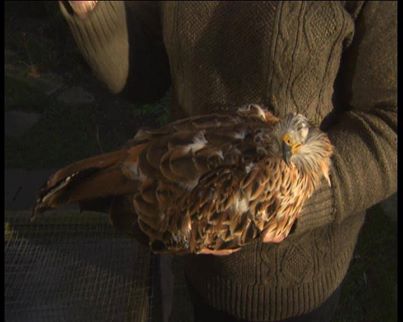
Red kite shot dead in West Yorkshire – police appeal 4 months later

Red Kite shot N Yorks Oct 2013Police are appealing for information four months after the discovery of a dead red kite in West Yorkshire.
The one year old bird was found by a footpath on the River Wharfe between Wetherby and Harewood last October. It had been shot.

The news about this bird’s death emerged via the BBC Look North (Yorkshire) Facebook page a couple of days ago (as highlighted on the Birders Against Wildlife Crime Facebook page).

We’ve looked elsewhere for a press release but can’t find anything, either from October or now, including on the West Yorks Police website and police local community news sites.

What’s the point of waiting for four months before appealing for information? Why, after all the reassurances that ‘wildlife crime is a police priority’, are we still seeing these poor responses?

West Yorks Police have previously been applauded for their reaction to suspected raptor persecution in their area, and deservedly so (see here).


Gamekeeper convicted for setting illegal pole trap

Ryan Waite setting the pole trap.JPG-400x0Press release from RSPB:

A gamekeeper has been convicted of using an illegal trap on a shooting estate on two occasions.

At Harrogate Magistrate’s Court today (13 February) Ryan Waite, employed as a gamekeeper on the Swinton Estate in North Yorkshire was sentenced on two charges of illegally setting a spring trap between May and June 2013.

Waite had pleaded guilty to the charges at an earlier hearing on December 10, 2013.

However, he had denied that the trap was intended for birds of prey, as alleged by the prosecution, claiming rather that it was for catching squirrels.

The court today ruled that his conduct had been reckless.

He was fined £250 with an additional £105 costs and victim surcharge. 

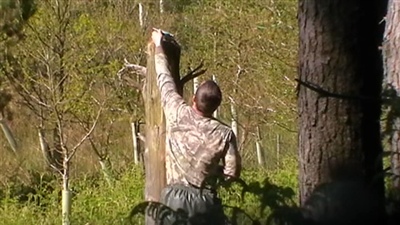
Following an initial report from the League Against Cruel Sports, on the 2nd June, RSPB Investigations visited Ox Close plantation on the Swinton Estate, North Yorkshire, and discovered a spring trap that had been placed on top of a two-metre high tree stump. These are commonly known as pole traps and have been banned since 1904.

Birds of prey are usually the target of such devices as they use the elevated position as a vantage point and the traps are strategically placed where they will hunt.

RSPB Investigations disabled the trap and then set up covert surveillance of the site to monitor who was responsible and two days later, on 4th June, Waite was filmed re-setting the trap on top of the stump.

As a result of this footage, North Yorkshire Police executed a search warrant, assisted by the RSPB. Although the spring trap had been removed from the pole trap site, it was later found and seized at Waite’s property.  Waite was also caught on camera removing the trap.

Howard Jones, RSPB Investigations Officer, said: “It is a disappointing reality that the use of pole traps still occurs in 2013 and that some gamekeepers are continuing to adopt these Victorian techniques. The device was deemed outdated and barbaric in 1904, yet a century on we are still finding these illegal traps being set in the countryside.  Sentencing needs to get tougher to ensure people are deterred from operating such devices in the future.

“We welcome today’s result as it shows that such barbaric practices will not be tolerated in today’s society.”   

There’s a good blog about this case written by the RSPB Investigations Team here.

There’s also an opportunity to view the covert footage showing Waite re-setting the pole trap here

Congratulations to the RSPB Investigations team for another job well done, and to the fieldworkers from the League Against Cruel Sports for identifying the illegal trap and alerting the authorities.

Bowland Betty (1)Swinton Estate has been described as “very well known and highly respected” by the author of The World’s Best Shoots (see here).

Swinton Estate is also ‘very well known’ for being the grouse moor location where hen harrier Bowland Betty’s shot corpse was found in 2012 (see here). Purely coincidental, obviously.

What interests us now is whether convicted gamekeeper Ryan Waite will keep his job, and whether he was/is a member of the National Gamekeepers Organisation. Let’s ask the NGO whether this criminal is from their ranks and if he is, whether they will continue to accept his membership. Emails to: info@nationalgamekeepers.org.uk

UPDATE 14/2: The NGO has issued a statement to say convicted gamekeeper Ryan Waite has never been one of their members (see here).

We’re still interested in whether this convicted gamekeeper will keep his job at the “highly respected” Swinton Estate. Emails to: swinton@stantonmortimer.co.uk

Raptor persecution to feature on Channel 4 News tonight

Channel-FourAs HRH Prince Charles & HRH Prince William prepare to host an international summit on tackling wildlife crime, Channel 4 News will take a closer look at crimes against wildlife in the UK, with a particular focus on the illegal persecution of golden eagles on Scottish moors managed for driven grouse shooting.

We’re expecting film footage from the Angus Glens, a notorious raptor persecution hotspot (e.g. see here) and interviews with several key players.

Channel 4 News, tonight at 7-8pm.

UPDATE 17.30hrs: Watch the preview video clips here!

UPDATE 23.55hrs: Our comments on the programme here

Environment Minister faces more calls for grouse shoot licences

SRSGWell now this is interesting.

The Scottish Raptor Study Group (SRSG) has called for the Scottish Government to introduce grouse-shooting licences. Many of us have been asking for this action for some time, but to hear it from the SRSG is quite something.

The SRSG, which has been monitoring raptor populations in Scotland since the 1980s, is typically quite a restrained yet highly respected organisation, preferring to work quietly behind the scenes rather than make bold policy statements. You know that things are pretty dire when the SRSG is calling for grouse shooting licencing.

So what’s forced their hand? Well, if you read their letter to the Environment Minister (see here, scroll down to 18th January), it seems that the illegal poisoning of golden eagle Fearnan was the catalyst, as it has been for so many of us. But there’s more to it than that…

Take a closer look at their letter. They refer to a claim made by the Scottish Gamekeepers Association last July that gamekeepers are good for golden eagle conservation. We blogged about that claim here, and you really should read it to understand the context of what the SRSG is saying.

The SGA published a map that attempted to portray the notion that golden eagles were doing ok on keepered grouse moors in the East and Central Highlands (notorious raptor black spots). What the SRSG has done is provide some much-needed context to that map.

According to the SGA, there are ‘at least 55 active golden eagle nests’ in these ‘keepered grouse areas’; the SRSG is saying that there are 52 ‘active nests’ in the area, and of those 52, only 8 are on driven grouse moors. Crucially, the SRSG also includes information about the vacant golden eagle territories in the area – information that the SGA conveniently ‘forgot’ to include. According to the SRSG, there are an additional 57 ‘non-active’ golden eagle nests in this area, and 31 of them (54%) happen to be on driven grouse moors.

Hmm. The picture doesn’t look quite so rosy now, does it?

What also impressed us about the SRSG’s letter is their well-thought-out approach to licensing. They haven’t taken the usual route of calling for a blanket ‘estate-licensing’ system. Instead, they’ve proposed a system whereby the licensing would cover individuals as well as land-holdings (estates), thus side-stepping the predictable ploys that would probably be used by the grouse-shooting industry to avoid being licensed.

The BBC has covered this news story today (see here), and it looks like the RSPB has also called on the government to consider further sanctions.

The pressure is mounting.

Naturally, the SGA and Scottish Land & Estates (SLE) have responded against the proposed licensing sanctions (read the BBC article). Predictably, SLE claim that raptor persecution is in ‘significant decline’ – they are, of course, referring to 2012 figures which did show a drop in reported poisoning figures – and conveniently ignored the 2013 figures which show a 100% increase in poisoning. To be fair, the 2013 ‘official’ figures have not yet been released, but they know fine well what they show and they seem determined to ignore them for as long as possible (i.e. until they’re actually published, which will take place at some point this year).

The SGA meanwhile, suggest that there is ‘perpetual over-regulation’ (of estates) – the truth is somewhat different – game-shooting is probably one of the least regulated industries and what regulation is in place is rarely enforced.

Environment Minister Paul Wheelhouse has responded to the SRSG’s letter and while he hasn’t ruled out licensing, he still seems to be clinging on to previous measures and wanting to give them time to take effect.

We’ll be blogging next week about Mr Wheelhouse’s response to the SRSG’s letter and his response to all those emails he received over Xmas about the death of golden eagle Fearnan. It won’t make for comfortable reading.

MSP wants review of legislation concerning game management

Claire Baker MSPTen days ago we blogged about a new parliamentary motion (see here) that had been lodged by MSP James Dornan, concerning the illegal poisoning of golden eagle Fearnan, found dead on an Angus grouse moor in early December.
Yesterday, an amendment to that motion was made by MSP Claire Baker, calling for sufficient police and COPFS resources to address raptor persecution.

She also called for a review of the laws that cover game management to assess whether further measures could be taken against the criminals within the game management industry.

The original motion, along with the amendment, can be viewed here.

Well done, Claire Baker MSP. Hmm, the first step on the road to estate licensing? It’s long overdue.

Talking of long overdue (although technically he has until 31st Jan so it’s not overdue, it just feels like a very long time), has anyone yet had any response from the Environment Minister regarding the illegal poisoning of golden eagle Fearnan? We understand that hundreds of people bombarded his inbox just before Xmas, and indeed over the Xmas break, following the news of Fearnan’s death (see here). We’re looking forward to hearing what he has to say…or more to the point, what he intends to do.

Fearnan Angus Glens Dec 2013

Case against Stody Estate gamekeeper Allen Lambert: part 3

A case management hearing was heard today at Kings Lynn Magistrates Court regarding the remaining charges against Stody Estate gamekeeper, Allen Lambert.

In December 2013, Lambert was charged with seven alleged offences including the killing of 14 buzzards, 1 sparrowhawk and 1 tawny owl (see here).

Lambert, 64, of Old Lodge House, Stody, Melton Constable, Norfolk pled guilty to storing the pesticides Mevinphos and Aldicarb but denied killing and possessing the dead birds.

His case was adjourned today and is expected to continue in February 2014.

‘Man’ reported for hen harrier death in Aberdeenshire

A 58 year-old man has been reported to the Procurator Fiscal in relation to the death of a hen harrier in Aberdeenshire, according to the BBC (see here).

This relates to an incident that took place in June last year.

The un-named man is expected to appear at Aberdeen Sheriff Court ‘at a later date’.

This is another disappointingly vague press release from Police Scotland. There’s no mention of the man’s name, his occupation, the specific location of the incident, or the cause of the harrier’s death.

There is also no explanation as to why it has taken seven months just to get to the reporting stage.

It’s not very impressive given that the hen harrier is supposed to be one of the government’s highest wildlife crime priority species.

We look forward to further details emerging about this case in due course.

Buzzard poisonings in Northern Ireland: 1 confirmed, 3 suspected

BZNIPolice in Northern Ireland are appealing for information about the suspected poisonings of 3 buzzards in two separate incidents.

In the first incident (April 2013!) a dead buzzard was found on land at Drumdreenagh Road in the Hilltown area of Warrenpoint, County Down. We happen to know that this bird was found with a dead red kite which has since been confirmed as being poisoned with Carbofuran.

The second incident (October 2013) was also in the Hilltown area – this time two buzzards were found dead on land in the Lisnamulligan Road.

Anyone with information can contact the police in Warrenpoint on 0845-600-8000. Article in Newry Times here.

It’s more than a little concerning that the police appeal for information has only just appeared and that the cause of death has not yet been confirmed – poisoning is still only suspected at this stage. We’ve blogged before about the excessively long delays in getting toxicology results from the lab in Northern Ireland (e.g. see here) and it seems reasonable to assume from the information provided in the latest press release that this is an on-going problem. Such slow response times can only hinder the police investigations, and also the work of the conservationists trying to assess whether the buzzards were deliberately targeted or were the unintended victims of secondary poisoning.

Another dead buzzard that was found in Castledawson, Co. Londonderry in March 2013 has been confirmed as being poisoned with Carbofuran. The police put out an appeal for information about this incident in October 2013 (article here).

Parliamentary motion about poisoned golden eagle Fearnan

Fearnan Angus Glens Dec 2013The Scottish Parliament is taking note of the illegal killing of golden eagle Fearnan, who was found poisoned on an Angus grouse moor in December.

The following parliamentary motion has been lodged:

Motion S4M-08715: James Dornan, Glasgow Cathcart, Scottish National Party, Date Lodged: 07/01/2014

No Place for Wildlife Crime

That the Parliament notes the poisoning of the golden eagle named Fearnan and believes that the killing of birds of prey has no place in modern Scotland; believes that the golden eagle population is of national interest, as demonstrated by a recent poll in which the species was voted the country’s favourite animal; supports efforts by Police Scotland to bring wildlife criminals to justice, and commends the Scottish Government’s commitment to end raptor persecution.

Supported by: Joan McAlpine, Stuart McMillan, Chic Brodie, Adam Ingram, Christina McKelvie, Mike MacKenzie, Bill Kidd, Patrick Harvie, Kenneth Gibson, David Torrance, Aileen McLeod, Colin Keir, John WilsonR, Roderick Campbell, Nigel Don, Dennis Robertson, Liam McArthur, Colin Beattie, Fiona McLeod, John Finnie, Jean Urquhart, Rob Gibson, Richard Lyle, Christine Grahame, Graeme Dey, Maureen Watt, Kevin Stewart, Sandra White, Mark McDonald

What’s significant about this motion is not necessarily that one has been lodged – there was a similar motion lodged in 2012 by Nigel Don MSP following the discovery of the now infamous dead ‘Deeside Eagle’ (see here), with an amendment to that motion made by Claudia Beamish MSP following the shooting of a golden eagle in South Lanarkshire (see here).

James Dornan MSPThe significance of this latest motion is that it’s been lodged by an MSP that doesn’t live in the region where Fearnan was killed and isn’t especially well-known for addressing raptor persecution issues – James Dornan MSP, representing  Glasgow Cathcart. We view this as an important indication that the raptor persecution issue is being brought to the attention of people who may previously have been unaware.

Well done, James Dornan. Let’s see how many more MSPs sign up to support this motion. Has yours signed?